 Скачать презентацию SME Programme Lending Overview Group Best Practices
695ef2bc68ebe43312179c42ab13986c.ppt
- Количество слайдов: 29



SME Programme Lending Overview Group Best Practices & Key Challenges SME Conference Lahore, Pakistan - May 2005 David Yong GRM Consumer & Programme Lending 1
Agenda w Introduction w Scope w Overview major ABN AMRO SME businesses w Business Models w Credit Process & Product Programmes w Portfolio MIS w Use of scoring w Key Challenges 2
ABN AMRO Pakistan w 1948: First foreign bank in Pakistan w 1993: Expansion of branch network (7 branches in 3 cities) w 1998: Introduction LCY deposits & penetration into Affluent segment w 1999: Introduction Personal Loans & Mortgages w 2002: Launch Commercial Banking focusing on Mid-sized Corporates w 2005: Launch Credit Cards 3
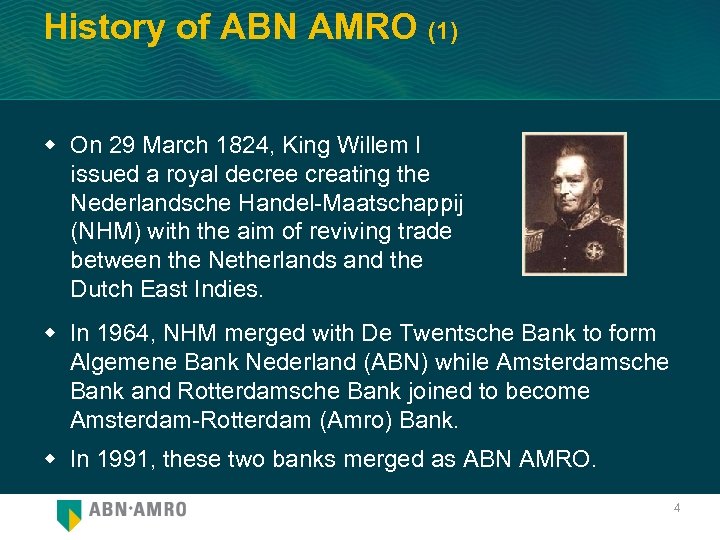
History of ABN AMRO (1) w On 29 March 1824, King Willem I issued a royal decree creating the Nederlandsche Handel-Maatschappij (NHM) with the aim of reviving trade between the Netherlands and the Dutch East Indies. w In 1964, NHM merged with De Twentsche Bank to form Algemene Bank Nederland (ABN) while Amsterdamsche Bank and Rotterdamsche Bank joined to become Amsterdam-Rotterdam (Amro) Bank. w In 1991, these two banks merged as ABN AMRO. 4
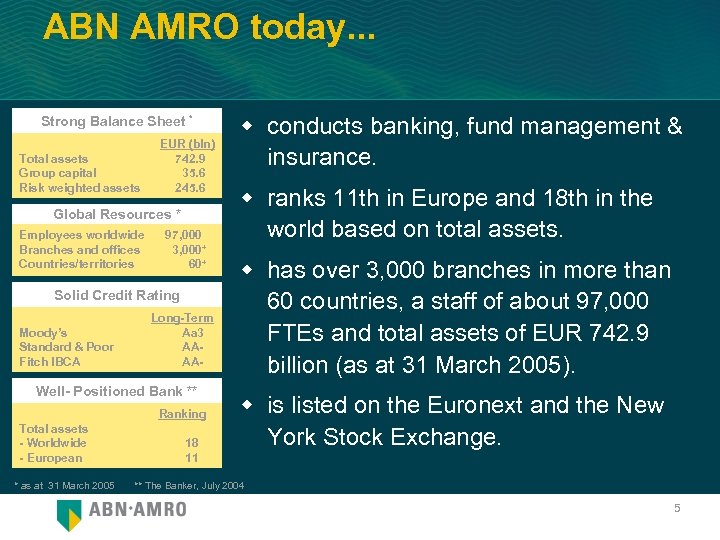
ABN AMRO today. . . Strong Balance Sheet * Total assets Group capital Risk weighted assets EUR (bln) 742. 9 35. 6 245. 6 Global Resources * Employees worldwide Branches and offices Countries/territories 97, 000 3, 000+ 60 + Solid Credit Rating Moody’s Standard & Poor Fitch IBCA Long-Term Aa 3 AAAA- Well- Positioned Bank ** Ranking Total assets - Worldwide - European * as at 31 March 2005 18 11 w conducts banking, fund management & insurance. w ranks 11 th in Europe and 18 th in the world based on total assets. w has over 3, 000 branches in more than 60 countries, a staff of about 97, 000 FTEs and total assets of EUR 742. 9 billion (as at 31 March 2005). w is listed on the Euronext and the New York Stock Exchange. ** The Banker, July 2004 5
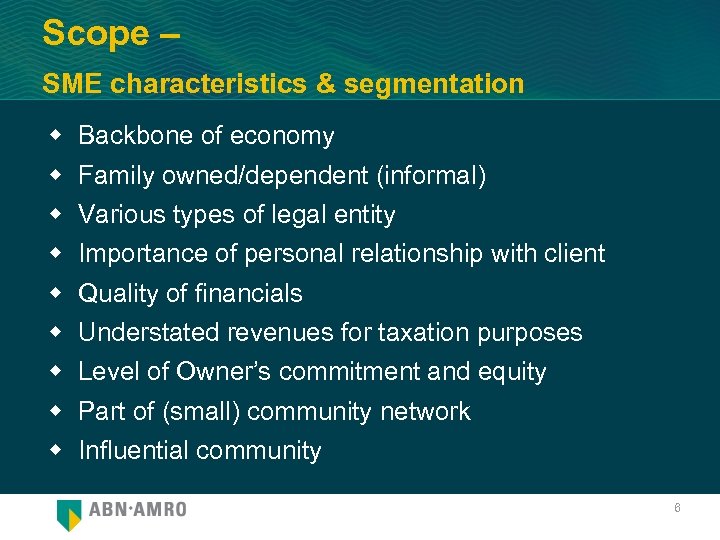
Scope – SME characteristics & segmentation w w w w w Backbone of economy Family owned/dependent (informal) Various types of legal entity Importance of personal relationship with client Quality of financials Understated revenues for taxation purposes Level of Owner’s commitment and equity Part of (small) community network Influential community 6
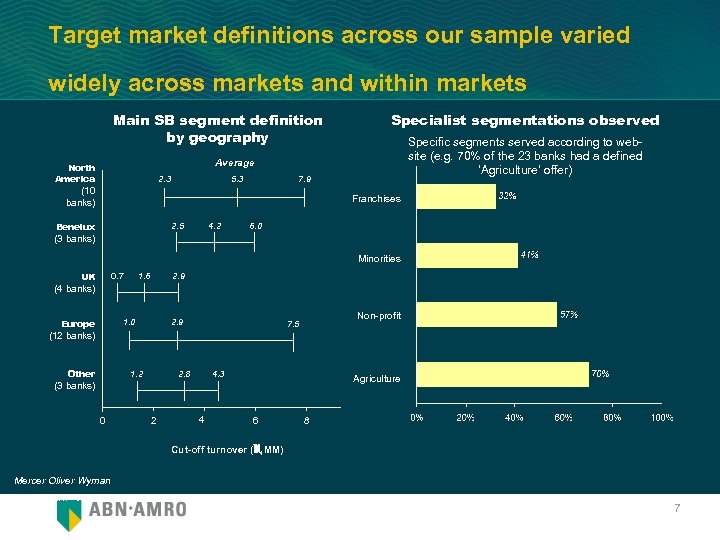
Target market definitions across our sample varied widely across markets and within markets Main SB segment definition by geography Specialist segmentations observed Specific segments served according to website (e. g. 70% of the 23 banks had a defined ‘Agriculture’ offer) Average North America 2. 3 5. 3 7. 9 (10 banks) Franchises Benelux 2. 5 4. 2 6. 0 (3 banks) Minorities UK 0. 7 1. 6 2. 9 (4 banks) Europe 1. 0 2. 9 Non-profit 7. 5 (12 banks) Other 1. 2 2. 8 4. 3 Agriculture (3 banks) 0 2 4 6 8 Cut-off turnover ( MM) Mercer Oliver Wyman Note: n = 32 banks 7
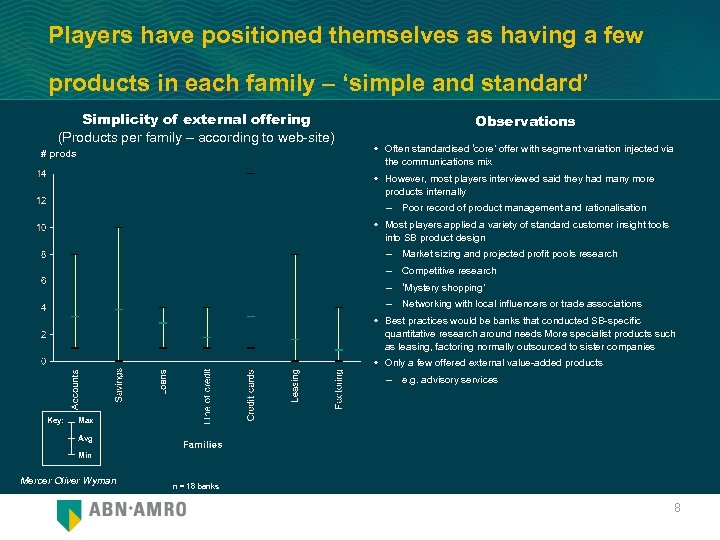
Players have positioned themselves as having a few products in each family – ‘simple and standard’ Simplicity of external offering (Products per family – according to web-site) # prods Observations w Often standardised ‘core’ offer with segment variation injected via the communications mix w However, most players interviewed said they had many more products internally – Poor record of product management and rationalisation w Most players applied a variety of standard customer insight tools into SB product design – Market sizing and projected profit pools research – Competitive research – ‘Mystery shopping’ – Networking with local influencers or trade associations w Best practices would be banks that conducted SB-specific quantitative research around needs More specialist products such as leasing, factoring normally outsourced to sister companies w Only a few offered external value-added products – e. g. advisory services Key: Max Avg Min Mercer Oliver Wyman n = 18 banks 8
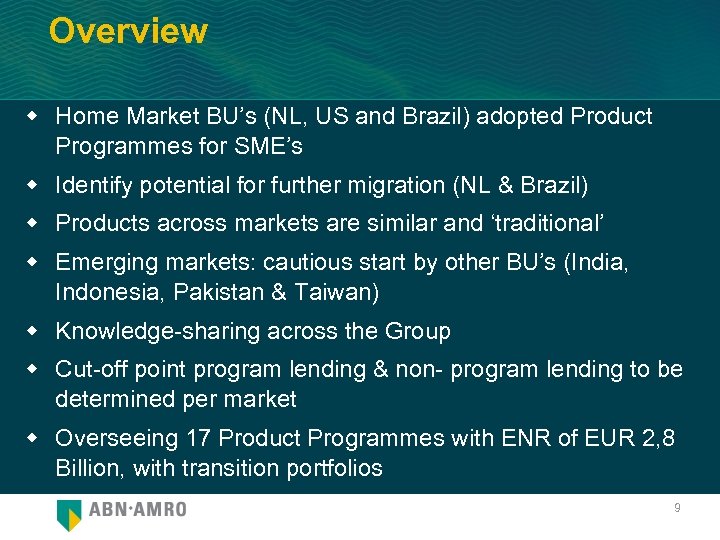
Overview w Home Market BU’s (NL, US and Brazil) adopted Product Programmes for SME’s w Identify potential for further migration (NL & Brazil) w Products across markets are similar and ‘traditional’ w Emerging markets: cautious start by other BU’s (India, Indonesia, Pakistan & Taiwan) w Knowledge-sharing across the Group w Cut-off point program lending & non- program lending to be determined per market w Overseeing 17 Product Programmes with ENR of EUR 2, 8 Billion, with transition portfolios 9
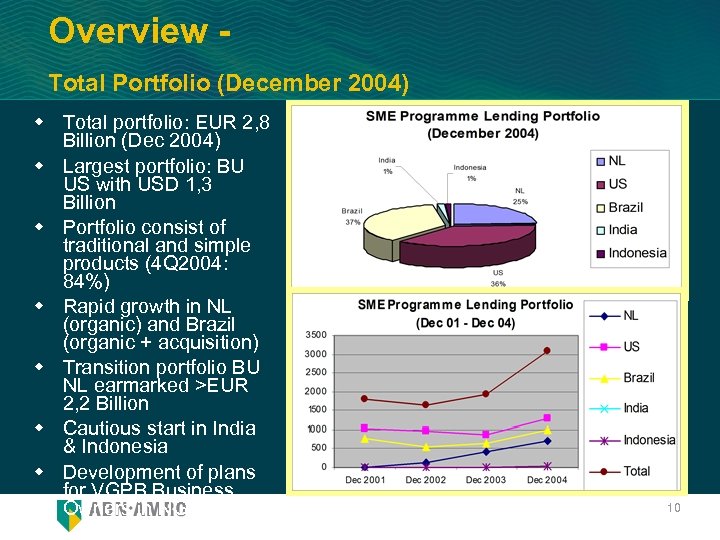
Overview Total Portfolio (December 2004) w Total portfolio: EUR 2, 8 Billion (Dec 2004) w Largest portfolio: BU US with USD 1, 3 Billion w Portfolio consist of traditional and simple products (4 Q 2004: 84%) w Rapid growth in NL (organic) and Brazil (organic + acquisition) w Transition portfolio BU NL earmarked >EUR 2, 2 Billion w Cautious start in India & Indonesia w Development of plans for VGPB Business Owners in NGM Asia 10
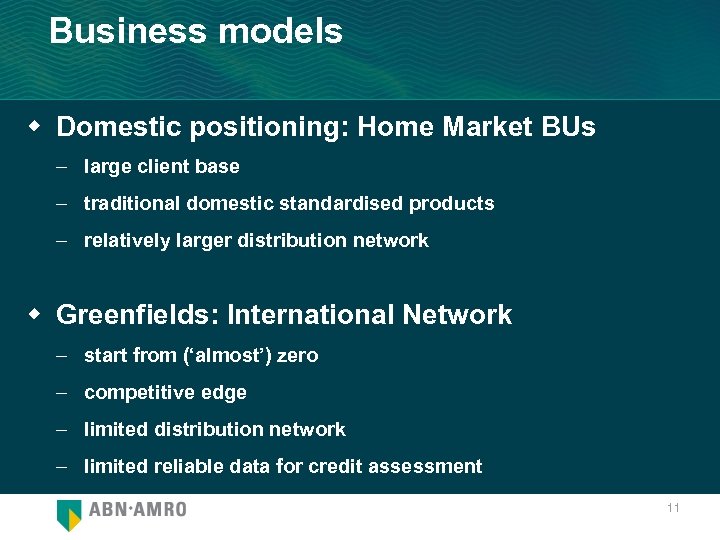
Business models w Domestic positioning: Home Market BUs – large client base – traditional domestic standardised products – relatively larger distribution network w Greenfields: International Network – start from (‘almost’) zero – competitive edge – limited distribution network – limited reliable data for credit assessment 11
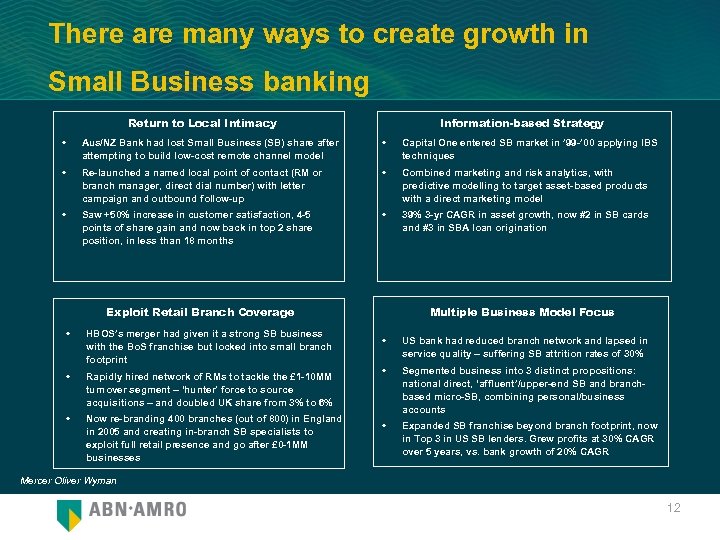
There are many ways to create growth in Small Business banking Return to Local Intimacy Information-based Strategy w Aus/NZ Bank had lost Small Business (SB) share after attempting to build low-cost remote channel model w Capital One entered SB market in ’ 99 -’ 00 applying IBS techniques w Re-launched a named local point of contact (RM or branch manager, direct dial number) with letter campaign and outbound follow-up w Combined marketing and risk analytics, with predictive modelling to target asset-based products with a direct marketing model w Saw +50% increase in customer satisfaction, 4 -5 points of share gain and now back in top 2 share position, in less than 18 months w 39% 3 -yr CAGR in asset growth, now #2 in SB cards and #3 in SBA loan origination Exploit Retail Branch Coverage w HBOS’s merger had given it a strong SB business with the Bo. S franchise but locked into small branch footprint w Rapidly hired network of RMs to tackle the £ 1 -10 MM turnover segment – ‘hunter’ force to source acquisitions – and doubled UK share from 3% to 6% w Now re-branding 400 branches (out of 800) in England in 2005 and creating in-branch SB specialists to exploit full retail presence and go after £ 0 -1 MM businesses Multiple Business Model Focus w US bank had reduced branch network and lapsed in service quality – suffering SB attrition rates of 30% w Segmented business into 3 distinct propositions: national direct, ‘affluent’/upper-end SB and branchbased micro-SB, combining personal/business accounts w Expanded SB franchise beyond branch footprint, now in Top 3 in US SB lenders. Grew profits at 30% CAGR over 5 years, vs. bank growth of 20% CAGR Mercer Oliver Wyman 12
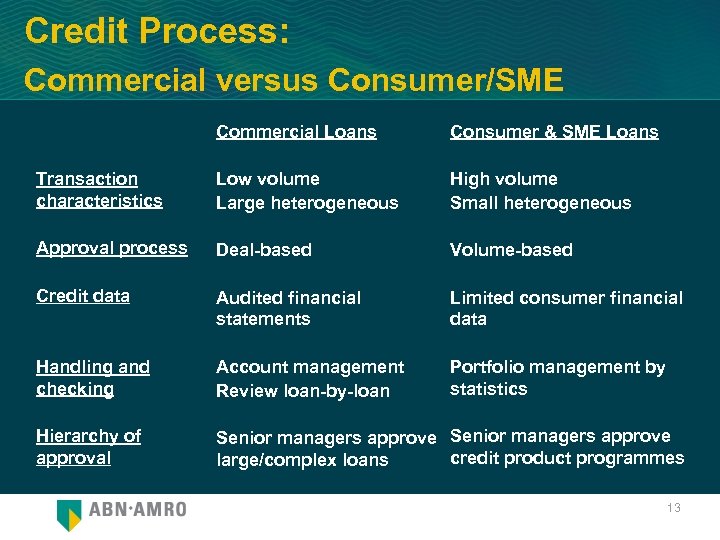
Credit Process: Commercial versus Consumer/SME Commercial Loans Consumer & SME Loans Transaction characteristics Low volume Large heterogeneous High volume Small heterogeneous Approval process Deal-based Volume-based Credit data Audited financial statements Limited consumer financial data Handling and checking Account management Review loan-by-loan Portfolio management by statistics Hierarchy of approval Senior managers approve credit product programmes large/complex loans 13
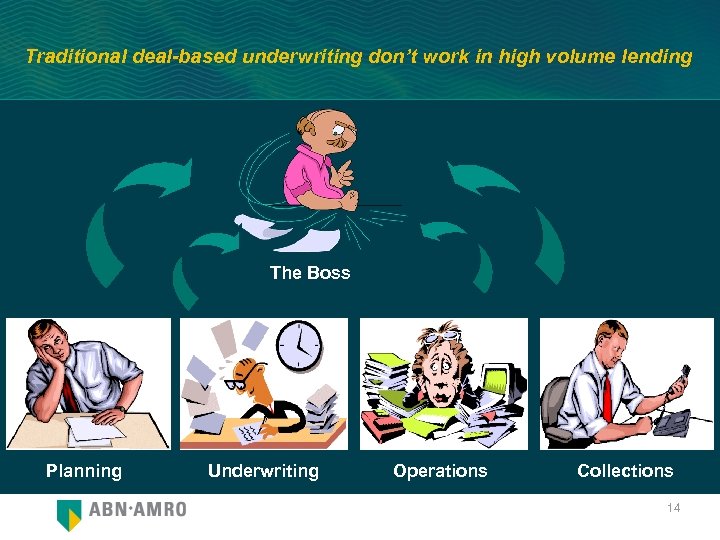
Traditional deal-based underwriting don’t work in high volume lending The Boss Planning Underwriting Operations Collections 14
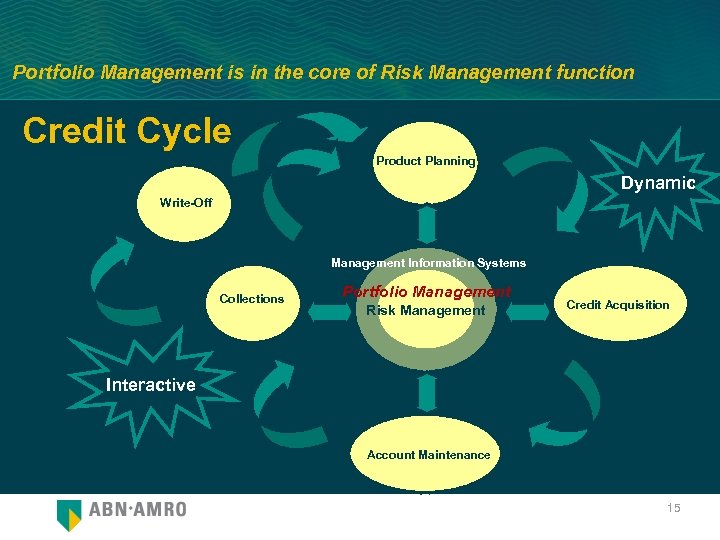
Portfolio Management is in the core of Risk Management function Credit Cycle Product Planning Dynamic Write-Off Management Information Systems Collections Portfolio Management Risk Management Credit Acquisition Interactive Account Maintenance 15
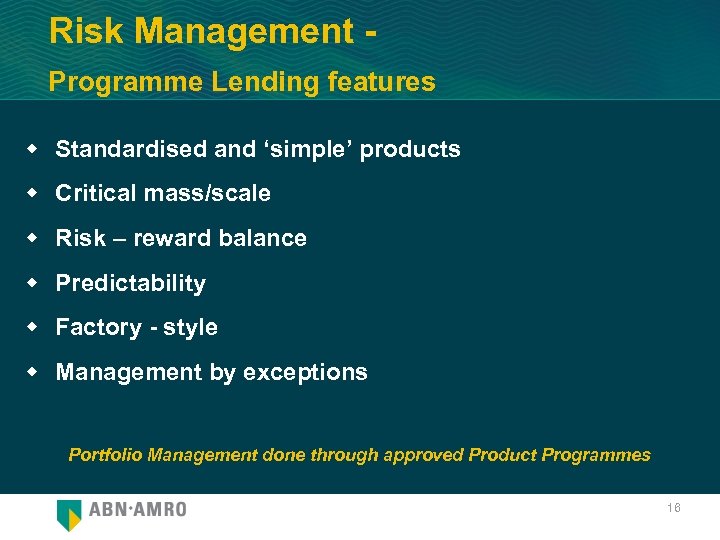
Risk Management Programme Lending features w Standardised and ‘simple’ products w Critical mass/scale w Risk – reward balance w Predictability w Factory - style w Management by exceptions Portfolio Management done through approved Product Programmes 16
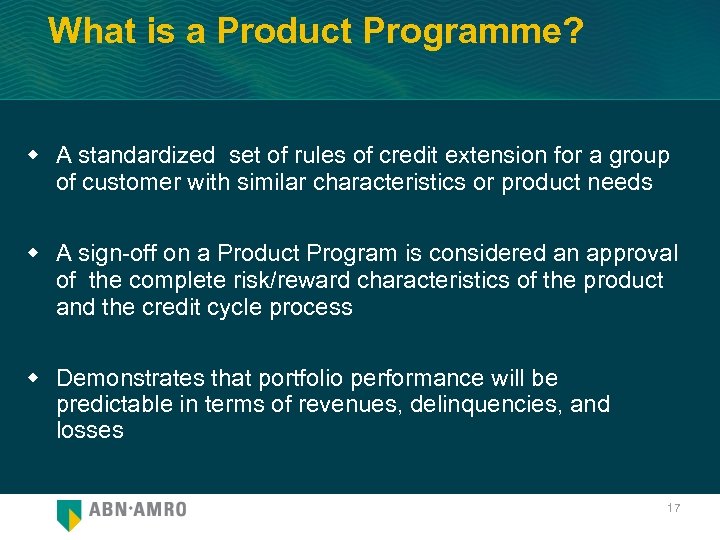
What is a Product Programme? w A standardized set of rules of credit extension for a group of customer with similar characteristics or product needs w A sign-off on a Product Program is considered an approval of the complete risk/reward characteristics of the product and the credit cycle process w Demonstrates that portfolio performance will be predictable in terms of revenues, delinquencies, and losses 17
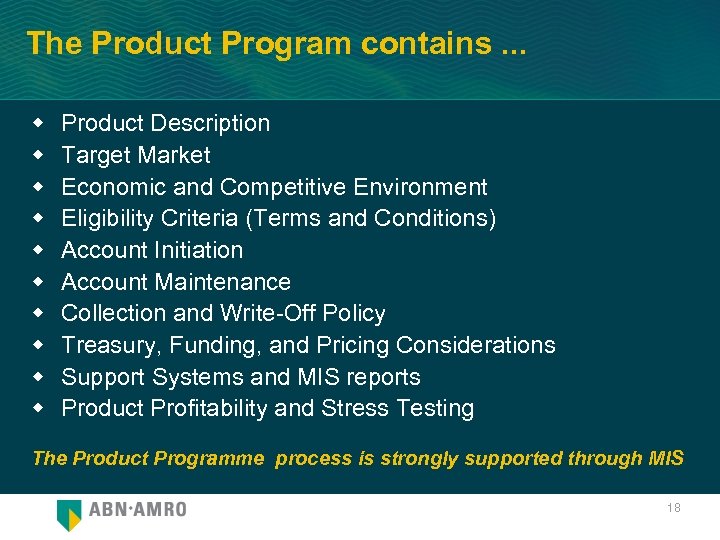
The Product Program contains. . . w w w w w Product Description Target Market Economic and Competitive Environment Eligibility Criteria (Terms and Conditions) Account Initiation Account Maintenance Collection and Write-Off Policy Treasury, Funding, and Pricing Considerations Support Systems and MIS reports Product Profitability and Stress Testing The Product Programme process is strongly supported through MIS 18
Importance of MIS w Continuously process and transforms data into information, which will be used in the decision making process directed towards optimizing results: Risk-Return Trade-Off w Serves as a base for effective credit cycle and portfolio management: controlling risks and assessing opportunities 19
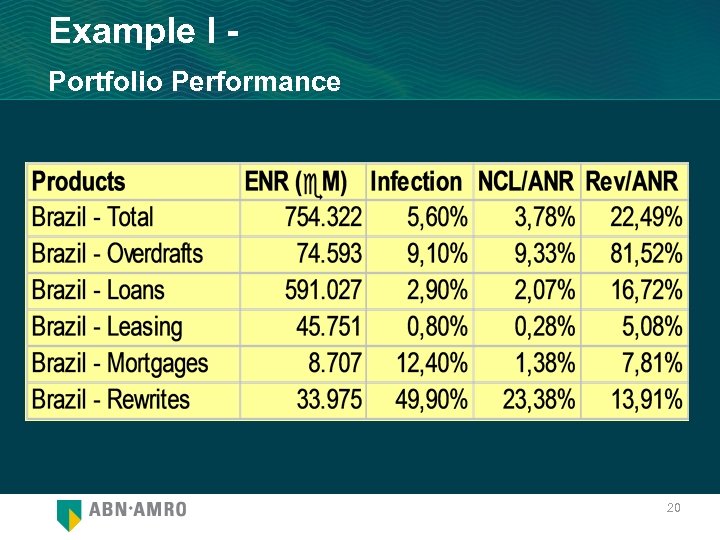
Example I Portfolio Performance 20
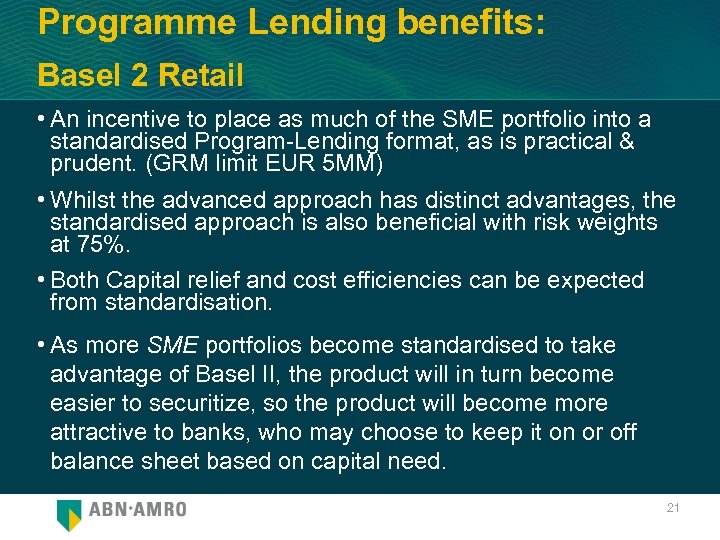
Programme Lending benefits: Basel 2 Retail • An incentive to place as much of the SME portfolio into a standardised Program-Lending format, as is practical & prudent. (GRM limit EUR 5 MM) • Whilst the advanced approach has distinct advantages, the standardised approach is also beneficial with risk weights at 75%. • Both Capital relief and cost efficiencies can be expected from standardisation. • As more SME portfolios become standardised to take advantage of Basel II, the product will in turn become easier to securitize, so the product will become more attractive to banks, who may choose to keep it on or off balance sheet based on capital need. 21
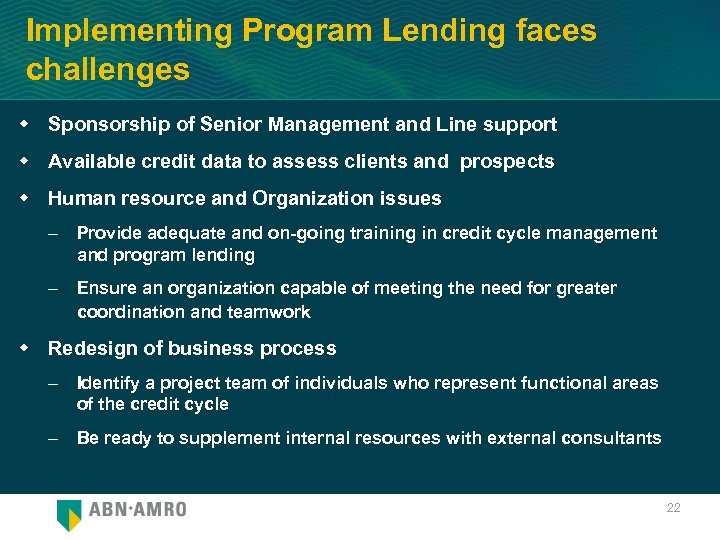
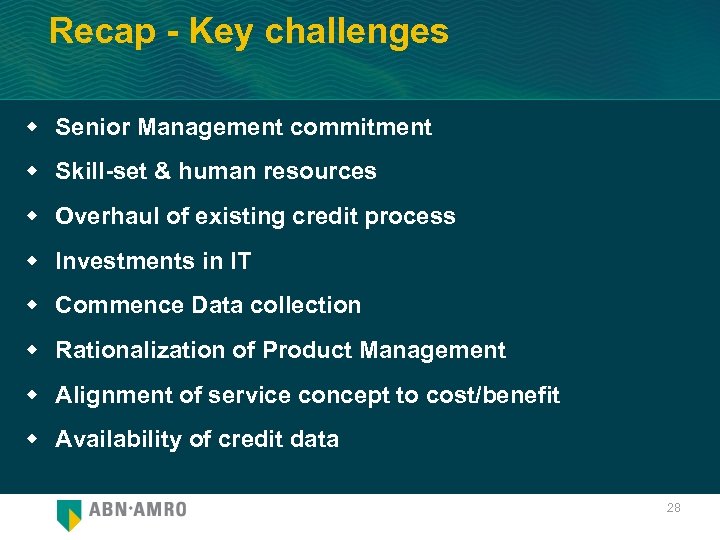
Implementing Program Lending faces challenges w Sponsorship of Senior Management and Line support w Available credit data to assess clients and prospects w Human resource and Organization issues – Provide adequate and on-going training in credit cycle management and program lending – Ensure an organization capable of meeting the need for greater coordination and teamwork w Redesign of business process – Identify a project team of individuals who represent functional areas of the credit cycle – Be ready to supplement internal resources with external consultants 22
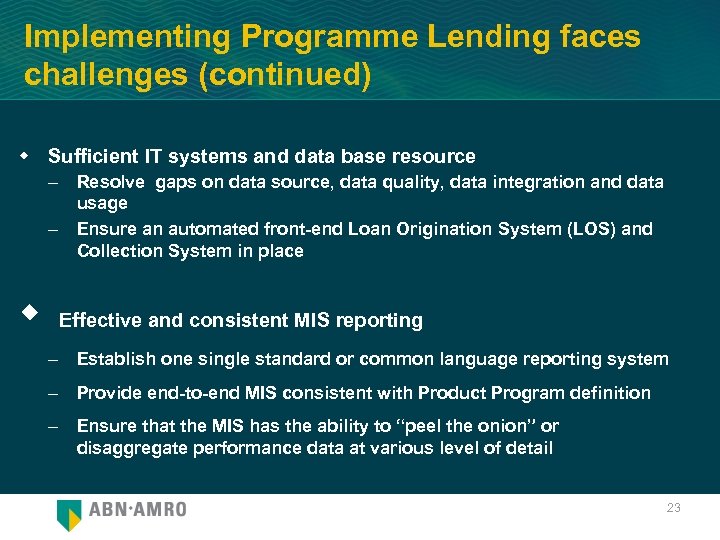
Implementing Programme Lending faces challenges (continued) w Sufficient IT systems and data base resource – Resolve gaps on data source, data quality, data integration and data usage – Ensure an automated front-end Loan Origination System (LOS) and Collection System in place w Effective and consistent MIS reporting – Establish one single standard or common language reporting system – Provide end-to-end MIS consistent with Product Program definition – Ensure that the MIS has the ability to “peel the onion” or disaggregate performance data at various level of detail 23
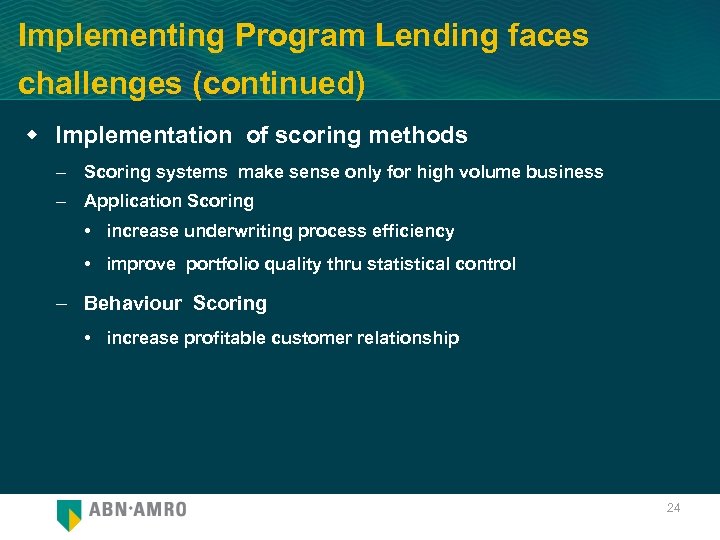
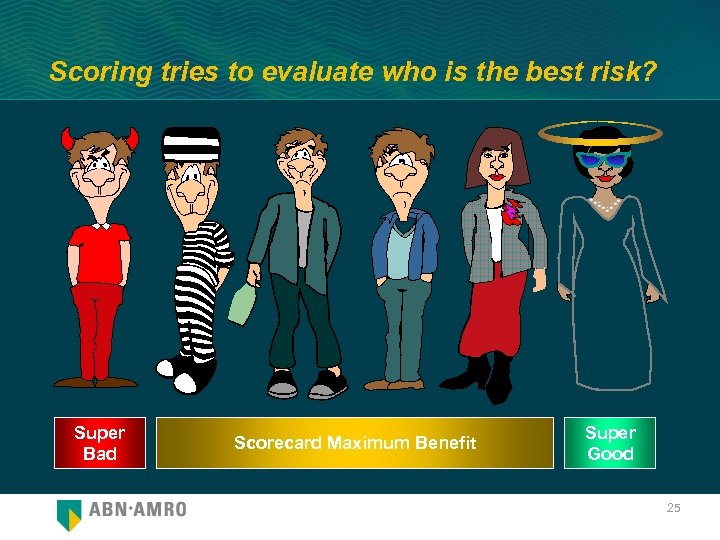
Implementing Program Lending faces challenges (continued) w Implementation of scoring methods – Scoring systems make sense only for high volume business – Application Scoring • increase underwriting process efficiency • improve portfolio quality thru statistical control – Behaviour Scoring • increase profitable customer relationship 24
Scoring tries to evaluate who is the best risk? Super Bad Scorecard Maximum Benefit Super Good 25
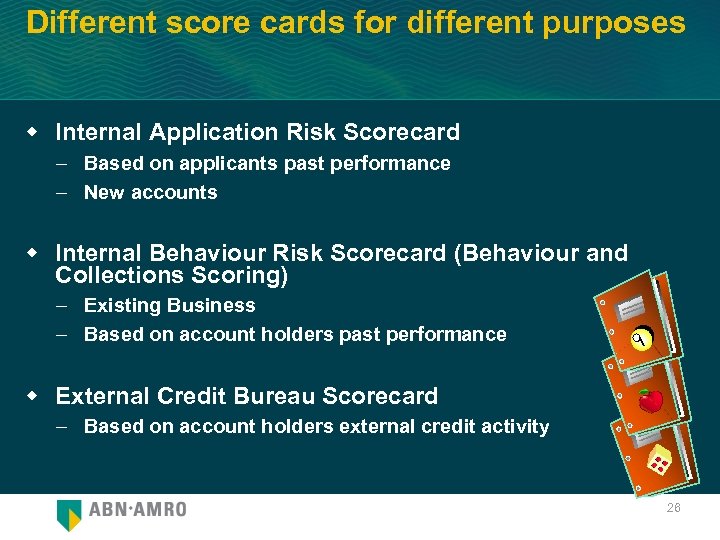
Different score cards for different purposes w Internal Application Risk Scorecard – Based on applicants past performance – New accounts w Internal Behaviour Risk Scorecard (Behaviour and Collections Scoring) – Existing Business – Based on account holders past performance 1 w External Credit Bureau Scorecard – Based on account holders external credit activity 26
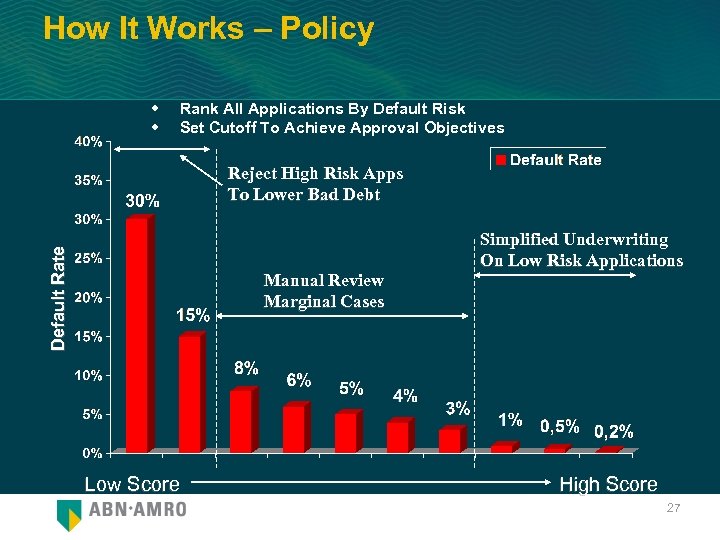
How It Works – Policy w w Rank All Applications By Default Risk Set Cutoff To Achieve Approval Objectives Default Rate Reject High Risk Apps To Lower Bad Debt Manual Review Marginal Cases Low Score Simplified Underwriting On Low Risk Applications High Score 27
Recap - Key challenges w Senior Management commitment w Skill-set & human resources w Overhaul of existing credit process w Investments in IT w Commence Data collection w Rationalization of Product Management w Alignment of service concept to cost/benefit w Availability of credit data 28
Thank you david. yong@nl. abnamro. com 29
Скачать презентацию SME Programme Lending Overview Group Best Practices
695ef2bc68ebe43312179c42ab13986c.ppt