 Скачать презентацию Smart Resource Utilizing Semantic Web Services to Monitor
8726647bf6eb731379bc178e5c55706c.ppt
- Количество слайдов: 78



Smart. Resource: Utilizing Semantic Web Services to Monitor Industrial Resources Vagan Terziyan “Expert” “Device” “Service” XML Finland 2005, 8 -9 March, 2005 University of Jyväskylä Industrial Ontologies Group "XML - the Enabling Technology for Integrating Business Processes" Pori, Finland
Our Congratulations for Dear Ladies
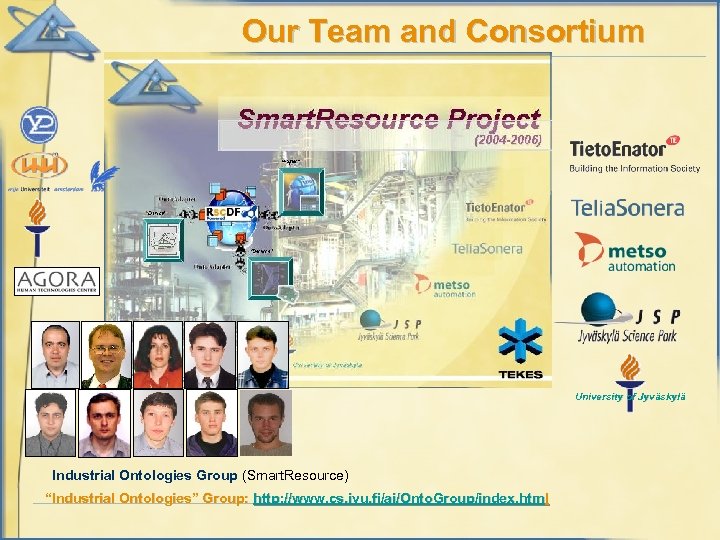
Our Team and Consortium University of Jyväskylä Industrial Ontologies Group (Smart. Resource) “Industrial Ontologies” Group: http: //www. cs. jyu. fi/ai/Onto. Group/index. html
WIDER OBJECTIVE - to combine the emerging Semantic Web, Web Services, Peer-to-Peer, Machine Learning and Agent technologies for the development of a global and smart maintenance management environment, to provide Web-based support for the predictive maintenance of industrial devices by utilizing heterogeneous and interoperable Web resources, services and human experts
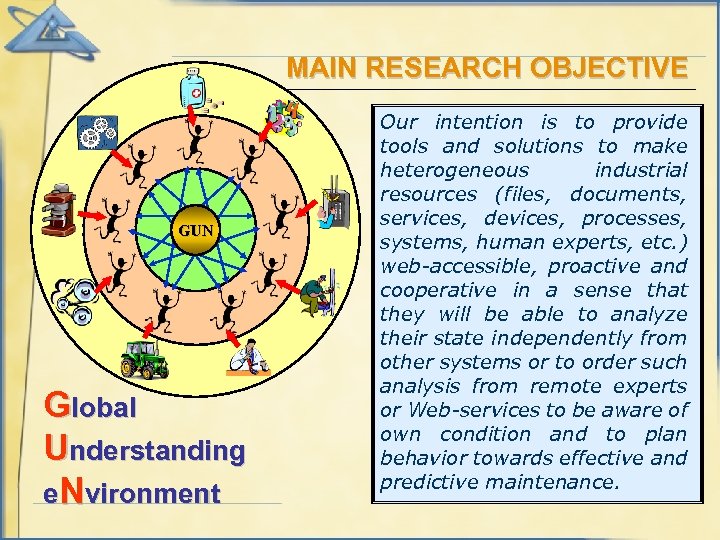
MAIN RESEARCH OBJECTIVE GUN Global Understanding e. Nvironment Our intention is to provide tools and solutions to make heterogeneous industrial resources (files, documents, services, devices, processes, systems, human experts, etc. ) web-accessible, proactive and cooperative in a sense that they will be able to analyze their state independently from other systems or to order such analysis from remote experts or Web-services to be aware of own condition and to plan behavior towards effective and predictive maintenance.
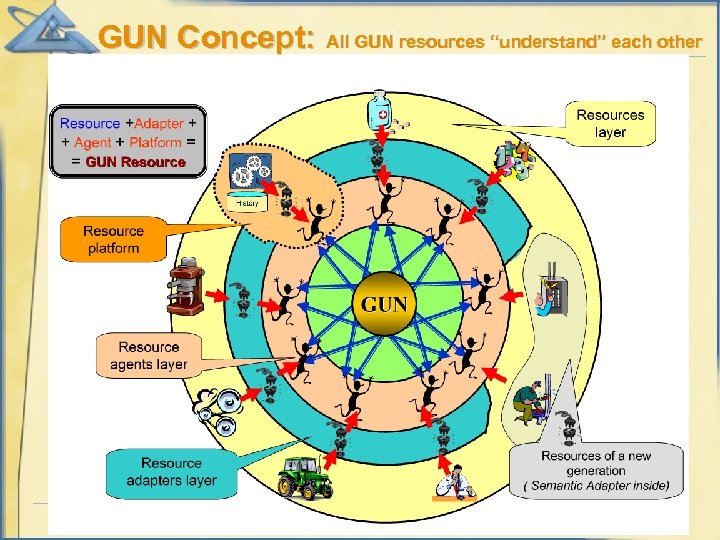
GUN Concept: All GUN resources “understand” each other
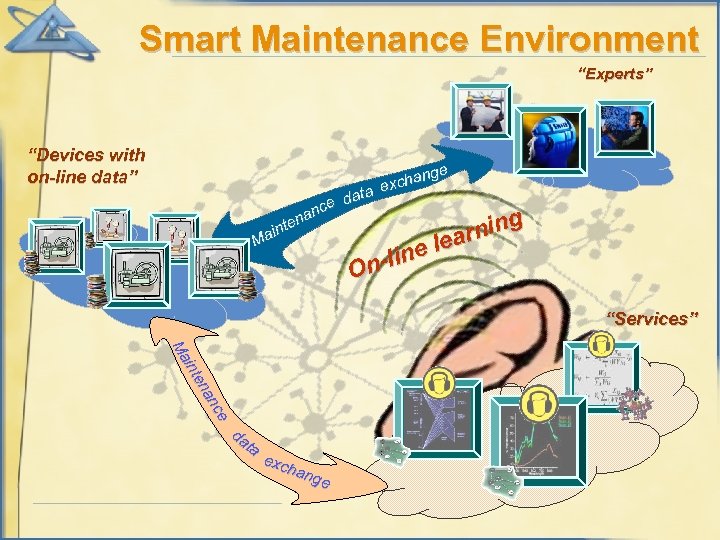
Smart Maintenance Environment “Experts” “Devices with on-line data” nge xcha e data ce an n inte ning Ma lear -line On “Services” e e nc an na en ne iintt Ma M da ta exc han ge
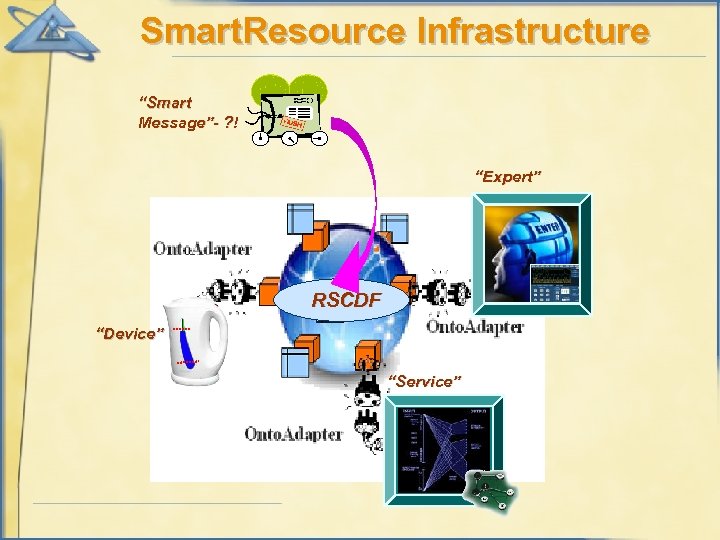
Smart. Resource Infrastructure “Smart Message”- ? ! “Expert” RSCDF “Device” “Service”
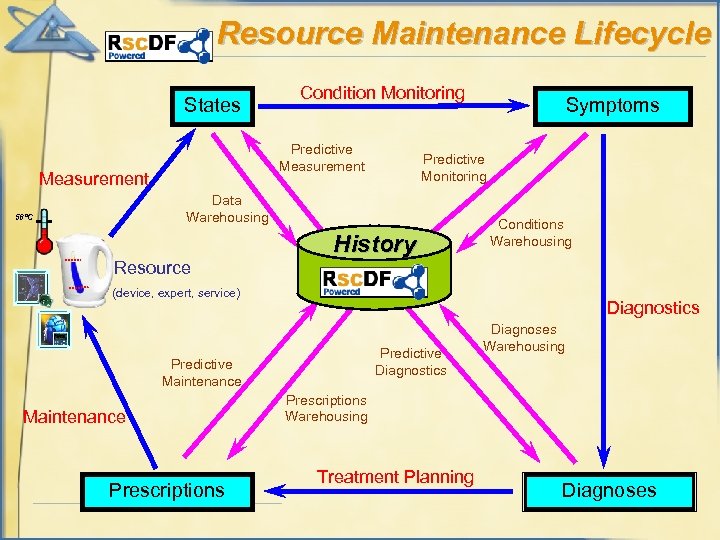
Resource Maintenance Lifecycle States Condition Monitoring Predictive Measurement Predictive Monitoring Data Warehousing 56°C Symptoms History Conditions Warehousing Resource (device, expert, service) Diagnostics Predictive Maintenance Prescriptions Diagnoses Warehousing Prescriptions Warehousing Treatment Planning Diagnoses
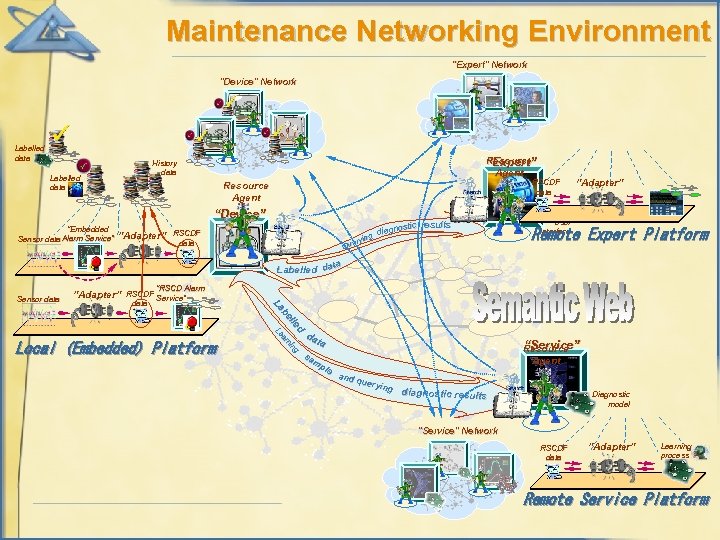
Maintenance Networking Environment “Expert” Network “Device” Network Labelled data Resource “Expert” Agent History data Labelled data RSCDF data Resource Agent “Device” “Embedded Sensor data Alarm Service” ”Adapter” ostic results iagn o g d ryin Que RSCDF data ”Adapter” User interface Remote Expert Platform a Labelled dat ”Adapter” “RSCD Alarm RSCDF Service” data Local (Embedded) Platform d g ed iing llle be earrn a be L La La Sensor data da ta sa mp le “Service” Resource Agent and q uery ing diagnostic results Diagnostic model “Service” Network RSCDF data ”Adapter” Learning process Remote Service Platform
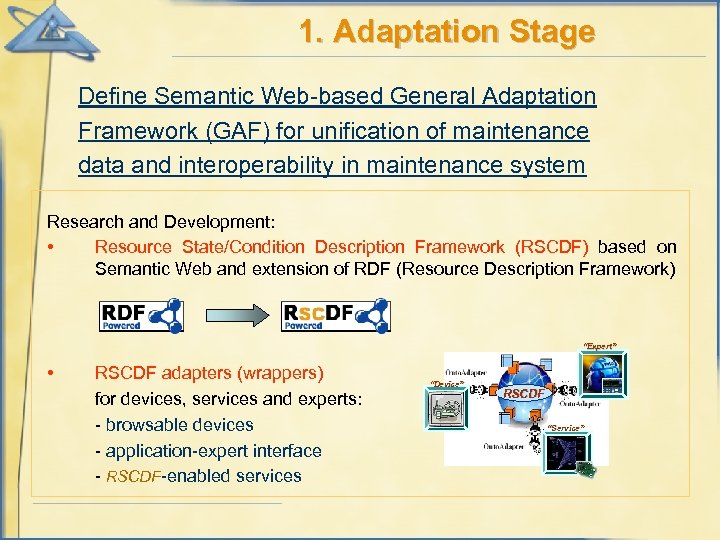
1. Adaptation Stage Define Semantic Web-based General Adaptation Framework (GAF) for unification of maintenance data and interoperability in maintenance system Research and Development: • Resource State/Condition Description Framework (RSCDF) based on Semantic Web and extension of RDF (Resource Description Framework) “Expert” • RSCDF adapters (wrappers) for devices, services and experts: - browsable devices - application-expert interface - RSCDF-enabled services “Device” RSCDF “Service”
Resource state/condition Description Framework (RSCDF)
RSCDF: Goal RSCDF – unified representation format for resource state and condition semantic description (annotation). RSCDF is an extension to RDF, which introduces upper-ontology for describing such characteristics of resources as states and correspondent conditions in different contexts, dynamics of state changes, target conditions and historical data about previous states and conditions.
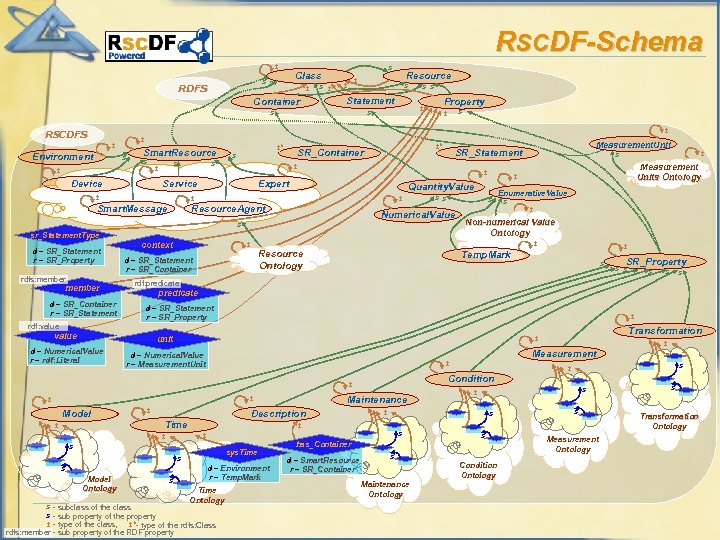
RSCDF-Schema t Class ss RDFS t Container s t s Resource t t s s s Statement s Property t s s t t RSCDFS t t Environment s t Smart. Resource s s t Device s t* SR_Container SR_Statement t Service t Expert t Smart. Message Resource. Agent t s s s Numerical. Value s sr_Statement. Type d – SR_Statement r – SR_Property rdfs: member d – SR_Container r – SR_Statement rdf: value Resource Ontology d – SR_Statement r – SR_Container t t Temp. Mark s SR_Property s s s predicate d – SR_Statement r – SR_Property d – Numerical. Value r – rdf: Literal t d – Numerical. Value r – Measurement. Unit Measurement t t Time s s sys. Time s s d – Environment r – Temp. Mark Time Ontology s - subclass of the class s - sub property of the property t - type of the class, t*- type of the rdfs: Class rdfs: member - sub property of the RDF property s t t s s has_Container d – Smart. Resource r – SR_Container s Condition Ontology Maintenance Ontology t t Condition Maintenance Description s Transformation t t Model Ontology s Non-numerical Value Ontology unit Model Enumerative. Value rdf: predicate value t Measurement Units Ontology t t context t s t Quantity. Value t Measurement. Unit Measurement Ontology s Transformation Ontology
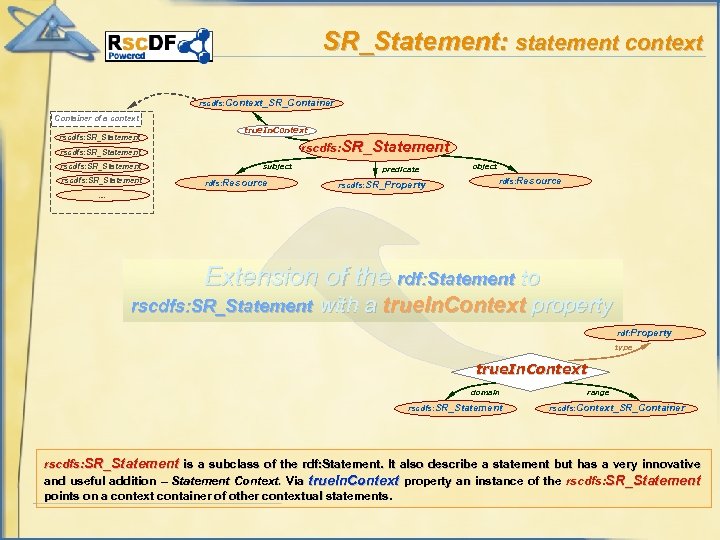
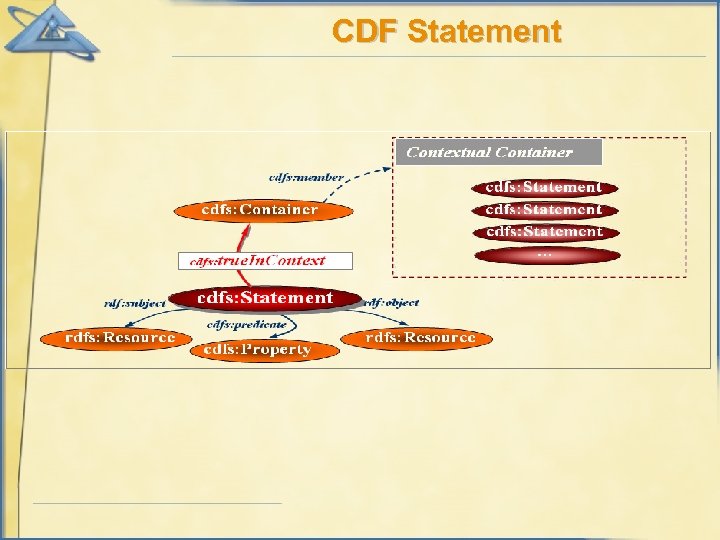
SR_Statement: statement context rscdfs: Context_SR_Container of a context rscdfs: SR_Statement true. In. Context rscdfs: SR_Statement subject rdfs: Resource predicate rscdfs: SR_Property object rdfs: Resource … Extension of the rdf: Statement to rscdfs: SR_Statement with a true. In. Context property rdf: Property type true. In. Context domain rscdfs: SR_Statement range rscdfs: Context_SR_Container rscdfs: SR_Statement is a subclass of the rdf: Statement. It also describe a statement but has a very innovative rdf: Statement. and useful addition – Statement Context. Via true. In. Context property an instance of the rscdfs: SR_Statement points on a context container of other contextual statements.
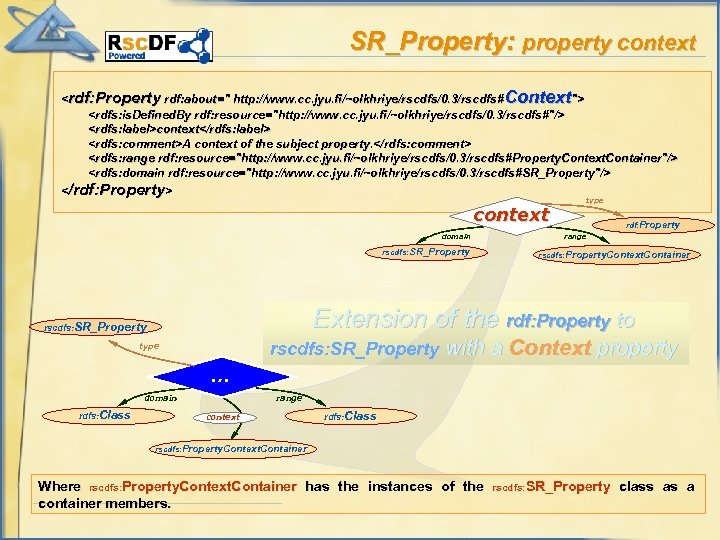
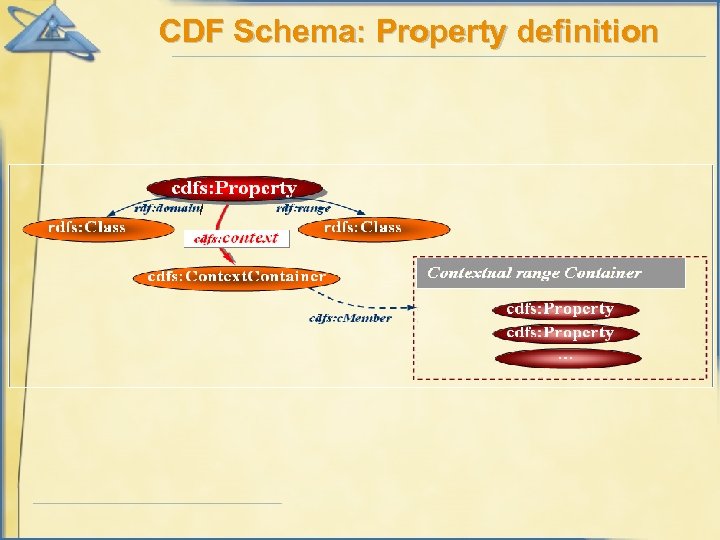
SR_Property: property context <rdf: Property rdf: about=" http: //www. cc. jyu. fi/~olkhriye/rscdfs/0. 3/rscdfs# Context"> rdf: about=" <rdfs: is. Defined. By rdf: resource="http: //www. cc. jyu. fi/~olkhriye/rscdfs/0. 3/rscdfs#"/> <rdfs: label>context</rdfs: label> <rdfs: comment>A context of the subject property. </rdfs: comment> <rdfs: comment>A property. </rdfs: comment> <rdfs: range rdf: resource="http: //www. cc. jyu. fi/~olkhriye/rscdfs/0. 3/rscdfs#Property. Context. Container"/> <rdfs: domain rdf: resource="http: //www. cc. jyu. fi/~olkhriye/rscdfs/0. 3/rscdfs#SR_Property"/> </rdf: Property> context domain rscdfs: SR_Property type rdf: Property range rscdfs: Property. Context. Container Extension of the rdf: Property to rscdfs: SR_Property type with a Context property … domain rdfs: Class range context rdfs: Class rscdfs: Property. Context. Container Where rscdfs: Property. Context. Container has the instances of the container members. rscdfs: SR_Property class as a
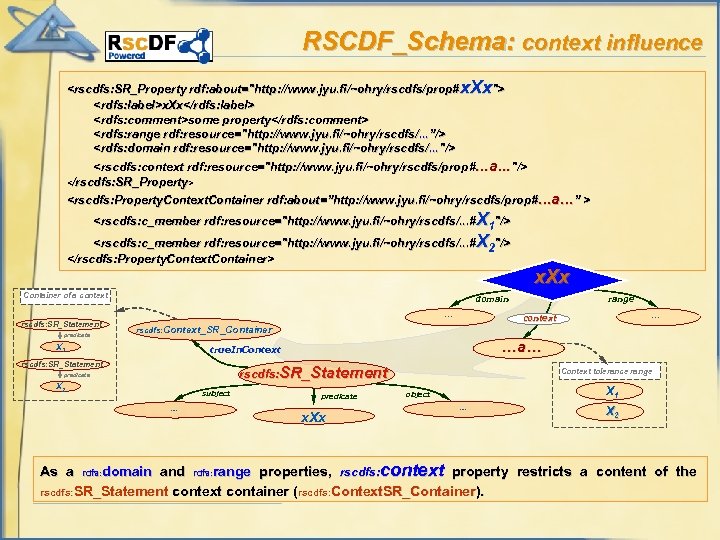
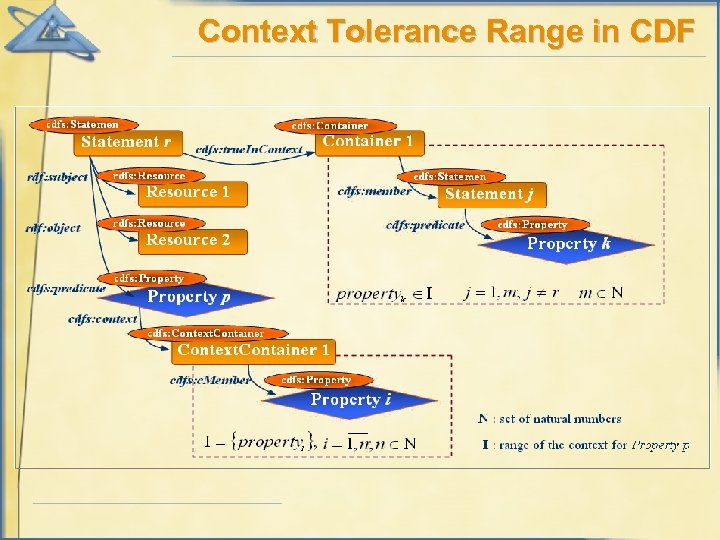
RSCDF_Schema: context influence <rscdfs: SR_Property rdf: about="http: //www. jyu. fi/~ohry/rscdfs/prop# x. Xx"> rdf: about="http: //www. jyu. fi/~ohry/rscdfs/prop# <rdfs: label>x. Xx</rdfs: label> <rdfs: comment>some property</rdfs: comment> <rdfs: range rdf: resource="http: //www. jyu. fi/~ohry/rscdfs/. . . ”/> <rdfs: domain rdf: resource="http: //www. jyu. fi/~ohry/rscdfs/. . . "/> <rscdfs: context rdf: resource="http: //www. jyu. fi/~ohry/rscdfs/prop#. . . a. . . "/> <rscdfs: context rdf: resource="http: //www. jyu. fi/~ohry/rscdfs/prop# </rscdfs: SR_Property> <rscdfs: Property. Context. Container rdf: about=”http: //www. jyu. fi/~ohry/rscdfs/prop#. . . a. . . ” > rdf: about=”http: //www. jyu. fi/~ohry/rscdfs/prop# <rscdfs: c_member rdf: resource="http: //www. jyu. fi/~ohry/rscdfs/. . . #X 1"/> <rscdfs: c_member rdf: resource="http: //www. jyu. fi/~ohry/rscdfs/. . . #X 2"/> <rscdfs: c_member rdf: resource="http: //www. jyu. fi/~ohry/rscdfs/. . . # </rscdfs: Property. Context. Container> Container of a context domain … rscdfs: SR_Statement predicate x. Xx range … context rscdfs: Context_SR_Container X 1 …a… true. In. Context rscdfs: SR_Statement predicate X 2 subject … predicate x. Xx Context tolerance range X 1 object … X 2 As a rdfs: domain and rdfs: range properties, rscdfs: context property restricts a content of the rscdfs: SR_Statement context container (rscdfs: Context. SR_Container).
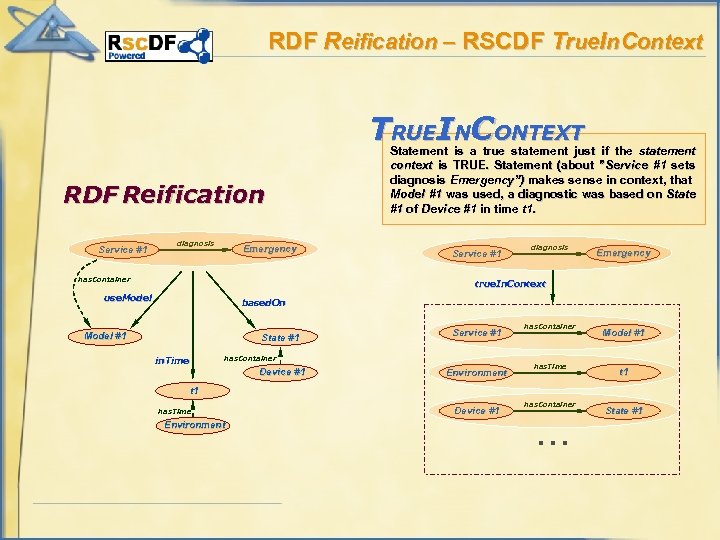
RDF Reification – RSCDF True. In. Context TRUEINCONTEXT RDF Reification Service #1 diagnosis Emergency has. Container Statement is a true statement just if the statement context is TRUE. Statement (about ”Service #1 sets diagnosis Emergency”) makes sense in context, that Model #1 was used, a diagnostic was based on State #1 of Device #1 in time t 1. Service #1 diagnosis Emergency true. In. Context use. Model based. On Model #1 State #1 in. Time Service #1 has. Container Model #1 has. Container Device #1 Environment has. Time t 1 has. Time Environment Device #1 has. Container … State #1
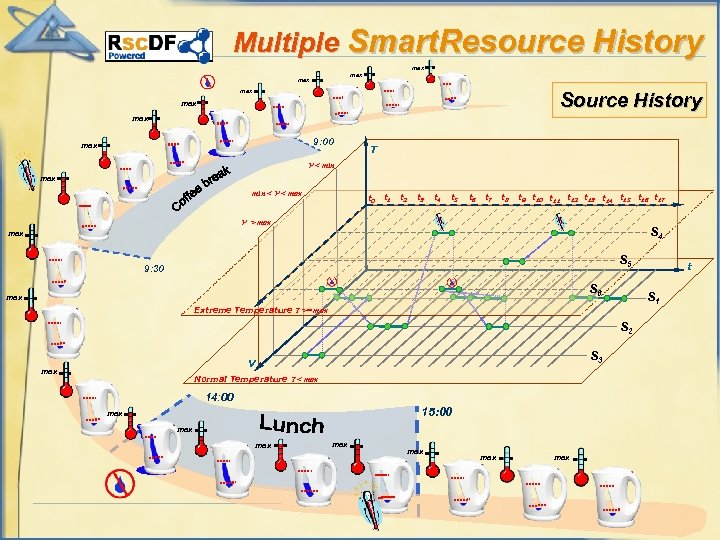
Multiple Smart. Resource History max max Source History max 9: 00 max T V < min max min < V < max t 0 t 1 t 2 t 3 t 4 t 5 t 6 t 7 t 8 t 9 t 10 t 11 t 12 t 13 t 14 t 15 t 16 t 17 V > max S 4 max S 5 9: 30 S 6 max S 1 Extreme Temperature T >= max S 2 S 3 V max Normal Temperature T < max 14: 00 15: 00 max max t
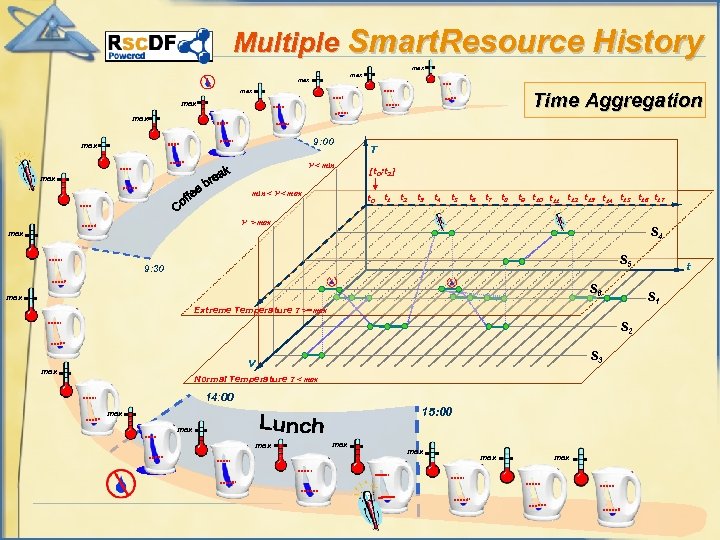
Multiple Smart. Resource History max max Time Aggregation max 9: 00 max V < min max min < V < max T [t 0; t 2] t 0 t 1 t 2 t 3 t 4 t 5 t 6 t 7 t 8 t 9 t 10 t 11 t 12 t 13 t 14 t 15 t 16 t 17 V > max S 4 max S 5 9: 30 S 6 max S 1 Extreme Temperature T >= max S 2 S 3 V max Normal Temperature T < max 14: 00 15: 00 max max t
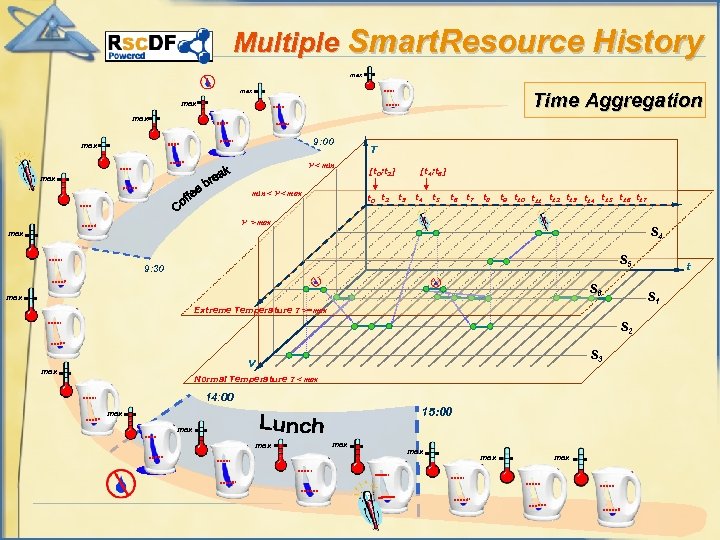
Multiple Smart. Resource History max Time Aggregation max 9: 00 max V < min max min < V < max T [t 4; t 6] [t 0; t 2] t 0 t 2 t 3 t 4 t 5 t 6 t 7 t 8 t 9 t 10 t 11 t 12 t 13 t 14 t 15 t 16 t 17 V > max S 4 max S 5 9: 30 S 6 max S 1 Extreme Temperature T >= max S 2 S 3 V max Normal Temperature T < max 14: 00 15: 00 max max t
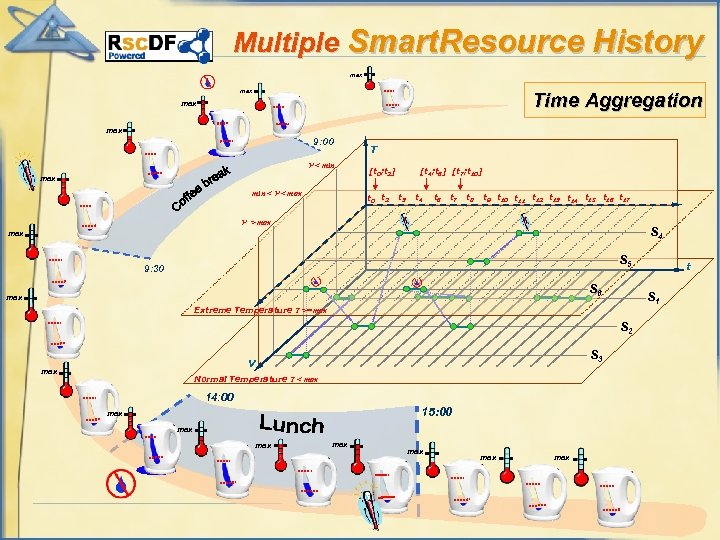
Multiple Smart. Resource History max Time Aggregation max 9: 00 V < min max min < V < max T [t 4; t 6] [t 7; t 10] [t 0; t 2] t 0 t 2 t 3 t 4 t 6 t 7 t 8 t 9 t 10 t 11 t 12 t 13 t 14 t 15 t 16 t 17 V > max S 4 max S 5 9: 30 S 6 max S 1 Extreme Temperature T >= max S 2 S 3 V max Normal Temperature T < max 14: 00 15: 00 max max t
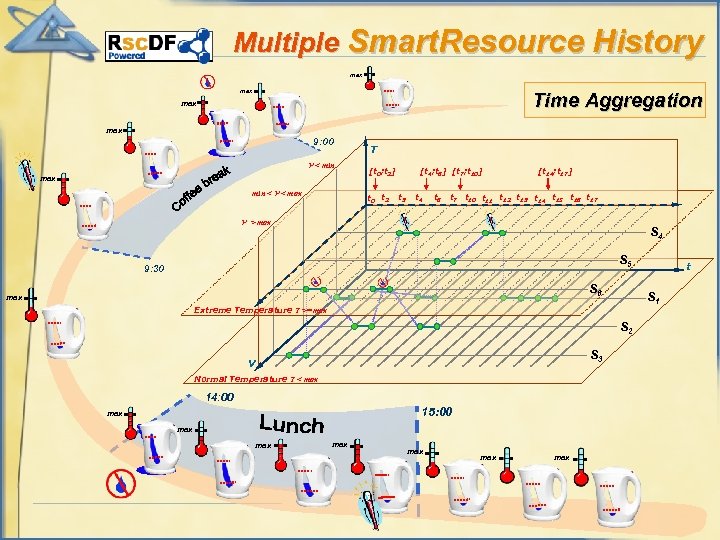
Multiple Smart. Resource History max Time Aggregation max 9: 00 V < min max min < V < max T [t 4; t 6] [t 7; t 10] [t 0; t 2] t 0 t 2 t 3 t 4 t 6 [t 14; t 17] t 7 t 10 t 11 t 12 t 13 t 14 t 15 t 16 t 17 V > max S 4 S 5 9: 30 S 6 max S 1 Extreme Temperature T >= max S 2 S 3 V Normal Temperature T < max 14: 00 15: 00 max max t
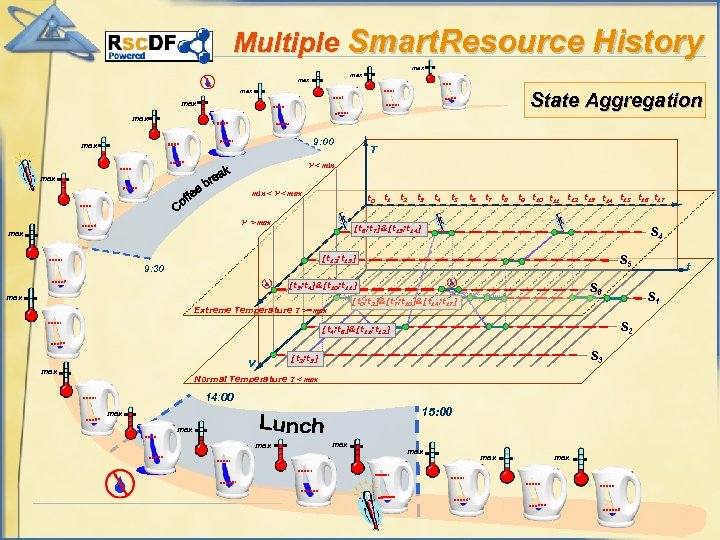
Multiple Smart. Resource History max max State Aggregation max 9: 00 max T V < min max min < V < max t 0 V > max t 1 t 2 t 3 t 4 t 5 t 6 t 7 t 8 t 9 t 10 t 11 t 12 t 13 t 14 t 15 t 16 t 17 [t 6; t 7]&[t 13; t 14] max S 4 [t 12; t 13] 9: 30 S 5 [t 3; t 4]&[t 10; t 11] max S 6 [t 0; t 2]&[t 7; t 10]&[t 14; t 17] Extreme Temperature T >= max V max S 3 [t 2; t 3] Normal Temperature T < max 14: 00 15: 00 max max S 1 S 2 [t 4; t 6]&[t 11; t 12] max max t
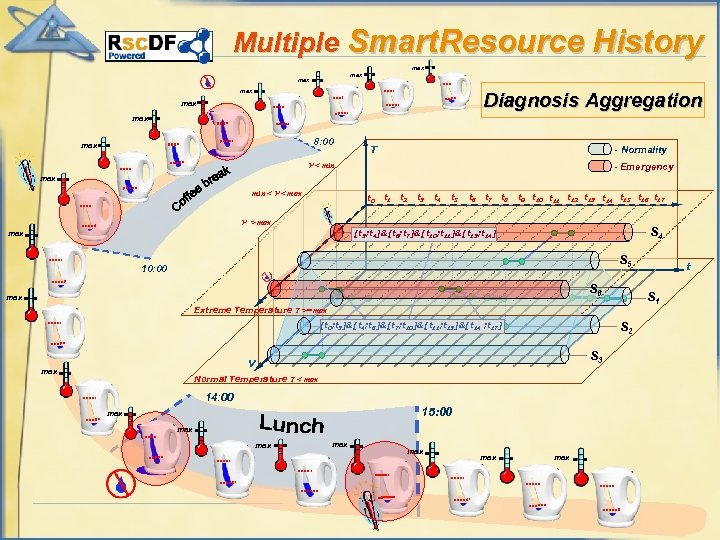
Multiple Smart. Resource History max max Diagnosis Aggregation max 8: 00 max T - Normality V < min - Emergency max min < V < max t 0 t 1 t 2 t 3 t 4 t 5 t 6 t 7 t 8 t 9 t 10 t 11 t 12 t 13 t 14 t 15 t 16 t 17 V > max S 4 [t 3; t 4]&[t 6; t 7]&[t 10; t 11]&[t 13; t 14] max S 5 10: 00 S 6 max S 1 Extreme Temperature T >= max S 2 [t 0; t 3]&[t 4; t 6]&[t 7; t 10]&[t 11; t 13]&[t 14 ; t 17] S 3 V max Normal Temperature T < max 14: 00 15: 00 max max t
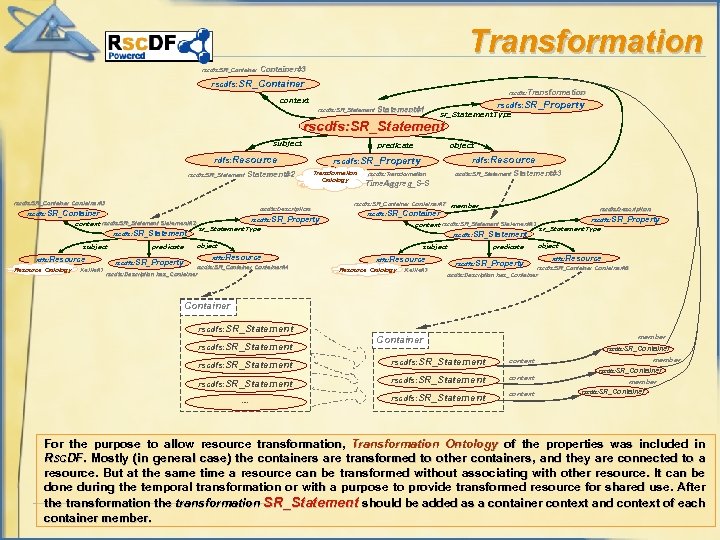
Transformation rscdfs: SR_Container#3 rscdfs: SR_Container rscdfs: Transformation context rscdfs: SR_Statement#1 rscdfs: SR_Property sr_Statement. Type rscdfs: SR_Statement subject predicate rdfs: Resource rscdfs: SR_Statement#2 rscdfs: SR_Container#5 rscdfs: SR_Property context rscdfs: SR_Statement#2 sr_Statement. Type rscdfs: SR_Statement subject rdfs: Resource Ontology Kettle#1 predicate rscdfs: SR_Property rdfs: Resource rscdfs: SR_Property Transformation Ontology rscdfs: Description rscdfs: SR_Container object rscdfs: SR_Statement rscdfs: Transformation rscdfs: SR_Container#7 member rscdfs: SR_Container subject rscdfs: SR_Container#4 rscdfs: Description has_Container rscdfs: Description rscdfs: SR_Property context rscdfs: SR_Statement#3 sr_Statement. Type rscdfs: SR_Statement object rdfs: Resource Statement#3 Time. Aggreg_S-S rdfs: Resource Ontology Kettle#1 predicate rscdfs: SR_Property object rdfs: Resource rscdfs: SR_Container#6 rscdfs: Description has_Container rscdfs: SR_Statement member Container rscdfs: SR_Statement context rscdfs: SR_Statement context … member rscdfs: SR_Container For the purpose to allow resource transformation, Transformation Ontology of the properties was included in RSCDF. Mostly (in general case) the containers are transformed to other containers, and they are connected to a DF. resource. But at the same time a resource can be transformed without associating with other resource. It can be done during the temporal transformation or with a purpose to provide transformed resource for shared use. After the transformation SR_Statement should be added as a container context and context of each container member.
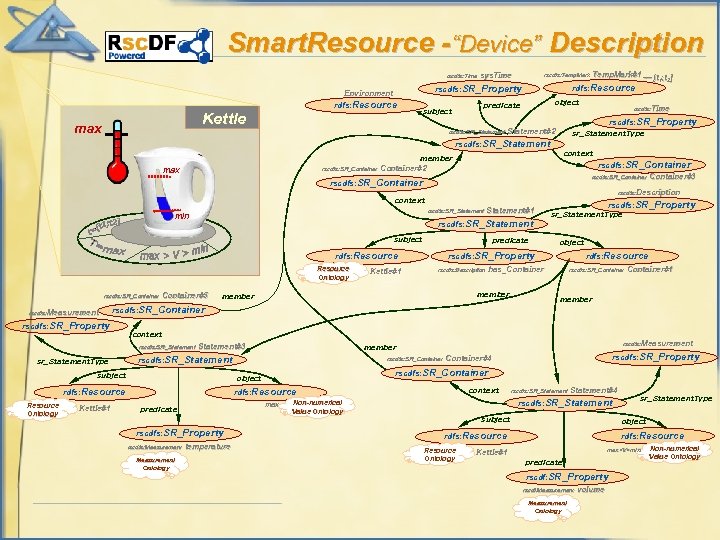
Smart. Resource -“Device” Description rscdfs: Time Environment rdfs: Resource Kettle max sys. Time rdfs: Resource object predicate subject Temp. Mark#1 --- [t ; t ] 1 2 rscdfs: Temp. Mark rscdfs: SR_Property rscdfs: Time rscdfs: SR_Property rscdfs: SR_Statement#2 sr_Statement. Type rscdfs: SR_Statement context member max rscdfs: SR_Container#3 Container#2 rscdfs: SR_Container rscdfs: Description context rscdfs: SR_Statement min Statement#1 rscdfs: SR_Statement subject predicate rdfs: Resource Ontology rscdfs: SR_Container rscdfs: Measurement Container#5 rscdfs: Description has_Container member rdfs: Resource rscdfs: SR_Container#1 member context rscdfs: SR_Statement sr_Statement. Type Statement#3 rscdfs: SR_Container context rdfs: Resource max predicate rscdfs: SR_Property rscdfs: Measuremenr Measurement Ontology temperature rscdfs: SR_Property Container#4 rscdfs: SR_Container object rdfs: Resource rscdfs: Measurement member rscdfs: SR_Statement subject Kettle#1 object rscdfs: SR_Property rscdfs: SR_Container rscdfs: SR_Property Resource Ontology Kettle#1 rscdfs: SR_Property sr_Statement. Type rscdfs: SR_Statement#4 rscdfs: SR_Statement Non-numerical Value Ontology subject object rdfs: Resource Ontology sr_Statement. Type max>V>min Kettle#1 predicate rscdf: SR_Property rscdf: Measuremenr Measurement Ontology volume Non-numerical Value Ontology
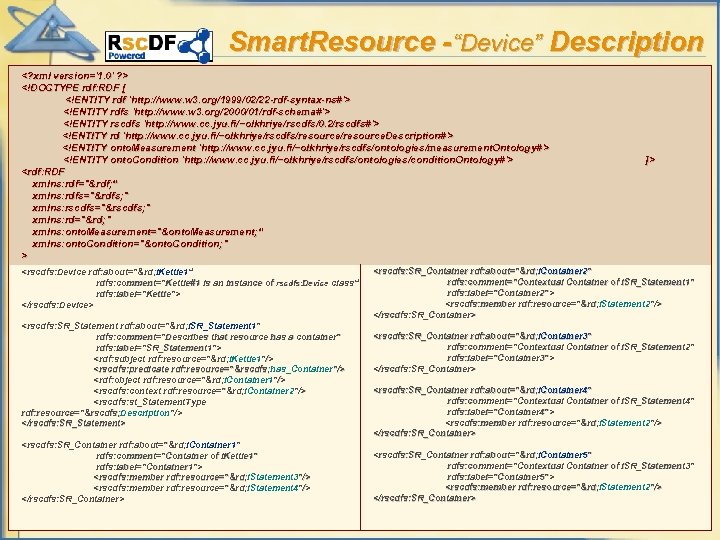
Smart. Resource -“Device” Description <? xml version='1. 0' ? > <!DOCTYPE rdf: RDF [ <!ENTITY rdf 'http: //www. w 3. org/1999/02/22 -rdf-syntax-ns#'> <!ENTITY rdfs 'http: //www. w 3. org/2000/01/rdf-schema#'> <!ENTITY rscdfs 'http: //www. cc. jyu. fi/~olkhriye/rscdfs/0. 2/rscdfs#'> <!ENTITY rd 'http: //www. cc. jyu. fi/~olkhriye/rscdfs/resource/resource. Description#'> <!ENTITY onto. Measurement 'http: //www. cc. jyu. fi/~olkhriye/rscdfs/ontologies/measurement. Ontology#'> <!ENTITY onto. Condition 'http: //www. cc. jyu. fi/~olkhriye/rscdfs/ontologies/condition. Ontology#'> <rdf: RDF xmlns: rdf="&rdf; “ xmlns: rdfs="&rdfs; " xmlns: rscdfs="&rscdfs; " xmlns: rd="&rd; " xmlns: onto. Measurement="&onto. Measurement; “ xmlns: onto. Condition="&onto. Condition; " > <rscdfs: Device rdf: about="&rd; i. Kettle 1“ rdfs: comment="Kettle#1 is an instance of rscdfs: Device class“ rdfs: comment="Kettle#1 rdfs: label="Kettle"> </rscdfs: Device> <rscdfs: SR_Statement rdf: about="&rd; i. SR_Statement 1" rdfs: comment="Describes that resource has a container" rdfs: comment="Describes rdfs: label="SR_Statement 1"> <rdf: subject rdf: resource="&rd; "/> rdf: resource="&rd; i. Kettle 1"/> <rscdfs: predicate rdf: resource="&rscdfs; has_Container"/> rdf: resource="&rscdfs; <rdf: object rdf: resource="&rd; "/> rdf: resource="&rd; i. Container 1"/> <rscdfs: context rdf: resource="&rd; "/> rdf: resource="&rd; i. Container 2"/> <rscdfs: st_Statement. Type rdf: resource="&rscdfs; Description"/> rdf: resource="&rscdfs; </rscdfs: SR_Statement> <rscdfs: SR_Container rdf: about="&rd; i. Container 1" rdfs: comment="Container of i. Kettle 1" rdfs: comment="Container rdfs: label="Container 1"> <rscdfs: member rdf: resource="&rd; "/> rdf: resource="&rd; i. Statement 3"/> <rscdfs: member rdf: resource="&rd; "/> rdf: resource="&rd; i. Statement 4"/> </rscdfs: SR_Container> ]> <rscdfs: SR_Container rdf: about="&rd; i. Container 2" rdfs: comment="Contextual Container of i. SR_Statement 1" rdfs: comment="Contextual rdfs: label="Container 2"> <rscdfs: member rdf: resource="&rd; "/> rdf: resource="&rd; i. Statement 2"/> </rscdfs: SR_Container> <rscdfs: SR_Container rdf: about="&rd; i. Container 3" rdfs: comment="Contextual Container of i. SR_Statement 2" rdfs: comment="Contextual rdfs: label="Container 3"> </rscdfs: SR_Container> <rscdfs: SR_Container rdf: about="&rd; i. Container 4" rdfs: comment="Contextual Container of i. SR_Statement 4" rdfs: comment="Contextual rdfs: label="Container 4"> <rscdfs: member rdf: resource="&rd; "/> rdf: resource="&rd; i. Statement 2"/> </rscdfs: SR_Container> <rscdfs: SR_Container rdf: about="&rd; i. Container 5" rdfs: comment="Contextual Container of i. SR_Statement 3" rdfs: comment="Contextual rdfs: label="Container 5"> <rscdfs: member rdf: resource="&rd; "/> rdf: resource="&rd; i. Statement 2"/> </rscdfs: SR_Container>
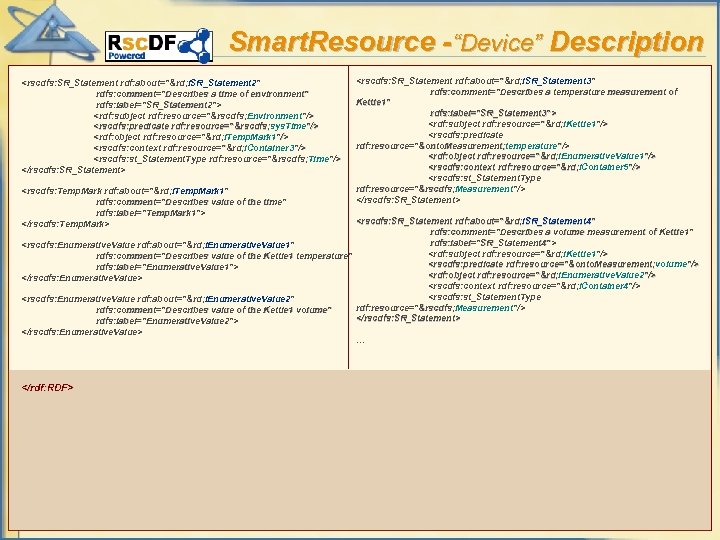
Smart. Resource -“Device” Description <rscdfs: SR_Statement rdf: about="&rd; i. SR_Statement 2" rdfs: comment="Describes a time of environment" rdfs: comment="Describes rdfs: label="SR_Statement 2"> <rdf: subject rdf: resource="&rscdfs; Environment"/> rdf: resource="&rscdfs; <rscdfs: predicate rdf: resource="&rscdfs; sys. Time"/> rdf: resource="&rscdfs; <rdf: object rdf: resource="&rd; "/> rdf: resource="&rd; i. Temp. Mark 1"/> <rscdfs: context rdf: resource="&rd; "/> rdf: resource="&rd; i. Container 3"/> <rscdfs: st_Statement. Type rdf: resource="&rscdfs; Time"/> rdf: resource="&rscdfs; </rscdfs: SR_Statement> <rscdfs: Temp. Mark rdf: about="&rd; i. Temp. Mark 1" rdfs: comment="Describes value of the time" rdfs: comment="Describes rdfs: label="Temp. Mark 1"> </rscdfs: Temp. Mark> <rscdfs: SR_Statement rdf: about="&rd; i. SR_Statement 3" rdfs: comment="Describes a temperature measurement of rdfs: comment="Describes Kettle 1" rdfs: label="SR_Statement 3"> <rdf: subject rdf: resource="&rd; "/> rdf: resource="&rd; i. Kettle 1"/> <rscdfs: predicate rdf: resource="&onto. Measurement; temperature"/> rdf: resource="&onto. Measurement; <rdf: object rdf: resource="&rd; "/> rdf: resource="&rd; i. Enumerative. Value 1"/> <rscdfs: context rdf: resource="&rd; "/> rdf: resource="&rd; i. Container 5"/> <rscdfs: st_Statement. Type rdf: resource="&rscdfs; Measurement"/> rdf: resource="&rscdfs; </rscdfs: SR_Statement> <rscdfs: SR_Statement rdf: about="&rd; i. SR_Statement 4" rdfs: comment="Describes a volume measurement of Kettle 1" rdfs: comment="Describes rdfs: label="SR_Statement 4"> <rscdfs: Enumerative. Value rdf: about="&rd; i. Enumerative. Value 1" <rdf: subject rdf: resource="&rd; "/> rdf: resource="&rd; i. Kettle 1"/> rdfs: comment="Describes value of the Kettle 1 temperature" rdfs: comment="Describes <rscdfs: predicate rdf: resource="&onto. Measurement; volume"/> rdf: resource="&onto. Measurement; rdfs: label="Enumerative. Value 1"> <rdf: object rdf: resource="&rd; "/> rdf: resource="&rd; i. Enumerative. Value 2"/> </rscdfs: Enumerative. Value> <rscdfs: context rdf: resource="&rd; "/> rdf: resource="&rd; i. Container 4"/> <rscdfs: st_Statement. Type <rscdfs: Enumerative. Value rdf: about="&rd; i. Enumerative. Value 2" rdf: resource="&rscdfs; Measurement"/> rdf: resource="&rscdfs; rdfs: comment="Describes value of the Kettle 1 volume" rdfs: comment="Describes </rscdfs: SR_Statement> rdfs: label="Enumerative. Value 2"> rdfs: label </rscdfs: Enumerative. Value> … </rdf: RDF>
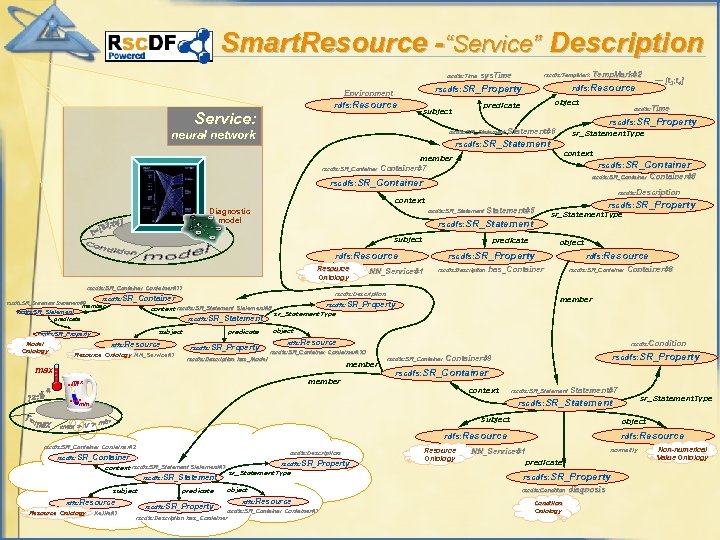
Smart. Resource -“Service” Description rscdfs: Time Environment rdfs: Resource Service: sys. Time rdfs: Resource object predicate subject Temp. Mark#2 rscdfs: Temp. Mark rscdfs: SR_Property rscdfs: Time rscdfs: SR_Property neural network rscdfs: SR_Statement#6 sr_Statement. Type rscdfs: SR_Statement context member rscdfs: SR_Container#8 Container#7 rscdfs: SR_Container rscdfs: Description context Diagnostic model rscdfs: SR_Statement#5 rscdfs: SR_Statement subject predicate rdfs: Resource Ontology rscdfs: SR_Container#11 context rscdfs: SR_Statement#8 rscdfs: SR_Statement predicate subject rscdfs: SR_Property Model Ontology rdfs: Resource Ontology NN_Service#1 NN_Service# predicate rscdfs: SR_Property rscdfs: Description has_Model rscdfs: SR_Property sr_Statement. Type object rscdfs: SR_Property rscdfs: Description rdfs: Resource has_Container rscdfs: Description rscdfs: SR_Container rscdfs: SR_Statement#9 member rscdfs: SR_Statement rscdfs: SR_Container object rdfs: Resource rscdfs: Condition rscdfs: SR_Container#10 member max rscdfs: SR_Container rscdfs: SR_Property Container#9 rscdfs: SR_Container context rscdfs: SR_Statement#7 sr_Statement. Type rscdfs: SR_Statement min subject object rdfs: Resource rscdfs: Description rscdfs: SR_Container context rscdfs: SR_Statement#1 rscdfs: SR_Statement subject rdfs: Resource Ontology Container#6 member rscdfs: SR_Property sr_Statement. Type max rscdfs: SR_Container#2 Kettle#1 predicate --- [t 3; t 4] rscdfs: SR_Property sr_Statement. Type object rdfs: Resource rscdfs: SR_Property rscdfs: SR_Container#1 rscdfs: Description has_Container Resource Ontology NN_Service#1 NN_Service# normality predicate rscdfs: SR_Property rscdfs: Condition Ontology diagnosis Non-numerical Value Ontology
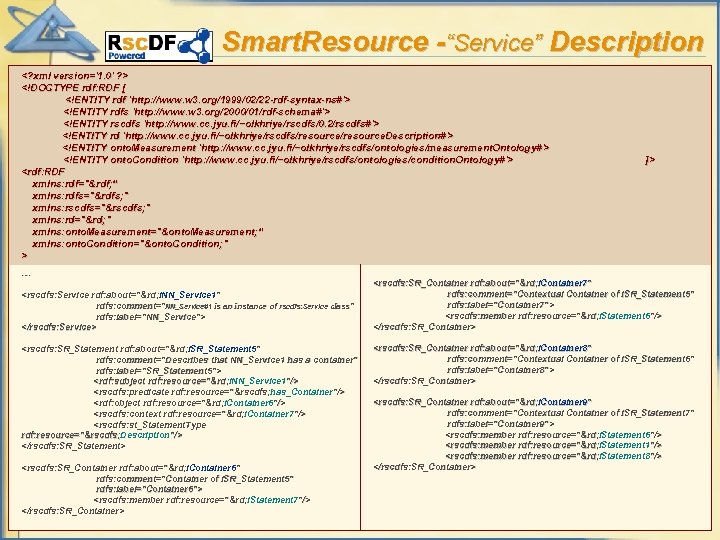
Smart. Resource -“Service” Description <? xml version='1. 0' ? > <!DOCTYPE rdf: RDF [ <!ENTITY rdf 'http: //www. w 3. org/1999/02/22 -rdf-syntax-ns#'> <!ENTITY rdfs 'http: //www. w 3. org/2000/01/rdf-schema#'> <!ENTITY rscdfs 'http: //www. cc. jyu. fi/~olkhriye/rscdfs/0. 2/rscdfs#'> <!ENTITY rd 'http: //www. cc. jyu. fi/~olkhriye/rscdfs/resource/resource. Description#'> <!ENTITY onto. Measurement 'http: //www. cc. jyu. fi/~olkhriye/rscdfs/ontologies/measurement. Ontology#'> <!ENTITY onto. Condition 'http: //www. cc. jyu. fi/~olkhriye/rscdfs/ontologies/condition. Ontology#'> <rdf: RDF xmlns: rdf="&rdf; “ xmlns: rdfs="&rdfs; " xmlns: rscdfs="&rscdfs; " xmlns: rd="&rd; " xmlns: onto. Measurement="&onto. Measurement; “ xmlns: onto. Condition="&onto. Condition; " > … <rscdfs: Service rdf: about="&rd; i. NN_Service 1" rdfs: comment="NN_Service#1 is an instance of rscdfs: Service class " rdfs: comment=" rdfs: label="NN_Service"> </rscdfs: Service> <rscdfs: SR_Statement rdf: about="&rd; i. SR_Statement 5" rdfs: comment="Describes that NN_Service 1 has a container" rdfs: comment="Describes rdfs: label="SR_Statement 5"> <rdf: subject rdf: resource="&rd; "/> rdf: resource="&rd; i. NN_Service 1"/> <rscdfs: predicate rdf: resource="&rscdfs; has_Container"/> rdf: resource="&rscdfs; <rdf: object rdf: resource="&rd; "/> rdf: resource="&rd; i. Container 6"/> <rscdfs: context rdf: resource="&rd; "/> rdf: resource="&rd; i. Container 7"/> <rscdfs: st_Statement. Type rdf: resource="&rscdfs; Description"/> rdf: resource="&rscdfs; </rscdfs: SR_Statement> <rscdfs: SR_Container rdf: about="&rd; i. Container 6" rdfs: comment="Container of i. SR_Statement 5" rdfs: comment="Container rdfs: label="Container 6"> <rscdfs: member rdf: resource="&rd; "/> rdf: resource="&rd; i. Statement 7"/> </rscdfs: SR_Container> ]> <rscdfs: SR_Container rdf: about="&rd; i. Container 7" rdfs: comment="Contextual Container of i. SR_Statement 5" rdfs: comment="Contextual rdfs: label="Container 7"> <rscdfs: member rdf: resource="&rd; "/> rdf: resource="&rd; i. Statement 6"/> </rscdfs: SR_Container> <rscdfs: SR_Container rdf: about="&rd; i. Container 8" rdfs: comment="Contextual Container of i. SR_Statement 6" rdfs: comment="Contextual rdfs: label="Container 8"> </rscdfs: SR_Container> <rscdfs: SR_Container rdf: about="&rd; i. Container 9" rdfs: comment="Contextual Container of i. SR_Statement 7" rdfs: comment="Contextual rdfs: label="Container 9"> <rscdfs: member rdf: resource="&rd; "/> rdf: resource="&rd; i. Statement 6"/> <rscdfs: member rdf: resource="&rd; "/> rdf: resource="&rd; i. Statement 1"/> <rscdfs: member rdf: resource="&rd; "/> rdf: resource="&rd; i. Statement 8"/> </rscdfs: SR_Container>
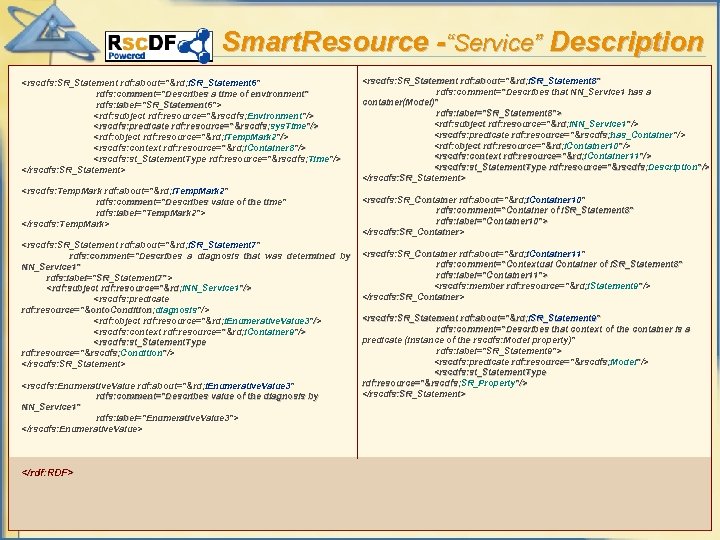
Smart. Resource -“Service” Description <rscdfs: SR_Statement rdf: about="&rd; i. SR_Statement 6" rdfs: comment="Describes a time of environment" rdfs: comment="Describes rdfs: label="SR_Statement 6"> <rdf: subject rdf: resource="&rscdfs; Environment"/> rdf: resource="&rscdfs; <rscdfs: predicate rdf: resource="&rscdfs; sys. Time"/> rdf: resource="&rscdfs; <rdf: object rdf: resource="&rd; "/> rdf: resource="&rd; i. Temp. Mark 2"/> <rscdfs: context rdf: resource="&rd; "/> rdf: resource="&rd; i. Container 8"/> <rscdfs: st_Statement. Type rdf: resource="&rscdfs; Time"/> rdf: resource="&rscdfs; </rscdfs: SR_Statement> <rscdfs: Temp. Mark rdf: about="&rd; i. Temp. Mark 2" rdfs: comment="Describes value of the time" rdfs: comment="Describes rdfs: label="Temp. Mark 2"> </rscdfs: Temp. Mark> <rscdfs: SR_Statement rdf: about="&rd; i. SR_Statement 7" rdfs: comment="Describes a diagnosis that was determined by rdfs: comment="Describes NN_Service 1" rdfs: label="SR_Statement 7"> <rdf: subject rdf: resource="&rd; "/> <rdf: subject rdf: resource="&rd; i. NN_Service 1"/> <rscdfs: predicate rdf: resource="&onto. Condition; diagnosis"/> rdf: resource="&onto. Condition; <rdf: object rdf: resource="&rd; "/> rdf: resource="&rd; i. Enumerative. Value 3"/> <rscdfs: context rdf: resource="&rd; "/> rdf: resource="&rd; i. Container 9"/> <rscdfs: st_Statement. Type rdf: resource="&rscdfs; Condition"/> rdf: resource="&rscdfs; </rscdfs: SR_Statement> <rscdfs: Enumerative. Value rdf: about="&rd; i. Enumerative. Value 3" rdfs: comment="Describes value of the diagnosis by rdfs: comment="Describes NN_Service 1" rdfs: label="Enumerative. Value 3"> </rscdfs: Enumerative. Value> </rdf: RDF> <rscdfs: SR_Statement rdf: about="&rd; i. SR_Statement 8" rdfs: comment="Describes that NN_Service 1 has a rdfs: comment="Describes container(Model)" rdfs: label="SR_Statement 8"> <rdf: subject rdf: resource="&rd; "/> rdf: resource="&rd; i. NN_Service 1"/> <rscdfs: predicate rdf: resource="&rscdfs; has_Container"/> rdf: resource="&rscdfs; <rdf: object rdf: resource="&rd; "/> rdf: resource="&rd; i. Container 10"/> <rscdfs: context rdf: resource="&rd; "/> rdf: resource="&rd; i. Container 11"/> <rscdfs: st_Statement. Type rdf: resource="&rscdfs; Description"/> rdf: resource="&rscdfs; </rscdfs: SR_Statement> <rscdfs: SR_Container rdf: about="&rd; i. Container 10" rdfs: comment="Container of i. SR_Statement 8" rdfs: comment="Container rdfs: label="Container 10"> </rscdfs: SR_Container> <rscdfs: SR_Container rdf: about="&rd; i. Container 11" rdfs: comment="Contextual Container of i. SR_Statement 8" rdfs: comment="Contextual rdfs: label="Container 11"> <rscdfs: member rdf: resource="&rd; "/> rdf: resource="&rd; i. Statement 9"/> </rscdfs: SR_Container> <rscdfs: SR_Statement rdf: about="&rd; i. SR_Statement 9" rdfs: comment="Describes that context of the container is a rdfs: comment="Describes predicate (instance of the rscdfs: Model property)" rdfs: label="SR_Statement 9"> <rscdfs: predicate rdf: resource="&rscdfs; Model"/> rdf: resource="&rscdfs; <rscdfs: st_Statement. Type rdf: resource="&rscdfs; SR_Property"/> rdf: resource="&rscdfs; </rscdfs: SR_Statement>
RSCDF-Lite: Context Description Framework (CDF) (Khriyenko O. , Terziyan V. )
CDF Statement
CDF Schema: Property definition
Context Tolerance Range in CDF
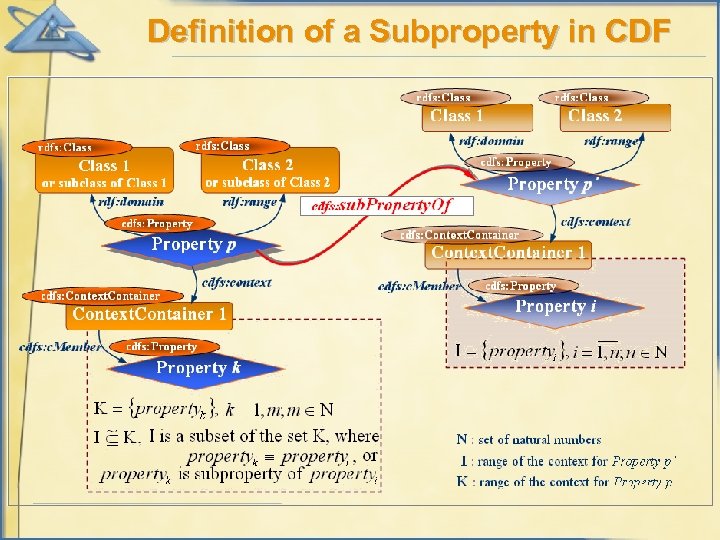
Definition of a Subproperty in CDF
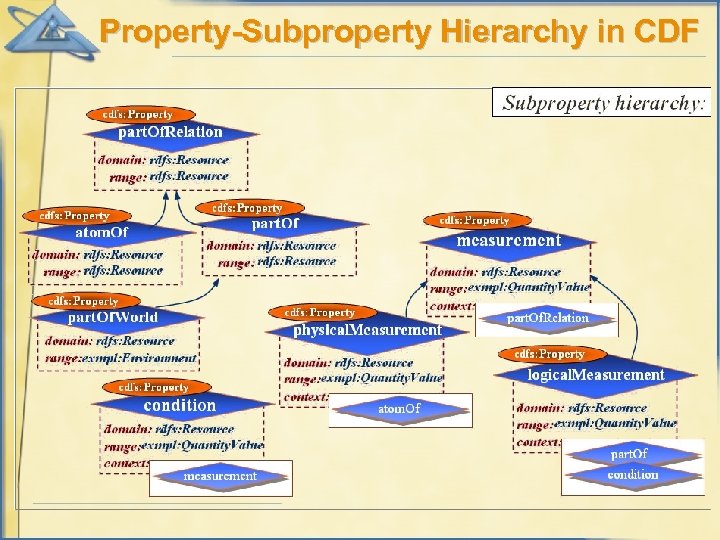
Property-Subproperty Hierarchy in CDF
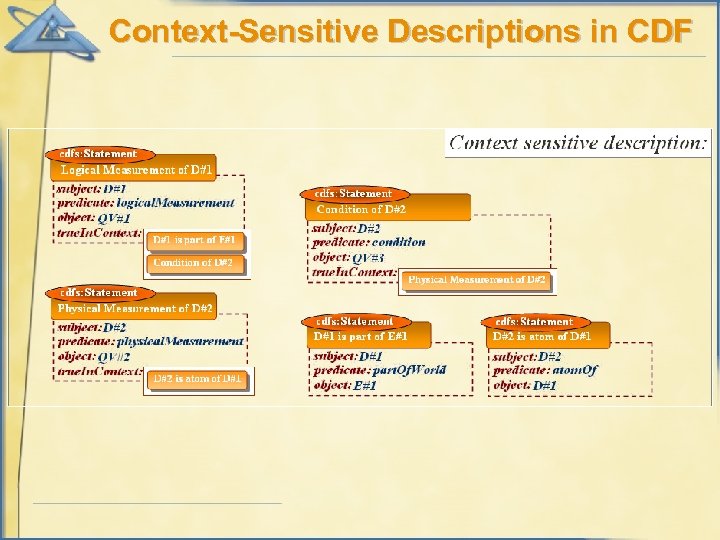
Context-Sensitive Descriptions in CDF
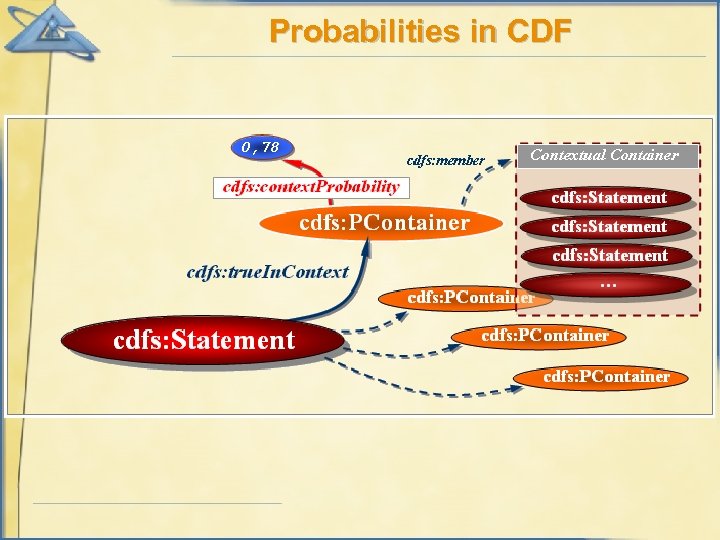
Probabilities in CDF
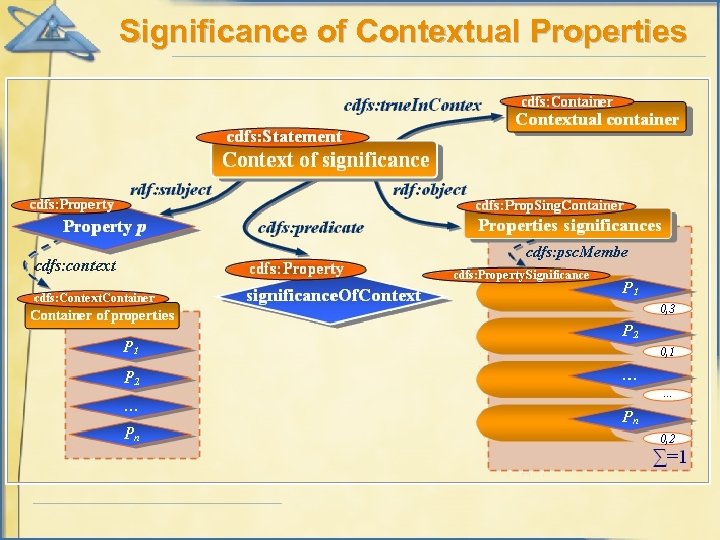
Significance of Contextual Properties
General Adaptation Framework (GAF)
Resource Adaptation Framework Semantic Resource Adaptation Framework is a generic ontology-based approach to design adapters for heterogeneous Web resources. Semantic Resource Adapters suppose to “wrap” data retrieved from external resources with semantic templates and deliver semantically annotated data from outside to a resource stripping out semantic markup.
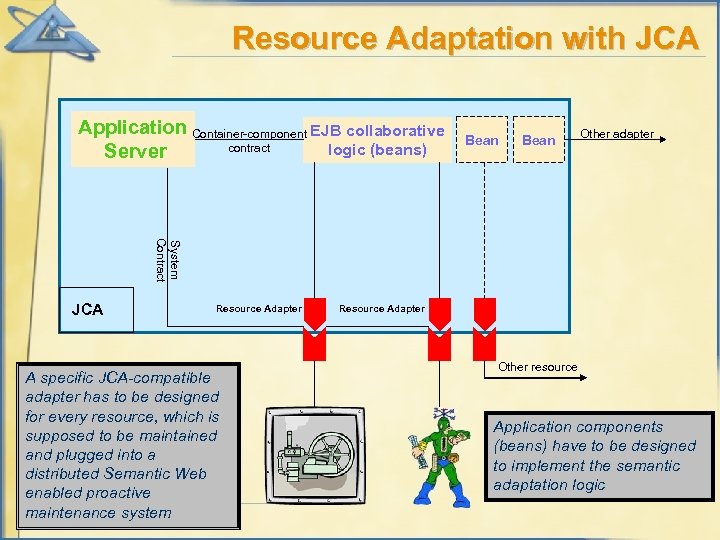
Resource Adaptation with JCA Application Container-component EJB collaborative contract logic (beans) Server Bean Other adapter System Contract JCA Resource Adapter A specific JCA-compatible adapter has to be designed for every resource, which is supposed to be maintained and plugged into a distributed Semantic Web enabled proactive maintenance system Resource Adapter Other resource Application components (beans) have to be designed to implement the semantic adaptation logic
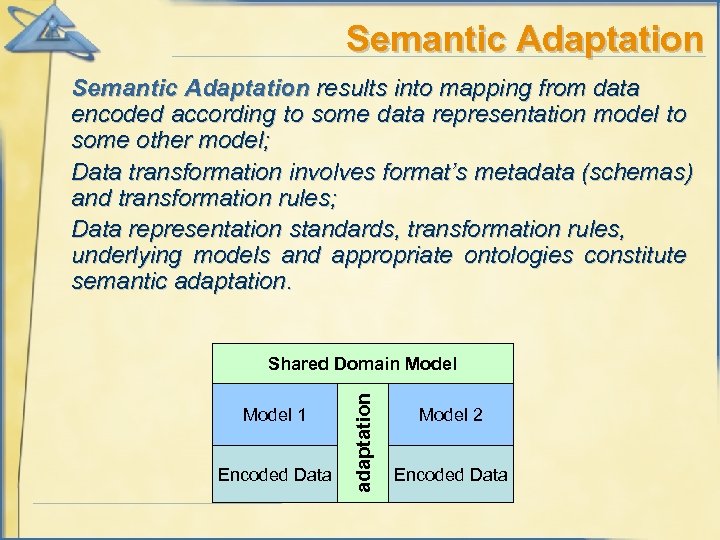
Semantic Adaptation results into mapping from data encoded according to some data representation model to some other model; Data transformation involves format’s metadata (schemas) and transformation rules; Data representation standards, transformation rules, underlying models and appropriate ontologies constitute semantic adaptation. Model 1 Encoded Data adaptation Shared Domain Model 2 Encoded Data
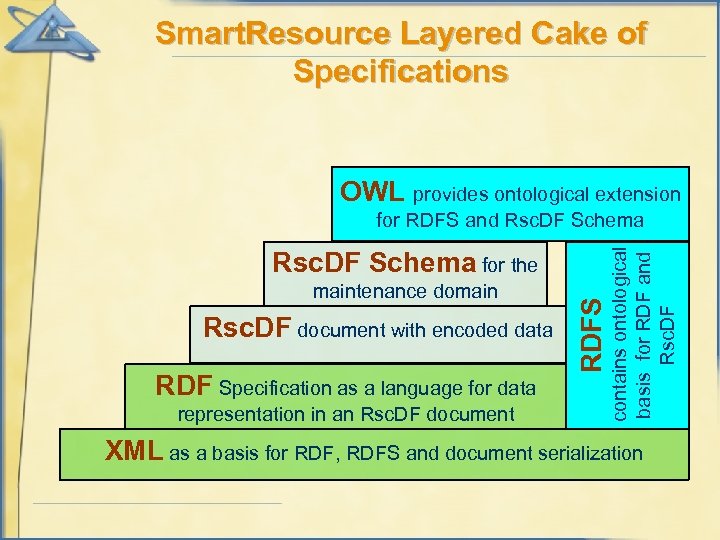
Smart. Resource Layered Cake of Specifications OWL provides ontological extension maintenance domain Rsc. DF document with encoded data RDF Specification as a language for data representation in an Rsc. DF document RDFS Rsc. DF Schema for the contains ontological basis for RDF and Rsc. DF for RDFS and Rsc. DF Schema XML as a basis for RDF, RDFS and document serialization
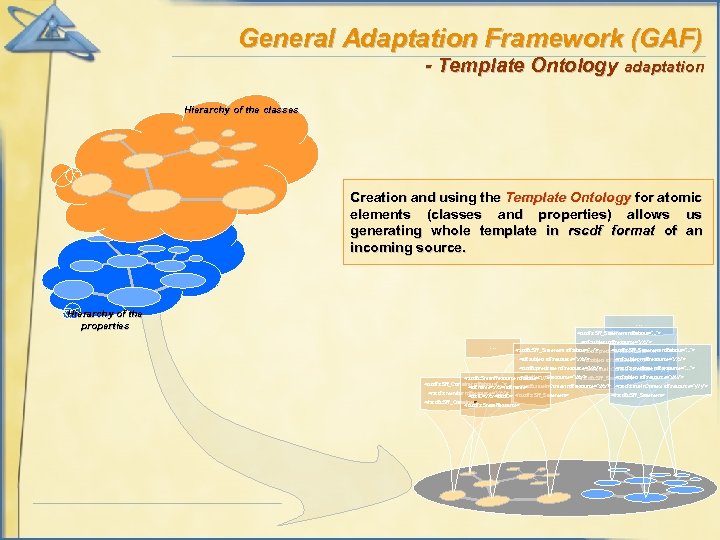
General Adaptation Framework (GAF) - Template Ontology adaptation Hierarchy of the classes Creation and using the Template Ontology for atomic elements (classes and properties) allows us generating whole template in rscdf format of an incoming source. Hierarchy of the properties … <rscdfs: SR_Statement rdf: about=”. . . ”> … <rdf: subject rdf: resource=”x. Xx”> <rscdfs: SR_Statement rdf: about=”. . . ”> <rscdfs: SR_Statement <rscdfs: predicate rdf: resource=”…”> rdf: about=”. . . ”> <rdf: subject rdf: resource=”x. Xx”> <rdf: object rdf: resource=”x. Xx”> <rscdfs: predicate rdf: resource=”…”> <rscdfs: true. In. Context rdf: resource=”y. Yy”> <rdf: object rdf: resource=”x. Xx”> </rscdfs: SR_Statement> <rscdfs: Smart. Resource rdf: about=”. . . ”> <rscdfs: SR_Container rdf: about=”. . . ”> <rscdfs: true. In. Context rdf: resource=”x. Xx”> <rscdfs: true. In. Context rdf: resource=”y. Yy”> <rdf: name>x. Xx</rdf: name> <rscdfs: member rdf: resource=”x. Xx”> </rscdfs: SR_Statement> <do: ID>x. Xx</do: ID> </rscdfs: SR_Container> </rscdfs: Smart. Resource>
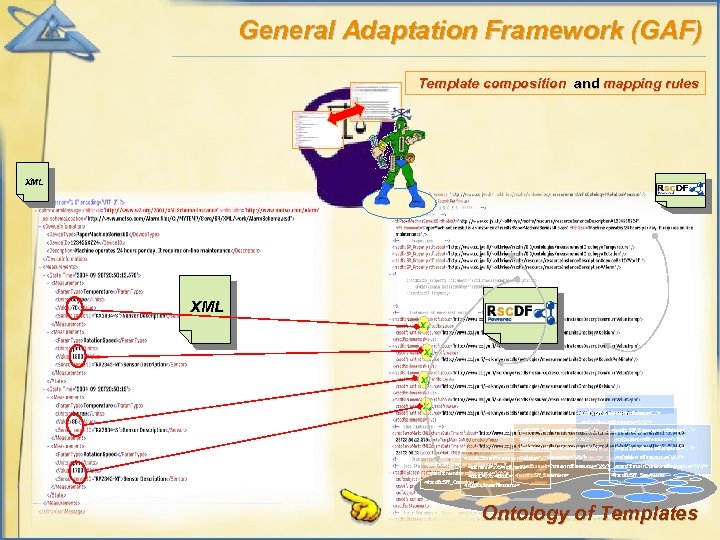
General Adaptation Framework (GAF) Template composition and mapping rules XML X 1 X 2 X 3 … X 4 <rscdfs: SR_Statement rdf: about=”. . . ”> <rdf: subject rdf: resource=”x. Xx”> <rscdfs: SR_Statement rdf: about=”. . . ”> <rscdfs: SR_Statement <rscdfs: predicate rdf: resource=”…”> rdf: about=”. . . ”> … <rdf: subject rdf: resource=”x. Xx”> <rdf: object rdf: resource=”x. Xx”> <rscdfs: predicate rdf: resource=”…”> <rscdfs: true. In. Context rdf: resource=”y. Yy”> <rdf: object rdf: resource=”x. Xx”> </rscdfs: SR_Statement> <rscdfs: Smart. Resource rdf: about=”. . . ”> <rscdfs: SR_Container rdf: about=”. . . ”> <rscdfs: true. In. Context rdf: resource=”x. Xx”> <rscdfs: true. In. Context rdf: resource=”y. Yy”> <rdf: name>x. Xx</rdf: name> <rscdfs: member rdf: resource=”x. Xx”> </rscdfs: SR_Statement> <do: ID>x. Xx</do: ID> </rscdfs: SR_Container> </rscdfs: Smart. Resource> Ontology of Templates
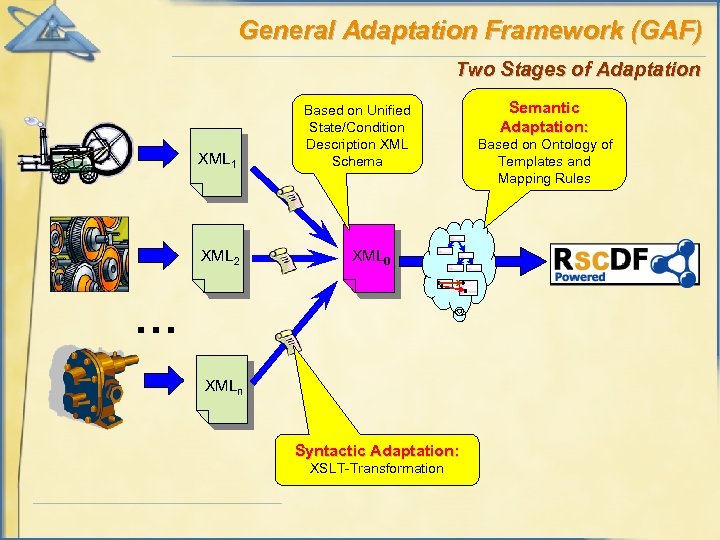
General Adaptation Framework (GAF) Two Stages of Adaptation XML 1 XML 2 Based on Unified State/Condition Description XML Schema XML 0 … XMLn Syntactic Adaptation: XSLT-Transformation Semantic Adaptation: Based on Ontology of Templates and Mapping Rules
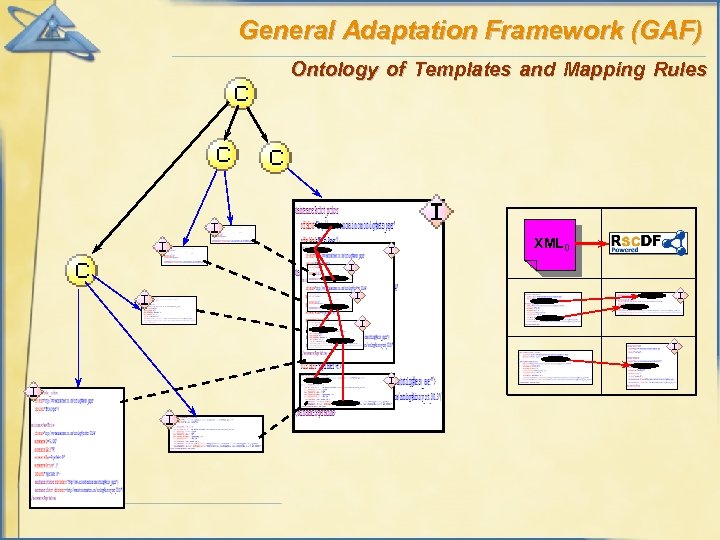
General Adaptation Framework (GAF) Ontology of Templates and Mapping Rules XML 0
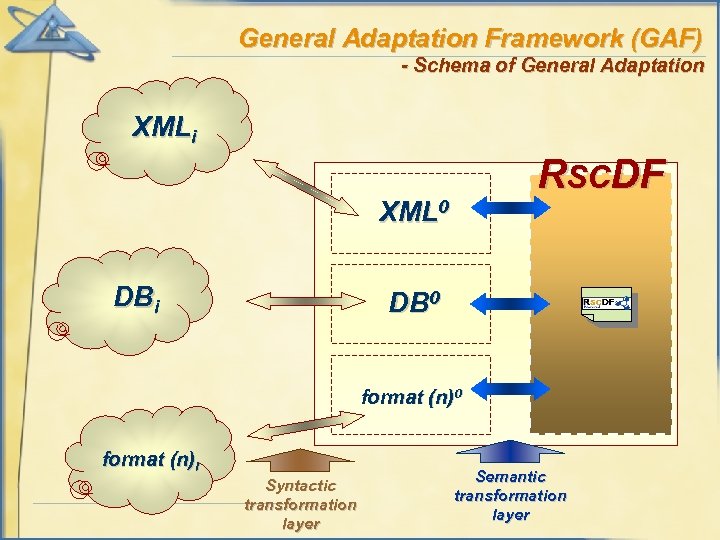
General Adaptation Framework (GAF) - Schema of General Adaptation XMLi RSCDF XML 0 DBi DB 0 format (n)i Syntactic transformation layer Semantic transformation layer
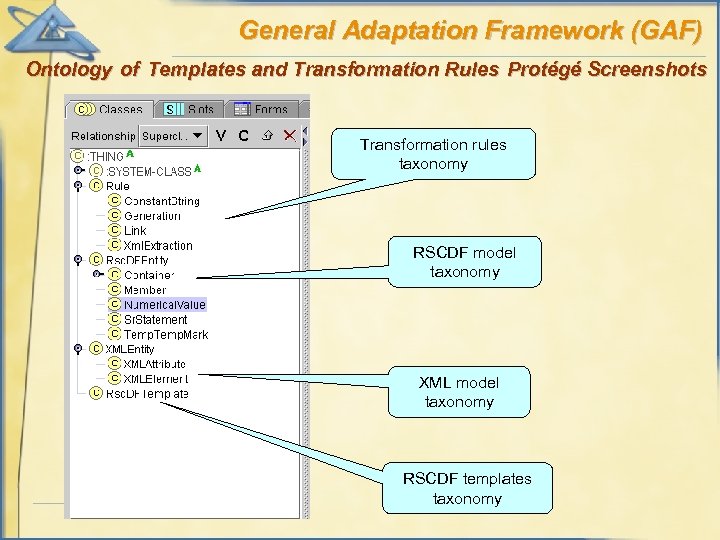
General Adaptation Framework (GAF) Ontology of Templates and Transformation Rules Protégé Screenshots Transformation rules taxonomy RSCDF model taxonomy XML model taxonomy RSCDF templates taxonomy
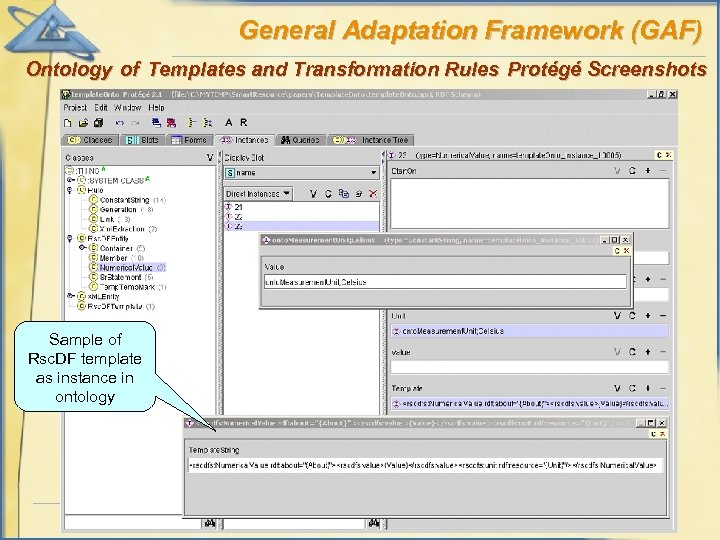
General Adaptation Framework (GAF) Ontology of Templates and Transformation Rules Protégé Screenshots Sample of Rsc. DF template as instance in ontology
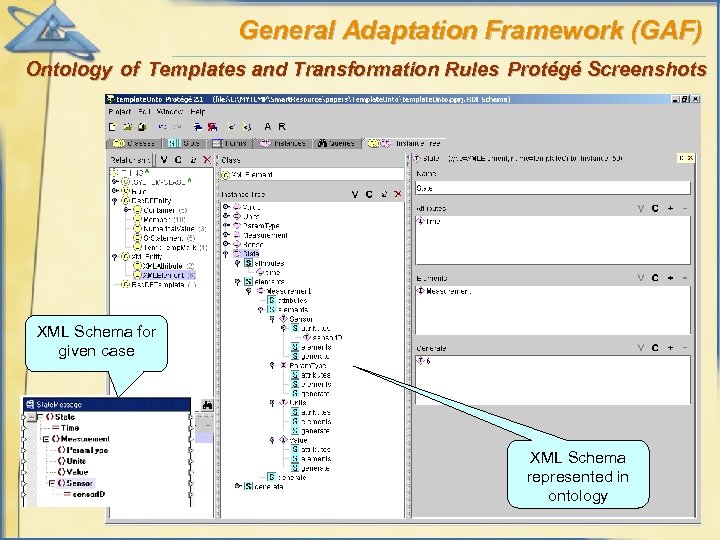
General Adaptation Framework (GAF) Ontology of Templates and Transformation Rules Protégé Screenshots XML Schema for given case XML Schema represented in ontology
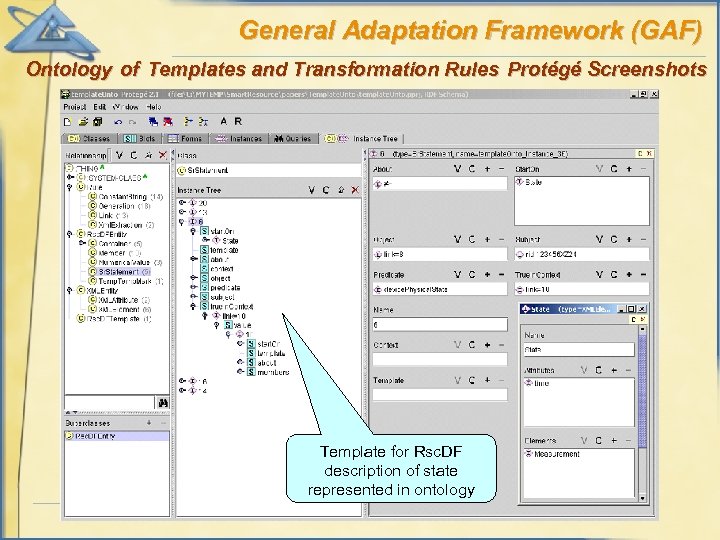
General Adaptation Framework (GAF) Ontology of Templates and Transformation Rules Protégé Screenshots Template for Rsc. DF description of state represented in ontology
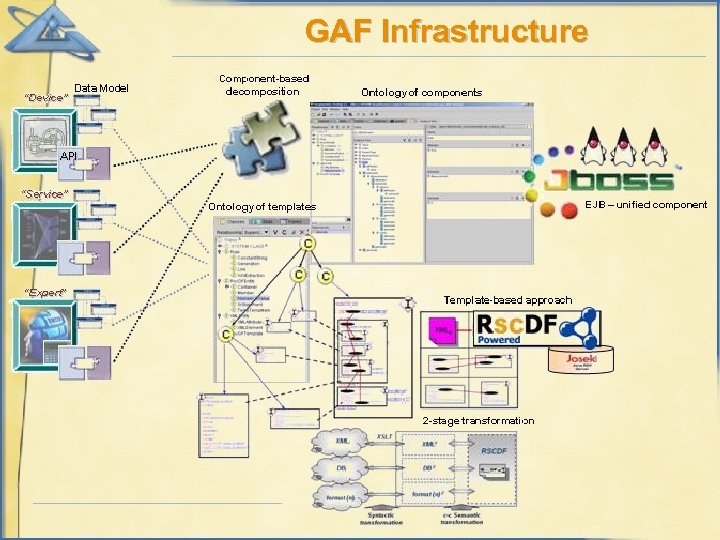
GAF Infrastructure
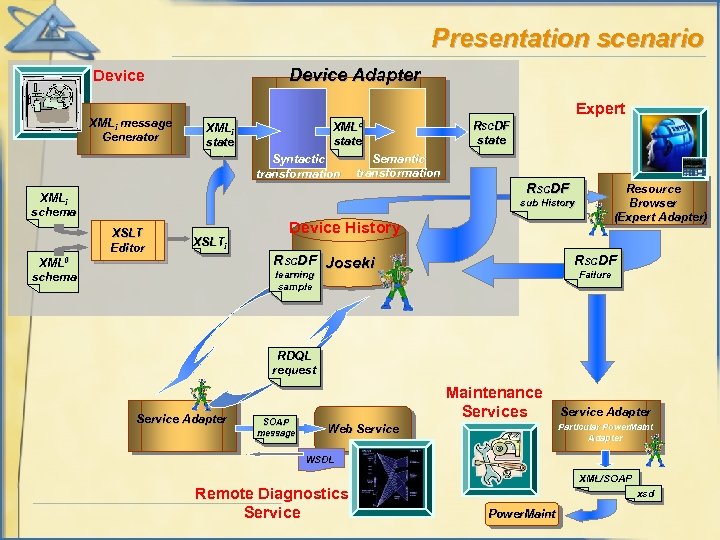
Presentation scenario Device Adapter Device XMLi message Generator Expert XMLo XMLi state Syntactic transformation RSCDF state Semantic transformation RSCDF sub History XMLi schema XSLT Editor XSLTi Device History RSCDF Joseki XML 0 schema Resource Browser (Expert Adapter) RSCDF learning sample Failure RDQL request Service Adapter SOAP message Maintenance Services Service Adapter Particular Power. Maint Adapter Web Service WSDL XML/SOAP Remote Diagnostics Service xsd Power. Maint
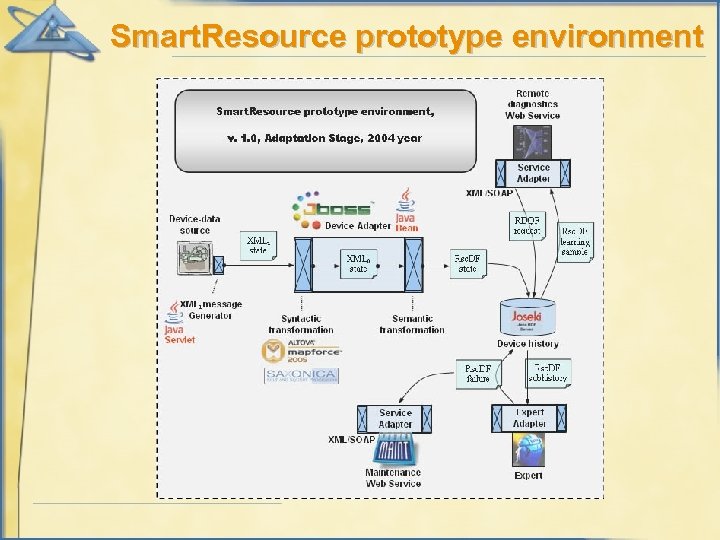
Smart. Resource prototype environment
Component Set JCA
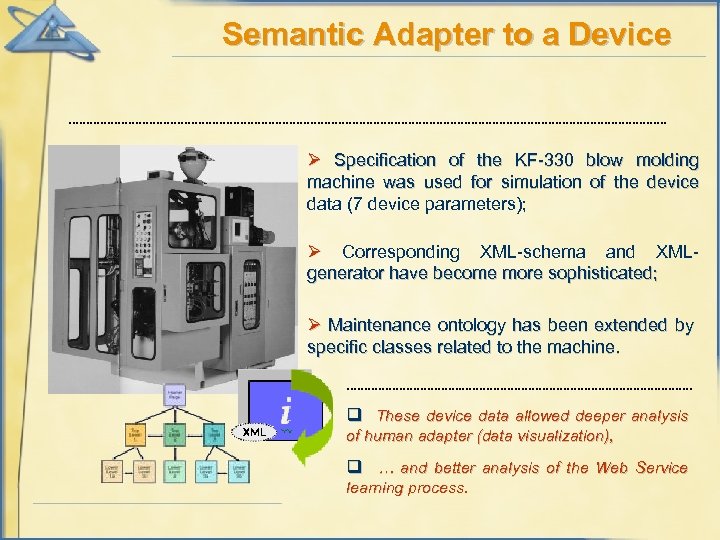
Semantic Adapter to a Device Ø Specification of the KF-330 blow molding machine was used for simulation of the device data (7 device parameters); Ø Corresponding XML-schema and XMLgenerator have become more sophisticated; Ø Maintenance ontology has been extended by specific classes related to the machine. q These device data allowed deeper analysis of human adapter (data visualization), q … and better analysis of the Web Service learning process.
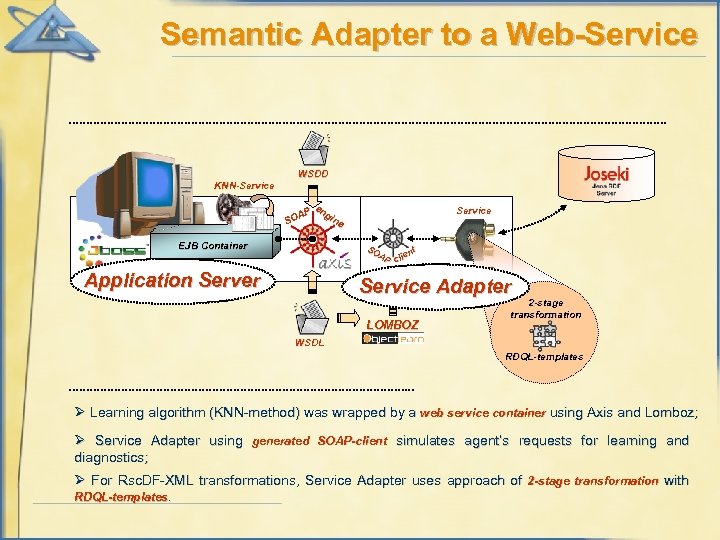
Semantic Adapter to a Web-Service WSDD KNN-Service e P ngi ne OA S EJB Container Service SO t AP lien c Application Server Adapter Service Adapter LOMBOZ 2 -stage transformation WSDL RDQL-templates Ø Learning algorithm (KNN-method) was wrapped by a web service container using Axis and Lomboz; Ø Service Adapter using generated SOAP-client simulates agent’s requests for learning and diagnostics; Ø For Rsc. DF-XML transformations, Service Adapter uses approach of 2 -stage transformation with RDQL-templates.
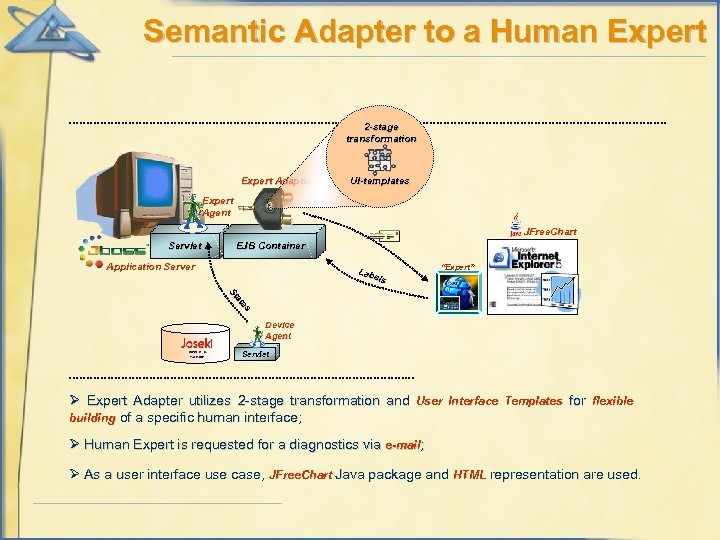
Semantic Adapter to a Human Expert 2 -stage transformation Expert Adapter UI-templates Expert Agent JFree. Chart Servlet EJB Container Application Server Lab els “Expert” es e at Stt S Device Agent Servlet Ø Expert Adapter utilizes 2 -stage transformation and User Interface Templates for flexible building of a specific human interface; Ø Human Expert is requested for a diagnostics via e-mail; Ø As a user interface use case, JFree. Chart Java package and HTML representation are used.
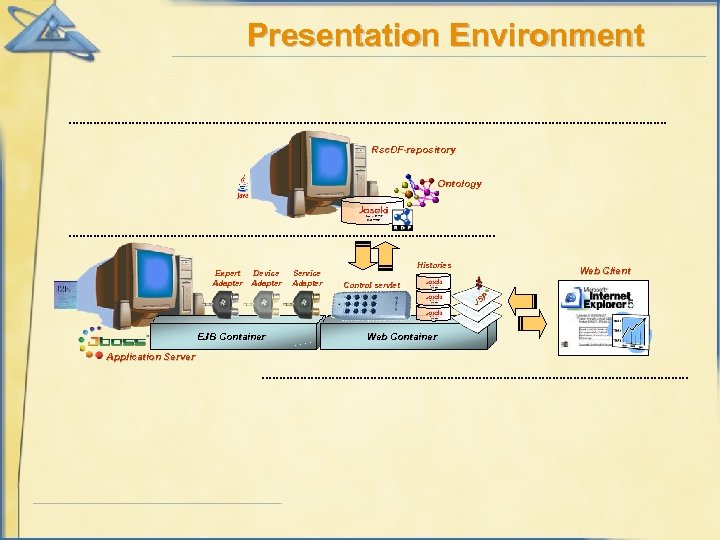
Presentation Environment Rsc. DF-repository Ontology Expert Adapter Device Adapter Service Adapter Histories Web Client Control servlet P JS EJB Container Application Server Web Container
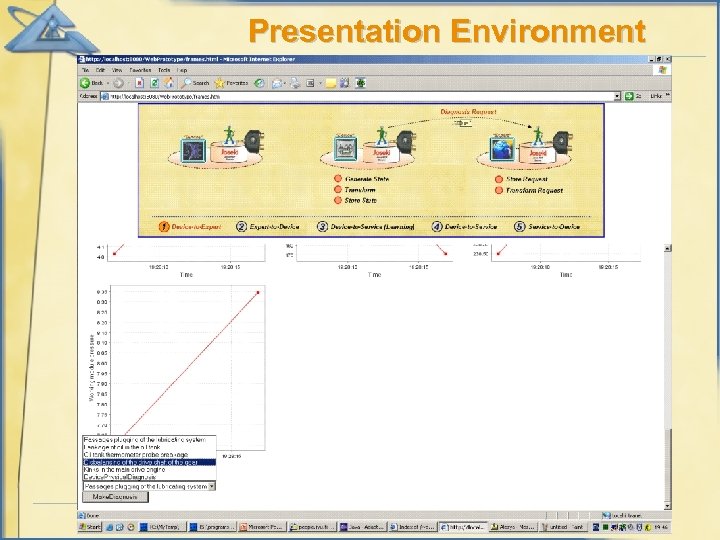
Presentation Environment
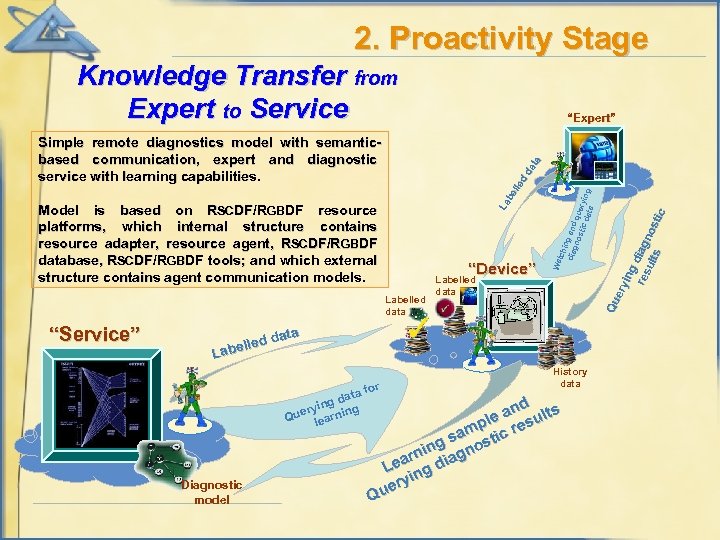
2. Proactivity Stage Knowledge Transfer from Expert to Service Model is based on RSCDF/RGBDF resource platforms, which internal structure contains resource adapter, resource agent, RSCDF/RGBDF database, RSCDF/RGBDF tools; and which external structure contains agent communication models. “Device” Labelled data “Service” Labelled data lled Labe r ta fo g da g ryin Que learnin Diagnostic model History data nd e a sults pl am tic re s ing gnos n ear g dia L n i ery Qu Qu ery ing res diag ult nos s tic La be lle d da ta Simple remote diagnostics model with semanticbased communication, expert and diagnostic service with learning capabilities. Wa tch in dia g and gno stic query dat ing a “Expert”
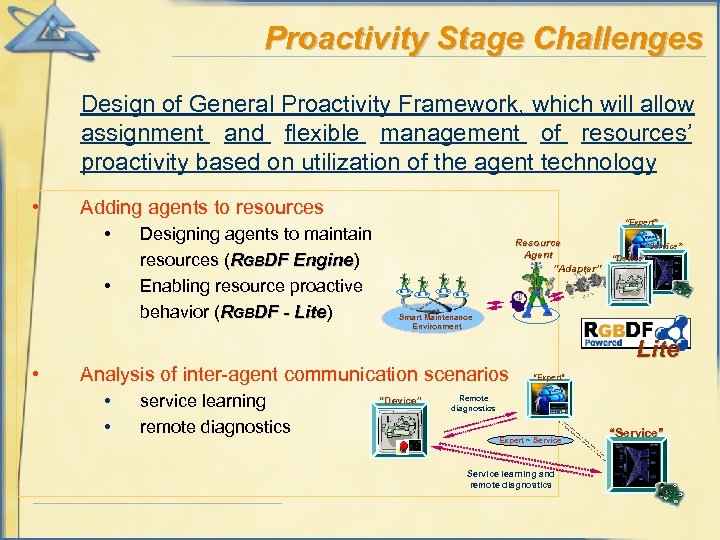
Proactivity Stage Challenges Design of General Proactivity Framework, which will allow assignment and flexible management of resources’ proactivity based on utilization of the agent technology • Adding agents to resources • • • Designing agents to maintain resources (RGBDF Engine) Engine Enabling resource proactive behavior (RGBDF - Lite) Lite “Expert” Resource Agent ”Adapter” Smart Maintenance Environment Analysis of inter-agent communication scenarios • • service learning remote diagnostics “Service” “Device” Lite “Expert” Remote diagnostics Expert ~ Service learning and remote diagnostics “Service”
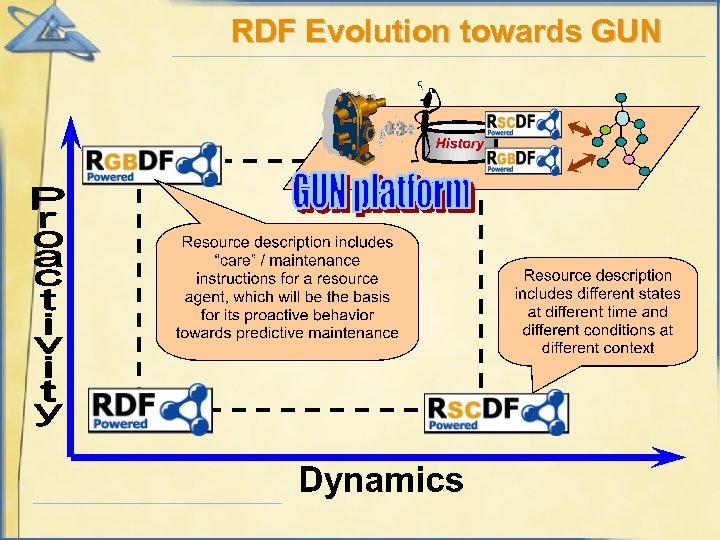
RDF Evolution towards GUN
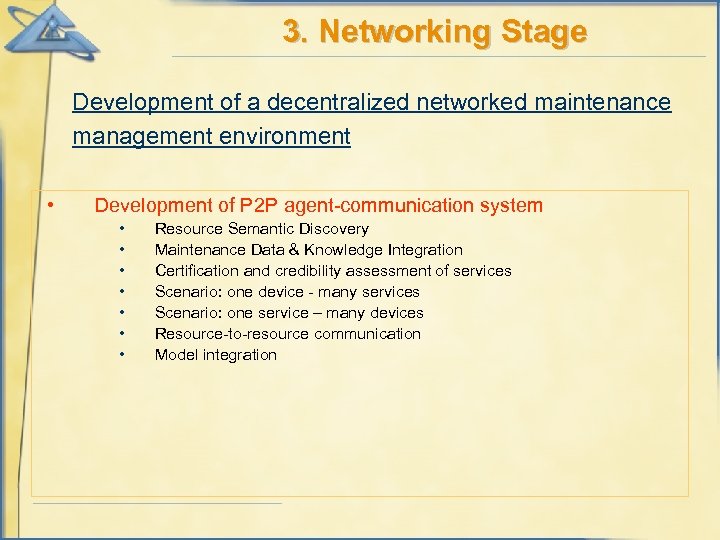
3. Networking Stage Development of a decentralized networked maintenance management environment • Development of P 2 P agent-communication system • • Resource Semantic Discovery Maintenance Data & Knowledge Integration Certification and credibility assessment of services Scenario: one device - many services Scenario: one service – many devices Resource-to-resource communication Model integration
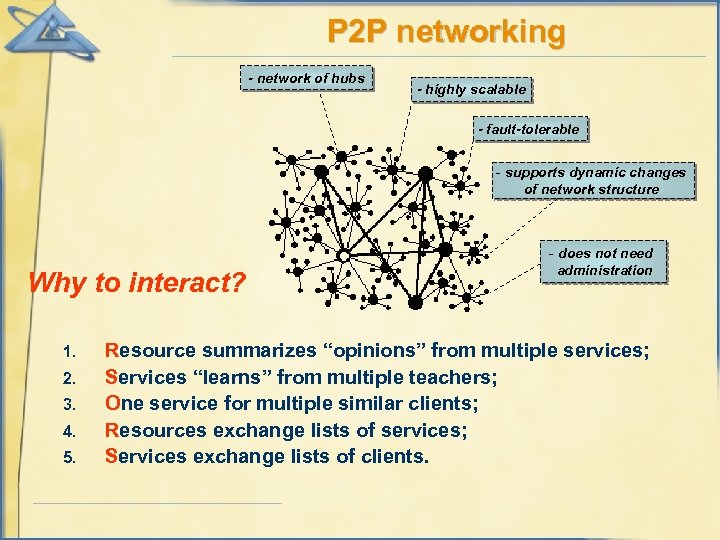
P 2 P networking - network of hubs - highly scalable - fault-tolerable - supports dynamic changes of network structure Why to interact? 1. 2. 3. 4. 5. - does not need administration Resource summarizes “opinions” from multiple services; Services “learns” from multiple teachers; One service for multiple similar clients; Resources exchange lists of services; Services exchange lists of clients.
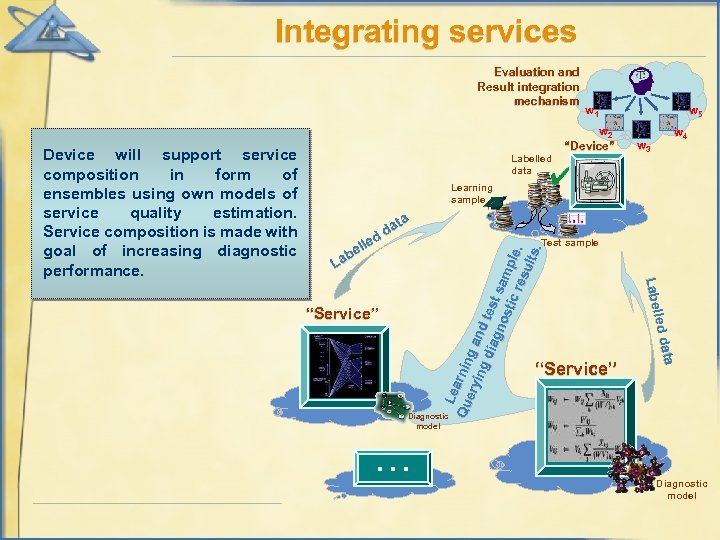
Integrating services Evaluation and Result integration mechanism Labelled data w 2 “Device” w 5 w 3 w 4 Learning sample “Service” Test sample Le Qu arnin e ry g ing and dia t est gno s stic a mpl res e. ults. ta da ed ell b La “Service” t ata led da lled d Label Labe Device will support service composition in form of ensembles using own models of service quality estimation. Service composition is made with goal of increasing diagnostic performance. w 1 Diagnostic model … Diagnostic model
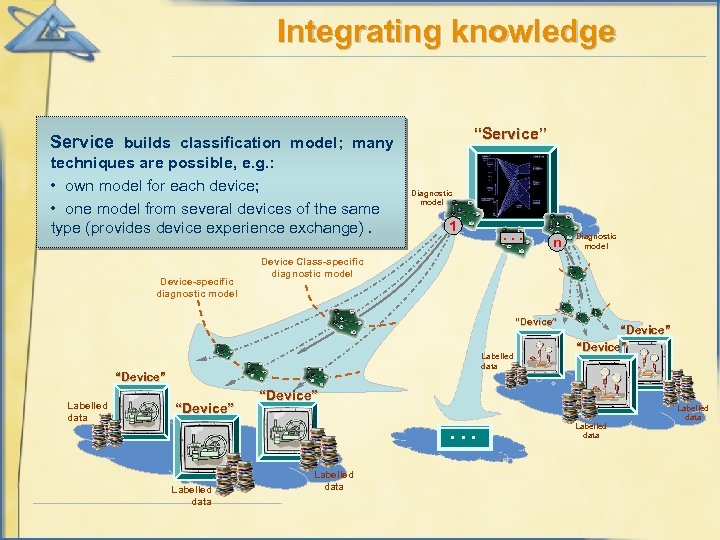
Integrating knowledge “Service” Service builds classification model; many techniques are possible, e. g. : • own model for each device; • one model from several devices of the same type (provides device experience exchange). Device-specific diagnostic model Diagnostic model 1 … n Device Class-specific diagnostic model “Device” Labelled data Diagnostic model “Device” … Labelled data
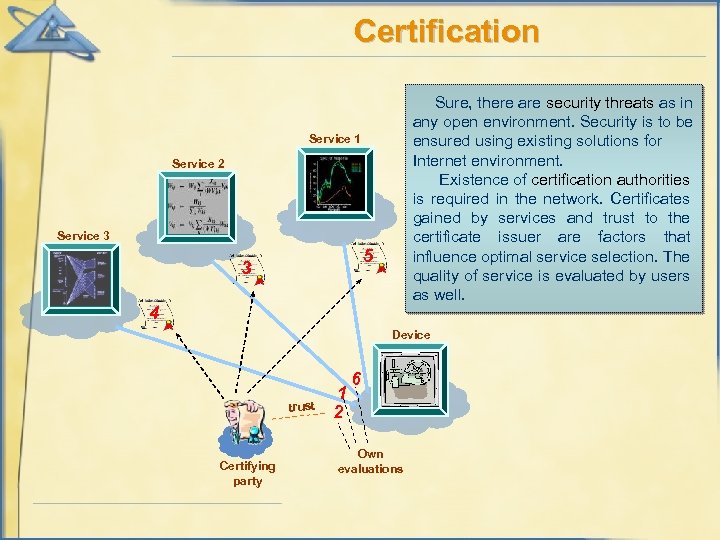
Certification Sure, there are security threats as in any open environment. Security is to be ensured using existing solutions for Internet environment. Existence of certification authorities is required in the network. Certificates gained by services and trust to the certificate issuer are factors that influence optimal service selection. The quality of service is evaluated by users as well. Service 1 Service 2 Service 3 5 3 4 Device trust Certifying party 1 2 6 Own evaluations
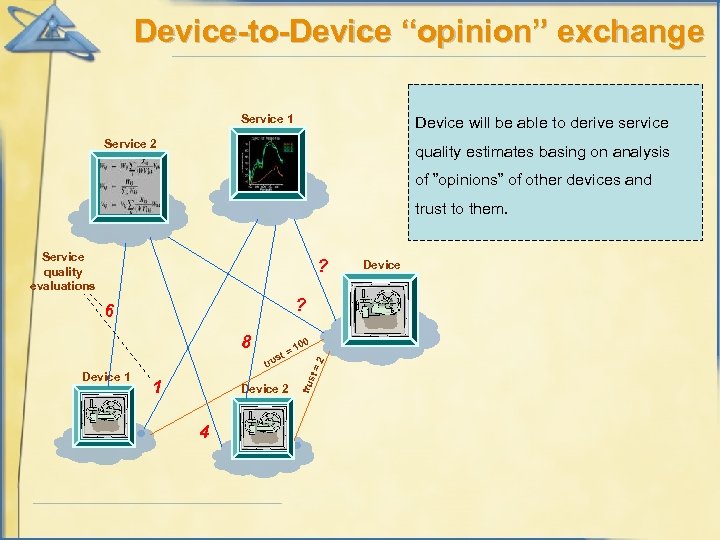
Device-to-Device “opinion” exchange Service 1 Device will be able to derive service Service 2 quality estimates basing on analysis of ”opinions” of other devices and trust to them. Service quality evaluations ? ? Device 1 t 1 Device 2 4 0 10 2 t= rus st = 8 tru 6 Device
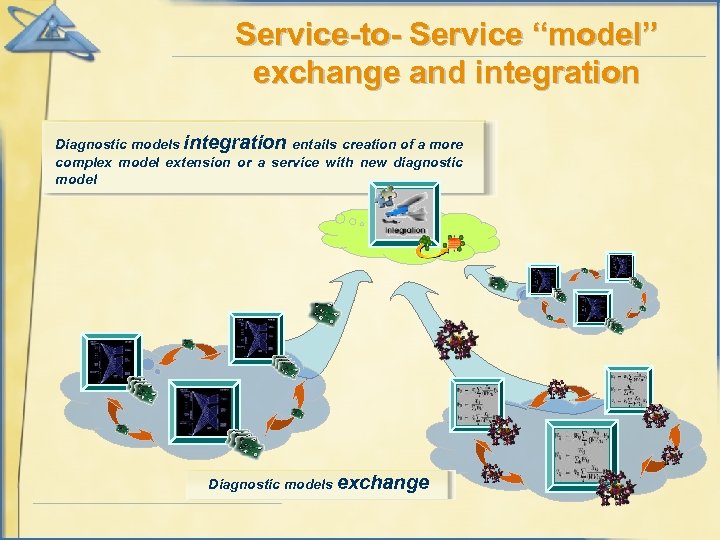
Service-to- Service “model” exchange and integration Diagnostic models integration entails creation of a more complex model extension or a service with new diagnostic model Diagnostic models exchange
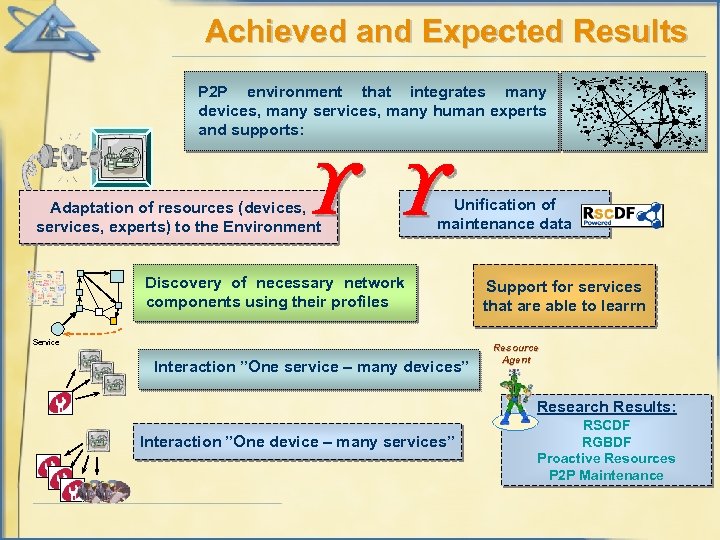
Achieved and Expected Results P 2 P environment that integrates many devices, many services, many human experts and supports: Adaptation of resources (devices, services, experts) to the Environment Unification of maintenance data Discovery of necessary network components using their profiles Service Interaction ”One service – many devices” Support for services that are able to learrn Resource Agent Research Results: Interaction ”One device – many services” RSCDF RGBDF Proactive Resources P 2 P Maintenance
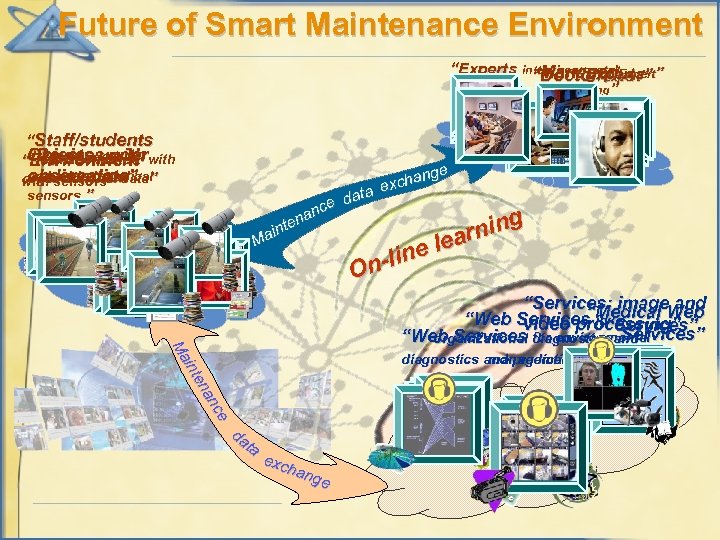
Future of Smart Maintenance Environment “Experts in“Doctor/Expert” ” environmental “Manager/Expert “Experts” monitoring” “Staff/students Objects with “Devicespatient with monitored ““Human/underwith Environment embedded medical observation on-line data” organizational with sensors ” data” sensors ” nge xcha e data ce an n inte ning Ma lear -line On e e nc an na en ne iintt Ma M “Services: image and “Medical Web “Web Services in“Services” video processing” Services” “Web Services diagnostics and organizational for environmental management” diagnostics and prediction” da ta exc han ge

New partners …are warmly welcome!
Obtain More Information about Smart. Resource from: Head of Smart. Resource Industrial Consortium (Steering Committee Head) Dr. Jouni Pyötsiä, Metso Automation Oy. Jouni. Pyotsia@metso. com , Tel. : 040 -548 -3544 Smart. Resource Contact Person Prof. Timo Tiihonen, Vice-Rector, University of Jyväskylä tiihonen@it. jyu. fi , Tel. : 014 -260 -2741 Smart. Resource Project Leader Prof. Vagan Terziyan, Agora Center, University of Jyväskylä vagan@it. jyu. fi , Tel. : 014 -260 -4618
Скачать презентацию Smart Resource Utilizing Semantic Web Services to Monitor
8726647bf6eb731379bc178e5c55706c.ppt