


 Скачать презентацию SMART Math Jackson State Community College Jackson Tennessee
544e6eb3153766496e97821329ba8789.ppt
- Количество слайдов: 16
 SMART Math Jackson State Community College Jackson, Tennessee www. jscc. edu/smart-math Winner of the prestigious 2010 Bellwether Award in the category of Innovative Instruction and Services Given by Community College Futures Assembly Betty Frost, Presenter Assoc. Prof. of Mathematics NCAT Scholar bfrost@jscc. edu
 Tennessee Board of Regents 2005 -2010 Strategic Plan Objective A 8 n Increase speed and success of remedial/developmental work for students requiring it to become college-ready. Strategy A 8 n Establish a best practice, system-wide, communitycollege-based remedial/developmental program that is substantially technology driven, composed of language arts and mathematics, and allows students to identify and focus on the academic areas where they are deficient.
 Mathematical Association of America MAA publication Supporting Assessment in Undergraduate Mathematics © 2006 “The goal for Developmental Studies seems clear: Prepare students for credit bearing courses. However, judging by the course content, the goal often appears to be remediating what students haven’t learned in grades K-12. These two goals may be quite different. High Schools attempt to prepare children for all possible educational futures, including majoring in mathematics. Once the student is in college, that educational aim may be much better defined, and the student may not ever need to study calculus. So remediating the high school deficiencies may not be necessary or appropriate. ”
 What was the problem? n n n n Three Traditional Courses: Basic Mathematics, Elementary Algebra and Intermediate Algebra Pass Rate: 42% Attempted to remediate high school math deficiencies Student had to pass course or start over next term Student had to successfully complete all three courses before enrolling in Allied Health or Nursing programs or taking certain college level courses Student class time was inflexible Each instructor designed own course agenda, lectures, homework assignments, and tests Course Drift
 Timeline for Our Redesign §Spring 2007 – attended statewide NCAT seminar §Summer 2007 – wrote & submitted proposal to NCAT §Fall 2007 – Notified that our proposal was selected. Began plan for implementing Pilot 1 in Spring 2008 §Spring 2008 - Pilot 1 - Offered Parallel Sections • Traditional - Taught by “traditional” instructors • Redesign - In SMART Math Center Began process to change • Courses to modules • Programs and Courses with DSPM Prerequisites identified modules needed for success §Fall 2008 - Pilot 2 – Offered mostly Redesign Sections (One section of traditional). §Spring 2009 - Pilot 3 –SMART Math fully implemented!
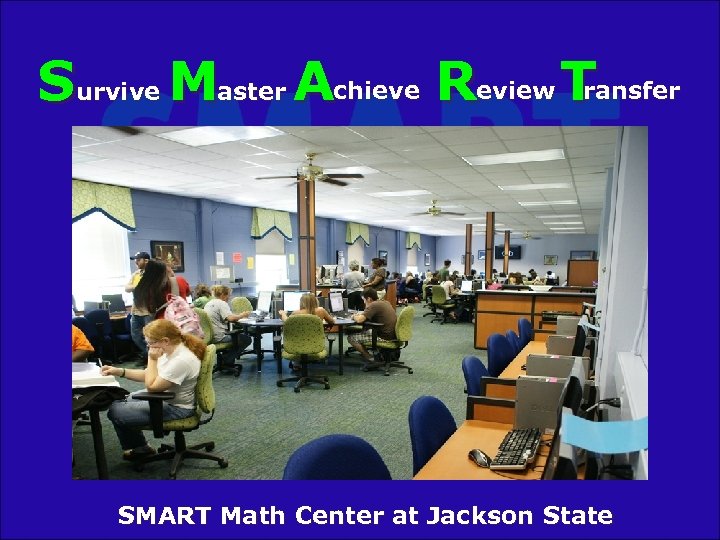 ransfer Survive Master Achieve Review T SMART Math Center at Jackson State
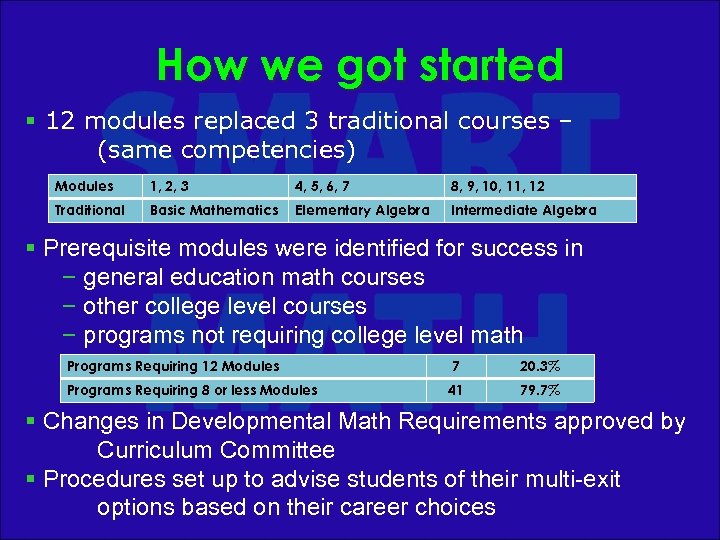 How we got started § 12 modules replaced 3 traditional courses – (same competencies) Modules 1, 2, 3 4, 5, 6, 7 8, 9, 10, 11, 12 Traditional Basic Mathematics Elementary Algebra Intermediate Algebra § Prerequisite modules were identified for success in ‒ general education math courses ‒ other college level courses ‒ programs not requiring college level math Programs Requiring 12 Modules 7 20. 3% Programs Requiring 8 or less Modules 41 79. 7% § Changes in Developmental Math Requirements approved by Curriculum Committee § Procedures set up to advise students of their multi-exit options based on their career choices
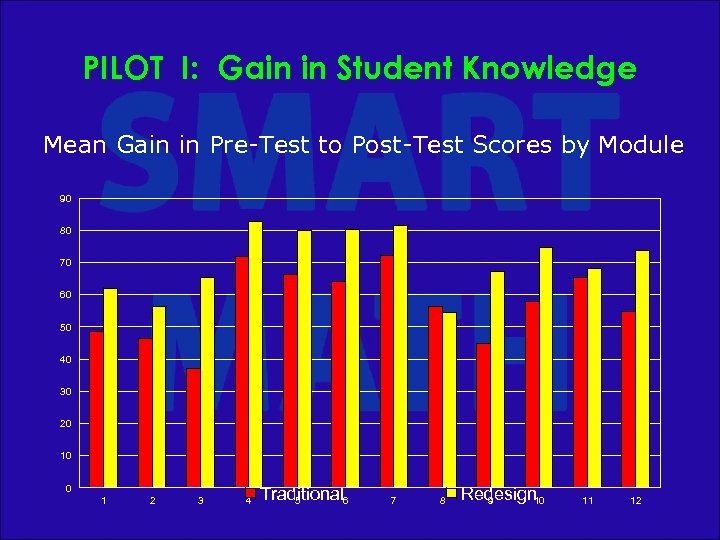 PILOT I: Gain in Student Knowledge Mean Gain in Pre-Test to Post-Test Scores by Module 90 80 70 60 50 40 30 20 10 0 1 2 3 4 Traditional 6 5 7 8 Redesign 9 10 11 12
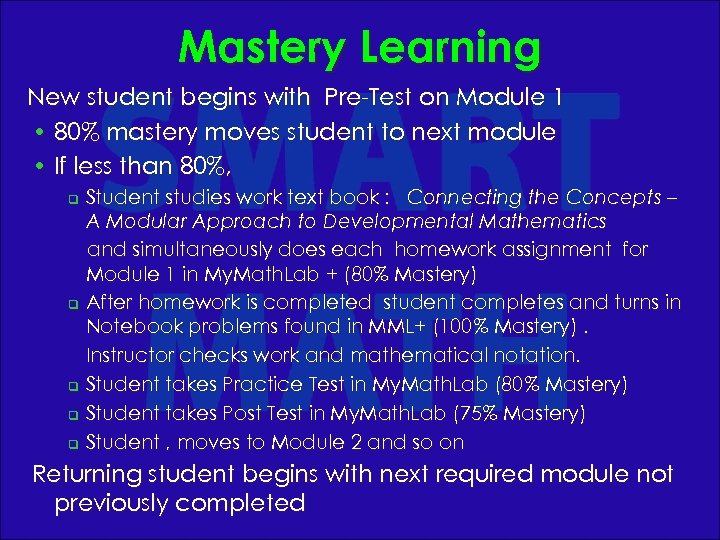 Mastery Learning New student begins with Pre-Test on Module 1 • 80% mastery moves student to next module • If less than 80%, q q q Student studies work text book : Connecting the Concepts – A Modular Approach to Developmental Mathematics and simultaneously does each homework assignment for Module 1 in My. Math. Lab + (80% Mastery) After homework is completed student completes and turns in Notebook problems found in MML+ (100% Mastery). Instructor checks work and mathematical notation. Student takes Practice Test in My. Math. Lab (80% Mastery) Student takes Post Test in My. Math. Lab (75% Mastery) Student , moves to Module 2 and so on Returning student begins with next required module not previously completed
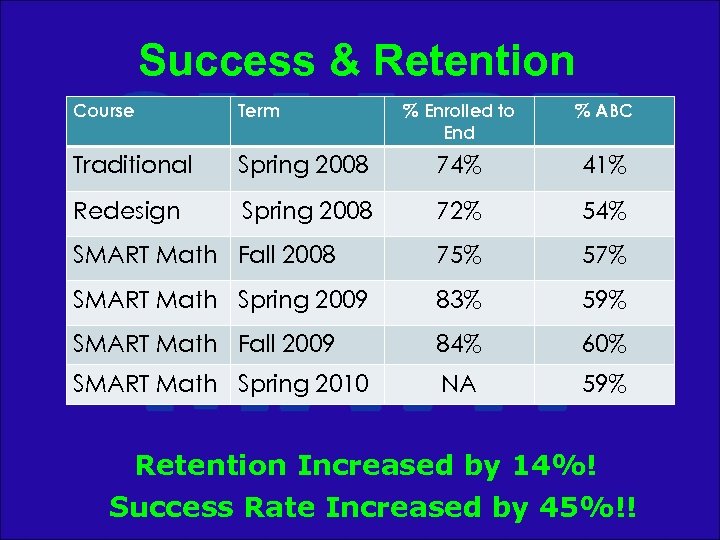 Success & Retention Course Term % Enrolled to End % ABC Traditional Spring 2008 74% 41% Redesign Spring 2008 72% 54% SMART Math Fall 2008 75% 57% SMART Math Spring 2009 83% 59% SMART Math Fall 2009 84% 60% SMART Math Spring 2010 NA 59% Retention Increased by 14%! Success Rate Increased by 45%!!
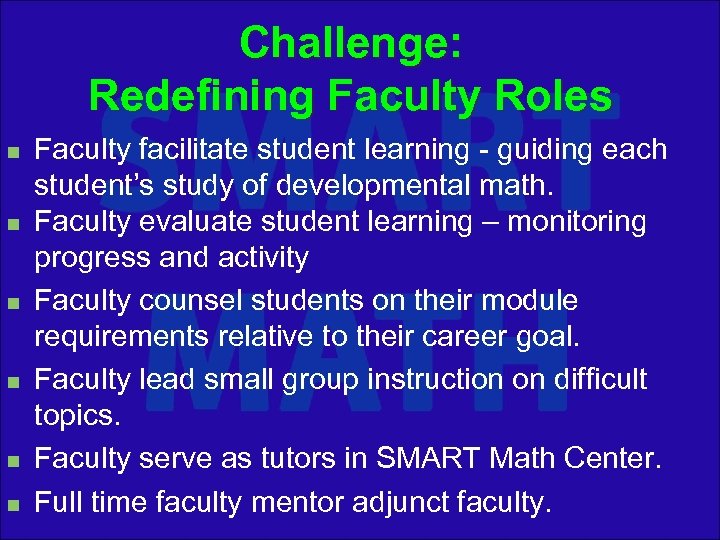 Challenge: Redefining Faculty Roles n n n Faculty facilitate student learning - guiding each student’s study of developmental math. Faculty evaluate student learning – monitoring progress and activity Faculty counsel students on their module requirements relative to their career goal. Faculty lead small group instruction on difficult topics. Faculty serve as tutors in SMART Math Center. Full time faculty mentor adjunct faculty.
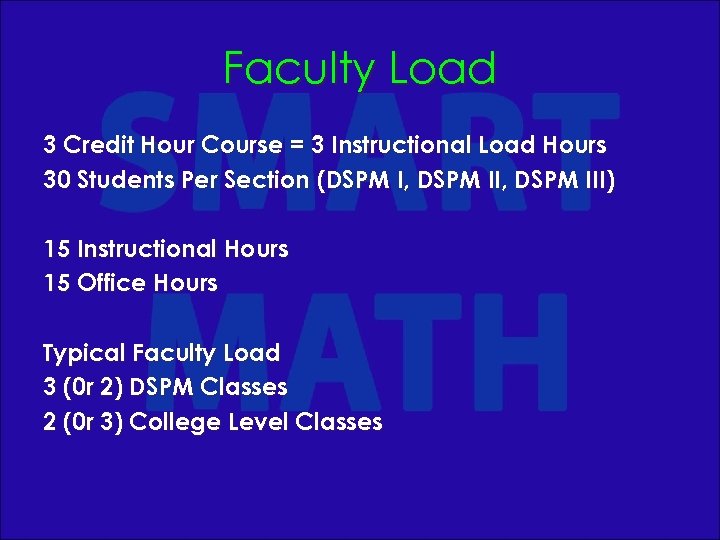 Faculty Load 3 Credit Hour Course = 3 Instructional Load Hours 30 Students Per Section (DSPM I, DSPM III) 15 Instructional Hours 15 Office Hours Typical Faculty Load 3 (0 r 2) DSPM Classes 2 (0 r 3) College Level Classes
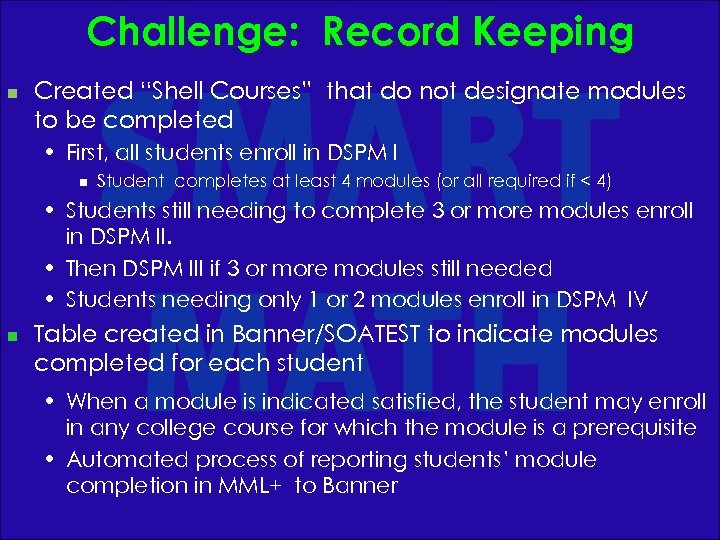 Challenge: Record Keeping n Created “Shell Courses” that do not designate modules to be completed • First, all students enroll in DSPM I n Student completes at least 4 modules (or all required if < 4) • Students still needing to complete 3 or more modules enroll in DSPM II. • Then DSPM III if 3 or more modules still needed • Students needing only 1 or 2 modules enroll in DSPM IV n Table created in Banner/SOATEST to indicate modules completed for each student • When a module is indicated satisfied, the student may enroll in any college course for which the module is a prerequisite • Automated process of reporting students’ module completion in MML+ to Banner
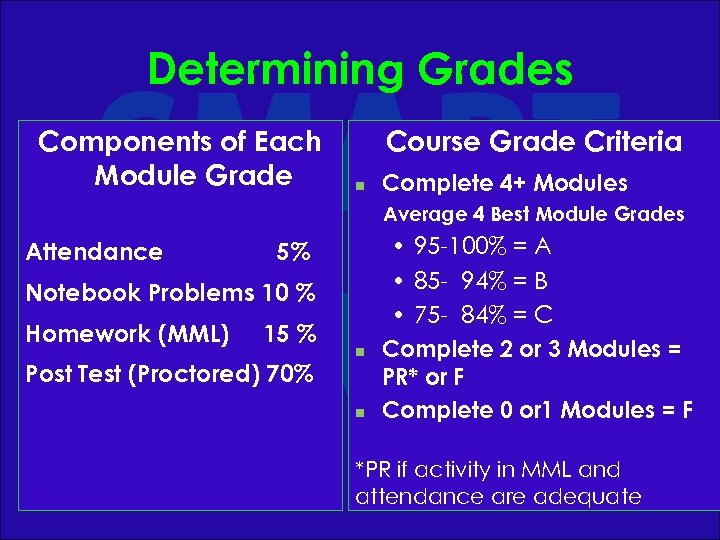 Determining Grades Components of Each Module Grade Course Grade Criteria n Complete 4+ Modules Average 4 Best Module Grades Attendance • 95 -100% = A • 85 - 94% = B • 75 - 84% = C 5% Notebook Problems 10 % Homework (MML) 15 % Post Test (Proctored) 70% n n Complete 2 or 3 Modules = PR* or F Complete 0 or 1 Modules = F *PR if activity in MML and attendance are adequate
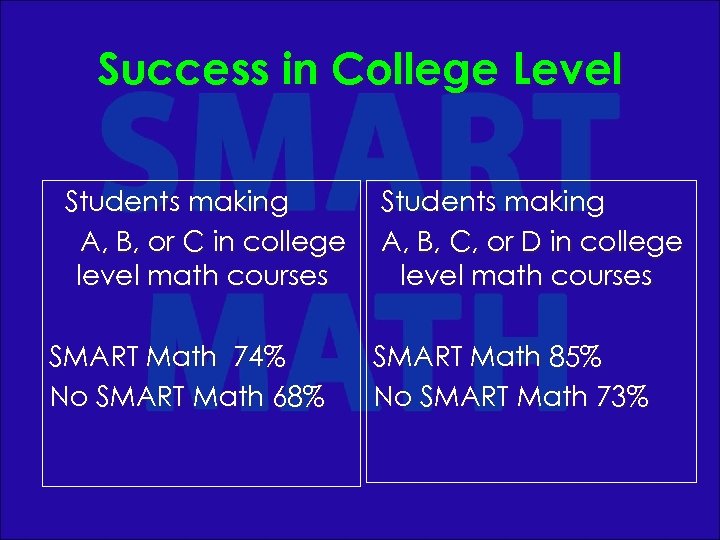 Success in College Level Students making A, B, or C in college level math courses SMART Math 74% No SMART Math 68% Students making A, B, C, or D in college level math courses SMART Math 85% No SMART Math 73%
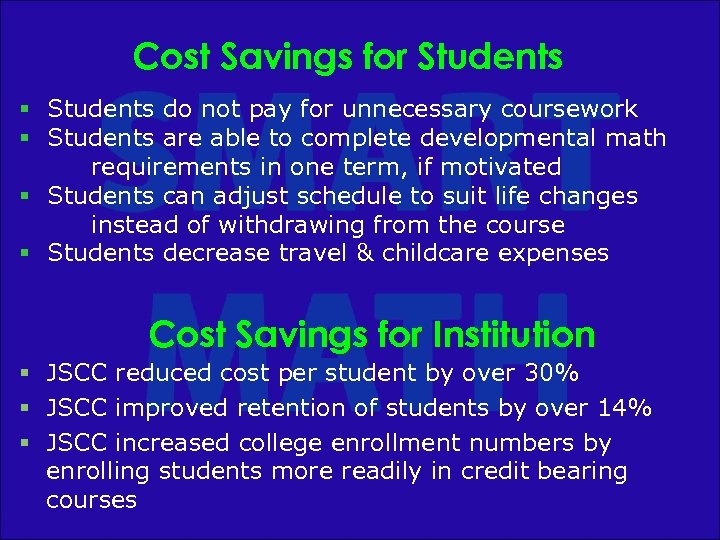 Cost Savings for Students § Students do not pay for unnecessary coursework § Students are able to complete developmental math requirements in one term, if motivated § Students can adjust schedule to suit life changes instead of withdrawing from the course § Students decrease travel & childcare expenses Cost Savings for Institution § JSCC reduced cost per student by over 30% § JSCC improved retention of students by over 14% § JSCC increased college enrollment numbers by enrolling students more readily in credit bearing courses