 Скачать презентацию Smart materials in the Republic of Moldova Dr
65db550dbbac1696f6b92f4a87a68129.ppt
- Количество слайдов: 19



Smart materials in the Republic of Moldova Dr. Olga Covaliova, Coord. Researcher, Institute of Chemistry of the Academy of Sciences of Moldova Chisinau, MD 2028, Republic of Moldova Str. Academiei 3, Tel. +373 22 727911 Black Sea Horizon International Workshop “Applied research in chemistry: Smart materials for a smart future” Identifying perspective areas of STI Cooperation between the European Union and the Black Sea region in the field of smart materials 31 March 2016, Sofia, Bulgaria
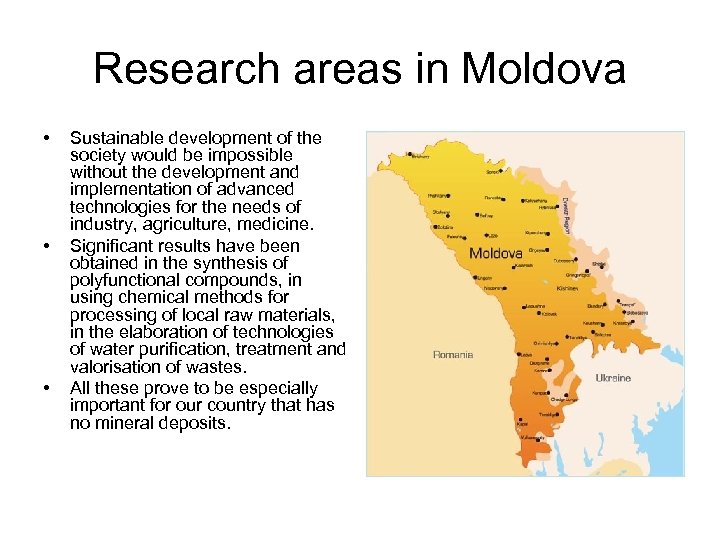
Research areas in Moldova • • • Sustainable development of the society would be impossible without the development and implementation of advanced technologies for the needs of industry, agriculture, medicine. Significant results have been obtained in the synthesis of polyfunctional compounds, in using chemical methods for processing of local raw materials, in the elaboration of technologies of water purification, treatment and valorisation of wastes. All these prove to be especially important for our country that has no mineral deposits.
Chemistry research in Moldova • • Chemical studies in the Republic of Moldova started in the 1950 s. Research findings acknowledged worldwide are mostly in the areas related to inorganic chemistry (chemistry of coordination compounds), organic and bioorganic chemistry, quantum and physical chemistry, analytical and ecological chemistry – branches of the modern chemistry that have been formed and firmly established since the very beginning of the activity of profile institutions. At present, on the base of previous success, the research in chemistry is being intensely developed at following institutions: the Institute of Chemistry of the Academy of Sciences of Moldova, the Faculty of Chemistry and Chemical Technology of Moldova State University, the State University of Medicine and Pharmacy “Nicolae Testemitanu”, the Technical University of Moldova, the State Agrarian University of Moldova, other scientific and educational institutions.
Coordination compounds • Coordination compounds with various useful properties: polynuclear compounds of Cr(III) as molecular magnets, catalysts of technological and biotechnological processes, macrocyclic colorants for plastics and synthetic fibres; • New compounds for obtaining extra-pure metals, • Compounds for ion selective electrodes; • Agents for anticorrosive coating and protection of metals. • Coordination combinations with anticancer, antiviral, antibacterial, anticoccidial, antidote properties; growth regulators for plants and algae.
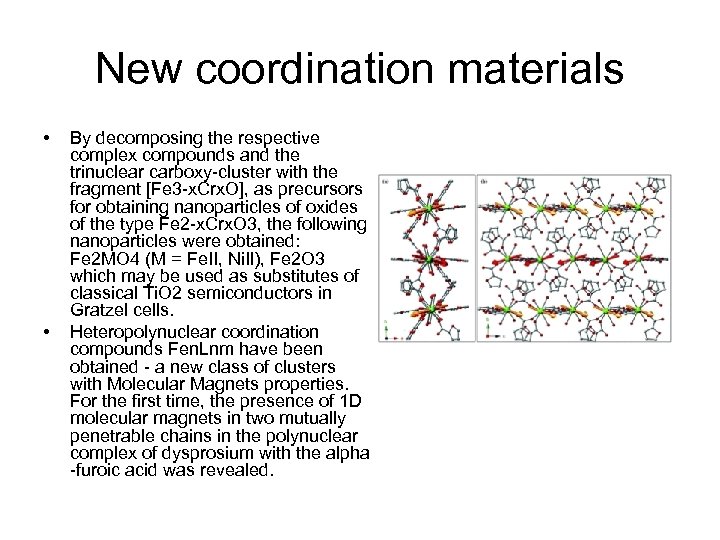
New coordination materials • • By decomposing the respective complex compounds and the trinuclear carboxy-cluster with the fragment [Fe 3 -x. Crx. O], as precursors for obtaining nanoparticles of oxides of the type Fe 2 -x. Crx. O 3, the following nanoparticles were obtained: Fe 2 MO 4 (M = Fe. II, Ni. II), Fe 2 O 3 which may be used as substitutes of classical Ti. O 2 semiconductors in Gratzel cells. Heteropolynuclear coordination compounds Fen. Lnm have been obtained - a new class of clusters with Molecular Magnets properties. For the first time, the presence of 1 D molecular magnets in two mutually penetrable chains in the polynuclear complex of dysprosium with the alpha -furoic acid was revealed.
Coordination compounds: recent studies • Synthesis of polydentate polyfunctional ligands based on triphenyl and bis-mezythyl containing the donor carboxyl groups; • Synthesis of porous polymer coordination compounds of transition elements (Fe, Co, Ni, Cu, Zn) with synthetic ligands; • Porous coordination polymers of Fe, Co, Ni, Zn with polydentate polyfunctional ligands based on terfenyl and bis-mezythil • These compounds can be used for gases sorbtion/desorbtion (hydrogen, carbon dioxide, nitrogen)
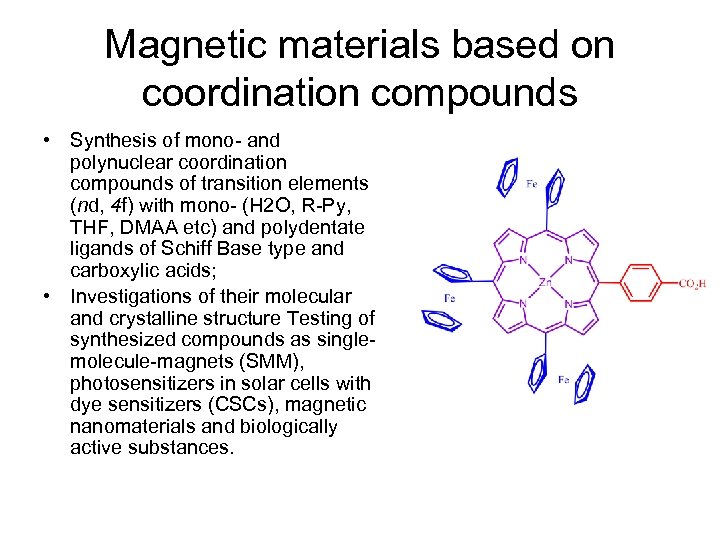
Magnetic materials based on coordination compounds • Synthesis of mono- and polynuclear coordination compounds of transition elements (nd, 4 f) with mono- (H 2 O, R-Py, THF, DMAA etc) and polydentate ligands of Schiff Base type and carboxylic acids; • Investigations of their molecular and crystalline structure Testing of synthesized compounds as singlemolecule-magnets (SMM), photosensitizers in solar cells with dye sensitizers (CSCs), magnetic nanomaterials and biologically active substances.
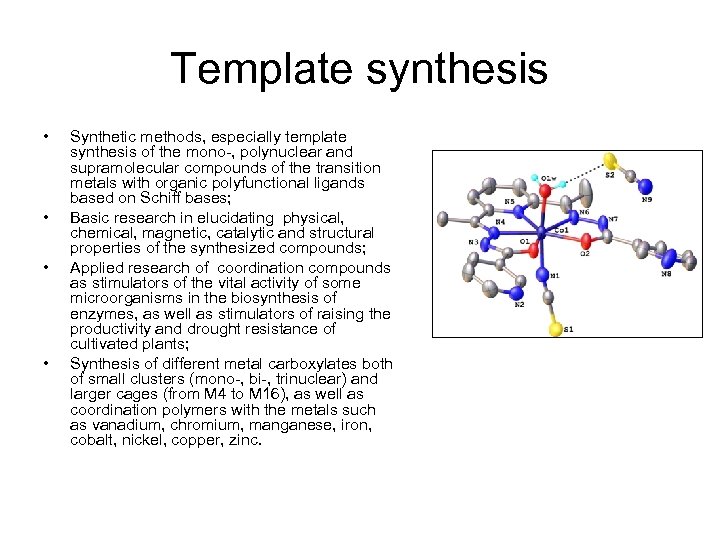
Template synthesis • • Synthetic methods, especially template synthesis of the mono-, polynuclear and supramolecular compounds of the transition metals with organic polyfunctional ligands based on Schiff bases; Basic research in elucidating physical, chemical, magnetic, catalytic and structural properties of the synthesized compounds; Applied research of coordination compounds as stimulators of the vital activity of some microorganisms in the biosynthesis of enzymes, as well as stimulators of raising the productivity and drought resistance of cultivated plants; Synthesis of different metal carboxylates both of small clusters (mono-, bi-, trinuclear) and larger cages (from M 4 to M 16), as well as coordination polymers with the metals such as vanadium, chromium, manganese, iron, cobalt, nickel, copper, zinc.
Organic materials and substances • Odorant products, aromatizers and biologically active products based on natural terpenes, used in tobacco processing, perfumery, medicine. • Organic substances with psychostimulating, anticonvulsant, sedative, tranquilizing, antimycotic effects; • Regulators of cardiac activity; compounds with significant tuberculostatic activity.
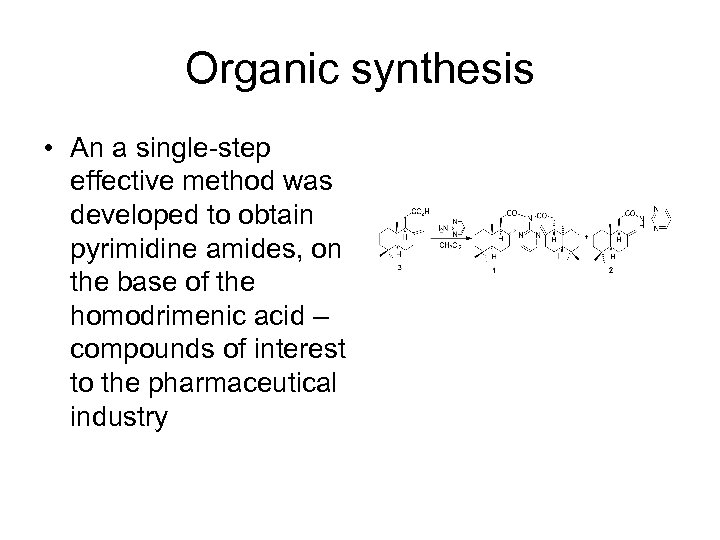
Organic synthesis • An a single-step effective method was developed to obtain pyrimidine amides, on the base of the homodrimenic acid – compounds of interest to the pharmaceutical industry
New organic materials of practical interest • • • Methods to reduce norambreinolide and to obtain new preparations: ambrol, ketoxide, sclareoloxide and ionoxide were developed and implemented, as well as those of sclareol isolation, of obtaining enriched fennel oil anethole; Methods for the preparation of an analogue of ambrox were developed, then, for the preparation of norambreinolide and sclareoloxid, of a series of more than 20 compounds with strong amber odor of the norlabdane and homotrichinane class; A number of tobacco flavoring compositions an were obtained and a series of drimane compounds with potential biological activity was synthesized; An effective way was developed for the sclareol ozonolytic splitting into sclareoloxide, with the yield of 97 %, which is a useful product for perfumery, cosmetics and tobacco processing; All developments are protected by patents. The implemented ones have already found application in perfumery industry, tobacco processing, essential oils industry. Currently work is carried out on compounds of interest for pharmacology.
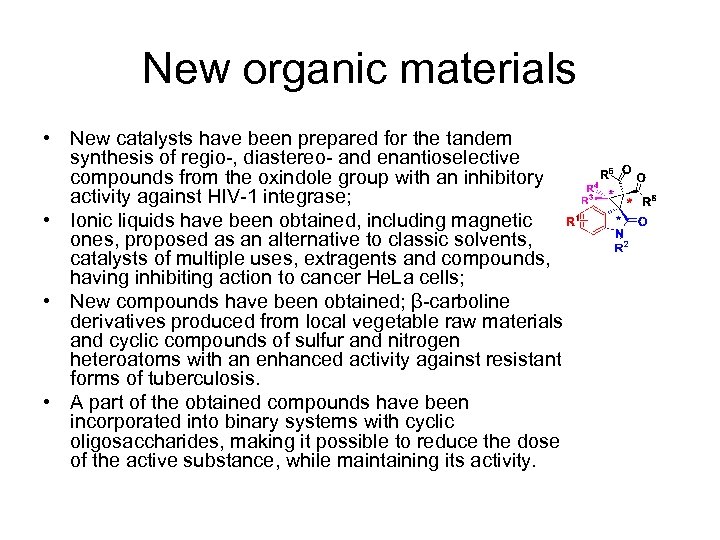
New organic materials • New catalysts have been prepared for the tandem synthesis of regio-, diastereo- and enantioselective compounds from the oxindole group with an inhibitory activity against HIV-1 integrase; • Ionic liquids have been obtained, including magnetic ones, proposed as an alternative to classic solvents, catalysts of multiple uses, extragents and compounds, having inhibiting action to cancer He. La cells; • New compounds have been obtained; β-carboline derivatives produced from local vegetable raw materials and cyclic compounds of sulfur and nitrogen heteroatoms with an enhanced activity against resistant forms of tuberculosis. • A part of the obtained compounds have been incorporated into binary systems with cyclic oligosaccharides, making it possible to reduce the dose of the active substance, while maintaining its activity.
Active carbons • Procedures of obtaining and regenerating of activated carbons from vegetable waste; • medicinal preparations based on activated carbons, catalysts and adsorbents for the purification of ground and surface waters. • New functionalized ionic liquids as renewable catalysts for chemoselective redox processes; • Adsorbents were obtained, based on the intercalated bentonite from Moldova. They may be used as adsorbents/catalysts in technologies of purification of drinking water and/or wastewater from admixtures and pollutants
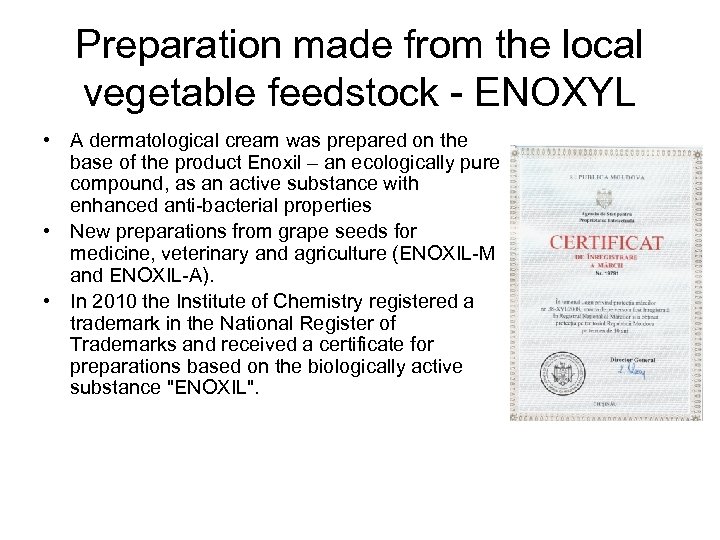
Preparation made from the local vegetable feedstock - ENOXYL • A dermatological cream was prepared on the base of the product Enoxil – an ecologically pure compound, as an active substance with enhanced anti-bacterial properties • New preparations from grape seeds for medicine, veterinary and agriculture (ENOXIL-M and ENOXIL-A). • In 2010 the Institute of Chemistry registered a trademark in the National Register of Trademarks and received a certificate for preparations based on the biologically active substance "ENOXIL".
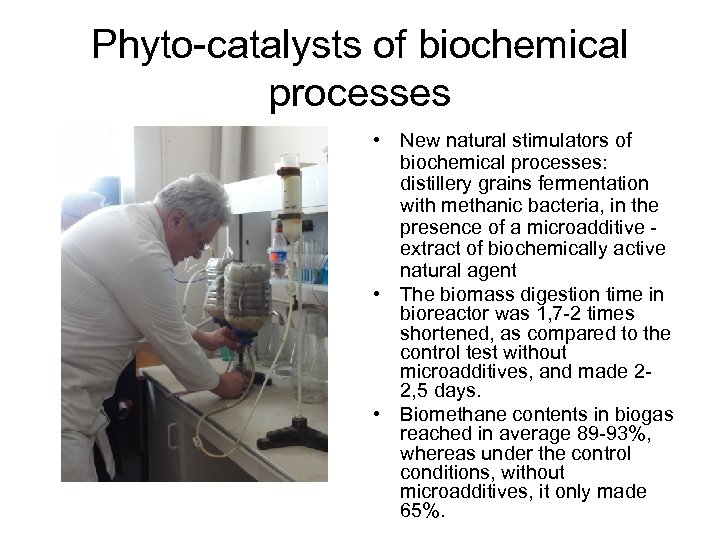
Phyto-catalysts of biochemical processes • New natural stimulators of biochemical processes: distillery grains fermentation with methanic bacteria, in the presence of a microadditive extract of biochemically active natural agent • The biomass digestion time in bioreactor was 1, 7 -2 times shortened, as compared to the control test without microadditives, and made 22, 5 days. • Biomethane contents in biogas reached in average 89 -93%, whereas under the control conditions, without microadditives, it only made 65%.
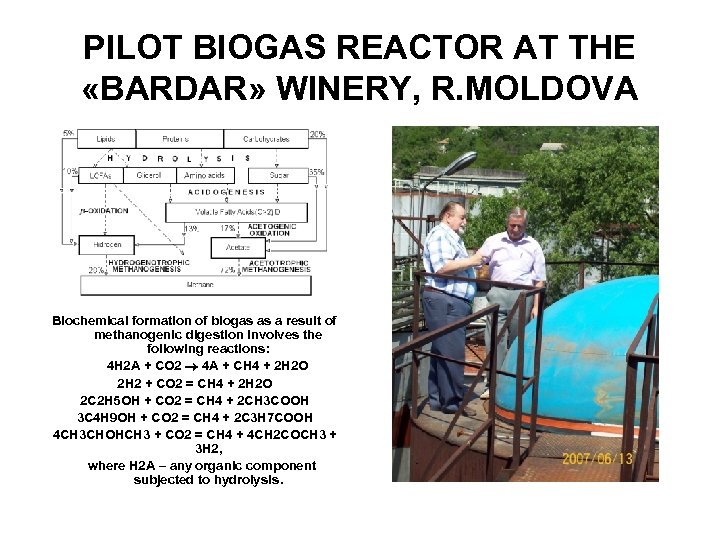
PILOT BIOGAS REACTOR AT THE «BARDAR» WINERY, R. MOLDOVA Biochemical formation of biogas as a result of methanogenic digestion involves the following reactions: 4 Н 2 А + СО 2 4 А + СН 4 + 2 Н 2 О 2 Н 2 + СО 2 = СН 4 + 2 Н 2 О 2 С 2 Н 5 ОН + СО 2 = СН 4 + 2 СН 3 СООН 3 С 4 Н 9 ОН + СО 2 = СН 4 + 2 С 3 Н 7 СООН 4 СН 3 СНОНСН 3 + СО 2 = СН 4 + 4 СН 2 СОСН 3 + 3 Н 2, where Н 2 А – any organic component subjected to hydrolysis.
Perspective research areas • The synthesis and study of new polyfunctional compounds of inorganic and organic nature • Elaboration of chemical, physicochemical, biochemical processes using the newly developed materials with targeted properties
Proposed thematic subtopics for Research Programmes related to smart materials • Coordination compounds with various properties • Organic biologically active compounds, including natural ones • Synthesis and testing of phyto-catalysts for biochemical processes • Technologies for the synthesis of activated carbons and activation of mineral sorbents
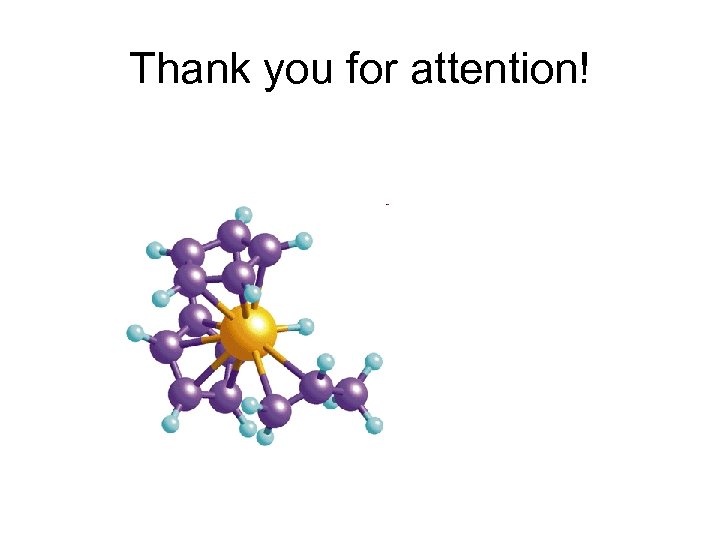
Thank you for attention!
Скачать презентацию Smart materials in the Republic of Moldova Dr
65db550dbbac1696f6b92f4a87a68129.ppt