


 Скачать презентацию Smart Impact Meeting Report 31 st January
5c76af7a6ba34eeb884a3679543c1ab6.ppt
- Количество слайдов: 25
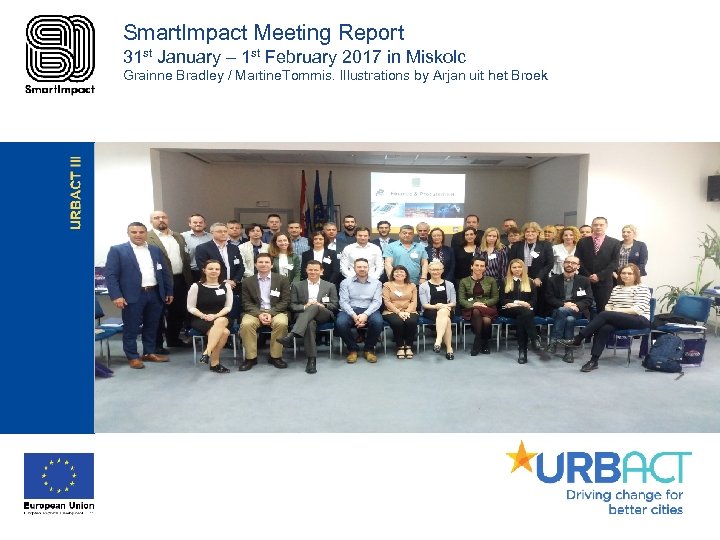 Smart. Impact Meeting Report 31 st January – 1 st February 2017 in Miskolc Grainne Bradley / Martine. Tommis. Illustrations by Arjan uit het Broek Add your photo
 Agenda Day 1 • Smart City Finance Day 2 • Recap of day 1 • European Investment Bank – role and opportunities • Mid Term Review and final product • Smart Cities - Barriers & Challenges and Success Stories • IAP Peer Review – Dublin • Tools & opportunities for innovative project financing • IAP Peer Review - Smolyan • Project Finance Workshops
 Financing Smart Projects Questions to consider: • What are the benefits of a specific smart city investment? • What does it cost and why should I spend more money than for a default solution? • How do I calculate this and sell it to the decision makers? • Whose money could I use to generate scale? How do I do this? • How can I trigger innovation through procurement?
 Smart City Finance Prior to the meeting Ad hoc expert Petr Suska (Fraunhofer finance expert) visited 4 partner cities to try to better understand the challenges, barriers and opportunities for funding and procuring smart city projects. This was the focus for the meeting workshops. Creative engagement and funding models will strengthen smart initiatives: • Securing external funding through regional banks • Identifying revenue-generating (or costcutting) initiatives • Forming revenue-sharing agreements • Brokering public-private partnerships • Enabling larger city IT departments to become service providers • Enabling data monetization • Leasing and financing • Exchanging products and services for resources and references • Facilitating multicity initiatives Selection of applicable models: Revenue-sharing agreements – Eindhoven waste recyclation investment Public-private partnerships – Long term cooperation with the private owners of a 200 ha brownfield in Miskolc Enabling successful city departments /organizations to become service providers to others – CBA (New Economy) approach exported successfully to Glasgow and others, or DITSS (Eindhoven) consultancy on new fire alarm sensors Facilitating multicity initiatives and aggregating demand – economies of scale lower the costs per user: a collaborative procurement of a bike-sharing system in Dublin and Miskolc
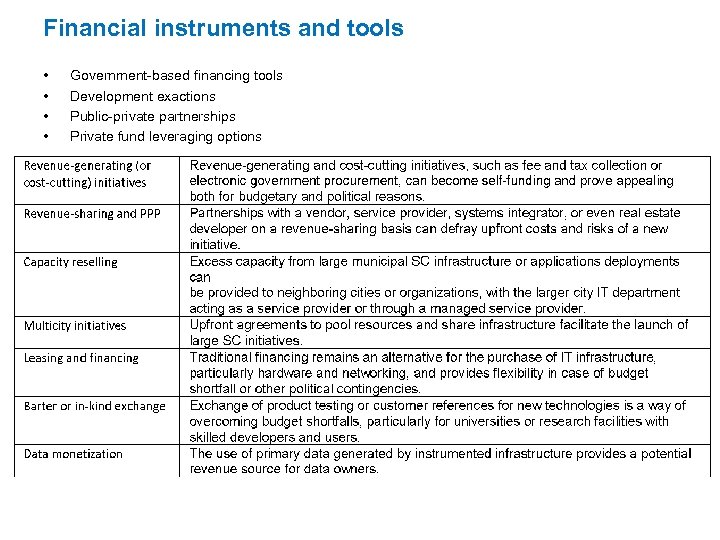 Financial instruments and tools • • Government-based financing tools Development exactions Public-private partnerships Private fund leveraging options
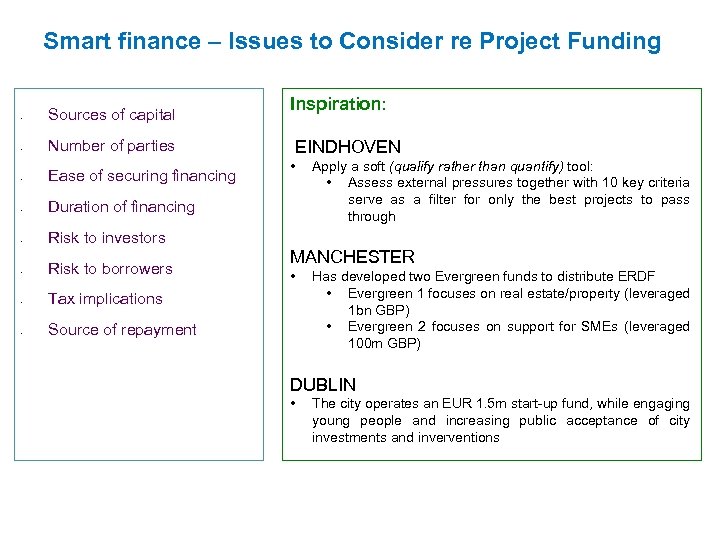 Smart finance – Issues to Consider re Project Funding • • Sources of capital Number of parties Ease of securing financing Inspiration: EINDHOVEN • Duration of financing Apply a soft (qualify rather than quantify) tool: • Assess external pressures together with 10 key criteria serve as a filter for only the best projects to pass through Risk to investors Risk to borrowers MANCHESTER • Tax implications Source of repayment Has developed two Evergreen funds to distribute ERDF • Evergreen 1 focuses on real estate/property (leveraged 1 bn GBP) • Evergreen 2 focuses on support for SMEs (leveraged 100 m GBP) DUBLIN • The city operates an EUR 1. 5 m start-up fund, while engaging young people and increasing public acceptance of city investments and inverventions
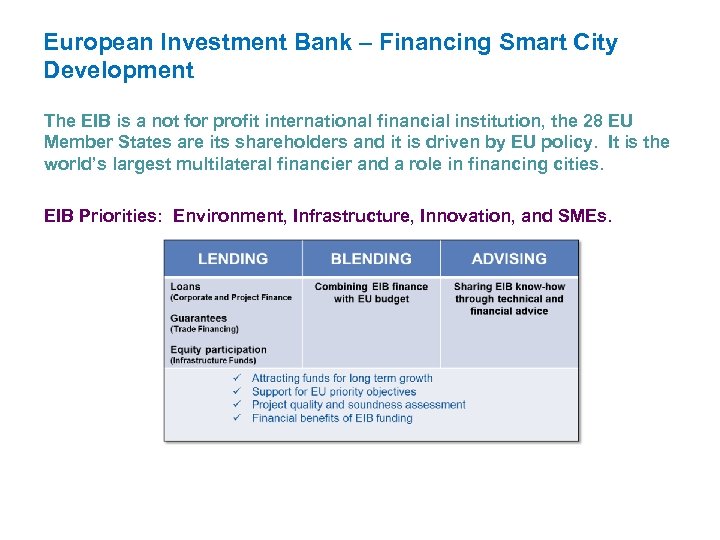 European Investment Bank – Financing Smart City Development The EIB is a not for profit international financial institution, the 28 EU Member States are its shareholders and it is driven by EU policy. It is the world’s largest multilateral financier and a role in financing cities. EIB Priorities: Environment, Infrastructure, Innovation, and SMEs.
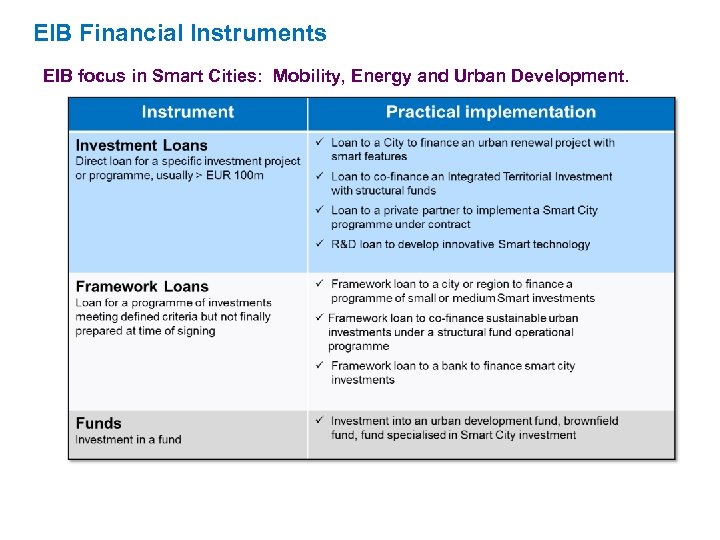 EIB Financial Instruments EIB focus in Smart Cities: Mobility, Energy and Urban Development.
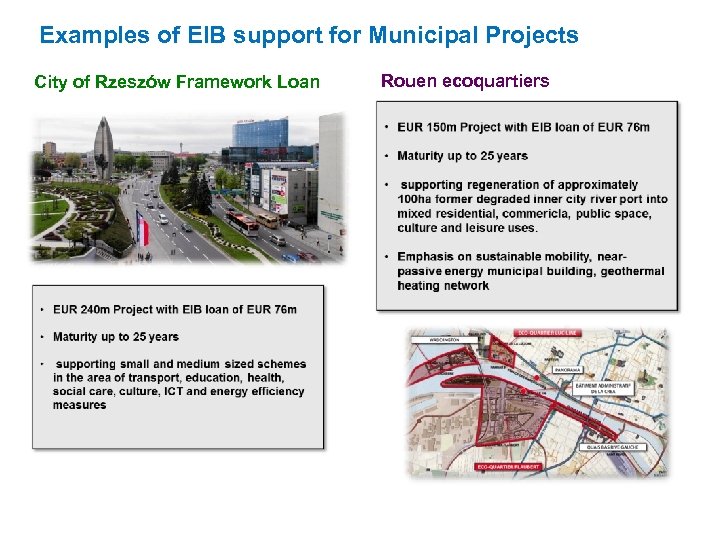 Examples of EIB support for Municipal Projects City of Rzeszów Framework Loan Rouen ecoquartiers
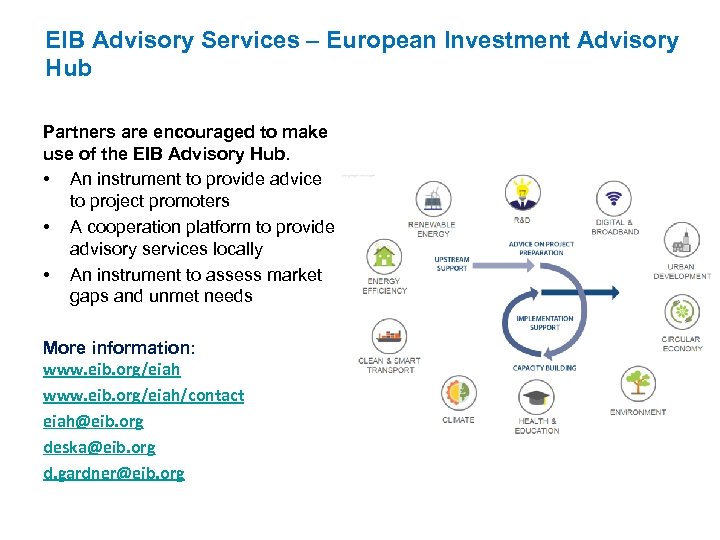 EIB Advisory Services – European Investment Advisory Hub Partners are encouraged to make use of the EIB Advisory Hub. • An instrument to provide advice to project promoters • A cooperation platform to provide advisory services locally • An instrument to assess market gaps and unmet needs More information: www. eib. org/eiah/contact eiah@eib. org deska@eib. org d. gardner@eib. org
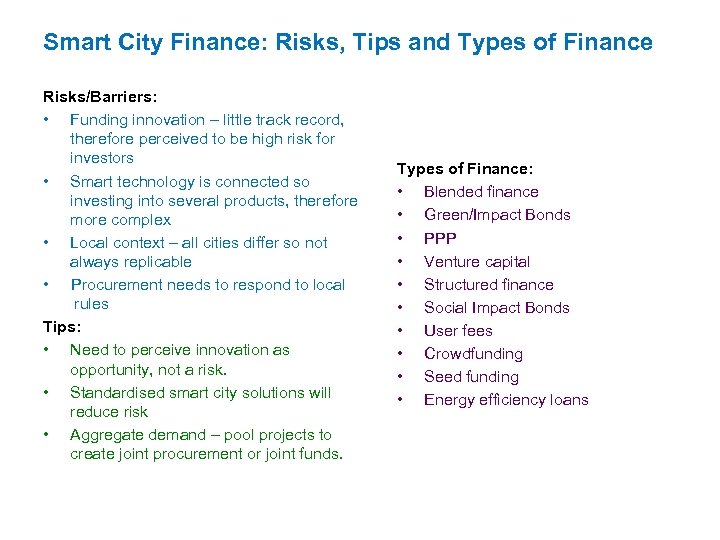 Smart City Finance: Risks, Tips and Types of Finance Risks/Barriers: • Funding innovation – little track record, therefore perceived to be high risk for investors • Smart technology is connected so investing into several products, therefore more complex • Local context – all cities differ so not always replicable • Procurement needs to respond to local rules Tips: • Need to perceive innovation as opportunity, not a risk. • Standardised smart city solutions will reduce risk • Aggregate demand – pool projects to create joint procurement or joint funds. Types of Finance: • Blended finance • Green/Impact Bonds • PPP • Venture capital • Structured finance • Social Impact Bonds • User fees • Crowdfunding • Seed funding • Energy efficiency loans
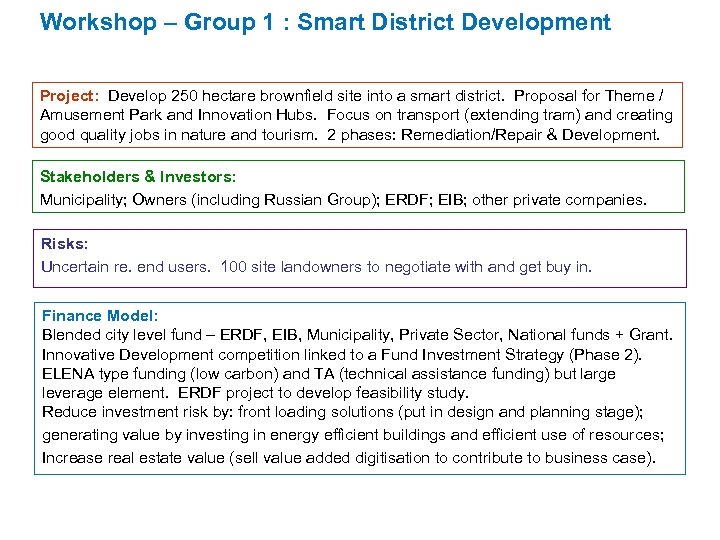 Workshop – Group 1 : Smart District Development Project: Develop 250 hectare brownfield site into a smart district. Proposal for Theme / Amusement Park and Innovation Hubs. Focus on transport (extending tram) and creating good quality jobs in nature and tourism. 2 phases: Remediation/Repair & Development. Stakeholders & Investors: Municipality; Owners (including Russian Group); ERDF; EIB; other private companies. Risks: Uncertain re. end users. 100 site landowners to negotiate with and get buy in. Finance Model: Blended city level fund – ERDF, EIB, Municipality, Private Sector, National funds + Grant. Innovative Development competition linked to a Fund Investment Strategy (Phase 2). ELENA type funding (low carbon) and TA (technical assistance funding) but large leverage element. ERDF project to develop feasibility study. Reduce investment risk by: front loading solutions (put in design and planning stage); generating value by investing in energy efficient buildings and efficient use of resources; Increase real estate value (sell value added digitisation to contribute to business case).
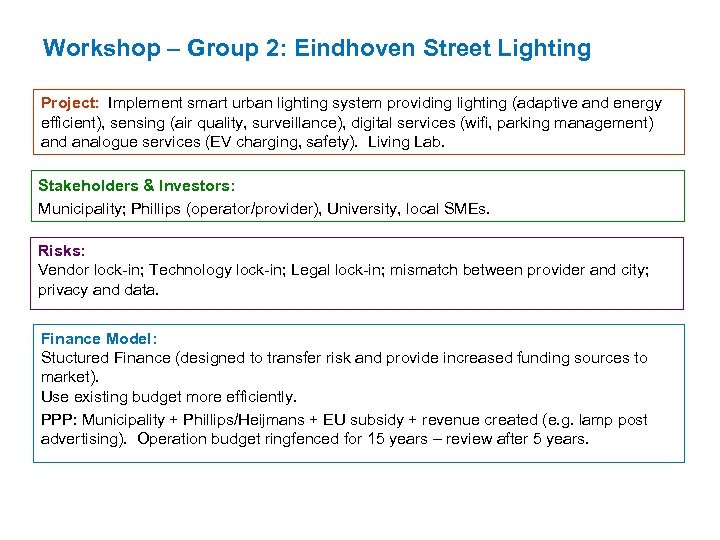 Workshop – Group 2: Eindhoven Street Lighting Project: Implement smart urban lighting system providing lighting (adaptive and energy efficient), sensing (air quality, surveillance), digital services (wifi, parking management) and analogue services (EV charging, safety). Living Lab. Stakeholders & Investors: Municipality; Phillips (operator/provider), University, local SMEs. Risks: Vendor lock-in; Technology lock-in; Legal lock-in; mismatch between provider and city; privacy and data. Finance Model: Stuctured Finance (designed to transfer risk and provide increased funding sources to market). Use existing budget more efficiently. PPP: Municipality + Phillips/Heijmans + EU subsidy + revenue created (e. g. lamp post advertising). Operation budget ringfenced for 15 years – review after 5 years.
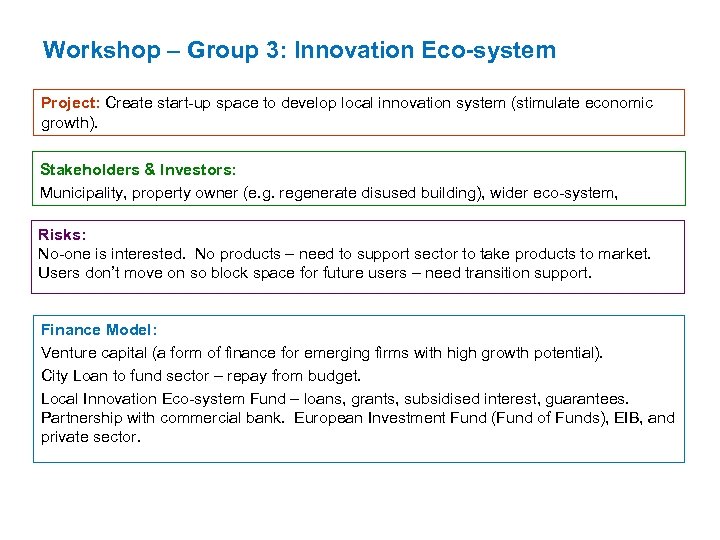 Workshop – Group 3: Innovation Eco-system Project: Create start-up space to develop local innovation system (stimulate economic growth). Stakeholders & Investors: Municipality, property owner (e. g. regenerate disused building), wider eco-system, Risks: No-one is interested. No products – need to support sector to take products to market. Users don’t move on so block space for future users – need transition support. Finance Model: Venture capital (a form of finance for emerging firms with high growth potential). City Loan to fund sector – repay from budget. Local Innovation Eco-system Fund – loans, grants, subsidised interest, guarantees. Partnership with commercial bank. European Investment Fund (Fund of Funds), EIB, and private sector.
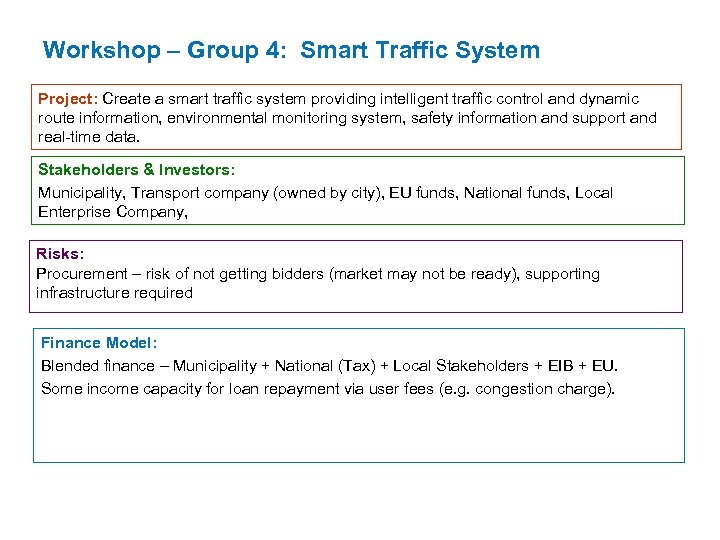 Workshop – Group 4: Smart Traffic System Project: Create a smart traffic system providing intelligent traffic control and dynamic route information, environmental monitoring system, safety information and support and real-time data. Stakeholders & Investors: Municipality, Transport company (owned by city), EU funds, National funds, Local Enterprise Company, Risks: Procurement – risk of not getting bidders (market may not be ready), supporting infrastructure required Finance Model: Blended finance – Municipality + National (Tax) + Local Stakeholders + EIB + EU. Some income capacity for loan repayment via user fees (e. g. congestion charge).
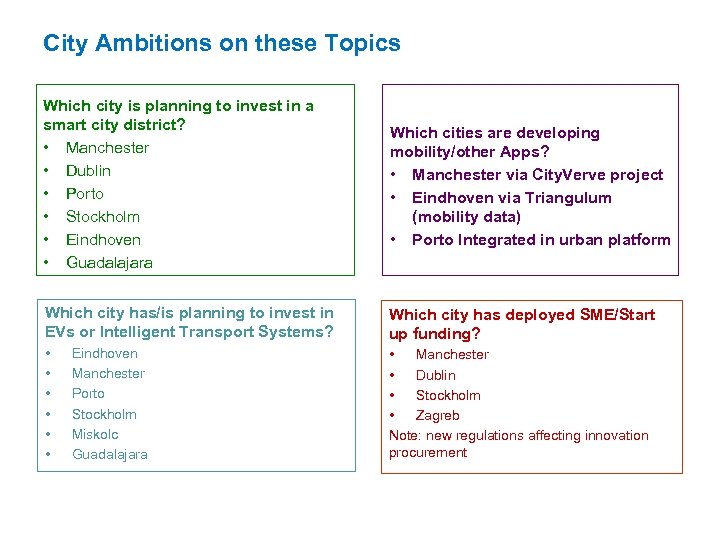 City Ambitions on these Topics Which city is planning to invest in a smart city district? • Manchester • Dublin • Porto • Stockholm • Eindhoven • Guadalajara Which cities are developing mobility/other Apps? • Manchester via City. Verve project • Eindhoven via Triangulum (mobility data) • Porto Integrated in urban platform Which city has/is planning to invest in EVs or Intelligent Transport Systems? Which city has deployed SME/Start up funding? • • Manchester • Dublin • Stockholm • Zagreb Note: new regulations affecting innovation procurement Eindhoven Manchester Porto Stockholm Miskolc Guadalajara
 Procurement Procure differently: • Solution based procurement – challenge based approach • Use procurement to drive innovation - Target start-ups to provide innovative thinking re. solutions • Include additional requirement in contract, e. g. social value - M/c Town Hall refurbishment included conditions regarding recruitment and apprenticeships • Think about procurement as commissioning, i. e. design of service with business • Develop better working relationships with city procurement team • Include future planning and scale up potential • Look at Manchester CBA method for demonstrating return on investment • Factor in social value – use procurement to respond to social challenges • Examples: Philadelphia model which is a philanthropic approach.
 Mid Term Review Mid term review is an opportunity to review progress and future activity. • • Survey results – overall acceptable but how can we improve? Progress on URBACT Local Group and Integrated Action Plan Development – how can we help you get the most from this? Programme and deliverables – current status and views re. future activity What next? ULG & IAP • Need to continue to provide details of progress on this. This is an important deliverable designed to help your city to address a local problem. • Carry out ULG self-assessment to help you assess your ULG and improve its impact where possible. Also, self-assessment of IAP. Toolkits for these uploaded to Basecamp and are available via URBACT. • Use network to help you get the most from your ULG, e. g. invite network partner city to you meeting • Continue with IAP peer review sessions at network meetings
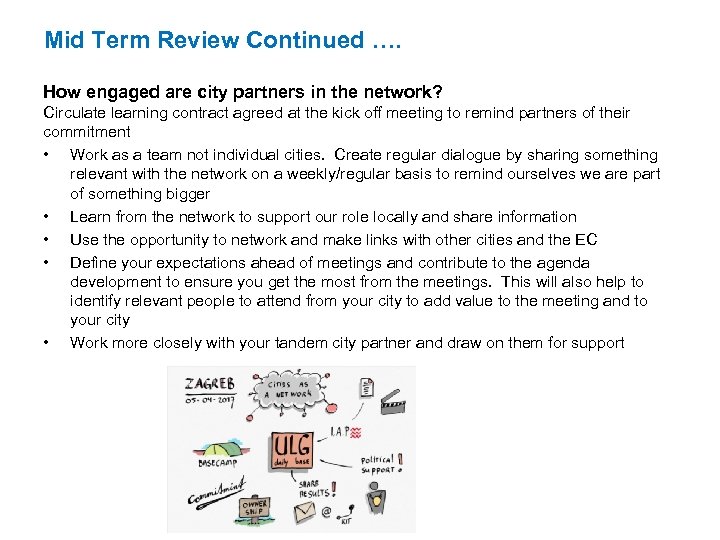 Mid Term Review Continued …. How engaged are city partners in the network? Circulate learning contract agreed at the kick off meeting to remind partners of their commitment • Work as a team not individual cities. Create regular dialogue by sharing something relevant with the network on a weekly/regular basis to remind ourselves we are part of something bigger • Learn from the network to support our role locally and share information • Use the opportunity to network and make links with other cities and the EC • Define your expectations ahead of meetings and contribute to the agenda development to ensure you get the most from the meetings. This will also help to identify relevant people to attend from your city to add value to the meeting and to your city • Work more closely with your tandem city partner and draw on them for support
 Mid Term Review continued …. • Tandem cities to engage to organise their transnational thematic meeting. For example, Porto is hosting the next meeting in June which will focus on Innovation eco-systems. Smolyan as its thematic partner will work with Porto to support them in organising that meeting and the agenda covering that topic. Smolyan will also work with Porto on drafting thematic report from the meeting. This will provide an important learning opportunity for these cities in particular. • This will be replicated by Guadalajara and Miskolc for the transnational meeting focusing on data integration schedule for October in Guadalajara Communication: • Basecamp is effective. Request for all cities to upload their information and keep a regular flow of information between partner cities • Keep in touch (KIT) calls –organised on a monthly basis What next? • LP to draft mid term review report and circulate to partners for comment • LP to present MTR report at the URBACT APN session in Paris in June • Lead Partner to contact city partners individually to discuss budget post MTR • Partner to consider using the URBACT ULG and IAP self-assessment tools
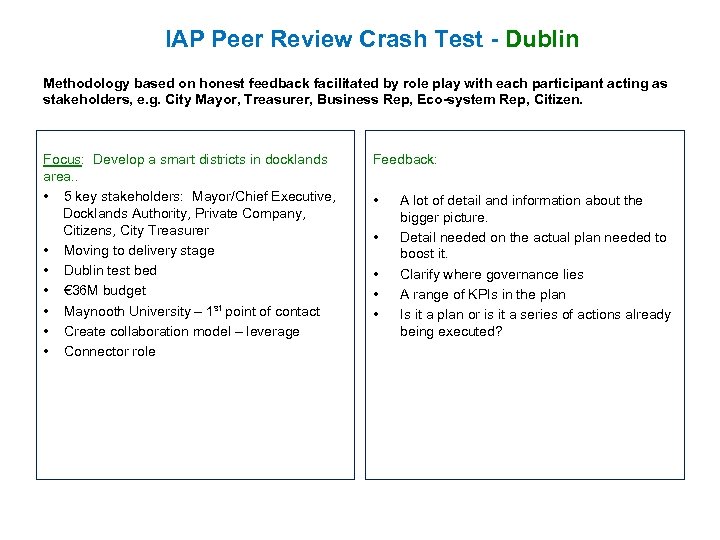 IAP Peer Review Crash Test - Dublin Methodology based on honest feedback facilitated by role play with each participant acting as stakeholders, e. g. City Mayor, Treasurer, Business Rep, Eco-system Rep, Citizen. Focus: Develop a smart districts in docklands area. . • 5 key stakeholders: Mayor/Chief Executive, Docklands Authority, Private Company, Citizens, City Treasurer • Moving to delivery stage • Dublin test bed • € 36 M budget • Maynooth University – 1 st point of contact • Create collaboration model – leverage • Connector role Feedback: • • • A lot of detail and information about the bigger picture. Detail needed on the actual plan needed to boost it. Clarify where governance lies A range of KPIs in the plan Is it a plan or is it a series of actions already being executed?
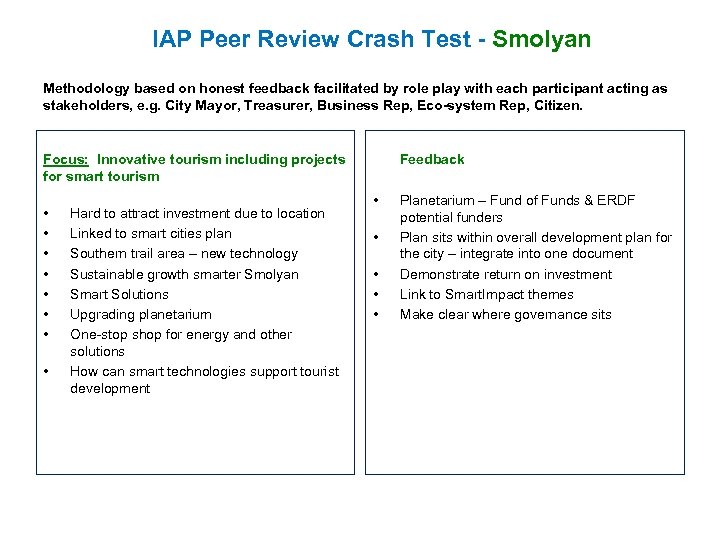 IAP Peer Review Crash Test - Smolyan Methodology based on honest feedback facilitated by role play with each participant acting as stakeholders, e. g. City Mayor, Treasurer, Business Rep, Eco-system Rep, Citizen. Focus: Innovative tourism including projects for smart tourism • • Hard to attract investment due to location Linked to smart cities plan Southern trail area – new technology Sustainable growth smarter Smolyan Smart Solutions Upgrading planetarium One-stop shop for energy and other solutions How can smart technologies support tourist development Feedback • • • Planetarium – Fund of Funds & ERDF potential funders Plan sits within overall development plan for the city – integrate into one document Demonstrate return on investment Link to Smart. Impact themes Make clear where governance sits
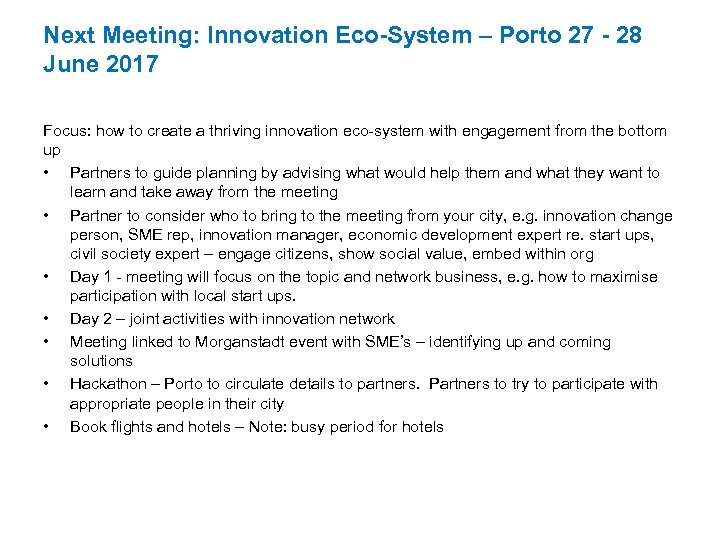 Next Meeting: Innovation Eco-System – Porto 27 - 28 June 2017 Focus: how to create a thriving innovation eco-system with engagement from the bottom up • Partners to guide planning by advising what would help them and what they want to learn and take away from the meeting • Partner to consider who to bring to the meeting from your city, e. g. innovation change person, SME rep, innovation manager, economic development expert re. start ups, civil society expert – engage citizens, show social value, embed within org • Day 1 - meeting will focus on the topic and network business, e. g. how to maximise participation with local start ups. • Day 2 – joint activities with innovation network • Meeting linked to Morganstadt event with SME’s – identifying up and coming solutions • Hackathon – Porto to circulate details to partners. Partners to try to participate with appropriate people in their city • Book flights and hotels – Note: busy period for hotels
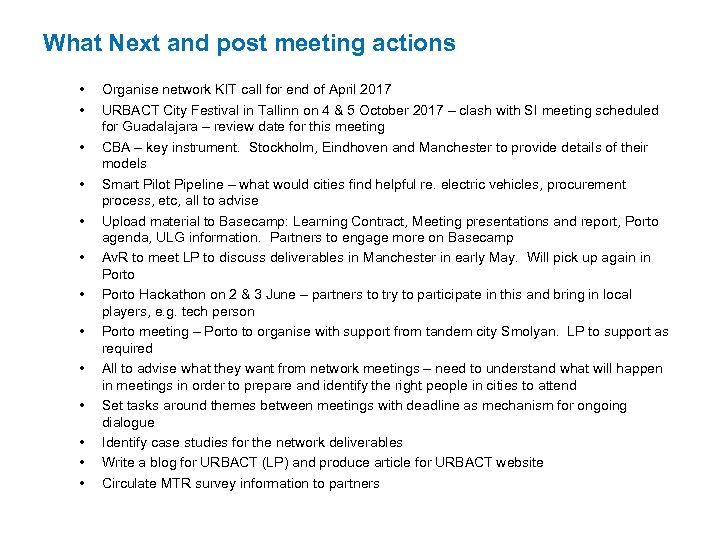 What Next and post meeting actions • • • • Organise network KIT call for end of April 2017 URBACT City Festival in Tallinn on 4 & 5 October 2017 – clash with SI meeting scheduled for Guadalajara – review date for this meeting CBA – key instrument. Stockholm, Eindhoven and Manchester to provide details of their models Smart Pilot Pipeline – what would cities find helpful re. electric vehicles, procurement process, etc, all to advise Upload material to Basecamp: Learning Contract, Meeting presentations and report, Porto agenda, ULG information. Partners to engage more on Basecamp Av. R to meet LP to discuss deliverables in Manchester in early May. Will pick up again in Porto Hackathon on 2 & 3 June – partners to try to participate in this and bring in local players, e. g. tech person Porto meeting – Porto to organise with support from tandem city Smolyan. LP to support as required All to advise what they want from network meetings – need to understand what will happen in meetings in order to prepare and identify the right people in cities to attend Set tasks around themes between meetings with deadline as mechanism for ongoing dialogue Identify case studies for the network deliverables Write a blog for URBACT (LP) and produce article for URBACT website Circulate MTR survey information to partners
 Email: Smart. Impact@Manchester. gov. uk Website: http: //urbact. eu/smartimpact