


 Скачать презентацию Smart Attacker Towards Developing an Attacker Exploiting Artificial
1a2b921abc0393d1697fe6ef9621cc55.ppt
- Количество слайдов: 1
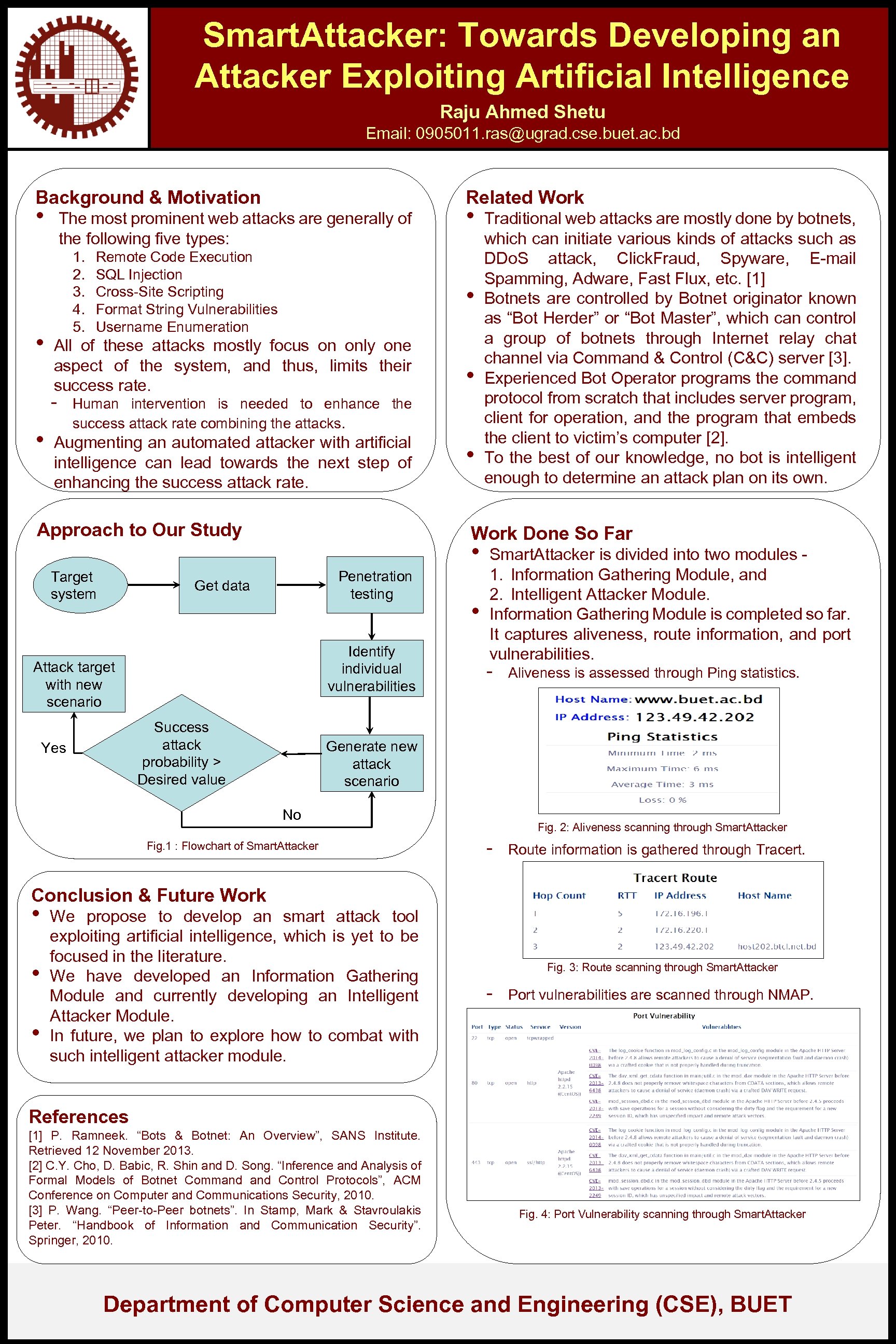 Smart. Attacker: Towards Developing an Attacker Exploiting Artificial Intelligence Raju Ahmed Shetu Email: 0905011. ras@ugrad. cse. buet. ac. bd Background & Motivation • The most prominent web attacks are generally of the following five types: 1. 2. 3. 4. 5. • Remote Code Execution SQL Injection Cross-Site Scripting Format String Vulnerabilities Username Enumeration • • All of these attacks mostly focus on only one aspect of the system, and thus, limits their success rate. • Related Work • Human intervention is needed to enhance the success attack rate combining the attacks. Augmenting an automated attacker with artificial intelligence can lead towards the next step of enhancing the success attack rate. Approach to Our Study Target system Work Done So Far • Penetration testing Get data • Smart. Attacker is divided into two modules 1. Information Gathering Module, and 2. Intelligent Attacker Module. Information Gathering Module is completed so far. It captures aliveness, route information, and port vulnerabilities. Identify individual vulnerabilities Attack target with new scenario Success attack probability > Desired value Yes • Traditional web attacks are mostly done by botnets, which can initiate various kinds of attacks such as DDo. S attack, Click. Fraud, Spyware, E-mail Spamming, Adware, Fast Flux, etc. [1] Botnets are controlled by Botnet originator known as “Bot Herder” or “Bot Master”, which can control a group of botnets through Internet relay chat channel via Command & Control (C&C) server [3]. Experienced Bot Operator programs the command protocol from scratch that includes server program, client for operation, and the program that embeds the client to victim’s computer [2]. To the best of our knowledge, no bot is intelligent enough to determine an attack plan on its own. Aliveness is assessed through Ping statistics. Generate new attack scenario No Fig. 1 : Flowchart of Smart. Attacker Fig. 2: Aliveness scanning through Smart. Attacker Route information is gathered through Tracert. Conclusion & Future Work • • • We propose to develop an smart attack tool exploiting artificial intelligence, which is yet to be focused in the literature. We have developed an Information Gathering Module and currently developing an Intelligent Attacker Module. In future, we plan to explore how to combat with such intelligent attacker module. Fig. 3: Route scanning through Smart. Attacker Port vulnerabilities are scanned through NMAP. References [1] P. Ramneek. “Bots & Botnet: An Overview”, SANS Institute. Retrieved 12 November 2013. [2] C. Y. Cho, D. Babic, R. Shin and D. Song. “Inference and Analysis of Formal Models of Botnet Command Control Protocols”, ACM Conference on Computer and Communications Security, 2010. [3] P. Wang. “Peer-to-Peer botnets”. In Stamp, Mark & Stavroulakis Peter. “Handbook of Information and Communication Security”. Springer, 2010. Fig. 4: Port Vulnerability scanning through Smart. Attacker Department of Computer Science and Engineering (CSE), BUET