


 Скачать презентацию Smallpox Vaccine Operations Seminar North Dakota Department of
71e2fefc1de7306d42116691061eeb14.ppt
- Количество слайдов: 87
 Smallpox Vaccine Operations Seminar North Dakota Department of Health
 Smallpox Vaccine Storage and Handling Larry A. Shireley, MS, MPH State Epidemiologist North Dakota Department of Health
 Smallpox Kits
 Package Insert
 Storage n n 36 – 46 o F ( 2 – 8 o C) u DO NOT FREEZE Transportation u Powered Coolers u Temperature Monitors u Chain of Custody Forms Can keep at room temperature during clinics Security
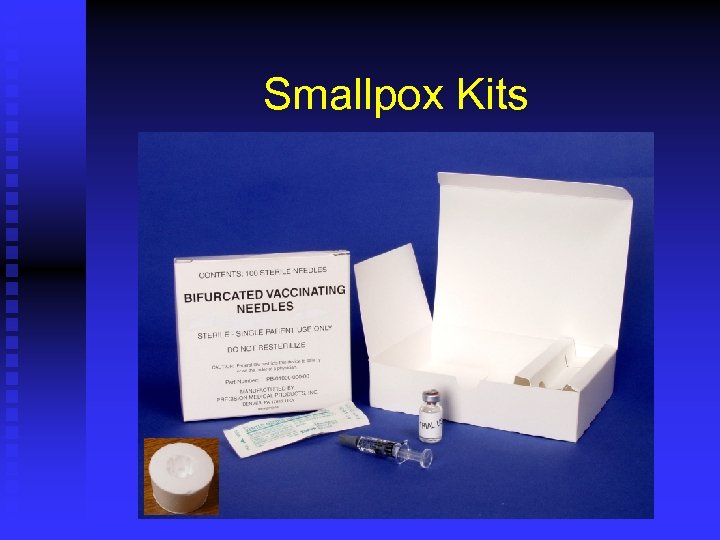
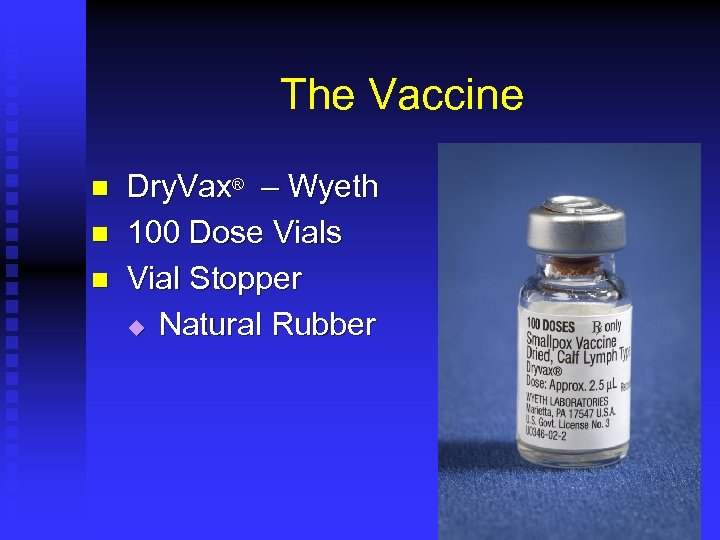 The Vaccine n n n Dry. Vax® – Wyeth 100 Dose Vials Vial Stopper u Natural Rubber
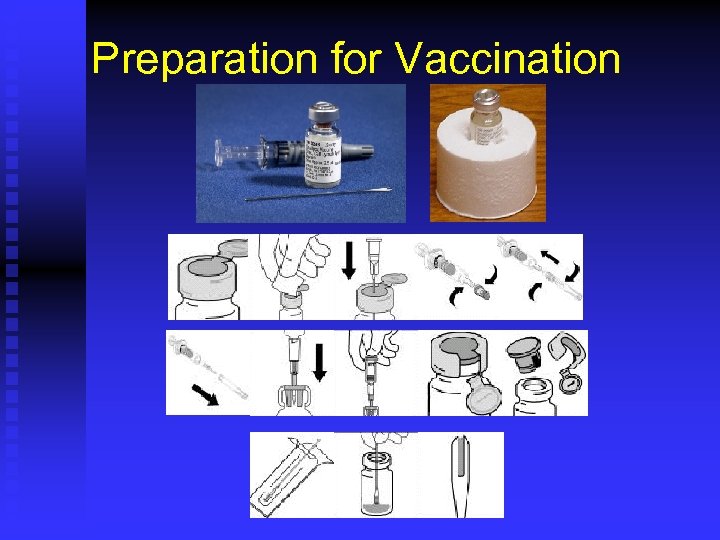 Preparation for Vaccination
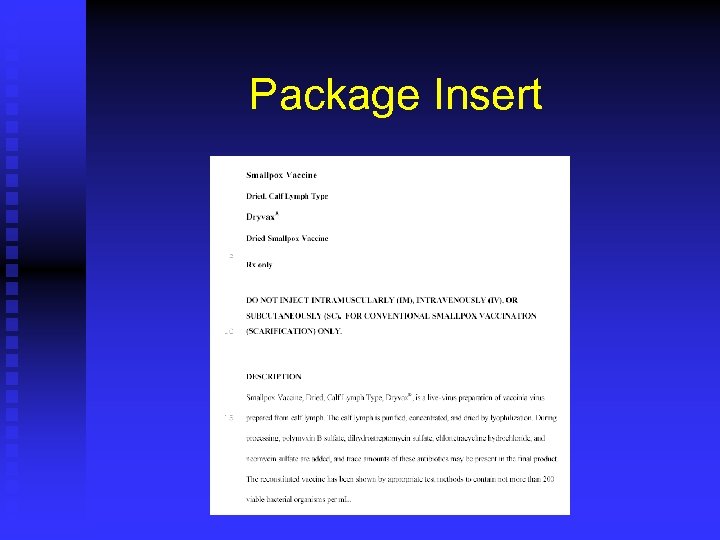
 Reconstituted Vaccine n Use for 60 days u www. bt. cdc. gov/agent/smallpox/vaccination/pdf/w yeth-dryvax-letter-dec-23 -2002. pdf u Package insert indicates 15 days
 Disposal n Burn, Boil or Autoclave
 VACCINATION CLINICS Brenda Vossler, RN, CIC Hospital Coordinator Division of Bioterrorism North Dakota Department of Health
 Ready, Set, Go n n n Smallpox vaccination clinics are scheduled to start the end of February. Multiple clinics in each area, 10 -21 days apart. u Limits number of staff ill at any one time. u Controls workload as we enter unfamiliar territory. Phase I is expected to take 6 -9 weeks.
 Prior to Clinic Date n Prospective vaccinees receive the following: u Cover letter from Dr. Gerberding, CDC u Vaccine information fact sheets u Pre-screening tool
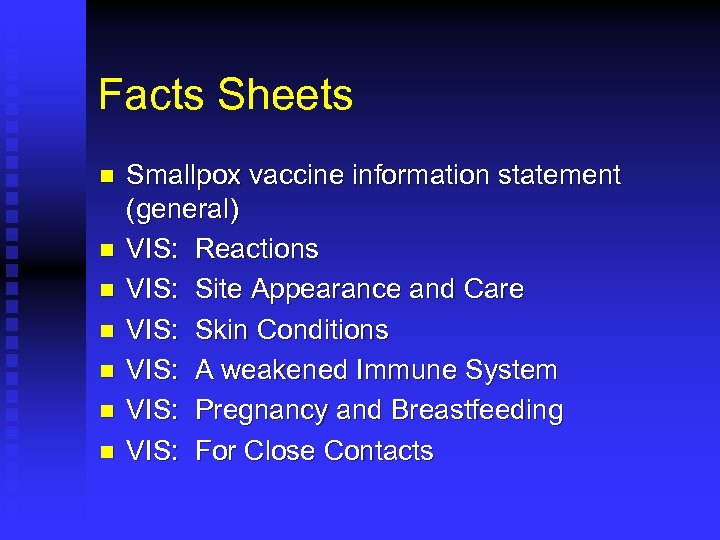 Facts Sheets n n n n Smallpox vaccine information statement (general) VIS: Reactions VIS: Site Appearance and Care VIS: Skin Conditions VIS: A weakened Immune System VIS: Pregnancy and Breastfeeding VIS: For Close Contacts
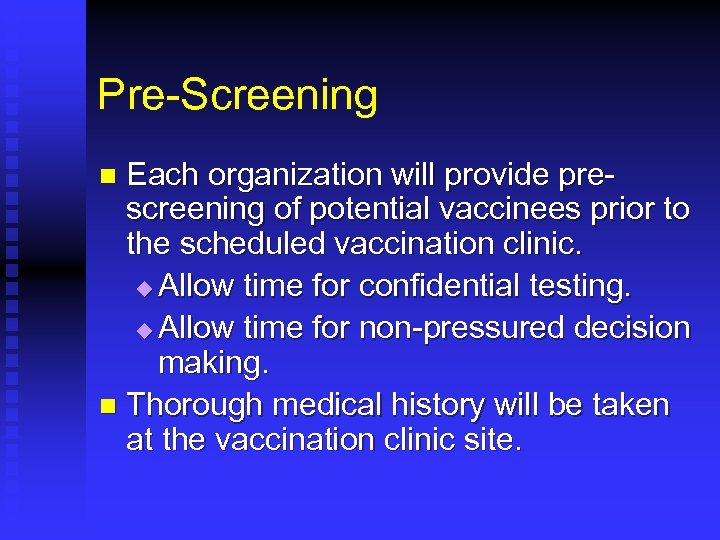 Pre-Screening Each organization will provide prescreening of potential vaccinees prior to the scheduled vaccination clinic. u Allow time for confidential testing. u Allow time for non-pressured decision making. n Thorough medical history will be taken at the vaccination clinic site. n
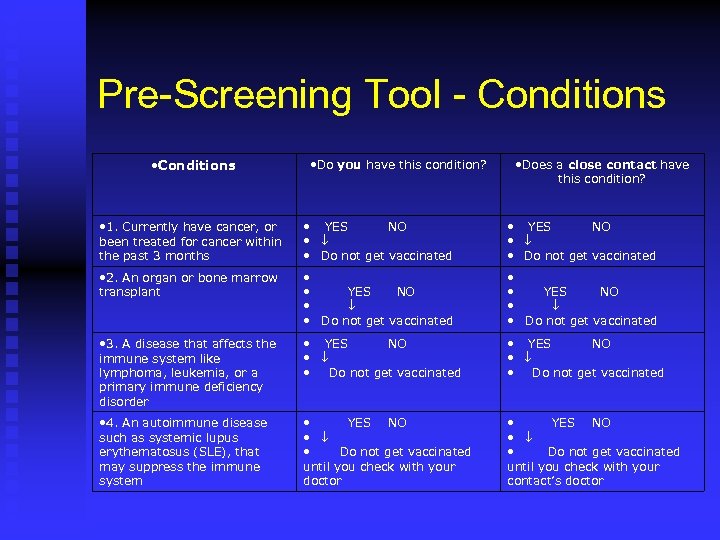 Pre-Screening Tool - Conditions • Conditions • Do you have this condition? • Does a close contact have this condition? • 1. Currently have cancer, or been treated for cancer within the past 3 months • YES NO • • Do not get vaccinated • 2. An organ or bone marrow transplant • • YES NO • • Do not get vaccinated • 3. A disease that affects the immune system like lymphoma, leukemia, or a primary immune deficiency disorder • YES NO • • Do not get vaccinated • 4. An autoimmune disease such as systemic lupus erythematosus (SLE), that may suppress the immune system • YES NO • • Do not get vaccinated until you check with your doctor • YES NO • • Do not get vaccinated until you check with your contact’s doctor
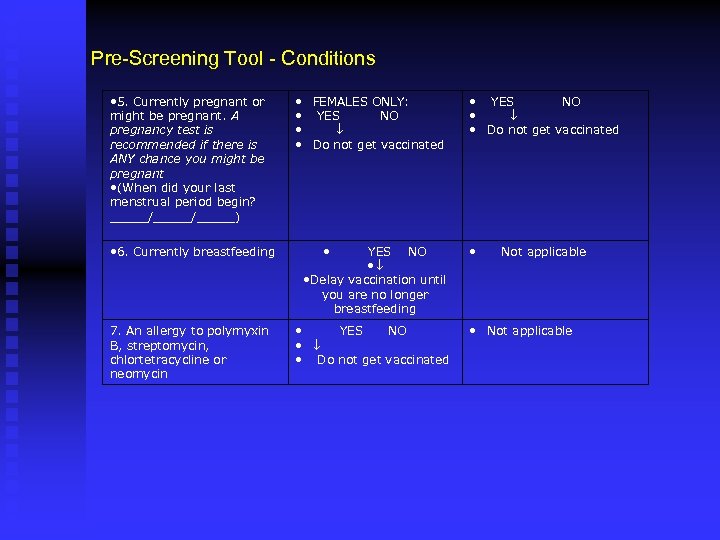 Pre-Screening Tool - Conditions • 5. Currently pregnant or might be pregnant. A pregnancy test is recommended if there is ANY chance you might be pregnant • (When did your last menstrual period begin? _____/_____) • FEMALES ONLY: • YES NO • • Do not get vaccinated • 6. Currently breastfeeding • YES NO • • Delay vaccination until you are no longer breastfeeding 7. An allergy to polymyxin B, streptomycin, chlortetracycline or neomycin • YES NO • • Do not get vaccinated • Not applicable • Not applicable
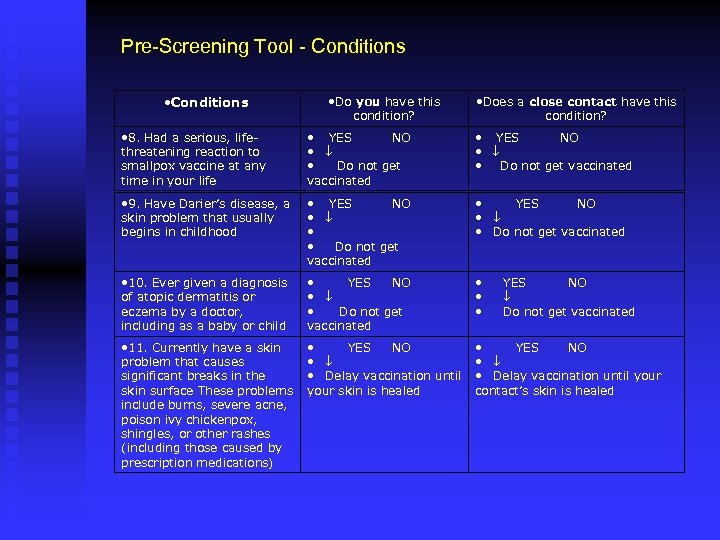 Pre-Screening Tool - Conditions • Conditions • Do you have this condition? • Does a close contact have this condition? • 8. Had a serious, lifethreatening reaction to smallpox vaccine at any time in your life • YES NO • • Do not get vaccinated • 9. Have Darier’s disease, a skin problem that usually begins in childhood • YES NO • • • Do not get vaccinated • YES NO • • Do not get vaccinated • 10. Ever given a diagnosis of atopic dermatitis or eczema by a doctor, including as a baby or child • YES NO • • Do not get vaccinated • • 11. Currently have a skin problem that causes significant breaks in the skin surface These problems include burns, severe acne, poison ivy chickenpox, shingles, or other rashes (including those caused by prescription medications) • YES NO • • Delay vaccination until your skin is healed • YES NO • • Delay vaccination until your contact’s skin is healed YES NO Do not get vaccinated
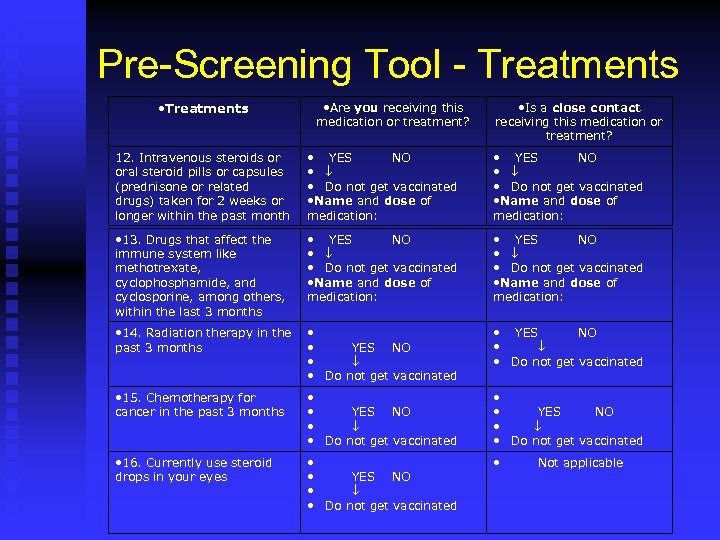 Pre-Screening Tool - Treatments • Treatments • Are you receiving this medication or treatment? • Is a close contact receiving this medication or treatment? 12. Intravenous steroids or oral steroid pills or capsules (prednisone or related drugs) taken for 2 weeks or longer within the past month • YES NO • • Do not get vaccinated • Name and dose of medication: • 13. Drugs that affect the immune system like methotrexate, cyclophosphamide, and cyclosporine, among others, within the last 3 months • YES NO • • Do not get vaccinated • Name and dose of medication: • 14. Radiation therapy in the past 3 months • • YES NO • • Do not get vaccinated • 15. Chemotherapy for cancer in the past 3 months • • YES NO • • Do not get vaccinated • 16. Currently use steroid drops in your eyes • • YES NO • • Do not get vaccinated • Not applicable
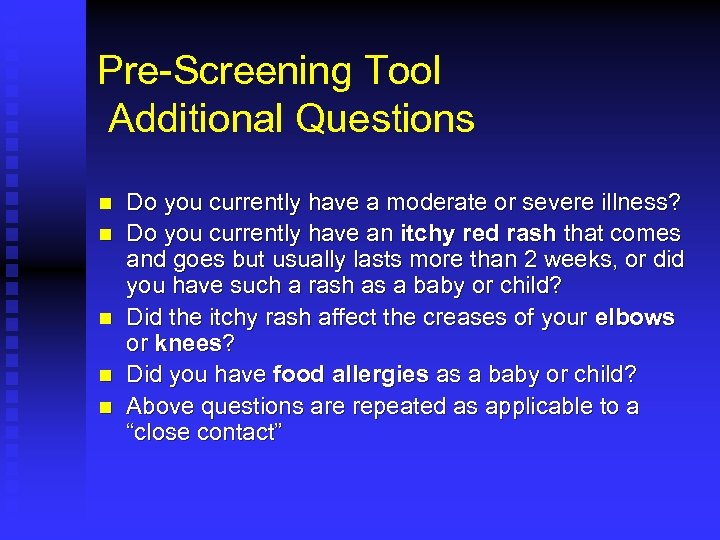 Pre-Screening Tool Additional Questions n n n Do you currently have a moderate or severe illness? Do you currently have an itchy red rash that comes and goes but usually lasts more than 2 weeks, or did you have such a rash as a baby or child? Did the itchy rash affect the creases of your elbows or knees? Did you have food allergies as a baby or child? Above questions are repeated as applicable to a “close contact”
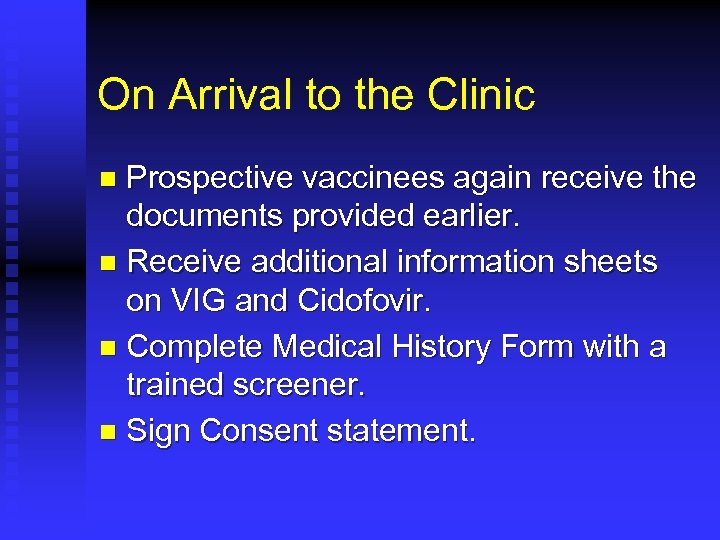 On Arrival to the Clinic Prospective vaccinees again receive the documents provided earlier. n Receive additional information sheets on VIG and Cidofovir. n Complete Medical History Form with a trained screener. n Sign Consent statement. n
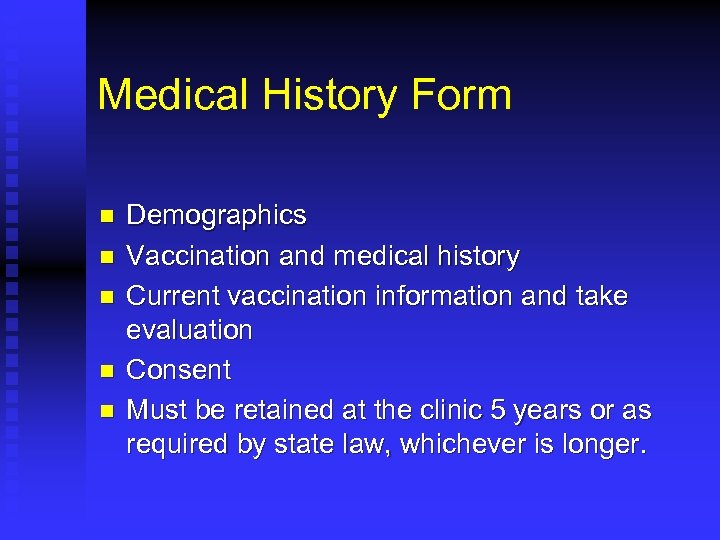 Medical History Form n n n Demographics Vaccination and medical history Current vaccination information and take evaluation Consent Must be retained at the clinic 5 years or as required by state law, whichever is longer.
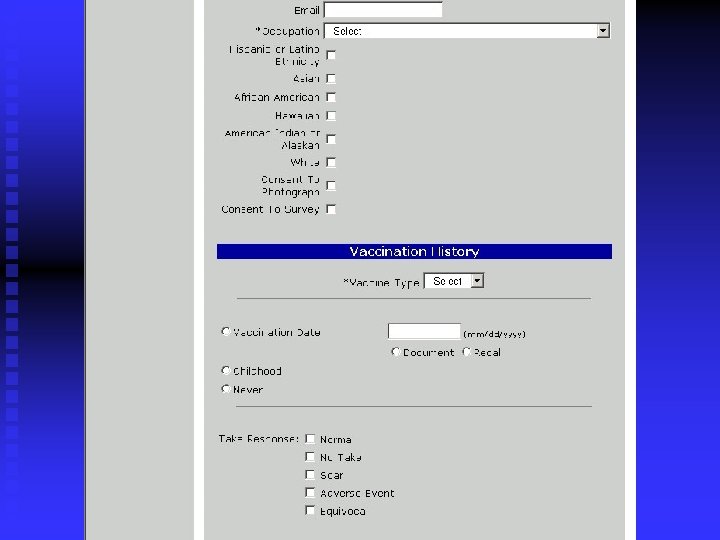
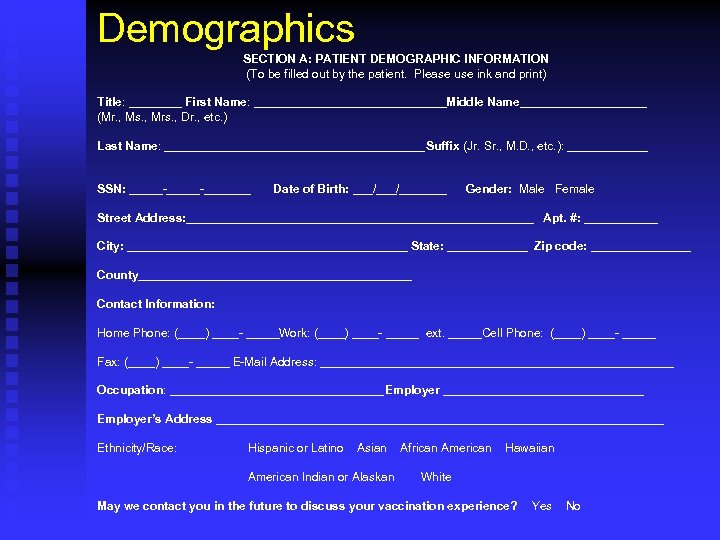 Demographics SECTION A: PATIENT DEMOGRAPHIC INFORMATION (To be filled out by the patient. Please use ink and print) Title: ____ First Name: _______________Middle Name__________ (Mr. , Ms. , Mrs. , Dr. , etc. ) Last Name: ____________________ Suffix (Jr. Sr. , M. D. , etc. ): ______ SSN: _____-_______ Date of Birth: ___/_______ Gender: Male Female Street Address: __________________________ Apt. #: ______ City: _____________________ State: ______ Zip code: ________ County_____________________ Contact Information: Home Phone: (____) ____- _____Work: (____) ____- _____ ext. _____Cell Phone: (____) ____- _____ Fax: (____) ____- _____ E-Mail Address: ___________________________ Occupation: ________________ Employer’s Address __________________________________ Ethnicity/Race: Hispanic or Latino Asian American Indian or Alaskan African American Hawaiian White May we contact you in the future to discuss your vaccination experience? Yes No
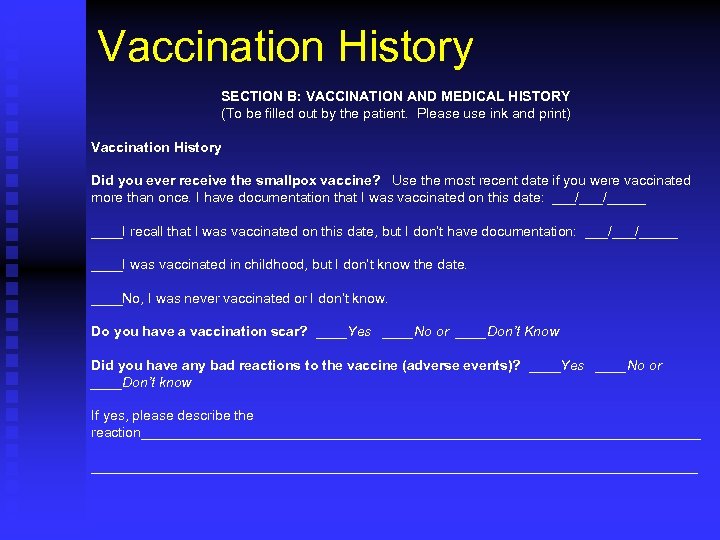 Vaccination History SECTION B: VACCINATION AND MEDICAL HISTORY (To be filled out by the patient. Please use ink and print) Vaccination History Did you ever receive the smallpox vaccine? Use the most recent date if you were vaccinated more than once. I have documentation that I was vaccinated on this date: ___/_____I recall that I was vaccinated on this date, but I don’t have documentation: ___/_____I was vaccinated in childhood, but I don’t know the date. ____No, I was never vaccinated or I don’t know. Do you have a vaccination scar? ____Yes ____No or ____Don’t Know Did you have any bad reactions to the vaccine (adverse events)? ____Yes ____No or ____Don’t know If yes, please describe the reaction_______________________________________
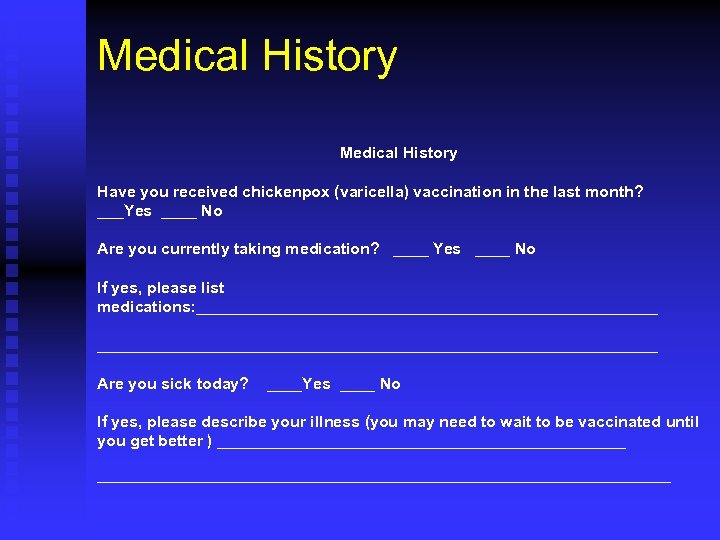 Medical History Have you received chickenpox (varicella) vaccination in the last month? ___Yes ____ No Are you currently taking medication? ____ Yes ____ No If yes, please list medications: __________________________________________________________ Are you sick today? ____Yes ____ No If yes, please describe your illness (you may need to wait to be vaccinated until you get better ) __________________________________________________________________
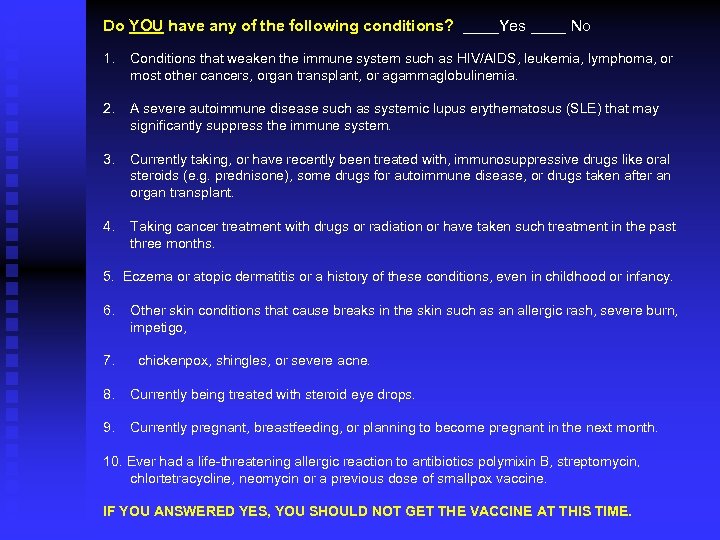 Do YOU have any of the following conditions? ____Yes ____ No 1. Conditions that weaken the immune system such as HIV/AIDS, leukemia, lymphoma, or most other cancers, organ transplant, or agammaglobulinemia. 2. A severe autoimmune disease such as systemic lupus erythematosus (SLE) that may significantly suppress the immune system. 3. Currently taking, or have recently been treated with, immunosuppressive drugs like oral steroids (e. g. prednisone), some drugs for autoimmune disease, or drugs taken after an organ transplant. 4. Taking cancer treatment with drugs or radiation or have taken such treatment in the past three months. 5. Eczema or atopic dermatitis or a history of these conditions, even in childhood or infancy. 6. 7. Other skin conditions that cause breaks in the skin such as an allergic rash, severe burn, impetigo, chickenpox, shingles, or severe acne. 8. Currently being treated with steroid eye drops. 9. Currently pregnant, breastfeeding, or planning to become pregnant in the next month. 10. Ever had a life-threatening allergic reaction to antibiotics polymixin B, streptomycin, chlortetracycline, neomycin or a previous dose of smallpox vaccine. IF YOU ANSWERED YES, YOU SHOULD NOT GET THE VACCINE AT THIS TIME.
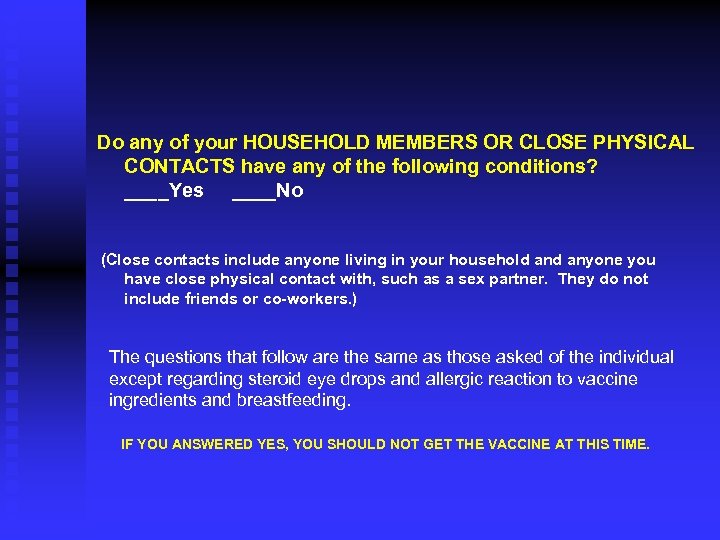 Do any of your HOUSEHOLD MEMBERS OR CLOSE PHYSICAL CONTACTS have any of the following conditions? ____Yes ____No (Close contacts include anyone living in your household anyone you have close physical contact with, such as a sex partner. They do not include friends or co-workers. ) The questions that follow are the same as those asked of the individual except regarding steroid eye drops and allergic reaction to vaccine ingredients and breastfeeding. IF YOU ANSWERED YES, YOU SHOULD NOT GET THE VACCINE AT THIS TIME.
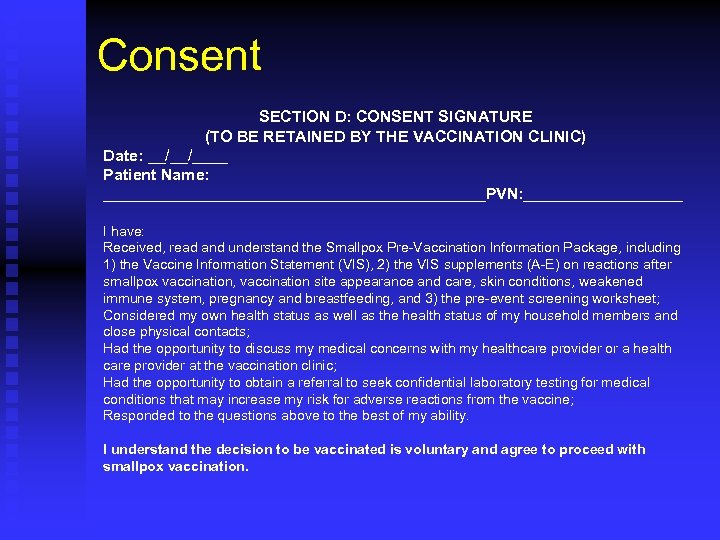 Consent SECTION D: CONSENT SIGNATURE (TO BE RETAINED BY THE VACCINATION CLINIC) Date: __/__/____ Patient Name: ______________________PVN: _________ I have: Received, read and understand the Smallpox Pre-Vaccination Information Package, including 1) the Vaccine Information Statement (VIS), 2) the VIS supplements (A-E) on reactions after smallpox vaccination, vaccination site appearance and care, skin conditions, weakened immune system, pregnancy and breastfeeding, and 3) the pre-event screening worksheet; Considered my own health status as well as the health status of my household members and close physical contacts; Had the opportunity to discuss my medical concerns with my healthcare provider or a health care provider at the vaccination clinic; Had the opportunity to obtain a referral to seek confidential laboratory testing for medical conditions that may increase my risk for adverse reactions from the vaccine; Responded to the questions above to the best of my ability. I understand the decision to be vaccinated is voluntary and agree to proceed with smallpox vaccination.
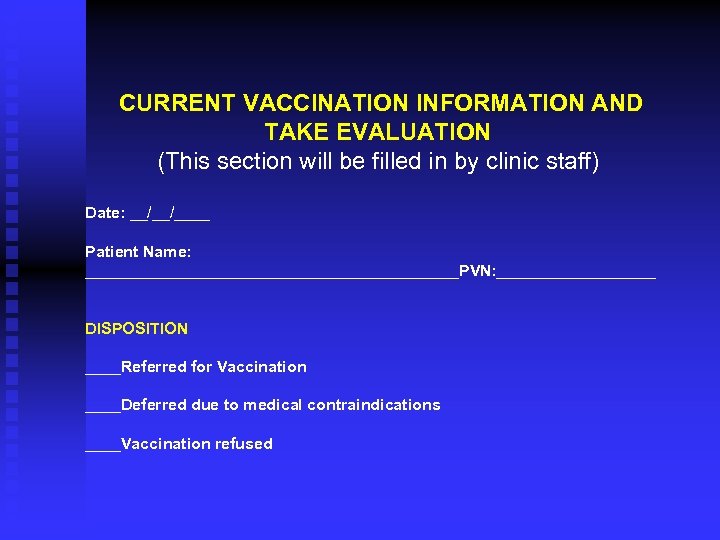 CURRENT VACCINATION INFORMATION AND TAKE EVALUATION (This section will be filled in by clinic staff) Date: __/__/____ Patient Name: _____________________PVN: _________ DISPOSITION ____Referred for Vaccination ____Deferred due to medical contraindications ____Vaccination refused
 Proceed to Vaccination Station n n Vaccination will occur in the upper arm. 2 -3 punctures with the bifurcated needle for first time vaccinees. 15 punctures for re-vaccinees. Site will be dressed with gauze/tape dressing or gauze/semi-permeable dressing. Post-vaccination and follow up information sheet will be reviewed and given to the vaccinee.
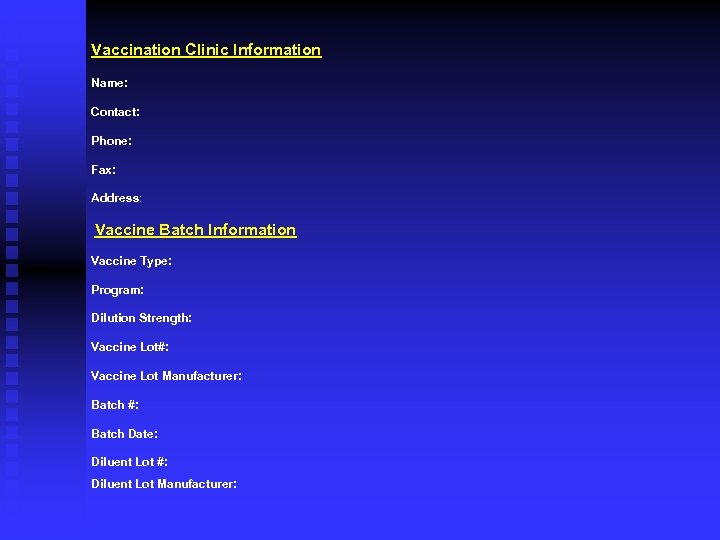 Vaccination Clinic Information Name: Contact: Phone: Fax: Address: Vaccine Batch Information Vaccine Type: Program: Dilution Strength: Vaccine Lot#: Vaccine Lot Manufacturer: Batch #: Batch Date: Diluent Lot #: Diluent Lot Manufacturer:
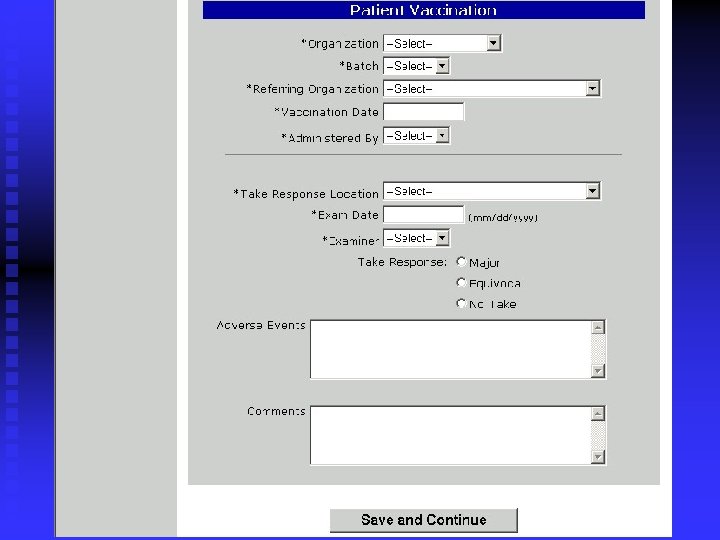
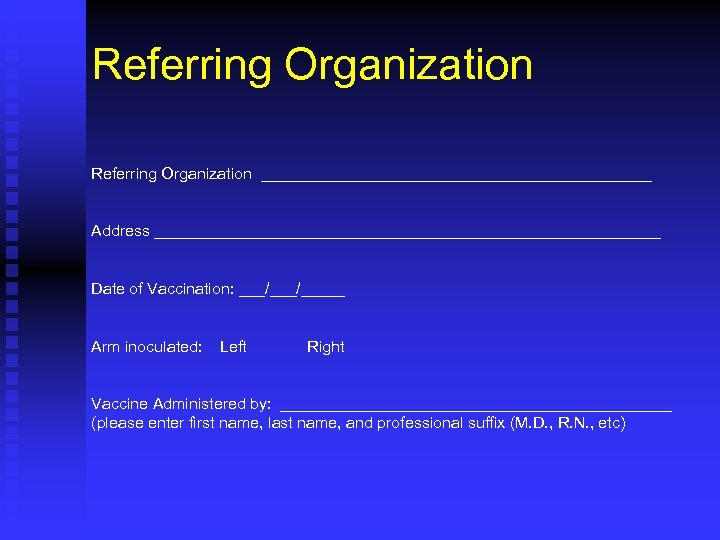 Referring Organization ______________________ Address _____________________________ Date of Vaccination: ___/_____ Arm inoculated: Left Right Vaccine Administered by: ______________________ (please enter first name, last name, and professional suffix (M. D. , R. N. , etc)
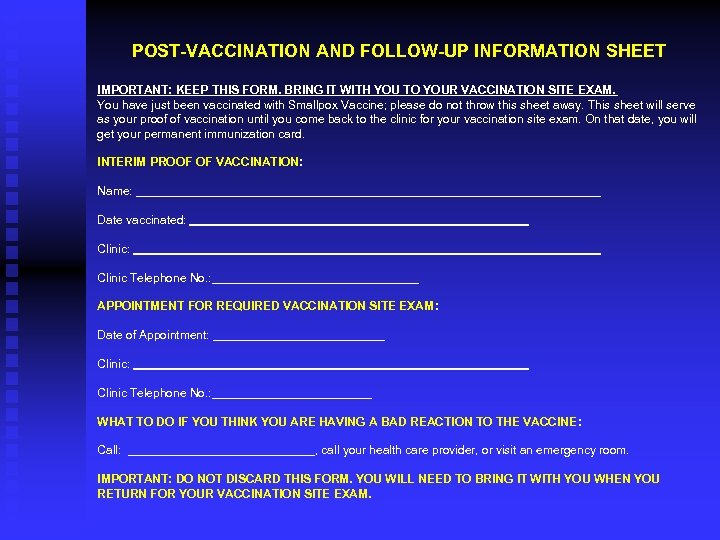 POST-VACCINATION AND FOLLOW-UP INFORMATION SHEET IMPORTANT: KEEP THIS FORM. BRING IT WITH YOU TO YOUR VACCINATION SITE EXAM. You have just been vaccinated with Smallpox Vaccine; please do not throw this sheet away. This sheet will serve as your proof of vaccination until you come back to the clinic for your vaccination site exam. On that date, you will get your permanent immunization card. INTERIM PROOF OF VACCINATION: Name: Date vaccinated: Clinic Telephone No. : ________________ APPOINTMENT FOR REQUIRED VACCINATION SITE EXAM: Date of Appointment: Clinic Telephone No. : ____________ WHAT TO DO IF YOU THINK YOU ARE HAVING A BAD REACTION TO THE VACCINE: Call: ______________, call your health care provider, or visit an emergency room. IMPORTANT: DO NOT DISCARD THIS FORM. YOU WILL NEED TO BRING IT WITH YOU WHEN YOU RETURN FOR YOUR VACCINATION SITE EXAM.
 Site Observation n Hospitals and public health units have plans for a trained observer to check or change dressings of patient care providers prior to each shift. u To evaluate for adverse reactions. u To confirm that semi-permeable dressing is intact and drainage contained. u To educate on infection control practices. u Recommended that site care provider is vaccinated.
 Vaccination Site Appearance and Care Site Care Instructions Follow these instructions until the scab that forms at the vaccination site has fallen off on its own. WHAT YOU SHOULD DO: • When working in a health care setting, cover the vaccination site loosely with gauze, using first aid adhesive tape to keep it in place. Then cover the gauze with a semipermeable (or semi-occlusive) dressing. Change the bandage at least every 3 -5 days in order to prevent build-up of fluids and irritation of the vaccination site. Also wear a shirt that covers the vaccination site as an additional barrier to spread of vaccinia. (A “semipermeable dressing” is one that does not allow for the passage of fluids but allows for the passage of air. ) • When not at work in a health care setting, you need only wear the gauze bandage secured by first aid adhesive tape over the vaccination site. Change the gauze bandage frequently (every 1 -3 days). As an added precaution against spread of transmission, wear a shirt that covers the vaccination site as well. This is particularly important in situations of close physical contact such as occurs in the household. • Wash hands with soap and warm water or with alcohol-based hand rubs such as gels or foams after direct contact with vaccine, the vaccination site, or anything that might be contaminated with live virus, including bandages, clothing, towels or sheets that came in contact with the vaccination site. This is vital in order to remove any virus from your hands and prevent contact spread.
 Site Care WHAT YOU SHOULD DO: • Keep the vaccination site dry. Cover the vaccination site with a waterproof bandage when you bathe. Remember to change back to the loose gauze dressing after bathing. If the gauze covering the vaccination site gets wet, change it. • Put the contaminated bandages in a sealed plastic bag and throw them away in the trash. • Keep a separate laundry hamper for clothing, towels, bedding or other items that may have come in direct contact with the vaccination site or drainage from the site. • Wash clothing or any other material that comes in contact with the vaccination site using hot water with detergent and/or bleach. Wash hands afterwards. • When the scab falls off, throw it away in a sealed plastic bag (remember to wash your hands afterwards).
 Site Care WHAT YOU SHOULD NOT DO: • Don’t use a bandage that blocks all air from the vaccination site. This may cause the skin at the vaccination site to soften and wear away. Use loose gauze secured with first aid adhesive tape to cover the site and then cover this with a semi-permeable dressing and shirt when at work in a health care setting. • Don’t put salves or ointments on the vaccination site. • Don’t scratch or pick at the scab. The vaccination site can become very itchy but you should not scratch it.
 Take Evaluation n n Vacinee will return to clinic site or hospital based site for evaluation of the “take”. Will be read as u Major take: visicle or pustule is present. u Equivical take: erythema only. u No take: no response
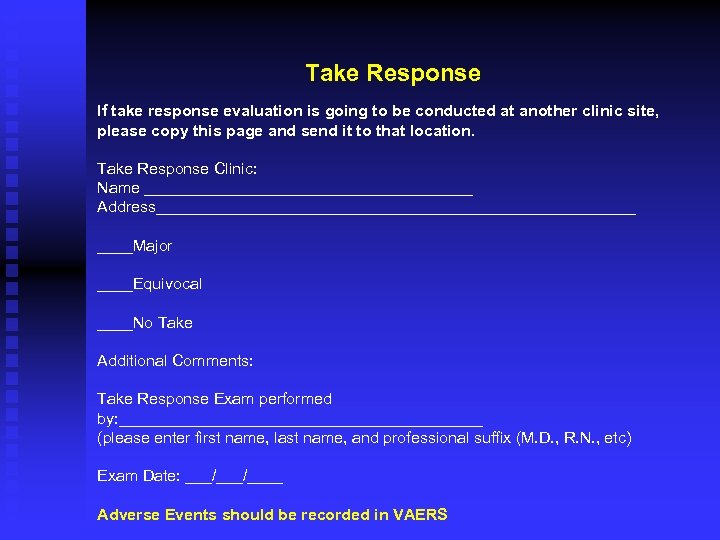 Take Response If take response evaluation is going to be conducted at another clinic site, please copy this page and send it to that location. Take Response Clinic: Name ___________________ Address___________________________Major ____Equivocal ____No Take Additional Comments: Take Response Exam performed by: _____________________ (please enter first name, last name, and professional suffix (M. D. , R. N. , etc) Exam Date: ___/____ Adverse Events should be recorded in VAERS
 Equivical Take Person is sufficiently immune. n Sub-potent vaccine. n Improper technique. n Hypersensitive reaction to vaccine components. n Impossible to know which reason is cause of this response. n
 Re-Vaccination If no take or equivical take, re-vaccination is necessary. n Re-vaccination may occur immediately following the read 6 -8 days after the initial vaccination. n
 CDC Pre-Event Vaccination System Overview Presented by: Heather Weaver, RN Division of Disease Control ND Immunization Program
 Objectives Why do we need PVS? n Who will have access to PVS? n What does PVS look like? n Questions? n What is PVS? n
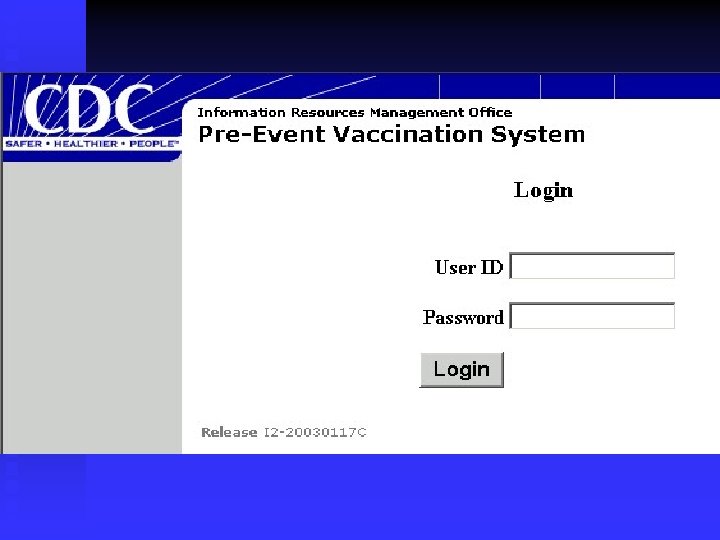
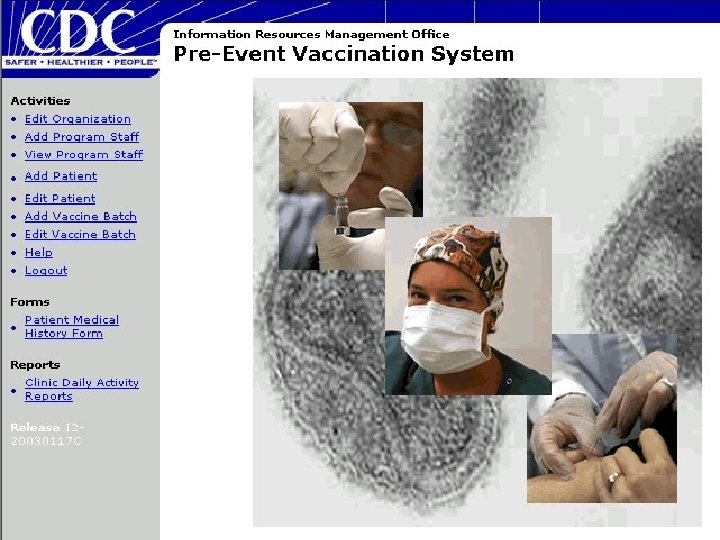
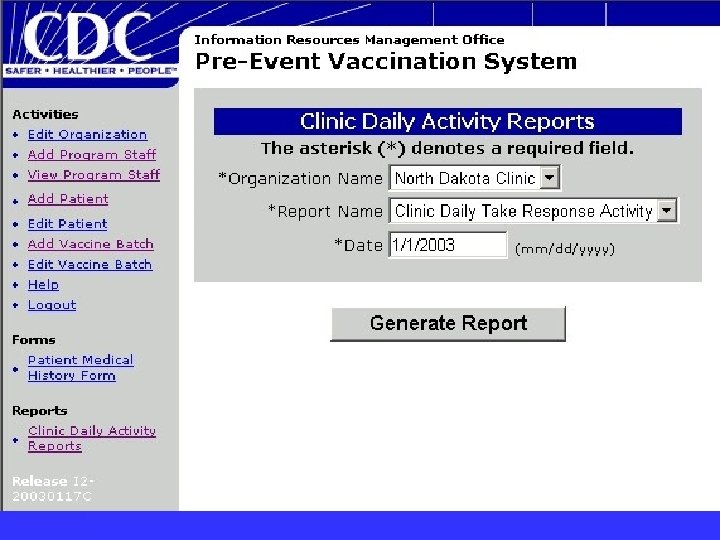
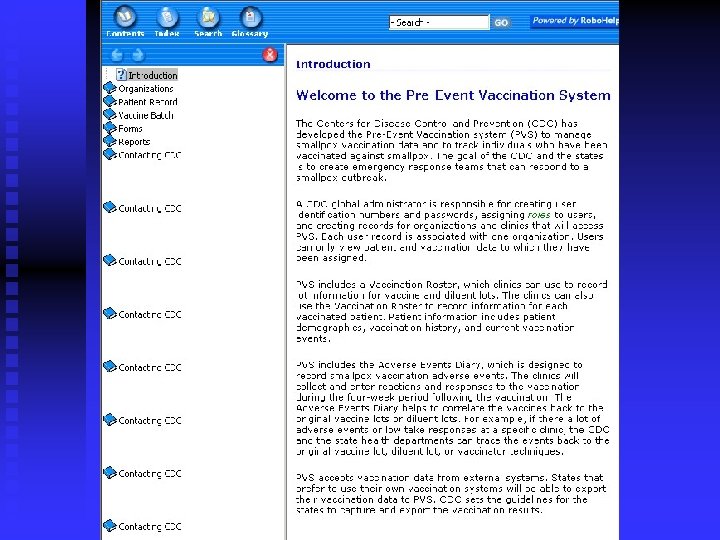
 Pre-Event Vaccination System (PVS) n n n Developed by CDC for use with the Smallpox Vaccination Program A vaccine administration support system Web-based system provided to clinics at no cost Manages secure data transmission and storage Provides pre-defined reports required for evaluation and monitoring of clinics Provides secure data views for ad-hoc reporting
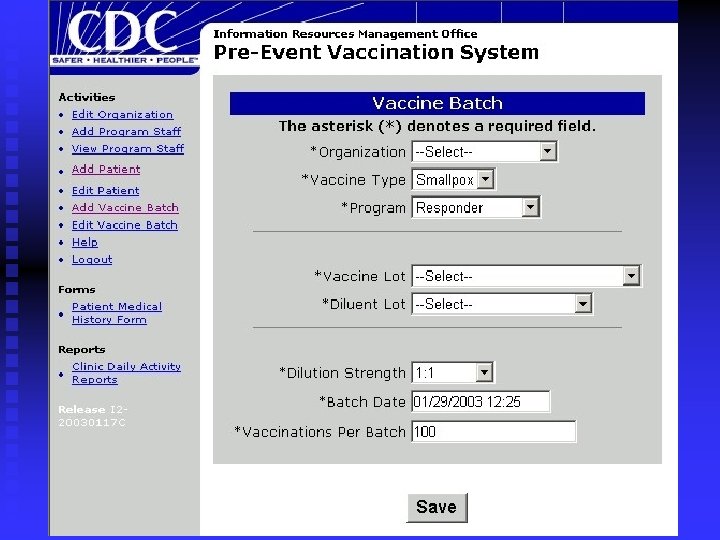
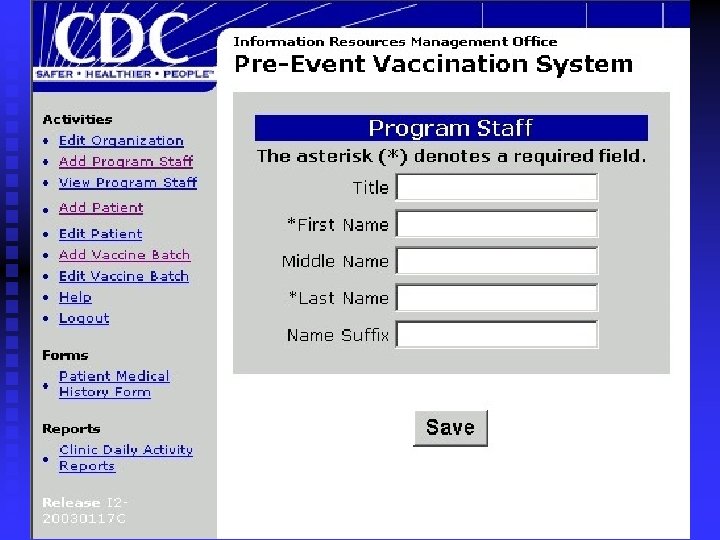
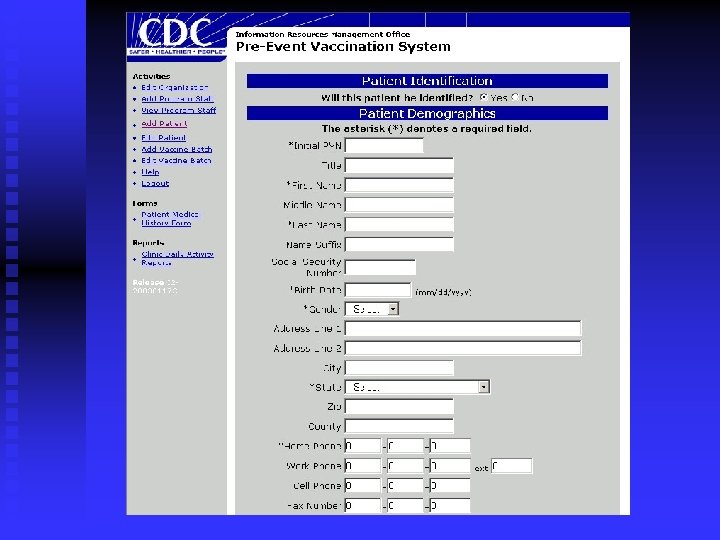
 PVS Overview n n n Administration and Management u Clinic contact information u User roles and security u Digital certificate management Vaccine/Diluent Batch Management u Vaccine and diluent lot management through National Pharmaceutical Stockpile Patient Management u Patient Demographics u Vaccination History u Current Vaccination u Take Response
 Why Is PVS Needed? To manage vaccine administration, lot and diluent usage, take tracking n Existing Registry does not allow for data to be sent to CDC n Allows data in PVS to be used for aggregate reporting at state and federal levels n
 Who will have access to PVS? State Health Officials n Local Public Health Units u Data Entry staff u Administrative staff n
 What does PVS look like? Login screen n Main Menu Screen n Adding a patient n Batch Information n Generating Reports n Help Screen n
 Questions? Please Contact Heather Weaver, RN Division of Disease Control Immunization Program 701 -328 -2035 hweaver@state. nd. us n
 Managing Adverse Events Stephen P. Pickard MD
 Primary Care of Vaccinees Likely to see self-limited conditions u Constitutional symptoms u Robust or severe takes u Satellite lesions u Viral cellulitis n May see inadvertent inoculation (e. g. , eye) or household transmission n Unlikely to see serious reactions n
 Regional Consultants Contraindications to vaccination n Take n Robust and severe reactions n Wound site care n Infection control procedures n Diagnosis of adverse reactions n Acute management n
 Specialists ID, Derm, Ophthalmology, Neurology u Ocular implantation, eczema vaccinatum, generalized vaccinia, encephalitis, progressive vaccinia n Diagnosis n Management n
 Specialists n ID specialists who have assisted NDDo. H prepare for vaccination u Dr. James Hargreaves u Dr. Robert Tight u Dr. Kent Martin u Dr. Paul Carson
 State or Local Public Health Questions u Screening, vaccination risk, site care, take, clinic scheduling, liability, media, vaccine indications, investigational drug protocols, adverse reactions n Virologic laboratory n VIG or Cidofovir n Disease surveillance and reporting n
 Contacting NDDo. H Clinical issues (701) 328 -2372 u Steve Pickard MD u Terry Dwelle, MD, MPHTM n Vaccination program (701) 328 -2378 u Heather Weaver u Larry Shireley n Smallpox program / BT (701) 328 -2270 u Tim Wiedrich u Brenda Vossler n
 CDC Consultants Multidisciplinary teams n National smallpox/vaccinia experts n VIG distribution n Clinician Information Line: n 877 -554 -4625
 Obtaining VIG You may call NDDo. H or Clinician Information Line n Strongly recommend consultative assistance from ID specialist n VIG delivered to point of care within 12 hours n IV product likely, under IND n
 VAERS Reporting All clinically significant vaccine events n Additional form added for smallpox n Anyone can report n Physicians should report n Possible request for f/u (CDC or FDA) n On-line reporting: https: //secure. vaers. org/ n
 Additional Information www. bt. cdc. gov/agent/smallpox/ MMWR January 24, 2003 / 52; 1 -29 Smallpox Vaccination and Adverse Reactions: Guidance for Clinicians
 Smallpox Communications Loreeta Leer Frank Public Information Officer North Dakota Department of Health
 Guiding Principle The public will need information that will help them minimize their risk
 Not Business as Usual A public health emergency: u Triggers a level of public interest and media inquiry that requires a response beyond normal operations and resources. u Requires a significant diversion of department staff from regular duties.
 Recent Events n Anthrax concerns ~ 2001 n West Nile virus ~ 2002
 Emergencies Are Media Events n Emergency response would be hampered if media not involved u People rely on media for up-to-date information during an emergency u Media relay important protective actions for the public u Media know how to reach their audiences and what their audiences need
 Psychology of a Crisis Common human emotions may lead to negative behaviors that hamper recovery or cause more harm.
 Negative Behaviors Demands for unneeded treatment n Reliance on special relationships n Unreasonable trade and travel restrictions n Multiple unexplained physical symptoms n
 What Do People Feel During a Disaster? Denial n Fear and avoidance n Hopelessness or helplessness n Vicarious rehearsal n Seldom panic n
 Communicating During a Crisis When in “fight or flight” moments of an emergency, more information leads to decreased anxiety.
 Decision Making During a Crisis We simplify n We cling to current beliefs n We remember what we previously saw or experienced n
 How Do We Initially Communicate During a Crisis? Simply Timely Accurately Repeatedly Credibly Consistently
 During an Emergency … Don’t over reassure n State continued concern before stating reassuring updates n Don’t make promises about outcomes n Give people things to do n Allow people the right to feel fear u Acknowledge fear in self and others n
 Avoid These Pitfalls Jargon n Humor n Personal opinions n Speculation n
 Effective Messages Speed counts n Facts n Trusted source n
 Building Trust in the Message and the Messenger Express empathy n Competence n Honesty n Commitment n Accountability n
 Public Health’s Goal in Emergency Response To efficiently and effectively reduce and prevent illness, injury and death and to return individuals and communities to normal
 Contact Information Loreeta Leer Frank, public information officer 701. 328. 1665 rfrank@state. nd. us Patience Hurley, public information coordinator 701. 328. 4619 phurley@state. nd. us
 Questions? During this Live program Call 701 -328 -2614 or Send E-mail Following the Live Program Call 701 -328 -2270 or Send E-mail to twiedric@state. nd. us North Dakota Department of Health
 Smallpox Vaccine Operations Seminar North Dakota Department of Health