


 Скачать презентацию Small-Dollar Loan Pilot Program Final Results Safe Transactional
a493f62e60fbdf5d2232933db0faeaca.ppt
- Количество слайдов: 37
 Small-Dollar Loan Pilot Program Final Results, Safe Transactional and Savings Account Proposed Templates, and Policy and Project Updates June 24, 2010
 Opening Remarks Sheila C. Bair Chairman, FDIC
 Discussion of the Strategic Planning Subcommittee’s Meeting Regarding the Small- Dollar Loan Pilot Final Results and Case Studies Moderator: Bruce D. Murphy, Executive Vice President and President, Community Development Banking, Key. Bank, N. A. Rae-Ann Miller, Special Advisor to the Director, Division of Insurance and Research Alden Mc. Donald, President & CEO, Liberty Bank, New Orleans, LA Lilia Escajeda, Public Relations Consultant , Amarillo National Bank, Amarillo, TX Casandra Slade, Senior Vice President, Community Development Officer, Lake Forest Bank, Lake Forest, IL
 Affordable, Responsible, and Feasible Small Dollar Loans: The FDIC Small Dollar Loan Pilot Advisory Committee on Economic Inclusion June 24, 2010
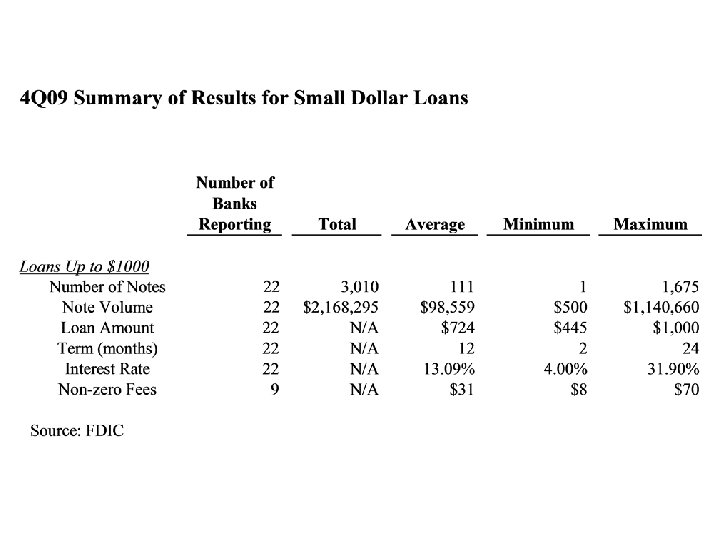
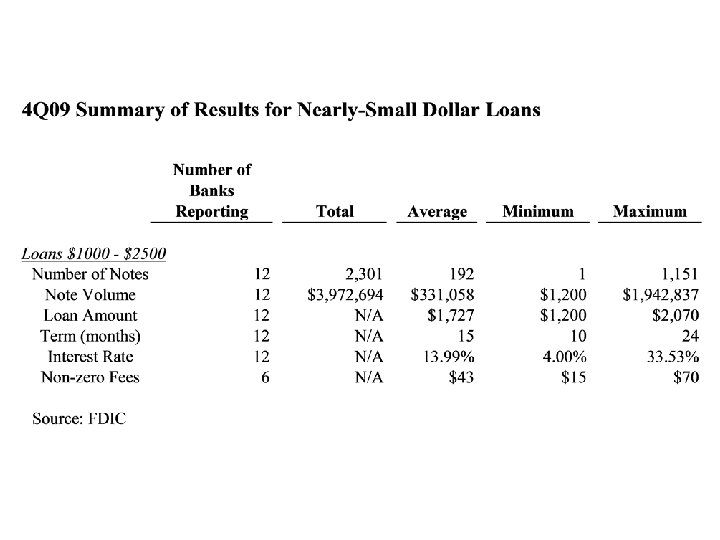
 The Small-Dollar Loan Pilot Program • In February 2008, 31 banks were selected to participate in the Small-Dollar Loan (SDL) Pilot Program. • The two-year case study explored how banks can profitably offer small-dollar as an alternative to high cost credit products. • Data were collected quarterly from 1 Q 08 through 4 Q 09.
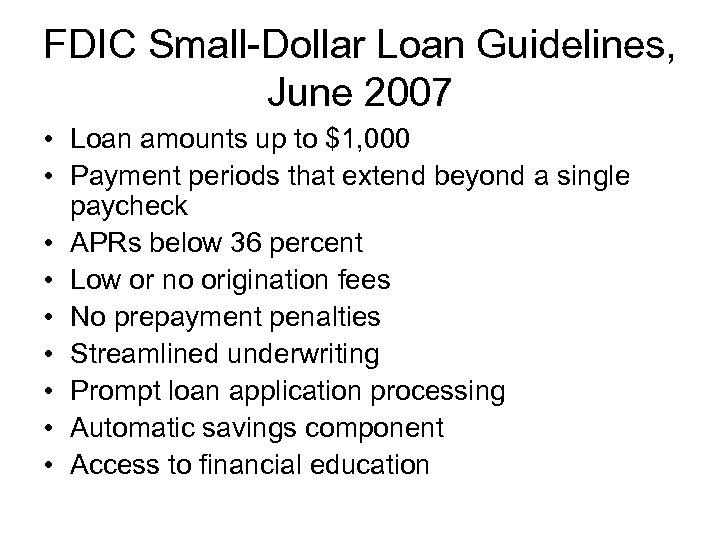 FDIC Small-Dollar Loan Guidelines, June 2007 • Loan amounts up to $1, 000 • Payment periods that extend beyond a single paycheck • APRs below 36 percent • Low or no origination fees • No prepayment penalties • Streamlined underwriting • Prompt loan application processing • Automatic savings component • Access to financial education
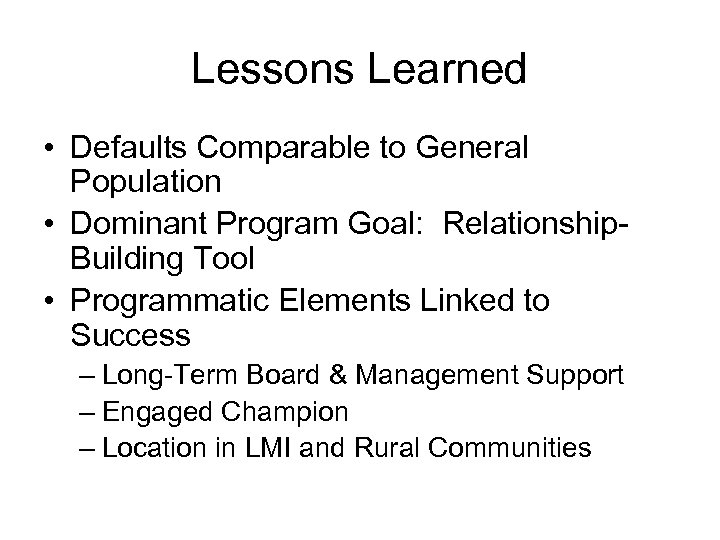 Lessons Learned • Defaults Comparable to General Population • Dominant Program Goal: Relationship. Building Tool • Programmatic Elements Linked to Success – Long-Term Board & Management Support – Engaged Champion – Location in LMI and Rural Communities
 Lessons Learned • Product Elements Linked to Success – Loan Terms Longer Than a Few Pay Periods – Strong, but Streamlined Underwriting • Linked Savings and Financial Education – Better Loan Performance May Be Correlated – Mixed Views on Mandates
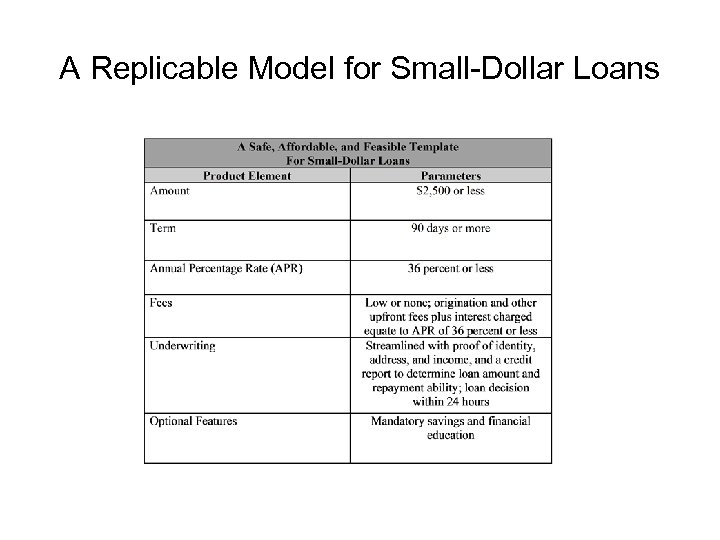 A Replicable Model for Small-Dollar Loans
 Next Steps • Objective: Small Dollar Loans Become a Staple Product for Mainstream Financial Institutions.
 – Highlight the Facts About Existing Models, Pilot Case Studies • Liberty Bank • Amarillo National Bank • Lake Forest Bank & Trust
 Encourage Partnerships • “Bank-On” Campaigns • FDIC Alliance for Economic Inclusion – 35 Small-Dollar Lending Banks • “Pooled Funds” Model – Baltimore’s Borrow and Save
 Study Creation of Guarantees • Linked, Low-Cost Deposits – Illinois Micro Loan Program • Loan Loss Reserves – Virginia State Employees Loan Program – Wilmington Trust/WENH – CDFI Proposed Legislation
 Embrace New Technologies • Employer-Based Lending Programs – Virginia State Employees Loan Program – Federal Employee Education and Assistance Fund – Lake Forest Bank & Trust – United Way Working Bridges • Employer-Based Platform Providers – Employee Loan Solutions
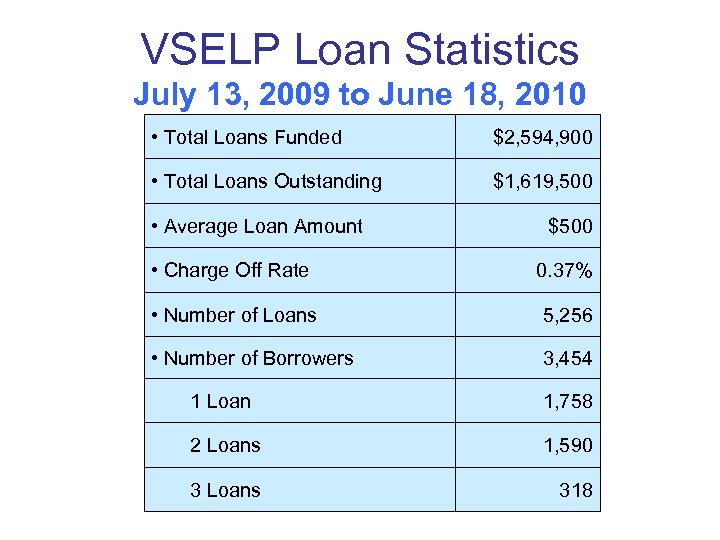 VSELP Loan Statistics July 13, 2009 to June 18, 2010 • Total Loans Funded $2, 594, 900 • Total Loans Outstanding $1, 619, 500 • Average Loan Amount $500 • Charge Off Rate 0. 37% • Number of Loans 5, 256 • Number of Borrowers 3, 454 1 Loan 1, 758 2 Loans 1, 590 3 Loans 318
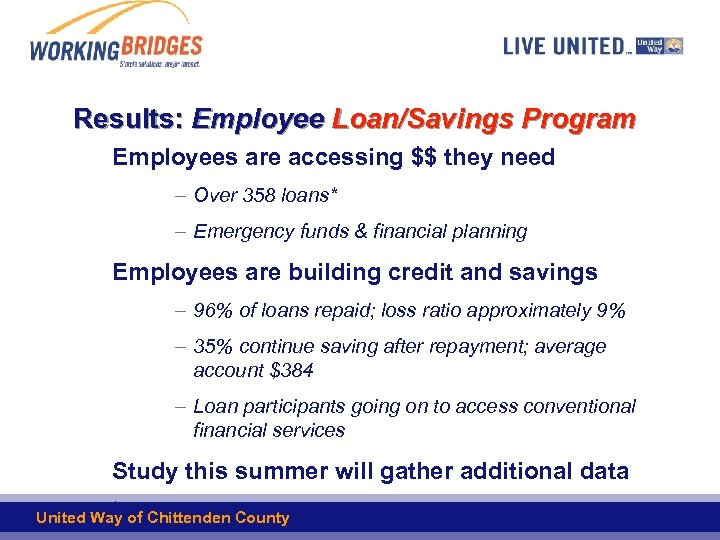 Results: Employee Loan/Savings Program Employees are accessing $$ they need – Over 358 loans* – Emergency funds & financial planning Employees are building credit and savings – 96% of loans repaid; loss ratio approximately 9% – 35% continue saving after repayment; average account $384 – Loan participants going on to access conventional financial services Study this summer will gather additional data * North Country Federal Credit Union two-year data United Way of Chittenden County
 Regulatory Issues • Community Reinvestment Act – Current Policy/Examination Procedures – More Specific Consideration – CRA to Offset ROI – CRA Public Hearings • Other Incentives – EFTA Carve-Out – Loss Sharing/Guarantees – Overdrafts
 Break
Break
 Transactional and Savings Account Proposed Templates Moderator: Ellen Lazar, Senior Advisor to the Chairman for Consumer Policy Barbara A. Ryan, Deputy to the Vice Chairman Roberta K. Mc. Inerney, Deputy General Counsel Rae-Ann Miller, Special Advisor to the Director, Division of Insurance and Research Sherrie Rhine, Senior Economist, Division of Insurance and Research
 Transactional and Savings Account Proposed Templates Transactional Work Group Savings Work Group Committee on Economic Inclusion June 24, 2010
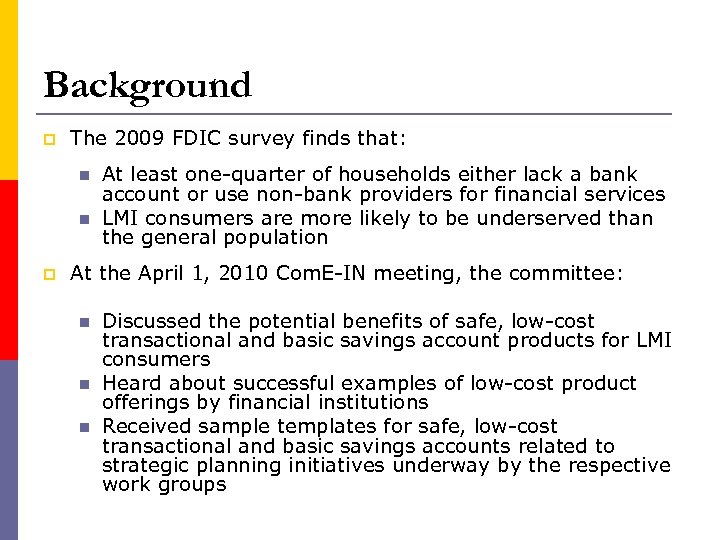 Background p The 2009 FDIC survey finds that: n n p At least one-quarter of households either lack a bank account or use non-bank providers for financial services LMI consumers are more likely to be underserved than the general population At the April 1, 2010 Com. E-IN meeting, the committee: n n n Discussed the potential benefits of safe, low-cost transactional and basic savings account products for LMI consumers Heard about successful examples of low-cost product offerings by financial institutions Received sample templates for safe, low-cost transactional and basic savings accounts related to strategic planning initiatives underway by the respective work groups
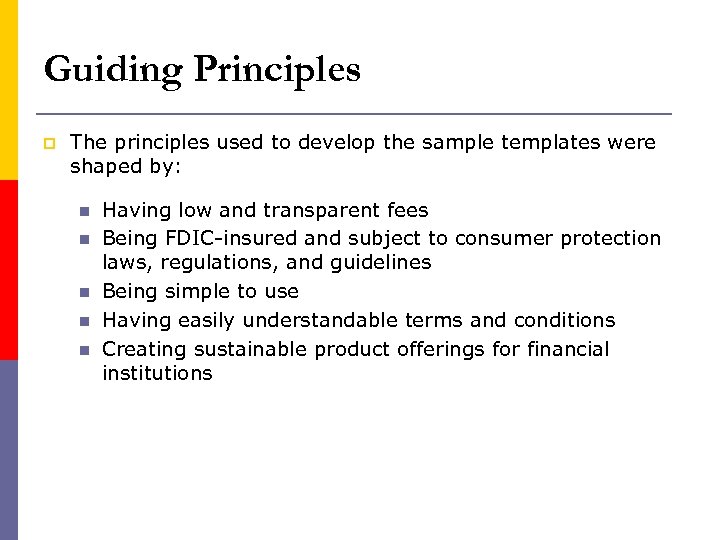 Guiding Principles p The principles used to develop the sample templates were shaped by: n n n Having low and transparent fees Being FDIC-insured and subject to consumer protection laws, regulations, and guidelines Being simple to use Having easily understandable terms and conditions Creating sustainable product offerings for financial institutions
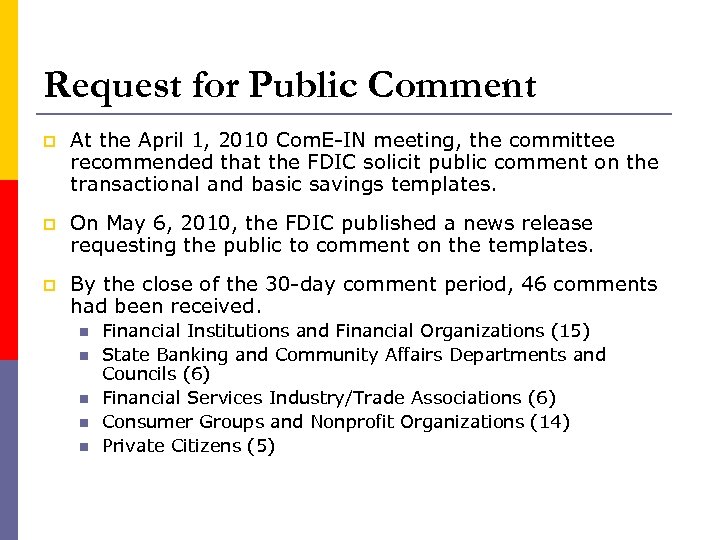 Request for Public Comment p At the April 1, 2010 Com. E-IN meeting, the committee recommended that the FDIC solicit public comment on the transactional and basic savings templates. p On May 6, 2010, the FDIC published a news release requesting the public to comment on the templates. p By the close of the 30 -day comment period, 46 comments had been received. n n n Financial Institutions and Financial Organizations (15) State Banking and Community Affairs Departments and Councils (6) Financial Services Industry/Trade Associations (6) Consumer Groups and Nonprofit Organizations (14) Private Citizens (5)
 Transactional Account Comments p Broad support for the idea of a low-cost account for LMI customers. p Banks believe they already offer such accounts. p Consumer groups believe it is critical to structure the accounts carefully.
 Transactional Account Comment Themes and Issues p Role of technology p Targeted population p Overdraft p Ancillary services p Minimum balances and fees p Incentives, CRA, and marketing p Concerns: n Mandate versus guidance n Eligibility requirements
 Transactional Account: Areas of Broad Support p Electronic delivery (debit-based card, paperless) p Direct deposit p No overdraft (tied to electronic account) p Available to all p Clear guidance on eligibility p Simple, clear, predictable, and affordable fee structure p Ancillary services are a critical component: money orders, check cashing, money transfers, and free online banking
 Common Themes Raised in the Basic Savings Account Comments p Role of technology, targeted population, eligibility requirement, mandate versus guidance and impact on product innovation, direct deposit and other automated saving, and incentives and potential role of CRA were raised. p Opening and minimum balances: banks and bank trades suggested higher amounts, states, community and consumer groups suggested lower amounts. p Several commenters suggested providing incentives to save: discounts on other services for maintaining balances, limits on numbers of withdrawals, limits on methods of withdrawing.
 Basic Savings Account: Areas of Broad Support p Automated savings p Direct deposit p Interest earning
 Proposed FDIC Model Safe Accounts p The public comments helped inform the creation of the proposed FDIC Model Safe Accounts to the committee. p Common features of the transactional and basic savings accounts include: n Electronic card-based deposit accounts n Low opening and minimum balances n Low, transparent and predictable fees n Direct deposit n Paperless, electronic statements n Available to all consumers n No overdraft – Transactional Accounts n Interest earning – Basic Savings Accounts
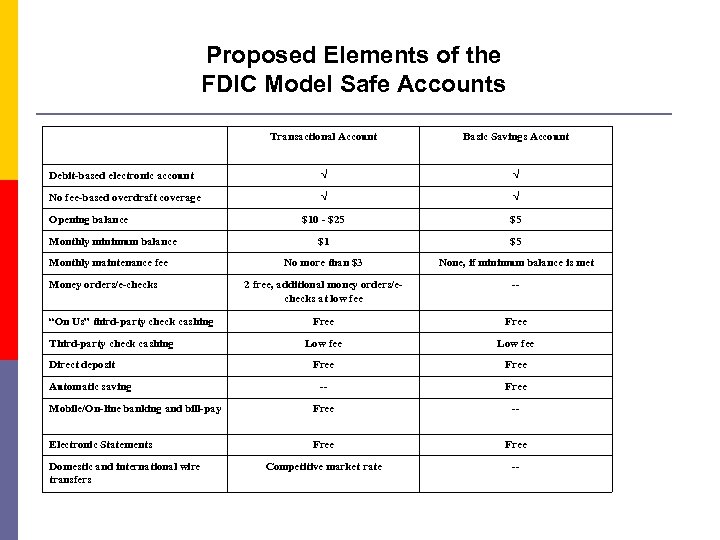 Proposed Elements of the FDIC Model Safe Accounts Transactional Account Basic Savings Account Debit-based electronic account √ √ No fee-based overdraft coverage √ √ $10 - $25 $5 $1 $5 No more than $3 None, if minimum balance is met 2 free, additional money orders/echecks at low fee -- Free Low fee Free -- Free Mobile/On-line banking and bill-pay Free -- Electronic Statements Free Competitive market rate -- Opening balance Monthly minimum balance Monthly maintenance fee Money orders/e-checks “On Us” third-party check cashing Third-party check cashing Direct deposit Automatic saving Domestic and international wire transfers
 Thank you
 Lunch
Lunch
 Transactional and Savings Account Proposed Templates (Continued) and Status Report On Strategic Plan Projects Moderator: Ellen Lazar Luke Brown, Associate Director, Compliance Policy Branch, Division of Supervision and Consumer Protection, FDIC Roberta K. Mc. Inerney Rae-Ann Miller Luke Reynolds, Chief, Outreach and Program Development Section, Division of Supervision and Consumer Protection, FDIC Barbara A. Ryan
 Issues Update Moderator: Ellen Lazar Luke Brown Roberta K. Mc. Inerney Rae-Ann Miller Luke Reynolds Barbara A. Ryan Janet R. Gordon, Senior Policy Analyst, Division of Supervision and Consumer Protection, FDIC
 Conclusion Sheila C. Bair Ellen Lazar