


 Скачать презентацию Small Community CDM projects IDFC experience and perspectives
6309b5c8d0f51ecefde3665955069fdf.ppt
- Количество слайдов: 28
 Small Community CDM projects IDFC experience and perspectives Ajay Narayanan Head EMSD/DINT IDFC
 Outline • Background to IDFC – Introduction – Decentralized Infrastructure – Carbon Finance • IDFC perspective on Small projects – SELCO – IRNET Rural electrification in India • Perspectives for CDCF 2
 IDFC Background • Set up as a nodal FI to lead private capital to commercially viable infrastructure • 40% Go. I, 40% international agencies • Works on project finance, policy & advisory work • Sectors – Energy • Generation, transmission and distribution – Integrated Transport & Logistics • Roads and Bridges • Ports and harbors – – Telecommunication & IT Water, Sanitation and Solid waste Food & Agriculture Health, Education & Tourism • Environment Management and Decentralized Infrastructure 3
 Background of DI in IDFC • Limited last mile impact of centralized infrastructure • Adverse impacts of centralized development – Not always cost effective – Environment & Social impacts – Long gestation periods • Distortions in system for rural infrastructure & poverty alleviation • A divide of commercial finance vs. Donor programs • IDFC has set aside US $ 2 mn. year to fund such projects – Redefining Private sector to include any non-governmental structure – Predicated on profit motive being a reliable driver – Focus on proper incentivisation to achieve a sustainable project – Based on appropriate risk return allocation – Leveraging donor funds and State Development support to expand impact and reduce M&E costs 4
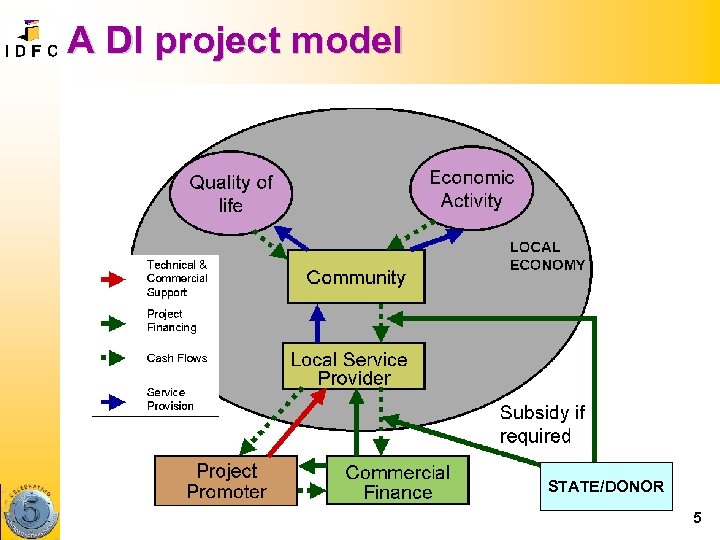 A DI project model STATE/DONOR 5
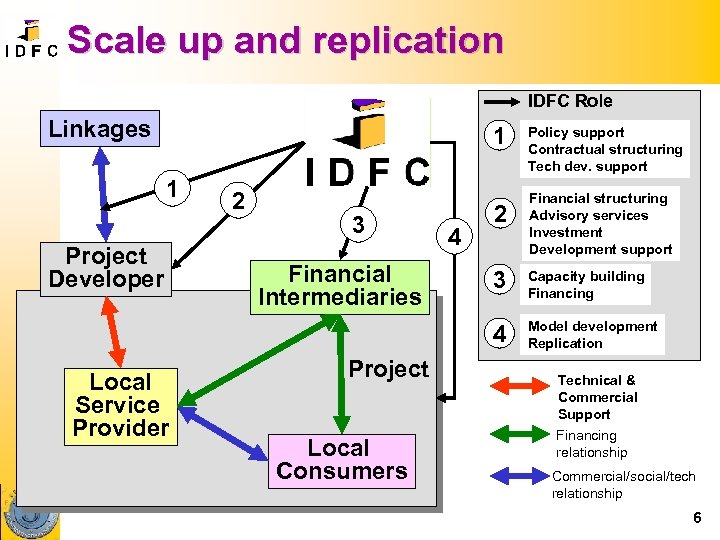 Scale up and replication IDFC Role Linkages 1 1 Project Developer 2 3 Financial Intermediaries 4 2 Policy support Contractual structuring Tech dev. support Financial structuring Advisory services Investment Development support Project Local Consumers Capacity building Financing 4 Local Service Provider 3 Model development Replication Technical & Commercial Support Financing relationship Commercial/social/tech relationship 6
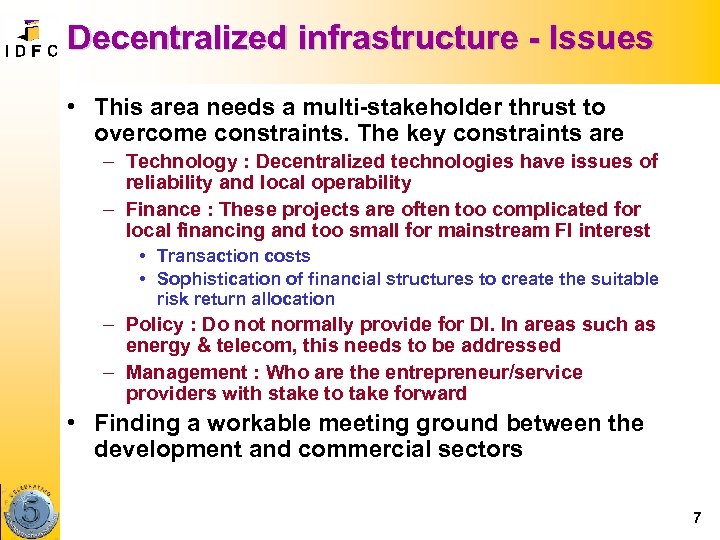 Decentralized infrastructure - Issues • This area needs a multi-stakeholder thrust to overcome constraints. The key constraints are – Technology : Decentralized technologies have issues of reliability and local operability – Finance : These projects are often too complicated for local financing and too small for mainstream FI interest • Transaction costs • Sophistication of financial structures to create the suitable risk return allocation – Policy : Do not normally provide for DI. In areas such as energy & telecom, this needs to be addressed – Management : Who are the entrepreneur/service providers with stake to take forward • Finding a workable meeting ground between the development and commercial sectors 7
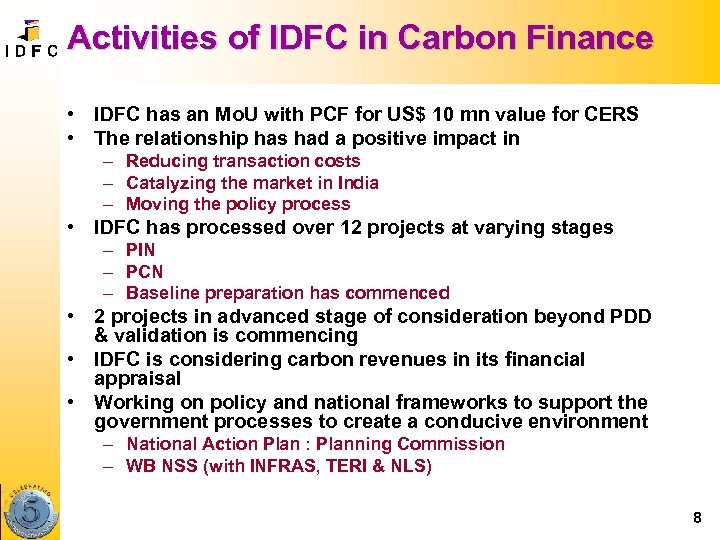 Activities of IDFC in Carbon Finance • IDFC has an Mo. U with PCF for US$ 10 mn value for CERS • The relationship has had a positive impact in – Reducing transaction costs – Catalyzing the market in India – Moving the policy process • IDFC has processed over 12 projects at varying stages – PIN – PCN – Baseline preparation has commenced • 2 projects in advanced stage of consideration beyond PDD & validation is commencing • IDFC is considering carbon revenues in its financial appraisal • Working on policy and national frameworks to support the government processes to create a conducive environment – National Action Plan : Planning Commission – WB NSS (with INFRAS, TERI & NLS) 8
 DI project examples in India
 SELCO Home lighting system finance
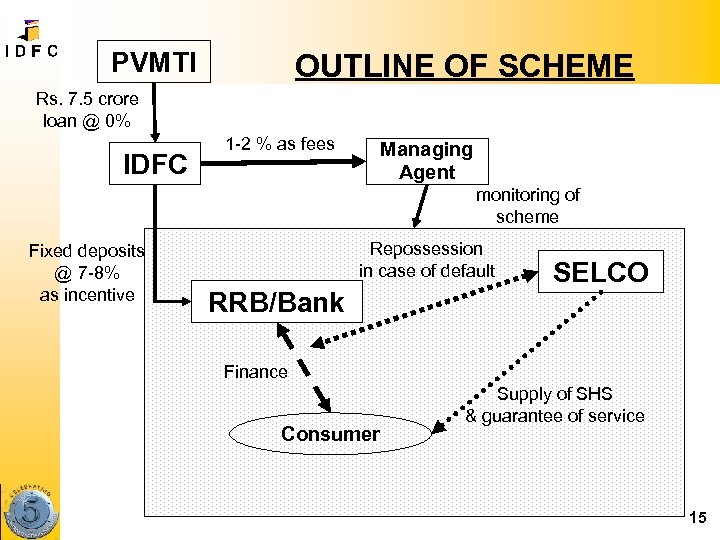 PVMTI OUTLINE OF SCHEME Rs. 7. 5 crore loan @ 0% IDFC 1 -2 % as fees Managing Agent monitoring of scheme Fixed deposits @ 7 -8% as incentive Repossession in case of default RRB/Bank SELCO Finance Consumer Supply of SHS & guarantee of service 15
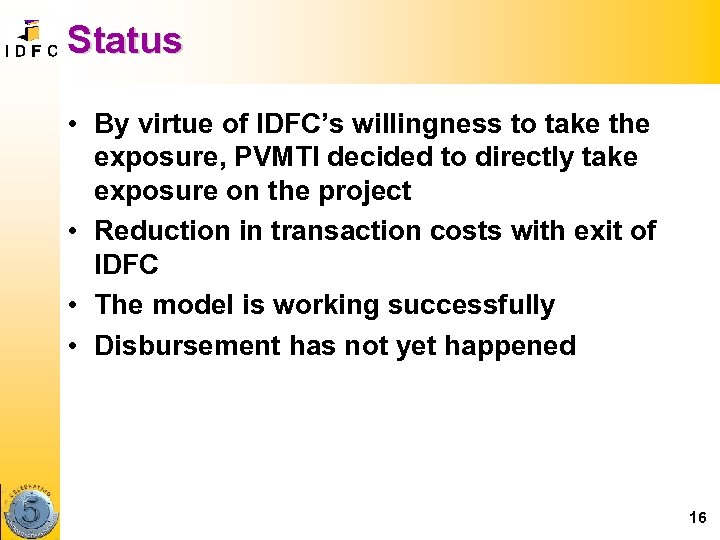 Status • By virtue of IDFC’s willingness to take the exposure, PVMTI decided to directly take exposure on the project • Reduction in transaction costs with exit of IDFC • The model is working successfully • Disbursement has not yet happened 16
 IRNET An NGO network as an intermediary
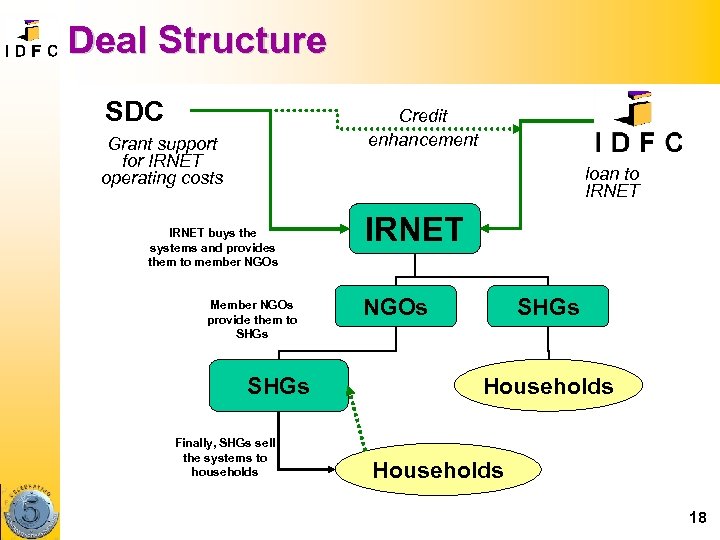 Deal Structure SDC Credit enhancement Grant support for IRNET operating costs loan to IRNET buys the systems and provides them to member NGOs Member NGOs provide them to SHGs Finally, SHGs sell the systems to households IRNET NGOs SHGs Households 18
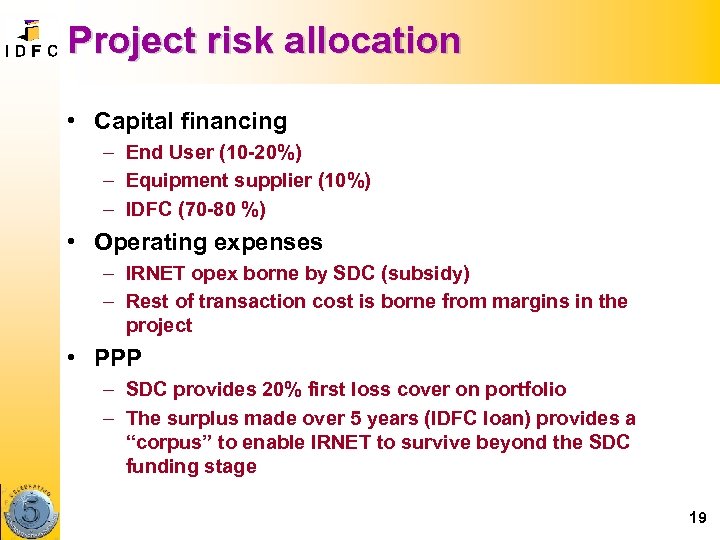 Project risk allocation • Capital financing – End User (10 -20%) – Equipment supplier (10%) – IDFC (70 -80 %) • Operating expenses – IRNET opex borne by SDC (subsidy) – Rest of transaction cost is borne from margins in the project • PPP – SDC provides 20% first loss cover on portfolio – The surplus made over 5 years (IDFC loan) provides a “corpus” to enable IRNET to survive beyond the SDC funding stage 19
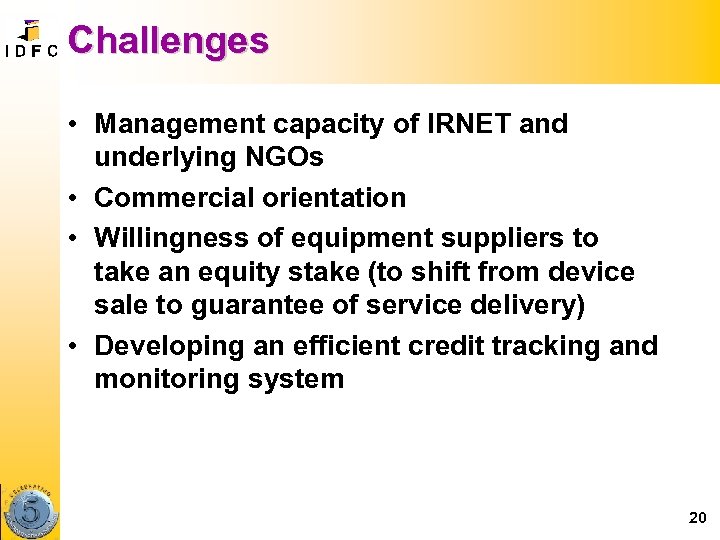 Challenges • Management capacity of IRNET and underlying NGOs • Commercial orientation • Willingness of equipment suppliers to take an equity stake (to shift from device sale to guarantee of service delivery) • Developing an efficient credit tracking and monitoring system 20
 Remote rural electrification : India A PPP model
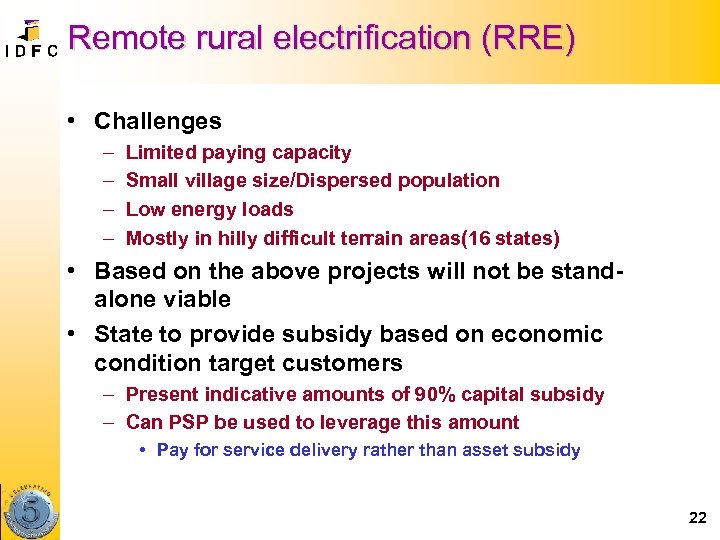 Remote rural electrification (RRE) • Challenges – – Limited paying capacity Small village size/Dispersed population Low energy loads Mostly in hilly difficult terrain areas(16 states) • Based on the above projects will not be standalone viable • State to provide subsidy based on economic condition target customers – Present indicative amounts of 90% capital subsidy – Can PSP be used to leverage this amount • Pay for service delivery rather than asset subsidy 22
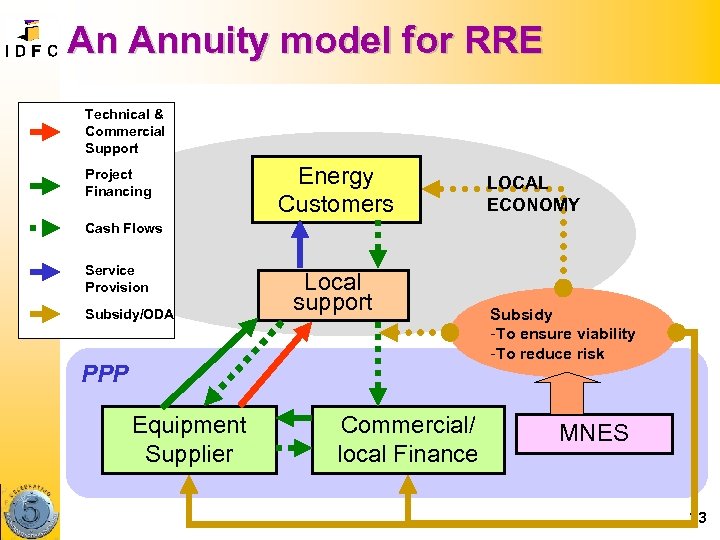 An Annuity model for RRE Technical & Commercial Support Project Financing Energy Customers LOCAL ECONOMY Cash Flows Service Provision Subsidy/ODA Local support PPP Equipment Supplier Commercial/ local Finance Subsidy -To ensure viability -To reduce risk MNES 23
 CDCF and doing deals
 Possible options for CDCF • Large projects with community development focus being funded by CDCF – Can work with existing frameworks for adding the community component – Possibly another supply driven approach • Small decentralized infrastructure projects – A longer term option for genuine local benefit and local demand based project development – Much more difficult to get started – Requires significant development assistance for facilitation • The latter will have more impact but is more difficult 25
 Prerequisites for CDM • Carbon Financing is essentially an “additional revenue stream for a project achieved by selling CERs • Most international buyers pay “on delivery of CERs • However viability & financial closure of the underlying project is paramount • This poses the main challenge for small community based projects 26
 Bringing about the “Shift” • Commercial Finance – National level institutions • Skills in project financing • Transaction costs • No local presence – Local institutions and banks • Appropriate scale • No skills in project financing • No incentive for business development/project finance • Local enterprises • Limited capacity/risk taking ability (equity) • Management skills • Equipment suppliers • Unwillingness to take exposure 27
 Bringing about the “Shift” • Civil society (NGOs working in grassroots) – Limited willingness to engage in commercial models – Limited management capacity – Donor dependency is easier (especially if agency is credible) • Governments – Reluctance to provide commercial support to private sector for development – Reluctance to move from Target based programmes • Donor community – Is slow to respond to new approaches – Work with new business models involving private sector – Slow internal processes • Much effort is required for project development & structuring in addition to convincing players to “try out the approach” • CDCF Could be a catalyst as it integrates : Development with a market mechanism (Carbon finance) 28
 Opportunities for CDCF
 Conclusions • Underlying project viability is vital for CDM deals. • If project is not done on commercial principles, transaction costs will be too high • This is a real challenge for small community centred projects – Players are slow to move to a new paradigm – Barrier removal is a process • Clearly there are too many risks for such project development unless it is support by – Development assistance and/or – ODA • This can be either from – State support for income redistribution – Donor/Bilateral support for development • This has been slow to move at the local level and a larger global scheme could create the required impetus (at least at a pilot level) 30
 Way forward • Work with donors and bilaterals to create new instruments for – Risk sharing – Annuity based payment models – Output based subsidy models • Seed these approaches with government agencies to create annuity based approaches that operate on commercial principles • Create a pool of experimental development assistance for the above that would support (from ODA) – Project development – Capacity building – Project risk sharing (guarantees etc) • Work with intermediaries (at the national/regional level) who should in turn work with local intermediaries to reduce transaction costs 31
 Thank you