 Скачать презентацию Small Cell創新應用與服務專題 課 程單元 行動通訊技術之 沿革與演進 國立中山大學 資訊
3ab4be90e8c971db7b1b782803546a7f.ppt
- Количество слайдов: 91



Small Cell創新應用與服務專題 課 程單元 :行動通訊技術之 沿革與演進 國立中山大學 資訊 程系 授課教師:李宗南教授 教材編撰:吳忠岳 1 L A B
大綱 • 課程目標 • 第一代 (1 G , First Generation) • 第二代 (2 G , Second Generation) • 第三代 (3 G , Third Generation) • 第四代 (4 G , Fourth Generation) • 第五代 (5 G and Beyond) 2 L A B
大綱 • 課程目標 • 第一代 (1 G , First Generation) • 第 二 代 (2 G , Second Generation) • 第三代 (3 G , Third Generation) • 第四代 (4 G , Fourth Generation) 3 L A B
課程目標 • 讓學生了解行動通訊技術的演進 • 從最一開始的類比通訊到 LTE的發展過程之簡介 • 相關通訊技術的基本介紹 4 L A B
大綱 • 課程目標 • 第一代 (1 G , First Generation) • 第 二 代 (2 G , Second Generation) • 第三代 (3 G , Third Generation) • 第四代 (4 G , Fourth Generation) 5 L A B
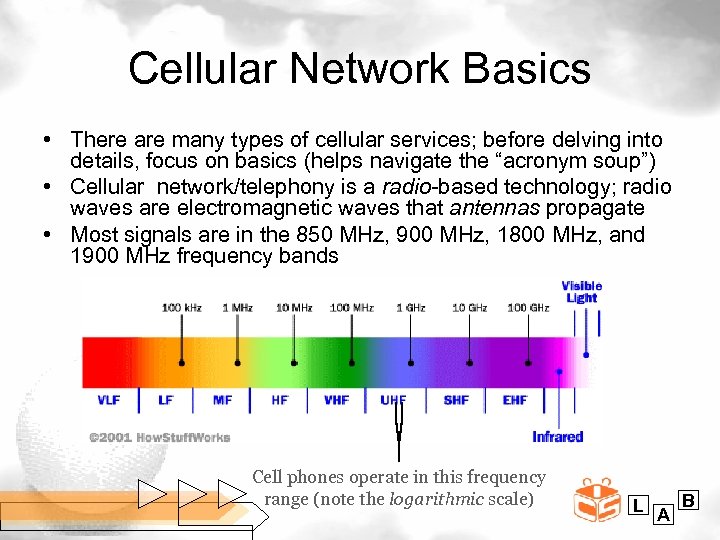
Cellular Network Basics • There are many types of cellular services; before delving into details, focus on basics (helps navigate the “acronym soup”) • Cellular network/telephony is a radio-based technology; radio waves are electromagnetic waves that antennas propagate • Most signals are in the 850 MHz, 900 MHz, 1800 MHz, and 1900 MHz frequency bands Cell phones operate in this frequency range (note the logarithmic scale) L A B
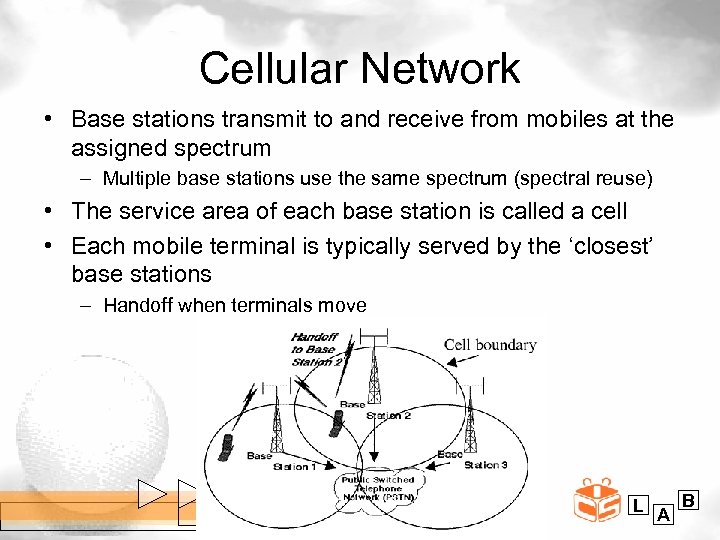
Cellular Network • Base stations transmit to and receive from mobiles at the assigned spectrum – Multiple base stations use the same spectrum (spectral reuse) • The service area of each base station is called a cell • Each mobile terminal is typically served by the ‘closest’ base stations – Handoff when terminals move L A B
Cellular Network Generations • It is useful to think of cellular Network/telephony in terms of generations: – – 0 G: Briefcase-size mobile radio telephones 1 G: Analog cellular telephony 2 G: Digital cellular telephony 3 G: High-speed digital cellular telephony (including video telephony) – 4 G: IP-based “anytime, anywhere” voice, data, and multimedia telephony at faster data rates than 3 G (to be deployed in 2012– 2015) L A B
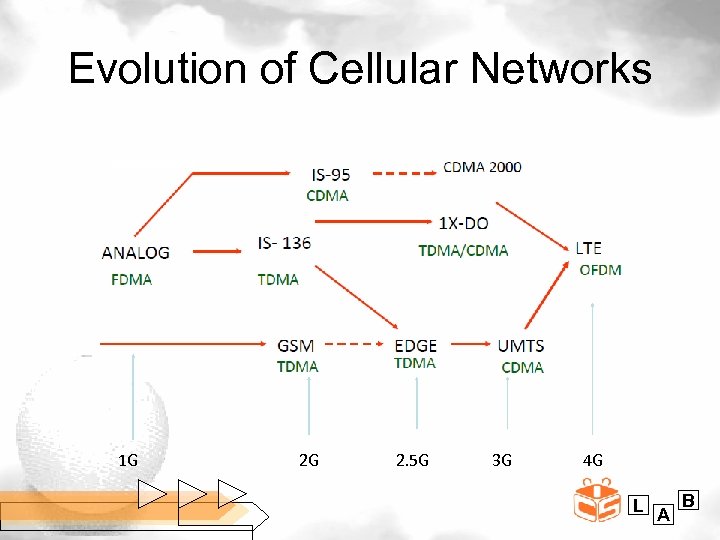
Evolution of Cellular Networks 1 G 2 G 2. 5 G 3 G 4 G L A B
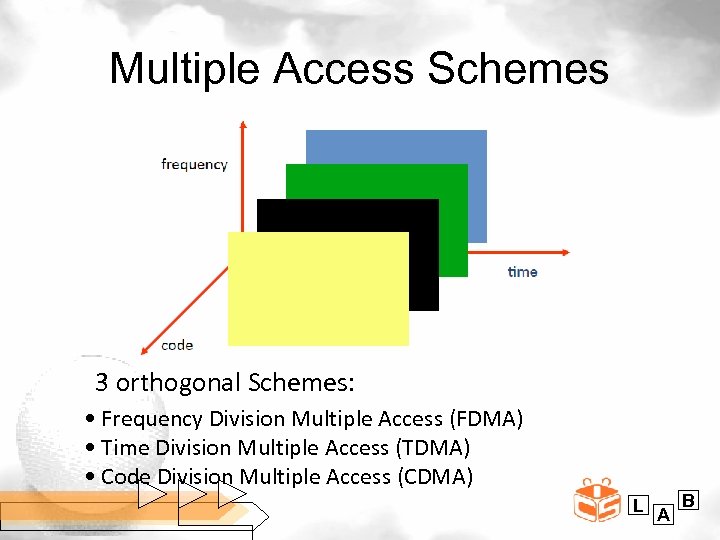
Multiple Access Schemes 3 orthogonal Schemes: • Frequency Division Multiple Access (FDMA) • Time Division Multiple Access (TDMA) • Code Division Multiple Access (CDMA) L A B
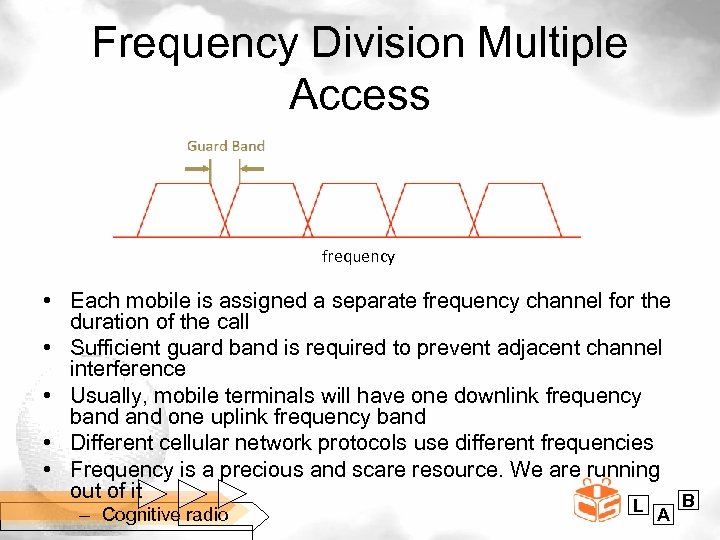
Frequency Division Multiple Access frequency • Each mobile is assigned a separate frequency channel for the duration of the call • Sufficient guard band is required to prevent adjacent channel interference • Usually, mobile terminals will have one downlink frequency band one uplink frequency band • Different cellular network protocols use different frequencies • Frequency is a precious and scare resource. We are running out of it B – Cognitive radio L A
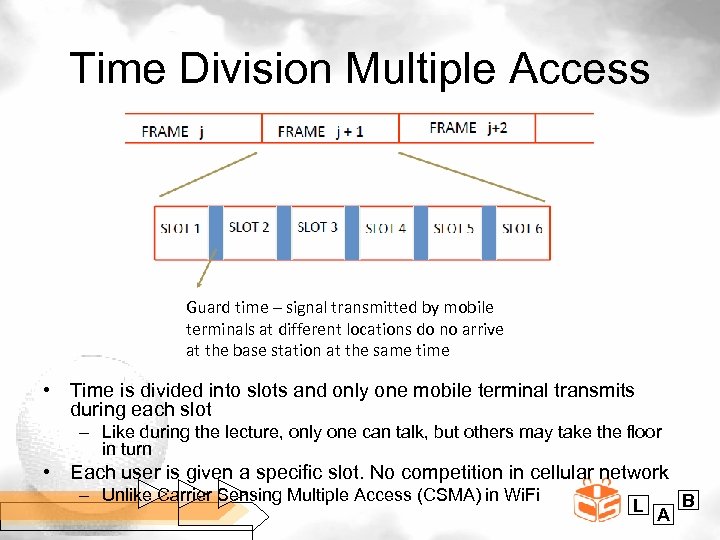
Time Division Multiple Access Guard time – signal transmitted by mobile terminals at different locations do no arrive at the base station at the same time • Time is divided into slots and only one mobile terminal transmits during each slot – Like during the lecture, only one can talk, but others may take the floor in turn • Each user is given a specific slot. No competition in cellular network – Unlike Carrier Sensing Multiple Access (CSMA) in Wi. Fi L A B
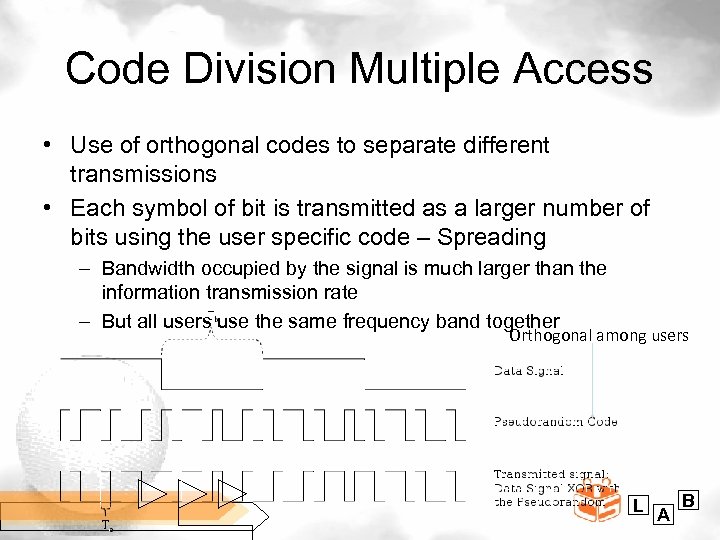
Code Division Multiple Access • Use of orthogonal codes to separate different transmissions • Each symbol of bit is transmitted as a larger number of bits using the user specific code – Spreading – Bandwidth occupied by the signal is much larger than the information transmission rate – But all users use the same frequency band together Orthogonal among users L A B
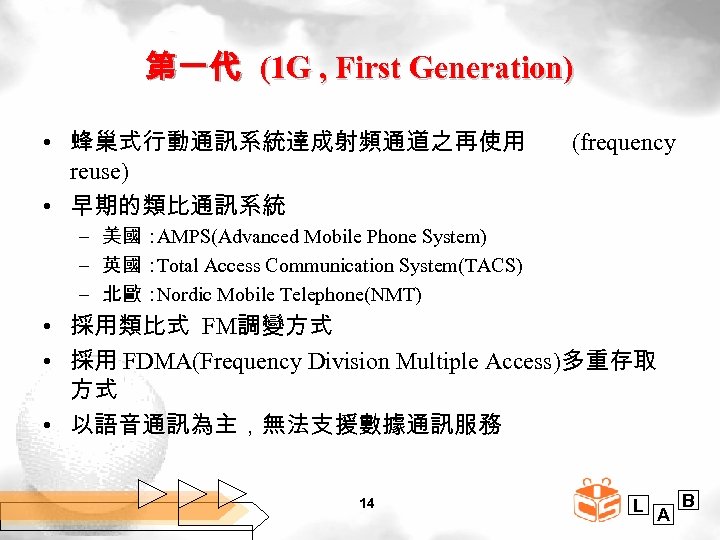
第一代 (1 G , First Generation) • 蜂巢式行動通訊系統達成射頻通道之再使用 reuse) • 早期的類比通訊系統 (frequency – 美國: AMPS(Advanced Mobile Phone System) – 英國: Total Access Communication System(TACS) – 北歐: Nordic Mobile Telephone(NMT) • 採用類比式 FM調變方式 • 採用 FDMA(Frequency Division Multiple Access)多重存取 方式 • 以語音通訊為主,無法支援數據通訊服務 14 L A B
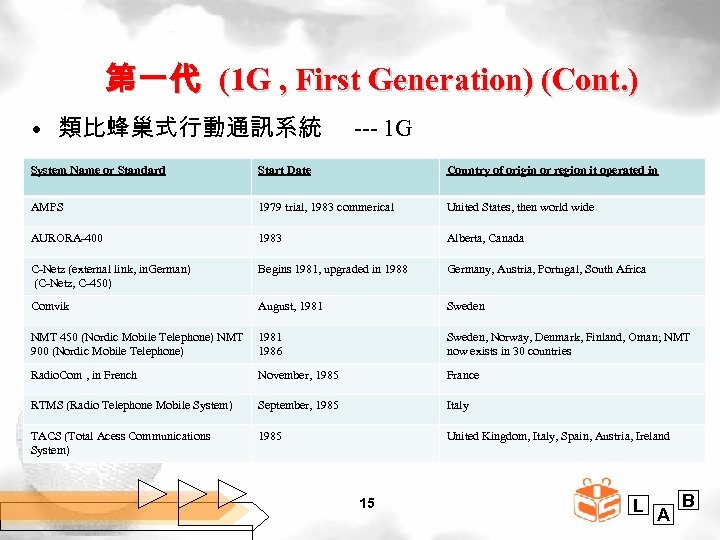
第一代 (1 G , First Generation) (Cont. ) • 類比蜂巢式行動通訊系統 --- 1 G System Name or Standard Start Date Country of origin or region it operated in AMPS 1979 trial, 1983 commerical United States, then world wide AURORA-400 1983 Alberta, Canada C-Netz (external link, in. German) (C-Netz, C-450) Begins 1981, upgraded in 1988 Germany, Austria, Portugal, South Africa Comvik August, 1981 Sweden NMT 450 (Nordic Mobile Telephone) NMT 1981 900 (Nordic Mobile Telephone) 1986 Sweden, Norway, Denmark, Finland, Oman; NMT now exists in 30 countries Radio. Com , in French November, 1985 France RTMS (Radio Telephone Mobile System) September, 1985 Italy TACS (Total Acess Communications System) 1985 United Kingdom, Italy, Spain, Austria, Ireland 15 L A B
大綱 • 課程目標 • 第一代 (1 G , First Generation) • 第 二 代 (2 G , Second Generation) • 第三代 (3 G , Third Generation) • 第四代 (4 G , Fourth Generation) 16 L A B
GSM 第二代 (2 G , Second Generation) • Abbreviation for Global System for Mobile Communications • Concurrent development in USA and Europe in the 1980’s • The European system was called GSM and deployed in the early 1990’s L A B
第二代 (2 G , Second Generation) • 2 G主要又分為 GSM(Global System for Mobile Communications)與 IS-95(Interim Standard 95) • GSM 行動通訊系統特點: (1) 全數位式 (4) 客戶識別 (SIM) (2) 細胞式 (cellular) (5) 保密通訊 (3) TDMA / FDMA (6) 國際漫遊 (roaming) 18 L A B
GSM Services • Voice, 3. 1 k. Hz • Short Message Service (SMS) – 1985 GSM standard that allows messages of at most 160 chars. (incl. spaces) to be sent between handsets and other stations – Over 2. 4 billion people use it; multi-billion $ industry • General Packet Radio Service (GPRS) – GSM upgrade that provides IP-based packet data transmission up to 114 kbps – Users can “simultaneously” make calls and send data – GPRS provides “always on” Internet access and the Multimedia Messaging Service (MMS) whereby users can send rich text, audio, video messages to each other – Performance degrades as number of users increase – GPRS is an example of 2. 5 G telephony – 2 G service similar to 3 G L A B
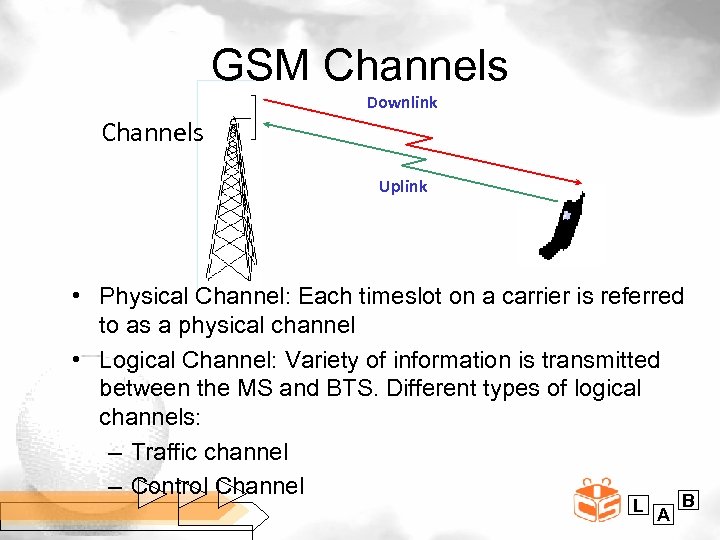
GSM Channels Downlink Channels Uplink • Physical Channel: Each timeslot on a carrier is referred to as a physical channel • Logical Channel: Variety of information is transmitted between the MS and BTS. Different types of logical channels: – Traffic channel – Control Channel L A B
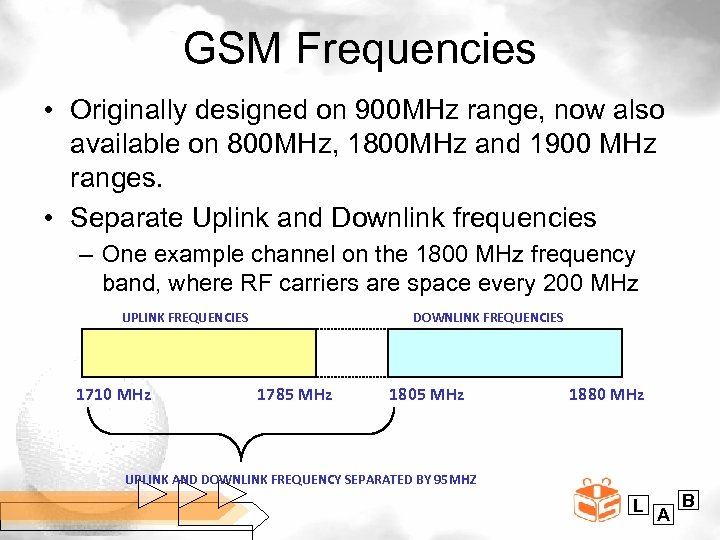
GSM Frequencies • Originally designed on 900 MHz range, now also available on 800 MHz, 1800 MHz and 1900 MHz ranges. • Separate Uplink and Downlink frequencies – One example channel on the 1800 MHz frequency band, where RF carriers are space every 200 MHz UPLINK FREQUENCIES 1710 MHz DOWNLINK FREQUENCIES 1785 MHz 1805 MHz 1880 MHz UPLINK AND DOWNLINK FREQUENCY SEPARATED BY 95 MHZ L A B
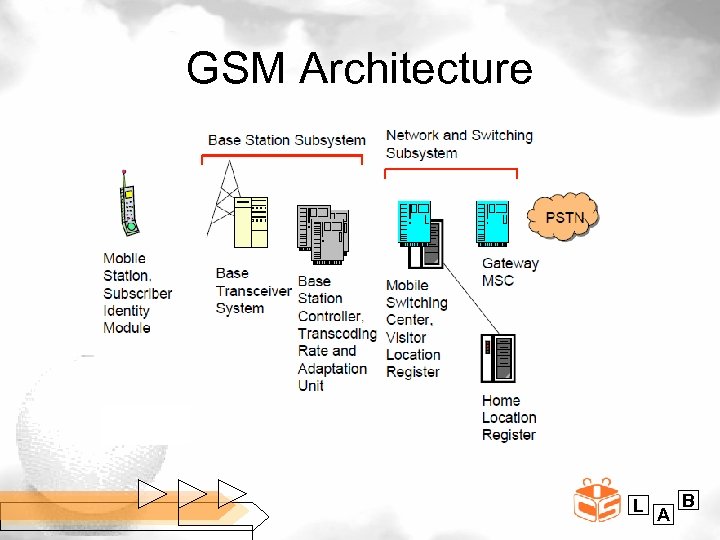
GSM Architecture L A B
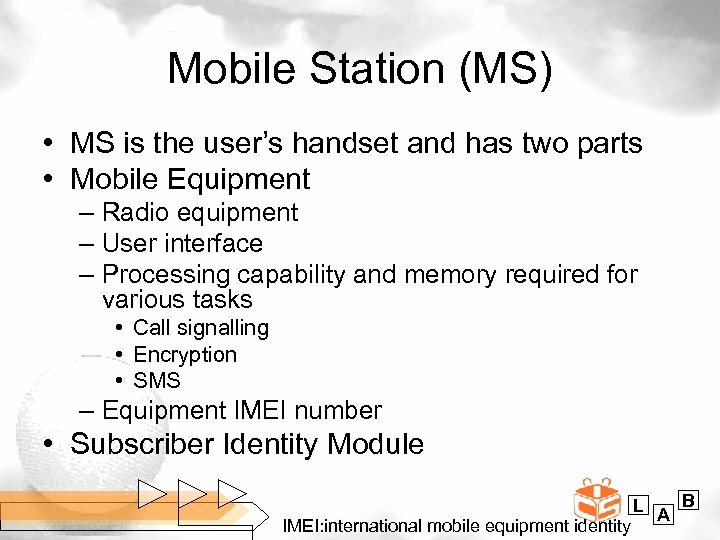
Mobile Station (MS) • MS is the user’s handset and has two parts • Mobile Equipment – Radio equipment – User interface – Processing capability and memory required for various tasks • Call signalling • Encryption • SMS – Equipment IMEI number • Subscriber Identity Module L IMEI: international mobile equipment identity A B
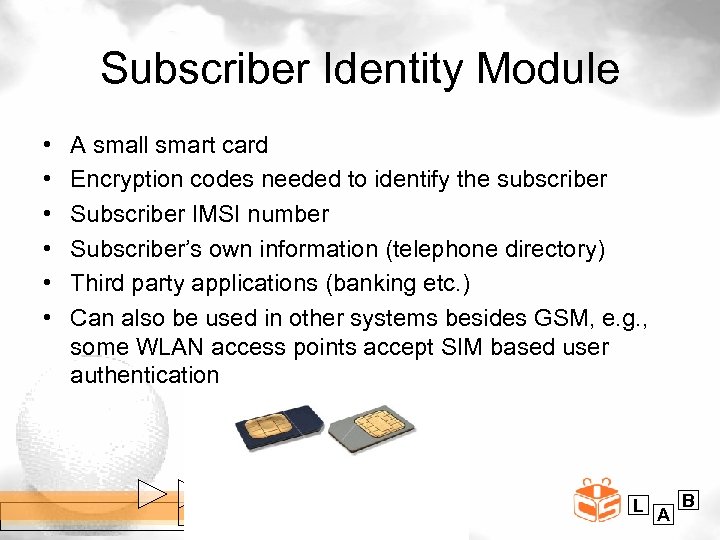
Subscriber Identity Module • • • A small smart card Encryption codes needed to identify the subscriber Subscriber IMSI number Subscriber’s own information (telephone directory) Third party applications (banking etc. ) Can also be used in other systems besides GSM, e. g. , some WLAN access points accept SIM based user authentication L A B
Base Station Subsystem • Transcoding Rate and Adaptation Unit (TRAU) – Performs coding between the 64 kbps PCM coding used in the backbone network and the 13 kbps coding used for the Mobile Station (MS) • Base Station Controller (BSC) – Controls the channel (time slot) allocation implemented by the BTSes – Manages the handovers within BSS area – Knows which mobile stations are within the cell and informs the MSC/VLR about this • Base Transceiver System (BTS) – Controls several transmitters – Each transmitter has 8 time slots, some used for signaling, on a specific frequency L A B
Network and Switching Subsystem • The backbone of a GSM network is a telephone network with additional cellular network capabilities • Mobile Switching Center (MSC) – An typical telephony exchange (ISDN exchange) which supports mobile communications – Visitor Location Register (VLR) • A database, part of the MSC • Contains the location of the active Mobile Stations • Gateway Mobile Switching Center (GMSC) – Links the system to PSTN and other operators • Home Location Register (HLR) – Contain subscriber information, including authentication information in Authentication Center (Au. C) • Equipment Identity Register (EIR) – International Mobile Station Equipment Identity (IMEI) codes for e. g. , blacklisting stolen phones L A B
Home Location Register • One database per operator • Contains all the permanent subscriber information – MSISDN (Mobile Subscriber ISDN number) is the telephone number of the subscriber – International Mobile Subscriber Identity (IMSI) is a 15 digit code used to identify the subscriber • It incorporates a country code and operator code – IMSI code is used to link the MSISDN number to the subscriber’s SIM (Subscriber Identity Module) – Charging information – Services available to the customer • Also the subscriber’s present Location Area Code, which refers to the MSC, which can connect to the MS. L A B
Other Systems • Operations Support System – The management network for the whole GSM network – Usually vendor dependent – Very loosely specified in the GSM standards • Value added services – Voice mail – Call forwarding – Group calls • Short Message Service Center – Stores and forwards the SMS messages – Like an E-mail server – Required to operate the SMS services L A B
Location Updates • The cells overlap and usually a mobile station can ‘see’ several transceivers (BTSes) • The MS monitors the identifier for the BSC controlling the cells • When the mobile station reaches a new BSC’s area, it requests an location update • The update is forwarded to the MSC, entered into the VLR, the old BSC is notified an acknowledgement is passed back L A B
Handoff (Handover) • When a call is in process, the changes in location need special processing • Within a BSS, the BSC, which knows the current radio link configuration (including feedbacks from the MS), prepares an available channel in the new BTS • The MS is told to switch over to the new BTS • This is called a hard handoff – In a soft handoff, the MS is connected to two BTSes simultaneously L A B
Roaming • When a MS enters another operators network, it can be allowed to use the services of this operator – Operator to operator agreements and contracts – Higher billing • The MS is identified by the information in the SIM card and the identification request is forwarded to the home operator – The home HLR is updated to reflect the MS’s current location L A B
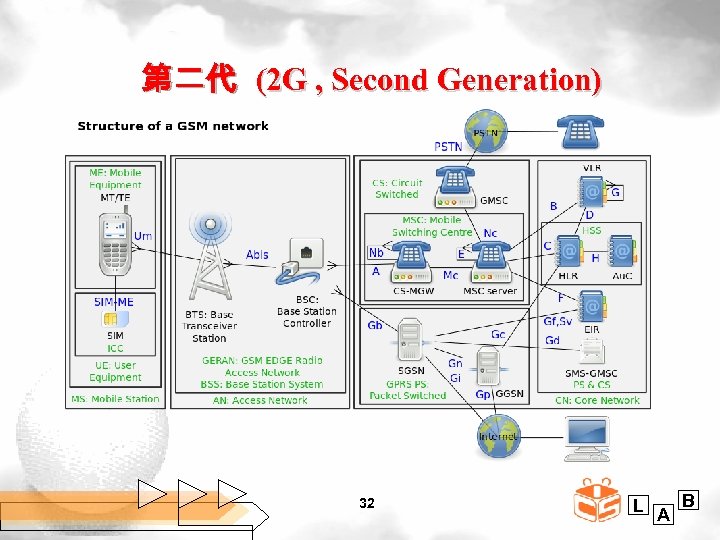
第二代 (2 G , Second Generation) 32 L A B
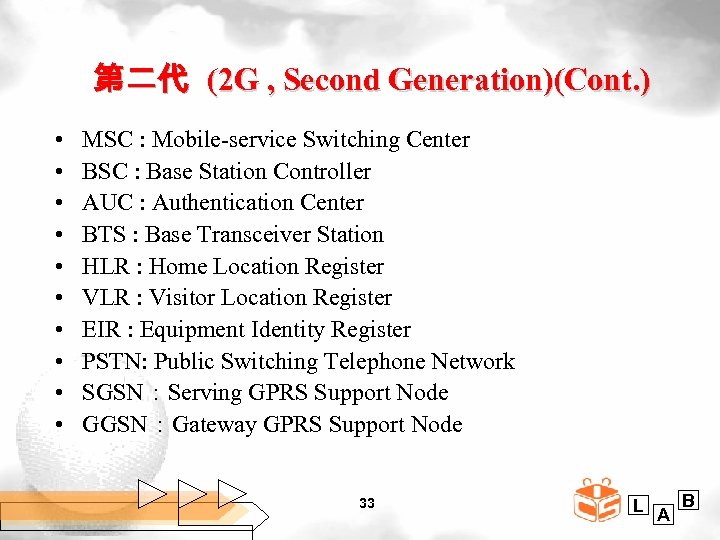
第二代 (2 G , Second Generation)(Cont. ) • • • MSC : Mobile-service Switching Center BSC : Base Station Controller AUC : Authentication Center BTS : Base Transceiver Station HLR : Home Location Register VLR : Visitor Location Register EIR : Equipment Identity Register PSTN: Public Switching Telephone Network SGSN:Serving GPRS Support Node GGSN:Gateway GPRS Support Node 33 L A B
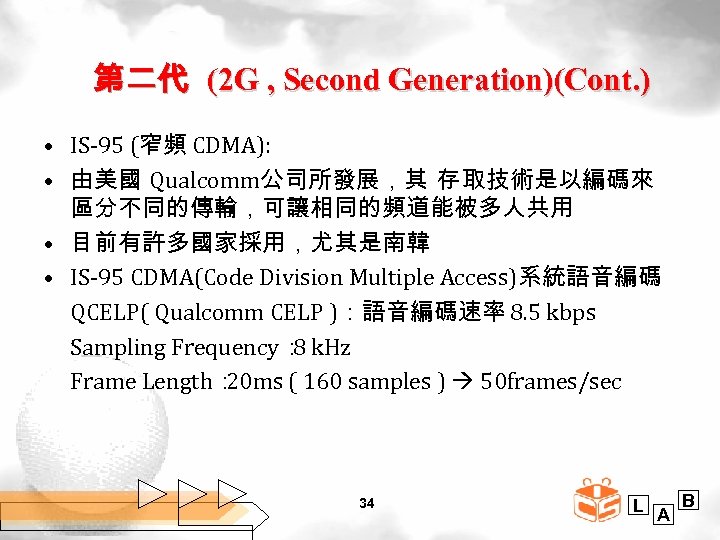
第二代 (2 G , Second Generation)(Cont. ) • IS-95 (窄頻 CDMA): • 由美國 Qualcomm公司所發展,其 存 取技術是以編碼來 區分不同的傳輸,可讓相同的頻道能被多人共用 • 目前有許多國家採用,尤其是南韓 • IS-95 CDMA(Code Division Multiple Access)系統語音編碼 QCELP( Qualcomm CELP ):語音編碼速率 8. 5 kbps Sampling Frequency: k. Hz 8 Frame Length: 20 ms ( 160 samples ) 50 frames/sec 34 L A B
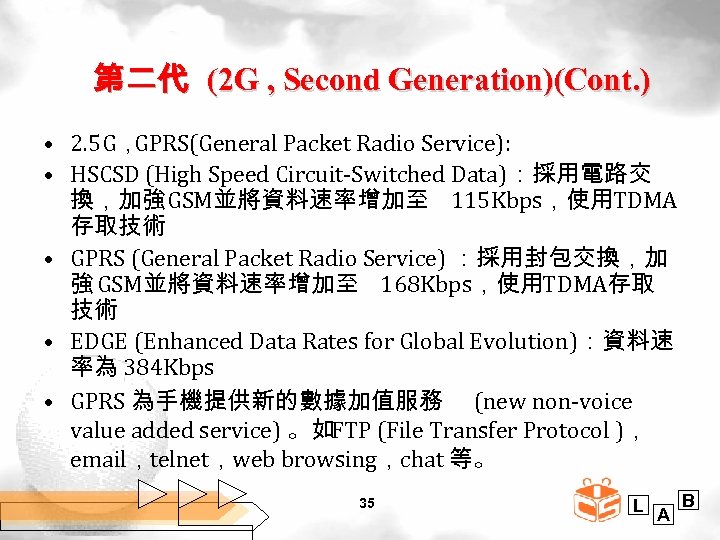
第二代 (2 G , Second Generation)(Cont. ) • 2. 5 G, GPRS(General Packet Radio Service): • HSCSD (High Speed Circuit-Switched Data):採用電路交 換,加強GSM並將資料速率增加至 115 Kbps,使用TDMA 存取技術 • GPRS (General Packet Radio Service) :採用封包交換,加 強 GSM並將資料速率增加至 168 Kbps,使用TDMA存取 技術 • EDGE (Enhanced Data Rates for Global Evolution):資料速 率為 384 Kbps • GPRS 為手機提供新的數據加值服務 (new non-voice value added service) 。如FTP (File Transfer Protocol ), email,telnet,web browsing,chat 等。 35 L A B
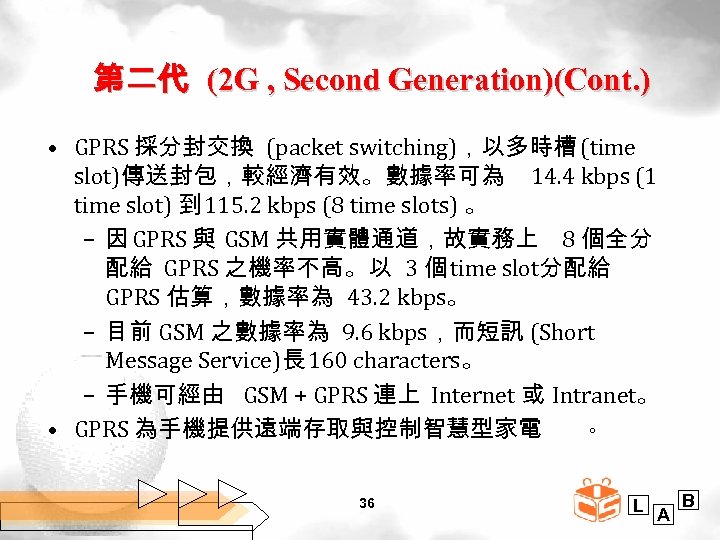
第二代 (2 G , Second Generation)(Cont. ) • GPRS 採分封交換 (packet switching),以多時槽 (time slot)傳送封包,較經濟有效。數據率可為 14. 4 kbps (1 time slot) 到 115. 2 kbps (8 time slots) 。 – 因 GPRS 與 GSM 共用實體通道,故實務上 8 個全分 配給 GPRS 之機率不高。以 3 個 time slot分配給 GPRS 估算,數據率為 43. 2 kbps。 – 目前 GSM 之數據率為 9. 6 kbps,而短訊 (Short Message Service)長 160 characters。 – 手機可經由 GSM + GPRS 連上 Internet 或 Intranet。 • GPRS 為手機提供遠端存取與控制智慧型家電 。 36 L A B
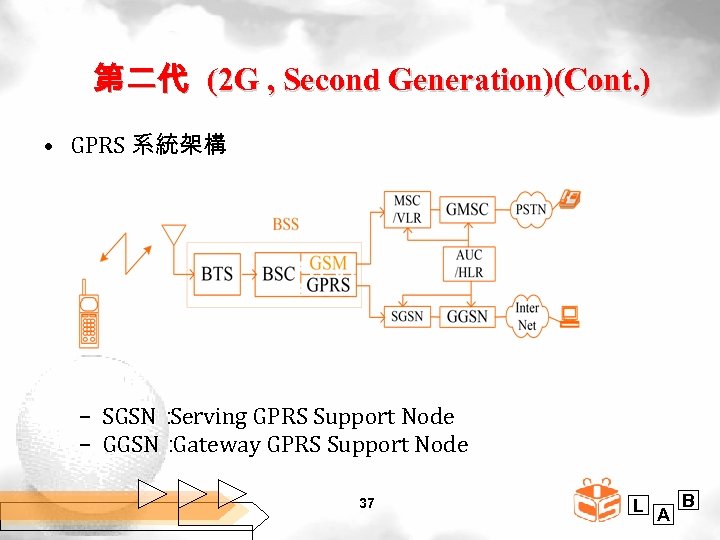
第二代 (2 G , Second Generation)(Cont. ) • GPRS 系統架構 – SGSN: Serving GPRS Support Node – GGSN: Gateway GPRS Support Node 37 L A B
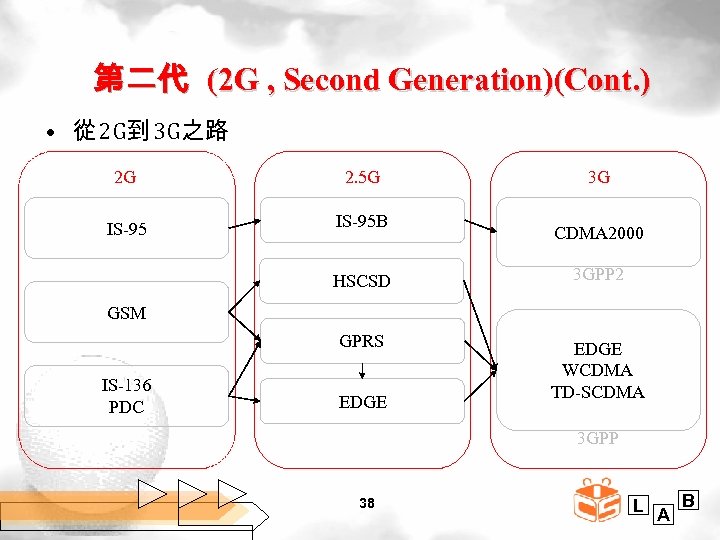
第二代 (2 G , Second Generation)(Cont. ) • 從 2 G到 3 G之路 2 G 2. 5 G IS-95 B 3 G CDMA 2000 HSCSD 3 GPP 2 GPRS EDGE WCDMA TD-SCDMA GSM IS-136 PDC EDGE 3 GPP 38 L A B
第二代 (2 G , Second Generation)(Cont. ) • 2 G/2. 5 G網路如何升級到 3 G網路 : – GPRS網路是從 GSM網路內加入 GGSN與 SGSN – EDGE網路是沿用 GPRS網路的無線頻譜,但改用更高速的無 線傳輸技術 – UMTS網路在新的發射頻譜上運用 3 G網路的 WCDMA技術 – PDC網路跨過 GPRS階段,直接採取 WCDMA的寬頻技術 – 美國與韓國的 CDMA系統採取 cdma 2000的方法 39 L A B
大綱 • 課程目標 • 第一代 (1 G , First Generation) • 第 二 代 (2 G , Second Generation) • 第三代 (3 G , Third Generation) • 第四代 (4 G , Fourth Generation) 40 L A B
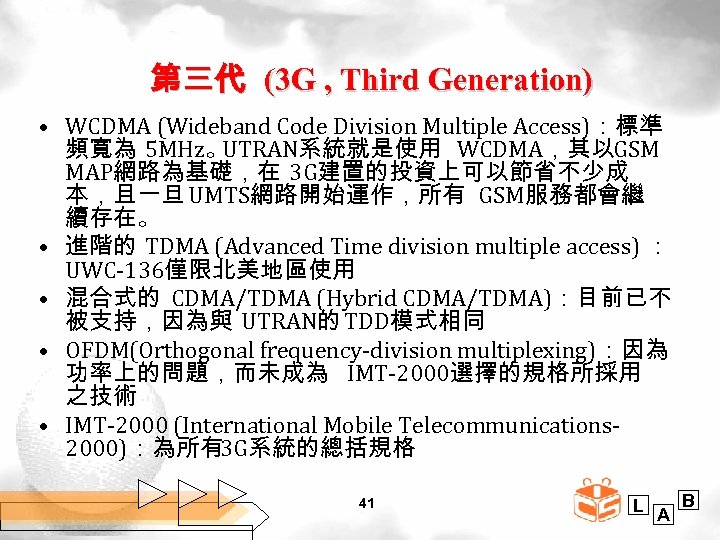
第三代 (3 G , Third Generation) • WCDMA (Wideband Code Division Multiple Access):標準 頻寬為 5 MHz。 UTRAN系統就是使用 WCDMA,其以GSM MAP網路為基礎,在 3 G建置的投資上可以節省不少成 本,且一旦 UMTS網路開始運作,所有 GSM服務都會繼 續存在。 • 進階的 TDMA (Advanced Time division multiple access) : UWC-136僅限北美地區使用 • 混合式的 CDMA/TDMA (Hybrid CDMA/TDMA):目前已不 被支持,因為與 UTRAN的 TDD模式相同 • OFDM(Orthogonal frequency-division multiplexing):因為 功率上的問題,而未成為 IMT-2000選擇的規格所採用 之技術 • IMT-2000 (International Mobile Telecommunications 2000):為所有3 G系統的總括規格 41 L A B
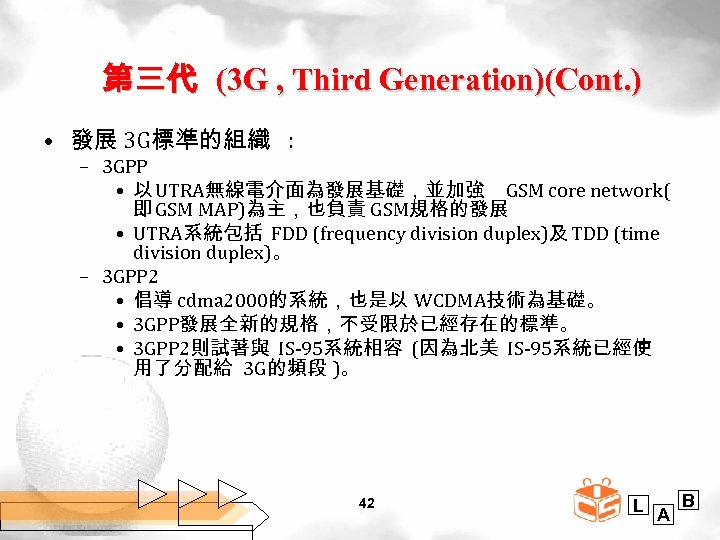
第三代 (3 G , Third Generation)(Cont. ) • 發展 3 G標準的組織 : – 3 GPP • 以 UTRA無線電介面為發展基礎,並加強 GSM core network( 即 GSM MAP)為主,也負責 GSM規格的發展 • UTRA系統包括 FDD (frequency division duplex)及 TDD (time division duplex)。 – 3 GPP 2 • 倡導 cdma 2000的系統,也是以 WCDMA技術為基礎。 • 3 GPP發展全新的規格,不受限於已經存在的標準。 • 3 GPP 2則試著與 IS-95系統相容 (因為北美 IS-95系統已經使 用了分配給 3 G的頻段 )。 42 L A B
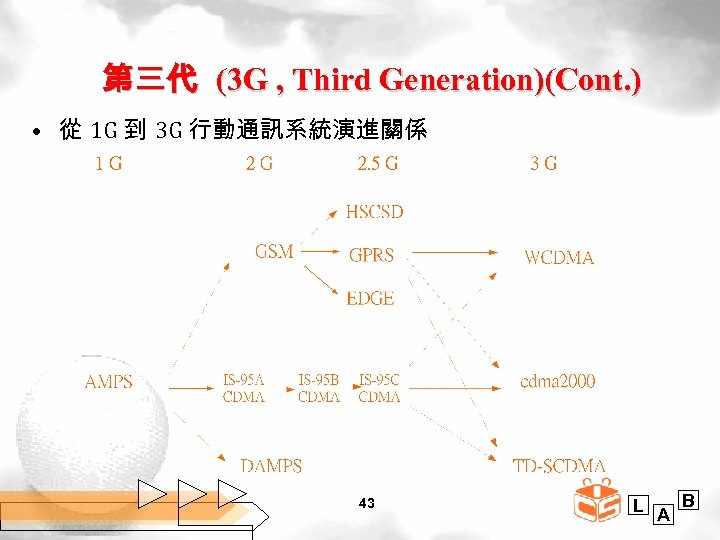
第三代 (3 G , Third Generation)(Cont. ) • 從 1 G 到 3 G 行動通訊系統演進關係 43 L A B
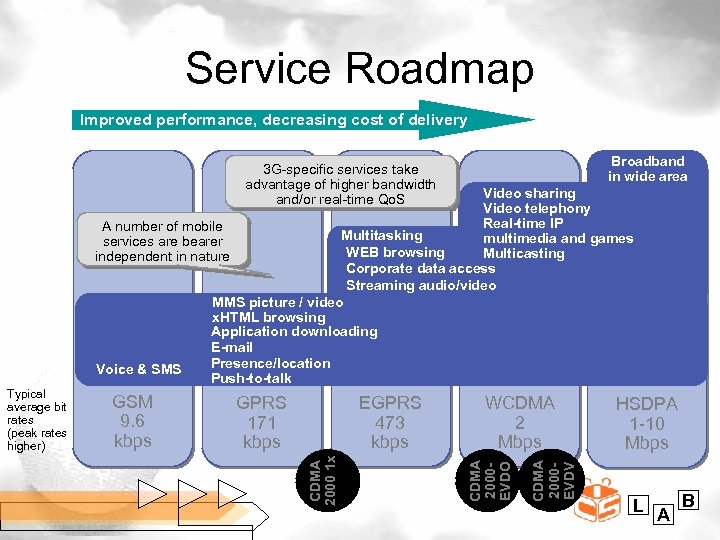
Service Roadmap Improved performance, decreasing cost of delivery Broadband in wide area 3 G-specific services take advantage of higher bandwidth and/or real-time Qo. S Video sharing Video telephony Real-time IP A number of mobile Multitasking multimedia and games services are bearer WEB browsing Multicasting independent in nature Corporate data access Streaming audio/video MMS picture / video x. HTML browsing Application downloading E-mail Presence/location Voice & SMS Push-to-talk EGPRS 473 kbps WCDMA 2 Mbps CDMA 2000 EVDV GPRS 171 kbps CDMA 2000 EVDO GSM 9. 6 kbps CDMA 2000 1 x Typical average bit rates (peak rates higher) HSDPA 1 -10 Mbps L A B
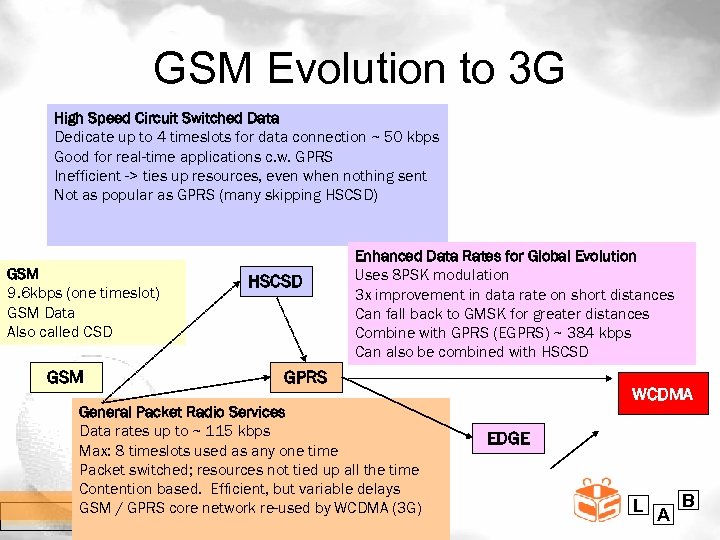
GSM Evolution to 3 G High Speed Circuit Switched Data Dedicate up to 4 timeslots for data connection ~ 50 kbps Good for real-time applications c. w. GPRS Inefficient -> ties up resources, even when nothing sent Not as popular as GPRS (many skipping HSCSD) GSM 9. 6 kbps (one timeslot) GSM Data Also called CSD GSM HSCSD Enhanced Data Rates for Global Evolution Uses 8 PSK modulation 3 x improvement in data rate on short distances Can fall back to GMSK for greater distances Combine with GPRS (EGPRS) ~ 384 kbps Can also be combined with HSCSD GPRS General Packet Radio Services Data rates up to ~ 115 kbps Max: 8 timeslots used as any one time Packet switched; resources not tied up all the time Contention based. Efficient, but variable delays GSM / GPRS core network re-used by WCDMA (3 G) WCDMA EDGE L A B
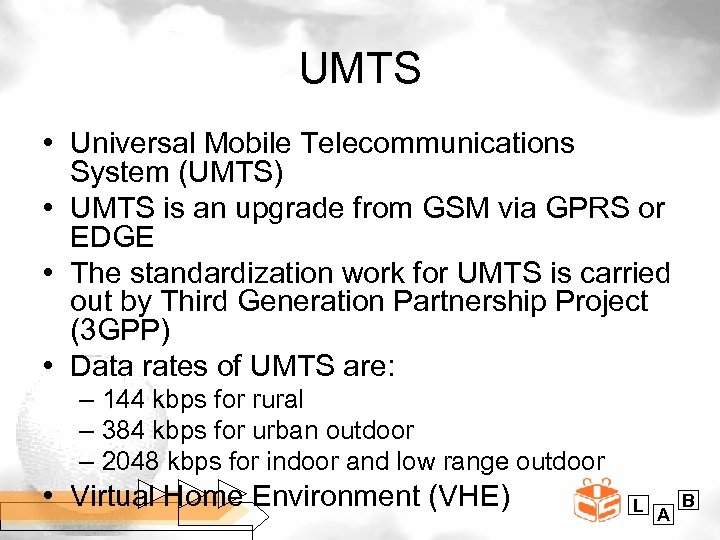
UMTS • Universal Mobile Telecommunications System (UMTS) • UMTS is an upgrade from GSM via GPRS or EDGE • The standardization work for UMTS is carried out by Third Generation Partnership Project (3 GPP) • Data rates of UMTS are: – 144 kbps for rural – 384 kbps for urban outdoor – 2048 kbps for indoor and low range outdoor • Virtual Home Environment (VHE) L A B
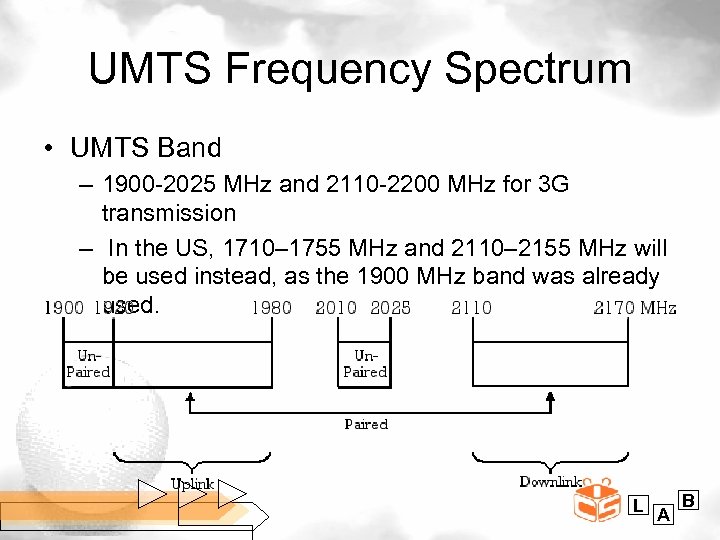
UMTS Frequency Spectrum • UMTS Band – 1900 -2025 MHz and 2110 -2200 MHz for 3 G transmission – In the US, 1710– 1755 MHz and 2110– 2155 MHz will be used instead, as the 1900 MHz band was already used. L A B
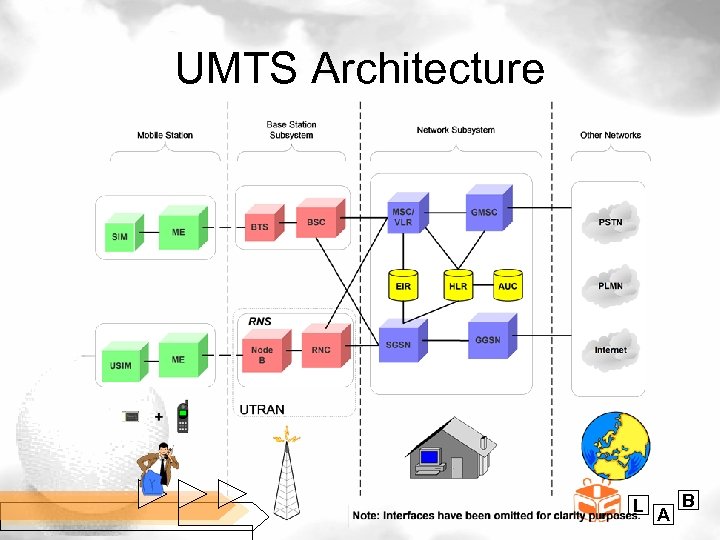
UMTS Architecture L A B
UMTS Network Architecture • UMTS network architecture consists of three domains – Core Network (CN): Provide switching, routing and transit for user traffic – UMTS Terrestrial Radio Access Network (UTRAN): Provides the air interface access method for user equipment. – User Equipment (UE): Terminals work as air interface counterpart for base stations. The various identities are: IMSI, TMSI, P-TMSI, TLLI, MSISDN, IMEISV L A B
UTRAN • Wide band CDMA technology is selected for UTRAN air interface – WCDMA – TD-SCDMA • Base stations are referred to as Node-B and control equipment for Node-B is called as Radio Network Controller (RNC). – Functions of Node-B are • Air Interface Tx/Rx • Modulation/Demodulation – Functions of RNC are: • • • Radio Resource Control Channel Allocation Power Control Settings Handover Control Ciphering Segmentation and reassembly L A B
3. 5 G (HSPA) High Speed Packet Access (HSPA) is an amalgamation of two mobile telephony protocols, High Speed Downlink Packet Access (HSDPA) and High Speed Uplink Packet Access (HSUPA), that extends and improves the performance of existing WCDMA protocols 3. 5 G introduces many new features that enhances the UMTS technology. 1 x. EV-DV already supports most of the features that was provided in 3. 5 G. These include: - Adaptive Modulation and Coding - Fast Scheduling - Backward compatibility with 3 G - Enhanced Air Interface L A B
大綱 • 課程目標 • 第一代 (1 G , First Generation) • 第 二 代 (2 G , Second Generation) • 第三代 (3 G , Third Generation) • 第四代 (4 G , Fourth Generation) 52 L A B
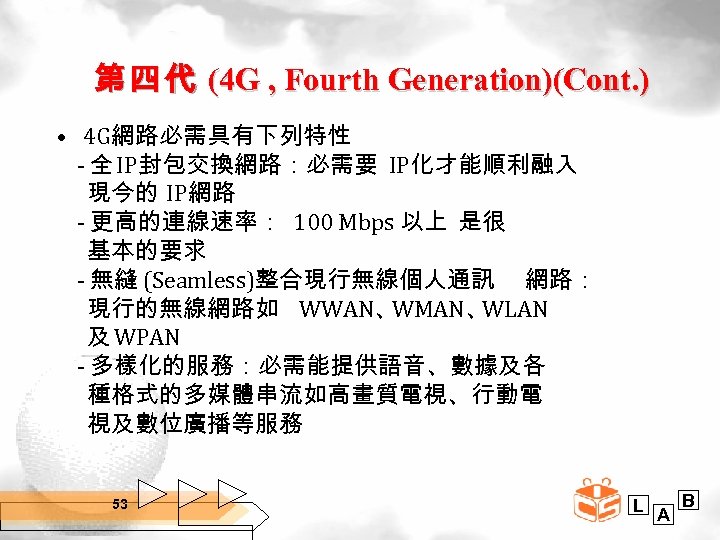
第 四 代 (4 G , Fourth Generation)(Cont. ) • 4 G網路必需具有下列特性 - 全 IP封包交換網路:必需要 IP化才能順利融入 現今的 IP網路 - 更高的連線速率: 100 Mbps 以上 是很 基本的要求 - 無縫 (Seamless)整合現行無線個人通訊 網路: 現行的無線網路如 WWAN、 WMAN、 WLAN 及 WPAN - 多樣化的服務:必需能提供語音、數據及各 種格式的多媒體串流如高畫質電視、行動電 視及數位廣播等服務 53 L A B
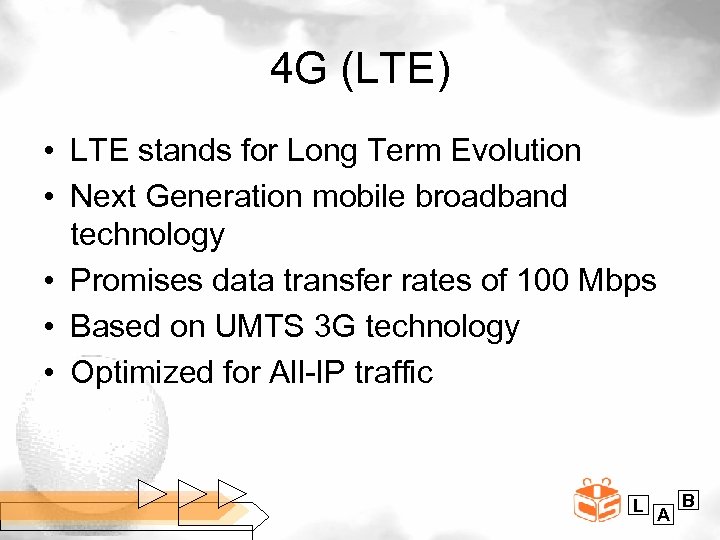
4 G (LTE) • LTE stands for Long Term Evolution • Next Generation mobile broadband technology • Promises data transfer rates of 100 Mbps • Based on UMTS 3 G technology • Optimized for All-IP traffic L A B
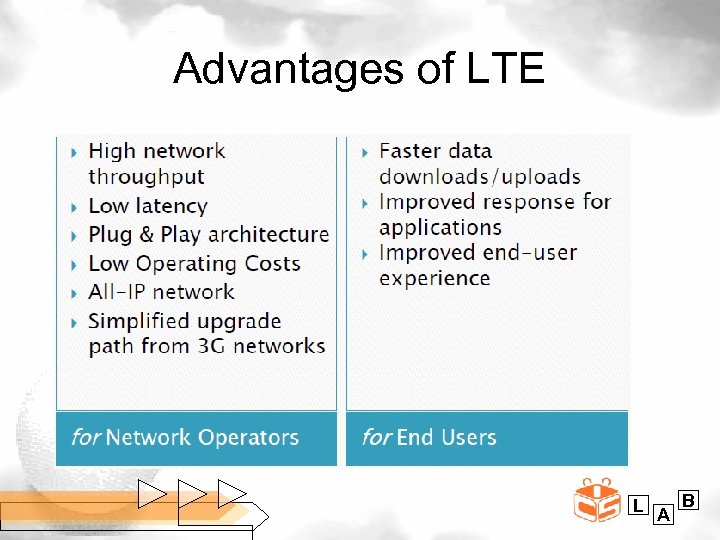
Advantages of LTE L A B
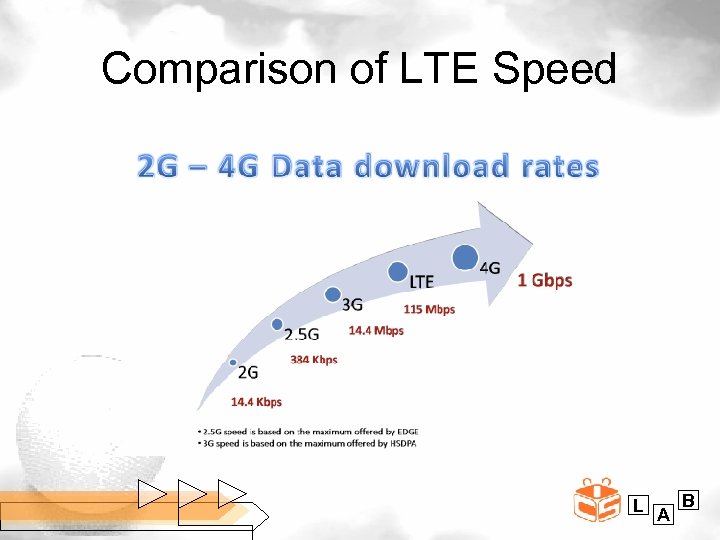
Comparison of LTE Speed L A B
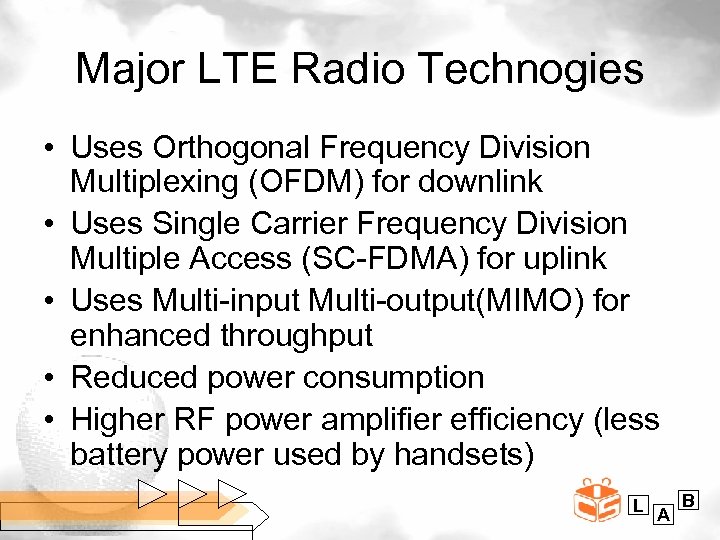
Major LTE Radio Technogies • Uses Orthogonal Frequency Division Multiplexing (OFDM) for downlink • Uses Single Carrier Frequency Division Multiple Access (SC-FDMA) for uplink • Uses Multi-input Multi-output(MIMO) for enhanced throughput • Reduced power consumption • Higher RF power amplifier efficiency (less battery power used by handsets) L A B
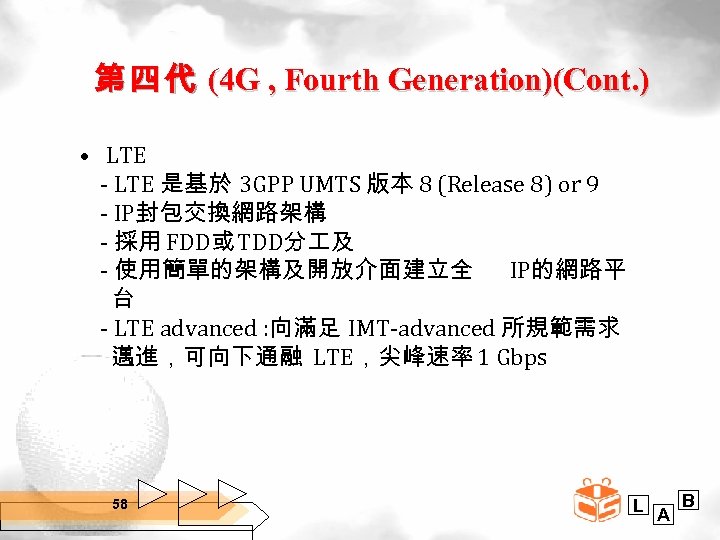
第 四 代 (4 G , Fourth Generation)(Cont. ) • LTE - LTE 是基於 3 GPP UMTS 版本 8 (Release 8) or 9 - IP封包交換網路架構 - 採用 FDD或 TDD分 及 - 使用簡單的架構及開放介面建立全 IP的網路平 台 - LTE advanced : 向滿足 IMT-advanced 所規範需求 邁進,可向下通融 LTE,尖峰速率 1 Gbps 58 L A B
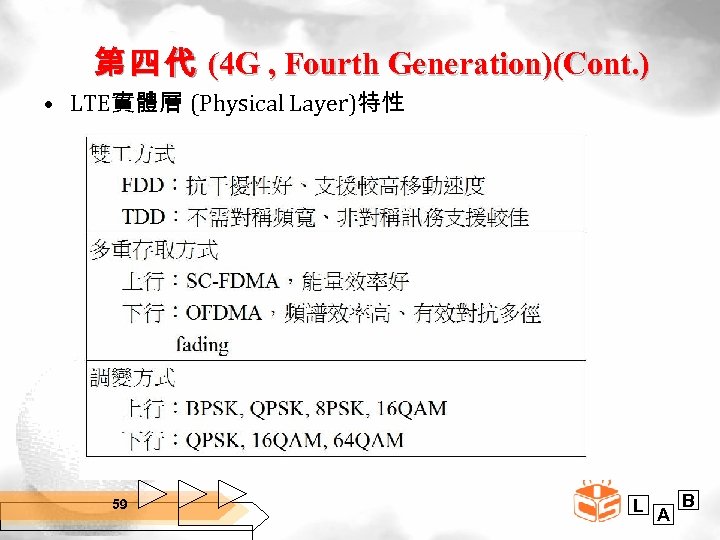
第 四 代 (4 G , Fourth Generation)(Cont. ) • LTE實體層 (Physical Layer)特性 59 L A B
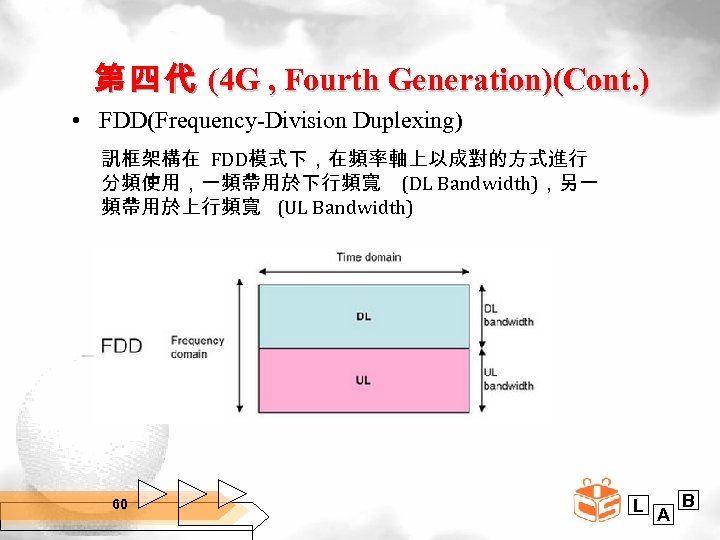
第 四 代 (4 G , Fourth Generation)(Cont. ) • FDD(Frequency-Division Duplexing) 訊框架構在 FDD模式下,在頻率軸上以成對的方式進行 分頻使用,一頻帶用於下行頻寬 (DL Bandwidth),另一 頻帶用於上行頻寬 (UL Bandwidth) 60 L A B
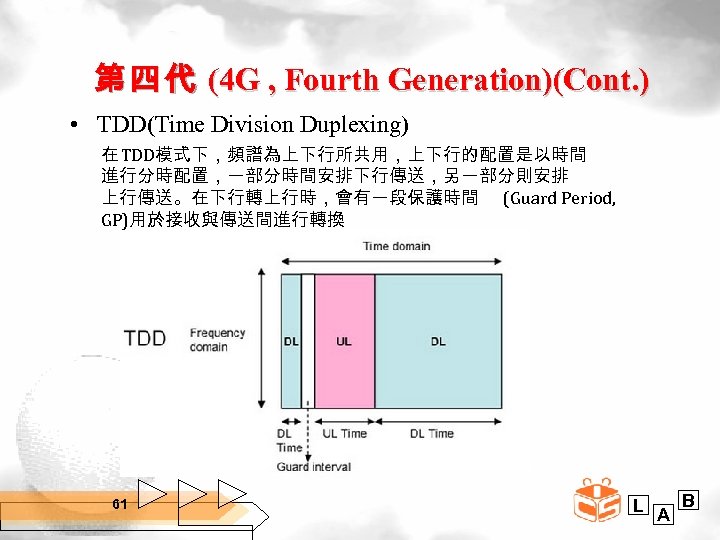
第 四 代 (4 G , Fourth Generation)(Cont. ) • TDD(Time Division Duplexing) 在 TDD模式下,頻譜為上下行所共用,上下行的配置是以時間 進行分時配置,一部分時間安排下行傳送,另一部分則安排 上行傳送。在下行轉上行時,會有一段保護時間 (Guard Period, GP)用於接收與傳送間進行轉換 61 L A B
第 四 代 (4 G , Fourth Generation)(Cont. ) • OFDMA(Orthogonal Frequency Division Multiple Access) OFDMA可以被描述為一種結合頻域和時域多 路存取,使用大量的正交窄帶子載波( subcarrier)來承載資料,使用者可以選擇信道 條件較好的子通道( subchannel)進行資料傳輸, 一組使用者可以同時接入到某一信道 62 L A B
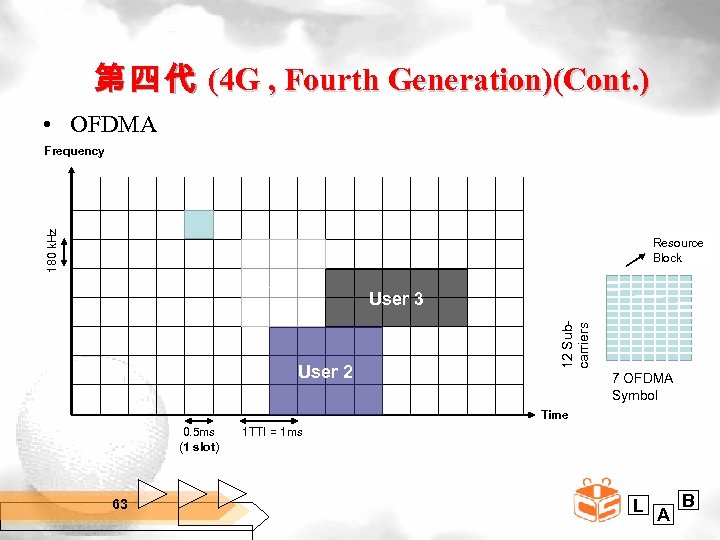
第 四 代 (4 G , Fourth Generation)(Cont. ) • OFDMA 180 k. Hz Frequency Resource Block User 2 User 3 12 Subcarriers User 1 7 OFDMA Symbol Time 0. 5 ms (1 slot) 63 1 TTI = 1 ms L A B
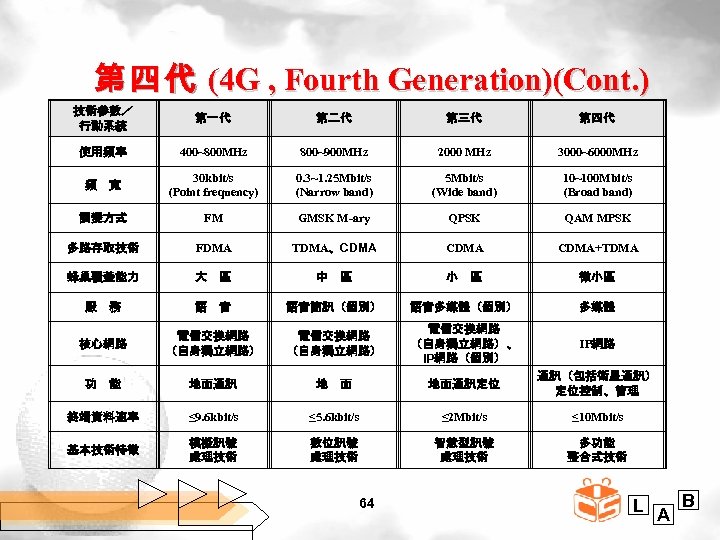
第 四 代 (4 G , Fourth Generation)(Cont. ) 技術參數/ 行動系統 第一代 第二代 第三代 第四代 使用頻率 400~800 MHz 800~900 MHz 2000 MHz 3000~6000 MHz 頻 寬 30 kbit/s (Point frequency) 0. 3~1. 25 Mbit/s (Narrow band) 5 Mbit/s (Wide band) 10~100 Mbit/s (Broad band) 調變方式 FM GMSK M-ary QPSK QAM MPSK 多路存取技術 FDMA TDMA、CDMA+TDMA 蜂巢覆蓋能力 大 區 中 區 小 區 微小區 服 務 語 音 語音簡訊(個別) 語音多媒體(個別) 多媒體 核心網路 電信交換網路 (自身獨立網路)、 IP網路(個別) IP網路 功 能 地面通訊 地 面 地面通訊定位 通訊(包括衛星通訊) 定位控制、管理 終端資料速率 ≤ 9. 6 kbit/s ≤ 5. 6 kbit/s ≤ 2 Mbit/s ≤ 10 Mbit/s 基本技術特徵 模擬訊號 處理技術 數位訊號 處理技術 智慧型訊號 處理技術 多功能 整合式技術 64 L A B
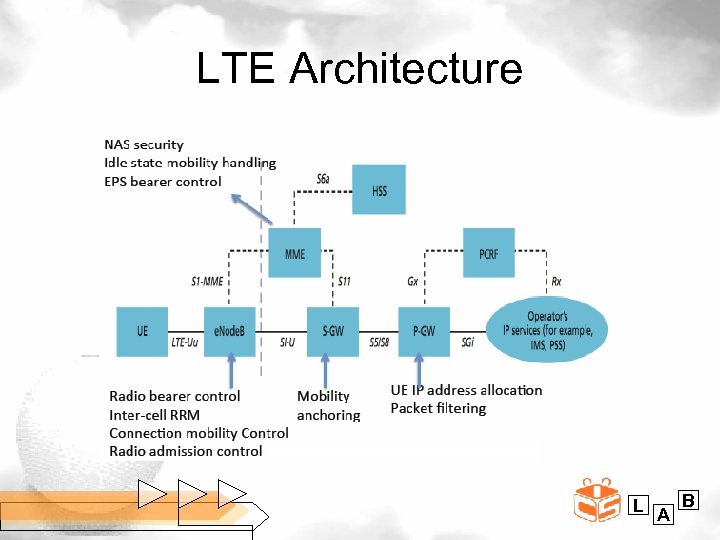
LTE Architecture L A B
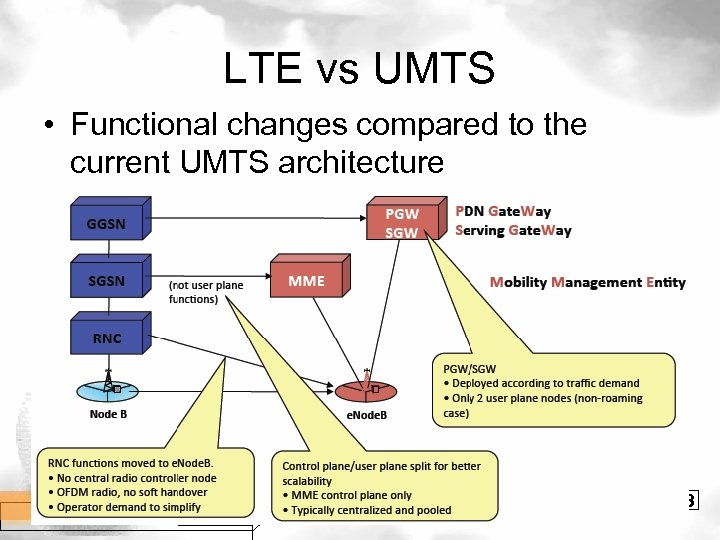
LTE vs UMTS • Functional changes compared to the current UMTS architecture L A B
www. metis 2020. com Radio Access and Spectrum innovations for 5 G 17 th March 2014 Athens Toward a 5 G Mobile & Wireless System Concept Prof. Nancy Alonistioti, NKUA On Behalf Dr. Afif Osseiran METIS Project Coordinator facebook. com/metis 2020 twitter. com/metis 2020 L A B
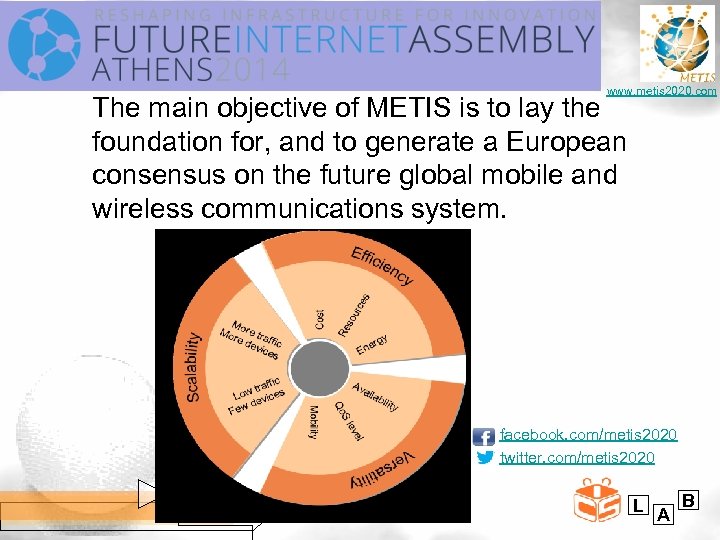
www. metis 2020. com The main objective of METIS is to lay the foundation for, and to generate a European consensus on the future global mobile and wireless communications system. facebook. com/metis 2020 twitter. com/metis 2020 L A B
Content • Introduction • 5 G Challenges & Scenarios • Toward a 5 G System Concept
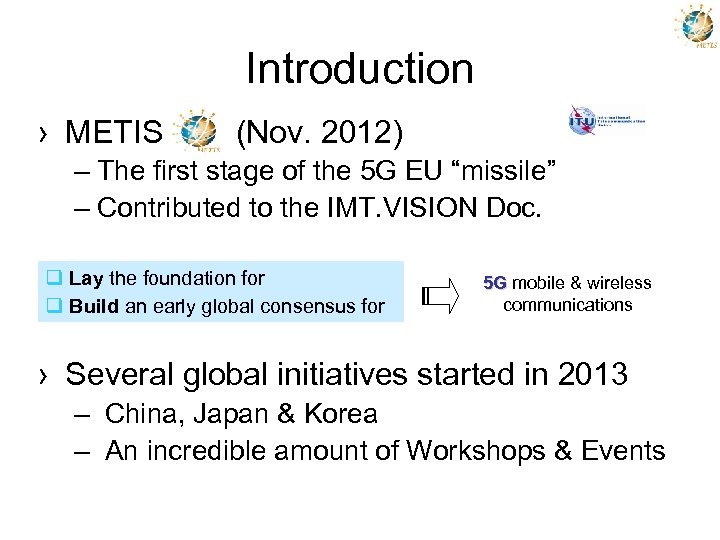
Introduction › METIS (Nov. 2012) – The first stage of the 5 G EU “missile” – Contributed to the IMT. VISION Doc. q Lay the foundation for q Build an early global consensus for 5 G mobile & wireless 5 G communications › Several global initiatives started in 2013 – China, Japan & Korea – An incredible amount of Workshops & Events
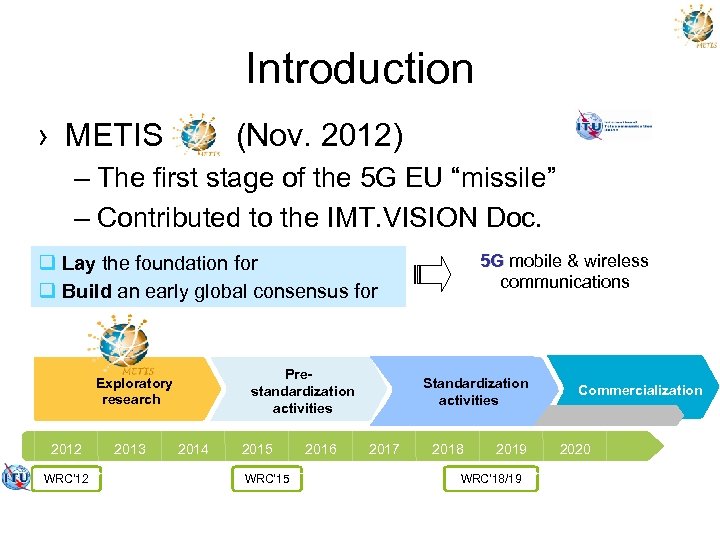
Introduction › METIS (Nov. 2012) – The first stage of the 5 G EU “missile” – Contributed to the IMT. VISION Doc. 5 G mobile & wireless 5 G communications q Lay the foundation for q Build an early global consensus for Prestandardization activities Exploratory research 2012 WRC’ 12 2013 2014 2015 WRC’ 15 2016 Standardization activities 2017 2018 2019 WRC’ 18/19 Commercialization 2020
5 G Challenges & Scenarios L A B
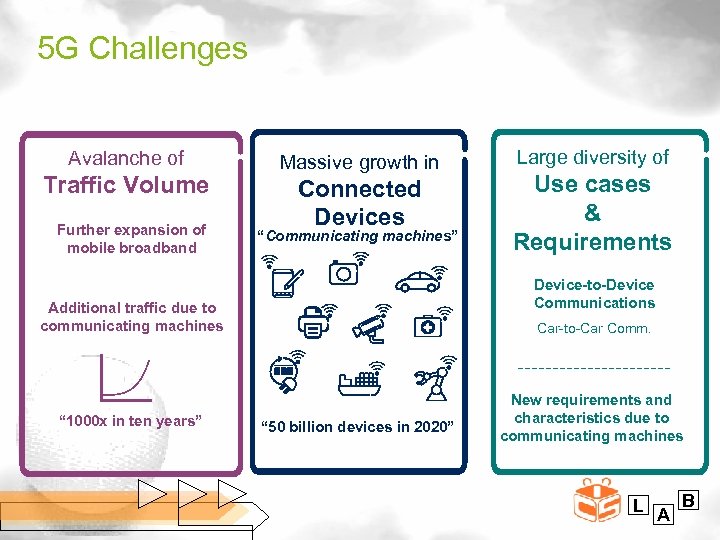
5 G Challenges Avalanche of Traffic Volume Further expansion of mobile broadband Massive growth in Connected Devices “Communicating machines” Use cases & Requirements Device-to-Device Communications Additional traffic due to communicating machines “ 1000 x in ten years” Large diversity of Car-to-Car Comm. “ 50 billion devices in 2020” New requirements and characteristics due to communicating machines L A B
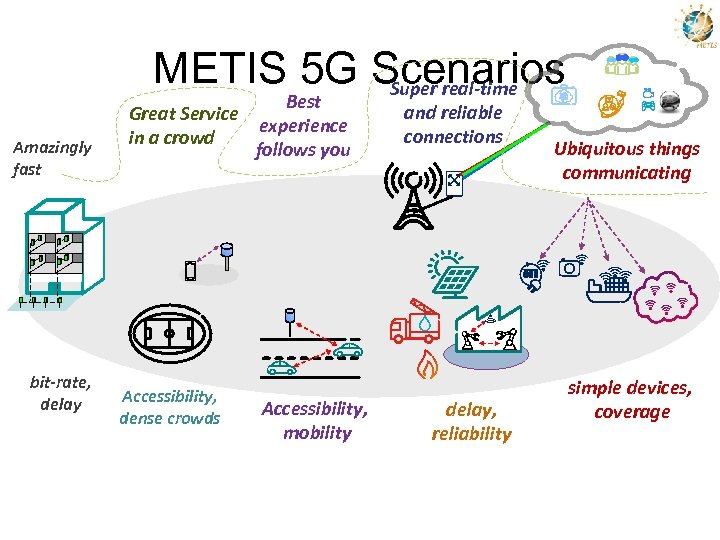
METIS 5 G Scenarios Super real-time Amazingly fast bit-rate, delay Best Great Service experience in a crowd follows you Accessibility, dense crowds Accessibility, mobility and reliable connections delay, reliability Ubiquitous things communicating simple devices, coverage
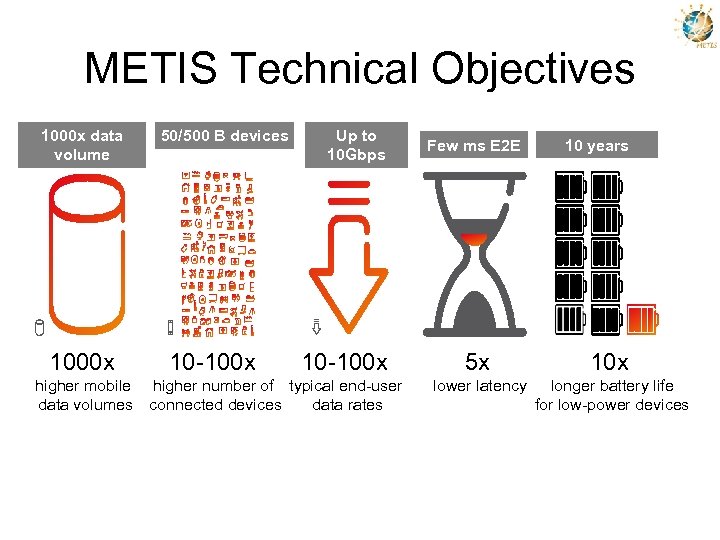
METIS Technical Objectives 1000 x data volume 1000 x 50/500 B devices 10 -100 x Up to 10 Gbps 10 -100 x higher mobile higher number of typical end-user data volumes connected devices data rates Few ms E 2 E 10 years 5 x 10 x lower latency longer battery life for low-power devices
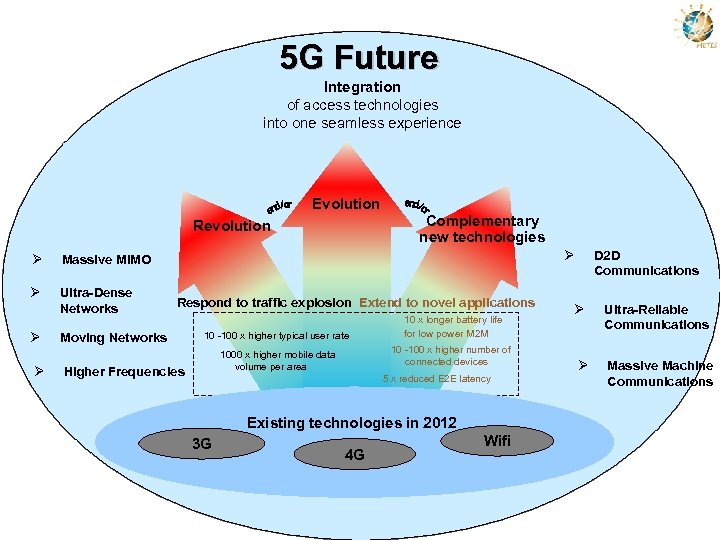
5 G Future Integration of access technologies into one seamless experience Evolution Complementary new technologies Revolution Ø Ø Ultra-Dense Networks Ø Massive MIMO Ø Ø Respond to traffic explosion Extend to novel applications Moving Networks 10 -100 x higher typical user rate 10 x longer battery life for low power M 2 M 1000 x higher mobile data volume per area 10 -100 x higher number of connected devices Higher Frequencies 5 x reduced E 2 E latency Existing technologies in 2012 3 G 4 G Wifi D 2 D Communications Ø Ultra-Reliable Communications Ø Massive Machine Communications
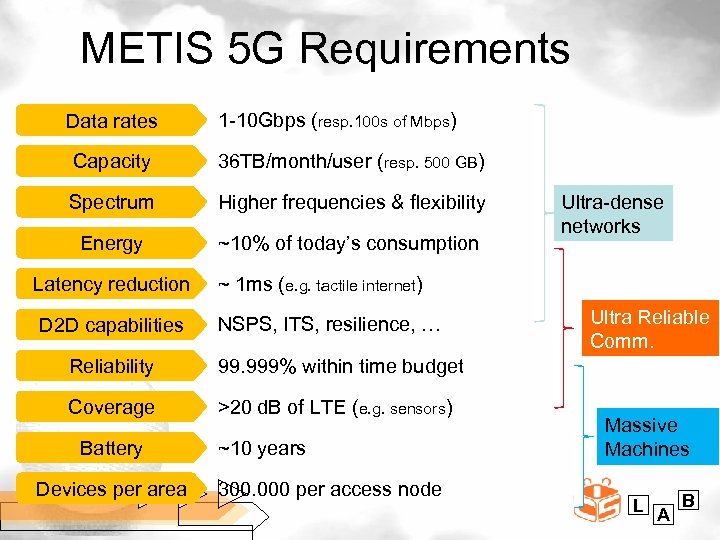
METIS 5 G Requirements Data rates 1 -10 Gbps (resp. 100 s of Mbps) Capacity 36 TB/month/user (resp. 500 GB) Spectrum Higher frequencies & flexibility Energy ~10% of today’s consumption Latency reduction D 2 D capabilities Ultra-dense networks ~ 1 ms (e. g. tactile internet) NSPS, ITS, resilience, … Reliability 99. 999% within time budget Coverage >20 d. B of LTE (e. g. sensors) Ultra Reliable Comm. Battery Devices per area ~10 years 300. 000 per access node Massive Machines L A B
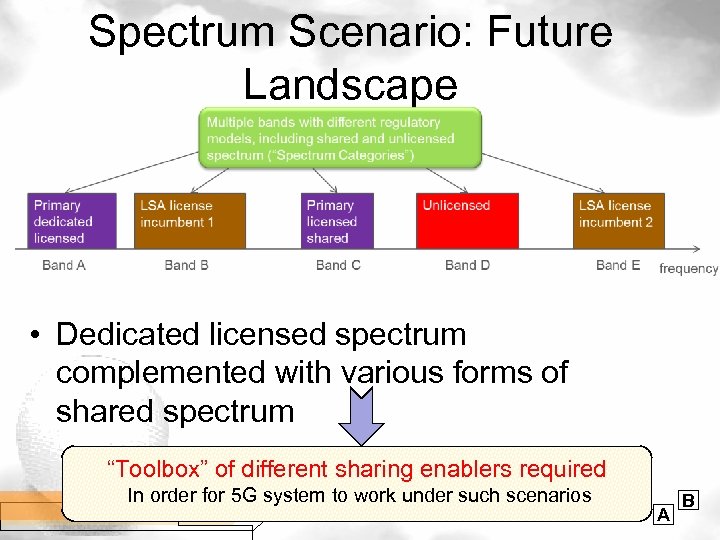
Spectrum Scenario: Future Landscape • Dedicated licensed spectrum complemented with various forms of shared spectrum “Toolbox” of different sharing enablers required In order for 5 G system to work under such scenarios L A B
Toward 5 G Concept: Technology Components Examples
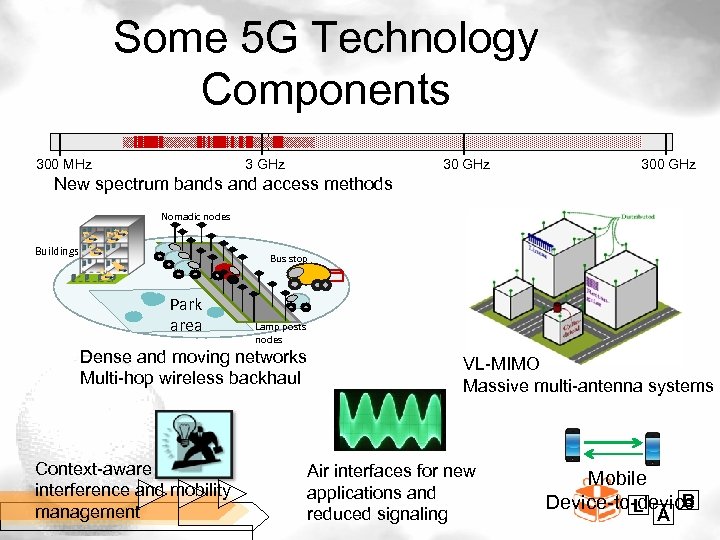
Some 5 G Technology Components 300 MHz 3 GHz 300 GHz New spectrum bands and access methods Nomadic nodes Buildings Bus stop Park area Lamp posts nodes Dense and moving networks Multi-hop wireless backhaul Context-aware interference and mobility management VL-MIMO Massive multi-antenna systems Air interfaces for new applications and reduced signaling Mobile B Device-to-device L A
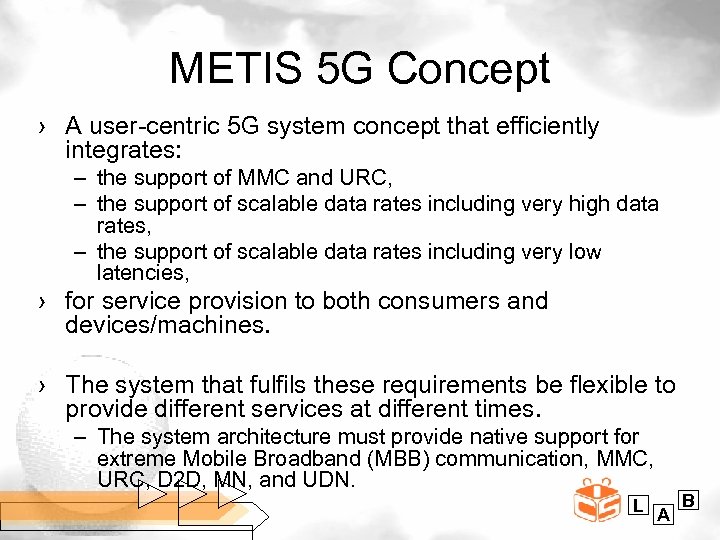
METIS 5 G Concept › A user-centric 5 G system concept that efficiently integrates: – the support of MMC and URC, – the support of scalable data rates including very high data rates, – the support of scalable data rates including very low latencies, › for service provision to both consumers and devices/machines. › The system that fulfils these requirements be flexible to provide different services at different times. – The system architecture must provide native support for extreme Mobile Broadband (MBB) communication, MMC, URC, D 2 D, MN, and UDN. L A B
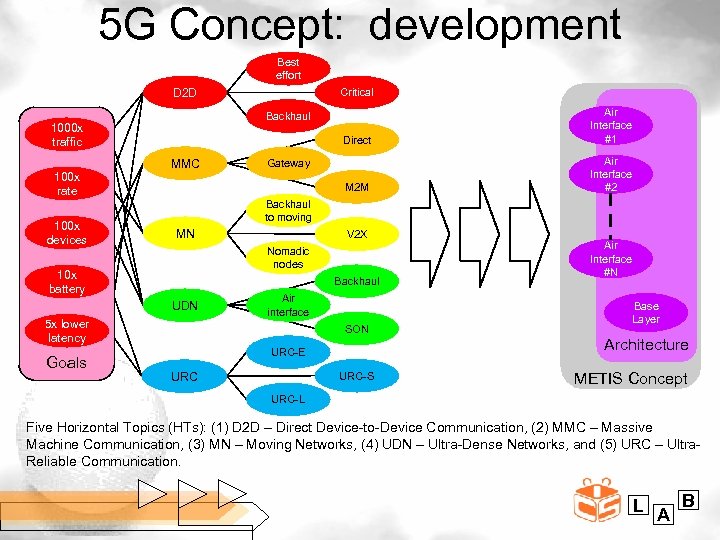
5 G Concept: development Best effort D 2 D Direct 100 x devices M 2 M MMC Air Interface #2 Gateway Backhaul to moving MN V 2 X Nomadic nodes 10 x battery Backhaul UDN 5 x lower latency Goals Air Interface #1 Backhaul 1000 x traffic 100 x rate Critical Air interface SON Base Layer Architecture URC-E URC Air Interface #N URC-S METIS Concept URC-L Five Horizontal Topics (HTs): (1) D 2 D – Direct Device-to-Device Communication, (2) MMC – Massive Machine Communication, (3) MN – Moving Networks, (4) UDN – Ultra-Dense Networks, and (5) URC – Ultra. Reliable Communication. L A B
Useful Links • • A. Osseiran et al, Scenarios for the 5 G Mobile and Wireless Communications: the Vision of the METIS Project, IEEE Comm. Mag. , May, 2014 --To appear on https: //www. metis 2020. com/documents/publications/ Deliverable D 1. 1, “Scenarios, requirements and KPIs for 5 G mobile and wireless system”, June 2013 • Deliverable D 2. 1, “Requirement analysis and design approaches for 5 G air interface”, Sept. 2013 • Deliverable D 3. 1, “Positioning of multi-node/multi-antenna transmission technologies”, Aug. 2013 • Deliverable D 5. 1, “Intermediate description of the spectrum needs and usage principles”, Sep. 2013 • Deliverable D 4. 1, “Summary on preliminary trade-off investigations and first set of potential network-level solutions”, Nov. 2013 • Deliverable D 6. 1, “Simulation guidelines”, Nov. 2013 All deliverables can be downloaded from https: //www. metis 2020. com/documents/deliverables/

Thank You
Back up Slides
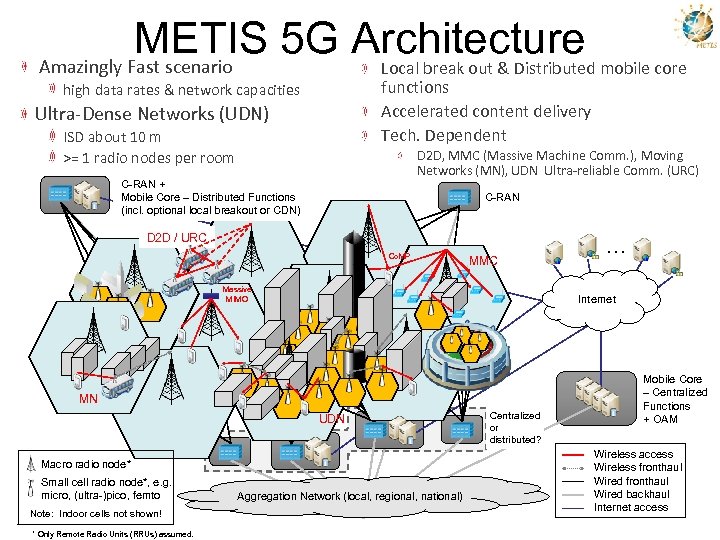
METIS 5 G Architecture mobile core Amazingly Fast scenario Local break out & Distributed functions Accelerated content delivery Tech. Dependent high data rates & network capacities Ultra-Dense Networks (UDN) ISD about 10 m >= 1 radio nodes per room D 2 D, MMC (Massive Machine Comm. ), Moving Networks (MN), UDN Ultra-reliable Comm. (URC) C-RAN + Mobile Core – Distributed Functions (incl. optional local breakout or CDN) C-RAN D 2 D / URC Co. MP MMC Massive MIMO Internet MN UDN Macro radio node* Small cell radio node*, e. g. micro, (ultra-)pico, femto Note: Indoor cells not shown! * Only Remote Radio Units (RRUs) assumed. … Aggregation Network (local, regional, national) Centralized or distributed? Mobile Core – Centralized Functions + OAM Wireless access Wireless fronthaul Wired backhaul Internet access
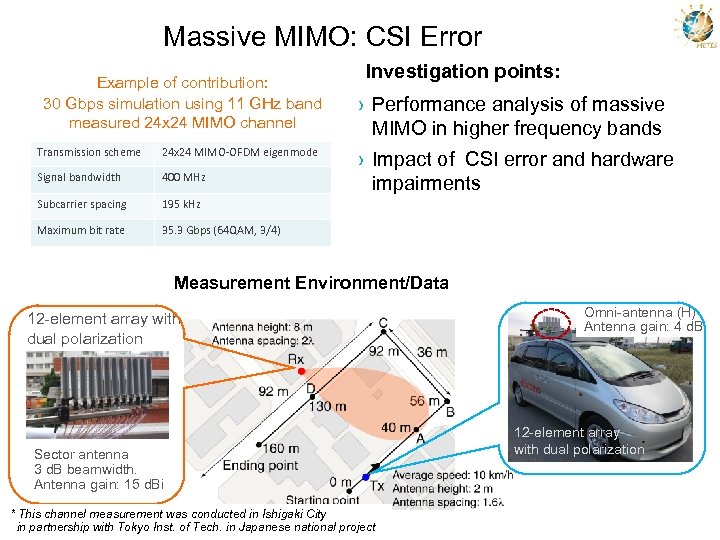
Massive MIMO: CSI Error Example of contribution: 30 Gbps simulation using 11 GHz band measured 24 x 24 MIMO channel Transmission scheme 24 x 24 MIMO-OFDM eigenmode Signal bandwidth 400 MHz Subcarrier spacing › Performance analysis of massive MIMO in higher frequency bands 195 k. Hz Maximum bit rate Investigation points: 35. 3 Gbps (64 QAM, 3/4) › Impact of CSI error and hardware impairments Measurement Environment/Data 12 -element array with dual polarization Sector antenna 3 d. B beamwidth. Antenna gain: 15 d. Bi * This channel measurement was conducted in Ishigaki City in partnership with Tokyo Inst. of Tech. in Japanese national project Omni-antenna (H) Antenna gain: 4 d. Bi 12 -element array with dual polarization
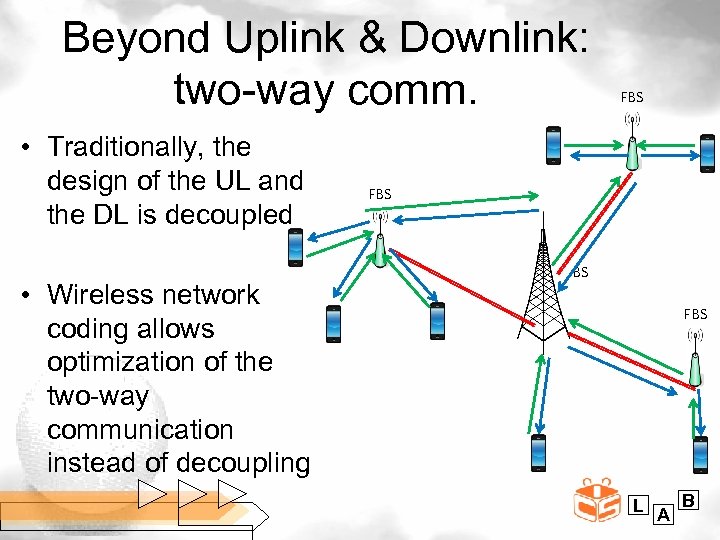
Beyond Uplink & Downlink: two-way comm. • Traditionally, the design of the UL and the DL is decoupled • Wireless network coding allows optimization of the two-way communication instead of decoupling FBS BS FBS L A B
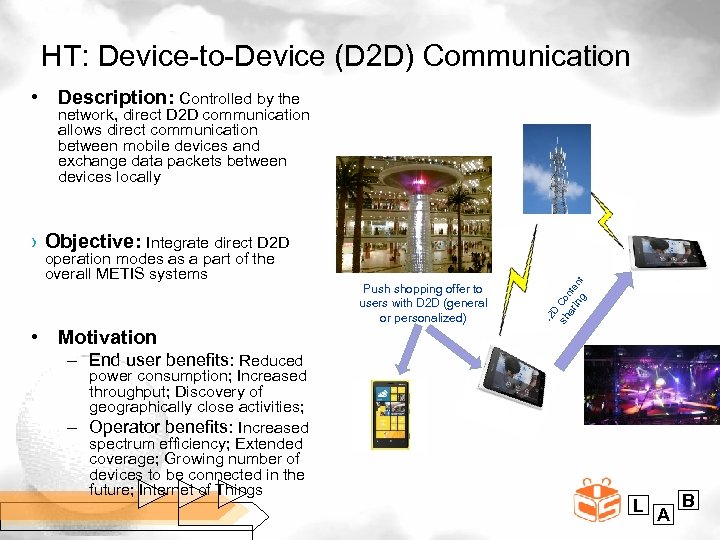
HT: Device-to-Device (D 2 D) Communication • Description: Controlled by the network, direct D 2 D communication allows direct communication between mobile devices and exchange data packets between devices locally Push shopping offer to users with D 2 D (general or personalized) D 2 operation modes as a part of the overall METIS systems D sh Co ar nte ing nt › Objective: Integrate direct D 2 D • Motivation – End user benefits: Reduced power consumption; Increased throughput; Discovery of geographically close activities; – Operator benefits: Increased spectrum efficiency; Extended coverage; Growing number of devices to be connected in the future; Internet of Things L A B
參考資料 • Structure of a GSM network https: //en. wikipedia. org/wiki/GSM • LTE TDD/FDD http: //www. mem. com. tw/article_content. asp? sn=1112020004 • 顏春煌「行動與無線通訊」,2013 碁峯資訊股份有限公司 發行 91 L A B
Скачать презентацию Small Cell創新應用與服務專題 課 程單元 行動通訊技術之 沿革與演進 國立中山大學 資訊
3ab4be90e8c971db7b1b782803546a7f.ppt