 Скачать презентацию SM 4 Readiness Review Tuesday 9 September 2008
5e8c1c186938de985fb8338250a7455f.ppt
- Количество слайдов: 140



SM 4 Readiness Review Tuesday, 9 September 2008, 9: 00 am -12: 40 pm Welcome SMOV Program Proposal Processing Status Long Range Planning Contingency Plans for STIS/ACS Planning & Scheduling Hubble Mission Office Carl Biagetti, 9 -9: 30 am Denise Taylor, 9: 30 -9: 45 am David Adler, 9: 45 -10 am Neill Reid, 10 - 10: 15 am Merle Reinhart & George Chapman, 10: 15 -10: 45 am …Break for 15 minutes… Commanding Alan Welty, 11 -11: 15 am Data Processing and Archiving Faith Abney, 11: 15 -11: 45 am Calibration Pipeline Processing Warren Hack, 11: 45 -12: 05 pm Operational Readiness Al Holm, 12: 05 -12: 25 pm Infrastructure Contingency Plans Doris Mc. Clure, 12: 25 -12: 40 pm 3/18/2018 1
SM 4 Readiness Review Wednesday, 10 September 2008, 9: 00 -12: 30: SM 4 Observatory Support WFC 3 Readiness COS and STIS Readiness ACS Readiness NICMOS Readiness FGS and OTA Readiness OPO and ERO Readiness 3/18/2018 Chris Long John Mac. Kenty Alessandra Aloisi Linda Smith Tommy Wiklind Ed Nelan and Matt Lallo Mario Livio and Keith Noll 2
SMOV 4 Planning Readiness Carl Biagetti System Engineering Branch OED 3/18/2018 3
SMOV 4 Plan Overview … 1 SMOV 4 Plan – Provides for the timely commissioning of the Observatory for science following SM 4 • Commissions the newly SIs on channel-by-channel basis – Introduces GO science on a channel-by-channel basis as SMOV progresses • Recommissions the restored SIs on channel-by-channel basis • Recommissions serviced Observatory Systems • Performs Early Release Observations (EROs) – Satisfies the SMOV 4 requirements of 21 March 2007 3/18/2018 • Plan presented, reviewed, and approved 12 Oct. 2007 (SMR-4029, CCR 5248) 4
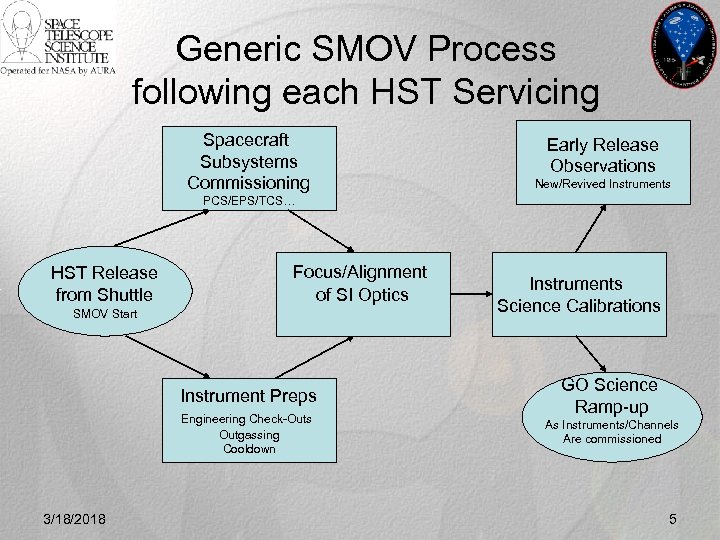
Generic SMOV Process following each HST Servicing Spacecraft Subsystems Commissioning Early Release Observations New/Revived Instruments PCS/EPS/TCS… HST Release from Shuttle Focus/Alignment of SI Optics SMOV Start Instrument Preps Engineering Check-Outs Outgassing Cooldown 3/18/2018 Instruments Science Calibrations GO Science Ramp-up As Instruments/Channels Are commissioned 5
SMOVs 2 – 4 EXTERNAL ORBITS HISTORICAL COMPARISON Notes: 1. STIS and NICMOS required more orbits than planned because of the NICMOS thermal short and the opto-coupler resets in both SIs. 2. SMOV 4 seems to be the most complex in terms of realtime interactions and in 3/18/2018 -line analyses. 6
SMOV 4 Plan Overview … 2 SMOV 4 Plan satisfies the following drivers • Perform EROs in time for Jan. AAS release – i. e. , schedule observations in early December 2008 • Minimize excess FGS 3 usage by timely commissioning of FGS 2 R 2 3/18/2018 7
SMOV 4 Plan Overview … 3 SMOV 4 Plan satisfies the following constraints Long intervals for outgassing and contaminants dissipation – Bright Earth Avoidance (for 21 days from Release) • to avoid UV-induced polymerization of exposed optics (WFC 3 POM) – COS NUV = 10 days from Release (per model) to allow internal pressure below 20 u. TORR, before detector activation – COS FUV = 15 days from Release (per model) to allow internal pressure below 10 u. TORR, before detector activation – WFC 3 = 21 days from Release before cal lamp usage and TEC cooldown Careful, incremental initial high-voltage ramp-ups – COS NUV/FUV – STIS NUV/FUV – ACS SBC 3/18/2018 8
SMOV 4 Plan Overview … 4 SMOV 4 Plan prioritizes SMOV activities to allow schedule flexibility Prioritization (High, Medium, Low) – Based on realistic assumptions about scheduling rates (external orbits) – Accommodates ERO schedule and other key dates – Accommodates non-SMOV (eg. , GO, ERS) programs before SMOV completion 3/18/2018 9
Prioritization of SMOV activities • High Priority = activities needed to enable EROs in early Dec. • Medium Priority = activities needed for enabling GO science • Low Priority = all other activities – Needed to satisfy all other SMOV 4 requirements and reference file generation – Needed for handbook inputs in spring 3/18/2018 10
SMOV Prioritization: COS High Priority Activities (EROs) – Through NUV and FUV Alignment and Focus Medium Priority Activities (Science enable) – All FUV cals beyond alignment/focus and target acq test – The rest of NUV wavelength scale calibration Low Priority Activities – Low 1 – needed for reference files and handbook inputs (data needed by Feb. 1) – Low 2 – desirable but not required for handbook inputs – Low 3 – All others 3/18/2018 11
SMOV Prioritization: WFC 3 High Priority Activities (EROs) – Through UVIS & IR Fine Alignment – In parallel with EROs • UVIS/IR/FGS alignment, UVIS/IR plate scales Medium Priority Activities (for “Easy” GO science) – Internal flats, flat-field uniformity, photometric zeropoints Low Priority Activities (for “Hard” GO science) – UVIS/IR image quality, PSF wings, UVIS PSF Core Modulation (shutter test), pointing stability, IR 3/18/2018 12 grisms
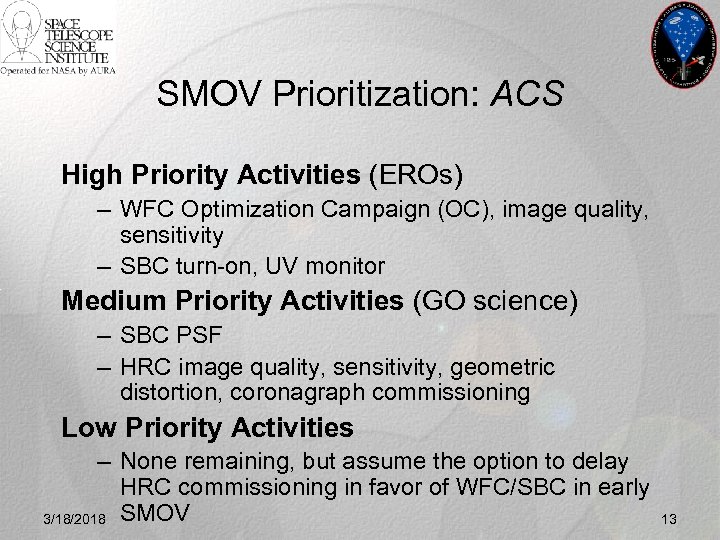
SMOV Prioritization: ACS High Priority Activities (EROs) – WFC Optimization Campaign (OC), image quality, sensitivity – SBC turn-on, UV monitor Medium Priority Activities (GO science) – SBC PSF – HRC image quality, sensitivity, geometric distortion, coronagraph commissioning Low Priority Activities – None remaining, but assume the option to delay HRC commissioning in favor of WFC/SBC in early 3/18/2018 SMOV 13
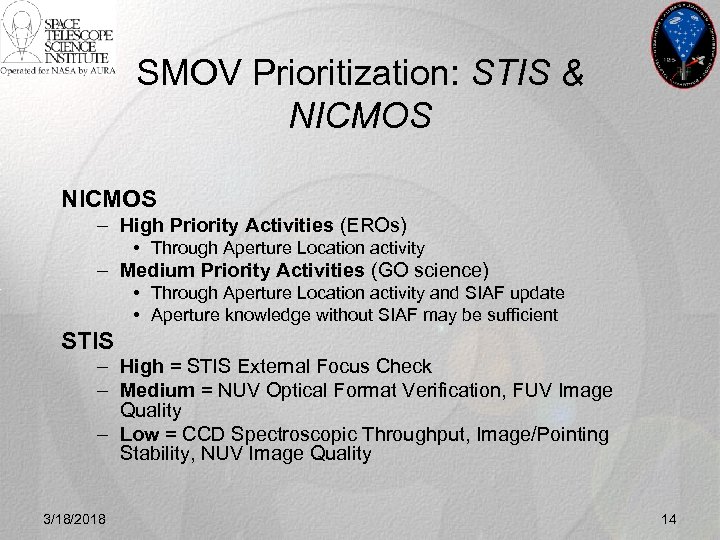
SMOV Prioritization: STIS & NICMOS – High Priority Activities (EROs) • Through Aperture Location activity – Medium Priority Activities (GO science) • Through Aperture Location activity and SIAF update • Aperture knowledge without SIAF may be sufficient STIS – High = STIS External Focus Check – Medium = NUV Optical Format Verification, FUV Image Quality – Low = CCD Spectroscopic Throughput, Image/Pointing Stability, NUV Image Quality 3/18/2018 14
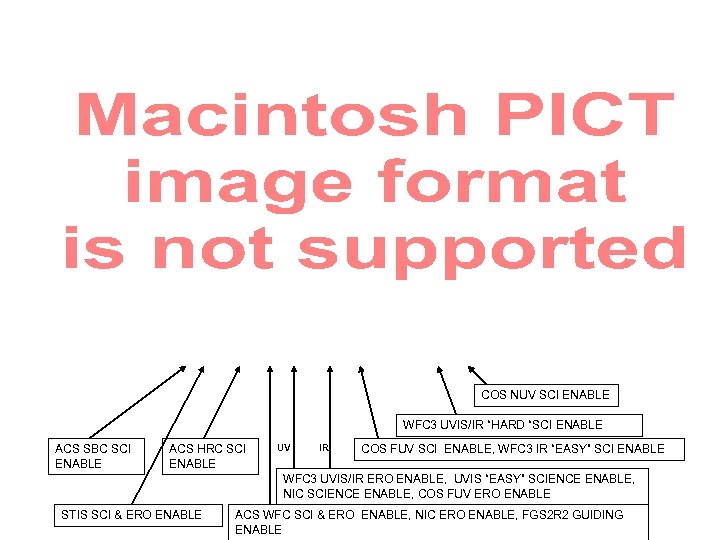
COS NUV SCI ENABLE WFC 3 UVIS/IR “HARD “SCI ENABLE ACS SBC SCI ENABLE ACS HRC SCI ENABLE UV IR COS FUV SCI ENABLE, WFC 3 IR “EASY” SCI ENABLE WFC 3 UVIS/IR ERO ENABLE, UVIS “EASY” SCIENCE ENABLE, NIC SCIENCE ENABLE, COS FUV ERO ENABLE STIS SCI & ERO ENABLE ACS WFC SCI & ERO ENABLE, NIC ERO ENABLE, FGS 2 R 2 GUIDING ENABLE
Critical Operations & Operational Challenges in SMOV HV Ramp-ups for STIS and COS Focus & Alignments for COS & WFC 3 – Iterative processes for each SI in the same weeks Realtime Commanding – GENSLEWs (Use Offsets) • Used in several proposals for pointing updates before aperture data (SIAF) is in place • Needed to meet ERO schedule – Table uploads, Event flag mgmt, etc. Fast Data Turnaround (FASTRACK) – Needed in several places for in-line analyses 3/18/2018 16
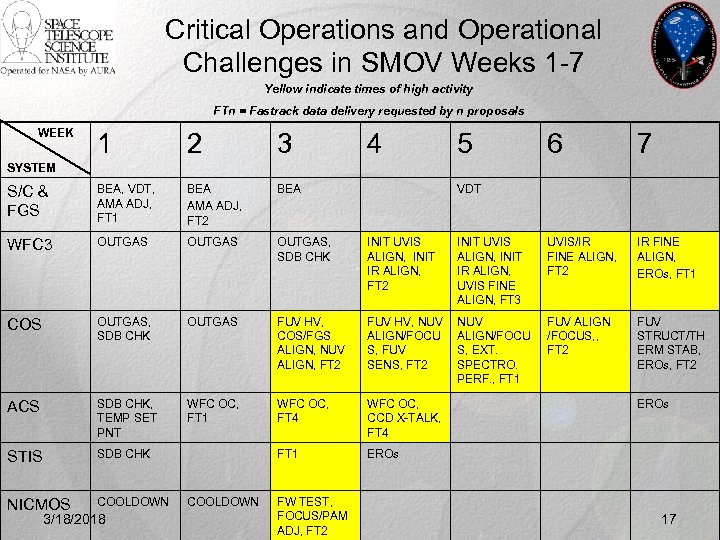
Critical Operations and Operational Challenges in SMOV Weeks 1 -7 Yellow indicate times of high activity FTn = Fastrack data delivery requested by n proposals WEEK 1 2 3 4 S/C & FGS BEA, VDT, AMA ADJ, FT 1 BEA AMA ADJ, FT 2 BEA WFC 3 OUTGAS, SDB CHK INIT UVIS ALIGN, INIT IR ALIGN, FT 2 COS OUTGAS, SDB CHK OUTGAS FUV HV, COS/FGS ALIGN, NUV ALIGN, FT 2 FUV HV, NUV ALIGN/FOCU S, FUV SENS, FT 2 ACS SDB CHK, TEMP SET PNT WFC OC, FT 1 WFC OC, FT 4 WFC OC, CCD X-TALK, FT 4 STIS SDB CHK FT 1 EROs NICMOS COOLDOWN 5 6 7 INIT UVIS ALIGN, INIT IR ALIGN, UVIS FINE ALIGN, FT 3 UVIS/IR FINE ALIGN, FT 2 IR FINE ALIGN, EROs, FT 1 NUV ALIGN/FOCU S, EXT. SPECTRO. PERF. , FT 1 FUV ALIGN /FOCUS, , FT 2 FUV STRUCT/TH ERM STAB, EROs, FT 2 SYSTEM 3/18/2018 COOLDOWN FW TEST, FOCUS/PAM ADJ, FT 2 VDT EROs 17
Organization, Management, Reporting during SMOV Team – Consists of STSc. I & Project science & engineering staff – Lead personnel identified for each critical activity – Team to meet regularly (“morning meeting”) • Daily, for 1 st couple of weeks, then at a slowly decreasing frequency • To assess daily progress, review daily plans • Determine replans • Contributions from each SI and subsystem teams • Daily minutes/reports to be published Project-wide SMOV TTRB – To assess replan requests – 3/18/2018 Make recommendations to HST MO and Project 18
SMOV 4 Contingency Planning High-level contingency plans are being worked for each SI/subsystem – Including SMOV OTA focus contingency 3/18/2018 19
SMOV PROPOSAL IMPLEMENTATION TEAM (PIT) EARNED VALUE (EV) as of 4 Sep 08 10 EV points/proposal – 3 pts for prop submit – 2 pts for 1 st PIT mtg – 2 pts for 2 nd PIT mtg – 3 pts for prop complete 3/18/2018 165 SMOV 4 PROPOSALS = 1650 total EV points - 163 PROPOSALS PIT-APPROVED PIT PROGRESS - 100 % PLANNED EARNED VALUE for Aug. 31 - 99. 0 % ACTUAL EARNED VALUE as of Sep 4 20
Credit goes to dozens and dozens of people - STSc. I, GSFC, COS & WFC 3 Teams For a very good SMOV 4 Plan 3/18/2018 21
Proposal Processing Status Denise Taylor, Observation Planning Branch - OED 3/18/2018 22
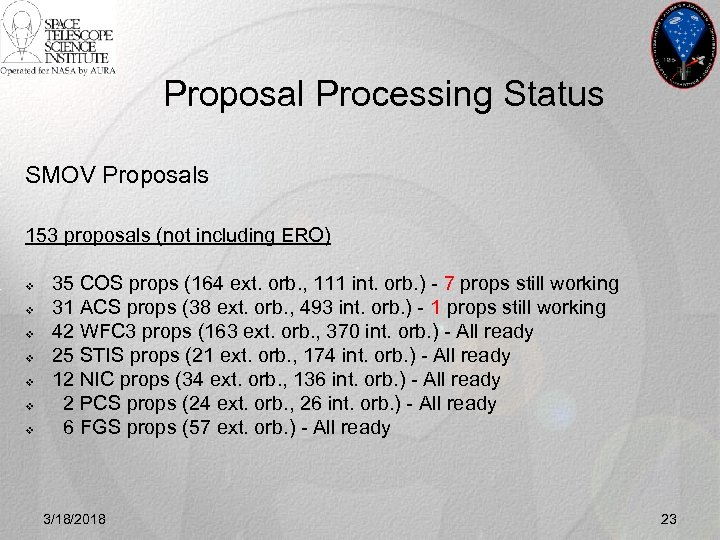
Proposal Processing Status SMOV Proposals 153 proposals (not including ERO) v v v v 35 COS props (164 ext. orb. , 111 int. orb. ) - 7 props still working 31 ACS props (38 ext. orb. , 493 int. orb. ) - 1 props still working 42 WFC 3 props (163 ext. orb. , 370 int. orb. ) - All ready 25 STIS props (21 ext. orb. , 174 int. orb. ) - All ready 12 NIC props (34 ext. orb. , 136 int. orb. ) - All ready 2 PCS props (24 ext. orb. , 26 int. orb. ) - All ready 6 FGS props (57 ext. orb. ) - All ready 3/18/2018 23
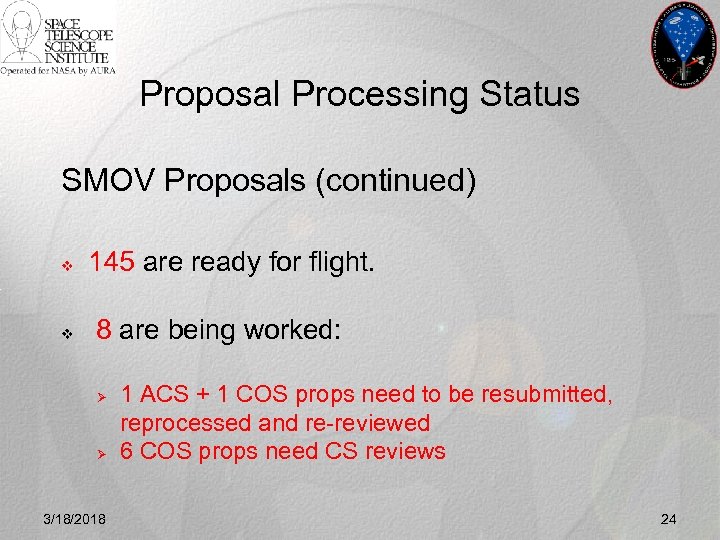
Proposal Processing Status SMOV Proposals (continued) v v 145 are ready for flight. 8 are being worked: Ø Ø 3/18/2018 1 ACS + 1 COS props need to be resubmitted, reprocessed and re-reviewed 6 COS props need CS reviews 24
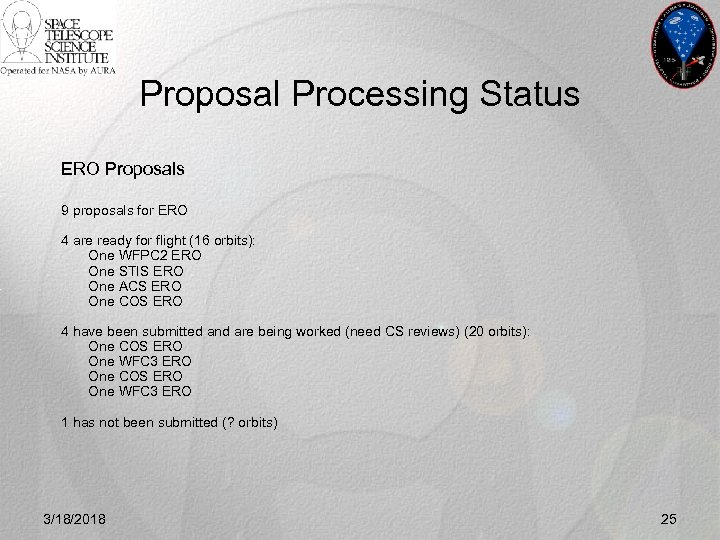
Proposal Processing Status ERO Proposals 9 proposals for ERO 4 are ready for flight (16 orbits): One WFPC 2 ERO One STIS ERO One ACS ERO One COS ERO 4 have been submitted and are being worked (need CS reviews) (20 orbits): One COS ERO One WFC 3 ERO 1 has not been submitted (? orbits) 3/18/2018 25
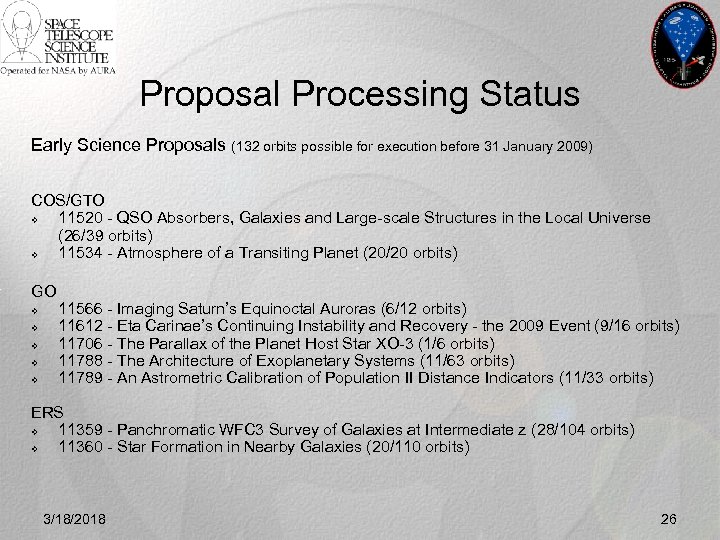
Proposal Processing Status Early Science Proposals (132 orbits possible for execution before 31 January 2009) COS/GTO v 11520 - QSO Absorbers, Galaxies and Large-scale Structures in the Local Universe (26/39 orbits) v 11534 - Atmosphere of a Transiting Planet (20/20 orbits) GO v v v 11566 - Imaging Saturn’s Equinoctal Auroras (6/12 orbits) 11612 - Eta Carinae’s Continuing Instability and Recovery - the 2009 Event (9/16 orbits) 11706 - The Parallax of the Planet Host Star XO-3 (1/6 orbits) 11788 - The Architecture of Exoplanetary Systems (11/63 orbits) 11789 - An Astrometric Calibration of Population II Distance Indicators (11/33 orbits) ERS v 11359 - Panchromatic WFC 3 Survey of Galaxies at Intermediate z (28/104 orbits) v 11360 - Star Formation in Nearby Galaxies (20/110 orbits) 3/18/2018 26
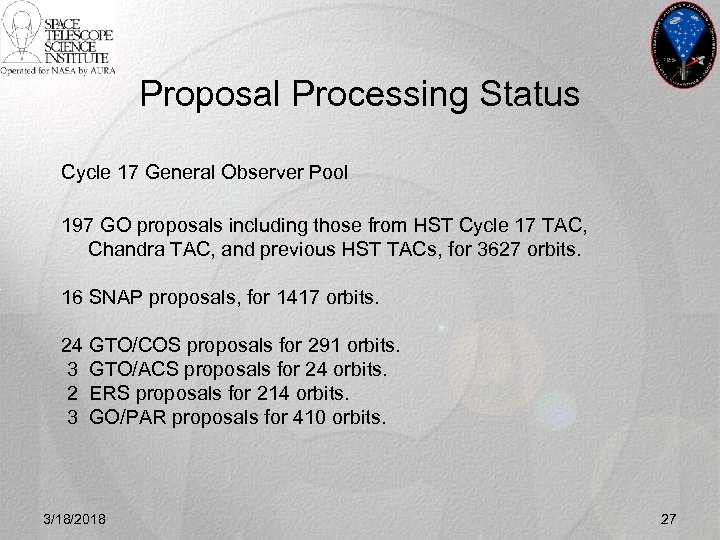
Proposal Processing Status Cycle 17 General Observer Pool 197 GO proposals including those from HST Cycle 17 TAC, Chandra TAC, and previous HST TACs, for 3627 orbits. 16 SNAP proposals, for 1417 orbits. 24 GTO/COS proposals for 291 orbits. 3 GTO/ACS proposals for 24 orbits. 2 ERS proposals for 214 orbits. 3 GO/PAR proposals for 410 orbits. 3/18/2018 27
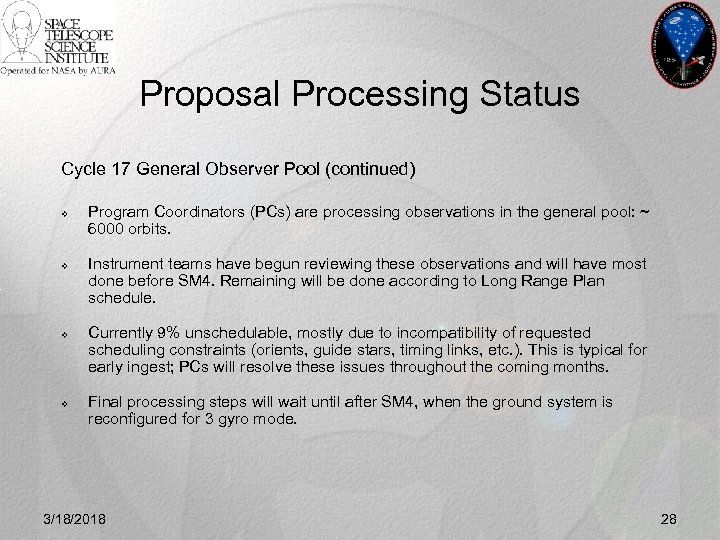
Proposal Processing Status Cycle 17 General Observer Pool (continued) v v Program Coordinators (PCs) are processing observations in the general pool: ~ 6000 orbits. Instrument teams have begun reviewing these observations and will have most done before SM 4. Remaining will be done according to Long Range Plan schedule. Currently 9% unschedulable, mostly due to incompatibility of requested scheduling constraints (orients, guide stars, timing links, etc. ). This is typical for early ingest; PCs will resolve these issues throughout the coming months. Final processing steps will wait until after SM 4, when the ground system is reconfigured for 3 gyro mode. 3/18/2018 28
Proposal Processing Status After SM 4 v v SMOV proposals and science proposals will be reworked as needed during SMOV. Remaining Cycle 15 and Cycle 16 proposals will be reworked for 3 -gyro scheduling. Cycle 17 pool will continue processing as usual, to execute observations according to the Long Range Plan. Begin processing Cycle 17 calibration proposals (Calibration review on 9/25/08; Phase II deadline TBD). 3/18/2018 29
The Long Range Plan David Adler Science & Mission Scheduling Branch - OED 3/18/2018 30
Long Range Planning Group (LRPG) Activity Summary • Remainder of Cycle 16: – 173 orbits before SM 4, 441 orbits after SM 4 in Cycle 16 “tail. ” • The LRPG is monitoring remaining Cycle 16 WFPC 2 observations. – all but one 3 -orbit To. O follow-up should be completed by SM 4. – PI of that program will put in a request to change SI if needed. • The LRPG has incorporated SMOV, SI commissioning, ERO, ERS, and GTO constraints into the Cycle 17 planning process. • A preliminary Cycle 17 LRP has been built and verified. • The LRPG has identified/developed plans for managing SM 4 contingencies in Cycle 17 planning. 3/18/2018 31
Preliminary Cycle 17 Plan Highlights • December/January priorities: – – – High priority SMOV EROs ERS/GTOs Time-critical Cycle 17 science Medium/low priority SMOV Cycle 16 GO science • Cycle 16 planning information for Oct-Dec programs is being maintained in case of launch slip. • All cycle 16 science planned for Oct-Dec can be replanned for 2009. • Under-subscription in early 2009 – LRPG is leaving space for Cycle 17 calibration programs, Target of Opportunity programs, DD, HOPR repeats, etc. 3/18/2018 32
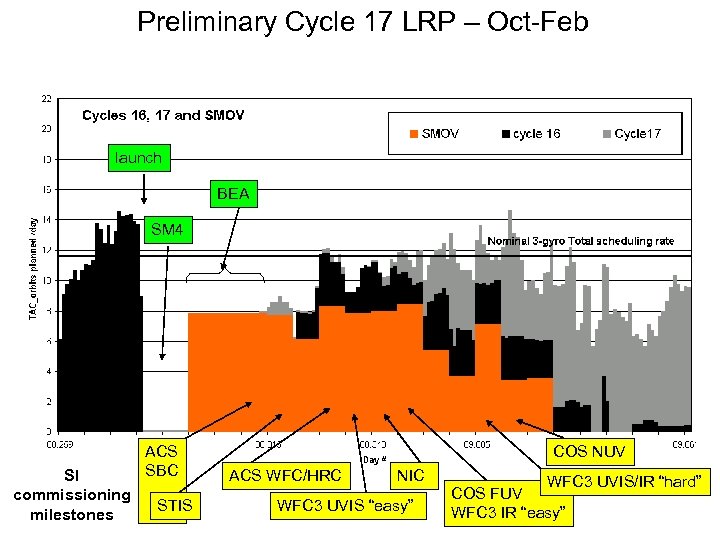
Preliminary Cycle 17 LRP – Oct-Feb launch BEA SM 4 SI commissioning milestones ACS SBC STIS COS NUV ACS WFC/HRC NIC WFC 3 UVIS “easy” WFC 3 UVIS/IR “hard” COS FUV WFC 3 IR “easy”
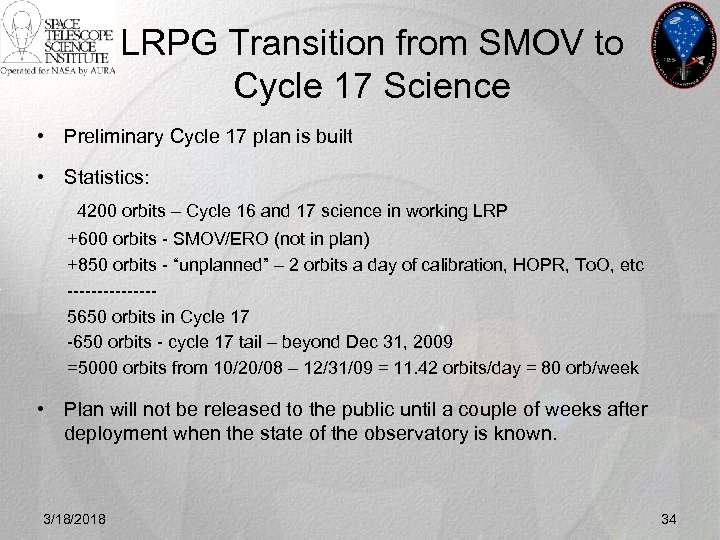
LRPG Transition from SMOV to Cycle 17 Science • Preliminary Cycle 17 plan is built • Statistics: 4200 orbits – Cycle 16 and 17 science in working LRP +600 orbits - SMOV/ERO (not in plan) +850 orbits - “unplanned” – 2 orbits a day of calibration, HOPR, To. O, etc -------5650 orbits in Cycle 17 -650 orbits - cycle 17 tail – beyond Dec 31, 2009 =5000 orbits from 10/20/08 – 12/31/09 = 11. 42 orbits/day = 80 orb/week • Plan will not be released to the public until a couple of weeks after deployment when the state of the observatory is known. 3/18/2018 34
LRPG Contingency Plans If there’s a launch slip: • Long Range Plan will be rebuilt to reflect the change. • For a 1 - 4 week slip, the following can fill the gap: – – • Existing Cycle 16 science programs Cycle 17 NIC science that can schedule in 2 -Gyro Cycle 15/16 Snaps Cycle 17 NIC Snaps that can schedule in 2 -Gyro 5 + week slip: – Existing science and Snaps, as described above; studies are ongoing to see how far out this can be extended. – If more science is needed, LRPG will consult with the Science Policies Group (SPG) for a course of action. 3/18/2018 35
Summary - LRPG Readiness for SM 4 • Transition plan between Cycle 16 – SM 4 – SMOV – Cycle 17 is in place. • Preliminary Cycle 17 LRP has been built and is ready for execution. It is currently on-hold pending the outcome of SM 4. • The LRP incorporates all constraints/HST orbit resource requirements of all SMOV (including SI commissioning) and ERO/ERS activities. • Process/policies are in place for updating the Cycle 17 plan in response to SM 4 contingencies. • The LRPG is ready for SM 4! 3/18/2018 36
Contingency plan if STIS and/or ACS are not available • The C 17 TAC recommended programs based on the assumption that SM 4 would be fully successful, i. e. , both STIS and ACS would be repaired • STIS and ACS are scheduled for repair after COS and WFC 3 and their repair is more challenging • Therefore STIS and ACS carry a higher risk of not being available in C 17 than COS and WFC 3 3/18/2018 37
Instrument Contingencies Neill Reid Science Mission Office 3/18/2018 38
C 17 allocation by orbit: • STIS: 8% of total; includes imaging and spectroscopy • ACS: 25% of total; includes 1% of SBC use (currently operational) • Numbers include parallels but no snapshots (1357 snapshot targets awarded in C 17; STIS: 140; ACS: 518) 3/18/2018 39
C 17 proposers were required to address whether their programs could be switched to a different instrument if STIS/ACS were not available Using this information, the TAC endorsed or rejected an instrument switch and made a recommendation to the Director 3/18/2018 40
STIS • Moderate-resolution UV spectroscopy can often be switched to COS • Imaging can almost always be done with WFC 3 or ACS • Optical spectroscopy, spatially resolved spectroscopy, high-resolution spectroscopy, etc. , need STIS • ~40% of all orbits using STIS can be switched • The Long Range Planning Group has run simulations showing that when STIS observations are removed, science with other SIs can be front-loaded in the Cycle 17 long range plan 3/18/2018 41
ACS • Standard broad- and narrow-band imaging can be switched to WFC 3 in most cases • SBC observations continue to be available • Optical coronagraphy, polarimetry, high-resolution imaging, etc. , need ACS • ~85% of all orbits using ACS can be switched • The Long Range Planning Group has run simulations showing that when ACS observations are removed, science with other SIs can be front-loaded in the Cycle 17 long range plan 3/18/2018 42
Impact if STIS/ACS are not available • Using the TAC recommendation as a guide-line and after additional STSc. I review, PI’s will be notified whether instruments can be switched • Process similar to that used when ACS failed and observations were switched to WFPC 2/NICMOS • PIs may appeal to the TTRB if switch was rejected • Switch can be done quickly (1 – 2 months) • Scheduling impact: ≤ 10% of the total orbits (sum of all C 17 orbits) will be lost because the science requirements preclude an instrument switch • Orbits can be replaced, e. g. , by snapshots 3/18/2018 43
Planning & Scheduling Merle Reinhart and George Chapman System Engineering Branch OED 3/18/2018 44 44
Overview Merle Reinhart – What is Planning and Scheduling? – SMOV Database Management – P&S Procedures and Tools George Chapman – – – – 3/18/2018 Rendezvous Intercept SMS Process Ephemeris Management Deploy SMS Process SMOV Calendar/SMS Build Process P&S Team Readiness Pending Changes Items Still in Work 45
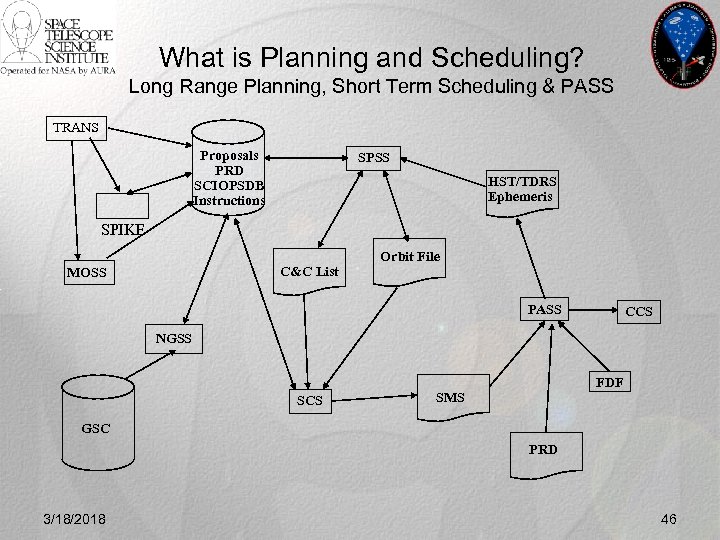
What is Planning and Scheduling? Long Range Planning, Short Term Scheduling & PASS TRANS Proposals PRD SCIOPSDB Instructions SPSS HST/TDRS Ephemeris SPIKE C&C List MOSS Orbit File PASS CCS NGSS SCS FDF SMS GSC PRD 3/18/2018 46
Database NSSC-1 Flight Software NSSC-1 FSW updates are required to support SM 4 NSSC-1 8. 6 supports full complement of SIs during SM 4 – This will be installed Sep. 10 during SMS 252 (SMS 254 is first use) – Avoids software changes during SM 4 NSSC-1 9. 0 removes support for COSTAR and WFPCII – This will be installed immediately after SM 4 during the H&S SMS 3/18/2018 47
Database PRD/SCIOPSDB OPSPRD 7. 0 has been deployed to SMS 254 – First used after NSSC-1 8. 6 FSW is loaded – PR 60745: TFPF JWOSCPRM for oscilloscope mode parameters Planned Updates – PR 60655, 60781: PLCP PIPHTHET, PIHETPHT, PISAFFLT needed for WFC 3 – After SM 4 rendezvous, but prior to deployment – PRD & SCIOPSDB updates for SMOV 4 are included in the OPS/SM 4 database merge (described later) – Other planned updates for use on initial H&S SMS • PR 60663: PLCP PJSAFHLD for ACS safing recovery including TEC commanding • PR 60739: AGCF and SCHF parameters for switch to 3 -gyro mode • PR 60742: Table ODB for NSSC-1 9. 0 FSW – Freeze Waivers will be requested for each update 3/18/2018 48
Database SMOV Preparation Environment SMOV 4 development utilizes the same methodology that was successfully used for all previous Servicing Missions. Use a separate database and disk space from Operations, but the same machines/servers. – spss_sm 4 database for SMOV 4 development – spss database for current SPSS Operations Uses the operational software and tools, but utilizes different PRD/SCIOPSDB and SMS Instructions – Allows simultaneous Flight Operations and SMOV development – Two environments are isolated The spss_sm 4 database is managed in the same way as the SPSS Operations database. This SMOV 4 environment is used to: – – 3/18/2018 Prepare the SMOV proposals for execution Create the SMGT products Create the SMOV 4 representative products Post-SM 4 DRM Planning and Scheduling exercise 49
Database The Merge Process SMOV environment gets merged into the Operations environment after rendezvous and berthing occurs. Unload all the SMOV 4 and housekeeping proposals from the spss_sm 4 database – This stores the proposals on disk as an sql load file – This part of the process nominally occurs right around launch time and takes about a day Get a backup of the spss database – This allows us to easily restore to pre-launch if necessary Database Administrator moves the contents of specified tables from the spss_sm 4 database into the spss database – This transfers the PRD/SCIOPSDB information and the Instructions needed post-SM 4 Load the SMOV 4 and housekeeping proposals into the spss database Database Administrator will rebuild the table indices to ensure good database performance 3/18/2018 50
Database The Merge Process (cont) Modify any spss database resident housekeeping visits to 3 -Gyro/OBAD mode PRD/SCIOPSDB group will audit the merged spss database for correctness OPS will audit the proposals for correctness End-to-end process generally takes about 2 days. This Merge process will be tested on September 15 th. 3/18/2018 51
Database PASS Configuration Files These are files used by the PASS software and configuration controlled by the P&S Operations group. Command Loader Basefile changes to disable WFPC 2 and COSTAR and enable WFC 3 and COS (or the appropriate combination). – In the CLBASE Namelist • Old: NS_SINAME = 'ACS ', 'NIC ', 'STIS', 'CSTR', 'WFII’ • New: NS_SINAME = 'ACS ', 'NIC ', 'STIS', 'COS ', 'WFC 3’ • Old: NSREDUNDV = 'A', 'B', 'A’ • New: NSREDUNDV = 'A', 'B', 'A', 'B’ • Old: NSSHPSI = '_NSSHPS 4’ • New: NSSHPSI = '_NSSHPS 5' 3/18/2018 52
Database PASS Configuration Files (cont) MEGG initialization file changes to swap in the appropriate new instruments. – Old: WFPC standby COSTAR hold STIS operate NICMOS saa_oper ACS hold NCS CPL_hold 3/18/2018 – New: WFC 3 hold COS hold STIS operate NICMOS saa_oper ACS hold NCS CPL_hold COS_NUV hold COS_FUV hold 53
Planning and Scheduling Procedures The Procedures are written, configured descriptions of a particular process workflow that describes the tools and actions that should be performed to accomplish that particular workflow. Procedures that need modification to support post-SM 4 – None of these updated procedures will be put into place until after the database merge is complete. • 3. 2. 01 - Scheduling Unit Selection – Remove the WFPC 2 decon references and add in the WFC 3/ACS/STIS Anneal proposals • 3. 2. 02 - Flight Calendar Preparation – Add the STIS Low Voltage management (STISLs) back in • 3. 2. 03 - Flight Calendar Building – Remove the special checks for non-functional ACS/STIS detectors – The following procedures were modified and installed • 3. 2. 17 - Science Instrument Safe Mode Recovery – Add WFC 3/COS and post_SM 4 ACS – All Visits (excepting WFC 3 Soft-Safing) are ready for use 3/18/2018 54
Planning and Scheduling Tools The tools are configured programs or scripts that are used to perform certain actions called out in the Procedures used for building the weekly flight calendars. Tools which have already been modified and being used for the initial SMOV calendar builds – ccl_gsselect • Selects the guidestars used in the SMS • Don’t allow FGS 2 R 2 to be used as the dominant guider – su_gaps. sqr • Calendar Visit summary report • Add COS/WFC 3 3/18/2018 55
Planning and Scheduling Tools (cont) Tools requiring modification for SM 4 – data_vol_report. py • Data Volume report for OPUS • Add COS/WFC 3 and remove WFPC 2 – gimme_snaps. py • Builds the lists of what to schedule on a particular week • Change the default for SI/configs to exclude back to nothing – Calendar/SMS checklists • Checks correctness of flight calendars and SMS’s • Changes yet to be determined All of these tools will be put into place operationally after the database merge is complete. 3/18/2018 56
Rendezvous Transitioning HST to Servicing Mission 4 Objective: prepare HST for rendezvous with the Space Shuttle while maximizing the science content of the launch week SMS Methodology: utilize the nominal P&S Intercept capability – A primary science SMS with “transition” visits – A pre-planned intercept SMS with Gyro-4 test and rendezvous attitude maintenance – Post-launch switch from science to intercept Testing: – Previously used for SM 3 B – Tested during the System Readiness 4. 2 (SR 4. 2) SMGT • Intercept loaded and executing but stopped prior to Gyro-4 test and rendezvous attitude maintenance to reduce test duration 3/18/2018 57
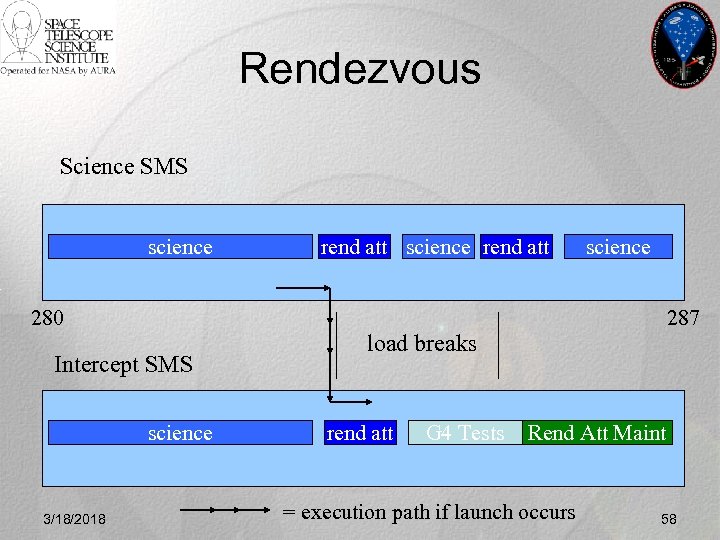
Rendezvous Science SMS science 280 Intercept SMS science 3/18/2018 rend att science 287 load breaks rend att G 4 Tests Rend Att Maint = execution path if launch occurs 58
Rendezvous Key Transition Components Transition Visit – Slews HST to rendezvous attitude (varies with launch date/time) – Configures SIs to nominal states in preparation for real-time safing – Provides intercept point and 2 hours of “dead time” to facilitate interception Science SMS – Nominal science SMS – One Transition visit scheduled for each launch window • Provides for launch delays – Nominal product delivery to GSFC Intercept SMS – Same as science SMS up through the Transition visit – Gyro-4 test and attitude maintenance replace science after Transition visit – Products generated and delivered pre-launch (post-science SMS delivery) • TDRS updates withheld until post-launch 3/18/2018 59
Rendezvous What happens on launch day? Science SMS is executing If launch occurs – Intercept the Science SMS • P&S updates TDRS schedule to match the Intercept SMS • FOT uplinks the Intercept loads – No science after start of launch window +7 h • SIs are safed and NSSC-1 “idled” in real-time at 7 h MET via Command Plan If launch is delayed – Science SMS continues uninterrupted • FOT uplinks the next loads from the Science SMS – P&S generates and delivers an Intercept SMS for the next opportunity 3/18/2018 60
Ephemerides Maintain nominal processing and delivery schedule during servicing mission – Prevents gaps in data • reduces manual intervention • less disruptive to PASS processing – Ensures recent data is available in an emergency deploy situation Support fast turnaround processing and delivery post-deploy – The process is fully automated – P&S personnel will be physically at the STSc. I for these critical ephems to deal with any unexpected problems 3/18/2018 61
Deploy SMS Process Firing Up an Improved HST The deploy SMS is a Health & Safety SMS generated using the nominal H&S generation process – 3 -Gyro Onboard Attitude Determination (OBAD) = “T”mode – Built using NSSC-1 FSW 9. 0 – 36 hour duration – BEA compliant initial attitude provided by PCS – Contains no SI commanding • Allows installation of NSSC-1 FSW 9. 0 and COS FSW – Removes support for COSTAR and WFPC 2 – Fixes a COS Lamp startup failure issue • Allows real-time commanding to configure HST for use Tested during the System Readiness 4. 2 (SR 4. 2) SMGT First Science SMS – NSSC-1 cold-start due to FSW install in previous SMS – Begin SMOV activities – Based upon preliminary SMOV template calendar 3/18/2018 62
SMOV 4 Calendar/SMS Builds Construct representative SMOV products assuming a nominal mission and a nominal SMOV Products will cover the first 4 -5 weeks of SMOV – Determines the scheduling feasibility of the SMOV Plan – Finds any inconsistencies between the different SMOV Proposals These products will be widely distributed for review – Ensures we haven’t missed or misinterpreted something Will be the starting point for building the templates the Flight Calendar Builders will use for flight. Templates will be started by ~T-14 days and handed to the Flight Calendar Builder by their nominal T-11 d build start. Currently have the first 3 weeks built which includes the first four post-BEA days. – As expected, this post-BEA area is oversubscribed in the SMOV plan 3/18/2018 63
P&S Team SM 4 Readiness Operations Training No difference in SPSS and PASS process and procedures between pre and post SM 4 operations Therefore, no special training/instruction required to support post SM 4 operations. All team members participated in training sessions to become familiar with COS and WFC 3 characteristics Team also familiarized with any changes in check tools and procedures related to the return to 3 Gyro operating mode Planning and Scheduling utilizing the Post-SM 4 DRM proposals 3/18/2018 64
P&S Team SM 4 Readiness Operations Support P&S staff will be on-site at STSc. I to cover critical activities as necessary – – – Launch to update TDRS schedule Pre and Post reboost ephem processing Post-Deploy ephem HST Attitude from PCS and H&S SMS creation Follow-on Science SMS creation Post-deploy scheduling – Resume normal SMS build and delivery schedule for SMOV following post-deploy H&S and first Science SMS P&S Team ready for SM 4, SMOV and Cycle 17 operations 3/18/2018 65
Pending Changes PRD & SCIOPSDB Things waiting for SM 4 that need preapproved freeze waivers – PRD & SCIOPSDB updates are included in the OPS/SM 4 database merge – Planned PRD updates • PR 60655, 60781: PLCP PIPHTHET, PIHETPHT, PISAFFLT needed for WFC 3 • PR 60663: PLCP PJSAFHLD for ACS safing recovery including TEC commanding • PR 60739: AGCF and SCHF parameters for switch to 3 -gyro mode • PR 60742: Table ODB for NSSC-1 9. 0 FSW 3/18/2018 66
Items Still in Work Database Merge Test – Sept 15 WFC 3 Soft Safing Recovery Procedure and Visits – Analysis completed by Sept 12 – Visits created and tested by Sept 19 Create Flight Rendezvous/Transition Visits – Completed by Sept 22 Calendar and SMS Checklist Tool Updates – Review and determination of needed changes by Sept 12 – Implementation and testing completed by Oct 3 data_vol_report. py and gimme_snaps. py Tool Updates – Implementation and testing completed by Oct 3 Flight Functional Tests (FT) Support Schedules – Completed by Oct 3 Finish building Representative SMOV Weeks out to at least 5 – Completed by Oct 3 3/18/2018 67
Commanding Alan Welty Commanding Branch - OED 3/18/2018 68
Commanding Front-End Science Instrument Support – Write requirements for PROPINST, APT, TRANS, and SCIOPSDB related to SI commanding – Write & maintain the IM “Instructions” – code used to generate most SMS statements – PDB tables and groups used in SI commanding • Define them, with the SI ops working groups • Create and validate the PDB files – Certification (see slide 5) – SMS Review Tool • Checks for CARD & OLD violations • Checks to ensure science data quality 3/18/2018 69
Regression Testing 1 Bit Validation (“bit busting”) of PDB files – – Create PDB files & bitval test instructions Run SPSS & PASS to generate the bits Verify that the bits are correct Deliver PDB files & bitval test instructions to Ball/GSFC • They also generate the bits & deliver them to us – Compare STSc. I and Ball/GSFC products – Do the paperwork 3/18/2018 70
Regression Testing 2 Bit Validation Status – ACS-R • New items Done (3 forms yet to be signed) • Items unaffected by repair – In progress – NICMOS • Done (revalidation not requested - NICMOS is fully operating) – STIS • TBD (no changes, so no issues are expected) – COS • Done (3 forms yet to be signed) – WFC 3 • GSFC has 2 TBDs and 8 forms to sign • STSc. I Done (except for signing 10 forms…) 3/18/2018 71
Regression Testing 3 Certification – Create/update certification test proposal (in APT) • • – – One proposal for each SI Typically, each visit tests a different ‘major’ capability Exercise all legal proposal inputs Negative testing is left to the Test Team Process proposals with TRANS Load TRANS output on CMD’s dev database Generate calendars & SMSs Verify correctness of SMSs • Make detailed check of any new commanding • Explain any differences in pre-existing commanding – Update SRT if necessary & run it on the SMSs 3/18/2018 72
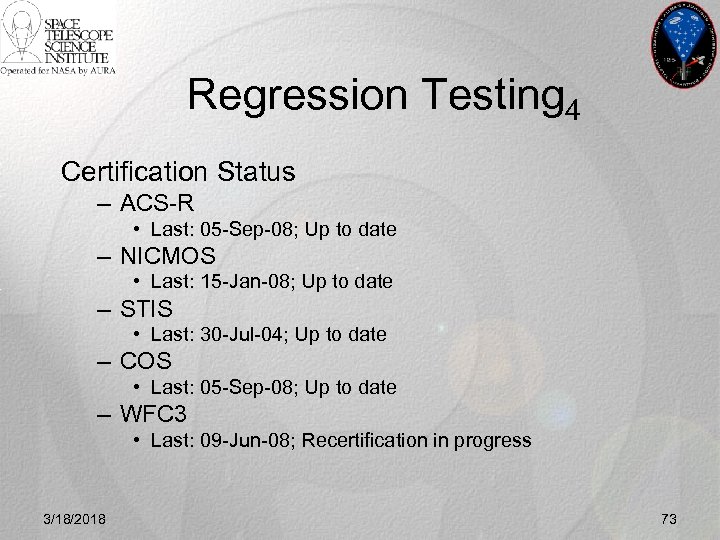
Regression Testing 4 Certification Status – ACS-R • Last: 05 -Sep-08; Up to date – NICMOS • Last: 15 -Jan-08; Up to date – STIS • Last: 30 -Jul-04; Up to date – COS • Last: 05 -Sep-08; Up to date – WFC 3 • Last: 09 -Jun-08; Recertification in progress 3/18/2018 73
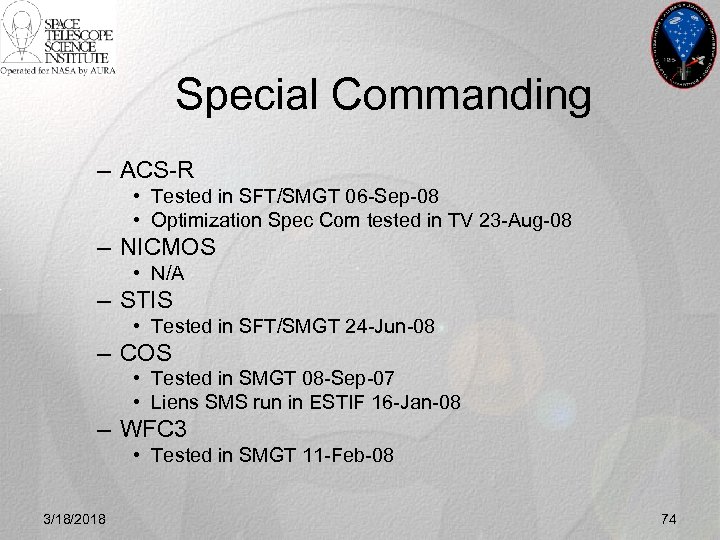
Special Commanding – ACS-R • Tested in SFT/SMGT 06 -Sep-08 • Optimization Spec Com tested in TV 23 -Aug-08 – NICMOS • N/A – STIS • Tested in SFT/SMGT 24 -Jun-08 – COS • Tested in SMGT 08 -Sep-07 • Liens SMS run in ESTIF 16 -Jan-08 – WFC 3 • Tested in SMGT 11 -Feb-08 3/18/2018 74
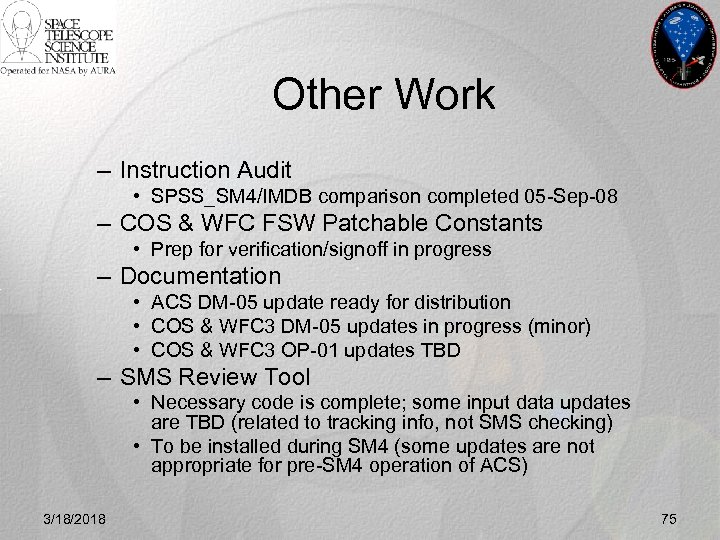
Other Work – Instruction Audit • SPSS_SM 4/IMDB comparison completed 05 -Sep-08 – COS & WFC FSW Patchable Constants • Prep for verification/signoff in progress – Documentation • ACS DM-05 update ready for distribution • COS & WFC 3 DM-05 updates in progress (minor) • COS & WFC 3 OP-01 updates TBD – SMS Review Tool • Necessary code is complete; some input data updates are TBD (related to tracking info, not SMS checking) • To be installed during SM 4 (some updates are not appropriate for pre-SM 4 operation of ACS) 3/18/2018 75
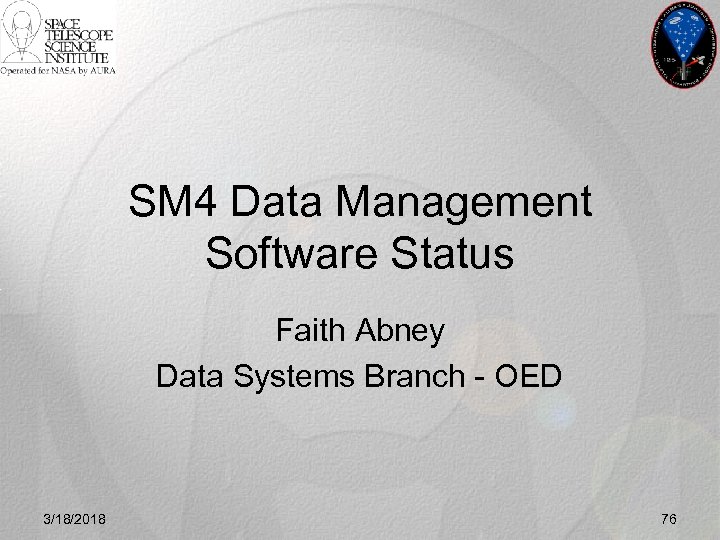
SM 4 Data Management Software Status Faith Abney Data Systems Branch - OED 3/18/2018 76
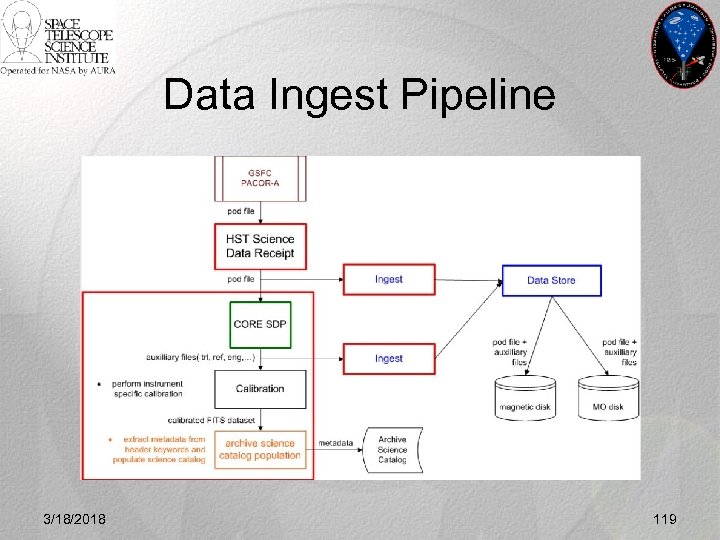
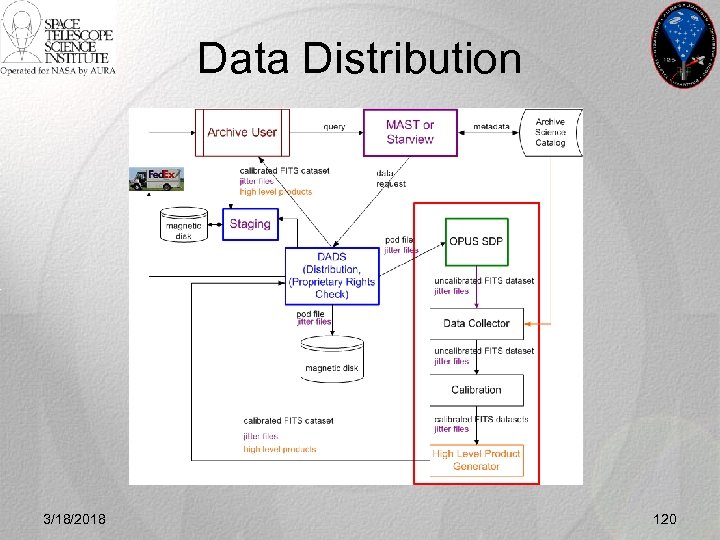
What do we mean by “Data Processing” ? • Receipt of science and engineering data • Reformatting, quality checking, calibration, to prepare data for archive • Archiving the data • Retrieving the data • Processing & calibration of retrieved data • Sending data to the user • User access tools 3/18/2018 77
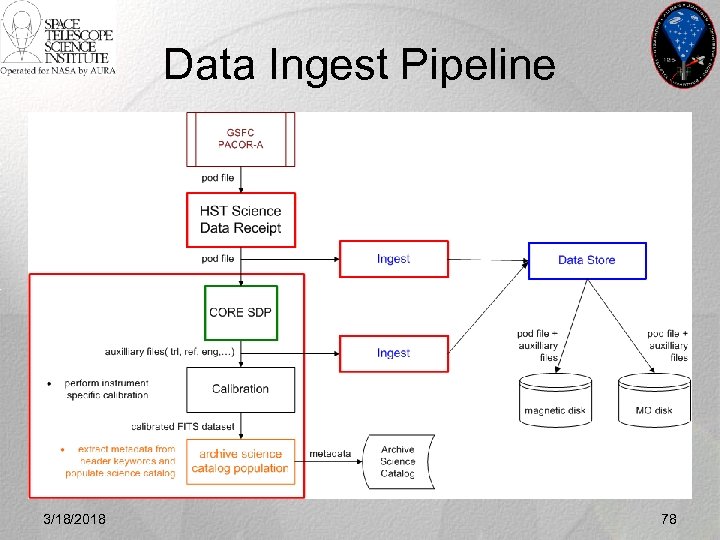
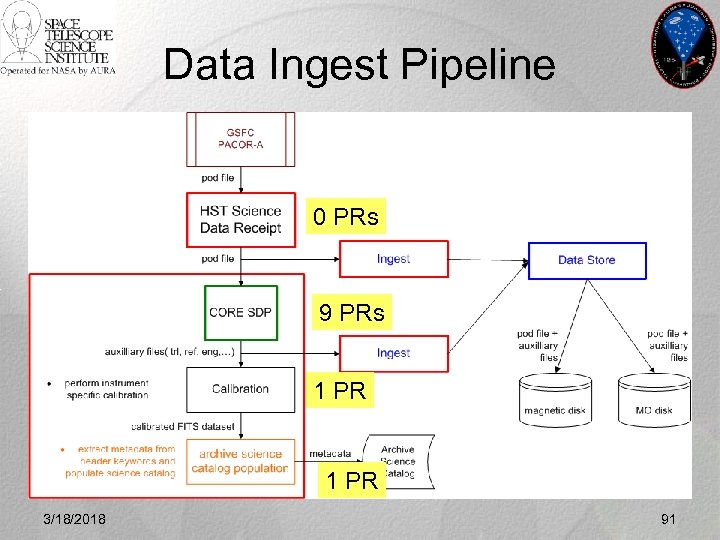
Data Ingest Pipeline 3/18/2018 78
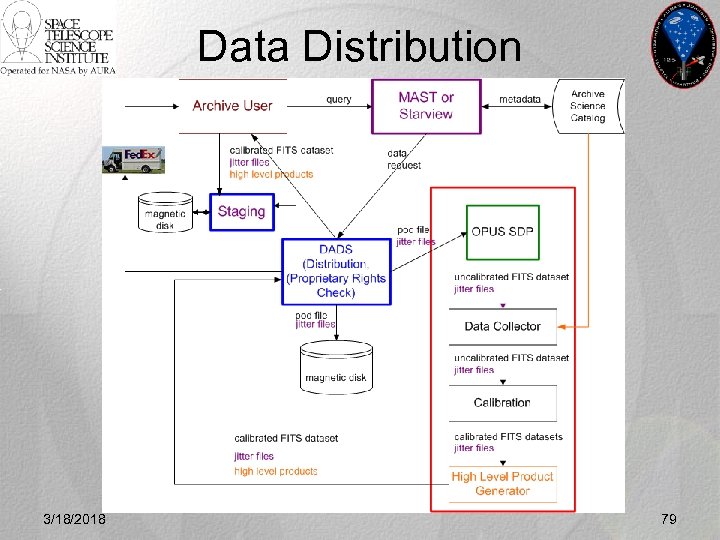
Data Distribution 3/18/2018 79
Raw Data Receipt and Ingest • PACOR interface code has not changed – Tested with all ground tests including STSc. I and PACOR • – • included all SMGT data Used daily to support HST operations No changes to POD ingest processing – – • • 3/18/2018 All instruments handled identically No instrument specific code Tested with all SMGT data for COS and WFC 3 Used daily to support HST operations 100% of COS and WFC 3 SMGT data have gone through data receipt and ingest processing No critical outstanding PRs for this part of the system 80
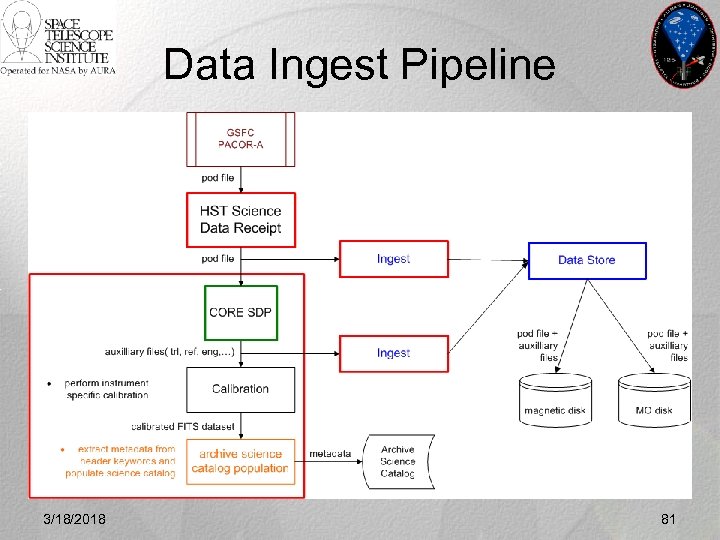
Data Ingest Pipeline 3/18/2018 81
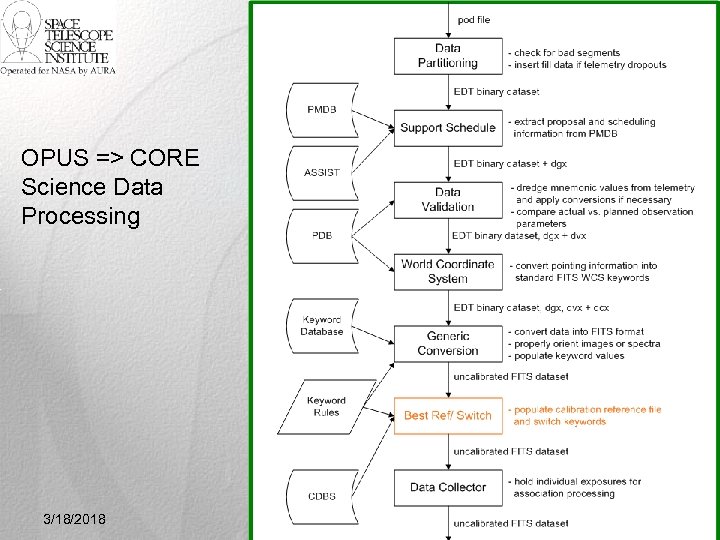
OPUS => CORE Science Data Processing 3/18/2018 82 82
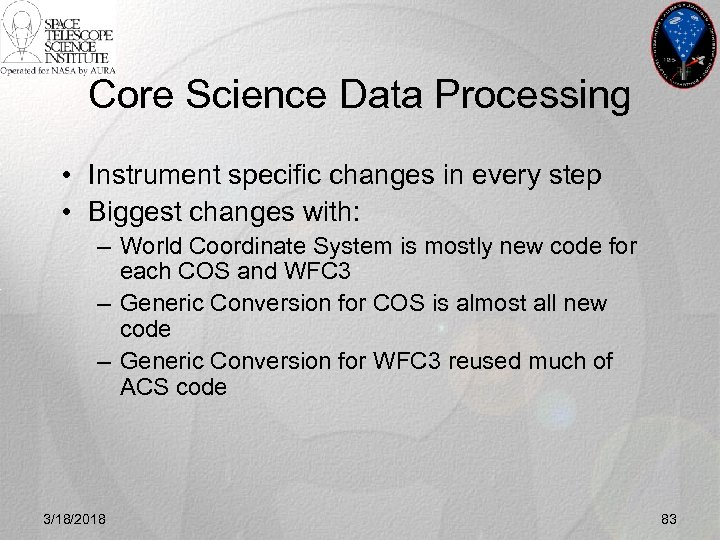
Core Science Data Processing • Instrument specific changes in every step • Biggest changes with: – World Coordinate System is mostly new code for each COS and WFC 3 – Generic Conversion for COS is almost all new code – Generic Conversion for WFC 3 reused much of ACS code 3/18/2018 83
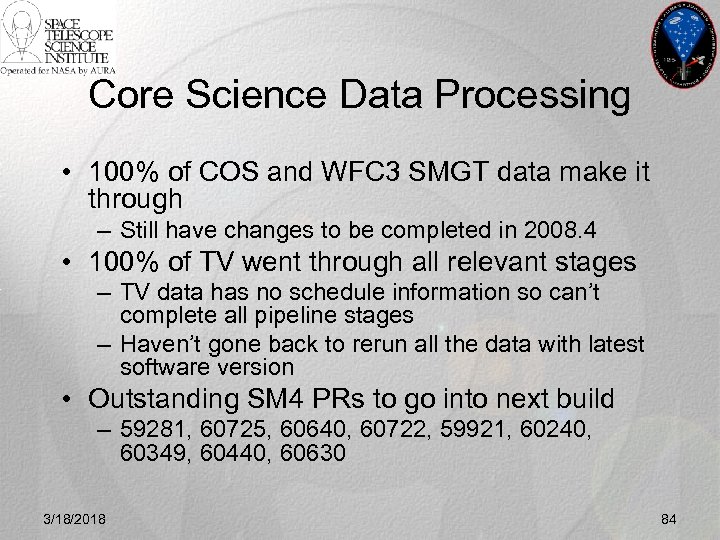
Core Science Data Processing • 100% of COS and WFC 3 SMGT data make it through – Still have changes to be completed in 2008. 4 • 100% of TV went through all relevant stages – TV data has no schedule information so can’t complete all pipeline stages – Haven’t gone back to rerun all the data with latest software version • Outstanding SM 4 PRs to go into next build – 59281, 60725, 60640, 60722, 59921, 60240, 60349, 60440, 60630 3/18/2018 84
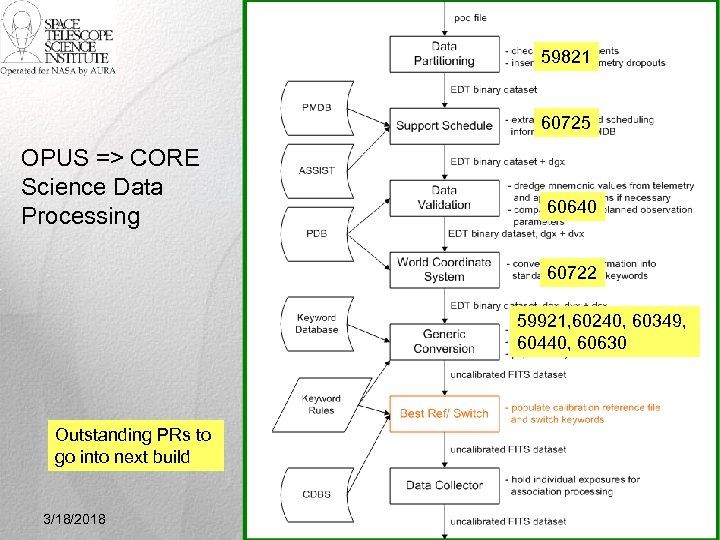
59821 60725 OPUS => CORE Science Data Processing 60640 60722 59921, 60240, 60349, 60440, 60630 Outstanding PRs to go into next build 3/18/2018 85 85
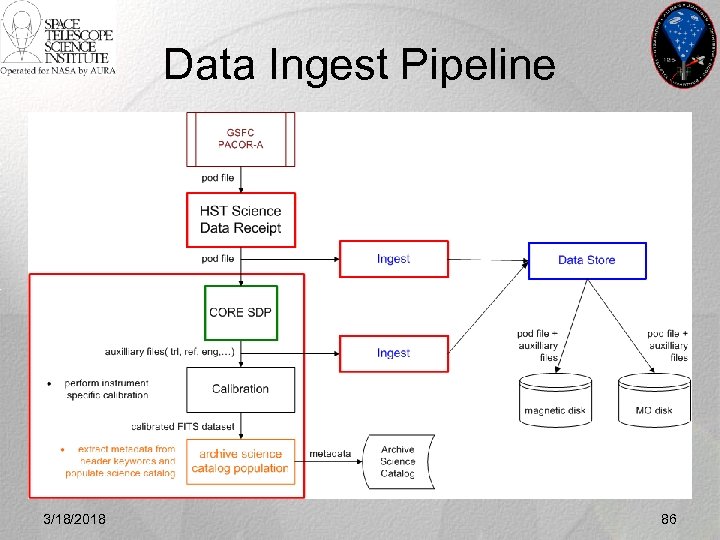
Data Ingest Pipeline 3/18/2018 86
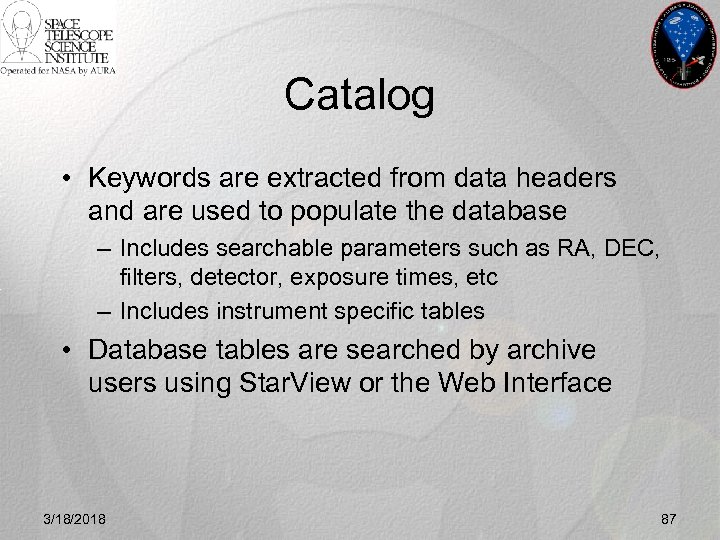
Catalog • Keywords are extracted from data headers and are used to populate the database – Includes searchable parameters such as RA, DEC, filters, detector, exposure times, etc – Includes instrument specific tables • Database tables are searched by archive users using Star. View or the Web Interface 3/18/2018 87
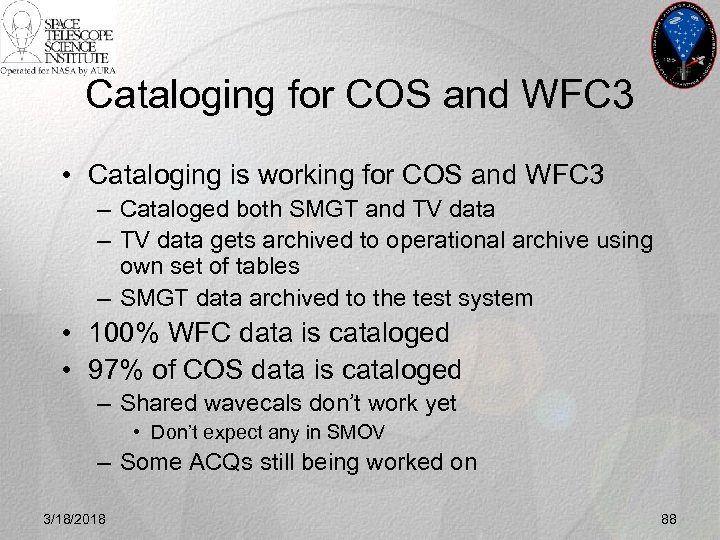
Cataloging for COS and WFC 3 • Cataloging is working for COS and WFC 3 – Cataloged both SMGT and TV data – TV data gets archived to operational archive using own set of tables – SMGT data archived to the test system • 100% WFC data is cataloged • 97% of COS data is cataloged – Shared wavecals don’t work yet • Don’t expect any in SMOV – Some ACQs still being worked on 3/18/2018 88
Cataloging for COS and WFC 3 • WFC 3 keyword cataloging is complete – May add more keywords after SMOV • COS first cut at keyword cataloging done – Iterating with the COS team • To verify catalog contents, an independent verification tool checks the data headers against the catalog – Verifies right values come from the right extensions – Tool has been used for other instruments, recently updated for COS and WFC 3 • One outstanding PR, 60615 3/18/2018 89
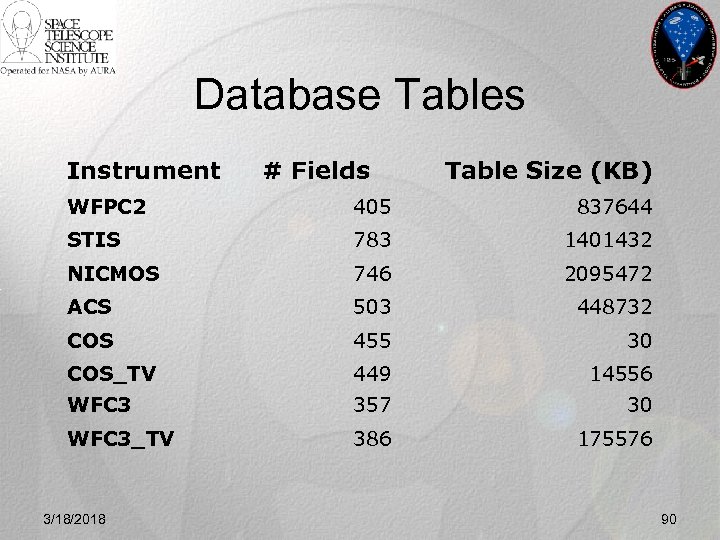
Database Tables Instrument # Fields Table Size (KB) WFPC 2 405 837644 STIS 783 1401432 NICMOS 746 2095472 ACS 503 448732 COS 455 30 COS_TV 449 14556 WFC 3 357 30 WFC 3_TV 386 175576 3/18/2018 90
Data Ingest Pipeline 0 PRs 9 PRs 1 PR 3/18/2018 91
Data Distribution 3/18/2018 92
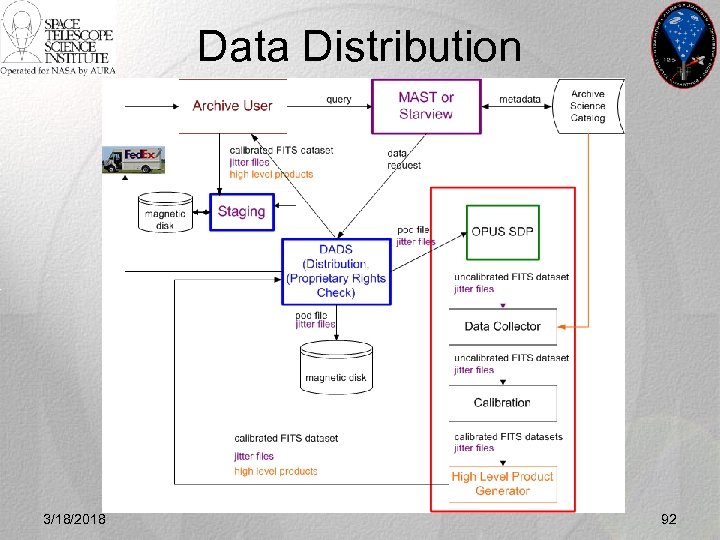
Data Distribution Changes • Added COS and WFC 3 to list of known HST instruments • Added definitions of “Calibrated” and “Uncalibrated” data retrieval keywords for COS and WFC 3 – Allowed for long extension names from OTFR for COS data (all other OTFR instruments used 3 char extensions) • Added more disk space • Distributed 100% of the COS and WFC 3 that was ingested (SMGT & TV) – Includes going through OTFR • No outstanding critical DADS PRs 3/18/2018 93
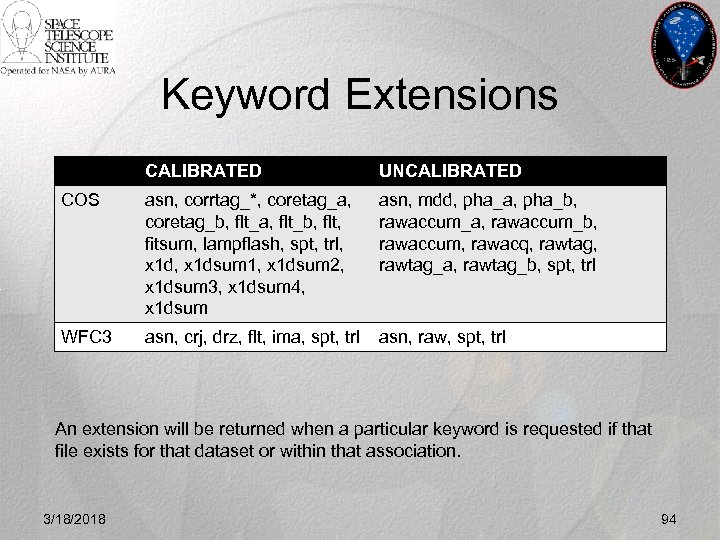
Keyword Extensions CALIBRATED UNCALIBRATED COS asn, corrtag_*, coretag_a, coretag_b, flt_a, flt_b, flt, fitsum, lampflash, spt, trl, x 1 dsum 1, x 1 dsum 2, x 1 dsum 3, x 1 dsum 4, x 1 dsum asn, mdd, pha_a, pha_b, rawaccum_a, rawaccum_b, rawaccum, rawacq, rawtag_a, rawtag_b, spt, trl WFC 3 asn, crj, drz, flt, ima, spt, trl asn, raw, spt, trl An extension will be returned when a particular keyword is requested if that file exists for that dataset or within that association. 3/18/2018 94
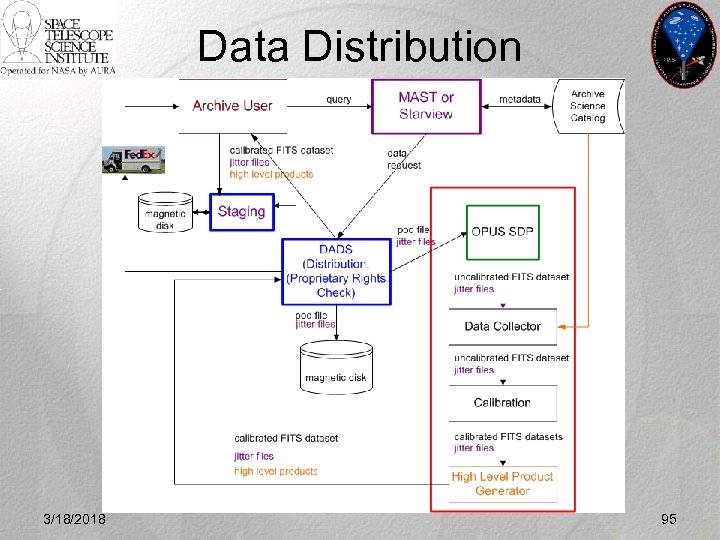
Data Distribution 3/18/2018 95
Retrieval Interface • Star. View was rusty railed 4 years ago – Had support issues with old code and new databases this spring – Data Retrieval by Star. View was less than 3% of total – Usage was largely in-house by data analysts and instrument scientists 3/18/2018 96
Retrieval Interface • Star. View functionality migrates to Web – Retain the name “Star. View” – Retrievals for COS and WFC 3 are working on the MAST science searches – Search screens for COS and WFC 3 instrument and engineering searches are not yet ready • Will be delivered as they become ready - not tied to build • Mostly used by instrument scientists and data analysts 3/18/2018 97
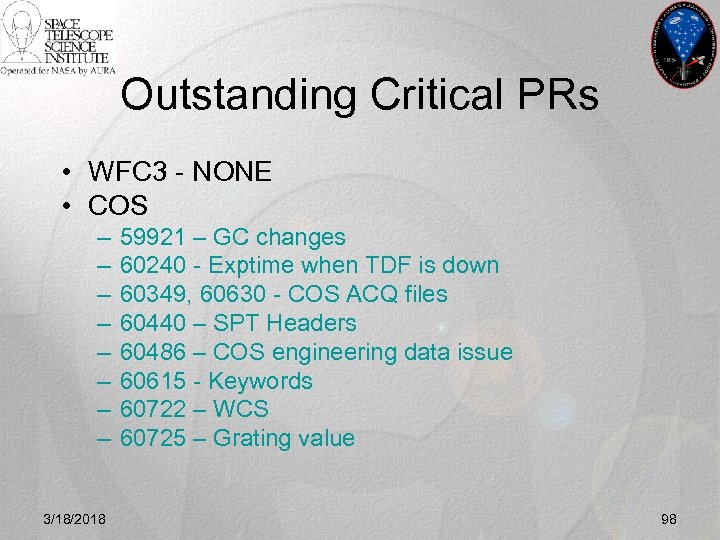
Outstanding Critical PRs • WFC 3 - NONE • COS – – – – 3/18/2018 59921 – GC changes 60240 - Exptime when TDF is down 60349, 60630 - COS ACQ files 60440 – SPT Headers 60486 – COS engineering data issue 60615 - Keywords 60722 – WCS 60725 – Grating value 98
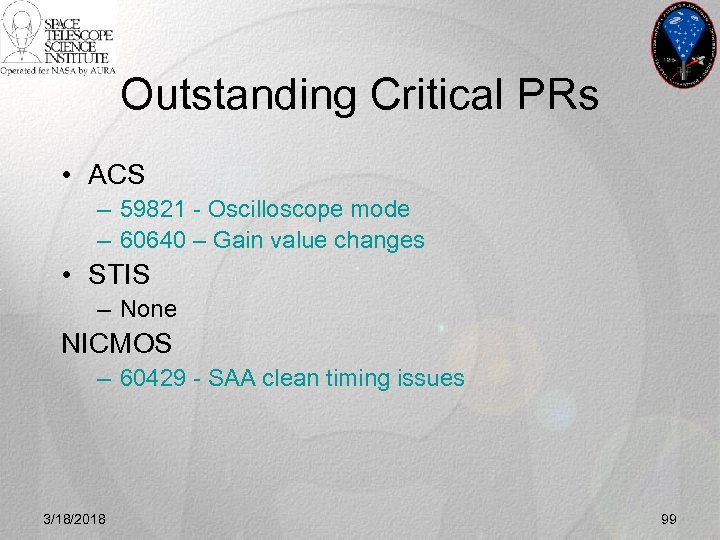
Outstanding Critical PRs • ACS – 59821 - Oscilloscope mode – 60640 – Gain value changes • STIS – None NICMOS – 60429 - SAA clean timing issues 3/18/2018 99
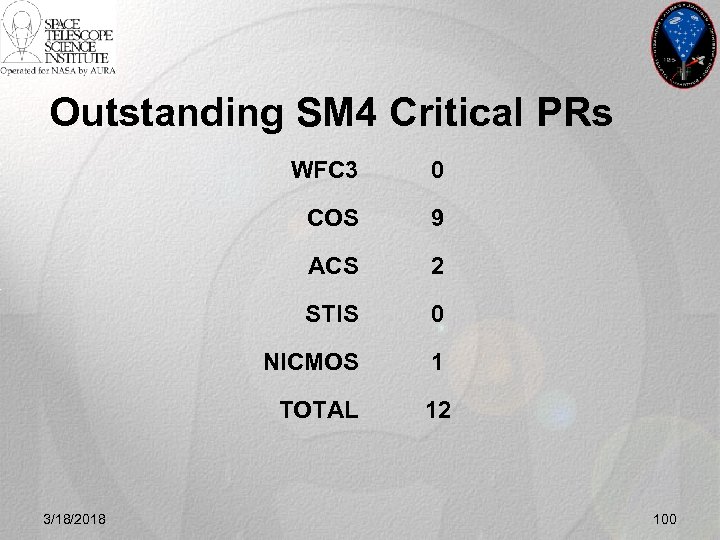
Outstanding SM 4 Critical PRs WFC 3 COS 9 ACS 2 STIS 0 NICMOS 1 TOTAL 3/18/2018 0 12 100
Build Schedule • DMS 2008. 4 – All SM 4 critical PRs are in build DMS 2008. 4 – Also includes 3 non-critical, database table fixes – Enhancements for easier reprocessing in operations – Installation scheduled for September 30 – Each PR approved by HSTMO prior to installation • Newly discovered critical problems will be delivered as quick fixes after 2008. 4 • 2009. 1 installation planned in early 2009 3/18/2018 101
Routine Maintenance after SM 4 • Likely items for DMS 2009. 1 – – Changes based on SMOV experience COS Pulse. Height Histogram COS Accumulated Images Pipeline enhancements • NICMOS Reprocessing – 60595, 60597, 60598, 60610, 60701 3/18/2018 102
Calibration Software Status for SM 4 Warren Hack Science Software Branch - OED 3/18/2018 103
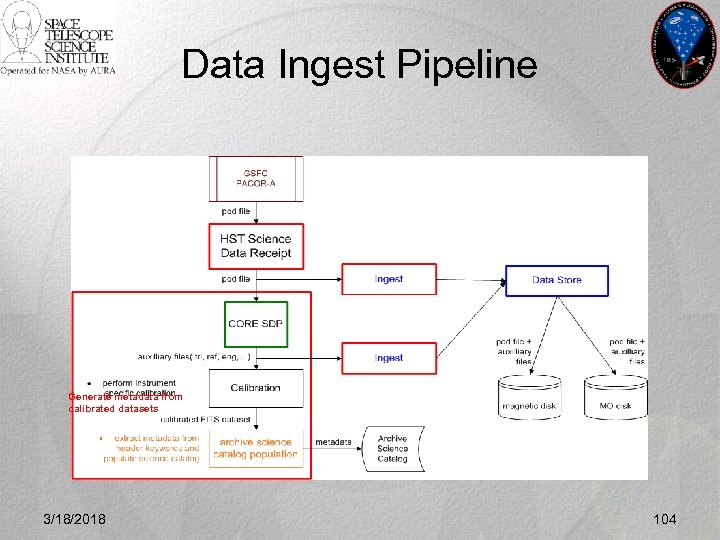
Data Ingest Pipeline Generate metadata from calibrated datasets 3/18/2018 104
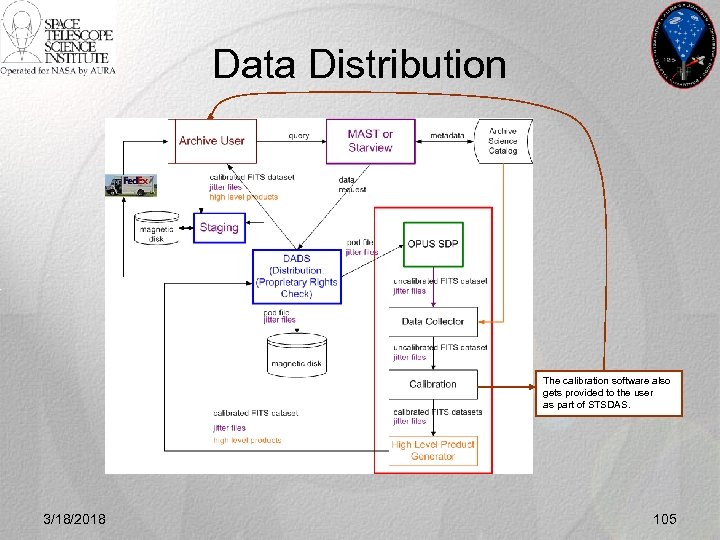
Data Distribution The calibration software also gets provided to the user as part of STSDAS. 3/18/2018 105
Current Instruments The pipeline calibration software for the legacy instruments has been reviewed to see whether any changes were needed to support SMOV activities. ACS: The ACS pipeline software will require changes to support the new commanded values of the gain. STIS: No changes required for SMOV support. NICMOS: The NICMOS pipeline have been enhanced with deliveries to OPUS 2008. 3 in order to prepare for reprocessing of pre-SM 4 NICMOS data. WFPC 2: All software development has focused on supporting final reprocessing during SMOV, and the version now in place will be sufficient. 3/18/2018 106
WFC 3 CALWF 3 Version 0. 95 was delivered to OPUS Build 2008. 3. – This version of CALWF 3 has been used to successfully process 100% of the relevant ground-test data from Servicing Mission Ground Test (SMGT) through OPUS. It has also been used by the WFC 3 team to process all the Thermal-Vac (TV) test data. • Testing of CALWF 3 carried out by OPUS as part of standard regression testing for operational OPUS builds using SMGT data, and through a separate OPUS TV pipeline to process WFC 3 thermal-vac data as needed by the WFC 3 team. • OPUS regression testing using SMGT data starts with raw telemetry files (POD files) processes them through Generic Conversion, CALWF 3 and ingests the calibrated results in the archive for WFC 3 team review. • OPUS regression testing validates the entire calibration pipeline system from telescope to delivery to the end user, while processing the TV data validates the algorithms used in CALWF 3 for the calibration. – Updates to the non-linearity and bias-level corrections were identified as result of the latest TV data, as well as bugs in CR rejection algorithms. 3/18/2018 107
WFC 3 CALWF 3 has been tested using thermal-vac data and SMGT data. – Thermal-vac data: • Nearly 60, 000 exposures • Every conceivable detector readout mode, including UVIS Extended Pixel Edge Response (EPER) mode for CTE, and UVIS and IR special warm engineering test readout modes which will be used during the SM 4 functional test. – SMGT data: • Regression test suite for OPUS/CALWF 3 and for complete end-to-end test of all WFC 3 front-end and back-end systems. • 30 visits with 99 exposure lines resulting in 172 individual exposures. • Wide range of possible exposure modes (binned, unbinned, 1 -2 -4 amp readout, UVIS and IR subarrays, …) • 22 associations consisting of pure CR-SPLIT, pure REPEAT-OBS, pure dither for both UVIS and IR, along with IR REPEAT-OBS plus dither associations. 3/18/2018 108
COS CALCOS Version 2. 4 has been delivered for OPUS Build 2008. 3. – This version of CALCOS has been tested using thermal vac (TV) data prior to delivery to OPUS. – Regression testing performed by OPUS relies on the SMGT datasets. These datasets contain blank science arrays, but complete headers. – OPUS regression testing has validated that 97% of all the COS SMGT data can be processed through the entire calibration pipeline system from telescope to delivery to the end user. • The only failures coming from the use of shared wavecals. – The COS Pipeline Verification Team processes the TV data to validate the algorithms used in CALCOS for the calibration. 3/18/2018 109
COS The COS PVT has reported: – Functional testing has been completed successfully for CALCOS. – Verification of the pipeline products based on assessment of the calibrated data and the algorithms has been performed using TV data for at least 8 of the 20 modules in CALCOS. The data used for performing these tests include: – The TV data from 2006 with more than 2100 exposures, covering the majority (if not all) observing modes. – The SMGT data with about 40 associations of both ACCUM and TIME-TAG data taken by both NUV and FUV channels. 3/18/2018 110
OPUS 2008. 4 Work continues on CALCOS, with only a couple PRs which were resolved with the delivery of CALCOS v 2. 5 for OPUS 2008. 4 – CALCOS should become an STSDAS package. (PR 60180) – Reference file handling for wavelength calibration (PR 60653) – Use of science exposure SPT for product SPT file (PR 60708) Recent TV testing of WFC 3 has highlighted the need to make some modifications to CALWF 3 to support the instrument during SMOV. The following OPRs were resolved with the delivery of CALWF 3 V 0. 99 for OPUS 2008. 4. – Cosmic-ray rejection algorithm updates (PR 60727, 60710, 60564) – Produce ‘drz’ files (PR 60674) 3/18/2018 111
OPUS 2008. 4 The repair of ACS will return it to an operational state, and changes will be delivered for testing under 2008. 4 to support ACS SMOV activities: – Support the new commanded gain values for ACS (PR 60729) – Corrections to cosmic-ray rejection (PR 60727, 60710) 3/18/2018 112
Multi. Drizzle No issues are expected for pipeline use of Multidrizzle during SMOV. Multi. Drizzle supports all current instruments imaging modes for ACS, STIS, NICMOS, and WFPC 2, as well as WFC 3 UVIS and IR images. Multidrizzle will only be used in the ACS and WFPC 2 pipelines during SMOV, but not for WFC 3. – – – 3/18/2018 It will not be turned on for WFC 3 pipeline use due to the fact that on-orbit calibrations will need to be performed in order to generate accurate enough distortion models for WFC 3. Verified distortion-correction reference files will be generated by the WFC 3 Instrument team based on calibrations taken in Nov 29 for UVIS and Dec 3 for IR. SMOV calibration activities will still be able to use any new reference files generated from on-orbit data using the locally installed version of Multidrizzle. Pipeline use of Multi. Drizzle for WFC 3 can be added to OPUS as early as OPUS 2009. 1. 113
Post-SMOV Work continues on CALWF 3 based on the results of TV testing of the IR channel to update the following processing steps: • the IR reference pixel subtraction (PR 60657) • the IR non-linearity correction (PR 60659) A number of issues have been identified for COS and even STIS which should not affect SMOV support. These issues have been given a low priority and will be resolved in time for delivery to OPUS 2009. 1. – COS: Trailer file handling may need to be revised based on experience during SMOV. – STIS: Zero exposure time members of STIS associations disappear from the calibrated product (PR 60326) – STIS: CALSTIS should use spectral order when saving the gross count rate (PR 60327) There will additional issues which come up during SMOV, and those will be prioritized based on the impact to SMOV activities. 3/18/2018 114
Routine Maintenance After SM 4 Significant testing has been performed to verify that data taken in the most common modes from each instrument will process successfully through the entire pipeline; from raw telemetry through calibration to archive ingest and retrieval from OTFR. However, issues with unexpected situations will arise during SMOV which will require immediate calibration software fixes, and a procedure will be in place to address these issues. Those isolated calibration pipeline problems which prevent the completion of processing and delivery of data to PIs will be worked with the highest priority during SMOV by SSB. The SSB developer will assess whether the problem arises from: – – – a software bug, reference file problem (which may or may not require a software change), or input file formatting issue (which may still require a software change). For fixes which require calibration software changes: 1. data causing failure will be provided to SSB 2. software will be revised to address the issue 3. functional testing will be performed by SSB along with testing against the problem data to verify that the problem was adequately resolved while still successfully processing the functional test data. 4. 3/18/2018 new code will be delivered to OPUS using standard mechanism 115
Routine Maintenance After SM 4 Any issue identified as a reference file problem will be reported to the instrument team for resolution, and any relevant software change will be verified using the procedure outlined here. Any issue involving the input file format will be reported to OPUS for discussion and resolution, and any relevant software change will be verified using the procedure outlined here. For those issues which do not prevent the processing of data or impede the deliver of data to the PIs: OPRs will be filed, and the work will be prioritized using current methods and criteria. – 3/18/2018 Such issues might include errors in keywords or interpretation of association tables. 116
Operational Readiness Albert Holm Data Processing & Archive Services OED 3/18/2018 117
Topics • • • Rapid data delivery Pointing adjustments Activity and staff schedules Data release policy implementation Metrics/completeness tracking tools Anomaly resolution procedure 3/18/2018 118
Data Ingest Pipeline 3/18/2018 119
Data Distribution 3/18/2018 120
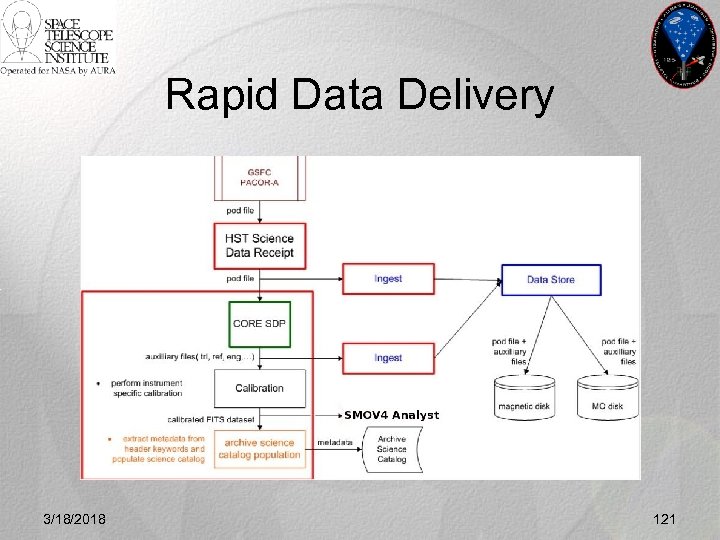
Rapid Data Delivery 3/18/2018 121
Rapid Data Delivery - 2 Proposals and visits requiring rapid turn around given fast track service – routinely identified via the SMOV 4 Proposal Implementation Team (PIT) – 14 ACS, 3 STIS, 2 NICMOS, 7 COS, and 4 WFC 3 – SM 4 functional test data also will be fasttracked 3/18/2018 122
Rapid Data Delivery - 3 Rapid delivery managed with existing DPAS procedure 11. 3. 3 & Fastrak tool • • PIs asked for destination directories for transfer tests in August ACS oscilloscope mode data requires special preparations – – Resource file overrides Transfer of ACS memory dumps successfully tested Oscilloscope tables test awaiting processing capability (PR 59821 in DMS 2008. 4) ITSD created a web interface to allow GSFC engineers to access the data PR 59582, Fastrak hangs when transferring more than 1 GB of data during session • Fix planned for DMS 2008. 4 3/18/2018 123
Pointing Adjustment Support Genslews allow small pointing adjustments of the telescope to correct for inaccuracies in assumed aperture positions • Ten SMOV 4 proposals requiring Genslews (One ACS and nine COS) identified via PIT • ACS coronographic apertures move • COS aperture locations may need adjustment from pre-launch measurements Genslew ops requests managed via existing DPAS procedure 11. 7. 9 3/18/2018 124
Activity Schedules Activity schedules for fast track and pointing adjustments are derived from mission schedule data delivered by SMSB. • Opus. Lib java tool automatically generates a table of times for pointing adjustments • Fast track dump times are determined manually from the RDO files Staff schedules will be adjusted if needed for critical events 3/18/2018 125
Staff SMOV 4 Schedules and Kepler Operations Readiness Test duties are split up among four DPAS personnel: • Forrest Hamilton, DMC Ops Lead, manages the test setup and execution, and provides HST trouble shooting • Deb Kenny and Gustavo Cardona will support the ORTs and SMOV 4 data processing operations • Tracy Ellis will support SMOV 4 and will support the ORTs if SMOV activities allow Only ORT-2 a is likely to occur during SMOV • This ORT will simulate a few days during commissioning • Impact upon SMOV activities should be small since this ORT will require the processing of only 6 Full Frame Images (FFIs) 3/18/2018 126
Data release policy implementation OPB has set initial proprietary period to one year for proposals using either new SIs or serviced modes • ERO and ERS data will remain proprietary until their press release • SMOV and calibration data for COS, WFC 3, and the serviced modes will remain proprietary until ERO press release 3/18/2018 127
Data release policy implementation - 2 Manual process for shortening release dates will continue • based on proposal ID, not visit or SI mode GO data taken with new SIs and with serviced modes will be embargoed • authorization to access data from proposal will be withheld until the PI agrees not to discuss or present the data publicly until after ERO press releases 3/18/2018 128
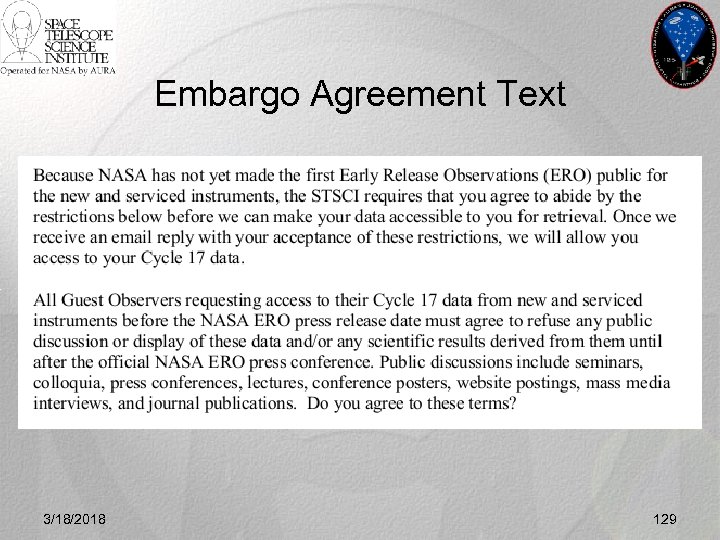
Embargo Agreement Text 3/18/2018 129
Metrics/completeness tracking tools Basic tracking tool recognizes COS & WFC 3 data • not thoroughly tested, but should be able to track whether all expected observations have been received and processed • supplies HSTMO metric pages HST Science Data Availability and HST Processing Status More detailed metrics tools and reports still in work and probably will not be ready at start of SMOV 4 3/18/2018 130
Anomaly resolution procedure Procedure 11. 10. 1, Response to Pipeline Processing Problems, will be followed 1. 2. 3. 4. 5. 3/18/2018 Investigate problem using process log files and trailer files as appropriate If symptoms are of a known problem with an existing workaround, execute the workaround. If the problem is known but no workaround exists, document the error and the dataset. Notify DSB of a previously unknown problem if error occurred in code DSB maintains Notify SSB and the SI team of a previously unknown problem which occurs during calibration 131
Infrastructure Contingency Planning Doris Mc. Clure IT Services Division 3/18/2018 132
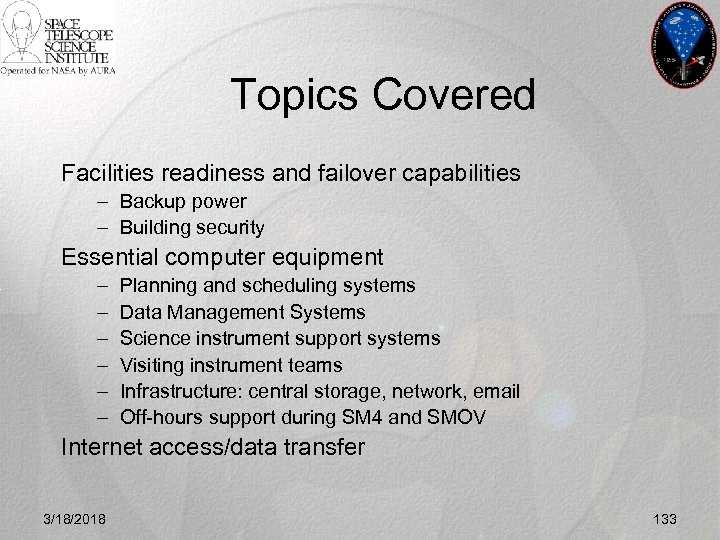
Topics Covered Facilities readiness and failover capabilities – Backup power – Building security Essential computer equipment – – – Planning and scheduling systems Data Management Systems Science instrument support systems Visiting instrument teams Infrastructure: central storage, network, email Off-hours support during SM 4 and SMOV Internet access/data transfer 3/18/2018 133
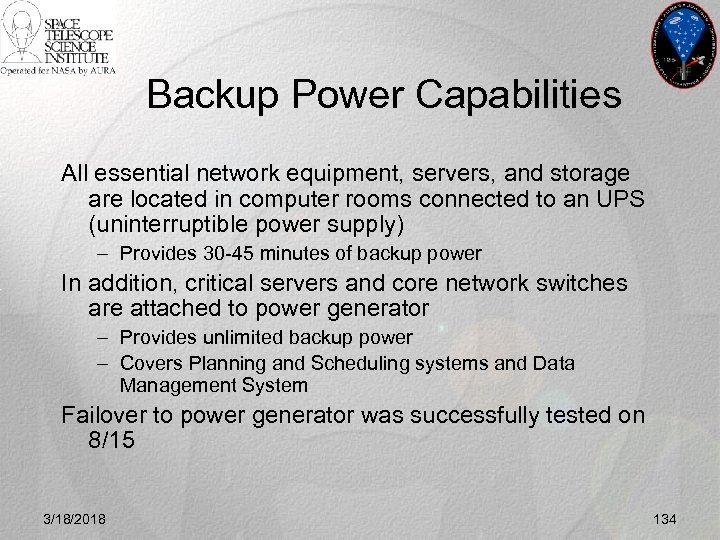
Backup Power Capabilities All essential network equipment, servers, and storage are located in computer rooms connected to an UPS (uninterruptible power supply) – Provides 30 -45 minutes of backup power In addition, critical servers and core network switches are attached to power generator – Provides unlimited backup power – Covers Planning and Scheduling systems and Data Management System Failover to power generator was successfully tested on 8/15 3/18/2018 134
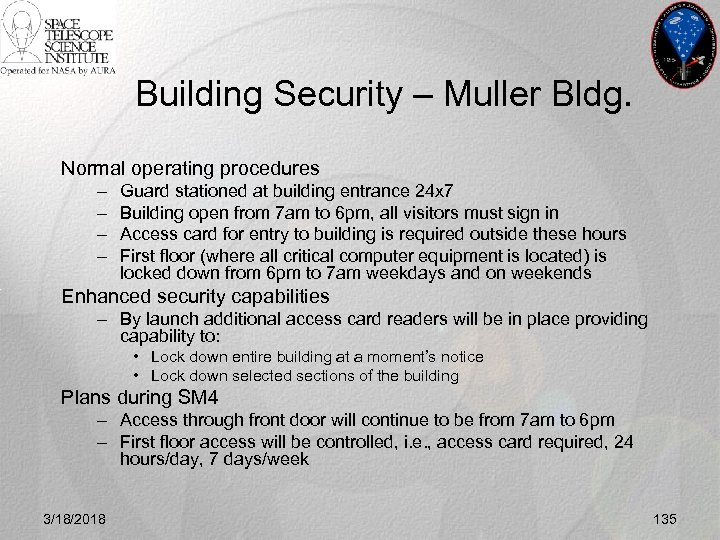
Building Security – Muller Bldg. Normal operating procedures – – Guard stationed at building entrance 24 x 7 Building open from 7 am to 6 pm, all visitors must sign in Access card for entry to building is required outside these hours First floor (where all critical computer equipment is located) is locked down from 6 pm to 7 am weekdays and on weekends Enhanced security capabilities – By launch additional access card readers will be in place providing capability to: • Lock down entire building at a moment’s notice • Lock down selected sections of the building Plans during SM 4 – Access through front door will continue to be from 7 am to 6 pm – First floor access will be controlled, i. e. , access card required, 24 hours/day, 7 days/week 3/18/2018 135
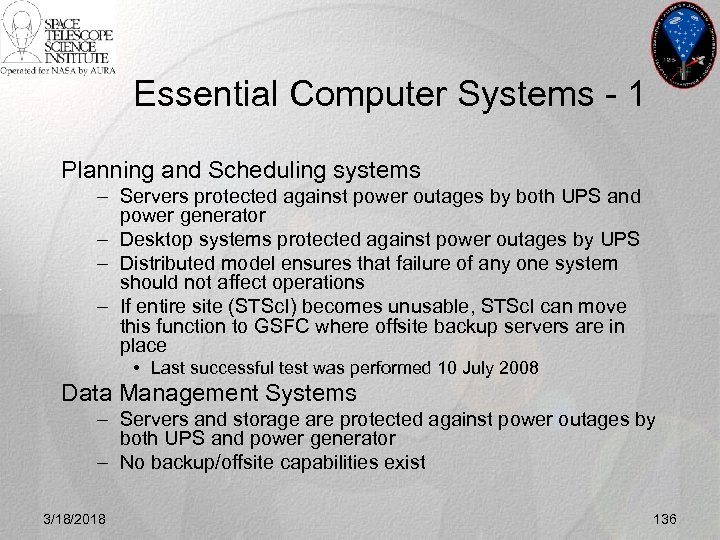
Essential Computer Systems - 1 Planning and Scheduling systems – Servers protected against power outages by both UPS and power generator – Desktop systems protected against power outages by UPS – Distributed model ensures that failure of any one system should not affect operations – If entire site (STSc. I) becomes unusable, STSc. I can move this function to GSFC where offsite backup servers are in place • Last successful test was performed 10 July 2008 Data Management Systems – Servers and storage are protected against power outages by both UPS and power generator – No backup/offsite capabilities exist 3/18/2018 136
Essential Computer Systems - 2 Science instrument support systems – Systems are primarily individual desktop/laptop systems – Protection against power failures • Systems in 4 th floor South offices are protected by UPS and power generator • Other offices are not protected • Alternative locations exist (e. g. Rm 111 “Fishbowl”) that are protected by UPS and power generator in the event of power failure Visiting instrument teams – Space set up in 135 and N 409 – Procedure in place to certify visitor systems prior to attaching them to the STSc. I network – No protection against power failure • Can use Rm 111 in the event of power failure 3/18/2018 137
Essential Computer Systems - 3 Network equipment and central storage system – Critical network equipment (core switches and routers) and the central storage system are protected against power failures by UPS and the power generator – Core switches and routers have failover capability to backup switch/router – Central storage system has new areas dedicated to SM 4/SMOV configured in highly available (RAID 6) configuration. Two disks can fail and the storage will continue to function. Email server – The email server is also connected to the UPS and generator – There is no backup server available, however alternatives will be in place: • Use of STSc. I Information Channel (SIC) via web • Contact list includes alternate email addresses for all essential staff 3/18/2018 138
Essential Computer Systems - 4 Off-hours support – On site support is provided from approximately 7 am to 6 pm, Monday through Friday – During mission, extra support will be on site as required for quick turn around items – On-call procedures in place for unanticipated failures of essential computer systems • ITSD management will be point of contact and on call 24 x 7 throughout SM 4 and SMOV • Essential IT personnel will be on call and will respond to emergencies 3/18/2018 139
Internet Access/Data Transfer Internet access is required to: – Send/receive all data between STSc. I and GSFC No backup capability exists at STSc. I Plans in event of unanticipated, extended failure – – Potential use of JHU network for certain data transfers Data from PACOR would need to be transferred via media (e. g. tape) Planning and Scheduling operations move to GSFC Science instrument support staff can go to GSFC • Laptops are certified and HSTnet ready • Offices at GSFC will be available through the end of January 2009 Plans to address outages – Scheduled outages: NISN sends notices of planned outages well in advance, usually 1 -2 weeks. If timing is bad, we will reschedule with GSFC/NISN. – Unscheduled outages: STSc. I will contact GSFC (Simrall) and/or NISN Help Desk in the event of an unplanned outage and work to resolve as quickly as possible. 3/18/2018 140
Скачать презентацию SM 4 Readiness Review Tuesday 9 September 2008
5e8c1c186938de985fb8338250a7455f.ppt