 Скачать презентацию SLR 2000 current status issues being worked
01b99542266e150b97b1f5b0c4a78a1f.ppt
- Количество слайдов: 9



SLR 2000: current status & issues being worked Jan Mc. Garry & Tom Zagwodzki Khz ranging session ILRS Workshop at Eastbourne October 2005
Progress since Workshop in June 2004 (glacial – but in a positive direction) Point-ahead of transmit using Risley Prisms: checked out and working. Transceiver transformations documented (Mc. Garry & Degnan, independently), verified, and parameters determined. New Sigma. Space Beam Expander and Iris are in the system, aligned and in the software. Both still need final checkout in the system. New photon-counting optical alignment technique using stars appears to do a better job of distributing light over the quadrants uniformly. Very important for closed-loop tracking. Replaced original detector with spare – appeared to have degraded. Started automated closed-loop tracking – some success – some problems. Work on SLR 2000 was extremely slow March – September 2005 due to work on Transponder experiments
Currently ongoing SLR 2000 work Sigma. Space is working on design to optically shutter the detector. We are working on technique to change laser PRF to prevent collisions between outgoing & incoming pulses. Currently we are just blanking electronically. We plan to purchase a higher QE 4 QMCP detector from Hamamatsu. We have analyzed the closed-loop tracking data and need to make some adjustments in the system. Future work SLR 2000 has been selected as primary ground station for LRO laser uplink. Will require the purchase of a higher energy 28 Hz laser.
Issues related to khz ranging Closed loop tracking: sometime it works and sometimes it doesn’t! - It is very important to get a uniform distribution of background noise across the four detectors and it is not easy. Probably need to use a software calibration of the quadrant levels to provide final correction. - Signal must be centered on quadrants when telescope is directly pointed at target. Degnan conjectures that point-ahead may be causing backscattered light to favor one quadrant over others. This does appear to be happening in some of the passes, but not in others. ? ? ? - We have a serious backscatter problem in SLR 2000 which is causing problems in a lot of areas, but especially in degradation of the detector and most likely also in the closed-loop tracking. We must drastically reduce the backscatter effects through optical blanking and by changing the laser PRF. Still not able to range to LAGEOS - Returns from all satellites are generally weaker than theoretical. - Until new beam expander, system wasn’t properly focused, beam divergence was unknown and not easily changed. This should improve performance.
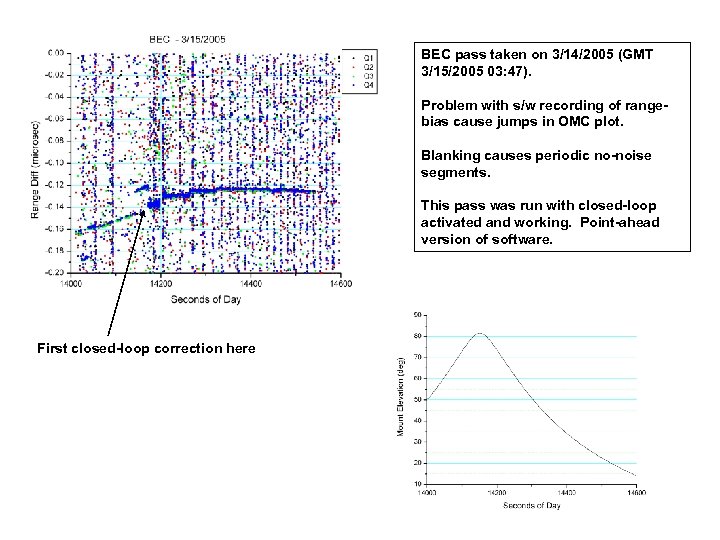
BEC pass taken on 3/14/2005 (GMT 3/15/2005 03: 47). Problem with s/w recording of rangebias cause jumps in OMC plot. Blanking causes periodic no-noise segments. This pass was run with closed-loop activated and working. Point-ahead version of software. First closed-loop correction here
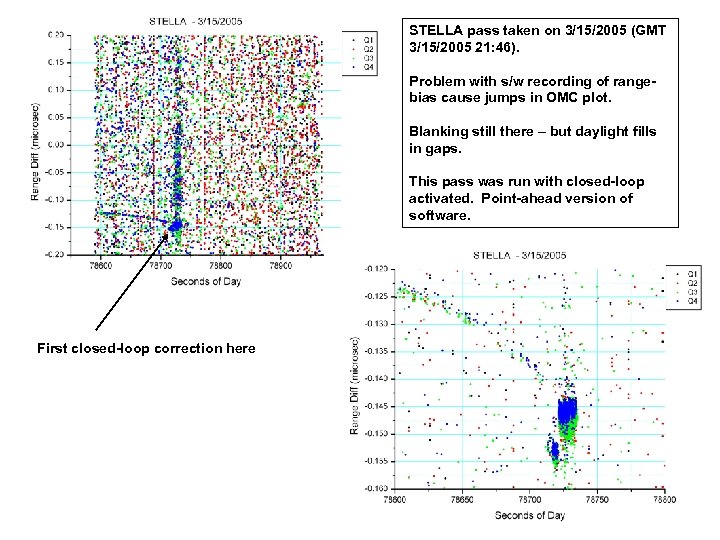
STELLA pass taken on 3/15/2005 (GMT 3/15/2005 21: 46). Problem with s/w recording of rangebias cause jumps in OMC plot. Blanking still there – but daylight fills in gaps. This pass was run with closed-loop activated. Point-ahead version of software. First closed-loop correction here
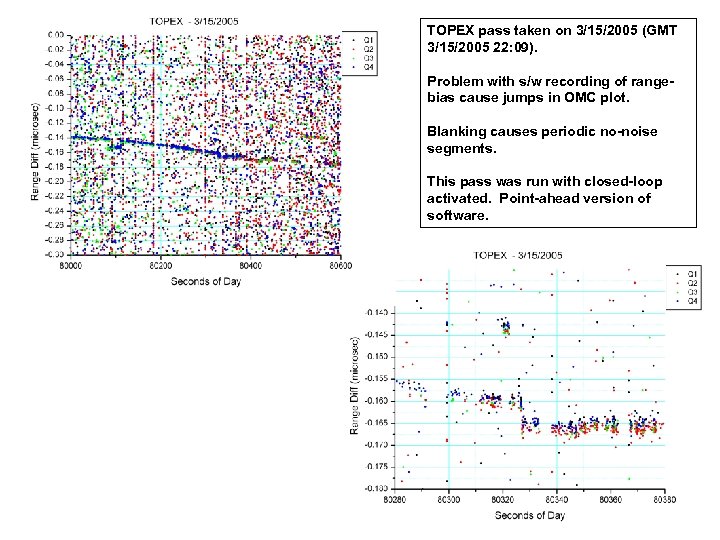
TOPEX pass taken on 3/15/2005 (GMT 3/15/2005 22: 09). Problem with s/w recording of rangebias cause jumps in OMC plot. Blanking causes periodic no-noise segments. This pass was run with closed-loop activated. Point-ahead version of software.
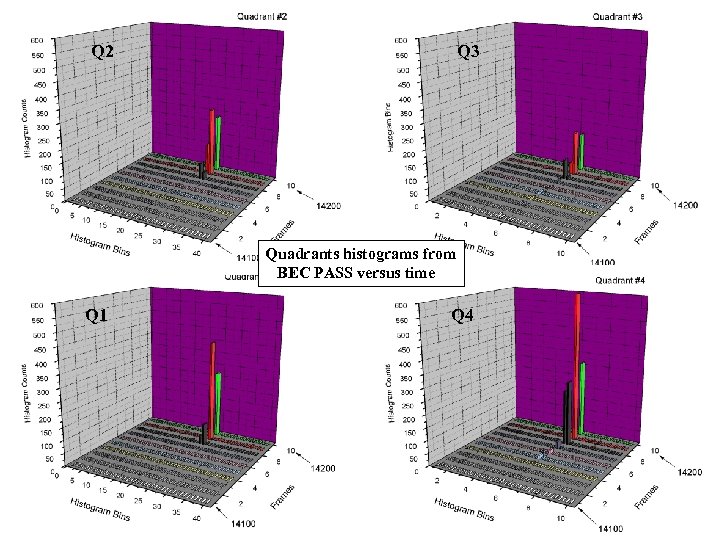
Q 2 Q 3 Quadrants histograms from BEC PASS versus time Q 1 Q 4
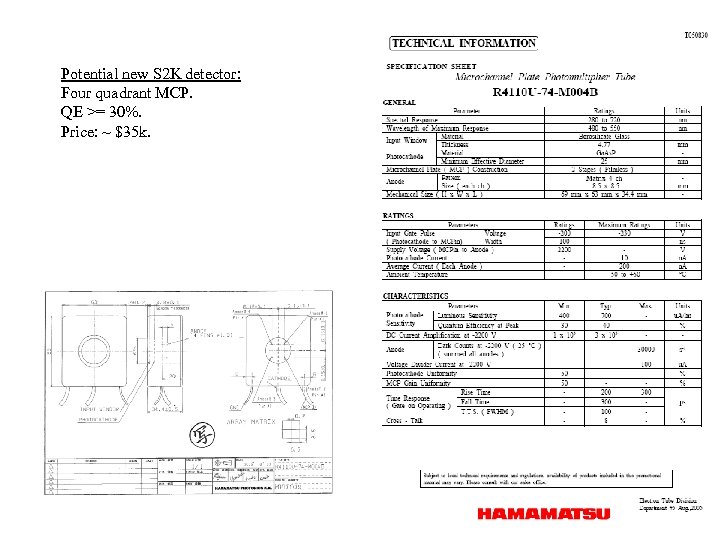
Potential new S 2 K detector: Four quadrant MCP. QE >= 30%. Price: ~ $35 k.
Скачать презентацию SLR 2000 current status issues being worked
01b99542266e150b97b1f5b0c4a78a1f.ppt