 Скачать презентацию Slides Handouts by Karen Clay Rhines Ph
8e6c51fe56a48ba8d5c349292991b220.ppt
- Количество слайдов: 61



Slides & Handouts by Karen Clay Rhines, Ph. D. Seton Hall University Chapter 3 Models of Abnormality Comer, Abnormal Psychology, 6 e – Chapter 3
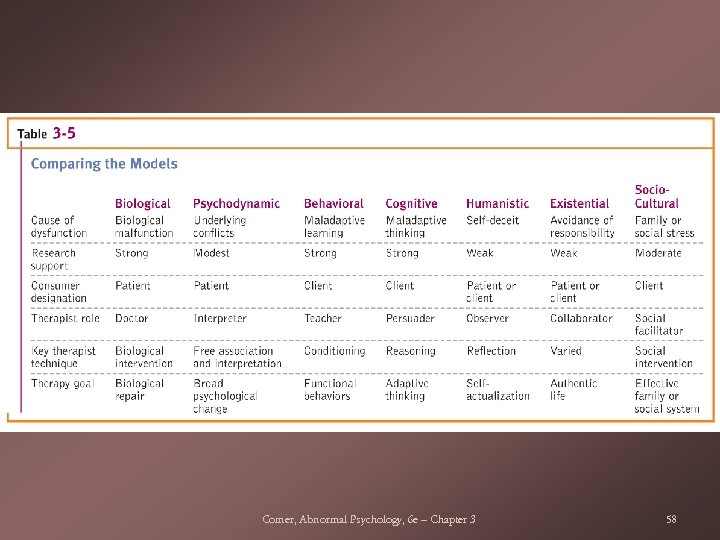
Models of Abnormality n In science, the perspectives used to explain phenomena are known as models or paradigms n Each provides a set of assumptions and concepts that help us explain and interpret observations n A school of thought n Helpful because they spell out basic assumptions and set guidelines for investigation n They influence what investigators observe, the questions they ask, the information they seek, and their interpretation of that information Comer, Abnormal Psychology, 6 e – Chapter 3 2
Models of Abnormality n Historically, clinical scientists of a given time and place agreed on a single model of abnormality – a model greatly influenced by cultural beliefs n Currently, there are several competing models of abnormality n Why? Each model focuses on one aspect of human functioning and no single model can explain all aspects of abnormality Comer, Abnormal Psychology, 6 e – Chapter 3 3
The Biological Model n Takes a medical perspective n Main focus is that psychological abnormality is an illness brought about by malfunctioning parts of the organism n Typically focused on the brain Comer, Abnormal Psychology, 6 e – Chapter 3 4
How Do Biological Theorists Explain Abnormal Behavior? n Brain anatomy n The brain is composed of ~100 billion nerve cells (called neurons) and thousands of billions of support cells (called glia) n Within the brain, large groups of neurons form distinct areas called brain regions Comer, Abnormal Psychology, 6 e – Chapter 3 5
How Do Biological Theorists Explain Abnormal Behavior? n Brain anatomy and abnormal behavior n Clinical researchers have found connections between certain psychological disorders and problems in specific brain areas n Example: Huntington’s disease & basal ganglia (forebrain) Comer, Abnormal Psychology, 6 e – Chapter 3 6
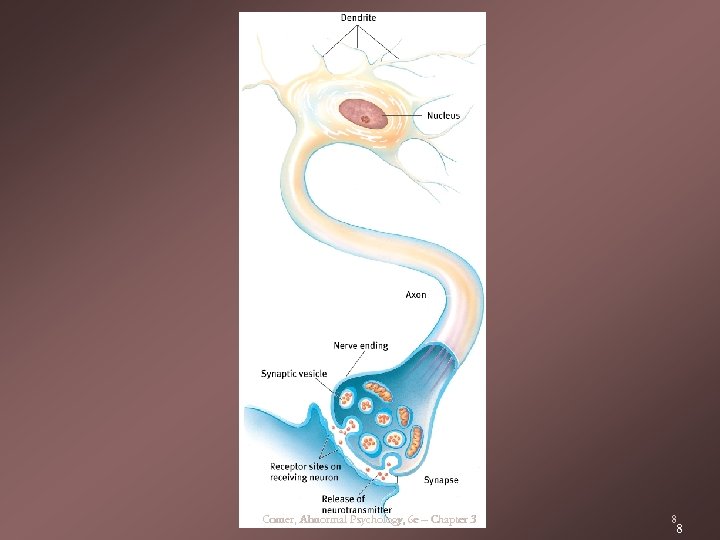
How Do Biological Theorists Explain Abnormal Behavior? n Brain chemistry n Information spreads throughout the brain in the form of electrical impulses that travel from one neuron to one (or more) other neurons n An impulse is first received at a neuron’s dendrites, travels down the axon, and is transmitted to other neurons through the nerve endings Comer, Abnormal Psychology, 6 e – Chapter 3 7
Comer, Abnormal Psychology, 6 e – Chapter 3 8 8
How Do Biological Theorists Explain Abnormal Behavior? n Brain chemistry n Neurons don’t touch; they are separated by a space (the synapse), across which a message moves n When an electrical impulse reaches a nerve ending, the nerve ending is stimulated to release a chemical called a neurotransmitter (NT) n Some NTs tell receiving neurons to “fire; ” other NTs tell receiving neurons to stop firing Comer, Abnormal Psychology, 6 e – Chapter 3 9
How Do Biological Theorists Explain Abnormal Behavior? n Brain chemistry n Researchers have identified dozens of NTs n Examples: serotonin, dopamine, and GABA n Studies indicate that abnormal activity in certain NTs can lead to specific mental disorders n Examples: depression (serotonin and norepinephrine) and anxiety (GABA) Comer, Abnormal Psychology, 6 e – Chapter 3 10
How Do Biological Theorists Explain Abnormal Behavior? n Brain chemistry n Additionally, researchers have learned that mental disorders are sometimes related to abnormal chemical activity in the endocrine system n Hormone release, triggered by a variety of factors, propels body organs into action. Abnormal secretions have been linked to psychological disorders n Example: cortisol release is related to anxiety and mood disorders Comer, Abnormal Psychology, 6 e – Chapter 3 11
How Do Biological Theorists Explain Abnormal Behavior? n Sources of biological abnormalities – Genetics n n Humans have 23 pairs of chromosomes, each with numerous genes that control the characteristics and traits a person inherits Studies suggest that inheritance plays a part in mood disorders, schizophrenia, mental retardation, Alzheimer’s disease, and other mental disorders n n Aren’t able (yet) to identify specific genes Don’t know the extent to which genetic factors contribute to disorders n Seems no SINGLE gene is responsible for a particular behavior or disorder Comer, Abnormal Psychology, 6 e – Chapter 3 12
How Do Biological Theorists Explain Abnormal Behavior? n Sources of biological abnormalities – Evolution n Genes that contribute to mental disorders are viewed as unfortunate occurrences: n n n May be mutations May be inherited after a mutation in the family line Evolutionary theorists argue that we can best understand abnormality by examining the millions of years of human evolution n n Looking at a combination of adaptive behaviors of the past, genes, and the interaction between genes and current environmental events This model has been criticized and remains controversial Comer, Abnormal Psychology, 6 e – Chapter 3 13
How Do Biological Theorists Explain Abnormal Behavior? n Sources of biological abnormalities – Viral infections n Infection provides another possible source of abnormal brain structure or biochemical dysfunction n Example: schizophrenia and prenatal viral exposure n Interest in viral explanations of psychological disorders has been growing in the past decade n Example: anxiety and mood disorders Comer, Abnormal Psychology, 6 e – Chapter 3 14
Biological Treatments n Biological practitioners attempt to pinpoint the physical source of dysfunction to determine the course of treatment n Three types of biological treatment: n Drug therapy n Electroconvulsive therapy (ECT) n Psychosurgery Comer, Abnormal Psychology, 6 e – Chapter 3 15
Biological Treatments n Drug therapy: n 1950 s = advent of psychotropic medications n Changed outlook for a number of mental disorders n Four groups of drugs: n Antianxiety drugs (anxiolytics; tranquilizers) n Antidepressant drugs n Antibipolar drugs (mood stabilizers) n Antipsychotic drugs Comer, Abnormal Psychology, 6 e – Chapter 3 16
Biological Treatments n Electroconvulsive therapy (ECT): n Currently experiencing a revival n Used for depression when drugs and otherapies have failed n In 60% of cases, ECT can lift symptoms within a few weeks Comer, Abnormal Psychology, 6 e – Chapter 3 17
Biological Treatments n Psychosurgery (or neurosurgery): n Historical roots in trephination n 1930 s = first lobotomy n Much more precise than in the past n Considered experimental and used only in extreme cases Comer, Abnormal Psychology, 6 e – Chapter 3 18
Assessing the Biological Model n Strengths: n n Enjoys considerable respect in the field n Weaknesses: Fruitful n Suggests new avenues of research Can limit rather than enhance our understanding n Too simplistic Creates new therapies n n n Evidence is incomplete or inconclusive n Treatments produce significant undesirable (negative) effects Comer, Abnormal Psychology, 6 e – Chapter 3 19
The Psychodynamic Model n n Oldest and most famous psychological model Based on belief that a person’s behavior (whether normal or abnormal) is determined largely by underlying dynamic psychological forces of which she or he is not aware n n Abnormal symptoms are the result of conflict among these forces Father of psychodynamic theory and psychoanalytic therapy: n Sigmund Freud (1856 – 1939) Comer, Abnormal Psychology, 6 e – Chapter 3 20
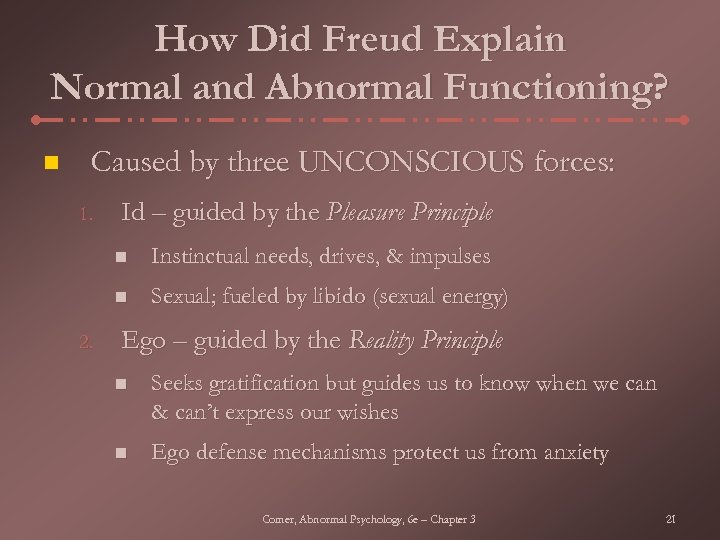
How Did Freud Explain Normal and Abnormal Functioning? n Caused by three UNCONSCIOUS forces: 1. Id – guided by the Pleasure Principle n n 2. Instinctual needs, drives, & impulses Sexual; fueled by libido (sexual energy) Ego – guided by the Reality Principle n Seeks gratification but guides us to know when we can & can’t express our wishes n Ego defense mechanisms protect us from anxiety Comer, Abnormal Psychology, 6 e – Chapter 3 21
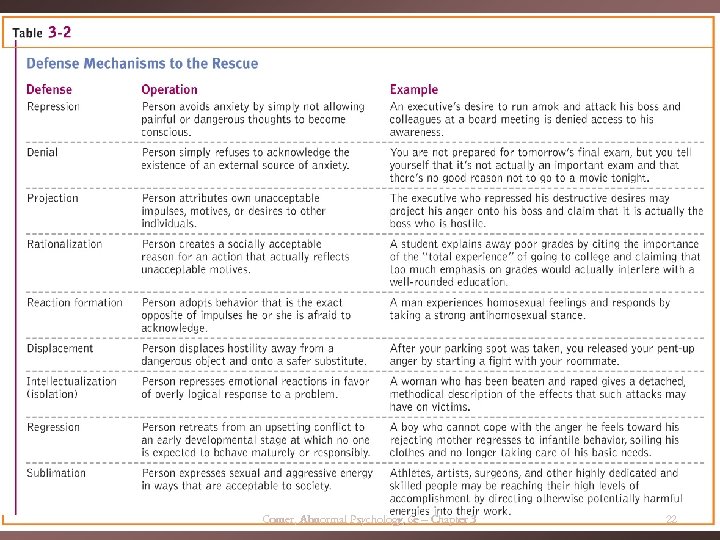
Comer, Abnormal Psychology, 6 e – Chapter 3 22
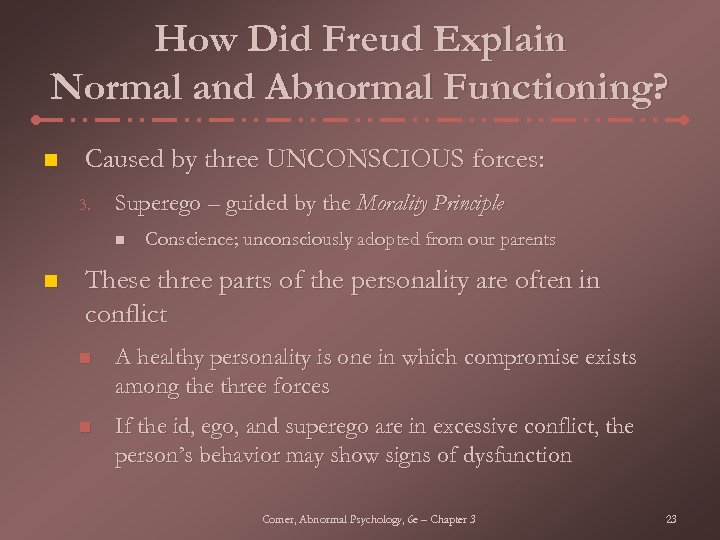
How Did Freud Explain Normal and Abnormal Functioning? n Caused by three UNCONSCIOUS forces: 3. Superego – guided by the Morality Principle n n Conscience; unconsciously adopted from our parents These three parts of the personality are often in conflict n A healthy personality is one in which compromise exists among the three forces n If the id, ego, and superego are in excessive conflict, the person’s behavior may show signs of dysfunction Comer, Abnormal Psychology, 6 e – Chapter 3 23
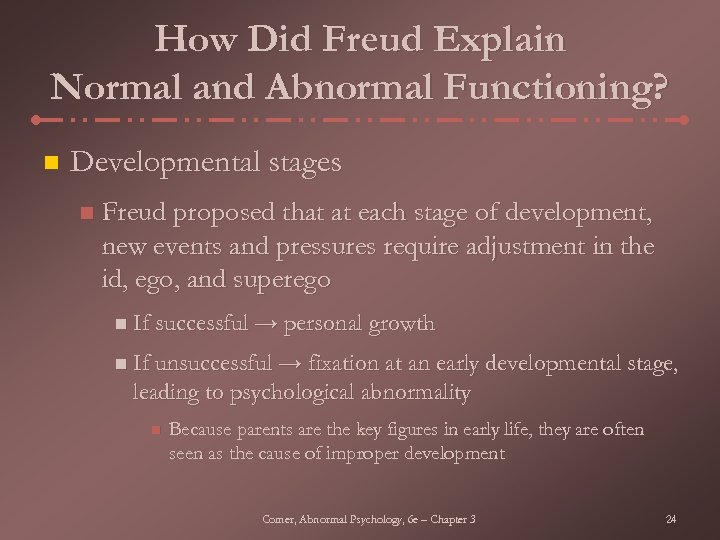
How Did Freud Explain Normal and Abnormal Functioning? n Developmental stages n Freud proposed that at each stage of development, new events and pressures require adjustment in the id, ego, and superego n If successful → personal growth n If unsuccessful → fixation at an early developmental stage, leading to psychological abnormality n Because parents are the key figures in early life, they are often seen as the cause of improper development Comer, Abnormal Psychology, 6 e – Chapter 3 24
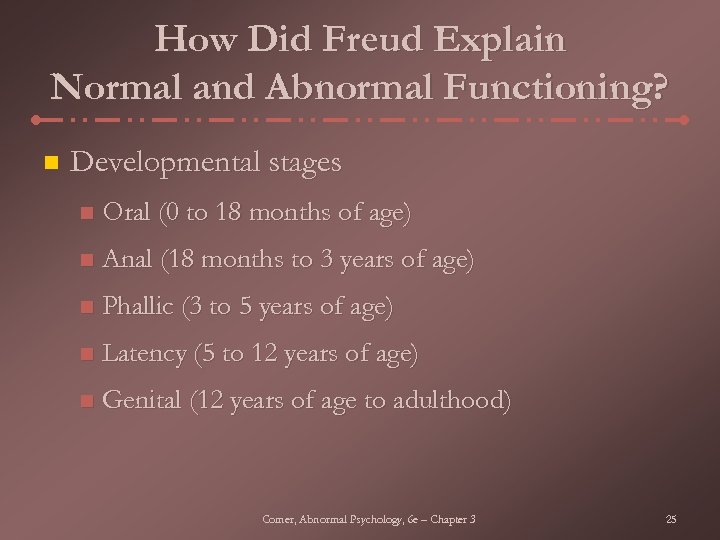
How Did Freud Explain Normal and Abnormal Functioning? n Developmental stages n Oral (0 to 18 months of age) n Anal (18 months to 3 years of age) n Phallic (3 to 5 years of age) n Latency (5 to 12 years of age) n Genital (12 years of age to adulthood) Comer, Abnormal Psychology, 6 e – Chapter 3 25
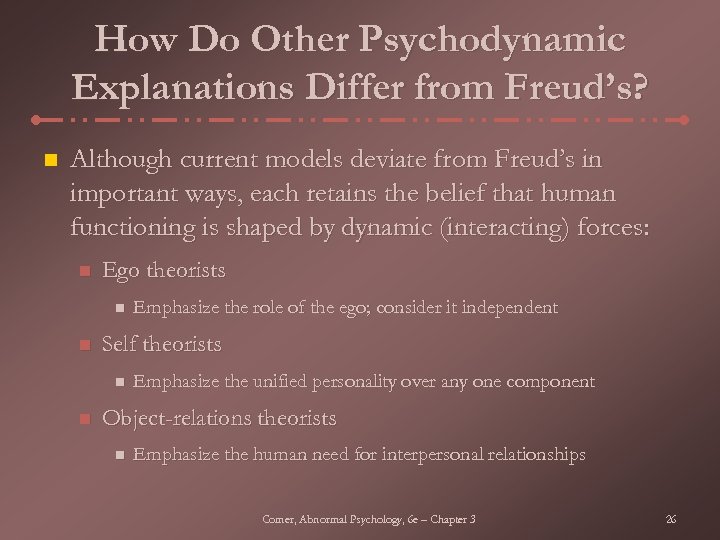
How Do Other Psychodynamic Explanations Differ from Freud’s? n Although current models deviate from Freud’s in important ways, each retains the belief that human functioning is shaped by dynamic (interacting) forces: n Ego theorists n n Self theorists n n Emphasize the role of the ego; consider it independent Emphasize the unified personality over any one component Object-relations theorists n Emphasize the human need for interpersonal relationships Comer, Abnormal Psychology, 6 e – Chapter 3 26
Psychodynamic Therapies n Range from Freudian psychoanalysis to more modern therapies n All seek to uncover past trauma and inner conflicts n n Understanding early life experience critically important Therapist acts as “subtle guide” Comer, Abnormal Psychology, 6 e – Chapter 3 27
Psychodynamic Therapies n Utilize various techniques: n Free association n Therapist interpretation n Resistance n Transference n Dream interpretation n Catharsis n Working through Comer, Abnormal Psychology, 6 e – Chapter 3 28
Psychodynamic Therapies n Contemporary trends: n Short-term psychodynamic therapies n Relational psychoanalytic therapy Comer, Abnormal Psychology, 6 e – Chapter 3 29
Assessing the Psychodynamic Model n Strengths: n n First to recognize importance of psychological theories & treatment n Saw internal conflict as important source of psychological health and abnormality n Weaknesses: n Unsupported ideas; difficult to research n Non-observable n Inaccessible to human subject (unconscious) First to apply theory and techniques systematically to treatment – monumental impact on the field Comer, Abnormal Psychology, 6 e – Chapter 3 30
The Behavioral Model n Like the psychodynamic perspective, behaviorism is deterministic, and is based on the idea that our actions are determined largely by our life experiences n Emphasizes observable behavior and environmental factors n Focuses on how behavior is acquired (learned) and maintained over time Comer, Abnormal Psychology, 6 e – Chapter 3 31
The Behavioral Model n Historical beginnings in laboratories where conditioning studies were conducted n Several forms of conditioning: n Operant conditioning n Modeling n Classical conditioning n May produce normal or abnormal behavior Comer, Abnormal Psychology, 6 e – Chapter 3 32
How Do Behaviorists Explain Abnormal Functioning? n Operant conditioning n Organism “operates” on environment and produces an effect n Humans and animals learn to behave in certain ways as a result of receiving rewards whenever they do so Comer, Abnormal Psychology, 6 e – Chapter 3 33
How Do Behaviorists Explain Abnormal Functioning? n Modeling n Individuals learn behavioral responses by observing and repeating behavior n No direct reinforcement Comer, Abnormal Psychology, 6 e – Chapter 3 34
How Do Behaviorists Explain Abnormal Functioning? n Classical conditioning n Learning by temporal association n When two events repeatedly occur close together in time, they become fused in a person’s mind; before long, the person responds in the same way to both events n Father of classical conditioning: Ivan Pavlov (1849 – 1936) n Classic study using dogs & meat powder Comer, Abnormal Psychology, 6 e – Chapter 3 35
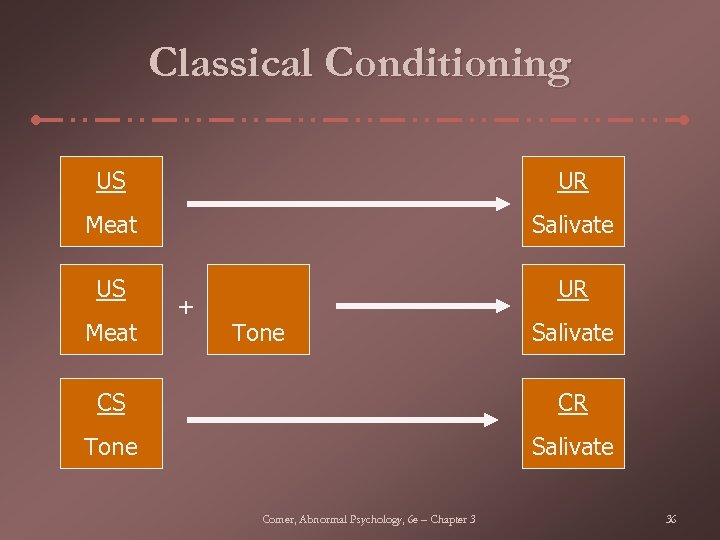
Classical Conditioning US UR Meat Salivate US UR Meat + Tone Salivate CS CR Tone Salivate Comer, Abnormal Psychology, 6 e – Chapter 3 36
How Do Behaviorists Explain Abnormal Functioning? n Classical conditioning n If, after conditioning, the CS is repeatedly presented alone, it will eventually stop eliciting the CR n This process is called extinction n Explains many familiar behaviors (both normal and abnormal) Comer, Abnormal Psychology, 6 e – Chapter 3 37
Behavioral Therapies n Aim is to identify the behaviors that are causing problems and replace them with more appropriate ones n n May use classical conditioning, operant conditioning, or modeling Therapist is “teacher” rather than healer n Early life experiences important only in providing clues to current learning Comer, Abnormal Psychology, 6 e – Chapter 3 38
Behavioral Therapies n Classical conditioning treatments may be used to change abnormal reactions to particular stimuli n Example: systematic desensitization for phobia n Step-by-step procedure n Learn relaxation skills n Develop a fear hierarchy n Confront feared situations (covertly or in vivo) Comer, Abnormal Psychology, 6 e – Chapter 3 39
Assessing the Behavioral Model n Strengths: n Weaknesses: n Powerful force in the field n Too simplistic n Rooted in empiricism n Unrealistic n Downplays role of cognition n n Phenomena can be observed and measured Significant research support for behavioral therapies n New focus on self-efficacy, social cognition, and cognitive-behavioral theories Comer, Abnormal Psychology, 6 e – Chapter 3 40
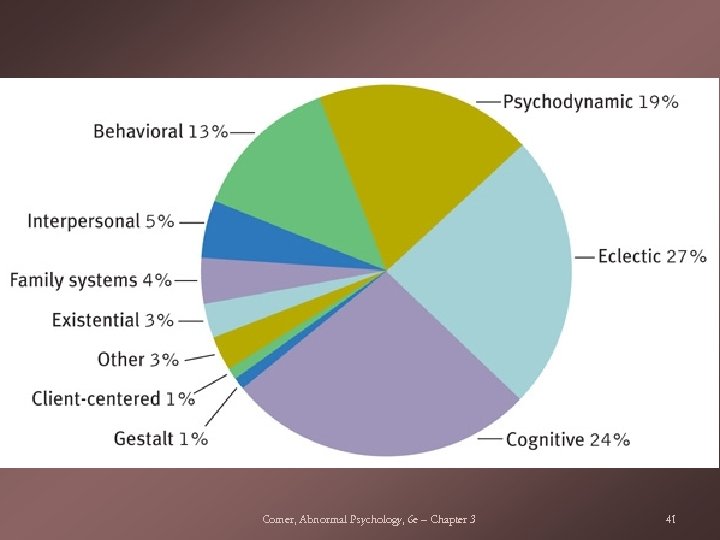
Comer, Abnormal Psychology, 6 e – Chapter 3 41
The Cognitive Model n Seeks to account for behavior by studying the ways in which the person attends to, interprets, and uses available information n Argues that clinicians must ask questions about assumptions, attitudes, and thoughts of a client n Concerned with internal processes n Present-focused Comer, Abnormal Psychology, 6 e – Chapter 3 42
How Do Cognitive Theorists Explain Abnormal Functioning? n Maladaptive thinking is the cause of maladaptive behavior n Several kinds of faulty thinking: n Faulty assumptions and attitudes n Illogical thinking processes n Example: overgeneralization Comer, Abnormal Psychology, 6 e – Chapter 3 43
Cognitive Therapies n People must be taught a new way of thinking to prevent maladaptive behavior n Main model: Beck’s Cognitive Therapy n The goal of therapy is to help clients recognize and restructure their thinking n Therapists also guide clients to challenge dysfunctional thoughts, try out new interpretations, and apply new ways of thinking in their daily lives n Widely used in treating depression Comer, Abnormal Psychology, 6 e – Chapter 3 44
Assessing the Cognitive Model n Strengths: n n Very broad appeal n Clinically useful & effective n Focuses on a uniquely human process n n n Singular, narrow focus n Overemphasis on the present Correlation between symptoms and maladaptive cognition n Limited effectiveness Therapies effective in treating several disorders n Verification of cognition is difficult n n Weaknesses: Adapt well to technology Research-based n Precise role is hard to determine Comer, Abnormal Psychology, 6 e – Chapter 3 45
The Humanistic-Existential Model n Combination model n The humanist view n Emphasis on people as friendly, cooperative, and constructive; focus on drive to self-actualization n The existentialist view n Emphasis on self-determination, choice, and individual responsibility; focus on authenticity Comer, Abnormal Psychology, 6 e – Chapter 3 46
Rogers’ Humanistic Theory and Therapy n Basic human need for unconditional positive regard n If received, leads to unconditional self-regard n If not, leads to “conditions of worth” n n Incapable of self-actualization because of distortion – don’t know what they really need, etc. Rogers’ “client-centered” therapy n Therapist provides unconditional positive regard n Both accurate & genuine in reflection (reflective listening) n Focus on the “experiencing person” n Little research support Comer, Abnormal Psychology, 6 e – Chapter 3 47
Gestalt Theory and Therapy n Humanistic approach n Developed by Fritz Perls n Goal is to help clients achieve self-recognition through challenge and frustration n Techniques: n Skillful frustration n Role playing n Rules, including “Here and Now” and “I” language Comer, Abnormal Psychology, 6 e – Chapter 3 48
Existential Theories and Therapy n Psychological dysfunction is caused by selfdeception: people hide from life’s responsibilities and fail to recognize that it is up to them to give meaning to their lives n Therapy is focused on patient acceptance of personal responsibility and recognition of freedom of action n Goals more important than technique n Great emphasis placed on client-therapist relationship Comer, Abnormal Psychology, 6 e – Chapter 3 49
Assessing the Humanistic. Existential Model n Strengths: n n Emphasizes the individual n Taps into domains missing from other theories n Non-deterministic n Optimistic n Weaknesses: n Focuses on abstract issues n Difficult to research n Not much influence n Weakened by disapproval of scientific approach Emphasizes health n Changing somewhat Comer, Abnormal Psychology, 6 e – Chapter 3 50
The Sociocultural Model n Argues that abnormal behavior is best understood in light of the social and cultural forces that influence an individual n Addresses norms and roles in society n Influenced by sociology and anthropology n Argues that we must examine a person’s social surroundings to understand their (abnormal) behavior Comer, Abnormal Psychology, 6 e – Chapter 3 51
How Do Sociocultural Theorists Explain Abnormal Functioning? n Focus on: n Societal labels & roles n Diagnostic labels (example: Rosenhan study) n Sick role n Social networks and support Comer, Abnormal Psychology, 6 e – Chapter 3 52
How Do Sociocultural Theorists Explain Abnormal Functioning? n Focus on: n Family structure and communication n Family systems theory = abnormal functioning within family leads to abnormal behavior (insane behavior becomes sane in an insane environment) n Examples: enmeshed, disengaged structures Comer, Abnormal Psychology, 6 e – Chapter 3 53
How Do Sociocultural Theorists Explain Abnormal Functioning? n Focus on: n Culture n Set of values, attitudes, beliefs, history, and behaviors shared by a group of people and communicated from one generation to the next n “Multicultural” psychology is a growing field of study Comer, Abnormal Psychology, 6 e – Chapter 3 54
How Do Sociocultural Theorists Explain Abnormal Functioning? n Focus on: n Religion and spirituality n For most of the twentieth century, clinical scientists viewed religion as a negative factor in mental health but this alienation now seems to be ending: n Researchers have begun to systematically study the influence of religion and spirituality on mental health n Many therapists now address spiritual issues when treating religious clients Comer, Abnormal Psychology, 6 e – Chapter 3 55

Sociocultural Treatments n May include traditional individual therapy n Broadened therapy to include: n Culturally sensitive therapy n Group therapy n Family therapy n Couple therapy n Community treatment n Includes prevention work Comer, Abnormal Psychology, 6 e – Chapter 3 56
Assessing the Sociocultural Model n Strengths: n Added greatly to the clinical understanding of abnormality n n n Increased awareness of labeling Clinically successful when other treatments have failed Weaknesses: n Research is difficult to interpret n n Correlation causation Model unable to predict abnormality in specific individuals Comer, Abnormal Psychology, 6 e – Chapter 3 57
Comer, Abnormal Psychology, 6 e – Chapter 3 58
Integration of the Models n Each perspective is valuable to understanding abnormal behavior n Different perspectives are more appropriate under differing conditions n An integrative approach provides a general framework for thinking about abnormal behavior, and also allows for specification of the factors that are especially pertinent to particular disorders Comer, Abnormal Psychology, 6 e – Chapter 3 59
Integration of the Models n Many theorists, clinicians, and practitioners adhere to a biopsychosocial model n n Abnormality results from the interaction of genetic, biological, developmental, emotional, behavioral, cognitive, social, and societal influences Also popular: n Diathesis-stress approach n n Diathesis = predisposition (bio, psycho, or social) Reciprocal effects explanation Comer, Abnormal Psychology, 6 e – Chapter 3 60
Integration of the Models n Integrative therapists are often called “eclectic” – taking the strengths from each model and using them in combination Comer, Abnormal Psychology, 6 e – Chapter 3 61
Скачать презентацию Slides Handouts by Karen Clay Rhines Ph
8e6c51fe56a48ba8d5c349292991b220.ppt