 Скачать презентацию Slides available at http sequoia continuent org Resources Postgre
a094ed45b466287b6924112dab4ffa44.ppt
- Количество слайдов: 47



Slides available at http: //sequoia. continuent. org/Resources Postgre. SQL replication strategies Understanding High Availability and choosing the right solution emmanuel. cecchet@continuent. com emmanuel. cecchet@epfl. ch © Continuent 3/19/2018
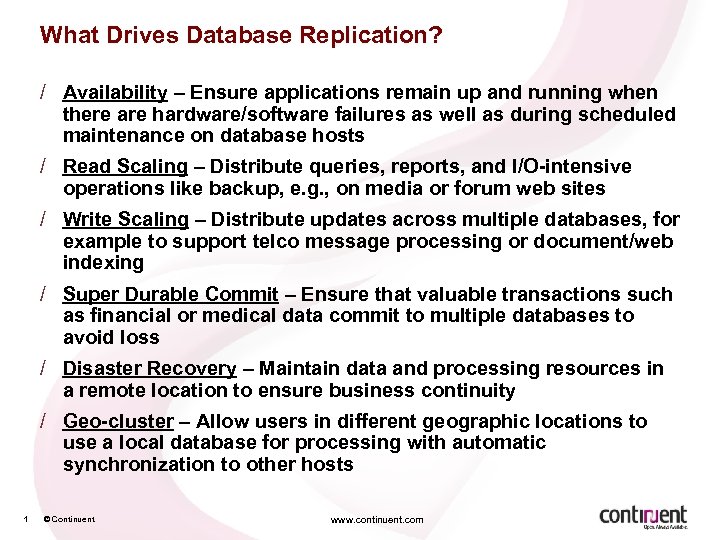
What Drives Database Replication? / Availability – Ensure applications remain up and running when there are hardware/software failures as well as during scheduled maintenance on database hosts / Read Scaling – Distribute queries, reports, and I/O-intensive operations like backup, e. g. , on media or forum web sites / Write Scaling – Distribute updates across multiple databases, for example to support telco message processing or document/web indexing / Super Durable Commit – Ensure that valuable transactions such as financial or medical data commit to multiple databases to avoid loss / Disaster Recovery – Maintain data and processing resources in a remote location to ensure business continuity / Geo-cluster – Allow users in different geographic locations to use a local database for processing with automatic synchronization to other hosts 1 © Continuent www. continuent. com
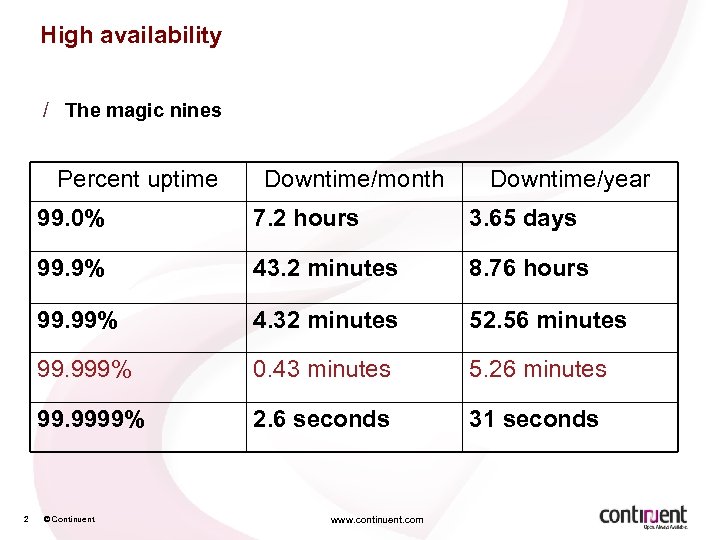
High availability / The magic nines Percent uptime Downtime/month Downtime/year 99. 0% 3. 65 days 99. 9% 43. 2 minutes 8. 76 hours 99. 99% 4. 32 minutes 52. 56 minutes 99. 999% 0. 43 minutes 5. 26 minutes 99. 9999% 2 7. 2 hours 2. 6 seconds 31 seconds © Continuent www. continuent. com
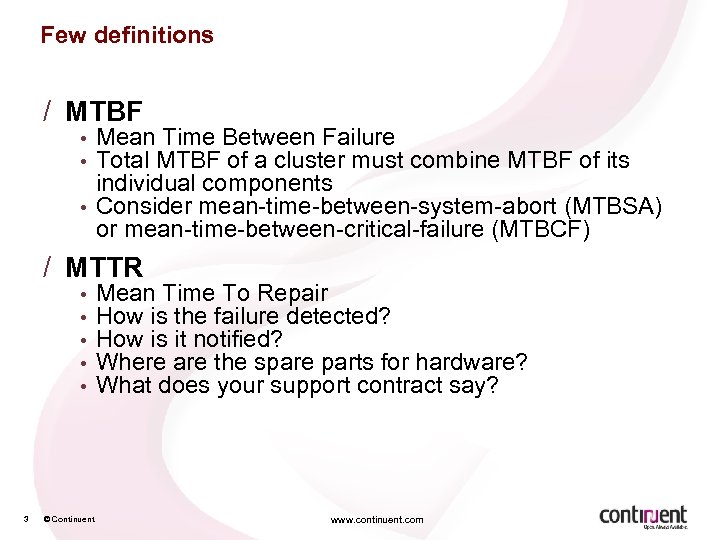
Few definitions / MTBF • • • Mean Time Between Failure Total MTBF of a cluster must combine MTBF of its individual components Consider mean-time-between-system-abort (MTBSA) or mean-time-between-critical-failure (MTBCF) / MTTR • • • 3 © Continuent Mean Time To Repair How is the failure detected? How is it notified? Where are the spare parts for hardware? What does your support contract say? www. continuent. com
Outline / Database replication strategies / Postgre. SQL replication solutions / Building HA solutions / Management issues in production 4 © Continuent www. continuent. com
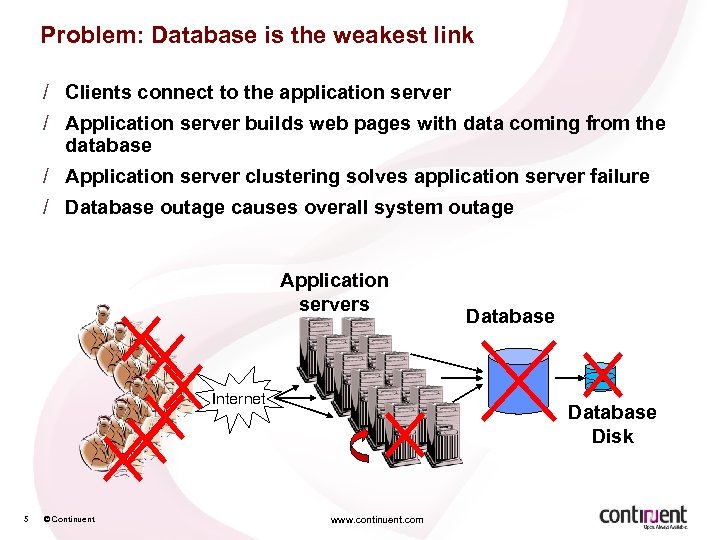
Problem: Database is the weakest link / Clients connect to the application server / Application server builds web pages with data coming from the database / Application server clustering solves application server failure / Database outage causes overall system outage Application servers Internet 5 © Continuent Database Disk www. continuent. com
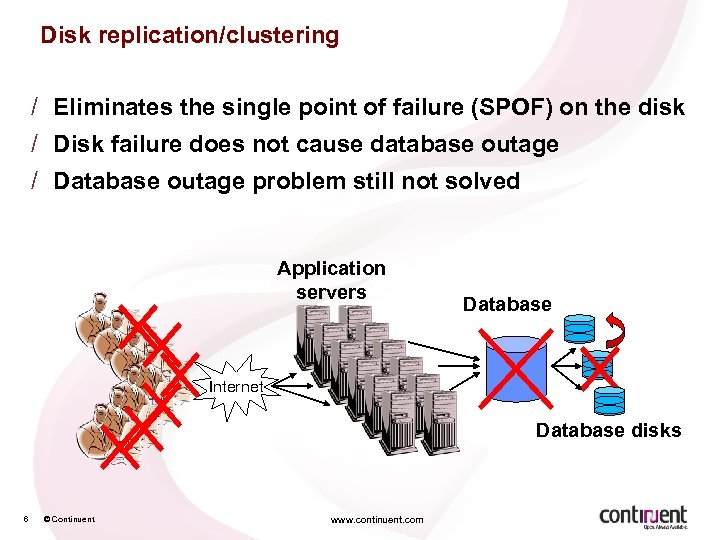
Disk replication/clustering / Eliminates the single point of failure (SPOF) on the disk / Disk failure does not cause database outage / Database outage problem still not solved Application servers Database Internet Database disks 6 © Continuent www. continuent. com
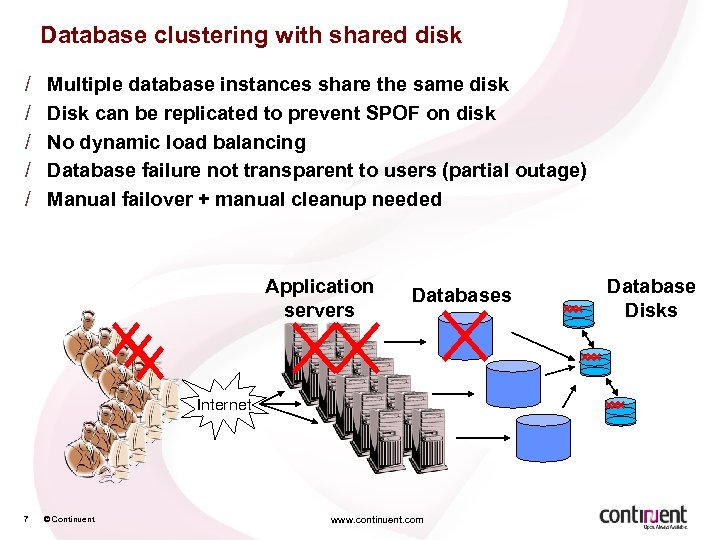
Database clustering with shared disk / / / Multiple database instances share the same disk Disk can be replicated to prevent SPOF on disk No dynamic load balancing Database failure not transparent to users (partial outage) Manual failover + manual cleanup needed Application servers Databases Internet 7 © Continuent www. continuent. com Database Disks
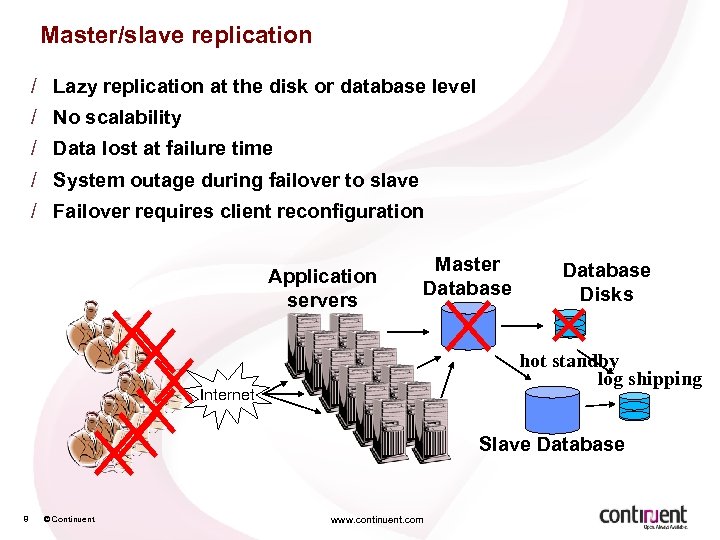
Master/slave replication / Lazy replication at the disk or database level / No scalability / Data lost at failure time / System outage during failover to slave / Failover requires client reconfiguration Application servers Master Database Disks hot standby log shipping Internet Slave Database 8 © Continuent www. continuent. com
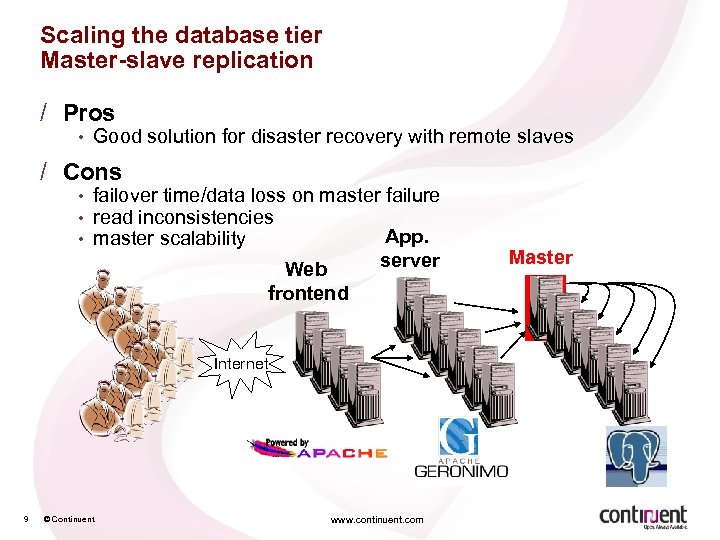
Scaling the database tier Master-slave replication / Pros • Good solution for disaster recovery with remote slaves / Cons • • • failover time/data loss on master failure read inconsistencies App. master scalability server Web frontend Internet 9 © Continuent www. continuent. com Master
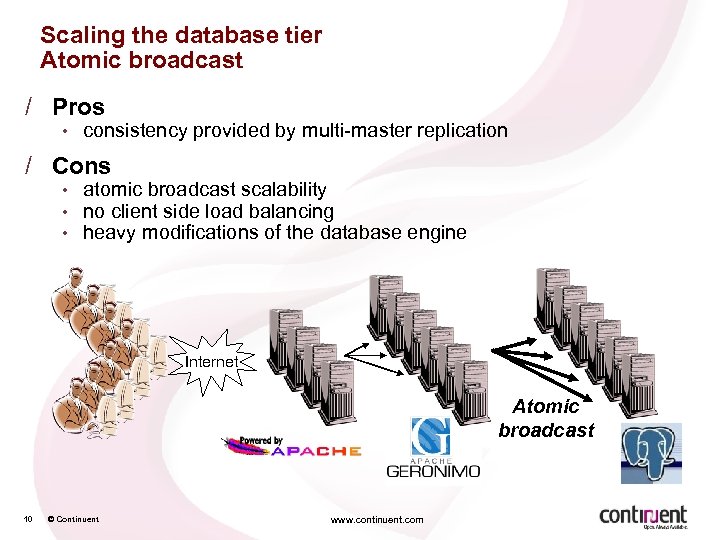
Scaling the database tier Atomic broadcast / Pros • consistency provided by multi-master replication / Cons • • • atomic broadcast scalability no client side load balancing heavy modifications of the database engine Internet Atomic broadcast 10 © Continuent www. continuent. com
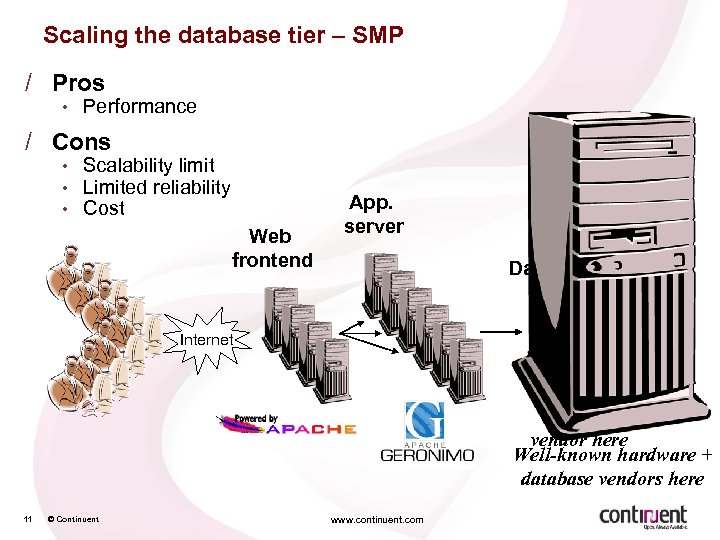
Scaling the database tier – SMP / Pros • Performance / Cons • • • Scalability limit Limited reliability Cost Web frontend App. server Database Internet Well-known database vendor here Well-known hardware + database vendors here 11 © Continuent www. continuent. com
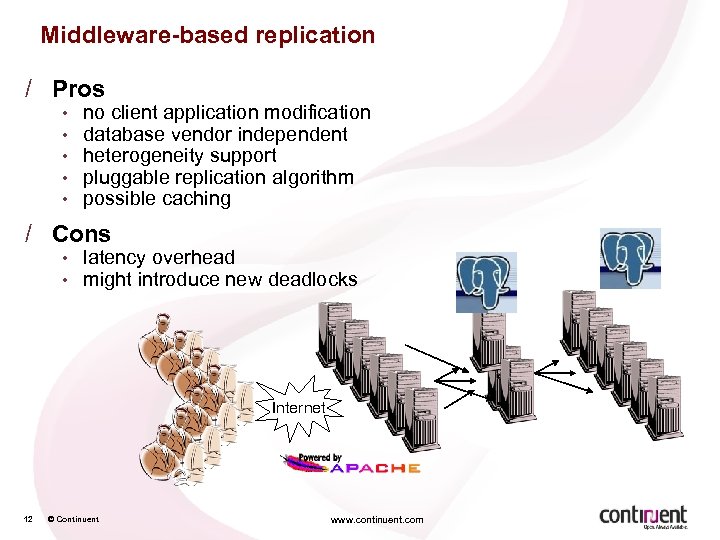
Middleware-based replication / Pros • • • no client application modification database vendor independent heterogeneity support pluggable replication algorithm possible caching / Cons • • latency overhead might introduce new deadlocks Internet 12 © Continuent www. continuent. com
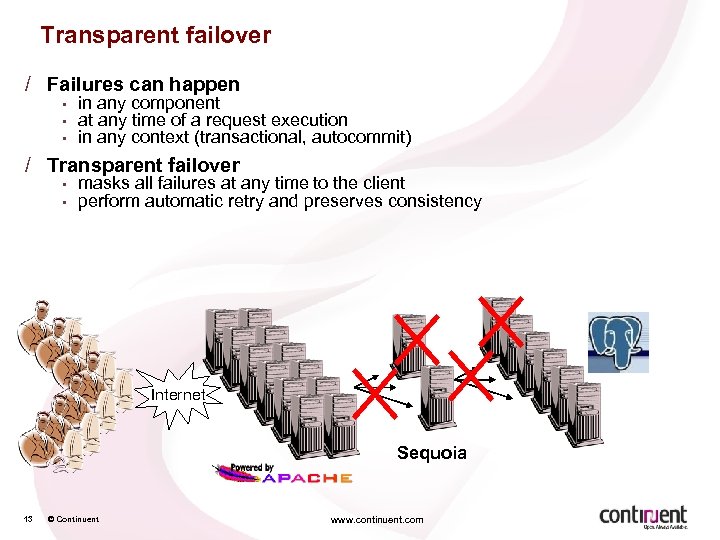
Transparent failover / Failures can happen • • • in any component at any time of a request execution in any context (transactional, autocommit) / Transparent failover • • masks all failures at any time to the client perform automatic retry and preserves consistency Internet Sequoia 13 © Continuent www. continuent. com
Outline / Database replication strategies / Postgre. SQL replication solutions / Building HA solutions / Management issues in production 14 © Continuent www. continuent. com
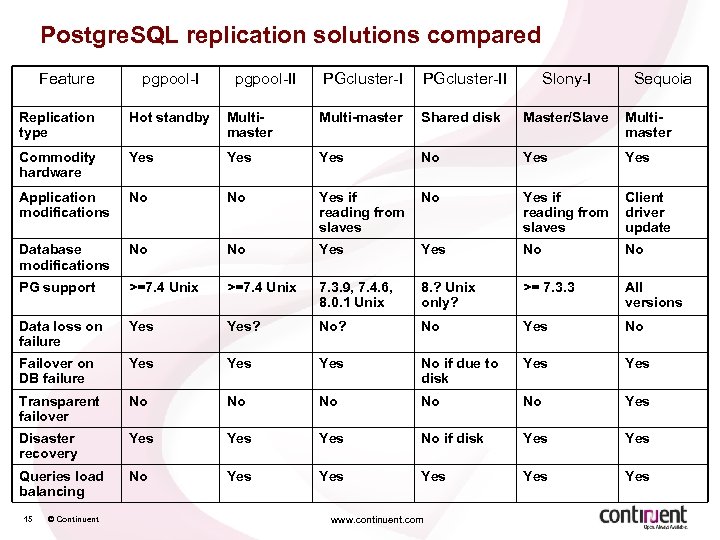
Postgre. SQL replication solutions compared Feature pgpool-II PGcluster-II Slony-I Sequoia Replication type Hot standby Multimaster Multi-master Shared disk Master/Slave Multimaster Commodity hardware Yes Yes No Yes Application modifications No No Yes if reading from slaves Client driver update Database modifications No No Yes No No PG support >=7. 4 Unix 7. 3. 9, 7. 4. 6, 8. 0. 1 Unix 8. ? Unix only? >= 7. 3. 3 All versions Data loss on failure Yes? No Yes No Failover on DB failure Yes Yes No if due to disk Yes Transparent failover No No No Yes Disaster recovery Yes Yes No if disk Yes Queries load balancing No Yes Yes Yes 15 © Continuent www. continuent. com
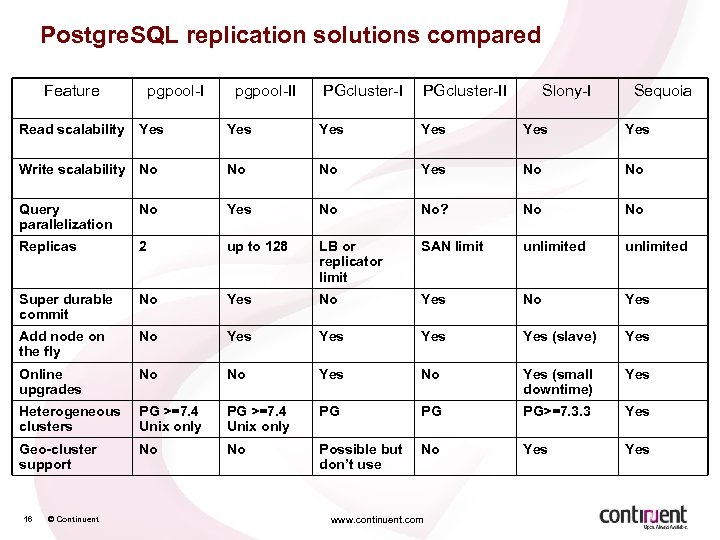
Postgre. SQL replication solutions compared Feature PGcluster-II Yes Yes Yes Write scalability No No No Yes No No Query parallelization No Yes No No? No No Replicas 2 up to 128 LB or replicator limit SAN limit unlimited Super durable commit No Yes Add node on the fly No Yes Yes (slave) Yes Online upgrades No No Yes (small downtime) Yes Heterogeneous clusters PG >=7. 4 Unix only PG PG PG>=7. 3. 3 Yes Geo-cluster support No No Possible but don’t use No Yes Read scalability 16 © Continuent pgpool-I Yes pgpool-II www. continuent. com Slony-I Sequoia
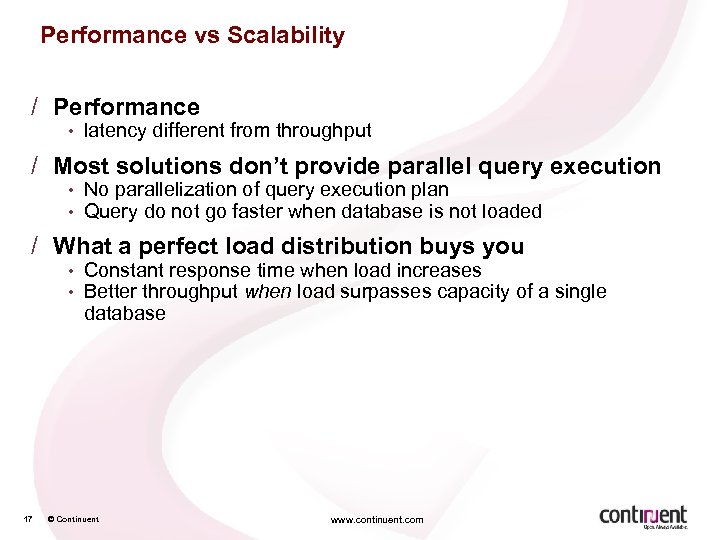
Performance vs Scalability / Performance • latency different from throughput / Most solutions don’t provide parallel query execution • • No parallelization of query execution plan Query do not go faster when database is not loaded / What a perfect load distribution buys you • • 17 Constant response time when load increases Better throughput when load surpasses capacity of a single database © Continuent www. continuent. com
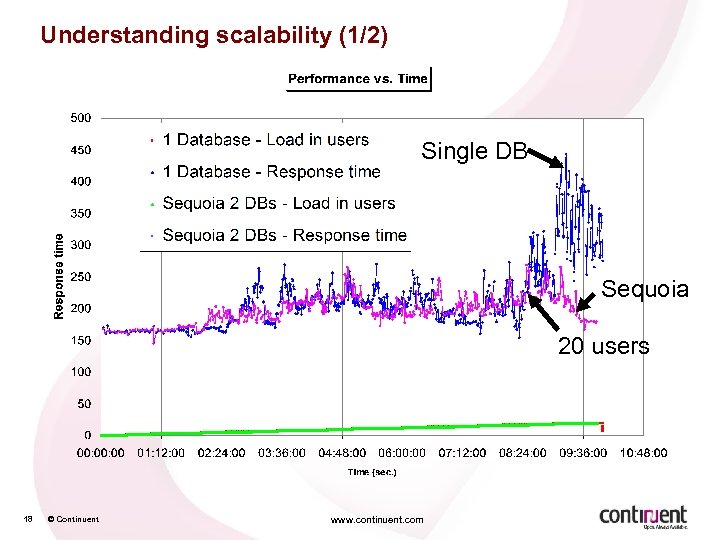
Understanding scalability (1/2) Single DB Sequoia 20 users 18 © Continuent www. continuent. com
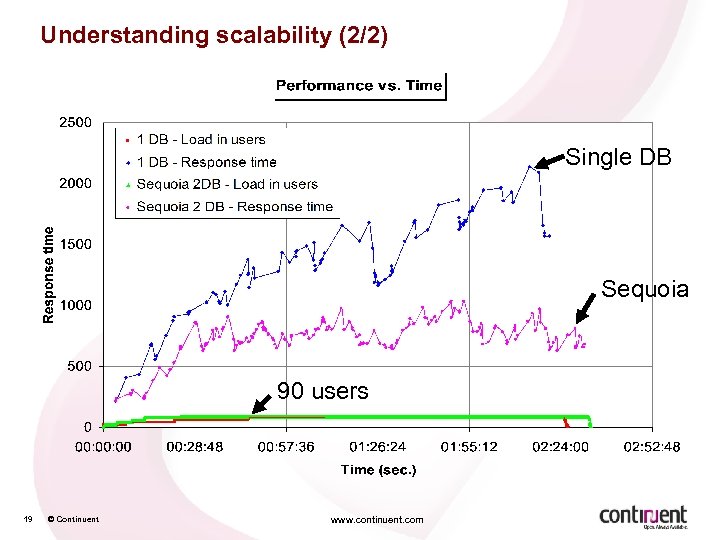
Understanding scalability (2/2) Single DB Sequoia 90 users 19 © Continuent www. continuent. com
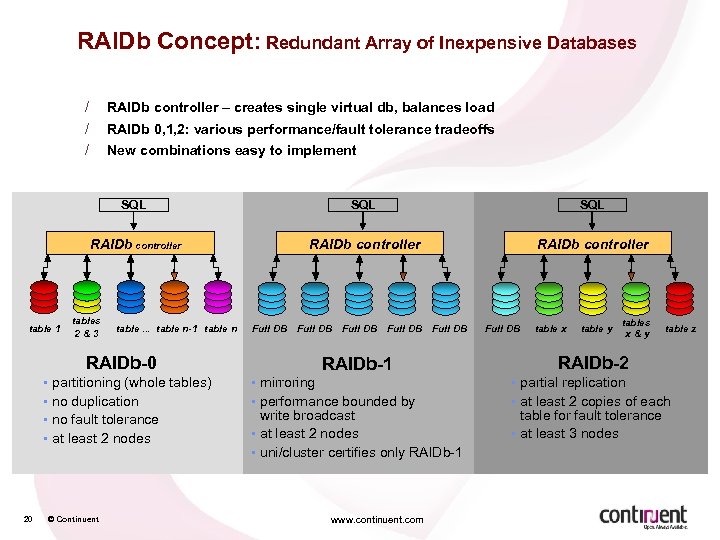
RAIDb Concept: Redundant Array of Inexpensive Databases / RAIDb controller – creates single virtual db, balances load / RAIDb 0, 1, 2: various performance/fault tolerance tradeoffs / New combinations easy to implement SQL RAIDb controller table 1 SQL RAIDb controller tables 2&3 table. . . table n-1 table n RAIDb-0 • • 20 partitioning (whole tables) no duplication no fault tolerance at least 2 nodes © Continuent Full DB Full DB RAIDb-1 • mirroring • performance bounded by write broadcast • at least 2 nodes • uni/cluster certifies only RAIDb-1 www. continuent. com Full DB table x table y tables x&y table z RAIDb-2 • partial replication • at least 2 copies of each table for fault tolerance • at least 3 nodes
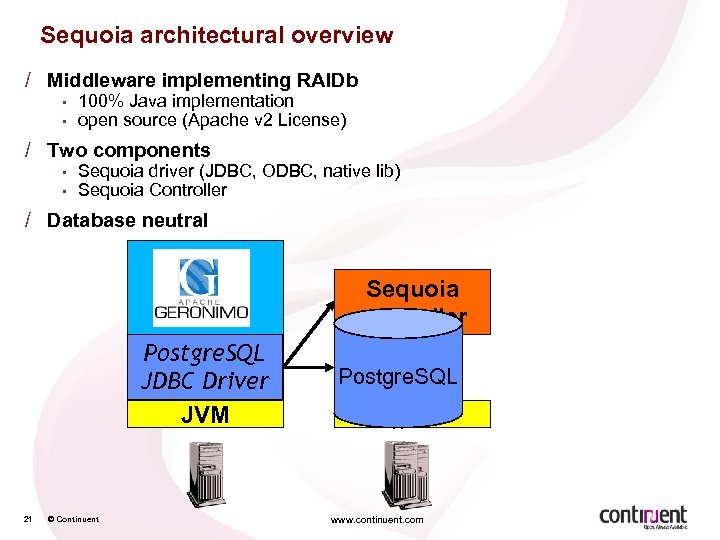
Sequoia architectural overview / Middleware implementing RAIDb • • 100% Java implementation open source (Apache v 2 License) / Two components • • Sequoia driver (JDBC, ODBC, native lib) Sequoia Controller / Database neutral Sequoia controller Postgre. SQL Sequoia JDBC Driver JDBC driver JVM 21 © Continuent Postgre. SQL JVM www. continuent. com
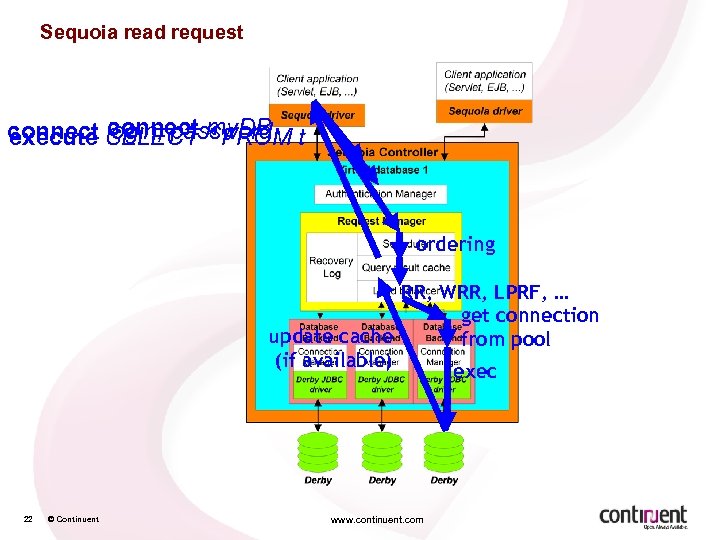
Sequoia read request connect my. DB connect SELECT * FROM t execute login, password ordering RR, WRR, LPRF, … get connection update cache from pool (if available) exec 22 © Continuent www. continuent. com
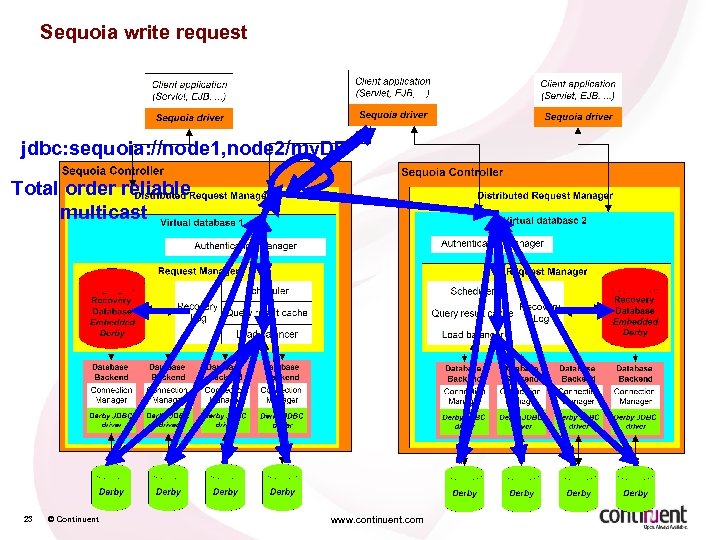
Sequoia write request jdbc: sequoia: //node 1, node 2/my. DB Total order reliable multicast 23 © Continuent www. continuent. com
Alternative replication algorithms / GORDA API • European consortium defining API for pluggable replication algorithms / Sequoia 3. 0 GORDA compliant prototype for Postgre. SQL • • • Uses triggers to compute write-sets Certifies transaction at commit time Propagate write-sets to other nodes / Tashkent/Tashkent+ • • Research prototype developed at EPFL Uses workload information for improved load balancing / More information • • 24 http: //sequoia. continuent. org http: //gorda. di. uminho. pt/ © Continuent www. continuent. com
Postgre. SQL specific issues / Indeterminist queries • • • Macros in queries (now(), current_timestamp, rand(), …) Stored procedures, triggers, … SELECT … LIMIT can create non-deterministic results in UPDATE statements if the SELECT does not have an ORDER BY with a unique index: UPDATE FOO SET KEYVALUE=‘x’ WHERE ID IN (SELECT ID FROM FOO WHERE KEYVALUE IS NULL LIMIT 10) / Sequences • • setval() and nextval() are not rollback nextval() can also be called within SELECT / Serial type / Large objects and OIDs / Schema changes / User access control • • • not stored in database (pg_hba. conf) host-based control might be fooled by proxy backup/restore with respect to user rights / VACUUM 25 © Continuent www. continuent. com
Outline / Database replication strategies / Postgre. SQL replication solutions / Building HA solutions / Management issues in production 26 © Continuent www. continuent. com
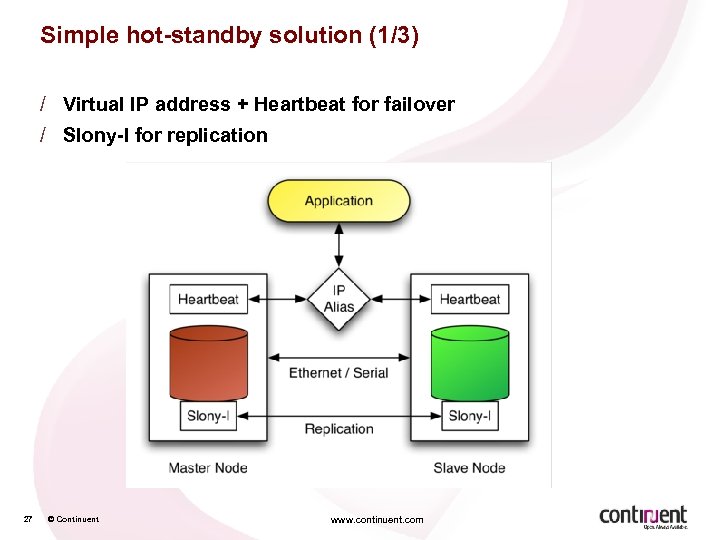
Simple hot-standby solution (1/3) / Virtual IP address + Heartbeat for failover / Slony-I for replication 27 © Continuent www. continuent. com
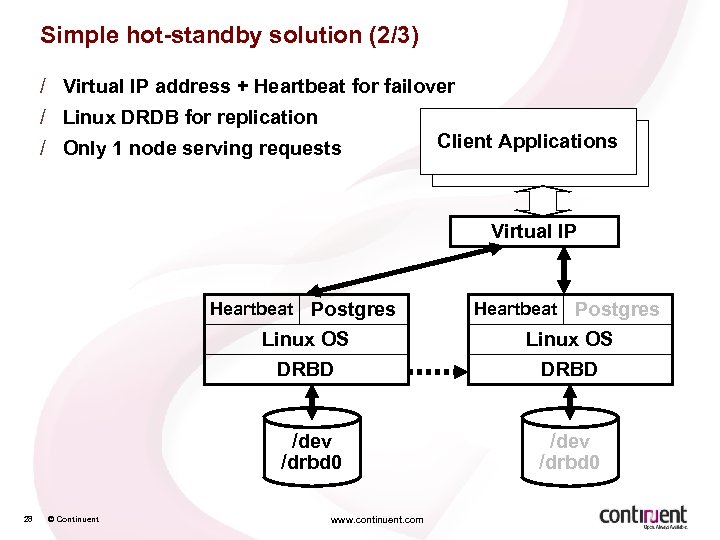
Simple hot-standby solution (2/3) / Virtual IP address + Heartbeat for failover / Linux DRDB for replication / Only 1 node serving requests Client Applications Virtual IP Heartbeat Postgres Linux OS DRBD © Continuent Linux OS DRBD /dev /drbd 0 28 Heartbeat Postgres /dev /drbd 0 www. continuent. com
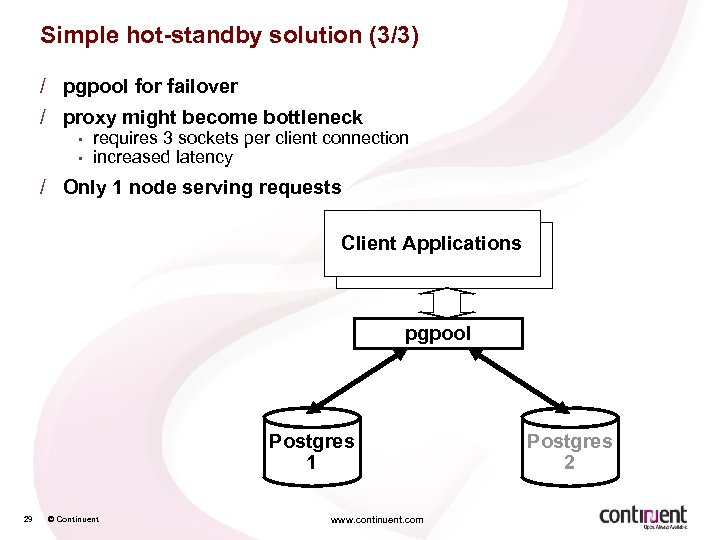
Simple hot-standby solution (3/3) / pgpool for failover / proxy might become bottleneck • • requires 3 sockets per client connection increased latency / Only 1 node serving requests Client Applications pgpool Postgres 1 29 © Continuent www. continuent. com Postgres 2
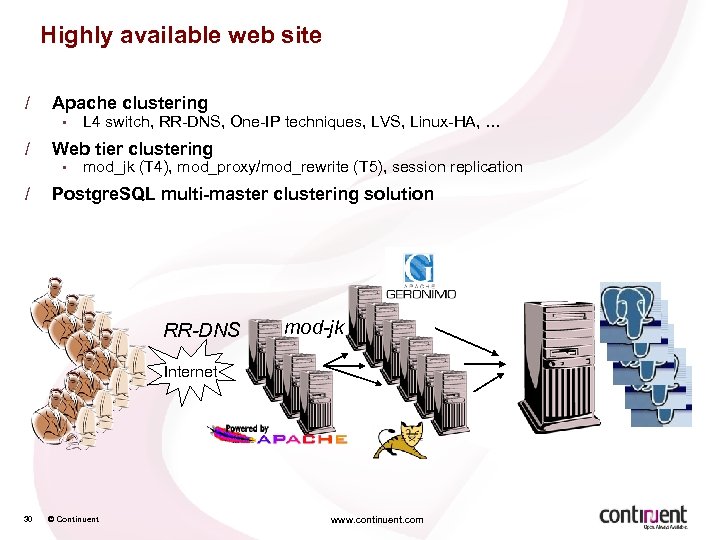
Highly available web site / Apache clustering • / Web tier clustering • / L 4 switch, RR-DNS, One-IP techniques, LVS, Linux-HA, … mod_jk (T 4), mod_proxy/mod_rewrite (T 5), session replication Postgre. SQL multi-master clustering solution RR-DNS mod-jk Internet 30 © Continuent www. continuent. com
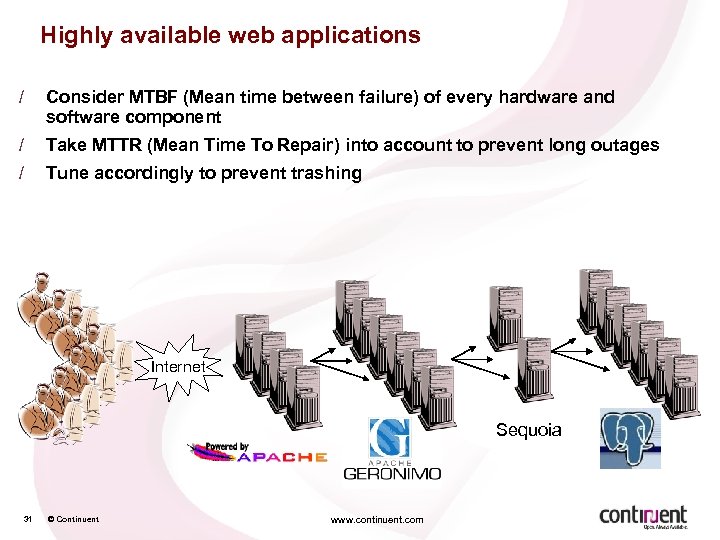
Highly available web applications / Consider MTBF (Mean time between failure) of every hardware and software component / Take MTTR (Mean Time To Repair) into account to prevent long outages / Tune accordingly to prevent trashing Internet Sequoia 31 © Continuent www. continuent. com
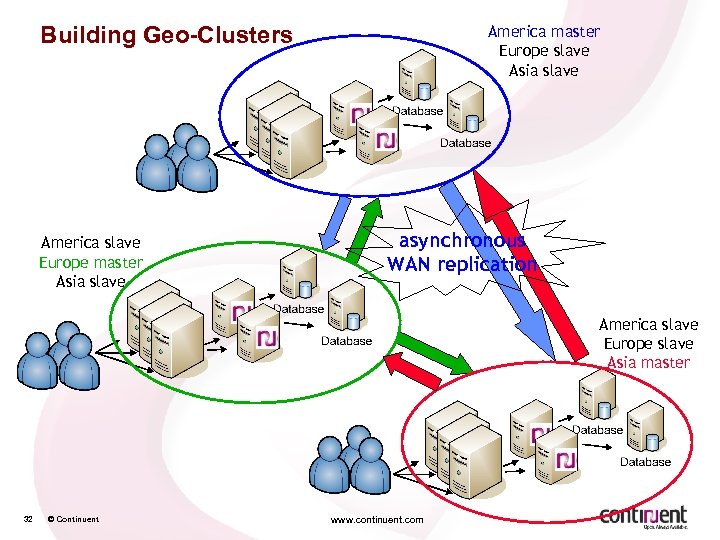
Building Geo-Clusters America slave Europe master Asia slave America master Europe slave Asia slave asynchronous WAN replication America slave Europe slave Asia master 32 © Continuent www. continuent. com
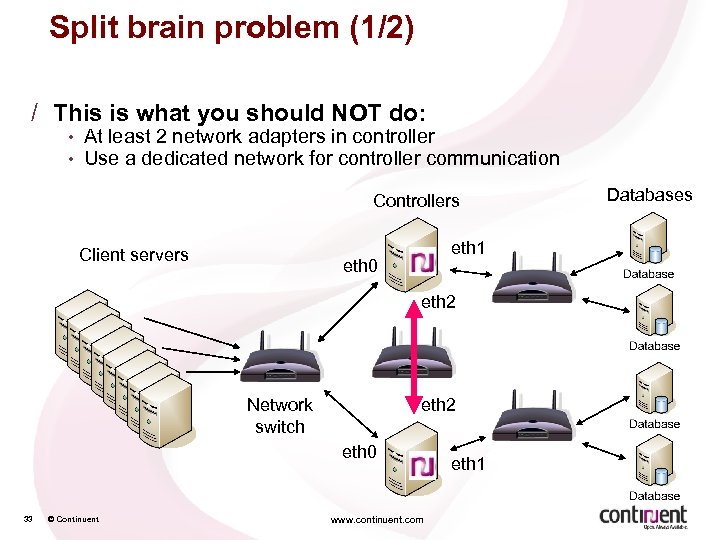
Split brain problem (1/2) / This is what you should NOT do: • • At least 2 network adapters in controller Use a dedicated network for controller communication Controllers Client servers eth 1 eth 0 eth 2 Network switch eth 2 eth 0 33 © Continuent www. continuent. com eth 1 Databases
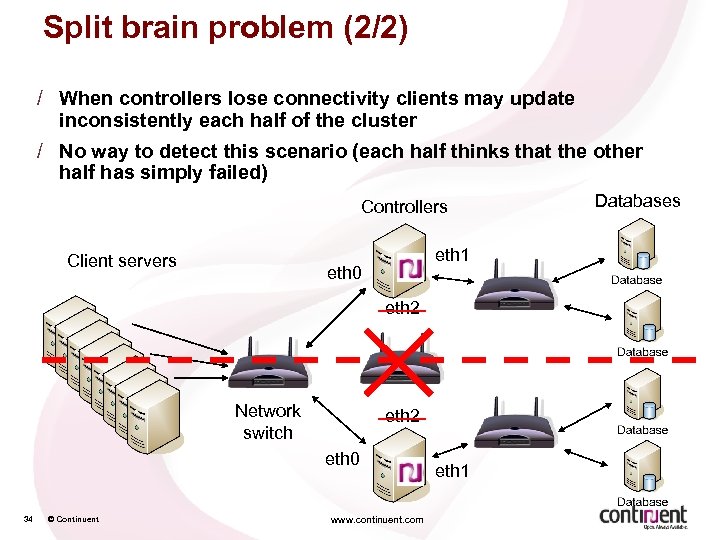
Split brain problem (2/2) / When controllers lose connectivity clients may update inconsistently each half of the cluster / No way to detect this scenario (each half thinks that the other half has simply failed) Controllers Client servers eth 1 eth 0 eth 2 Network switch eth 2 eth 0 34 © Continuent www. continuent. com eth 1 Databases
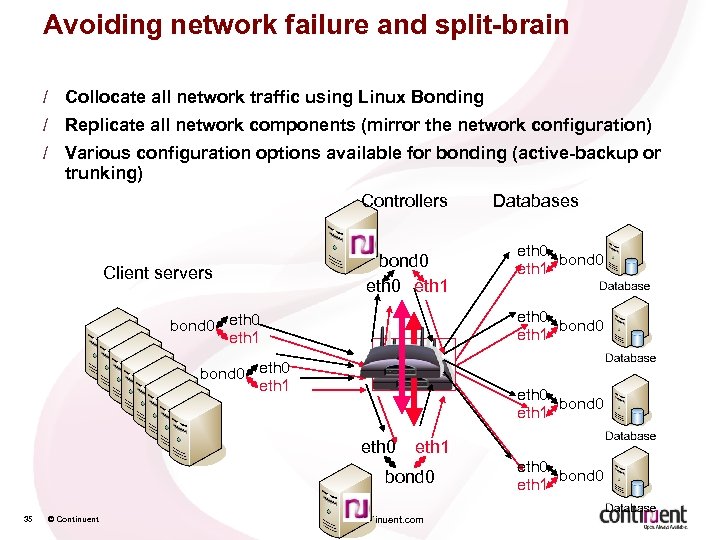
Avoiding network failure and split-brain / Collocate all network traffic using Linux Bonding / Replicate all network components (mirror the network configuration) / Various configuration options available for bonding (active-backup or trunking) Controllers Client servers bond 0 eth 1 eth 0 bond 0 eth 1 eth 0 eth 1 bond 0 © Continuent eth 0 bond 0 eth 1 35 Databases www. continuent. com eth 0 bond 0 eth 1
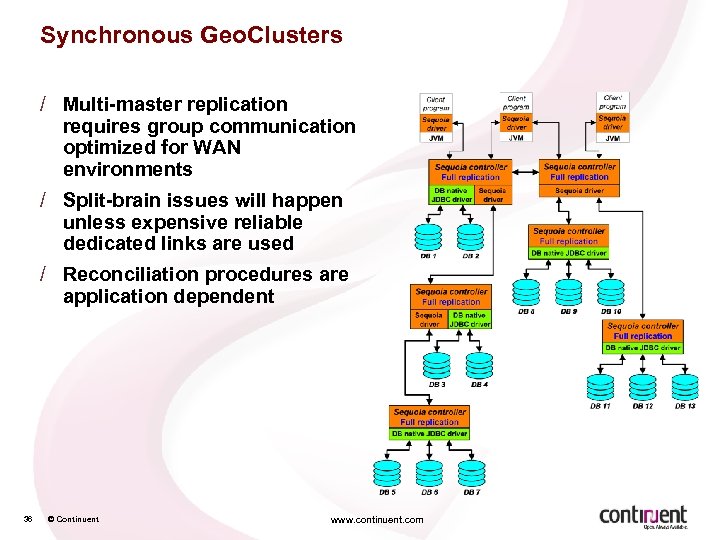
Synchronous Geo. Clusters / Multi-master replication requires group communication optimized for WAN environments / Split-brain issues will happen unless expensive reliable dedicated links are used / Reconciliation procedures are application dependent 36 © Continuent www. continuent. com
Outline / Database replication strategies / Postgre. SQL replication solutions / Building HA solutions / Management issues in production 37 © Continuent www. continuent. com
Managing a cluster in production / Diagnosing reliably cluster status / Getting proper notifications/alarms when something goes wrong • • Standard email or SNMP traps Logging is key for diagnostic / Minimizing downtime • • • Migrating from single database to cluster Expanding cluster Staging environment is key to test / Planned maintenance operations • • • 38 Vacuum Backup Software maintenance (DB, replication software, …) Node maintenance (reboot, power cycle, …) Site maintenance (in Geo. Cluster case) © Continuent www. continuent. com
Dealing with failures / Sotfware vs Hardware failures • • • client application, database, replication software, OS, VM, … power outage, node, disk, network, Byzantine failure, … Admission control to prevent trashing / Detecting failures require proper timeout settings / Automated failover procedures • • • client and cluster reconfiguration dealing with multiple simultaneous failures coordination required between different tiers or admin scripts / Automatic database resynchronization / node repair / Operator errors • • automation to prevent manual intervention always keep backups and try procedures on staging environment first / Disaster recovery • • minimize data loss but preserve consistency provisioning and planning are key / Split brain or Geo. Cluster failover • • 39 requires organization wide coordination manual diagnostic/reconfiguration often required © Continuent www. continuent. com
Summary / Different replication strategies for different needs / Performance ≠ Scalability / Manageability becomes THE major issue in production 40 © Continuent www. continuent. com
Links / pgpool: http: //pgpool. projects. postgresql. org/ / PGcluster: http: //pgcluster. projects. postgresql. org/ / Slony: http: //slony. info/ / Sequoia: http: //sequoia. continuent. org / GORDA: http: //gorda. di. uminho. pt/ / Slides: http: //sequoia. continuent. org/Resources http: //www. continuent. org 41 © Continuent www. continuent. com

Bonus slides © Continuent 3/19/2018
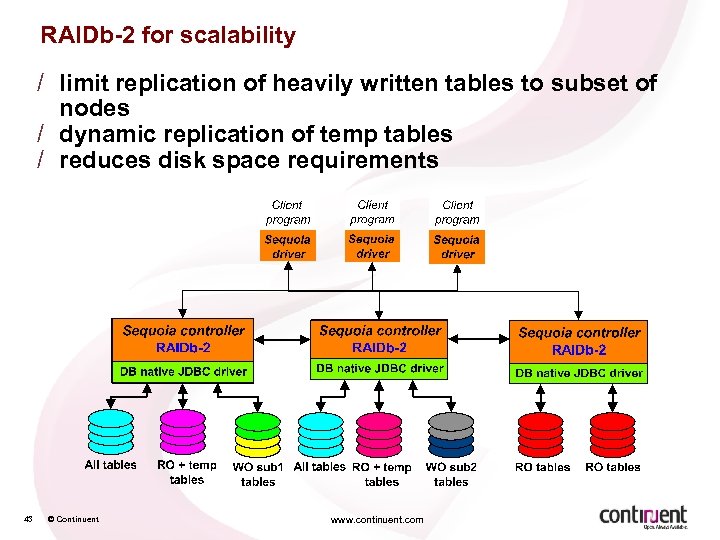
RAIDb-2 for scalability / limit replication of heavily written tables to subset of nodes / dynamic replication of temp tables / reduces disk space requirements 43 © Continuent www. continuent. com
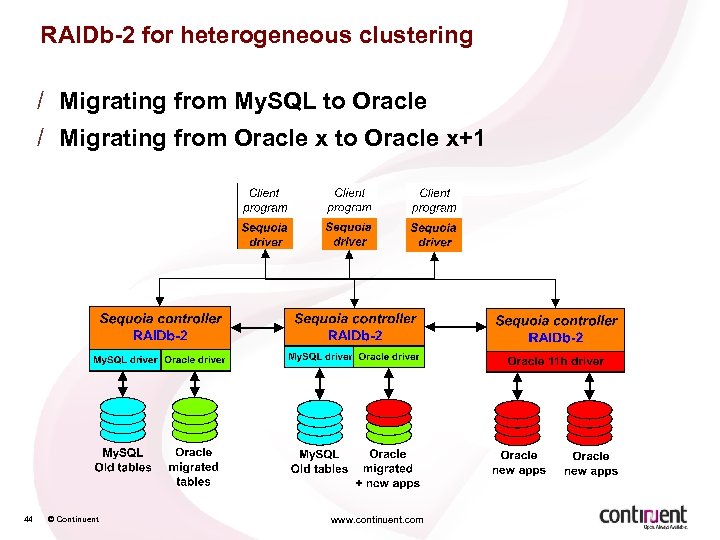
RAIDb-2 for heterogeneous clustering / Migrating from My. SQL to Oracle / Migrating from Oracle x to Oracle x+1 44 © Continuent www. continuent. com
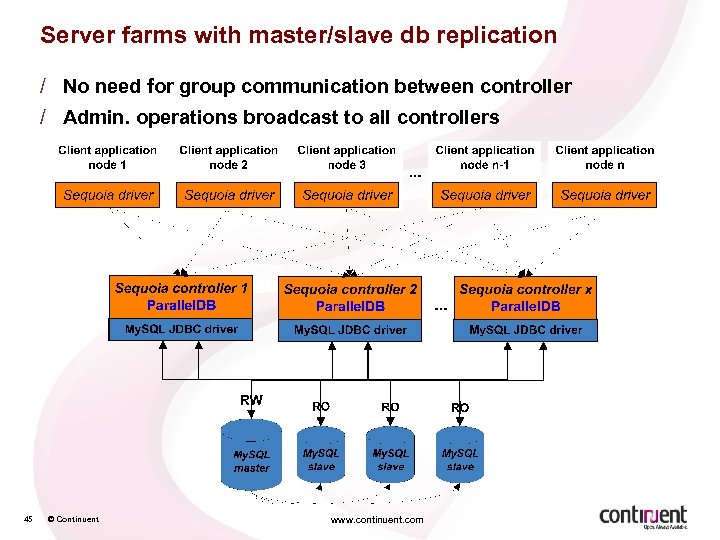
Server farms with master/slave db replication / No need for group communication between controller / Admin. operations broadcast to all controllers 45 © Continuent www. continuent. com
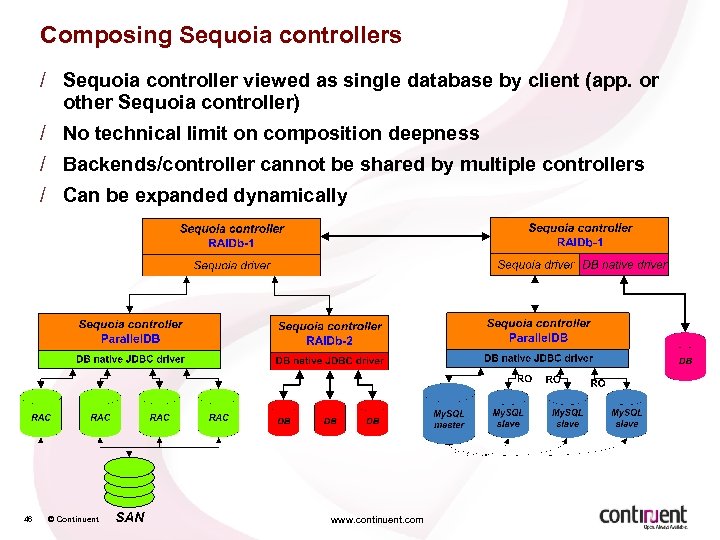
Composing Sequoia controllers / Sequoia controller viewed as single database by client (app. or other Sequoia controller) / No technical limit on composition deepness / Backends/controller cannot be shared by multiple controllers / Can be expanded dynamically 46 © Continuent www. continuent. com
Скачать презентацию Slides available at http sequoia continuent org Resources Postgre
a094ed45b466287b6924112dab4ffa44.ppt