


 Скачать презентацию Slides 1 -14 Precursor to Segmentation Topic
aff978efb206579510f6434ec6686f51.ppt
- Количество слайдов: 64
 Slides 1 -14 Precursor to Segmentation ( Topic 4) 1 -
 What is a Business Market? • Business Buyer Behaviour refers to the buying behaviour of: • all the organizations that • buy goods and services • for use in the production of other products and services • that are sold, rented, or supplied to others. • The business market is huge and involves many more dollars and items than consumer markets. 4 -2 Brassington & Pettitt, Essentials of Marketing 2 e, © Pearson Education 2007
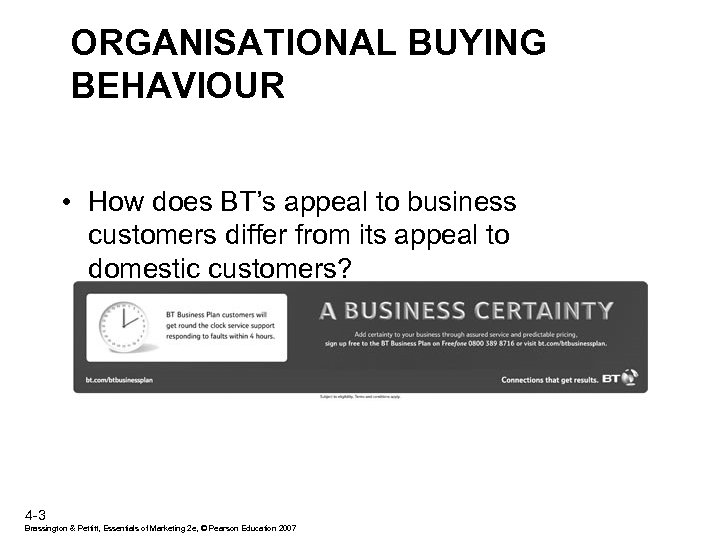 ORGANISATIONAL BUYING BEHAVIOUR • How does BT’s appeal to business customers differ from its appeal to domestic customers? 4 -3 Brassington & Pettitt, Essentials of Marketing 2 e, © Pearson Education 2007
 Some Examples of Organizational Buying Ø Paper cups by Mc. Donald's Ø Computer chips by Toshiba Ø Concrete by Local Authorities Ø Oil by Electricity Generators Ø Fertiliser by Farmers Ø Accountancy services by Ltd. Companies Ø TV’s by Comet or Dixons
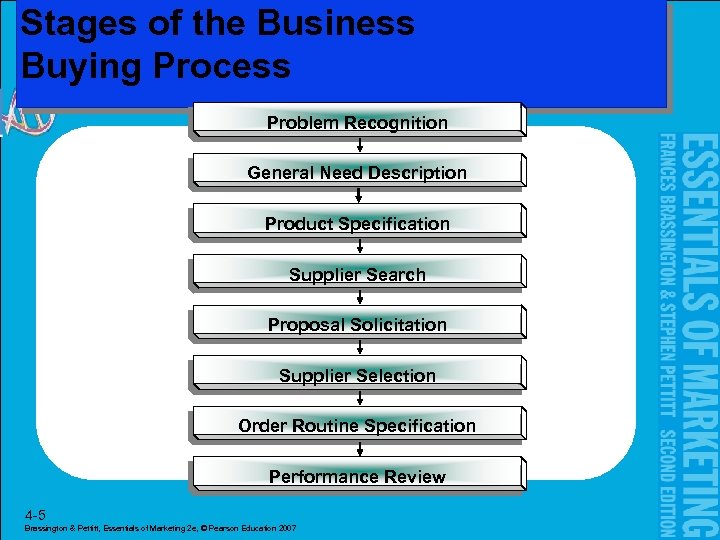 Stages of the Business Buying Process Problem Recognition General Need Description Product Specification Supplier Search Proposal Solicitation Supplier Selection Order Routine Specification Performance Review 4 -5 Brassington & Pettitt, Essentials of Marketing 2 e, © Pearson Education 2007
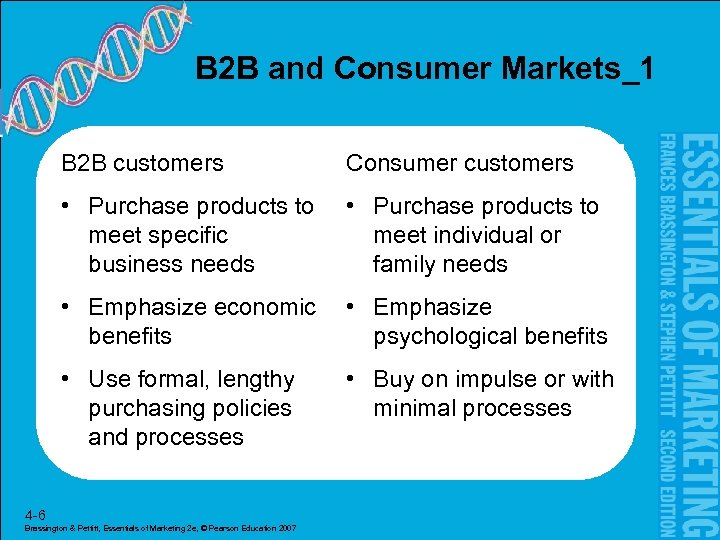 B 2 B and Consumer Markets_1 B 2 B customers Consumer customers • Purchase products to meet specific business needs • Purchase products to meet individual or family needs • Emphasize economic benefits • Emphasize psychological benefits • Use formal, lengthy purchasing policies and processes • Buy on impulse or with minimal processes 4 -6 Brassington & Pettitt, Essentials of Marketing 2 e, © Pearson Education 2007
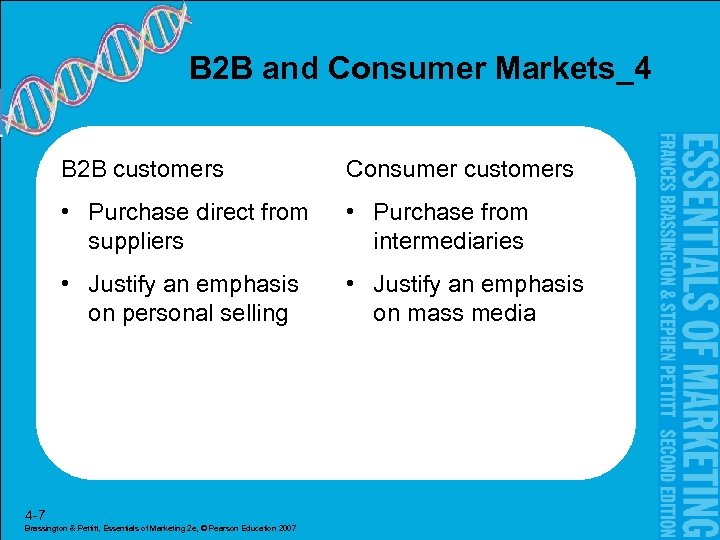 B 2 B and Consumer Markets_4 B 2 B customers Consumer customers • Purchase direct from suppliers • Purchase from intermediaries • Justify an emphasis on personal selling • Justify an emphasis on mass media 4 -7 Brassington & Pettitt, Essentials of Marketing 2 e, © Pearson Education 2007
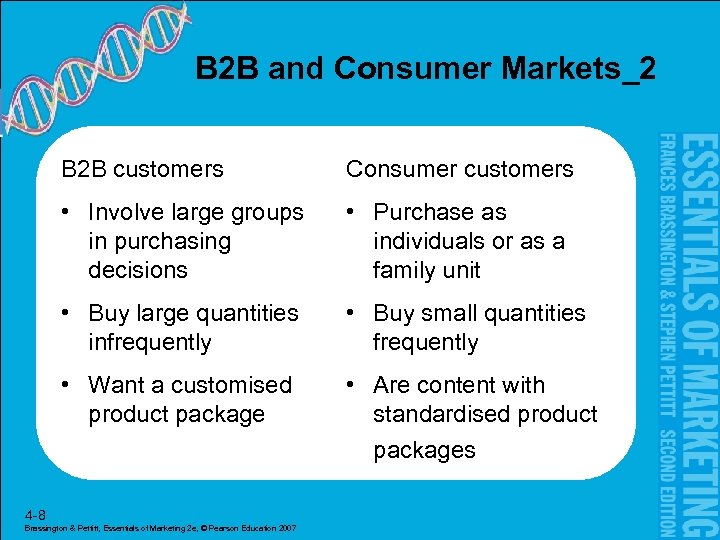 B 2 B and Consumer Markets_2 B 2 B customers Consumer customers • Involve large groups in purchasing decisions • Purchase as individuals or as a family unit • Buy large quantities infrequently • Buy small quantities frequently • Want a customised product package • Are content with standardised product packages 4 -8 Brassington & Pettitt, Essentials of Marketing 2 e, © Pearson Education 2007
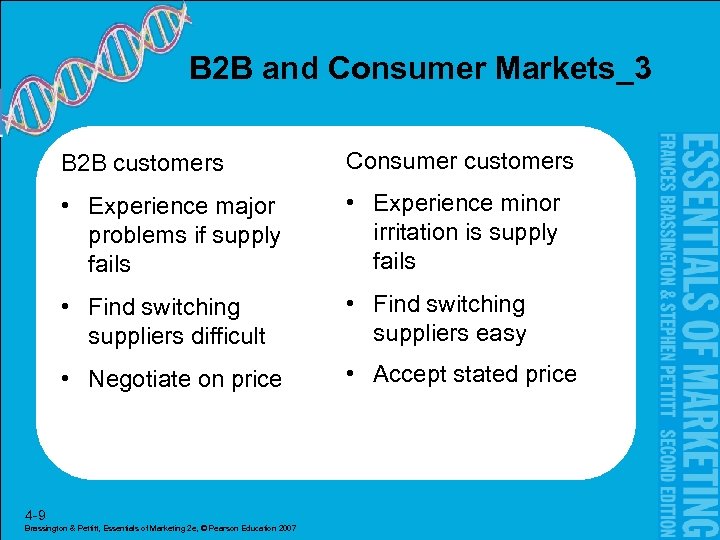 B 2 B and Consumer Markets_3 B 2 B customers Consumer customers • Experience major problems if supply fails • Experience minor irritation is supply fails • Find switching suppliers difficult • Find switching suppliers easy • Negotiate on price • Accept stated price 4 -9 Brassington & Pettitt, Essentials of Marketing 2 e, © Pearson Education 2007
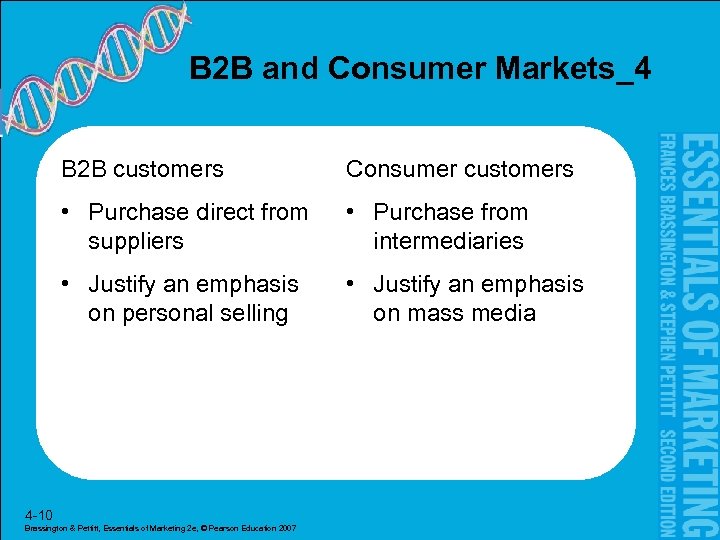 B 2 B and Consumer Markets_4 B 2 B customers Consumer customers • Purchase direct from suppliers • Purchase from intermediaries • Justify an emphasis on personal selling • Justify an emphasis on mass media 4 -10 Brassington & Pettitt, Essentials of Marketing 2 e, © Pearson Education 2007
 Types of B 2 B Customers • Commercial enterprises • Government bodies • Institutions 4 -11 Brassington & Pettitt, Essentials of Marketing 2 e, © Pearson Education 2007
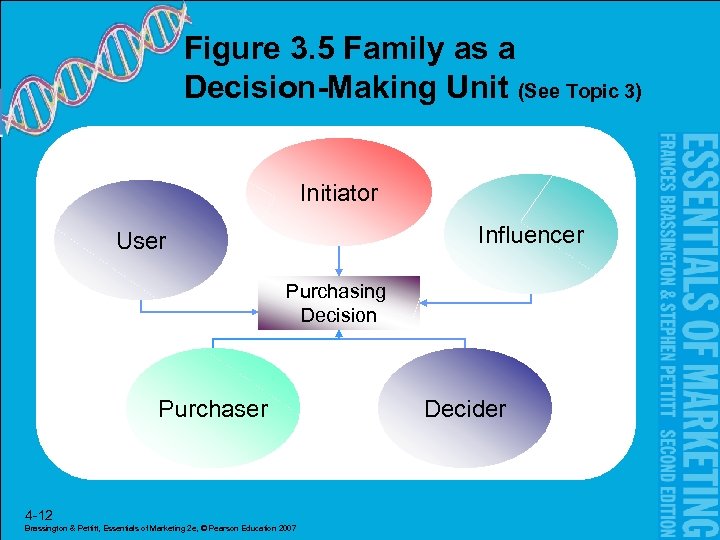 Figure 3. 5 Family as a Decision-Making Unit (See Topic 3) Initiator Influencer User Purchasing Decision Purchaser 4 -12 Brassington & Pettitt, Essentials of Marketing 2 e, © Pearson Education 2007 Decider
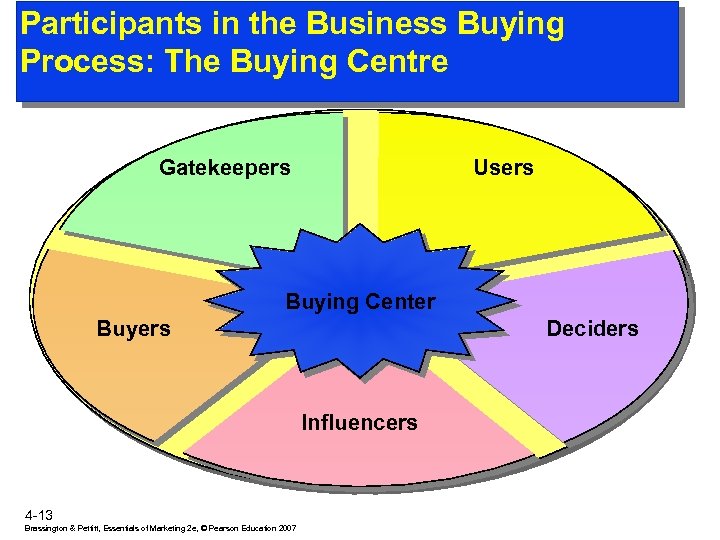 Participants in the Business Buying Process: The Buying Centre Gatekeepers Users Buying Center Buyers Deciders Influencers 4 -13 Brassington & Pettitt, Essentials of Marketing 2 e, © Pearson Education 2007
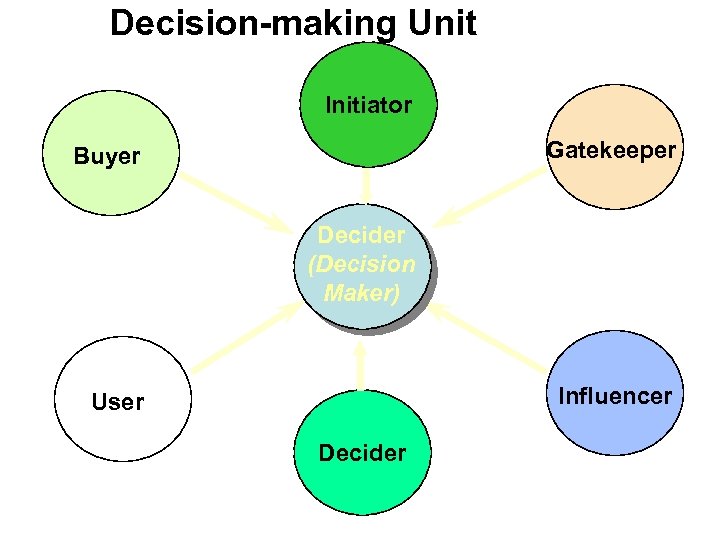 Decision-making Unit Initiator Gatekeeper Buyer Decider (Decision Maker) Influencer User Decider
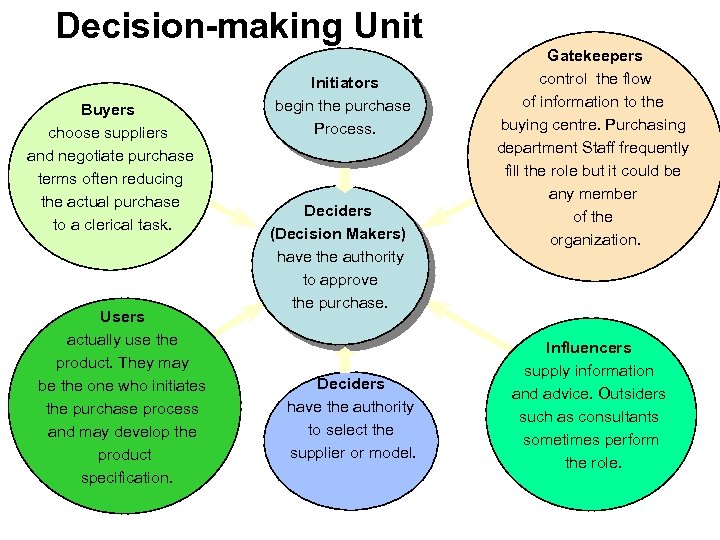 Decision-making Unit Buyers choose suppliers and negotiate purchase terms often reducing the actual purchase to a clerical task. Users actually use the product. They may be the one who initiates the purchase process and may develop the product specification. Initiators begin the purchase Process. Deciders (Decision Makers) have the authority to approve the purchase. Deciders have the authority to select the supplier or model. Gatekeepers control the flow of information to the buying centre. Purchasing department Staff frequently fill the role but it could be any member of the organization. Influencers supply information and advice. Outsiders such as consultants sometimes perform the role.
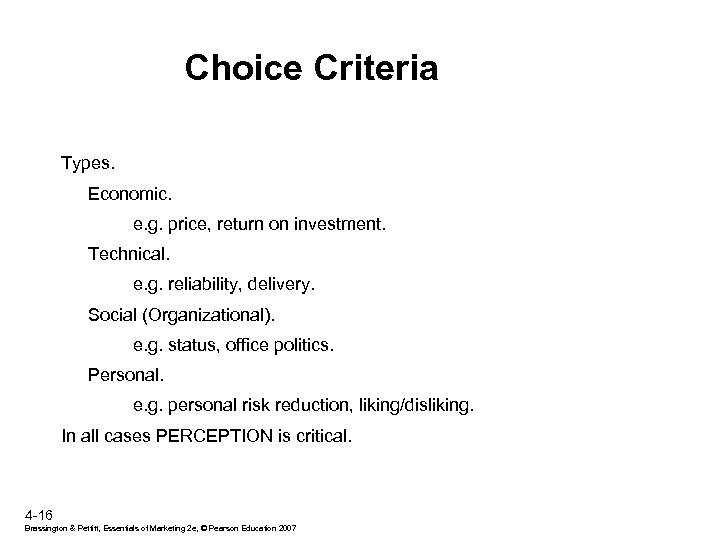 Choice Criteria Types. Ø Economic. e. g. price, return on investment. Ø Technical. e. g. reliability, delivery. Ø Social (Organizational). e. g. status, office politics. Ø Personal. e. g. personal risk reduction, liking/disliking. In all cases PERCEPTION is critical. 4 -16 Brassington & Pettitt, Essentials of Marketing 2 e, © Pearson Education 2007
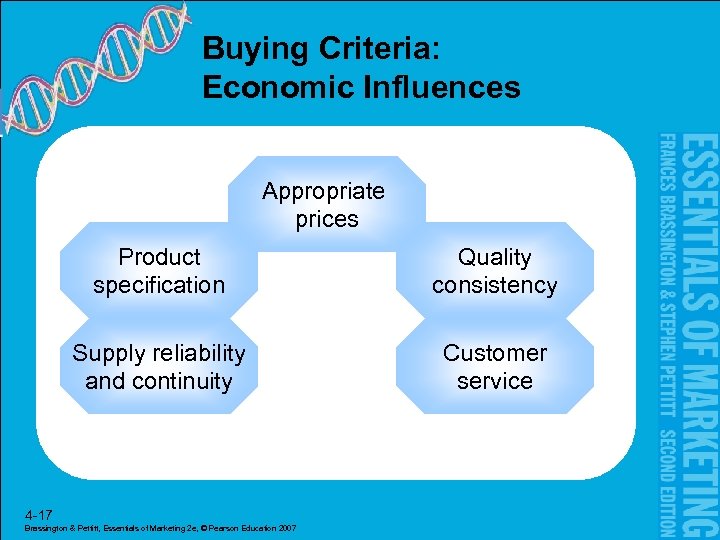 Buying Criteria: Economic Influences Appropriate prices Product specification Quality consistency Supply reliability and continuity Customer service 4 -17 Brassington & Pettitt, Essentials of Marketing 2 e, © Pearson Education 2007
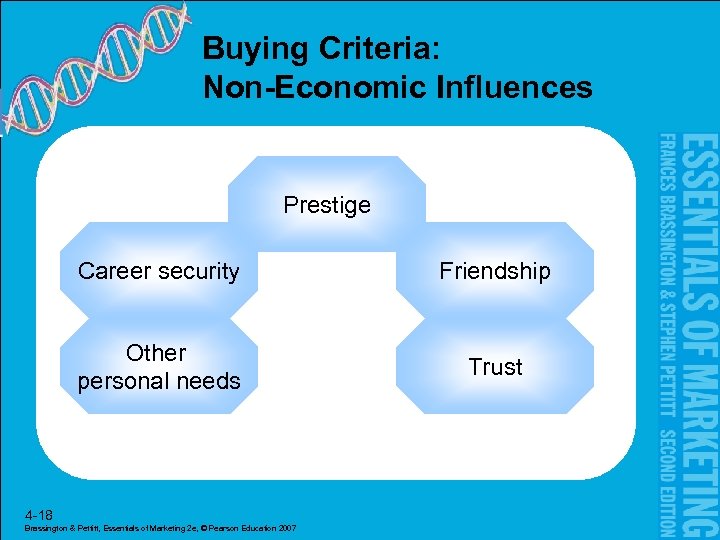 Buying Criteria: Non-Economic Influences Prestige Career security Friendship Other personal needs Trust 4 -18 Brassington & Pettitt, Essentials of Marketing 2 e, © Pearson Education 2007
 Topic 4 segmenting markets 1 -
 learning objectives_1 • Define the concept of Segmentation. • Explain how both B 2 B and consumer markets can be broken down into smaller, more manageable groups of similar customers 4 -20 Brassington & Pettitt, Essentials of Marketing 2 e, © Pearson Education 2007
 learning objectives_2 • Understand the effects on the marketing mix of pursuing specific segments • Understand the potential benefits and risks of segmentation • Appreciate the role of segmentation in strategic marketing thinking 4 -21 Brassington & Pettitt, Essentials of Marketing 2 e, © Pearson Education 2007
 Segmentation Defined Segmentation is the art of discerning and defining meaningful differences between groups of customers to form the foundations of a more focused marketing effort. 4 -22 Brassington & Pettitt, Essentials of Marketing 2 e, © Pearson Education 2007
 The need for market segmentation • Marketers understand that they cannot be all things to all people, all of the time. Buyers and markets are too complex and diverse for one simple marketing formula to adequately address the needs of all. 4 -23 Brassington & Pettitt, Essentials of Marketing 2 e, © Pearson Education 2007
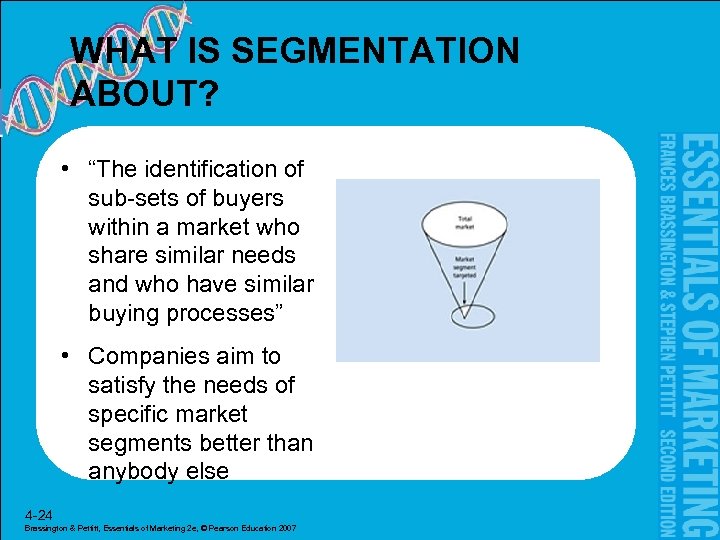 WHAT IS SEGMENTATION ABOUT? • “The identification of sub-sets of buyers within a market who share similar needs and who have similar buying processes” • Companies aim to satisfy the needs of specific market segments better than anybody else 4 -24 Brassington & Pettitt, Essentials of Marketing 2 e, © Pearson Education 2007
 Segmentation the Concept • Customer orientated concept - based on understanding customers. • Practical - breaking large markets down into manageable parts or groups. • Proactive part of developing a marketing strategy. • Consumer markets and B 2 B markets segmented differently. 4 -25 Brassington & Pettitt, Essentials of Marketing 2 e, © Pearson Education 2007
 Segmentation Process • Defining the boundaries of the market - what business are we in? , and looking at the world through the customers’ eyes. • Targeting customers. 4 -26 Brassington & Pettitt, Essentials of Marketing 2 e, © Pearson Education 2007
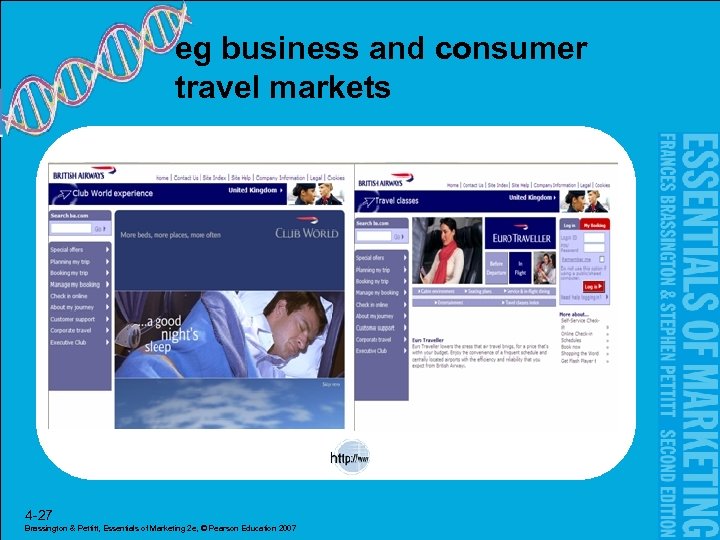 eg business and consumer travel markets 4 -27 Brassington & Pettitt, Essentials of Marketing 2 e, © Pearson Education 2007
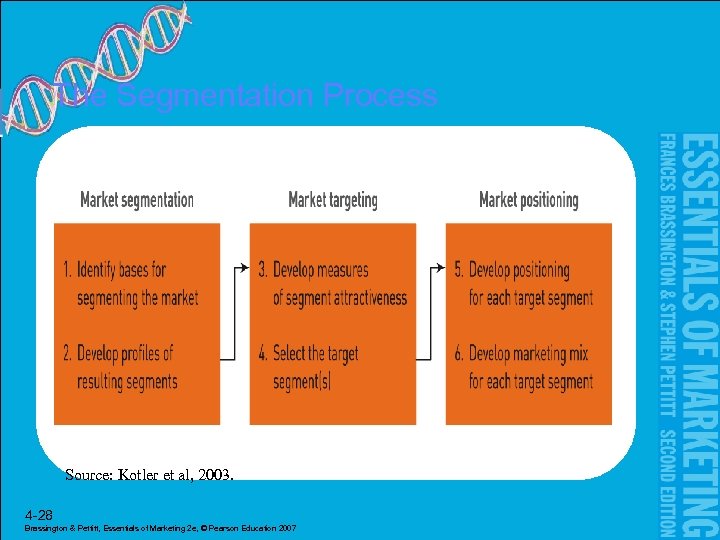 The Segmentation Process Source: Kotler et al, 2003. 4 -28 Brassington & Pettitt, Essentials of Marketing 2 e, © Pearson Education 2007
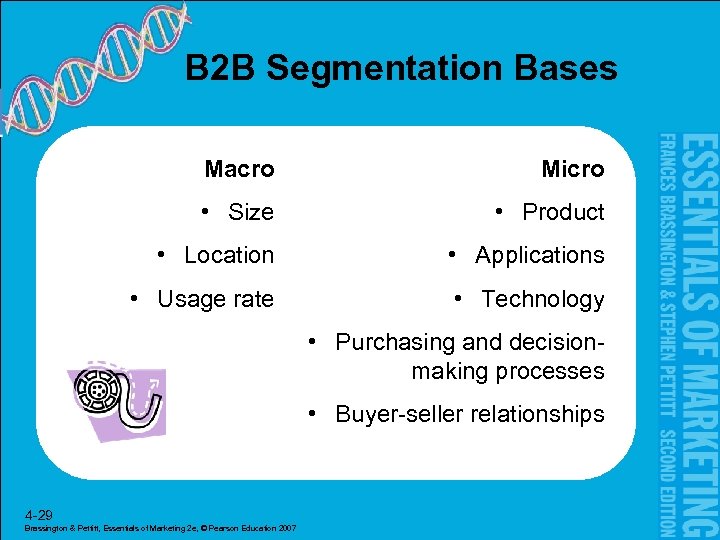 B 2 B Segmentation Bases Macro Micro • Size • Product • Location • Applications • Usage rate • Technology • Purchasing and decisionmaking processes • Buyer-seller relationships 4 -29 Brassington & Pettitt, Essentials of Marketing 2 e, © Pearson Education 2007
 Consumer Segmentation • Similar to B 2 B segmentation, except – Consumer segments tend to be larger – More difficult to get close to buyer – More emphasis on lifestyle and context 4 -30 Brassington & Pettitt, Essentials of Marketing 2 e, © Pearson Education 2007
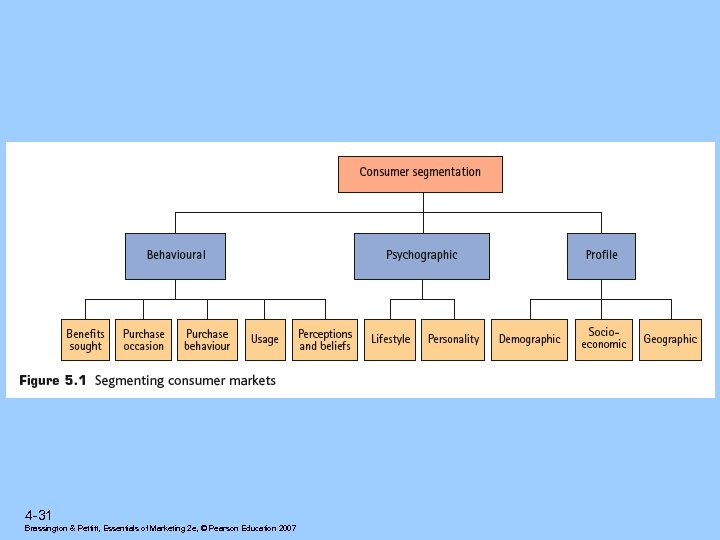 4 -31 Brassington & Pettitt, Essentials of Marketing 2 e, © Pearson Education 2007
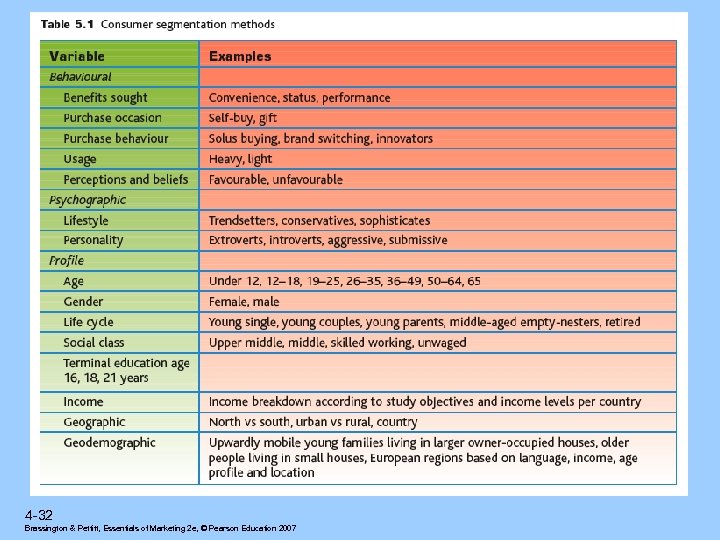 4 -32 Brassington & Pettitt, Essentials of Marketing 2 e, © Pearson Education 2007
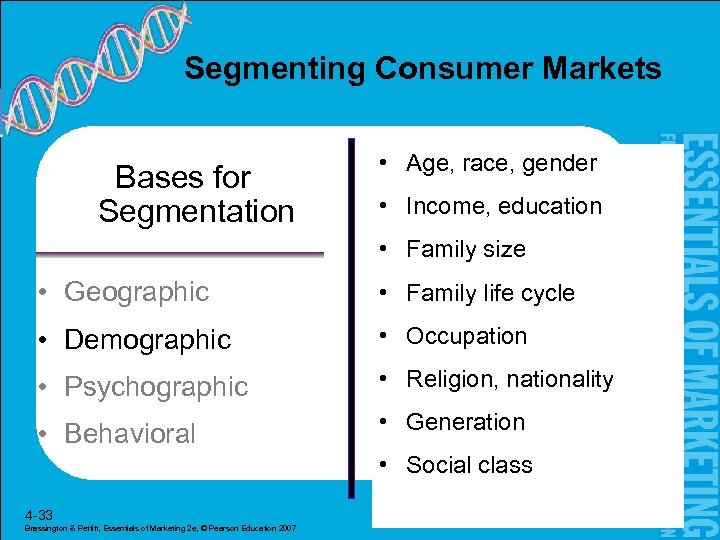 Segmenting Consumer Markets Bases for Segmentation • Age, race, gender • Income, education • Family size • Geographic • Family life cycle • Demographic • Occupation • Psychographic • Religion, nationality • Behavioral • Generation • Social class 4 -33 Brassington & Pettitt, Essentials of Marketing 2 e, © Pearson Education 2007
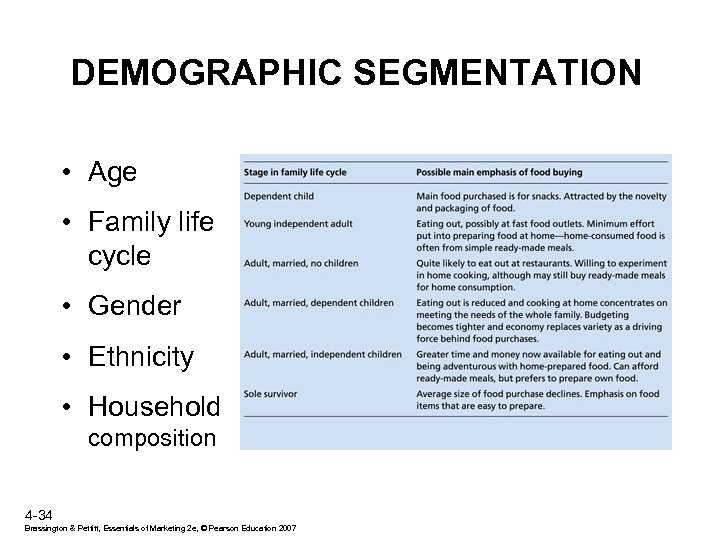 DEMOGRAPHIC SEGMENTATION • Age • Family life cycle • Gender • Ethnicity • Household composition 4 -34 Brassington & Pettitt, Essentials of Marketing 2 e, © Pearson Education 2007
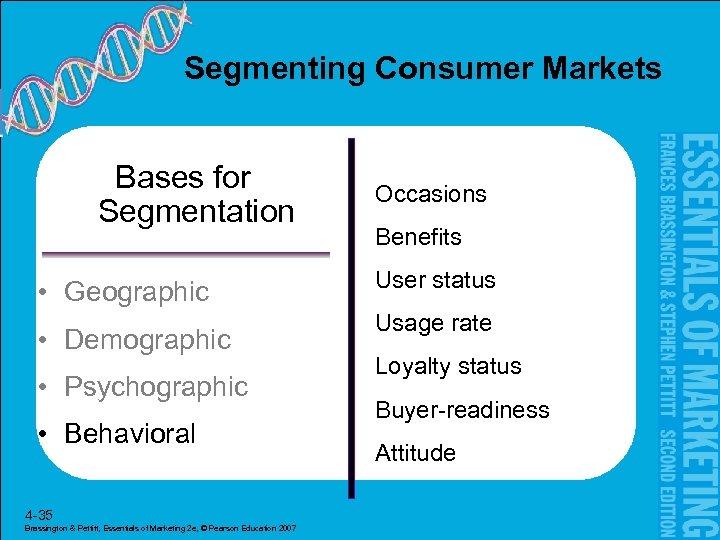 Segmenting Consumer Markets Bases for Segmentation • Geographic • Demographic • Psychographic • Behavioral 4 -35 Brassington & Pettitt, Essentials of Marketing 2 e, © Pearson Education 2007 • Occasions • Benefits • User status • Usage rate • Loyalty status • Buyer-readiness • Attitude
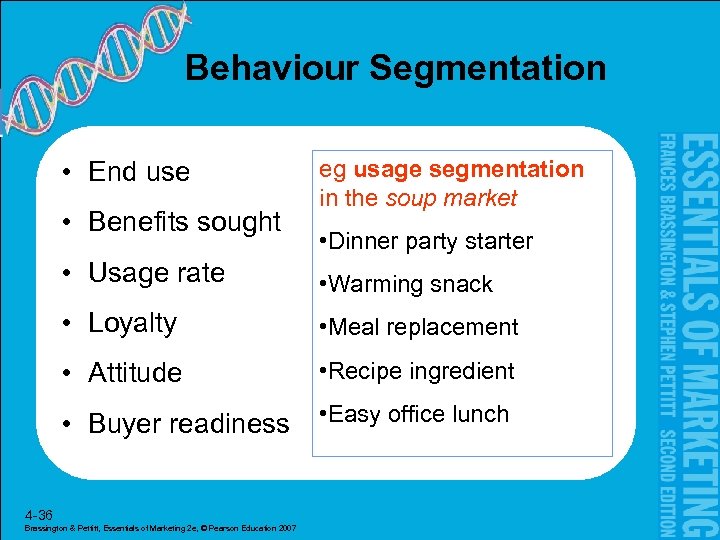 Behaviour Segmentation • End use • Benefits sought eg usage segmentation in the soup market • Dinner party starter • Usage rate • Warming snack • Loyalty • Meal replacement • Attitude • Recipe ingredient • Buyer readiness • Easy office lunch 4 -36 Brassington & Pettitt, Essentials of Marketing 2 e, © Pearson Education 2007
 Loyalty Segments • Current loyal user, continuing purchase • Current customer, switching possible • Occasional user, could become loyal • Occasional user, switching possible • Non-user, could become user • Non-user, unlikely to become user 4 -37 Brassington & Pettitt, Essentials of Marketing 2 e, © Pearson Education 2007
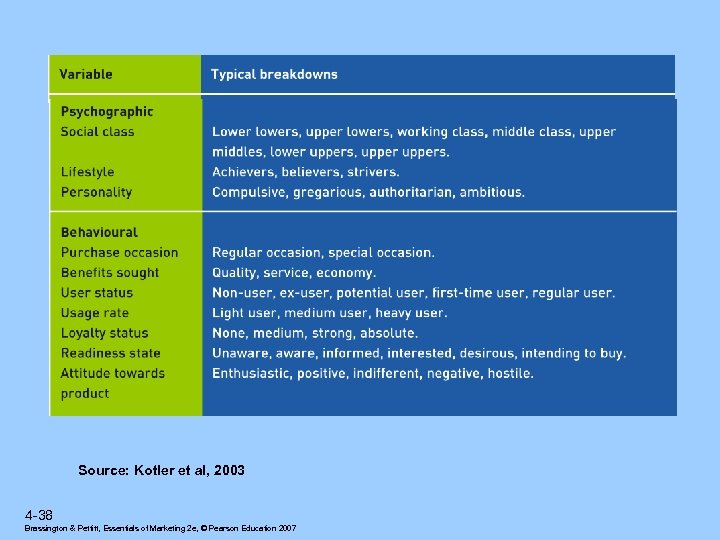 Source: Kotler et al, 2003 4 -38 Brassington & Pettitt, Essentials of Marketing 2 e, © Pearson Education 2007
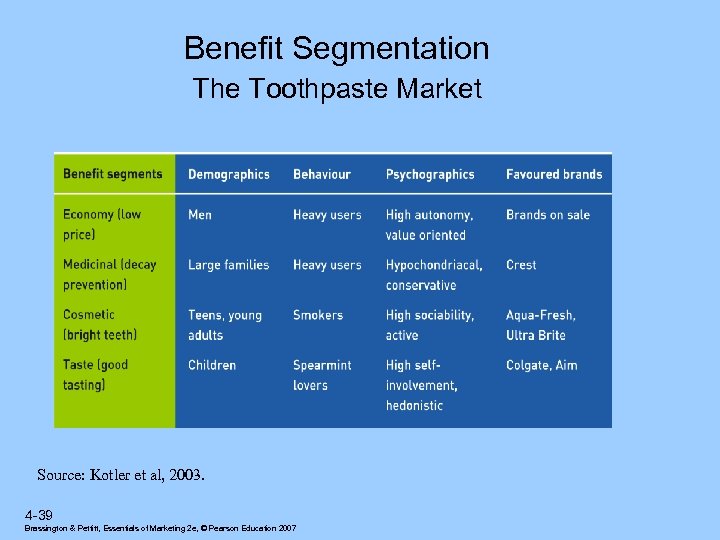 Benefit Segmentation The Toothpaste Market Source: Kotler et al, 2003. 4 -39 Brassington & Pettitt, Essentials of Marketing 2 e, © Pearson Education 2007
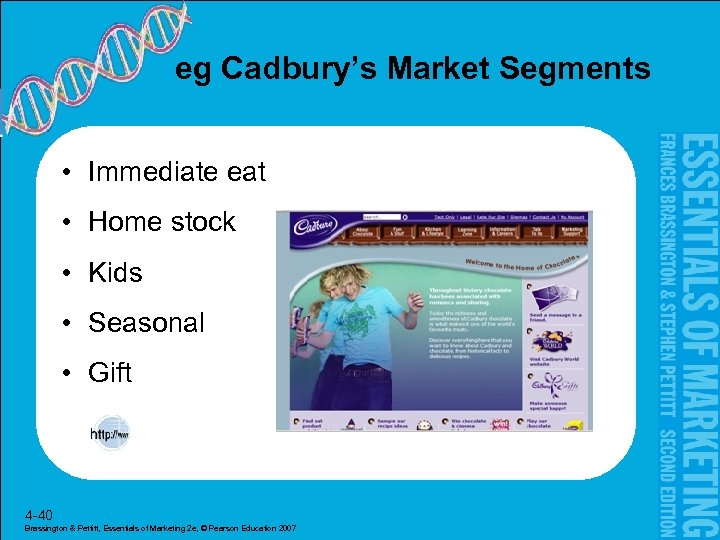 eg Cadbury’s Market Segments • Immediate eat • Home stock • Kids • Seasonal • Gift 4 -40 Brassington & Pettitt, Essentials of Marketing 2 e, © Pearson Education 2007
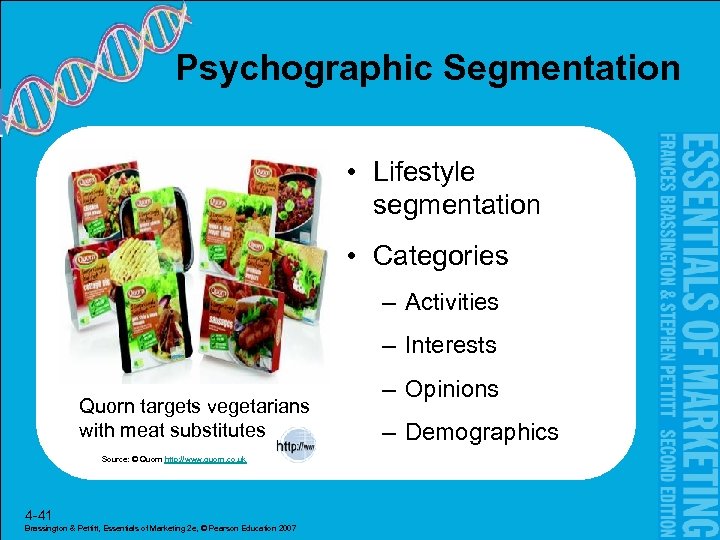 Psychographic Segmentation • Lifestyle segmentation • Categories – Activities – Interests Quorn targets vegetarians with meat substitutes Source: © Quorn http: //www. quorn. co. uk 4 -41 Brassington & Pettitt, Essentials of Marketing 2 e, © Pearson Education 2007 – Opinions – Demographics
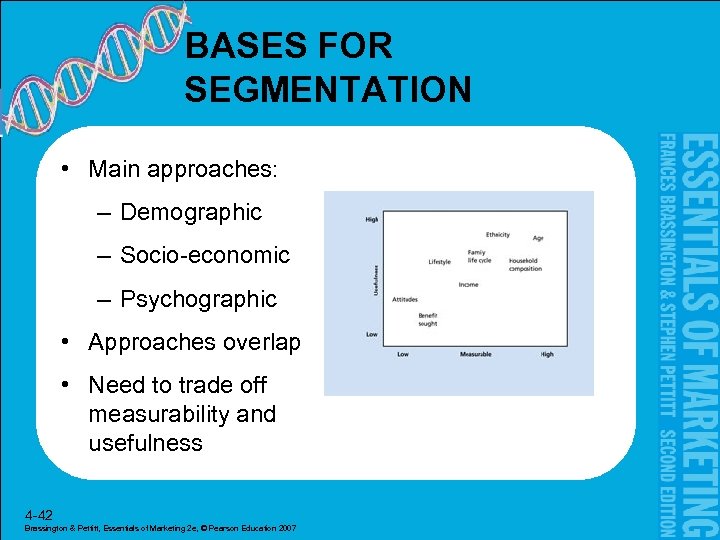 BASES FOR SEGMENTATION • Main approaches: – Demographic – Socio-economic – Psychographic • Approaches overlap • Need to trade off measurability and usefulness 4 -42 Brassington & Pettitt, Essentials of Marketing 2 e, © Pearson Education 2007
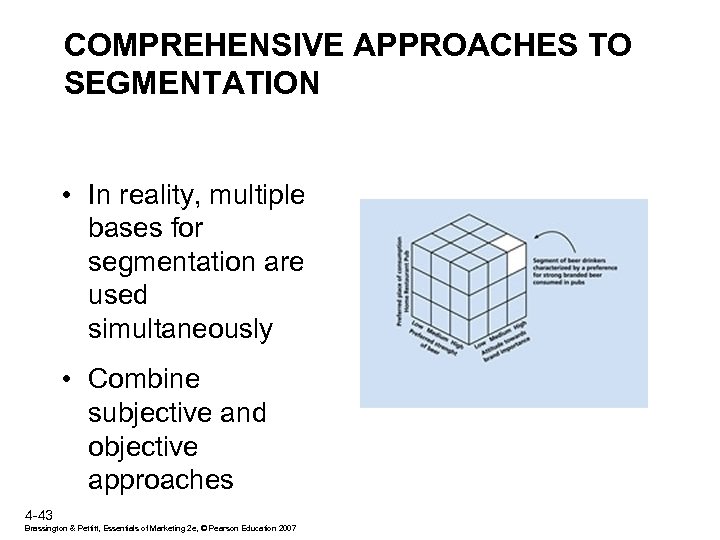 COMPREHENSIVE APPROACHES TO SEGMENTATION • In reality, multiple bases for segmentation are used simultaneously • Combine subjective and objective approaches 4 -43 Brassington & Pettitt, Essentials of Marketing 2 e, © Pearson Education 2007
 EVALUATION OF MARKET SEGMENTS • Market segments need to be evaluated and ranked for possible targeting • Evaluation is typically based on: – Size of segment – Growth prospects – Profitability – Competitive pressure – Fit with company objectives 4 -44 Brassington & Pettitt, Essentials of Marketing 2 e, © Pearson Education 2007
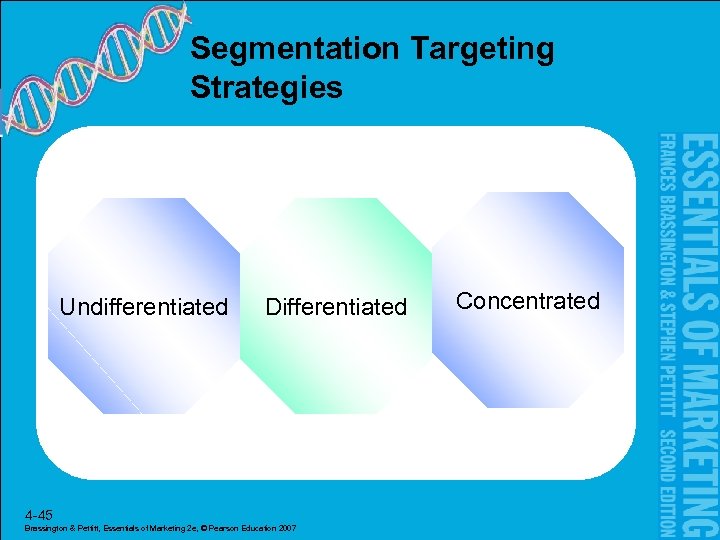 Segmentation Targeting Strategies Undifferentiated Differentiated 4 -45 Brassington & Pettitt, Essentials of Marketing 2 e, © Pearson Education 2007 Concentrated
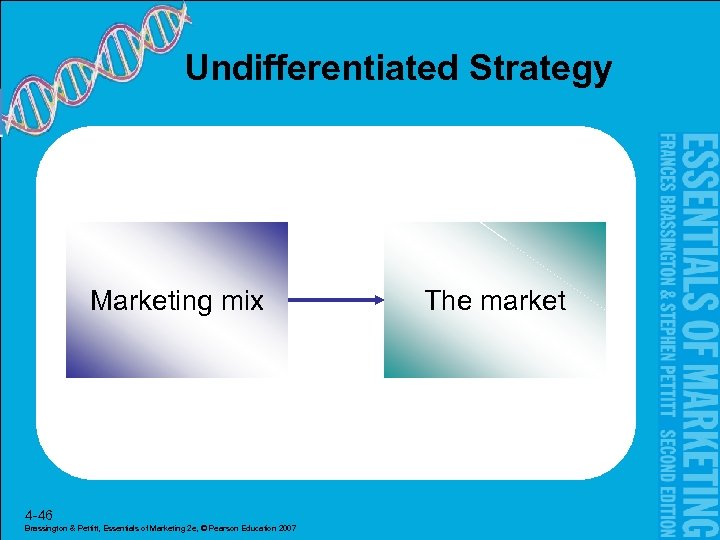 Undifferentiated Strategy Marketing mix 4 -46 Brassington & Pettitt, Essentials of Marketing 2 e, © Pearson Education 2007 The market
 4 -47 Brassington & Pettitt, Essentials of Marketing 2 e, © Pearson Education 2007
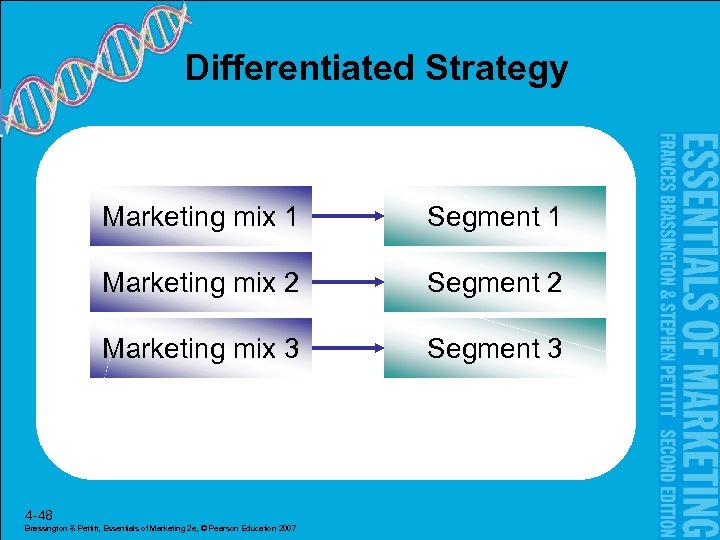 Differentiated Strategy Marketing mix 1 Segment 1 Marketing mix 2 Segment 2 Marketing mix 3 Segment 3 4 -48 Brassington & Pettitt, Essentials of Marketing 2 e, © Pearson Education 2007
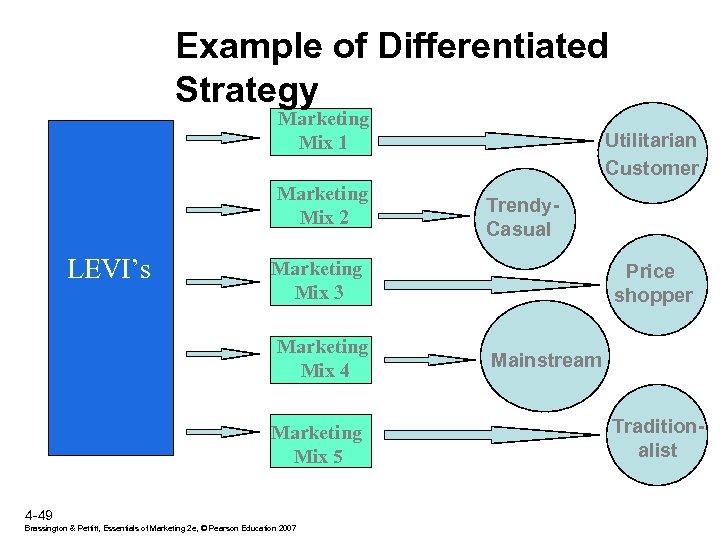 Example of Differentiated Strategy Marketing Mix 1 Marketing Mix 2 LEVI’s Utilitarian Customer Trendy. Casual Marketing Mix 3 Marketing Mix 4 Marketing Mix 5 4 -49 Brassington & Pettitt, Essentials of Marketing 2 e, © Pearson Education 2007 Price shopper Mainstream Traditionalist
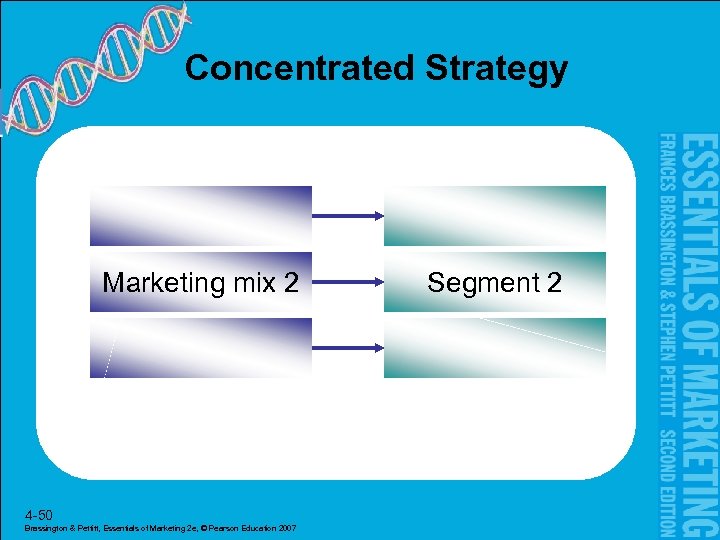 Concentrated Strategy Marketing mix 2 4 -50 Brassington & Pettitt, Essentials of Marketing 2 e, © Pearson Education 2007 Segment 2
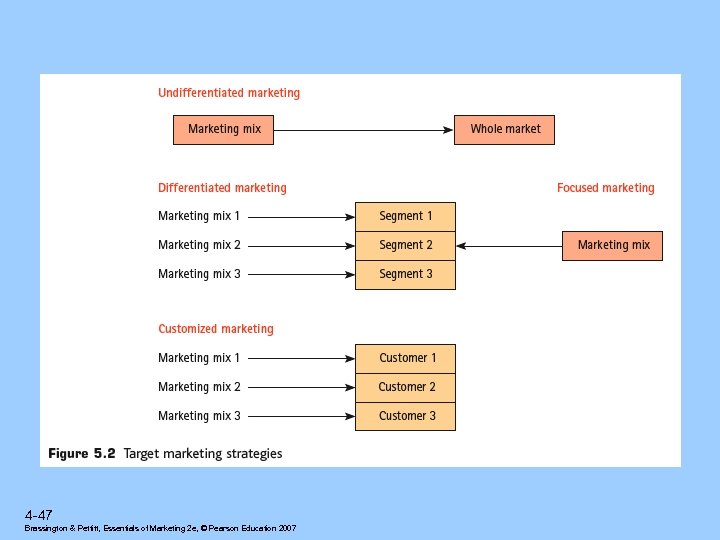
 The Concentrated Targeting Strategy • The concentrated approach is the most focused and involves specialising on serving one specific segment. • Can lead to very detailed knowledge of the target segment’s needs and wants. • This strategy can help keep costs down as there is only one marketing mix to manage. • Helps to develop a niche market. 4 -51 Brassington & Pettitt, Essentials of Marketing 2 e, © Pearson Education 2007
 The Differentiated Targeting Strategy • Involves the development of a number of different marketing mixes for different segments. • Allows a business to tailor its offerings to suit different segments. • Spreads risk across market segments. • Requires a detailed overview of the market and its development potential. • Can dilute a company’s efforts. 4 -52 Brassington & Pettitt, Essentials of Marketing 2 e, © Pearson Education 2007
 The Undifferentiated Targeting Strategy • Least demanding targeting strategy. • Assumes that the market is one homogeneous unit with no significant differences. • One single marketing mix serving all needs. • Relatively inexpensive. 4 -53 Brassington & Pettitt, Essentials of Marketing 2 e, © Pearson Education 2007
 Segmentation – the Benefits • Customers can find products/services that fit more closely to what they want. • Customers can feel more responsive and loyal to organisations that speak directly to them and tailor their products accordingly. • Enables organisations to target its marketing mix more closely on potential customers thus matching their needs more accurately. 4 -54 Brassington & Pettitt, Essentials of Marketing 2 e, © Pearson Education 2007
 Segmentation – the Benefits • Enables organisations to define shopping habits. • Places the customer at the core of all decisions. • Enables the organisation to achieve a better understanding of itself and its environment. 4 -55 Brassington & Pettitt, Essentials of Marketing 2 e, © Pearson Education 2007
 Segmentation - the Dangers • Risk of poor definition and implementation of psychographic segmentation. • Knowing where to stop. • Fragmentation of the market. • Customer confusion. 4 -56 Brassington & Pettitt, Essentials of Marketing 2 e, © Pearson Education 2007
 Criteria for Successful Segmentation Distinctiveness Tangibility Accessibility Defendability 4 -57 Brassington & Pettitt, Essentials of Marketing 2 e, © Pearson Education 2007
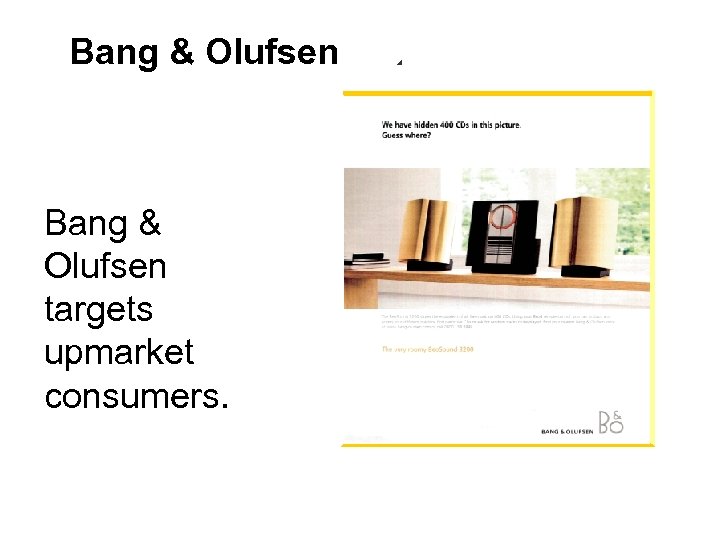 Bang & Olufsen targets upmarket consumers.
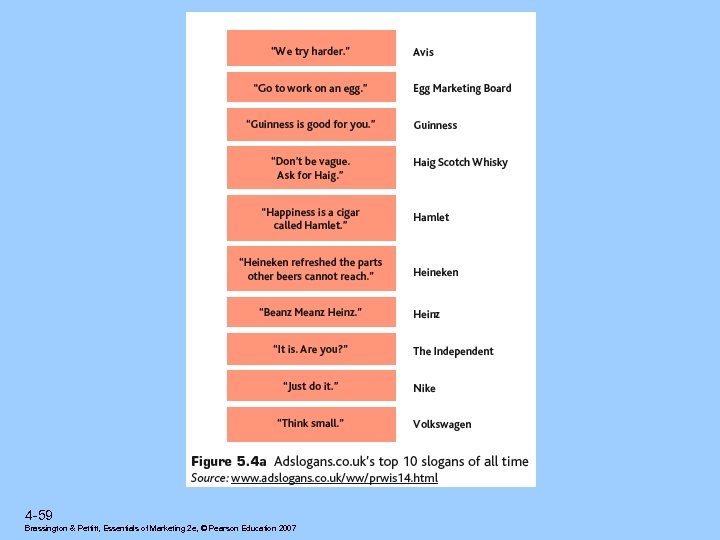 4 -59 Brassington & Pettitt, Essentials of Marketing 2 e, © Pearson Education 2007
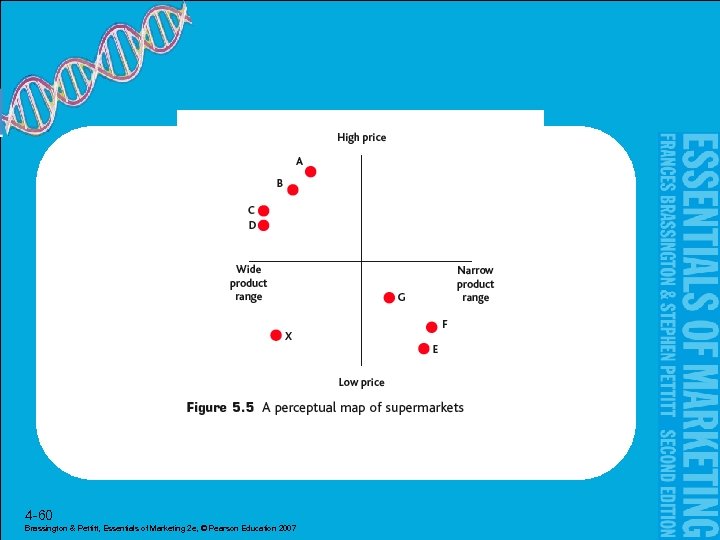 4 -60 Brassington & Pettitt, Essentials of Marketing 2 e, © Pearson Education 2007
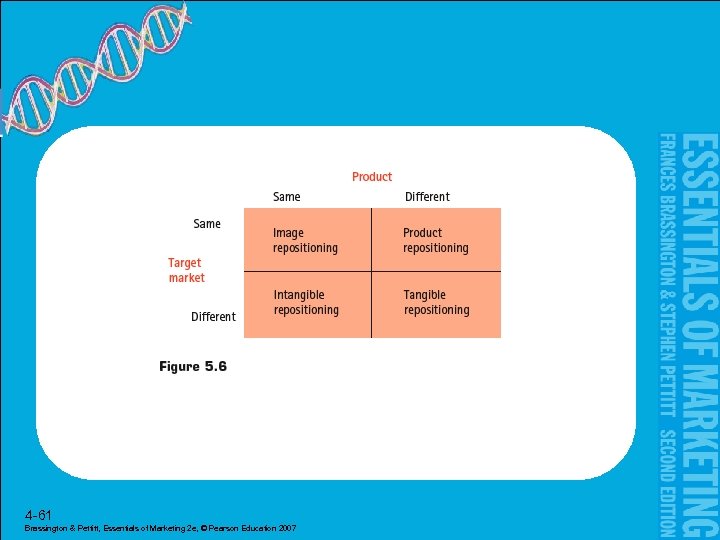 4 -61 Brassington & Pettitt, Essentials of Marketing 2 e, © Pearson Education 2007
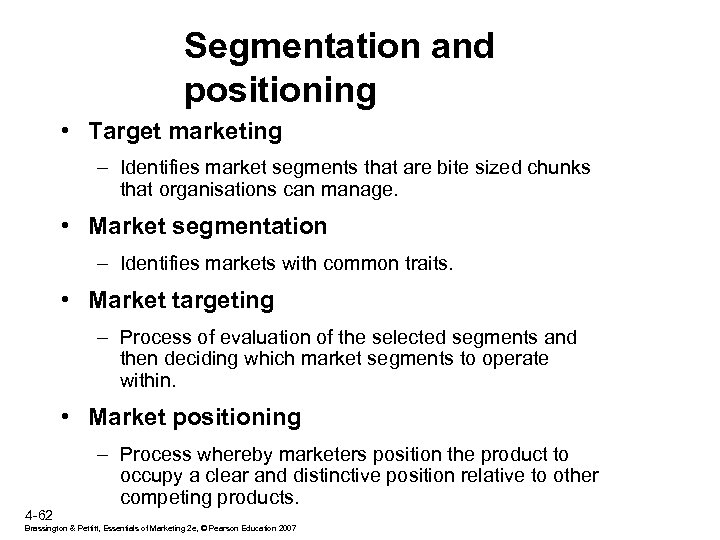 Segmentation and positioning • Target marketing – Identifies market segments that are bite sized chunks that organisations can manage. • Market segmentation – Identifies markets with common traits. • Market targeting – Process of evaluation of the selected segments and then deciding which market segments to operate within. • Market positioning 4 -62 – Process whereby marketers position the product to occupy a clear and distinctive position relative to other competing products. Brassington & Pettitt, Essentials of Marketing 2 e, © Pearson Education 2007
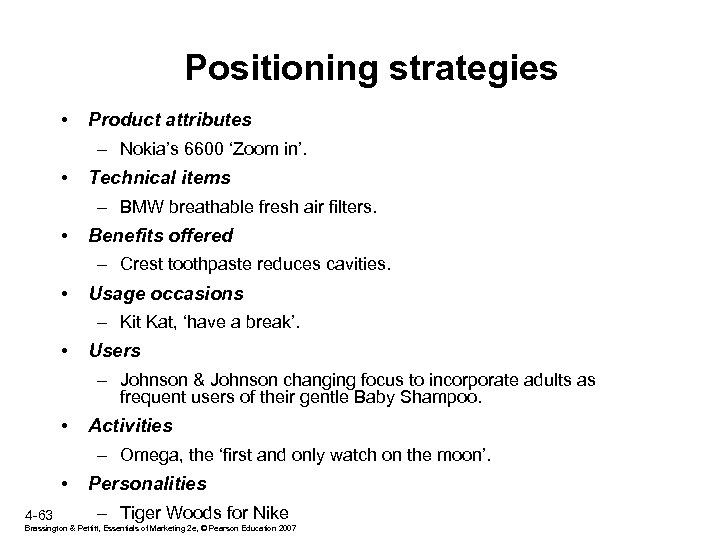 Positioning strategies • Product attributes – Nokia’s 6600 ‘Zoom in’. • Technical items – BMW breathable fresh air filters. • Benefits offered – Crest toothpaste reduces cavities. • Usage occasions – Kit Kat, ‘have a break’. • Users – Johnson & Johnson changing focus to incorporate adults as frequent users of their gentle Baby Shampoo. • Activities – Omega, the ‘first and only watch on the moon’. • 4 -63 Personalities – Tiger Woods for Nike Brassington & Pettitt, Essentials of Marketing 2 e, © Pearson Education 2007
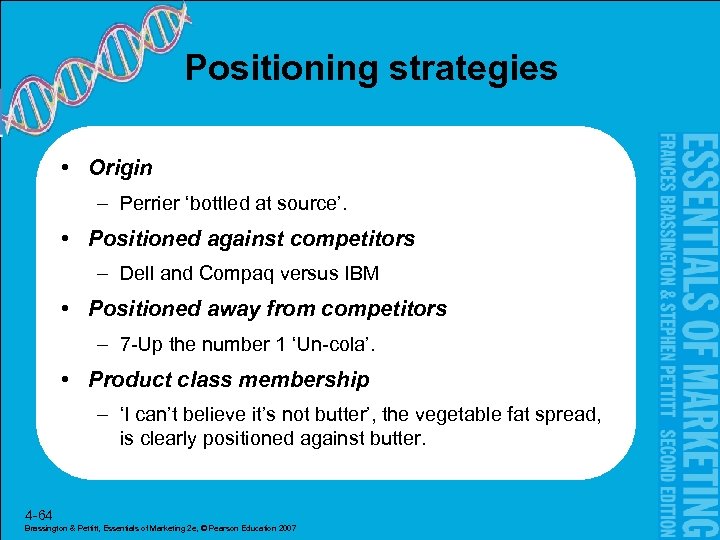 Positioning strategies • Origin – Perrier ‘bottled at source’. • Positioned against competitors – Dell and Compaq versus IBM • Positioned away from competitors – 7 -Up the number 1 ‘Un-cola’. • Product class membership – ‘I can’t believe it’s not butter’, the vegetable fat spread, is clearly positioned against butter. 4 -64 Brassington & Pettitt, Essentials of Marketing 2 e, © Pearson Education 2007