 Скачать презентацию Slide 2003 By Default Poverty Lines Celia
e2f1eed38f57bbe36e7fff704919256c.ppt
- Количество слайдов: 90



Slide © 2003 By Default! Poverty Lines Celia M. Reyes Introduction to Poverty Analysis NAI, Beijing, China Nov. 1 -8, 2005
Slide 2 © 2003 By Default! Step 2: How to define a poverty line n After choosing a measure of household wellbeing, say consumption expenditure, the next step is to choose a poverty line. Households whose consumption expenditure fall below the poverty line are considered poor. n The poverty line is obtained by specifying a consumption bundle considered adequate for basic consumption needs and then estimating the costs of these basic needs.
Slide 3 © 2003 By Default! How to define a poverty line n The poverty line is conceptualised as a minimum standard required by an individual to fulfil his or her basic food and non-food needs. n The poverty line defines the level of consumption (or income) needed for a household to escape poverty.
Slide 4 © 2003 By Default! How to define a poverty line n Well-being follows a continuum, and given how arbitrary the choice of the poverty line is, the notion of a turning point is not very compelling. n It may make sense to define more than one poverty line. One poverty line may mark households that are poor and another level could indicate those that are extremely poor.
Slide 5 © 2003 By Default! How to define a poverty line n One could also construct a “food poverty line” which is based on some notion of minimum amount of money that a household needs to purchase some basic-needs food bundle. n If the cost of the basic needs is estimated, then the food poverty line added to the nonfood needs will equal the overall poverty line.
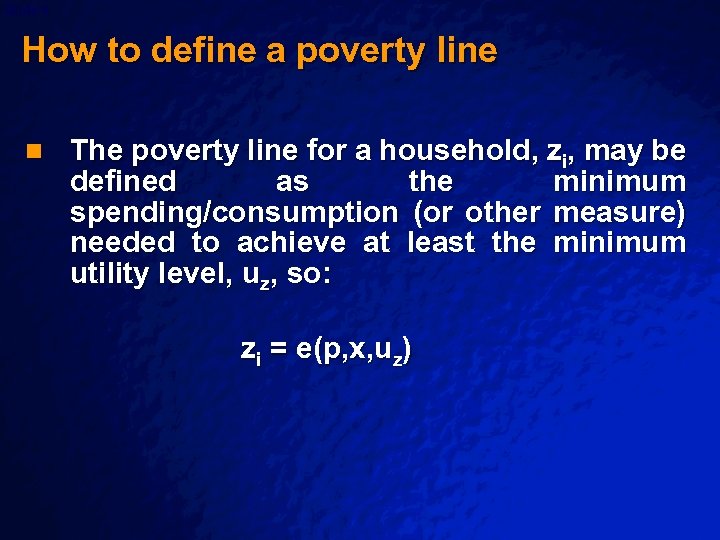
Slide 6 © 2003 By Default! How to define a poverty line n The poverty line for a household, zi, may be defined as the minimum spending/consumption (or other measure) needed to achieve at least the minimum utility level, uz, so: zi = e(p, x, uz)
Slide 7 © 2003 By Default! How to define a poverty line Two approaches in constructing poverty lines: 1. Compute a poverty line for each household, adjusting it from household to take into account differences in the prices they face and their demographic composition. Example - Thailand 2. Construct one per capita poverty line for all individuals, but to adjust per capita yi for differences in prices and household composition. Example - Philippines
Slide 8 © 2003 By Default! How to define a poverty line The approach taken for Cambodia in 1999 somewhere between these two extremes. Separate poverty lines were constructed for each of the three major regions based on the prices prevailing in those areas. These poverty lines are shown in Table 3. 1.
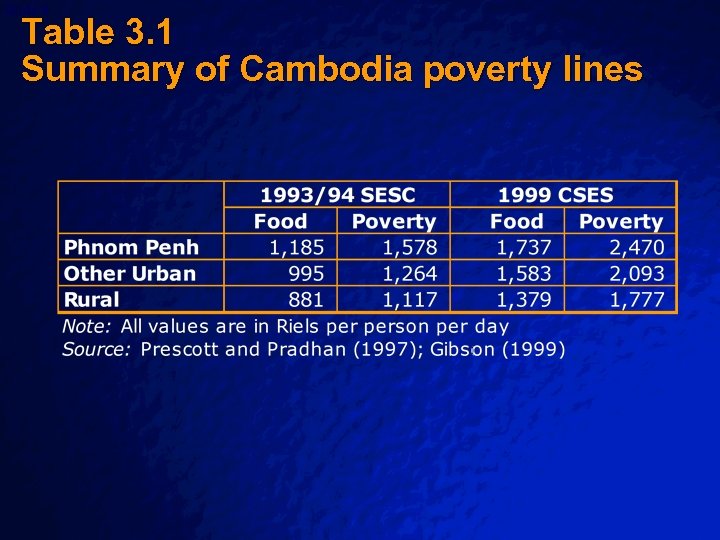
Slide 9 © 2003 By Default! Table 3. 1 Summary of Cambodia poverty lines
Slide 10 © 2003 By Default! How to define a poverty line n Why do poverty lines change over time: – As prices change, the poverty line will change – We could change the way we compute the poverty line (i. e. , real poverty threshold is revised).
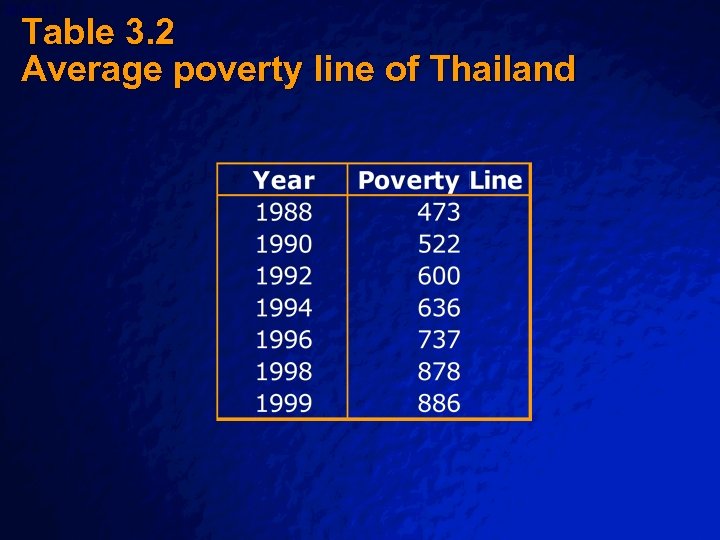
Slide 11 Table 3. 2 Average poverty line of Thailand © 2003 By Default!
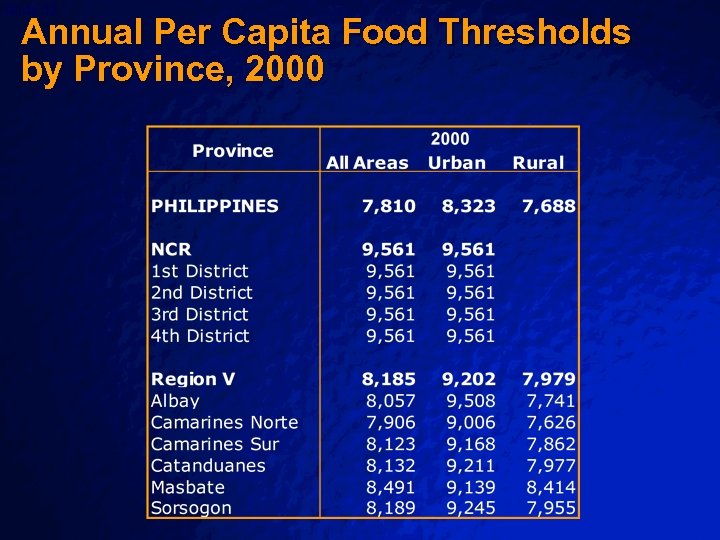
Slide 12 © 2003 By Default! Annual Per Capita Food Thresholds by Province, 2000
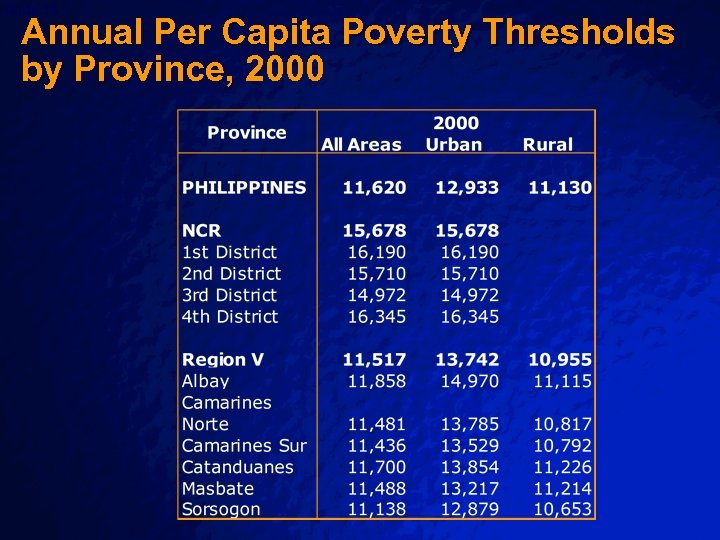
Slide 13 © 2003 By Default! Annual Per Capita Poverty Thresholds by Province, 2000
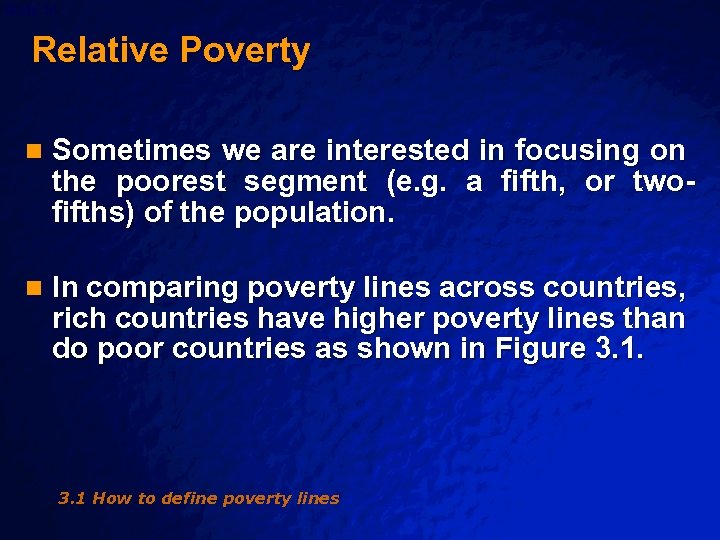
Slide 14 © 2003 By Default! Relative Poverty n Sometimes we are interested in focusing on the poorest segment (e. g. a fifth, or twofifths) of the population. n In comparing poverty lines across countries, rich countries have higher poverty lines than do poor countries as shown in Figure 3. 1 How to define poverty lines
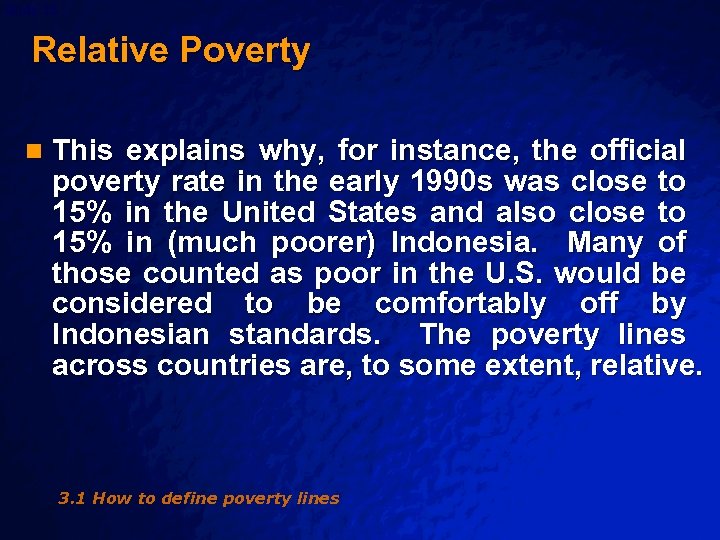
Slide 15 © 2003 By Default! Relative Poverty n This explains why, for instance, the official poverty rate in the early 1990 s was close to 15% in the United States and also close to 15% in (much poorer) Indonesia. Many of those counted as poor in the U. S. would be considered to be comfortably off by Indonesian standards. The poverty lines across countries are, to some extent, relative. 3. 1 How to define poverty lines
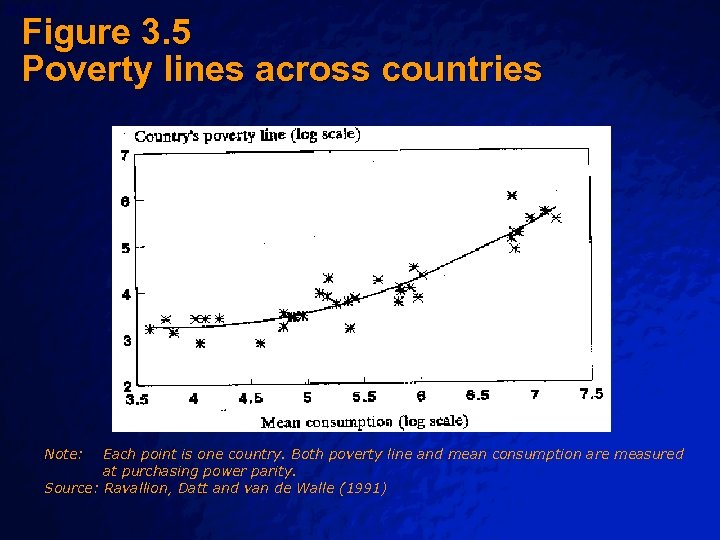
Slide 16 Figure 3. 5 Poverty lines across countries Note: © 2003 By Default! Each point is one country. Both poverty line and mean consumption are measured at purchasing power parity. Source: Ravallion, Datt and van de Walle (1991)
Slide 17 © 2003 By Default! Relative Poverty n The most common practice in setting relative poverty lines is to use some proportion of the arithmetic mean or median of the distribution of consumption or income as the poverty line; for example, many studies have used a poverty line which is set at about 50% of the national median: SESC 1993/94 Mean: 1833 --> poverty line = 916 too low? 3. 1 How to define poverty lines
Slide 18 © 2003 By Default! Relative Poverty n In comparing poverty lines across countries, rich countries have higher poverty lines than do poor countries. n This explains why, for instance, the official poverty rate in the early 1990 s was close to 15% in the United States and also close to 15% in (much poorer) Indonesia. Many of those counted as poor in the U. S. would be considered to be comfortably off by Indonesian standards. The poverty lines across countries are, to some extent, relative. 3. 1 How to define poverty lines
Slide 19 © 2003 By Default! Relative Poverty n As countries become better off, they have a tendency to revise the poverty line upwards – with the notable exception of the United States, where the line has (in principle) remained unchanged for almost four decades. 3. 1 How to define poverty lines
Slide 20 © 2003 By Default! Relative Poverty n To the extent that it is to identify and target today’s poor, then a relative poverty line is appropriate, and needs to be tailored to the overall level of development of the country. For instance, the European Union typically defines the poor as those whose per capita incomes fall below 50% of the median. As median incomes rise, so does the poverty line. 3. 1 How to define poverty lines
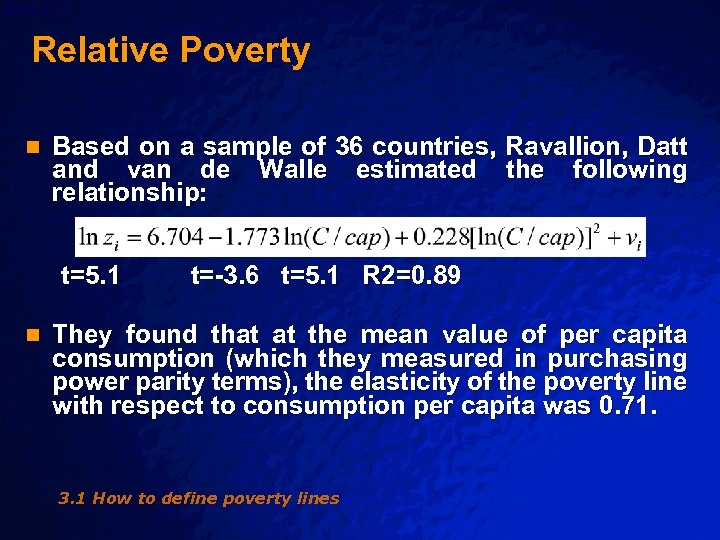
Slide 21 © 2003 By Default! Relative Poverty n Based on a sample of 36 countries, Ravallion, Datt and van de Walle estimated the following relationship: t=5. 1 n t=-3. 6 t=5. 1 R 2=0. 89 They found that at the mean value of per capita consumption (which they measured in purchasing power parity terms), the elasticity of the poverty line with respect to consumption per capita was 0. 71. 3. 1 How to define poverty lines
Slide 22 © 2003 By Default! Relative Poverty n This means that if per capita consumptions were to rise 10%, then the poverty line would rise 7. 1% on average. But the non-linear relationship implies that the elasticity of the poverty line with respect to consumption per capita was close to 0 in low-income countries, and was almost 1 in high-income countries. 3. 1 How to define poverty lines
Slide 23 © 2003 By Default! Relative Poverty n To the extent that it is to identify and target today’s poor, then a relative poverty line is appropriate, and needs to be tailored to the overall level of development of the country. For instance, a $1 per day poverty line might be useful in Vietnam, where 27% of the population would be considered poor by this standard in 1998 (Haughton 2000), but would be of little relevance in the United States where almost nobody would be poor by this standard. 3. 1 How to define poverty lines
Slide 24 © 2003 By Default! Absolute Poverty n An absolute poverty line is one that is fixed in terms of standard of living. A relative poverty line, by contrast, varies depending on the standard of living. n An absolute poverty line is essential if one is trying to judge the effect of anti-poverty policies over time, or to estimate the impact of a project (e. g. microcredit) on poverty. 3. 1 How to define poverty lines
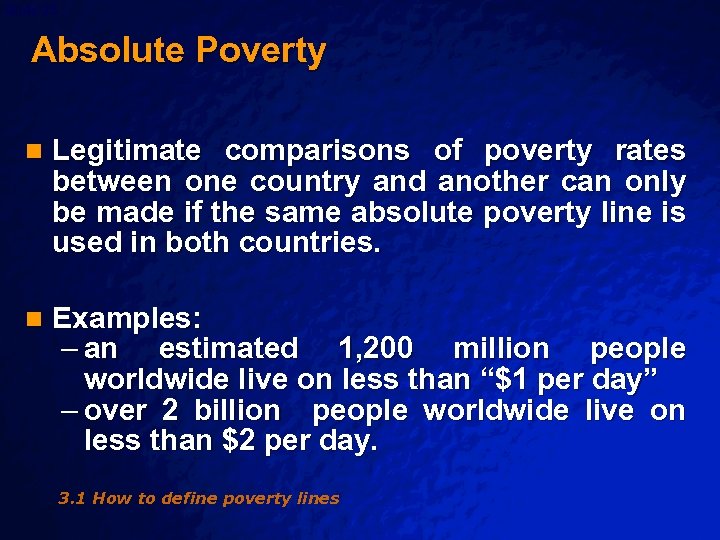
Slide 25 © 2003 By Default! Absolute Poverty n Legitimate comparisons of poverty rates between one country and another can only be made if the same absolute poverty line is used in both countries. n Examples: – an estimated 1, 200 million people worldwide live on less than “$1 per day” – over 2 billion people worldwide live on less than $2 per day. 3. 1 How to define poverty lines
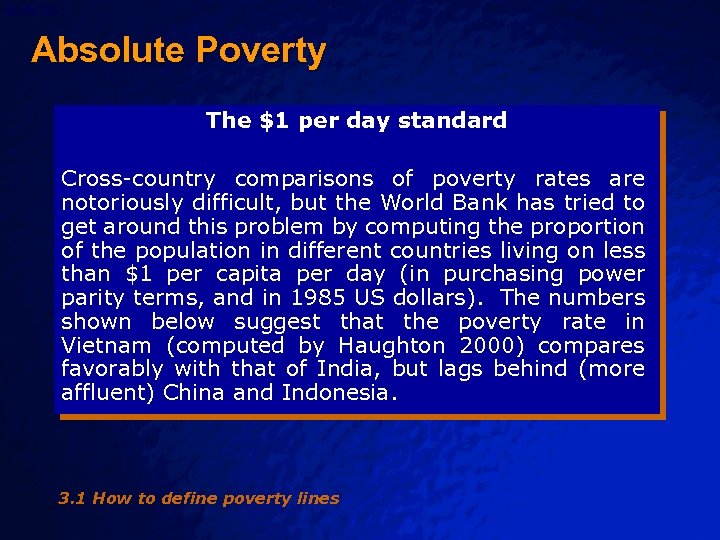
Slide 26 © 2003 By Default! Absolute Poverty The $1 per day standard Cross-country comparisons of poverty rates are notoriously difficult, but the World Bank has tried to get around this problem by computing the proportion of the population in different countries living on less than $1 per capita per day (in purchasing power parity terms, and in 1985 US dollars). The numbers shown below suggest that the poverty rate in Vietnam (computed by Haughton 2000) compares favorably with that of India, but lags behind (more affluent) China and Indonesia. 3. 1 How to define poverty lines
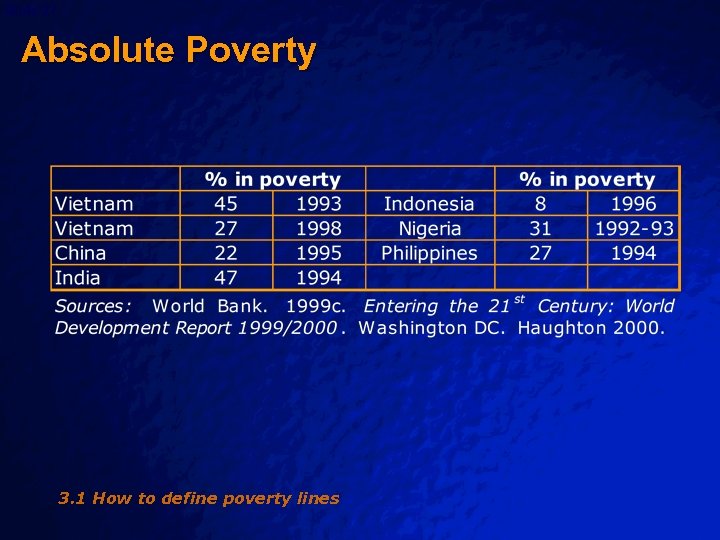
Slide 27 © 2003 By Default! Absolute Poverty 3. 1 How to define poverty lines
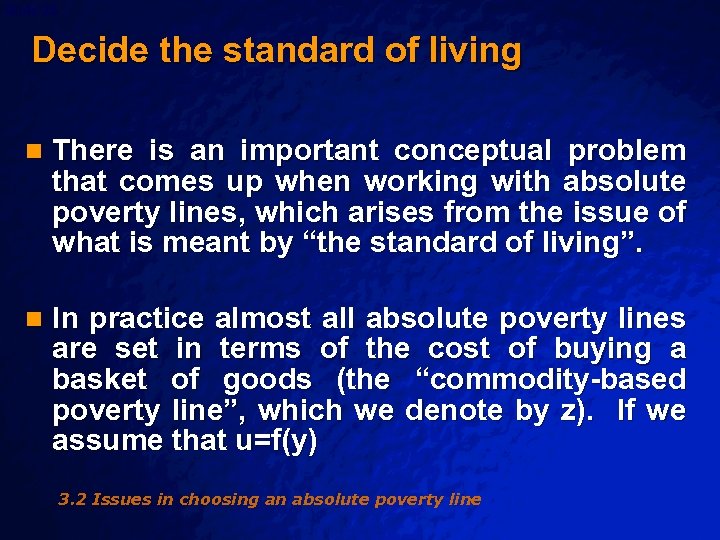
Slide 28 © 2003 By Default! Decide the standard of living n There is an important conceptual problem that comes up when working with absolute poverty lines, which arises from the issue of what is meant by “the standard of living”. n In practice almost all absolute poverty lines are set in terms of the cost of buying a basket of goods (the “commodity-based poverty line”, which we denote by z). If we assume that u=f(y) 3. 2 Issues in choosing an absolute poverty line
Slide 29 © 2003 By Default! Decide the standard of living If we assume that u=f(y), which says that utility or “standard of living” (u) depends on income or expenditure (y), then y=f-1(u) This says that for any given level of utility, there is some income (or expenditure) level that is needed to achieve it. If uz is the utility that just suffices to avoid being poor, then z=f-1(uz) In other words, given a poverty line that is absolute in the space of welfare (i. e. gives uz) there is a corresponding absolute commodity-based poverty line. 3. 2 Issues in choosing an absolute poverty line
Slide 30 © 2003 By Default! Decide the standard of living But suppose we make another equally plausible assumption, which is that utilities are interdependent. Then, one’s well-being may depend not just on what one consume, but on how one’s consumption stacks up against that of the rest of society. A household of four with an income of $12, 000 per year would not be considered poor in Indonesia, but when this household compares its position with average incomes in the US, it may feel very poor. 3. 2 Issues in choosing an absolute poverty line
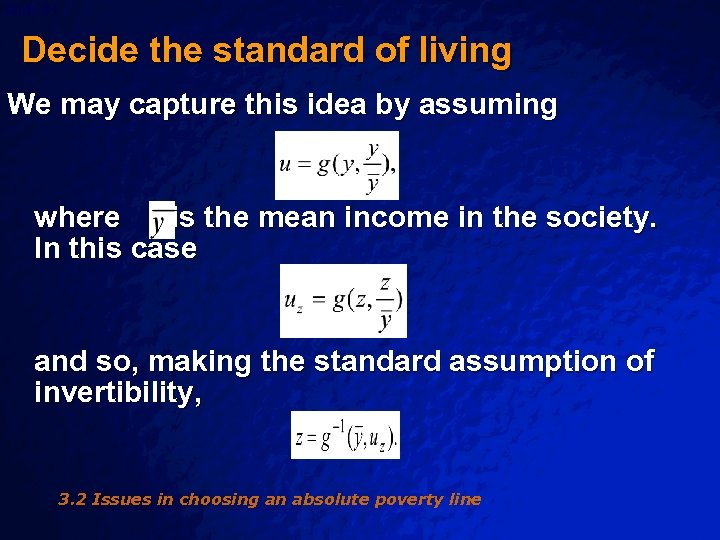
Slide 31 © 2003 By Default! Decide the standard of living We may capture this idea by assuming where is the mean income in the society. In this case and so, making the standard assumption of invertibility, 3. 2 Issues in choosing an absolute poverty line
Slide 32 © 2003 By Default! Decide the standard of living n This means that for a poverty line to be absolute in the space of welfare (i. e. to yield uz), the commodity-based poverty line (i. e. z) may have to rise as rises. The commoditybased poverty line would then look more like a relative poverty line. 3. 2 Issues in choosing an absolute poverty line
Slide 33 © 2003 By Default! Decide utility of the poverty line uz and commodity value of the poverty line Z) n Even if we assume that the commoditybased poverty line remains constant, we are still left with two problems: – The Referencing problem. What is the appropriate value of uz – i. e. the utility of the poverty line? The choice is arbitrary, but “a degree of consensus about the choice of the reference utility level in a specific society may well be crucial to mobilizing resources for fighting poverty” (Ravallion) 3. 2 Issues in choosing an absolute poverty line
Slide 34 © 2003 By Default! Decide utility of the poverty line uz and commodity value of the poverty line Z) – The Identification problem. Given uz, what is the correct value of z – i. e. of the commodity value of the poverty line. This problem arises both because the size and demographic composition of households vary and also because “the view that we can measure welfare by looking solely at demand behavior is untenable” (Ravallion) 3. 2 Issues in choosing an absolute poverty line
Slide 35 © 2003 By Default! Decide utility of the poverty line uz and commodity value of the poverty line Z) n The implication is that external information and judgments will be required to answer the referencing and identification problem, and hence to determine the absolute poverty line in practice. n Table 3. 3 presents absolute and relative poverty rates for different regions in the world. 3. 2 Issues in choosing an absolute poverty line
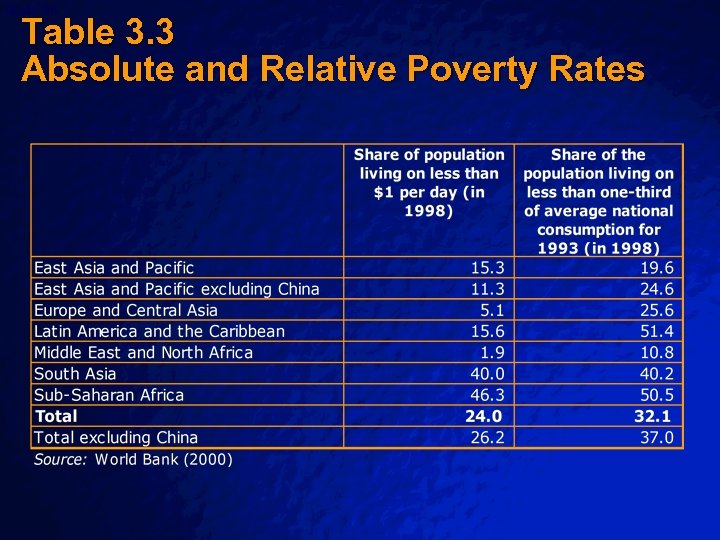
Slide 36 © 2003 By Default! Table 3. 3 Absolute and Relative Poverty Rates
Slide 37 © 2003 By Default! Decide utility of the poverty line uz and commodity value of the poverty line Z) n We might note that an absolute poverty line is best thought of as one which is fixed in terms of living standards, and fixed over the entire domain of the poverty comparison (Ravallion). n Absolute poverty will deem two persons at the same standard of living to both be either “poor” or “not poor” irrespective of the time or place being considered, or without some policy change, within the relevant domain. 3. 2 Issues in choosing an absolute poverty line
Slide 38 © 2003 By Default! Decide utility of the poverty line uz and commodity value of the poverty line Z) n The poverty comparison is then “consistent” in the specific sense that individuals who are identical in all relevant respects are treated identically. However, depending on the purpose of the comparison, the relevant domain may vary. n For example, a global comparison of absolute consumption poverty may entail using a poverty line (e. g. $1 consumption per capita per day) that is low by the standards of rich countries. 3. 2 Issues in choosing an absolute poverty line
Slide 39 © 2003 By Default! Decide utility of the poverty line uz and commodity value of the poverty line Z) n If, however, one is trying to form a poverty profile for one country only, the choice of an absolute poverty line should be appropriate to that country (e. g. a poverty line of $1 per day might be appropriate in Vietnam, and $10 per day might be suitable in the United States). Judgments of what constitutes a reasonable absolute poverty line must first specify the domain of comparisons, and recognize that the answer may change if the domain changes. 3. 2 Issues in choosing an absolute poverty line
Slide 40 © 2003 By Default! Solution A: objective poverty lines The poverty line should be set at a level that enables individuals to achieve certain capabilities, including a healthy and active lif and full participation in society. n In practice, this almost certainly would imply that the commodity-based poverty line would rise as a country becomes more affluent, because the minimum resources needed to participate fully in society probably rises over time. n Thus, “an absolute approach in the space of capabilities translates into a relative approach in the space of commodities. ” n
Slide 41 © 2003 By Default! Solution A: objective poverty lines n A common way of approaching capabilities is to begin with nutritional requirements. Two common ways of making this operational: – Cost-of-basic Needs approach – Food energy intake method
Slide 42 © 2003 By Default! Food energy Intake method n The goal here is to find the level of consumption expenditure (or income) that allows the household to obtain enough food to meet its energy requirements. n Consumption will include non-food as well as food as items; even underfed household typically consume some clothing and shelter, which means that at the margin these “basic needs” must be as valuable as additional food. 3. 3 Solution A: objective poverty lines
Slide 43 © 2003 By Default! Food energy Intake method n The basic idea is captured in figure 3. 2, which shows a calorie income function; as income (or expenditure) rises, food energy intake also rises, although typically more slowly. Given some level of just-adequate food energy intake k, one may use this curve to determine the poverty-line level of expenditure, z. 3. 3 Solution A: objective poverty lines
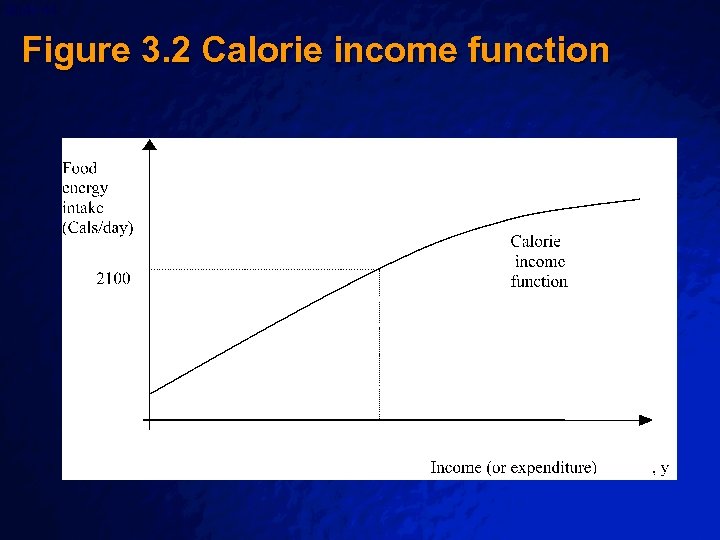
Slide 44 © 2003 By Default! Figure 3. 2 Calorie income function
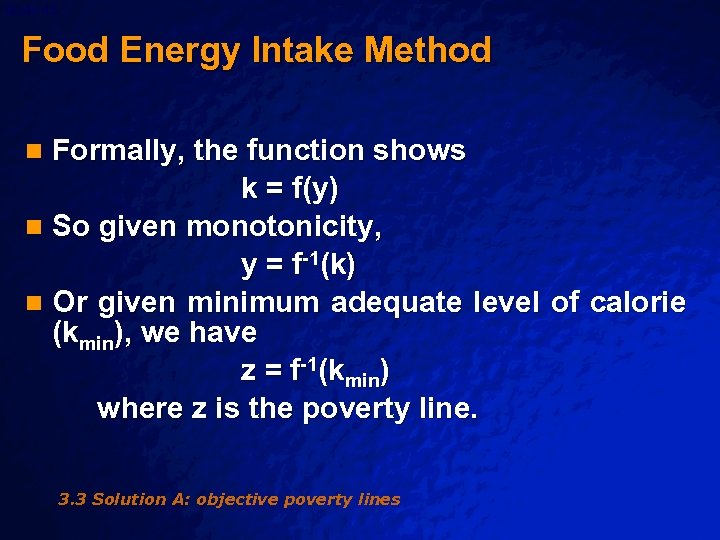
Slide 45 © 2003 By Default! Food Energy Intake Method Formally, the function shows k = f(y) n So given monotonicity, y = f-1(k) n Or given minimum adequate level of calorie (kmin), we have z = f-1(kmin) where z is the poverty line. n 3. 3 Solution A: objective poverty lines
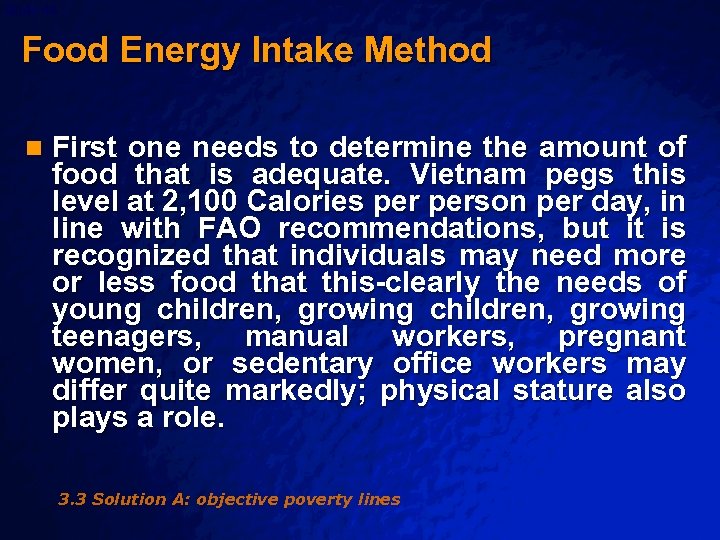
Slide 46 © 2003 By Default! Food Energy Intake Method n First one needs to determine the amount of food that is adequate. Vietnam pegs this level at 2, 100 Calories person per day, in line with FAO recommendations, but it is recognized that individuals may need more or less food that this-clearly the needs of young children, growing teenagers, manual workers, pregnant women, or sedentary office workers may differ quite markedly; physical stature also plays a role. 3. 3 Solution A: objective poverty lines
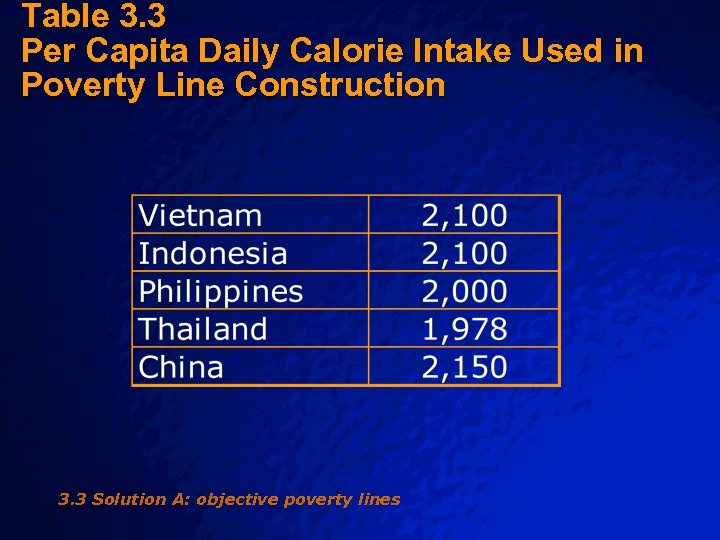
© 2003 By Default! Table 3. 3 Per Capita Daily Calorie Intake Used in Poverty Line Construction Slide 47 3. 3 Solution A: objective poverty lines
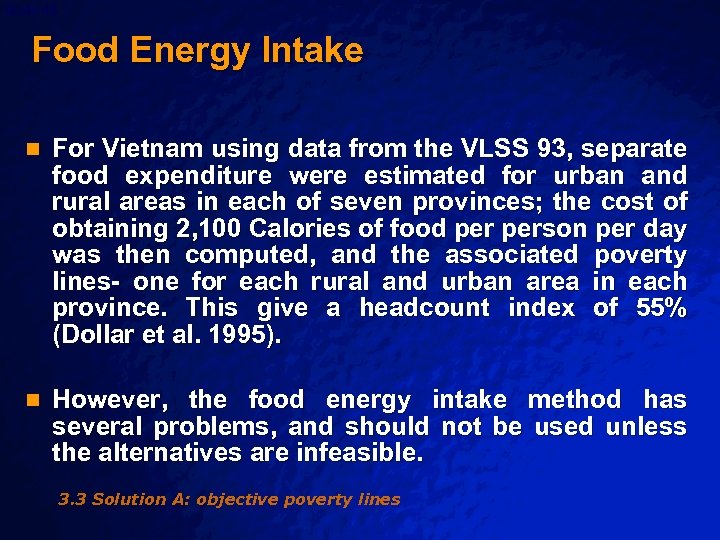
Slide 48 © 2003 By Default! Food Energy Intake n For Vietnam using data from the VLSS 93, separate food expenditure were estimated for urban and rural areas in each of seven provinces; the cost of obtaining 2, 100 Calories of food person per day was then computed, and the associated poverty lines- one for each rural and urban area in each province. This give a headcount index of 55% (Dollar et al. 1995). n However, the food energy intake method has several problems, and should not be used unless the alternatives are infeasible. 3. 3 Solution A: objective poverty lines
Slide 49 © 2003 By Default! The urban-rural problem n The problem begins when one recognizes that food energy – typically shown on the calorie income function – depends on other factors as well as income. n The other influences include – the tastes of the household (e. g. urban states in food may differ from rural tastes) – the level of activity of household members; – the relative prices of different foods, and of food to non- food items; – and the presence of publicly-provided goods. 3. 3. 1 Food Energy Intake
Slide 50 © 2003 By Default! The urban-rural problem Figure 3. 3 shows hypothetical (but plausible) calorie income functions for urban and rural households. n Rural households can obtain food more cheaply, both because food is typically less expensive in the rural areas and also because they are more willing to consume foodstuffs that are cheaper calorie (ex. Cassava rather than rice). n 3. 3. 1 Food Energy Intake
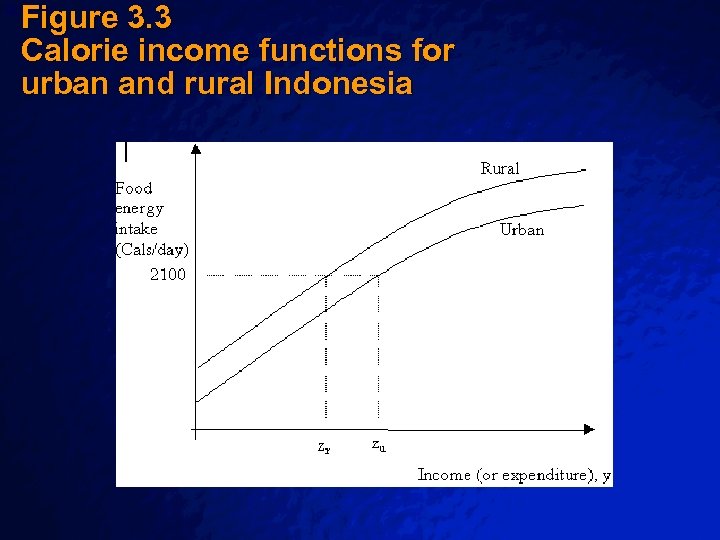
Figure 3. 3 Calorie income functions for urban and rural Indonesia Slide 51 © 2003 By Default!
Slide 52 © 2003 By Default! The urban-rural problem n The key finding of Ravallion and Bidani (1994), based on 1990 data from the SUSENAS household survey in Indonesia, was that the urban poverty line (20, 614 rupiah person per month) was much higher than the rural one (13, 295 Rp /person/month). This gap far exceeded the difference in the cost of living between urban and rural areas. n Using these poverty lines, Ravallion and Bidani (1994) found that poverty in Indonesia appeared to be higher in the urban than in the rural areas (Table 3. 4), a completely implausible result. 3. 3. 1 Food Energy Intake
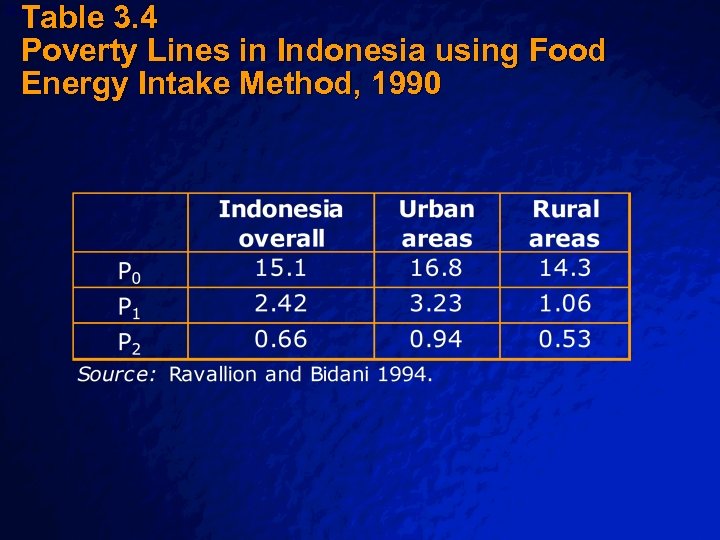
Table 3. 4 Poverty Lines in Indonesia using Food Energy Intake Method, 1990 Slide 53 © 2003 By Default!
Slide 54 © 2003 By Default! The urban-rural problem n The point is also illustrated in Figure 3. 4, which shows the cumulative distribution of consumption per capita, for rural and urban areas, and marks the poverty lines and headcount poverty rates. 3. 3. 1 Food Energy Intake
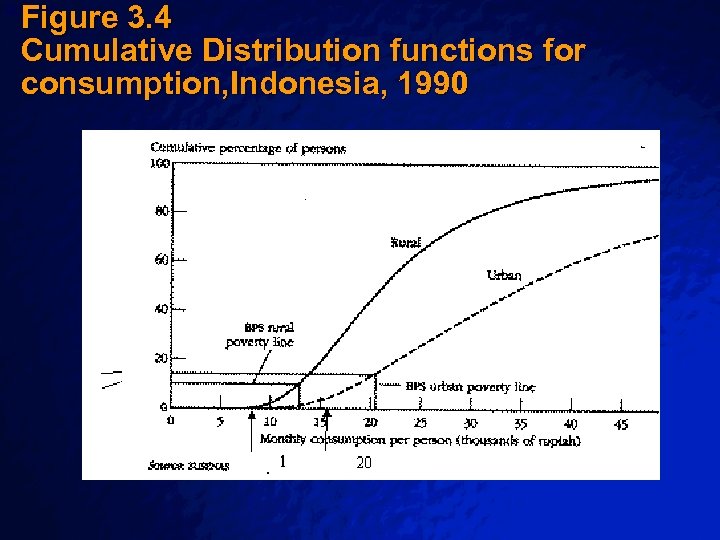
Figure 3. 4 Cumulative Distribution functions for consumption, Indonesia, 1990 Slide 55 © 2003 By Default!
Slide 56 © 2003 By Default! The relative price problem n When researchers tried to apply the Food Energy Intake approach to data from the Vietnam Living Standards Survey of 1998, the method failed. n As with the 1993 data, the idea was to compute food expenditure per capita, which would then serve as a poverty line. 3. 3. 1 Food Energy Intake
Slide 57 © 2003 By Default! The relative price problem n After undertaking this exercise, researchers found a higher level of poverty in 1998 than in 1993, an implausible result in an economy whose real GDP grew by 9% annually between 1993 and 1998, and where there was a widespread sense that the benefits of this growth had spread widely.
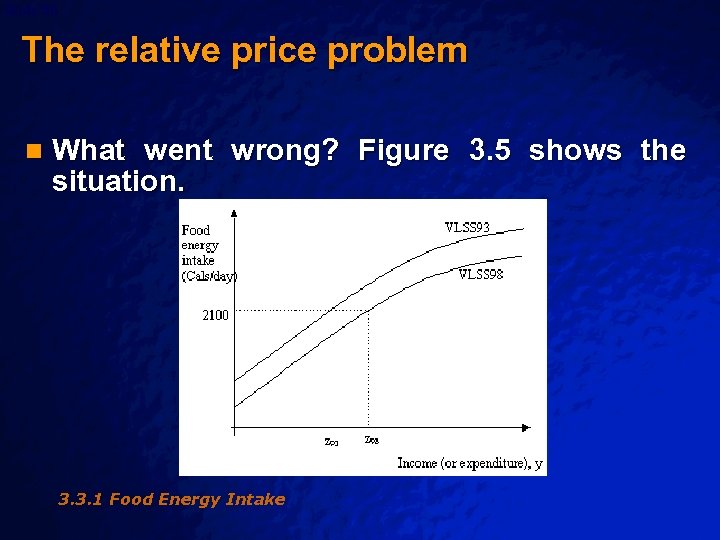
Slide 58 © 2003 By Default! The relative price problem n What went wrong? Figure 3. 5 shows the situation. 3. 3. 1 Food Energy Intake
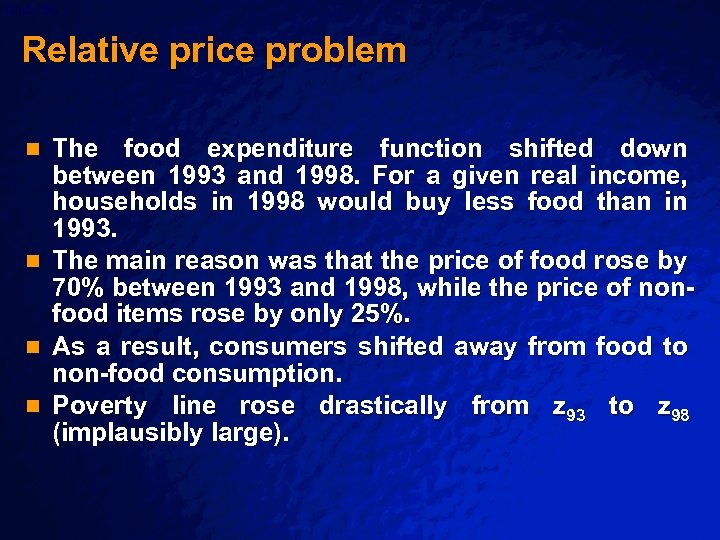
Slide 59 © 2003 By Default! Relative price problem n n The food expenditure function shifted down between 1993 and 1998. For a given real income, households in 1998 would buy less food than in 1993. The main reason was that the price of food rose by 70% between 1993 and 1998, while the price of nonfood items rose by only 25%. As a result, consumers shifted away from food to non-food consumption. Poverty line rose drastically from z 93 to z 98 (implausibly large).
Slide 60 © 2003 By Default! The Cost-of-Basic Needs Method n A more satisfactory approach to building up a poverty line, while remaining in the spirit of trying to ensure that the line covers basic needs, proceeds as follows: – Stipulate a consumption bundle that is deemed to be adequate, with both food and non food components; and – Estimate the cost of the bundle for each subgroup (urban/rural, each region, etc. ). 3. 3 Solution A: objective poverty lines
Slide 61 © 2003 By Default! The Cost-of-Basic Needs Method n Note that the poverty line is measured in money. We are therefore not insisting that each basic need be met, only that it could be met. n The steps to follow are these: – Pick a nutritional requirement for good health, such as 2, 100 Calories person per day. 3. 3 Solution A: objective poverty lines
Slide 62 © 2003 By Default! The Cost-of-Basic Needs Method n Estimate the cost of meeting these food energy requirement, using a diet that reflects the habit of households near the poverty line (e. g. those in the lowest, or second-lowest, quintile of the income distribution; or those consuming between 2000 and 2200 Calories). This may not be easy if diets vary widely across the country. Call this food component z. F. 3. 3 Solution A: objective poverty lines
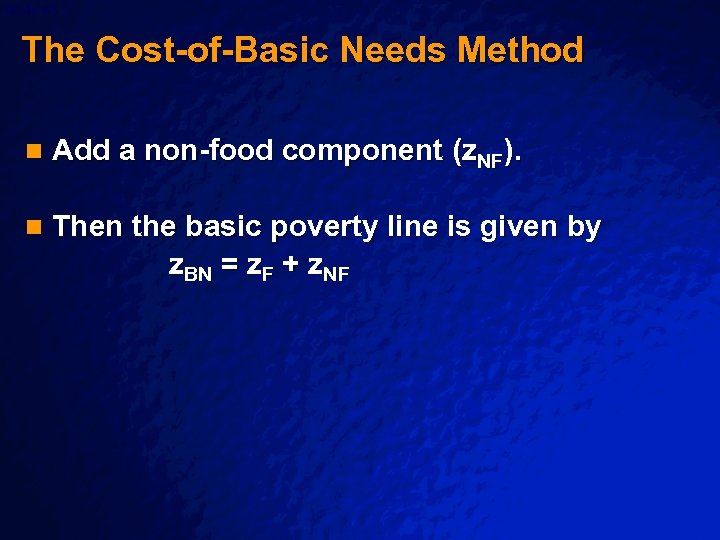
Slide 63 © 2003 By Default! The Cost-of-Basic Needs Method n Add a non-food component (z. NF). n Then the basic poverty line is given by z. BN = z. F + z. NF
Slide 64 © 2003 By Default! The Cost-of-Basic Needs Method Box. The US poverty line In 1963 and 1964, Mollie Orshansky of the Social Security Administration computed the cost of an ‘adequate’ amount of food intake, to get z. F. She then multiplied this number by 3 to get z. BN. Why? Because at the time, the average food share for all consumers in the United States was 1/3. This line is still used, updated regularly for price changes. 3. 3 Solution A: objective poverty lines
Slide 65 © 2003 By Default! The Cost-of-Basic Needs Method n To illustrate how this might work, suppose that we use a food energy threshold of 2100 Calories per day. Let there be three foodstuffs: rice, corn and eggs. Table 3. 5 shows the expenditure on each item, and the amount consumed by a household in the second (from bottom) quintile. 3. 3 Solution A: objective poverty lines
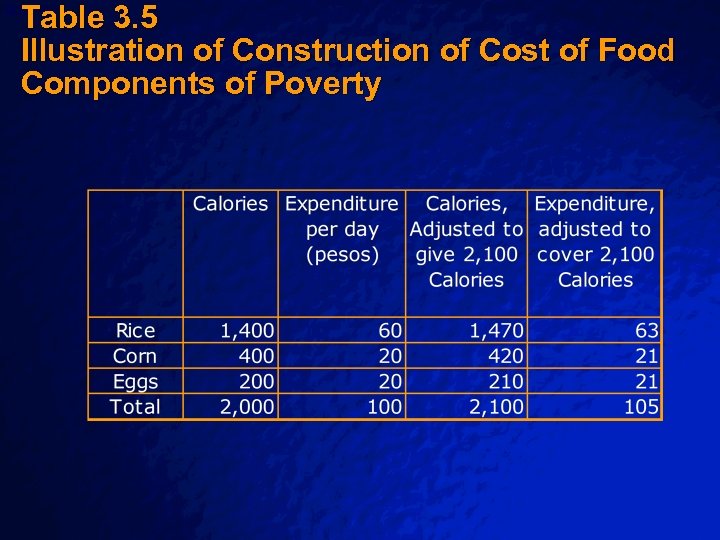
Table 3. 5 Illustration of Construction of Cost of Food Components of Poverty Slide 66 © 2003 By Default!
Slide 67 © 2003 By Default! The Cost-of-Basic Needs Method n The choice of which diet to use when estimating the cost of obtaining 2100 Calories is not a trivial one, a point emphasized in the context of Indonesia by Pradhan et al (2000). n Table 3. 6 illustrates this. Data is drawn from the VLSS of 1992 -93. 3. 3 Solution A: objective poverty lines
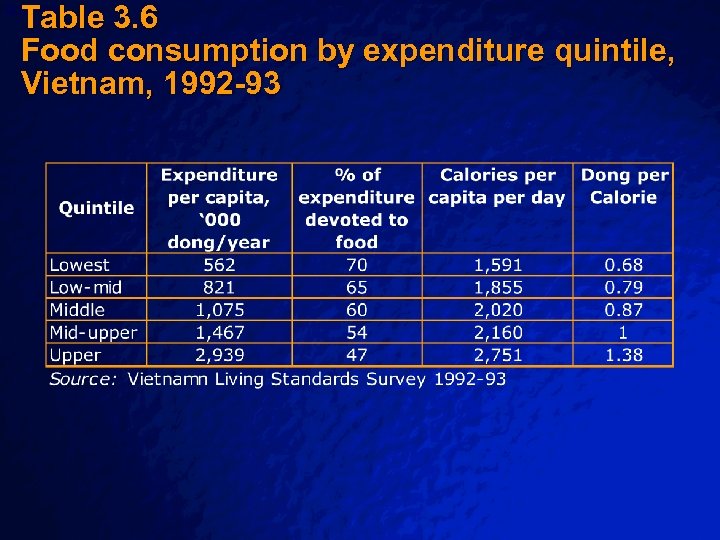
Table 3. 6 Food consumption by expenditure quintile, Vietnam, 1992 -93 Slide 68 © 2003 By Default!
Slide 69 © 2003 By Default! The Cost-of-Basic Needs Method n To compare poverty over time, this poverty line was updated to 1998. The cost of each item in the poverty-line diet of 1993 was recomputed using the prices of 1998; nonfood expenditure was inflated using data from the General Statistics Office’s price index. n This yielded a poverty line of 1, 793, 903 and an associated poverty rate of 37% of which details are in Table 3. 7. 3. 3 Solution A: objective poverty lines
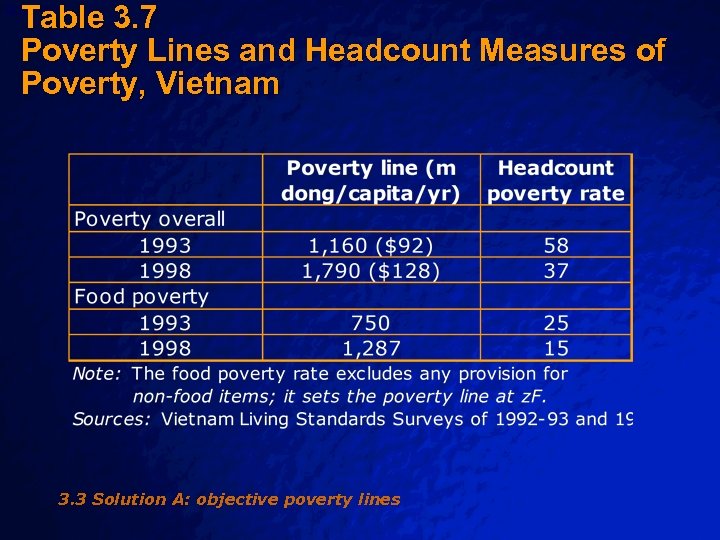
Table 3. 7 Poverty Lines and Headcount Measures of Poverty, Vietnam Slide 70 © 2003 By Default! 3. 3 Solution A: objective poverty lines
Slide 71 © 2003 By Default! The Cost-of-Basic Needs Method n There is no wholly satisfactory way to measure the non-food component of the poverty line and the procedures followed tend to be somewhat ad hoc. n We saw that for Vietnam, researchers essentially used the level of non-food spending by household that were in the middle expenditure quintile in 1993. 3. 3 Solution A: objective poverty lines
Slide 72 © 2003 By Default! The Cost-of-Basic Needs Method n The poverty line developed for South Korea (KIHASA 2000) measure the cost of food plus the cost of housing that meets the official minimum apartment size plus the cost of non-food items as measured by average spending by household in the poorest two-fifths of the income distribution. 3. 3 Solution A: objective poverty lines
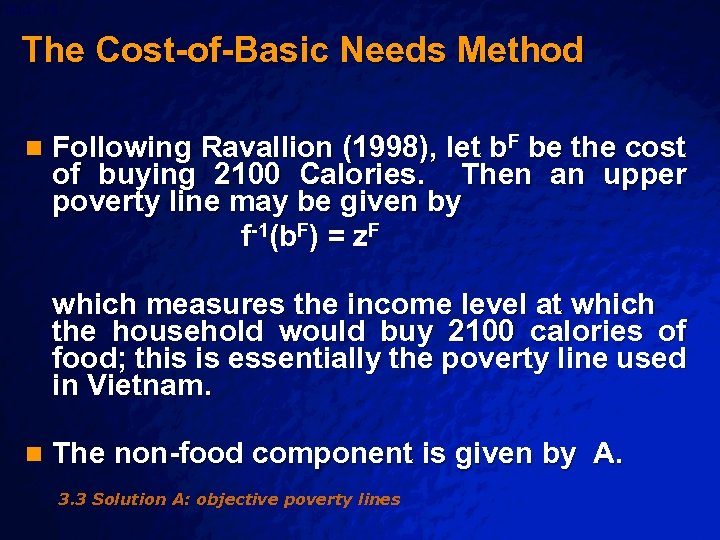
Slide 73 © 2003 By Default! The Cost-of-Basic Needs Method n Following Ravallion (1998), let b. F be the cost of buying 2100 Calories. Then an upper poverty line may be given by f-1(b. F) = z. F which measures the income level at which the household would buy 2100 calories of food; this is essentially the poverty line used in Vietnam. n The non-food component is given by A. 3. 3 Solution A: objective poverty lines
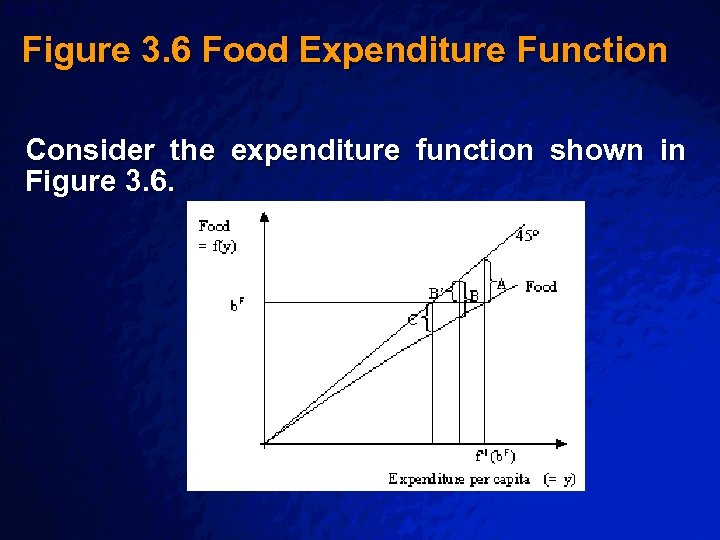
Slide 74 © 2003 By Default! Figure 3. 6 Food Expenditure Function Consider the expenditure function shown in Figure 3. 6.
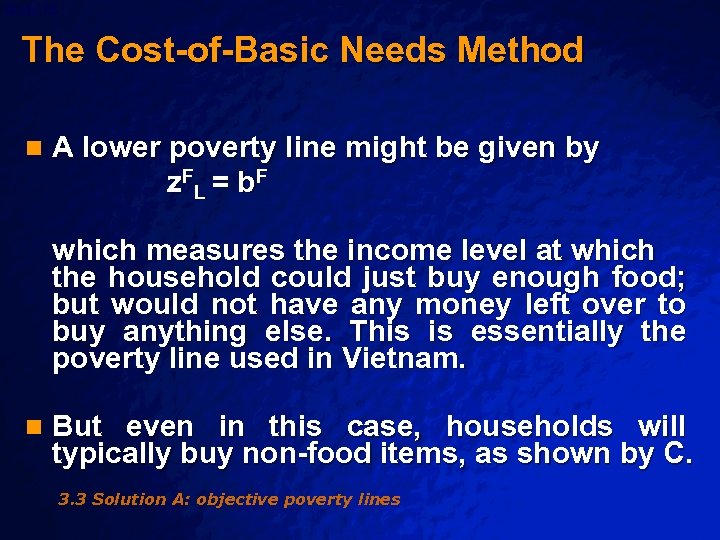
Slide 75 © 2003 By Default! The Cost-of-Basic Needs Method n A lower poverty line might be given by z. FL = b. F which measures the income level at which the household could just buy enough food; but would not have any money left over to buy anything else. This is essentially the poverty line used in Vietnam. n But even in this case, households will typically buy non-food items, as shown by C. 3. 3 Solution A: objective poverty lines
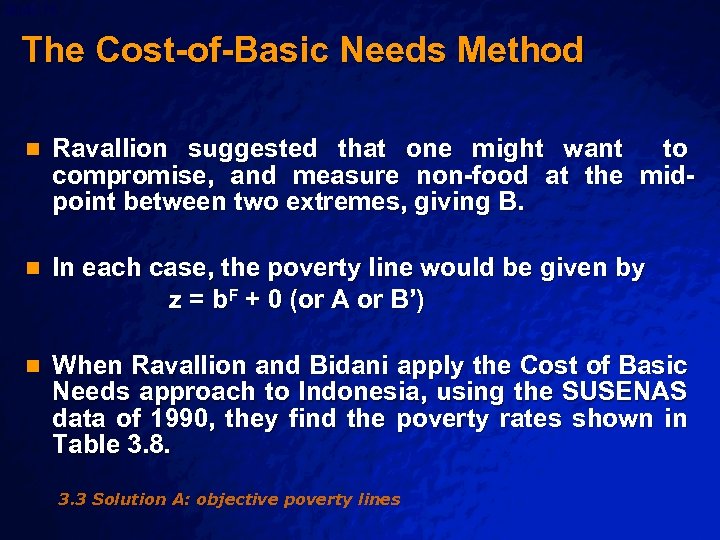
Slide 76 © 2003 By Default! The Cost-of-Basic Needs Method n Ravallion suggested that one might want to compromise, and measure non-food at the midpoint between two extremes, giving B. n In each case, the poverty line would be given by z = b. F + 0 (or A or B’) n When Ravallion and Bidani apply the Cost of Basic Needs approach to Indonesia, using the SUSENAS data of 1990, they find the poverty rates shown in Table 3. 8. 3. 3 Solution A: objective poverty lines
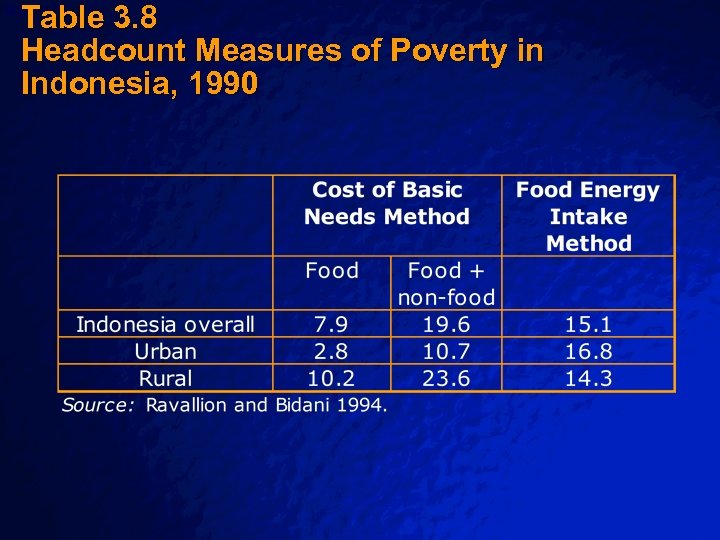
Table 3. 8 Headcount Measures of Poverty in Indonesia, 1990 Slide 77 © 2003 By Default!
Slide 78 © 2003 By Default! The Cost-of-Basic Needs Method n They computed poverty rates using these two measures, for each of the main regions of Indonesia, and found almost no correlation between the two measures. n This is a serious indictment of the Food Energy Intake method. But is should also be clear that every measure of poverty can be faulted, because it rests in part on arbitrary assumptions n In measuring poverty, there is no single truth. 3. 3 Solution A: objective poverty lines
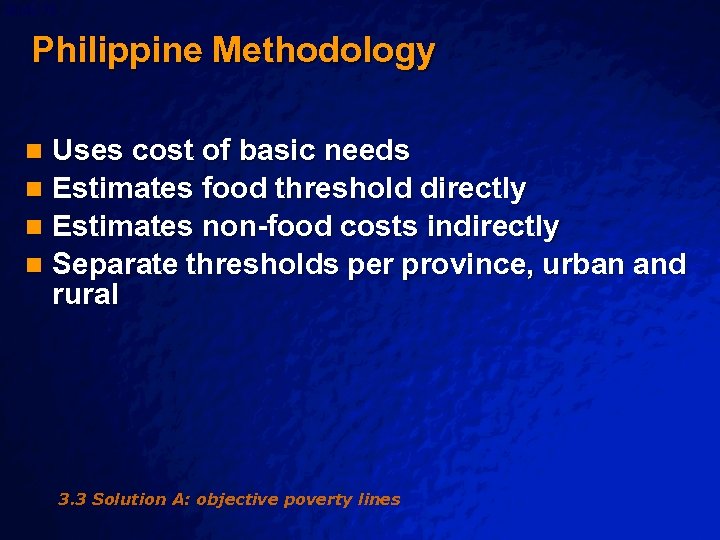
Slide 79 © 2003 By Default! Philippine Methodology Uses cost of basic needs n Estimates food threshold directly n Estimates non-food costs indirectly n Separate thresholds per province, urban and rural n 3. 3 Solution A: objective poverty lines
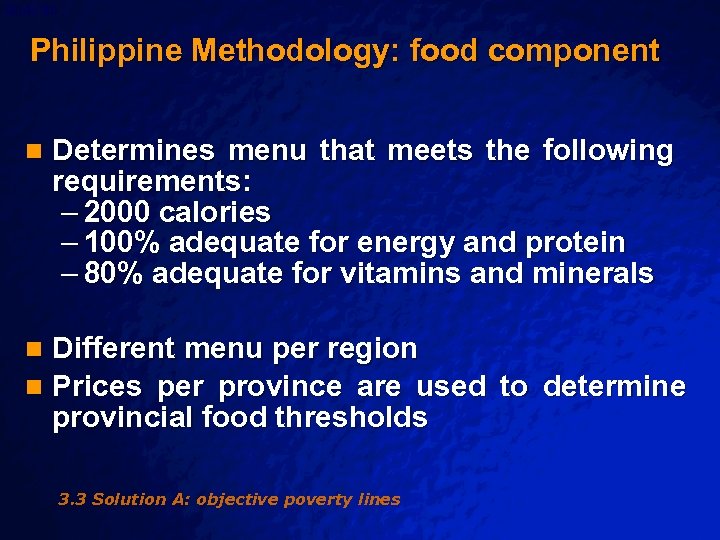
Slide 80 © 2003 By Default! Philippine Methodology: food component n Determines menu that meets the following requirements: – 2000 calories – 100% adequate for energy and protein – 80% adequate for vitamins and minerals Different menu per region n Prices per province are used to determine provincial food thresholds n 3. 3 Solution A: objective poverty lines
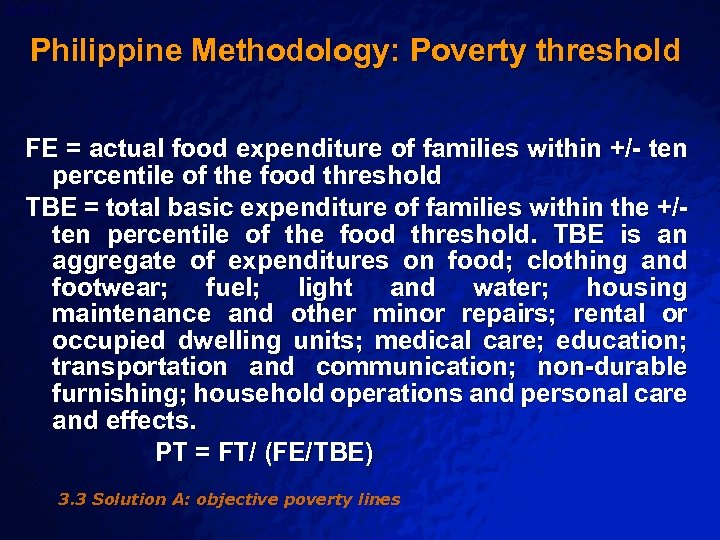
Slide 81 © 2003 By Default! Philippine Methodology: Poverty threshold FE = actual food expenditure of families within +/- ten percentile of the food threshold TBE = total basic expenditure of families within the +/ten percentile of the food threshold. TBE is an aggregate of expenditures on food; clothing and footwear; fuel; light and water; housing maintenance and other minor repairs; rental or occupied dwelling units; medical care; education; transportation and communication; non-durable furnishing; household operations and personal care and effects. PT = FT/ (FE/TBE) 3. 3 Solution A: objective poverty lines
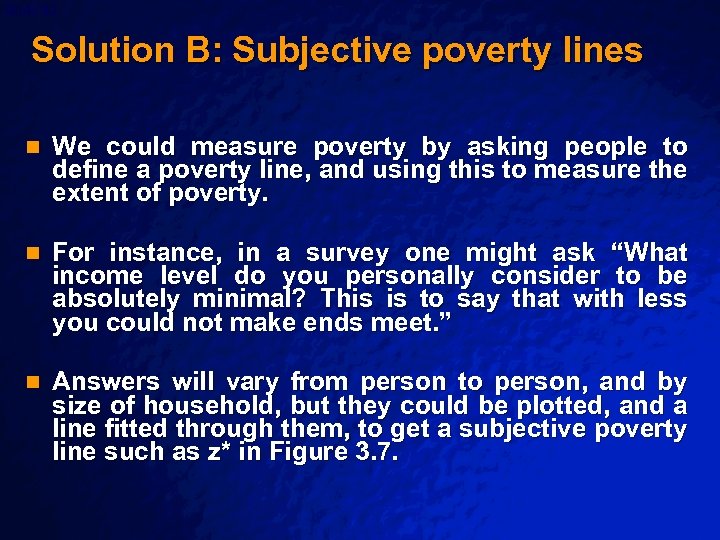
Slide 82 © 2003 By Default! Solution B: Subjective poverty lines n We could measure poverty by asking people to define a poverty line, and using this to measure the extent of poverty. n For instance, in a survey one might ask “What income level do you personally consider to be absolutely minimal? This is to say that with less you could not make ends meet. ” n Answers will vary from person to person, and by size of household, but they could be plotted, and a line fitted through them, to get a subjective poverty line such as z* in Figure 3. 7.

Slide 83 © 2003 By Default! Solution B: Subjective poverty lines n It may also be possible to get adequate results by asking “Do you consider your current consumption to be adequate to make ends meet? ” n Mahar Mangahas amassed extensive information on subjective poverty in the Philippines as part of the Social Weather Stations project. n Collected biannually since 1985, and quarterly since 1992, the surveys poll about 1200 households.
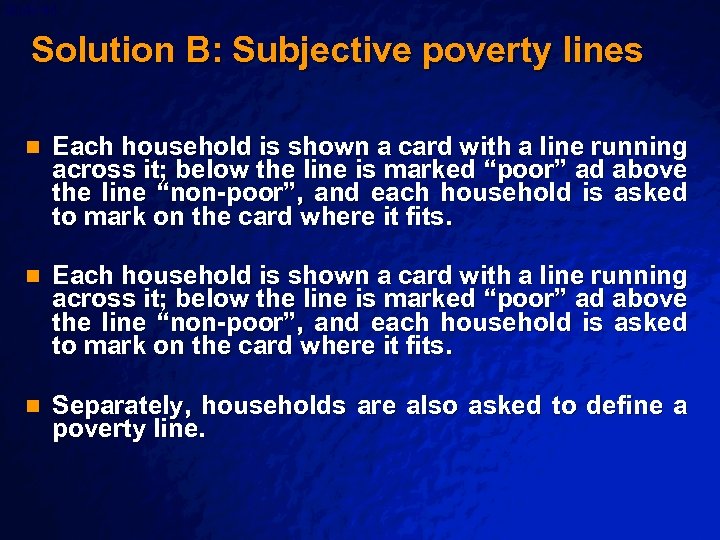
Slide 84 © 2003 By Default! Solution B: Subjective poverty lines n Each household is shown a card with a line running across it; below the line is marked “poor” ad above the line “non-poor”, and each household is asked to mark on the card where it fits. n Separately, households are also asked to define a poverty line.
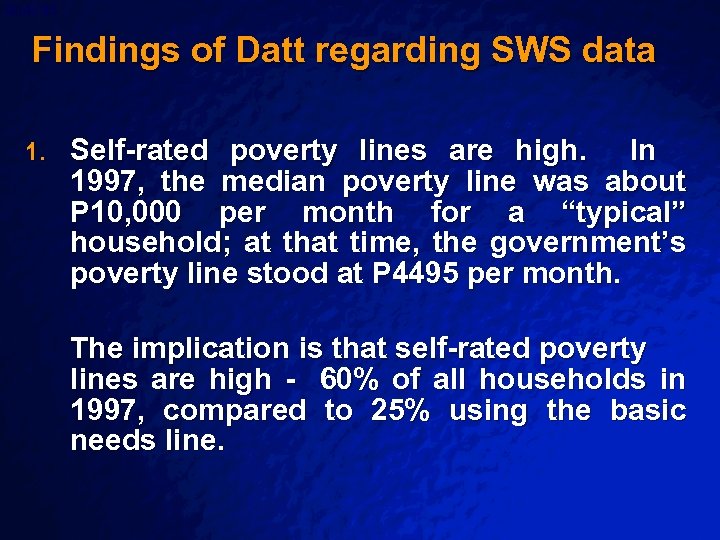
Slide 85 © 2003 By Default! Findings of Datt regarding SWS data 1. Self-rated poverty lines are high. In 1997, the median poverty line was about P 10, 000 per month for a “typical” household; at that time, the government’s poverty line stood at P 4495 per month. The implication is that self-rated poverty lines are high - 60% of all households in 1997, compared to 25% using the basic needs line.
Slide 86 © 2003 By Default! Findings of Datt regarding SWS data 2. The self-rated poverty line has risen rapidly over time, by about 60 -70% between 1985 and 1997. One consequence is that there is no trend in self-rated poverty. Another implication is that even when there is an economic slowdown, as occurred in 1997 -1998, the self-rated poverty rate hardly changes: it rose from 59% in 19961997 to 61% in 1998.
Slide 87 © 2003 By Default! Findings of Datt regarding SWS data 3. The self-rated poverty line given by poor households is only slightly lower than that for non-poor households, and in fact is not statistically significant. One might have expected poor households to have a less generous measure of the poverty line.
Slide 88 © 2003 By Default! Findings of Datt regarding SWS data 4. There is a clear urban/rural difference in proportions of the poverty line, with urban households setting a poverty line at about twice the level of rural households. The cost of living is certainly higher in urban areas, but by a factor of 1. 2 -1. 5 rather than by a factor of 2. Thus, the urban poverty line is, in real terms, higher than its rural counterpart. Possible reasons: -there is more inequality in the urban areas, and this raises expectations

Slide 89 © 2003 By Default! Findings of Datt regarding SWS data Possible reasons: - households in urban areas may have more exposure to the media , and may have ben more affected by consumerism - urban households may be more attuned to political processes and their estimate of the poverty line may include and element of strategic behavior – trying to influence policy makers
Slide 90 © 2003 By Default! Findings of Datt regarding SWS data Conclusion: Self-rated measures of poverty cannot supplant the more “objective” measures of poverty.
Скачать презентацию Slide 2003 By Default Poverty Lines Celia
e2f1eed38f57bbe36e7fff704919256c.ppt