


 Скачать презентацию Slide 2 1 Chapter 2 Structures and frameworks
6b661561c6cf5d21b7e9f81565126666.ppt
- Количество слайдов: 29
 Slide 2. 1 Chapter 2 Structures and frameworks • Introduction • Describing the project context: high-level frameworks • Describing the project process: activity models • Describing the projects management challenge: managerial complexity • Summary Project Management in Practice: The rescue of the Baghdad Zoo Project Management in Practice: Using the 7 -S approach in the review of a real project Maylor, Project Management, 4 th Edition, © Pearson Education Limited 2011
 Slide 2. 2 Introduction ‘Get the thinking right first. The rest is detail. ’ Project: Launching a product • Inherent complexity –Technical challenges –Customer buying patterns and usage • Managing stakeholders a significant PM role • Sense making of the complexity is vital –without this process project activities may be too difficult Maylor, Project Management, 4 th Edition, © Pearson Education Limited 2011
 Slide 2. 3 Introduction (Continued) This chapter examines • A model of the project environment • Issues that may be faced using the 7 S framework • The project context, the PESTEL model • A systems model • Continuous improvement • Project complexity Maylor, Project Management, 4 th Edition, © Pearson Education Limited 2011
 Slide 2. 4 2. 1 Describing the project context: high-level frameworks The project environment • Work can be done anywhere • Increasing competition • Requirement for meeting performance objectives • Falling trade barriers • Numbers of international collaborations have increased • Globalisation has impacted on the nature of work • Increased organisation complexity • Effective quality management leads to competitive advantage Maylor, Project Management, 4 th Edition, © Pearson Education Limited 2011
 Slide 2. 5 2. 1 Describing the project context: high-level frameworks (Continued) • Projects have become more complex – Easiest ideas exploited first – Businesses provide package to meet entire need – Turnkey contracts from a single supplier – Complex financing arrangements (public private partnerships) Maylor, Project Management, 4 th Edition, © Pearson Education Limited 2011
 Slide 2. 6 2. 1 Describing the project context: high-level frameworks (Continued) The project environment • Changes in the competitive environment have effected projects – Time (to market, to deliver) is a major source of competitive advantage – Human resource management has changed • Anonymous cogs to harnessing individual’s creativity – Changes in technology and methods are increasing in rate – Organisations need to be customer focused Maylor, Project Management, 4 th Edition, © Pearson Education Limited 2011
 Slide 2. 7 2. 1 Describing the project context: high-level frameworks (Continued) • Need to aspire to exceed customer requirements • Customers’ expectations are increasing – Integration and openness between customers and suppliers is trendy • Move towards partnerships, information is shared – Changes in management philosophy – Growth in service sector with huge employment and growth – Repetitive operations have improved, further improvement without significant investment is in decline Maylor, Project Management, 4 th Edition, © Pearson Education Limited 2011
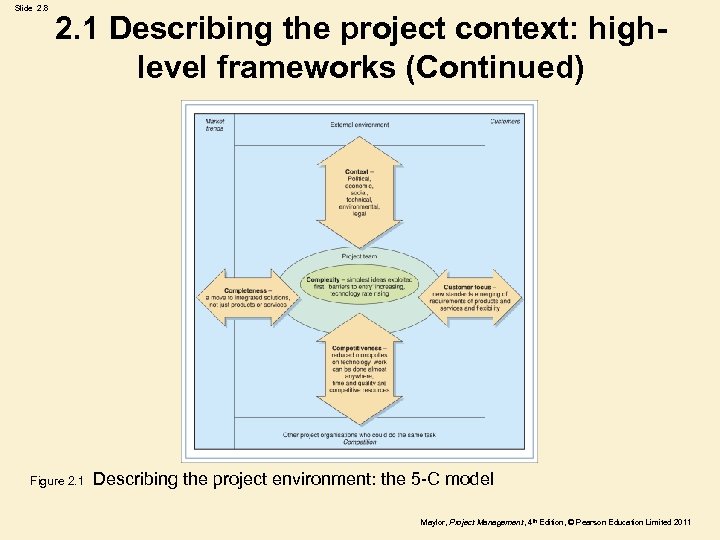 Slide 2. 8 2. 1 Describing the project context: highlevel frameworks (Continued) Figure 2. 1 Describing the project environment: the 5 -C model Maylor, Project Management, 4 th Edition, © Pearson Education Limited 2011
 Slide 2. 9 2. 1 Describing the project context: high-level frameworks (Continued) Project context – PESTEL – external influences • Political Influence – Changes in policy or government • Economic – general and local – Challenges of boom and bust • Social – Social changes, communication • Technical – Technology changes challenge viability and process • Environmental Maylor, Project Management, 4 th Edition, © Pearson Education Limited 2011
 Slide 2. 10 2. 1 Describing the project context: high-level frameworks (Continued) – Assessment of environmental impact – Emerging corporate social responsibility • Legal – Legislation – E. g. intellectual property, anti-trust, government procurement, etc. Project structure – 7 S framework – internal • Assist in making sense of the complexity Maylor, Project Management, 4 th Edition, © Pearson Education Limited 2011
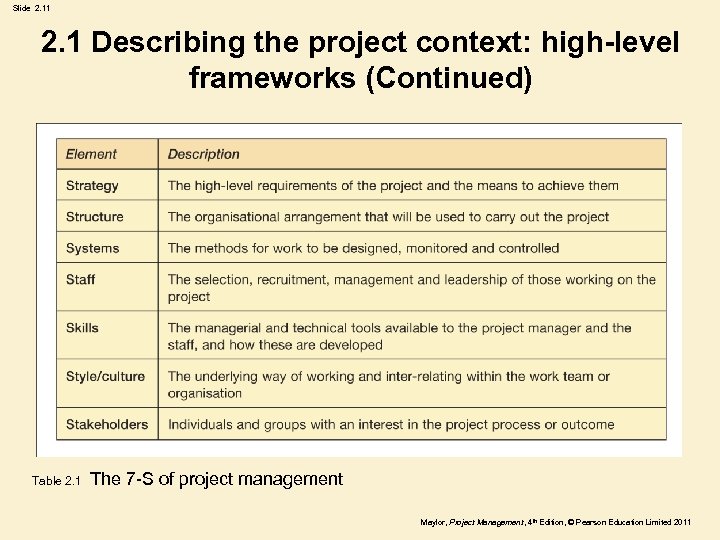 Slide 2. 11 2. 1 Describing the project context: high-level frameworks (Continued) Table 2. 1 The 7 -S of project management Maylor, Project Management, 4 th Edition, © Pearson Education Limited 2011
 Slide 2. 12 2. 2 Describing the project process: activity models The basic model of an operating system is the ‘input–output’ model A project can be viewed as • the conversion or transformation • of the inputs (including the want or need) • to the outputs (deliverable and benefit that satisfy the need) • under a set of constraints or controls (including assumptions or limitations) • utilising a set of mechanisms (resources that make the transformation possible) The major role of the project manager is the integrator of the elements Maylor, Project Management, 4 th Edition, © Pearson Education Limited 2011
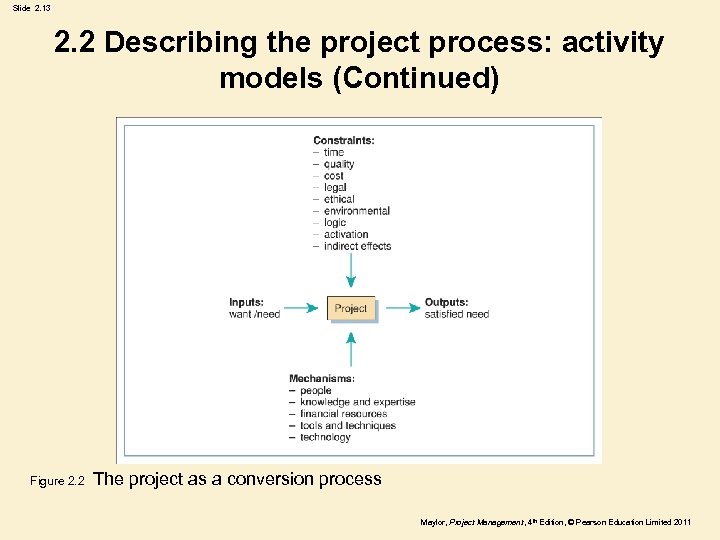 Slide 2. 13 2. 2 Describing the project process: activity models (Continued) Figure 2. 2 The project as a conversion process Maylor, Project Management, 4 th Edition, © Pearson Education Limited 2011
 Slide 2. 14 2. 2 Describing the project process: activity models (Continued) The hedgehog syndrome: People (contract staff) leave once the project is completed, no feedback occurs, knowledge is lost, the same mistakes happen. Need for continuous improvement of the system: • Previous project reviews can be used as the starting point for new projects • ‘Lessons identified’ review • The 4 -D model Maylor, Project Management, 4 th Edition, © Pearson Education Limited 2011
 Slide 2. 15 2. 2 Describing the project process: activity models (Continued) Worth noting: • Work is required prior to a project to justify resources, prepare documents, evaluate options; should this be included in the project? • Projects may be terminated before completion, the need becomes unnecessary • There may be many stages within each phase – Each phase becomes a mini project – There are cycles of activity rather than liner progress Maylor, Project Management, 4 th Edition, © Pearson Education Limited 2011
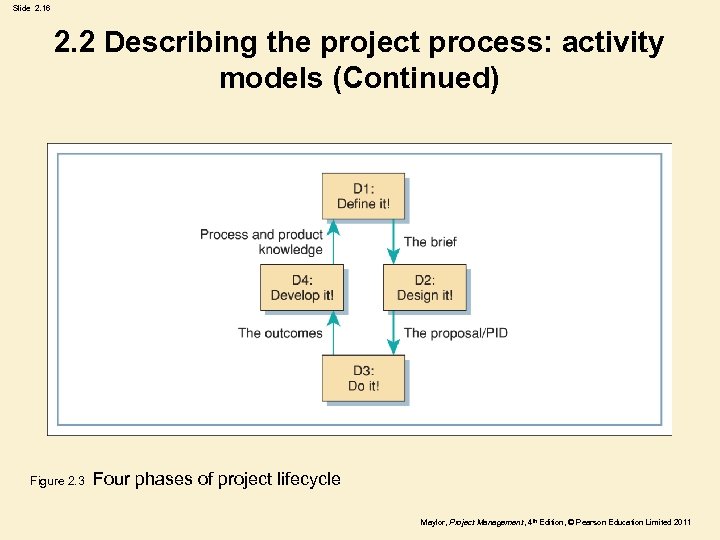 Slide 2. 16 2. 2 Describing the project process: activity models (Continued) Figure 2. 3 Four phases of project lifecycle Maylor, Project Management, 4 th Edition, © Pearson Education Limited 2011
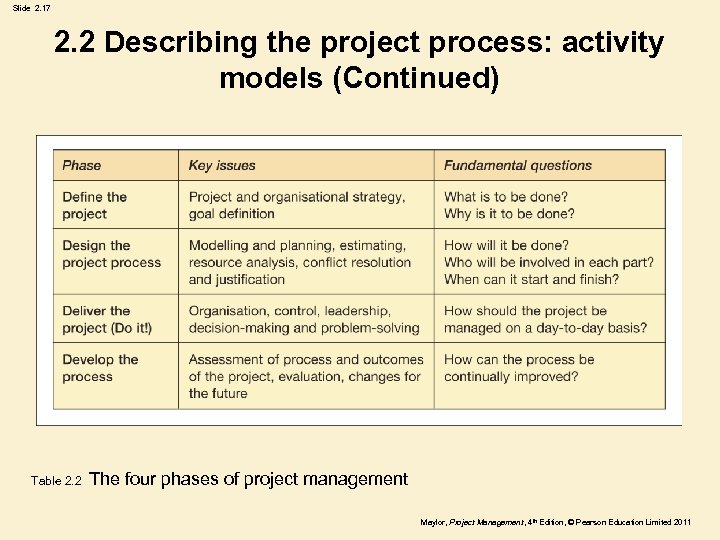 Slide 2. 17 2. 2 Describing the project process: activity models (Continued) Table 2. 2 The four phases of project management Maylor, Project Management, 4 th Edition, © Pearson Education Limited 2011
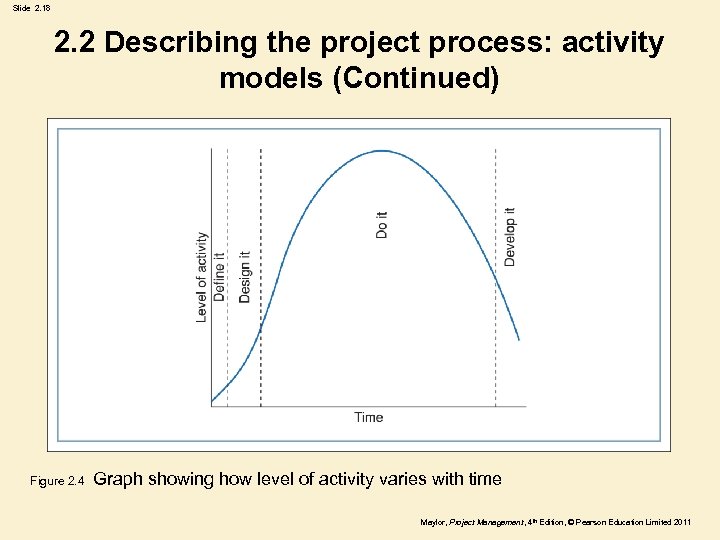 Slide 2. 18 2. 2 Describing the project process: activity models (Continued) Figure 2. 4 Graph showing how level of activity varies with time Maylor, Project Management, 4 th Edition, © Pearson Education Limited 2011
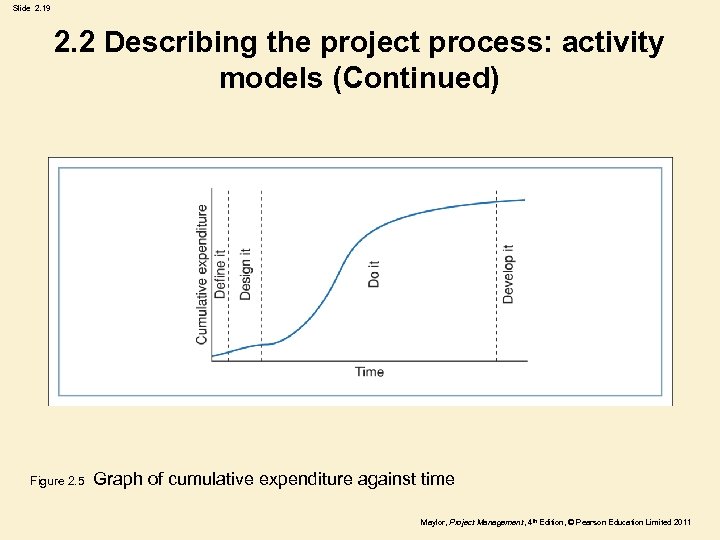 Slide 2. 19 2. 2 Describing the project process: activity models (Continued) Figure 2. 5 Graph of cumulative expenditure against time Maylor, Project Management, 4 th Edition, © Pearson Education Limited 2011
 Slide 2. 20 2. 2 Describing the project process: activity models (Continued) • The ‘develop it’ phase is vital for investment in future projects – The project team can benefit from lessons learnt, but, as 98%+ of expenditure will already have occurred, there is often little budget left to do so • Further development of the lifecycle (Table 2. 3) – Explicit analysis during ‘define it’ – Business case prepared as justification in ‘design it’ – Four phases have different characteristics and different management requirements – Many project managers will not be involved in early stages; they are handed a brief after ‘define or design it’ and are therefore not involved in problem avoidance • Gates are decision points Maylor, Project Management, 4 th Edition, © Pearson Education Limited 2011
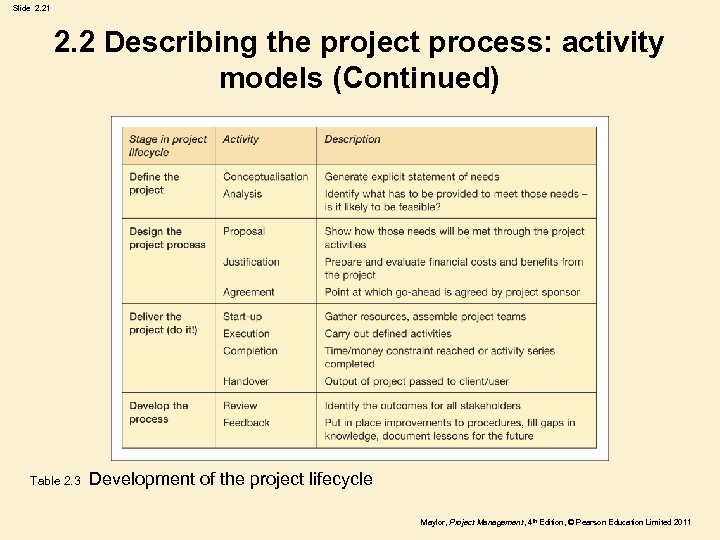 Slide 2. 21 2. 2 Describing the project process: activity models (Continued) Table 2. 3 Development of the project lifecycle Maylor, Project Management, 4 th Edition, © Pearson Education Limited 2011
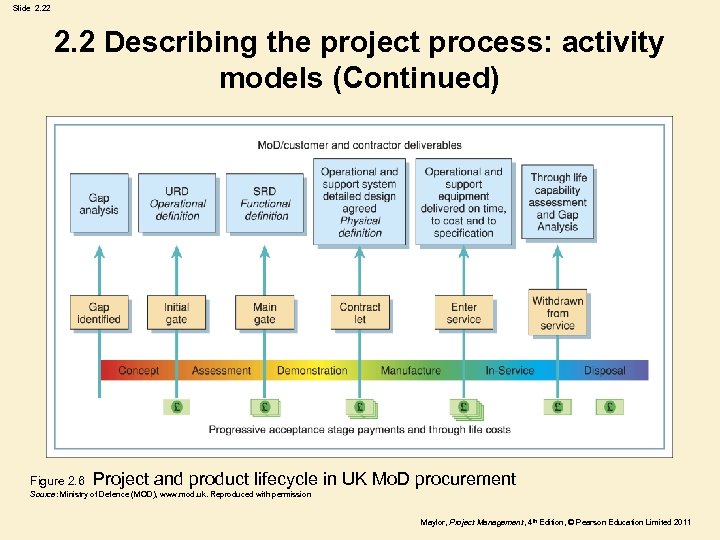 Slide 2. 22 2. 2 Describing the project process: activity models (Continued) Figure 2. 6 Project and product lifecycle in UK Mo. D procurement Source: Ministry of Defence (MOD), www. mod. uk. Reproduced with permission Maylor, Project Management, 4 th Edition, © Pearson Education Limited 2011
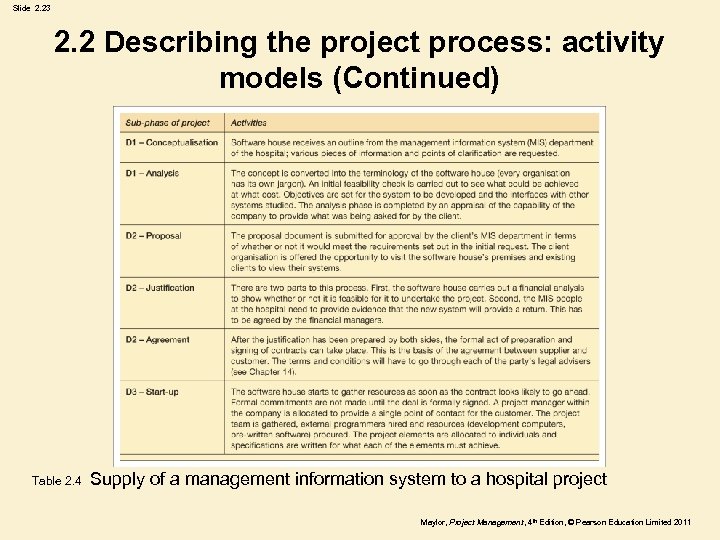 Slide 2. 23 2. 2 Describing the project process: activity models (Continued) Table 2. 4 Supply of a management information system to a hospital project Maylor, Project Management, 4 th Edition, © Pearson Education Limited 2011
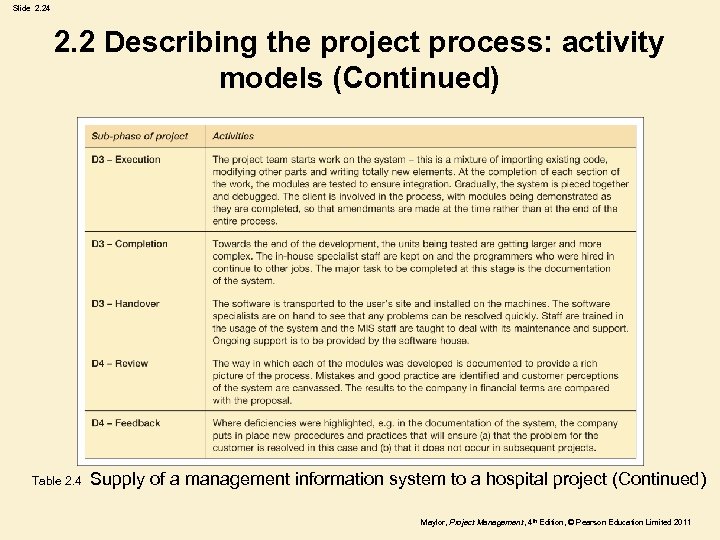 Slide 2. 24 2. 2 Describing the project process: activity models (Continued) Table 2. 4 Supply of a management information system to a hospital project (Continued) Maylor, Project Management, 4 th Edition, © Pearson Education Limited 2011
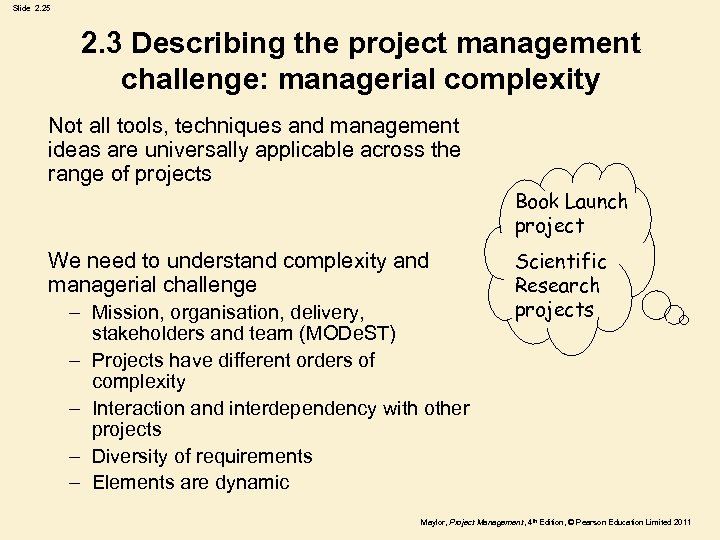 Slide 2. 25 2. 3 Describing the project management challenge: managerial complexity Not all tools, techniques and management ideas are universally applicable across the range of projects Book Launch project We need to understand complexity and managerial challenge – Mission, organisation, delivery, stakeholders and team (MODe. ST) – Projects have different orders of complexity – Interaction and interdependency with other projects – Diversity of requirements – Elements are dynamic Scientific Research projects Maylor, Project Management, 4 th Edition, © Pearson Education Limited 2011
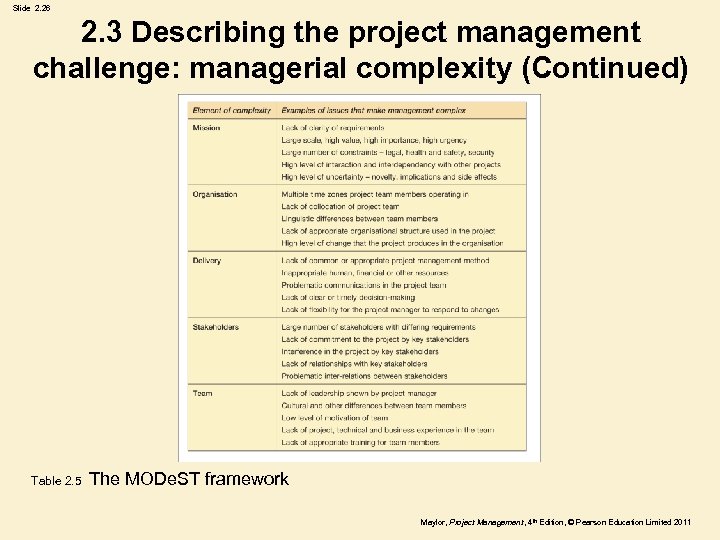 Slide 2. 26 2. 3 Describing the project management challenge: managerial complexity (Continued) Table 2. 5 The MODe. ST framework Maylor, Project Management, 4 th Edition, © Pearson Education Limited 2011
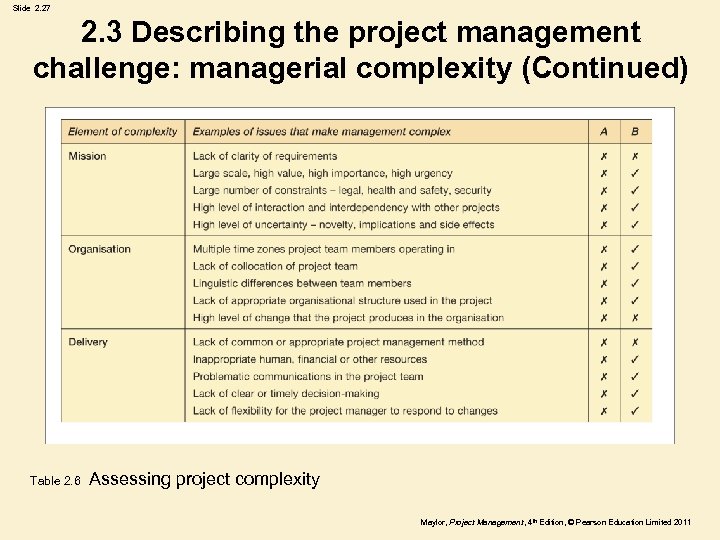 Slide 2. 27 2. 3 Describing the project management challenge: managerial complexity (Continued) Table 2. 6 Assessing project complexity Maylor, Project Management, 4 th Edition, © Pearson Education Limited 2011
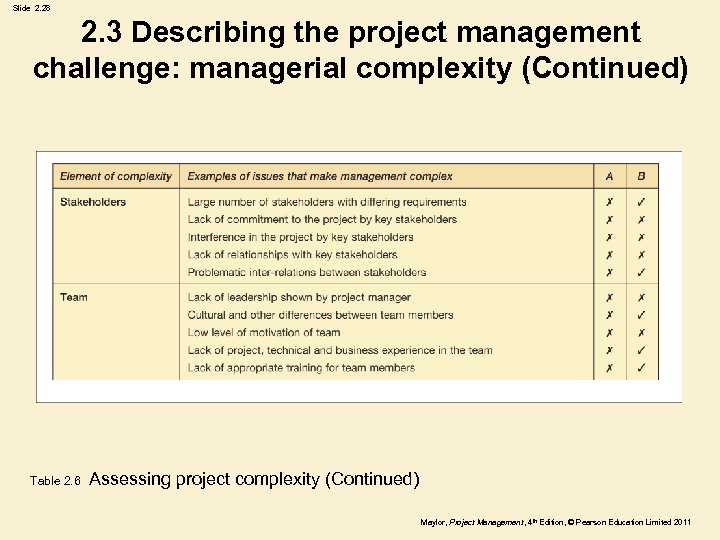 Slide 2. 28 2. 3 Describing the project management challenge: managerial complexity (Continued) Table 2. 6 Assessing project complexity (Continued) Maylor, Project Management, 4 th Edition, © Pearson Education Limited 2011
 Slide 2. 29 Summary • The world in which projects operate continues to grow in complexity – Adds to the challenges on project managers in delivering – As well as increased expectation about delivery • Frameworks and mental models aid making sense of complexity – But ‘All models are wrong. Some are useful’ (Dr W Edwards Deming) – Need to ‘get the thinking right’ Maylor, Project Management, 4 th Edition, © Pearson Education Limited 2011