



 Slide 16. 1 Price Pricing Chapter 16
 Slide 16. 2 Price defined • Price is the amount of money charged for a product or service, or the sum of the values that consumers exchange for the benefits of having or using the product or service.
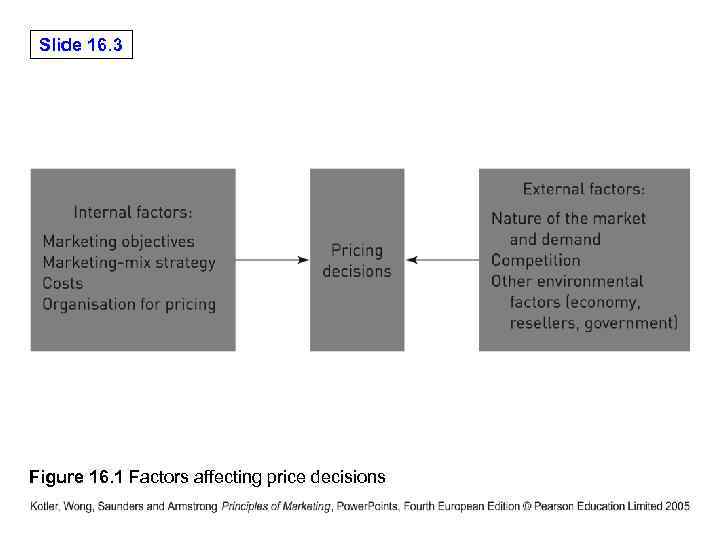 Slide 16. 3 Figure 16. 1 Factors affecting price decisions
 Slide 16. 4 Internal factors affecting price • • Company’s marketing objectives Marketing mix strategy Costs Organisation structure
 Slide 16. 5 Marketing objectives • Pricing should augment the marketing mix strategy • Marketing objectives are reflected in the pricing decisions and include – – Survival Current profit maximisation Market share maximisation Product-quality leadership
 Slide 16. 6 Marketing mix strategy • Price decisions are coordinated with product design, distribution and promotional decisions to form an effective integrated marketing programme. • Various strategies can be used depending upon the type of product and the environment in which it is involved. • Frequently pricing decisions are made first and the marketing mix evolves around that. • De-emphasis of price by using the other marketing mix tools to create non-price positions based upon differentiation and value.
 Slide 16. 7 Gucci’s very strong image and reputation as a prestigious brand mean that customers are willing to pay for the fashion house’s expensive fragrances. Source: Advertising Archives. Reproduced with permission.
 Slide 16. 8 Costs • Types of cost – Fixed costs that do not vary with production or sales level. – Variable costs vary with level of production. – Total costs, sum of variable and fixed costs.
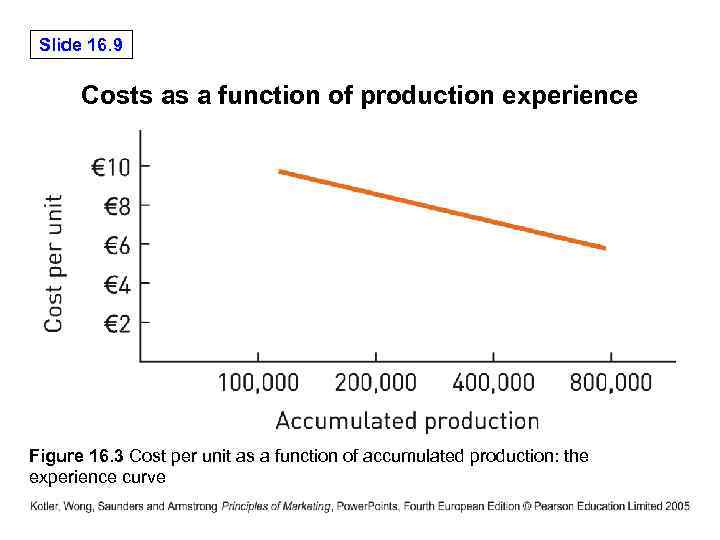 Slide 16. 9 Costs as a function of production experience Figure 16. 3 Cost per unit as a function of accumulated production: the experience curve
 Slide 16. 10 External factors affecting pricing decisions External factors include the nature of the market and demand, competition and other environmental elements. • The market and demand • Costs set the lower limit and demand sets the upper limit of price. This price-demand relationship is of fundamental importance to marketers.
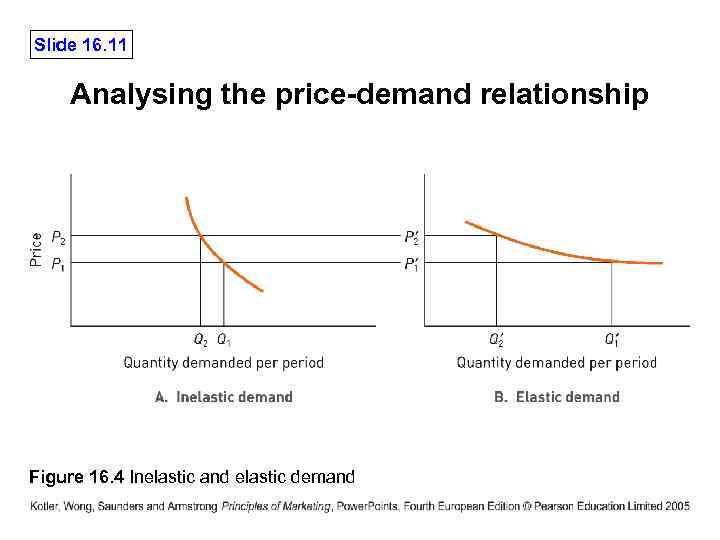 Slide 16. 11 Analysing the price-demand relationship Figure 16. 4 Inelastic and elastic demand
 Slide 16. 12 Price influence on profits – Profit is the balance of income generated minus the costs incurred to sell the product – Many financial management ratios • Return on investment (ROI) • Return on sales • (EVA) Economic Value Added
 Slide 16. 13 Competitors and other external factors impacting price • Competitors’ costs, prices and offers – Competitor price benchmarking gives a good indication of market price acceptance levels. • Economic conditions such as recession. • Resellers and intermediaries. • Governmental influences such as tariffs on imports. • Social concerns
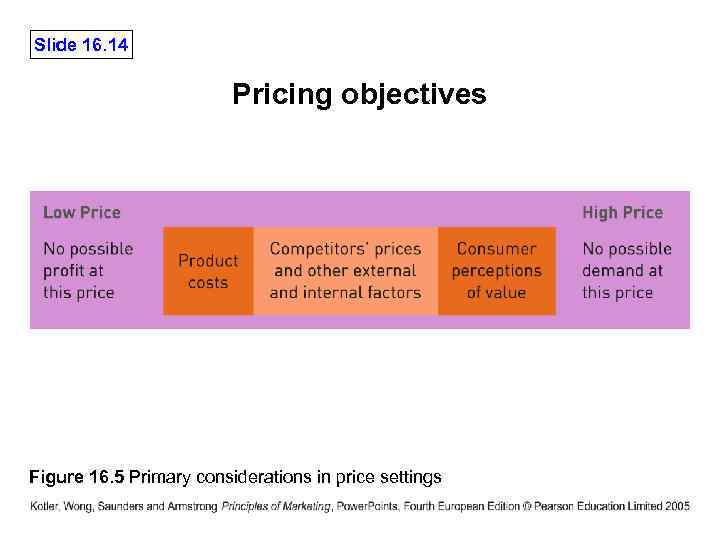 Slide 16. 14 Pricing objectives Figure 16. 5 Primary considerations in price settings
 Slide 16. 15 1. Cost based pricing • Cost-plus pricing – Adding a standard mark-up to the cost of the product. • Mark-up/down – The difference between selling price and cost as a percentage of selling price or cost • Break-even analysis and target profit pricing – Setting price to break even on the costs of making and marketing a product.
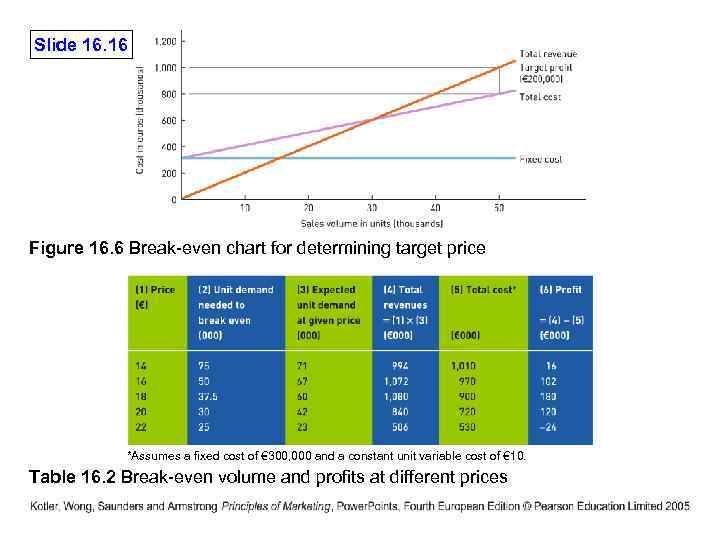 Slide 16. 16 Figure 16. 6 Break-even chart for determining target price *Assumes a fixed cost of € 300, 000 and a constant unit variable cost of € 10. Table 16. 2 Break-even volume and profits at different prices
 Slide 16. 17 2. Value based pricing • Setting price based on the buyers’ perceptions of product values rather than on the cost. • Underlying principle is to offer the right combination of quality and good service at a fair price. • Everyday low pricing is an important aspect of value pricing at the retail level.
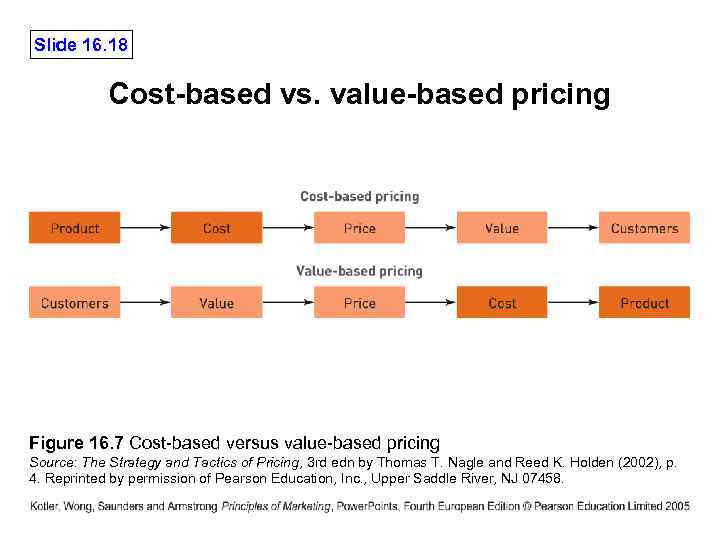 Slide 16. 18 Cost-based vs. value-based pricing Figure 16. 7 Cost-based versus value-based pricing Source: The Strategy and Tactics of Pricing, 3 rd edn by Thomas T. Nagle and Reed K. Holden (2002), p. 4. Reprinted by permission of Pearson Education, Inc. , Upper Saddle River, NJ 07458.
 Slide 16. 19 3. Competition based pricing • Going-rate pricing – Setting price based largely on following competitors’ prices rather than on company costs or demand. • Sealed-bid pricing – Potential buyers submit sealed bids, and the item is awarded to the buyer who offers the best price. • English auction is where the price is raised until only one bidder remains. • Dutch auction is where prices start high and are lowered successively until someone buys. • Collective buying is where an increasing number of customers agree to buy as prices are lowered to the final bargain price. • Reverse auction is where the customers name the price that they are willing to pay for an item and seek a company willing to sell.
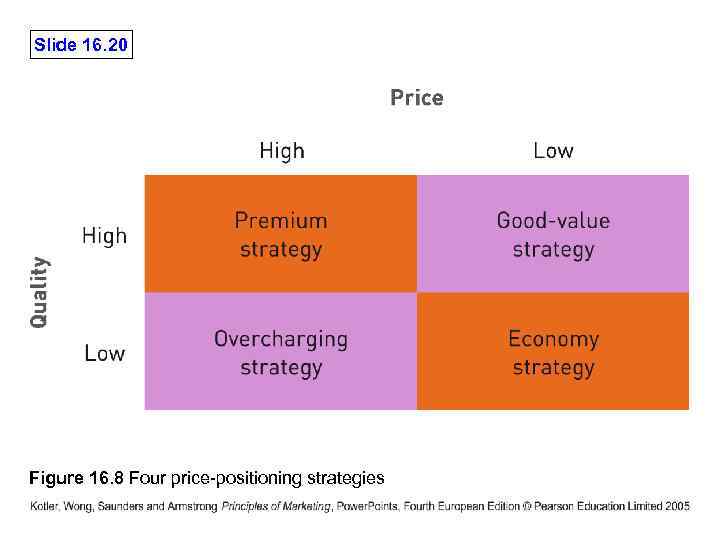 Slide 16. 20 Figure 16. 8 Four price-positioning strategies
 Slide 16. 21 Pricing for new products with innovative features and benefits: • Market skimming pricing • Pricing strategy used for new products that have unique features and benefits over the competition. • A high price is set for the new product to skim the maximum price and generate the most profit. • Market penetration pricing • Initial low price to penetrate the market and convert as many buyers onto the new product and grab a large market share. • This is a short-term strategy that is dangerous and needs to be supported by a robust range of products to leverage against.
 Slide 16. 22 Product-mix pricing strategies (1) • Product line pricing – Setting the price steps between various products in a product line, based on cost differences between the products, customer evaluations of the different features and the competitors’ pricing. • Optional-product pricing – The pricing of optional or accessory products along with a main product. • Captive-product pricing – Setting a price for products that must be used in conjunction with a main product, such as blades for a razor and film for a camera.
 Slide 16. 23 Product-mix pricing strategies (2) • By-product pricing – Using the by-product pricing method, the manufacturer seeks markets for the by-products of the main production and recoups costs of waste from the production process. – This may include the metal shavings from steel cutting, being gathered and processed as scrap metal. • Product bundle pricing – Strategy used to combine several products and offering the bundle of products at a reduced rate, thus leveraging the entire range of products.
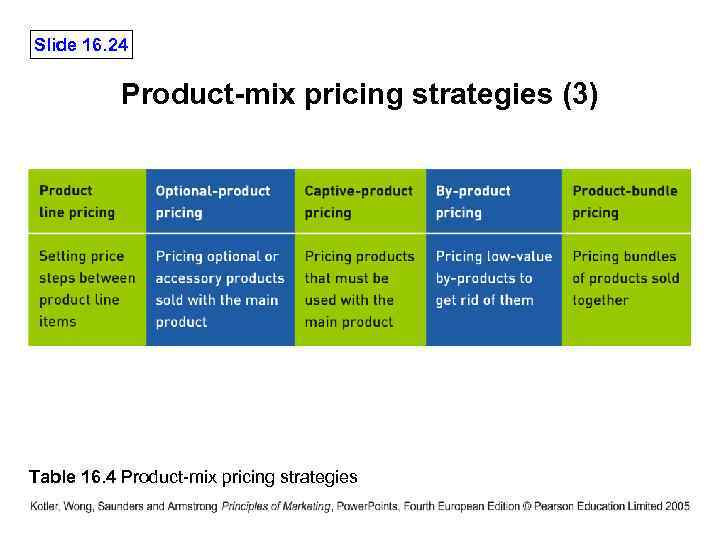 Slide 16. 24 Product-mix pricing strategies (3) Table 16. 4 Product-mix pricing strategies
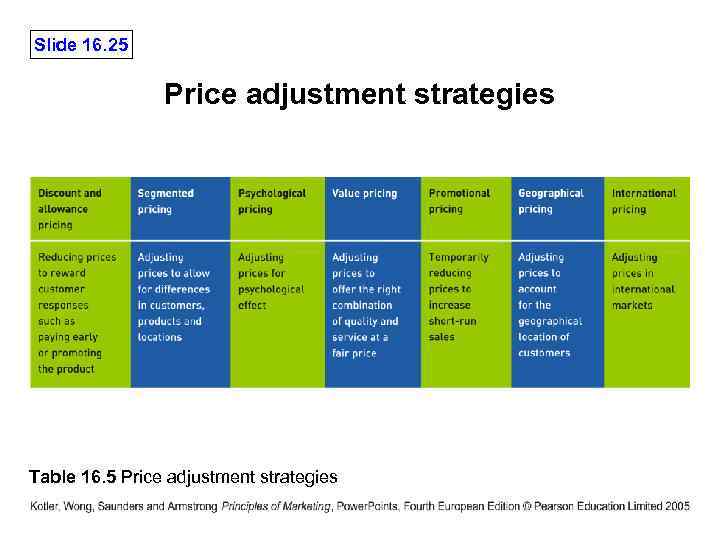 Slide 16. 25 Price adjustment strategies Table 16. 5 Price adjustment strategies
 Slide 16. 26 Geographical pricing (1) • Pricing based on where the customers are located. • Free on board FOB-origin pricing – Goods are placed free on board a carrier; the customer then pays the freight from the factory to the destination. • Uniform delivered pricing – Company charges the same price plus freight to all customers, regardless of their location.
 Slide 16. 27 International pricing • Globalisation and the development of international pricing strategies offer many challenges and complexities to companies. • Prices will be influenced by: – – – economic conditions competitive situations laws regulations sophistication of the retailing and wholesaler environments.
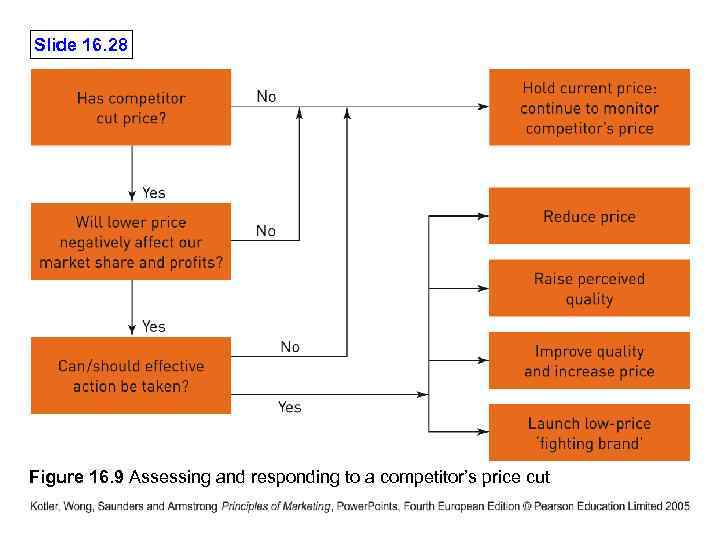 Slide 16. 28 Figure 16. 9 Assessing and responding to a competitor’s price cut