


 Скачать презентацию SLIDE 1 Analysis of the hidden terminal effect
a32b28b535c19ed32c471d0c7de01168.ppt
- Количество слайдов: 14
 SLIDE 1 Analysis of the hidden terminal effect in multi-rate IEEE 802. 11 b networks A note on the use of these ppt slides: We’re making these slides freely available to all, hoping they might be of use for researchers and/or students. They’re in Power. Point form so you can add, modify, and delete slides (including this one) and slide content to suit your needs. In return for use, we only ask the following: If you use these slides (e. g. , in a class, presentations, talks and so on) in substantially unaltered form, that you mention their source. If you post any slides in substantially unaltered form on a www site, that you note that they are adapted from (or perhaps identical to) our slides, and put a link to the authors webpage: www. dei. unipd. it/~zanella Thanks and enjoy! WPMC 2004 - 15 September 2004 – Mauro Borgo
 SLIDE 2 Analysis of the hidden terminal effect in multi-rate IEEE 802. 11 b networks Mauro Borgo, Andrea Zanella, Paola bisaglia, Simone Merlin WPMC 2004 - 15 September 2004 – Mauro Borgo
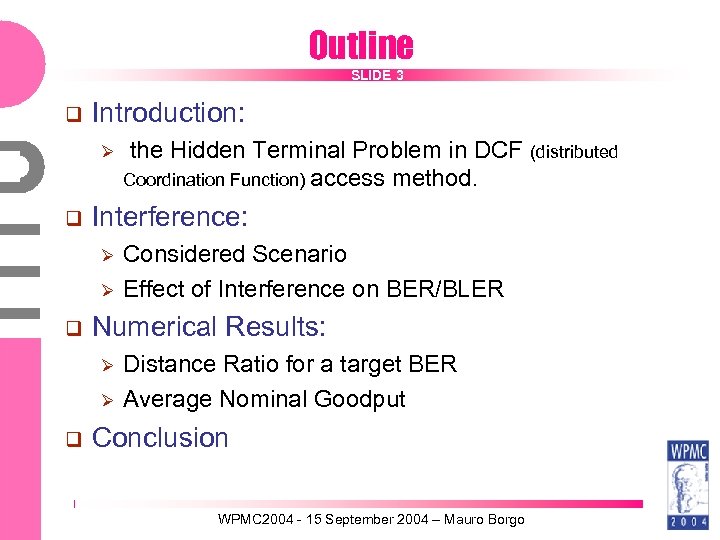 Outline SLIDE 3 Introduction: Interference: Considered Scenario Effect of Interference on BER/BLER Numerical Results: the Hidden Terminal Problem in DCF (distributed Coordination Function) access method. Distance Ratio for a target BER Average Nominal Goodput Conclusion WPMC 2004 - 15 September 2004 – Mauro Borgo
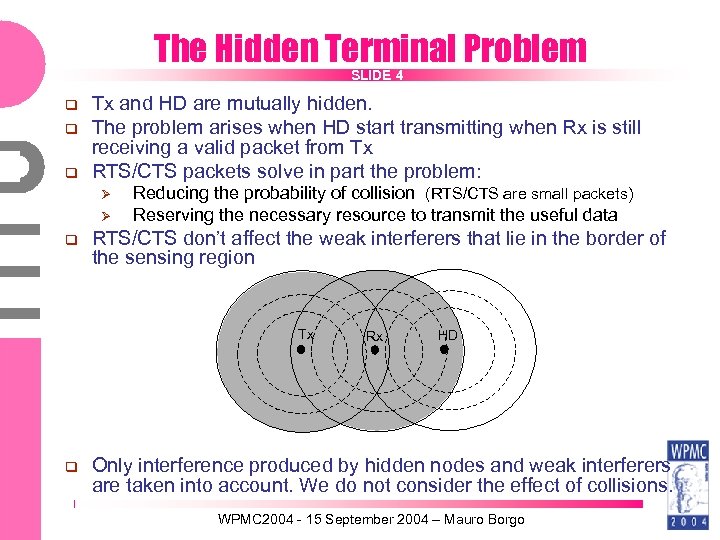 The Hidden Terminal Problem SLIDE 4 Tx and HD are mutually hidden. The problem arises when HD start transmitting when Rx is still receiving a valid packet from Tx RTS/CTS packets solve in part the problem: Reducing the probability of collision (RTS/CTS are small packets) Reserving the necessary resource to transmit the useful data RTS/CTS don’t affect the weak interferers that lie in the border of the sensing region Tx Rx HD Only interference produced by hidden nodes and weak interferers are taken into account. We do not consider the effect of collisions. WPMC 2004 - 15 September 2004 – Mauro Borgo
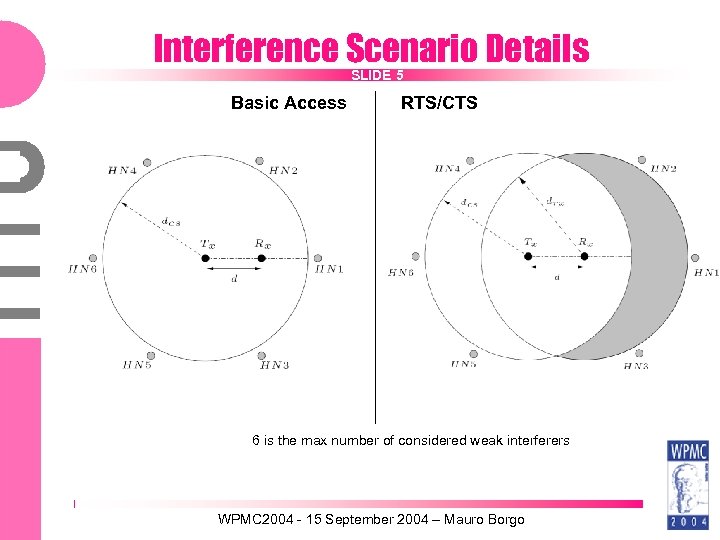 Interference Scenario Details SLIDE 5 Basic Access RTS/CTS 6 is the max number of considered weak interferers WPMC 2004 - 15 September 2004 – Mauro Borgo
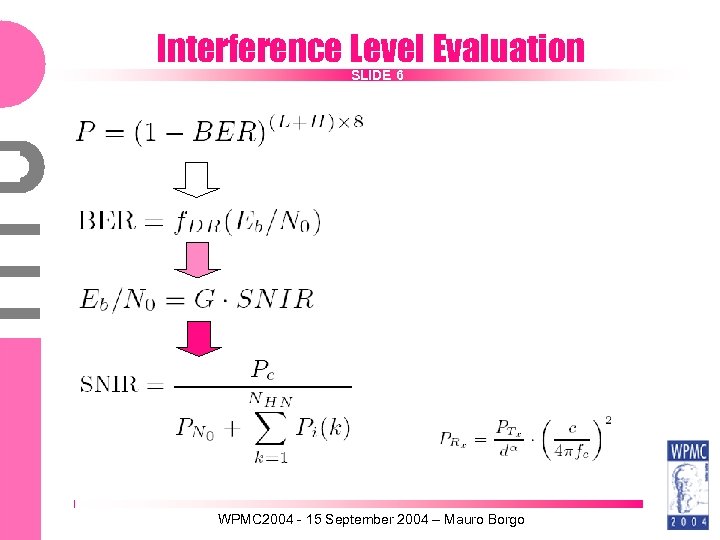 Interference Level Evaluation SLIDE 6 WPMC 2004 - 15 September 2004 – Mauro Borgo
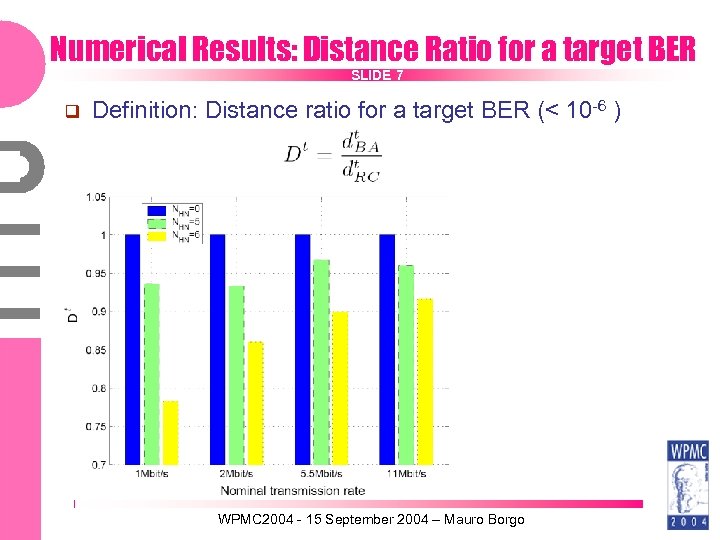 Numerical Results: Distance Ratio for a target BER SLIDE 7 Definition: Distance ratio for a target BER (< 10 -6 ) WPMC 2004 - 15 September 2004 – Mauro Borgo
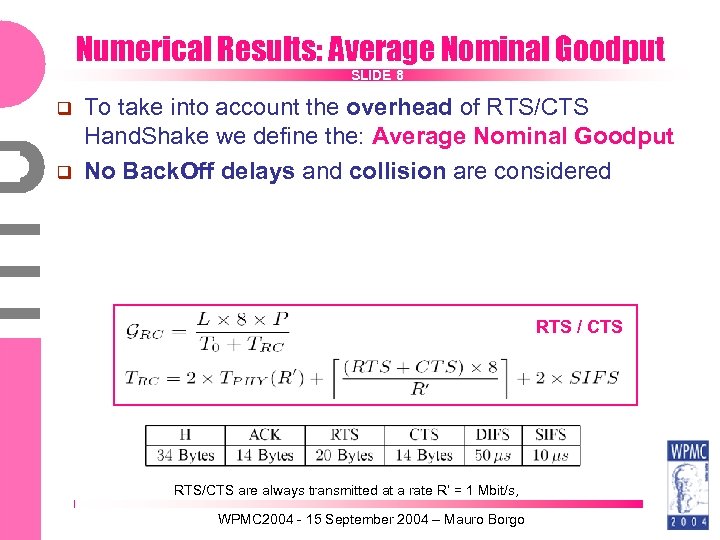 Numerical Results: Average Nominal Goodput SLIDE 8 To take into account the overhead of RTS/CTS Hand. Shake we define the: Average Nominal Goodput No Back. Off delays and collision are considered RTS / CTS RTS/CTS are always transmitted at a rate R’ = 1 Mbit/s, WPMC 2004 - 15 September 2004 – Mauro Borgo
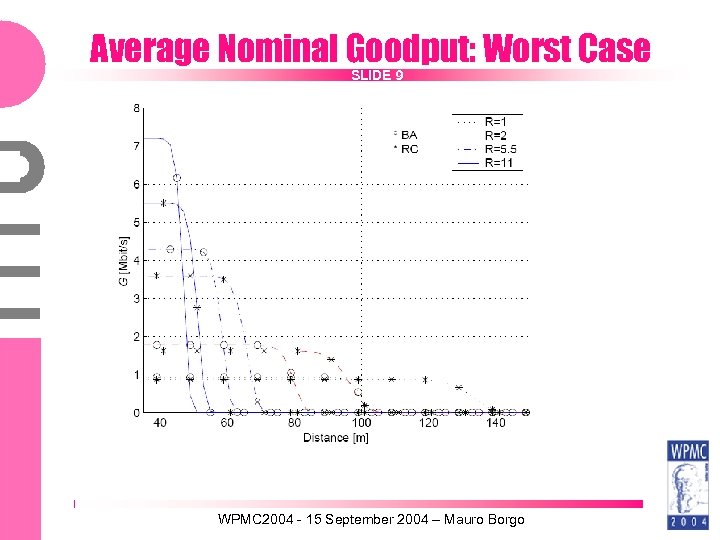 Average Nominal Goodput: Worst Case SLIDE 9 WPMC 2004 - 15 September 2004 – Mauro Borgo
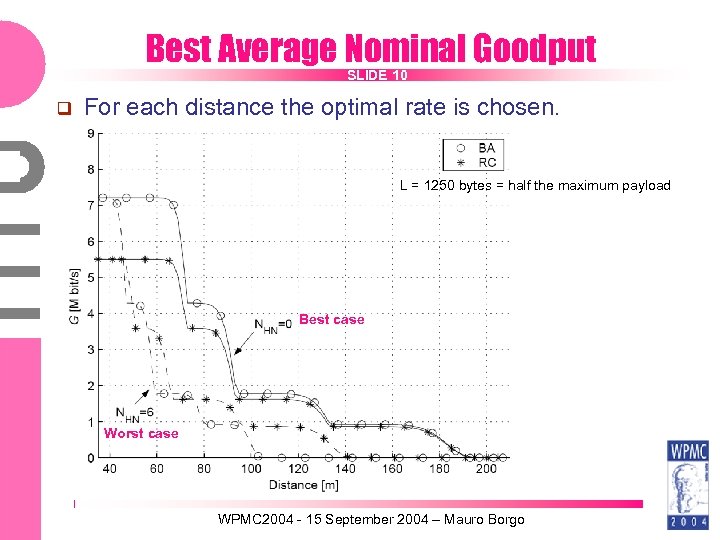 Best Average Nominal Goodput SLIDE 10 For each distance the optimal rate is chosen. L = 1250 bytes = half the maximum payload Best case Worst case WPMC 2004 - 15 September 2004 – Mauro Borgo
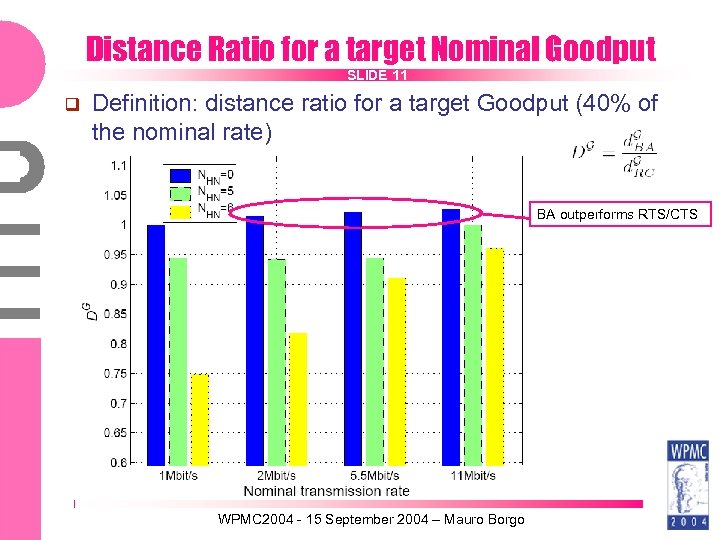 Distance Ratio for a target Nominal Goodput SLIDE 11 Definition: distance ratio for a target Goodput (40% of the nominal rate) BA outperforms RTS/CTS WPMC 2004 - 15 September 2004 – Mauro Borgo
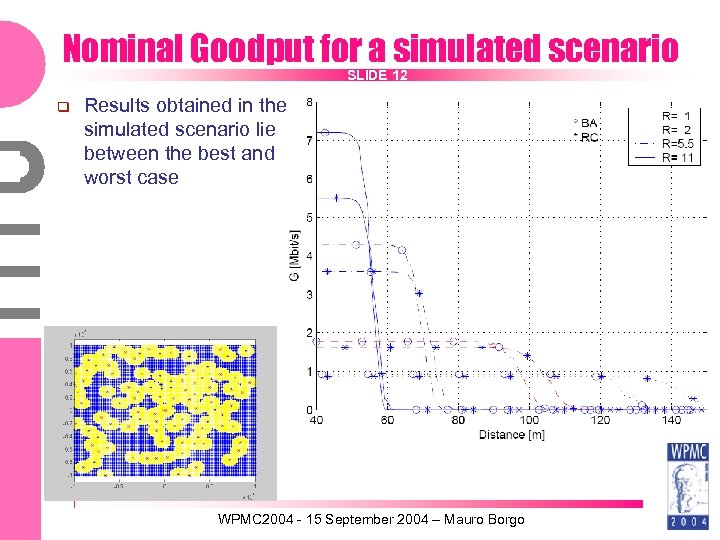 Nominal Goodput for a simulated scenario SLIDE 12 Results obtained in the simulated scenario lie between the best and worst case WPMC 2004 - 15 September 2004 – Mauro Borgo
 Conclusion SLIDE 13 Under the assumption of no collision and retransmission we have found: . . however for highly loaded networks RTS /CTS results to be effective against hidden node interference only for low transmission rate At high data rate both techniques attain similar performance RTS/CTS could be convenient also at high transmission rate. Future Work. . Evaluate in a ‘real’ scenario the effectiveness of RTS/CTS method against traffic load Extend study to 802. 11 a WPMC 2004 - 15 September 2004 – Mauro Borgo
 SLIDE 14 WPMC 2004 - 15 September 2004 – Mauro Borgo