


 Скачать презентацию Sleeping Late Alice Pomidor MD MPH FSU College
1fc8b9646bc324589e7c384f581c6ddc.ppt
- Количество слайдов: 27
 Sleeping Late Alice Pomidor, MD, MPH FSU College of Medicine Supported by a grant from the D. W. Reynolds Foundation
 If you had the time, would you…. • • Go to bed early, or do something with your family/friends? Sleep in, or catch up on stuff around the house? Study, watch TV/movie, or take a nap? Eat, or sleep?
 Objectives • • • List 3 differences in sleep patterns between older and younger adults Recognize the effects of disturbed sleep on functional abilities of older adults Describe 3 methods for assessing sleep Describe 3 aspects of the social environment which affect sleep List 3 therapeutic interventions for sleep
 Sleep Terminology • • Sleep continuity—balance of sleep and wakefulness through the night Sleep latency—how long it takes to fall asleep Sleep architecture—amount of sleep relatively spent in REM, NREM; uses stages of sleep 0 -4 as well as “light” or “deep” sleep as terms Sleep study—usually polysomnography w/EEG, O 2 monitoring, eye and breathing movement monitoring. Sometime may be include or substitute simpler tests of wakefulness, latency, or actigraphy
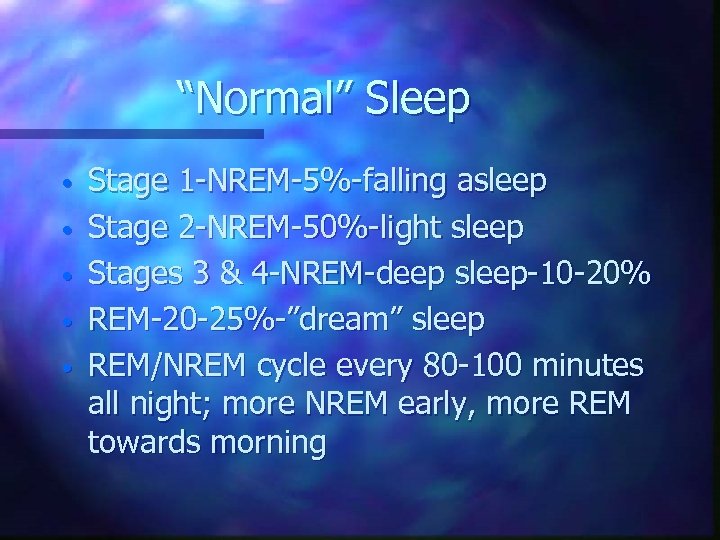 “Normal” Sleep • • • Stage 1 -NREM-5%-falling asleep Stage 2 -NREM-50%-light sleep Stages 3 & 4 -NREM-deep sleep-10 -20% REM-20 -25%-”dream” sleep REM/NREM cycle every 80 -100 minutes all night; more NREM early, more REM towards morning
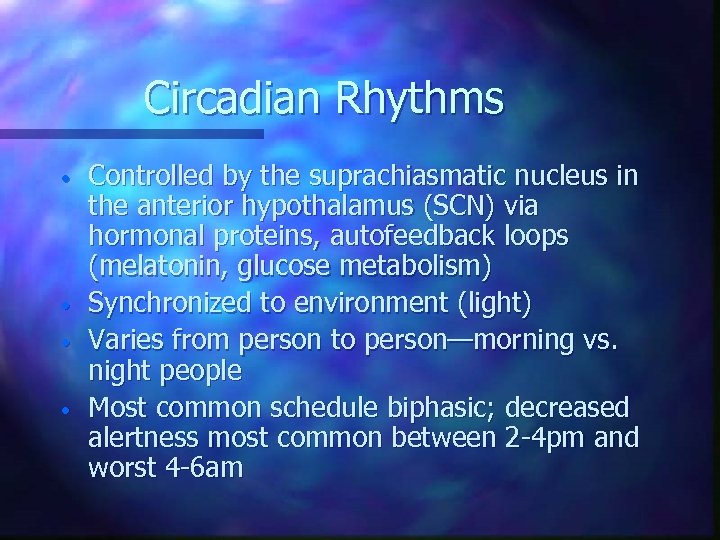 Circadian Rhythms • • Controlled by the suprachiasmatic nucleus in the anterior hypothalamus (SCN) via hormonal proteins, autofeedback loops (melatonin, glucose metabolism) Synchronized to environment (light) Varies from person to person—morning vs. night people Most common schedule biphasic; decreased alertness most common between 2 -4 pm and worst 4 -6 am
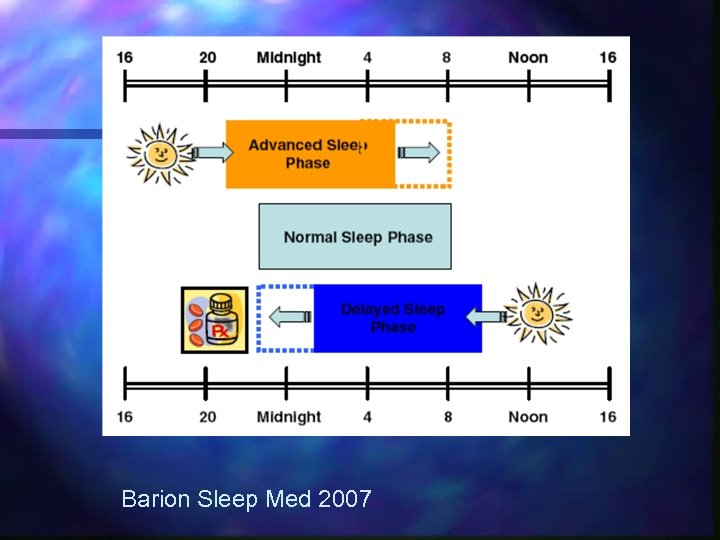 Barion Sleep Med 2007
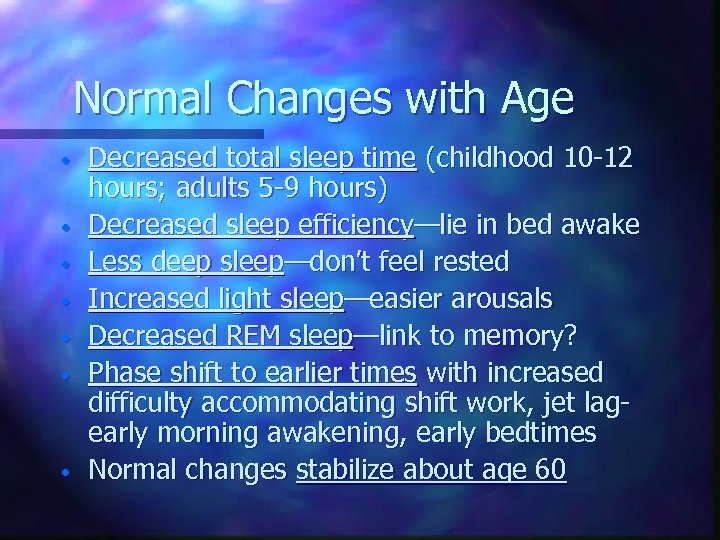 Normal Changes with Age • • Decreased total sleep time (childhood 10 -12 hours; adults 5 -9 hours) Decreased sleep efficiency—lie in bed awake Less deep sleep—don’t feel rested Increased light sleep—easier arousals Decreased REM sleep—link to memory? Phase shift to earlier times with increased difficulty accommodating shift work, jet lagearly morning awakening, early bedtimes Normal changes stabilize about age 60
 Perceived Sleep Problems • • 2003 “Sleep in America” survey found 36% health elderly over age 65, 52% with 1 -3 comorbidities, and 69% with 4 or more comorbidities reported disturbed sleep Most frequent survey causes: nocturia, worry, noise, dreaming, thirst, pain (presenting complaints)
 DSM IV TR Diagnoses • • Insomnia—difficulty falling or maintaining sleep for over a month Primary hypersomnia—prolonged or daytime sleep episodes occurring almost daily for over a month Breathing-related sleep disorder—obstructive or central sleep apnea, or hypoventilation Circadian Rhythm sleep disorder—Delayed sleep phase, jet lag, shift work types Dyssomnias—Restless legs, periodic limb movements, sleep deprivation, environmental factors Parasomnias—Nightmares, sleep terrors, sleepwalking Causes functional impairment, not due to another cause
 Medical comorbidities • • Substance misuse (Et. OH, nicotine, caffeine, meds) Anxiety Depression Pain Reflux Breathing problems from heart or lung disease Neuro disorders (dementia, stroke) True primary sleep disorders under diagnosed but still relatively rare
 Adverse Functional Effects • • • Cognitive impairment Independent risk factor for more falls ? diabetes and obesity Hypoxic effect on cardiac function Driving impairment Chicken or the egg? —depression, anxiety, pain, nocturia
 Sleep Expectations • • • Eight hours long Uninterrupted Fall asleep within 15 minutes Wake up refreshed and ready to go Will feel better than when went to bed
 Sleep Assessment • • Screening-NIH recommendation Composite Scale of Morningness Epworth Sleepiness Scale BEARS mnemonic Functional impact evaluation Comorbidities assessment Medication inventory
 NIH Consensus Screening Q’s • • • Is the person satisfied with his or her sleep? Does sleep or fatigue interfere with daytime activities? Does the bed partner or others complain of unusual behavior during sleep, such as snoring, interrupted breathing, or leg movements?
 Composite Scale of Morningness • • Morning vs. Evening person relatively recent terminology for cohort Helps determine fit between schedule and circadian rhythm Particularly frequent problem for persons in structured settings Scoring: 22 or less = evening person, 44 and above morning person
 Epworth Sleepiness Scale • • • Intended to screen for true sleep disorders Rating scale of 0 -3 in severity for each of 8 items Scoring: 6 -7 normal, 8 -11 mild, 12 -15 moderate (c/w apnea), 16 -18 severe (potential narcolepsy)
 BEARS • • • Bedtime Excessive sleepiness Awakenings, night and early morning Regularity and duration of sleep Snoring
 Sleep Studies • • • Obstructive apnea—near/complete obstruction of airflow for 10 seconds or more with continued respiratory effort Central apnea—cessation of respiratory effort Hypopnea— 2001 Medicare definition of 30% reduction from baseline in thoracoabdominal effort or airflow lasting 10 seconds or more accompanied by a 4% or great oxygen desaturation (usually below 85%). Respiratory-effort related arousals— 10 seconds of attempted inspiration followed by arousal Respiratory Disturbance Index—number of apnea and hyponea and respiratory effort-related arousals per hour of sleep, 10 -15 considered significant
 Special Problems • • • Dementia Blindness Hospitals Nursing homes Postmenopausal symptoms
 Treatment Expectations/Goals • • • Discuss who wants what: patient, caregiver(s), health care professional Set targets Develop intervention plan to reach targets Keep a sleep diary to monitor progress Follow-up at regular intervals depending on the intervention plan
 Environmental Interventions • • Noise Light TV Substance use Roommates Facility interruptions Medication schedule
 Behavioral Interventions • • • Sleep hygiene education Relaxation techniques Stimulus control-TV, reading, exercise Sleep restriction Sleep compression Cognitive therapy
 Alternative Interventions • • • Light therapy Electrical stimulation Herbals (lavender) Traditional remedies (chamomile tea, warm milk) Nutrition
 Medication Interventions • • Sedative-hypnotics Antidepressants Melatonin and derivatives Anticholinergics Dopamine agonists Stimulants Hormone therapy Self-medication issues
 Risks of Intervention • • Medication dependency Psychomotor impairment Parasomnias Tolerance Anticholinergic side effects Other medication side effects Tolerance of equipment Caregiver impact
 Objectives • • • List 3 differences in sleep patterns between older and younger adults Recognize the effects of disturbed sleep on functional abilities of older adults Describe 3 methods for assessing sleep Describe 3 aspects of the social environment which affect sleep List 3 therapeutic interventions for sleep