


 Скачать презентацию Sleep Shift Work and the Emergency Physician Mark
2ae1d82b61fded508461fc033c63379f.ppt
- Количество слайдов: 76
 Sleep, Shift Work and the Emergency Physician Mark Wahba MD, CCFP Emergency Medicine Grand Rounds June 17, 2004
 Special Guest } Charles H. Samuels MD, CCFP § Diploma, American Board of Sleep Medicine § Clinical Adjunct Lecturer, Faculty of Medicine § Main. Pro C Program Coordinator, Dept of CME/PD, University of Calgary § Vice Chair, Research Ethics Review Committee, College of Physicians and Surgeons of Alberta § Shift Work Advisor to the Calgary City Police
 Introduction
 Dr. Mike Hodsman: My Hero Mark Wahba MD, CCFP Emergency Medicine Grand Rounds June 17, 2004
 Outline } Introduction § Importance to Emergency Medicine § Sleep Basics and Circadian Principles } Shift Work § Fatigue and Error § Application to Emergency Medicine Ideas and Suggestions } Questions }
 My original thoughts
 } “Sleep and circadian physiology are complex, individuals are different, the task demands of settings are different, and schedules are extremely diverse” § Rosekind et al. Alertness Management: strategic naps in operational settings. J Sleep Research 1995; 4: 62 -66
 Definition of Shift Work “work performed primarily outside typical daytime hours and includes evening shifts, rotating shifts, irregular shifts, extended-duty shifts, and flextime” } Statistics Canada estimates that one in four Canadians is employed in shift work } § Outside the hours of 0700 h to 1800 h Klompas M et a. Patients Working Shifts: Treating the Chronic Effects. The Canadian Journal of Diagnosis. Feb 1998 p. 95
 Economic problems associated with Shift Work } } } absenteeism illness and accident costs insurance premiums associated with accidents and injury rate of work related accidents and errors employee turnover/retraining costs productivity Heselgrave R. Asleep at the Switch: Coping with shift work. The canadian journal of Diagnosis. Feb 1998 p. 78
 Social problems associated with Shift Work } } } 1. 2. 3. Twice as more likely to be divorced compared to non shift workers High rates of drug and alcohol abuse 60% of shift workers’ partners report that their spouses work schedules have led to: increased conflict in the relationship disruption of joint social life poor contact with children Smith L et al. The perceptions and feelings of shiftworkers’partners. Ergonomics 1993; 36 (1 -3): 299 -305
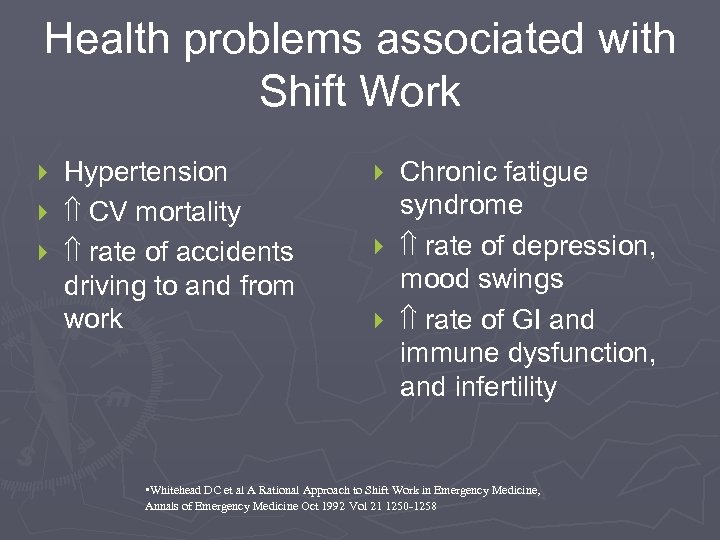 Health problems associated with Shift Work Hypertension } CV mortality } rate of accidents driving to and from work } Chronic fatigue syndrome } rate of depression, mood swings } rate of GI and immune dysfunction, and infertility } • Whitehead DC et al A Rational Approach to Shift Work in Emergency Medicine, Annals of Emergency Medicine Oct 1992 Vol 21 1250 -1258
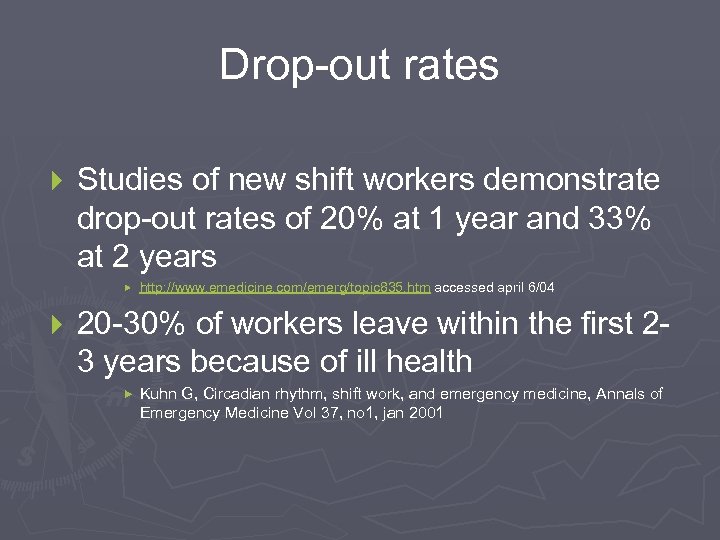 Drop-out rates } Studies of new shift workers demonstrate drop-out rates of 20% at 1 year and 33% at 2 years http: //www. emedicine. com/emerg/topic 835. htm accessed april 6/04 } 20 -30% of workers leave within the first 23 years because of ill health Kuhn G, Circadian rhythm, shift work, and emergency medicine, Annals of Emergency Medicine Vol 37, no 1, jan 2001
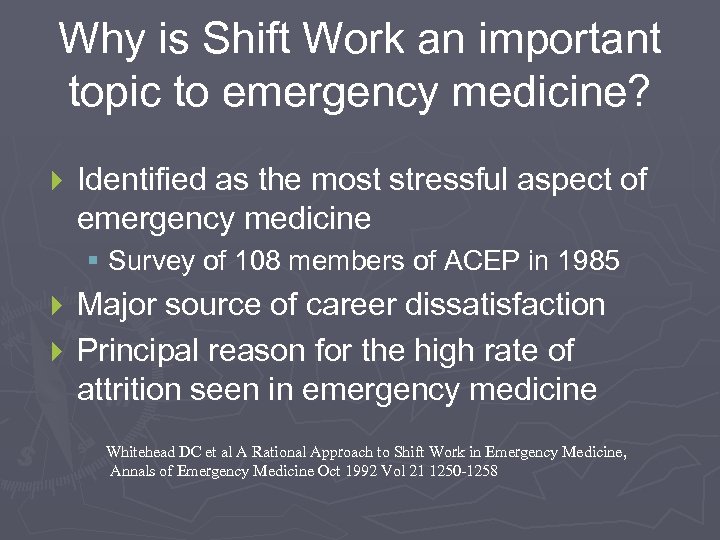 Why is Shift Work an important topic to emergency medicine? } Identified as the most stressful aspect of emergency medicine § Survey of 108 members of ACEP in 1985 Major source of career dissatisfaction } Principal reason for the high rate of attrition seen in emergency medicine } Whitehead DC et al A Rational Approach to Shift Work in Emergency Medicine, Annals of Emergency Medicine Oct 1992 Vol 21 1250 -1258
 Sleep Basics
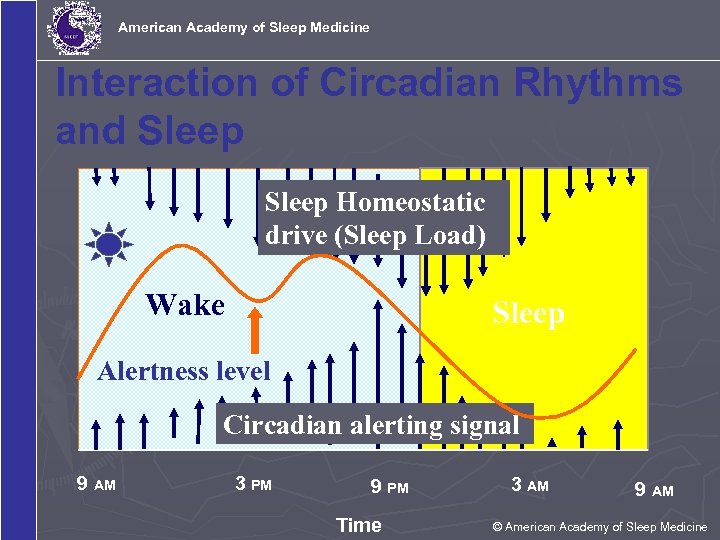 American Academy of Sleep Medicine Interaction of Circadian Rhythms and Sleep Homeostatic drive (Sleep Load) Wake Sleep Alertness level Circadian alerting signal 9 AM 3 PM 9 PM Time 3 AM 9 AM © American Academy of Sleep Medicine
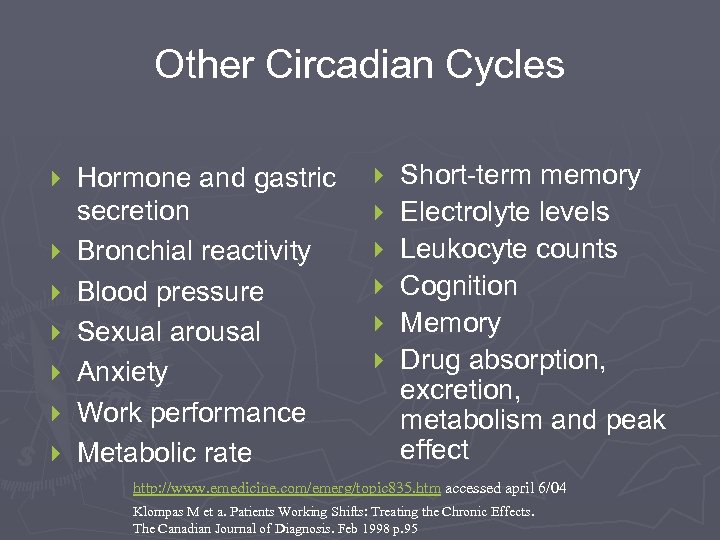 Other Circadian Cycles } } } } Hormone and gastric secretion Bronchial reactivity Blood pressure Sexual arousal Anxiety Work performance Metabolic rate } } } Short-term memory Electrolyte levels Leukocyte counts Cognition Memory Drug absorption, excretion, metabolism and peak effect http: //www. emedicine. com/emerg/topic 835. htm accessed april 6/04 Klompas M et a. Patients Working Shifts: Treating the Chronic Effects. The Canadian Journal of Diagnosis. Feb 1998 p. 95
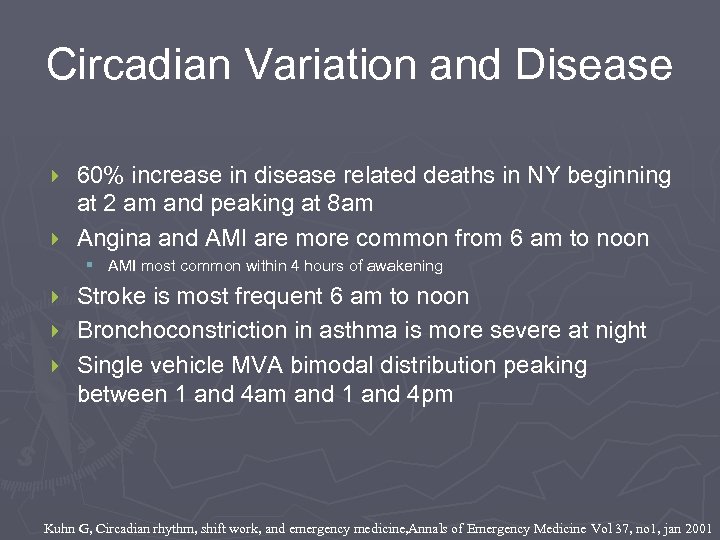 Circadian Variation and Disease 60% increase in disease related deaths in NY beginning at 2 am and peaking at 8 am } Angina and AMI are more common from 6 am to noon } § AMI most common within 4 hours of awakening Stroke is most frequent 6 am to noon } Bronchoconstriction in asthma is more severe at night } Single vehicle MVA bimodal distribution peaking between 1 and 4 am and 1 and 4 pm } Kuhn G, Circadian rhythm, shift work, and emergency medicine, Annals of Emergency Medicine Vol 37, no 1, jan 2001
 Shift Work and Error
 Shift Work and Error Fatigue and Error has been well studied } Less information specifically on Shift Work and Error } Not a lot of literature on shift work as it relates to Emergency Medicine } § “Shift work and error” in medline gives 0 hits § “Shift work and emergency” gives 6 hits § “Emergency and night shift” gives 20 more
 Shift Work and Error } Three Mile Island, Pennsylvania § 4 am March 28, 1979 nuclear power plant partial meltdown } Bhopal, India § “early hours” Dec. 3, 1984, gas leaked from a tank of methyl isocyanate } Chernobyl, Ukraine § 1: 23 am April 25, 1986 Nuclear Reactor explosion } Exxon Valdez, Alaska § 12: 04 am March 24, 1989 11 million gallons of oil spilled • Mitler M et al Catastrophes, sleep and public policy: consensus report, SLEEP, 1988 11: 100 -109
 Shift Work and Error } Cognitive and psychomotor performance parallel the circadian course of body temperature § Show a nadir at the minimum core body temperature Kuhn G, Circadian rhythm, shift work, and emergency medicine, Annals of Emergency Medicine Vol 37, no 1, jan 2001
 Fatigue and Medical Error
 } “Patient care may be compromised if a fatigued, sleep-deprived clinician is allowed to operate, administer an anesthetic, manage a medical crisis, or deal with an unusual or cognitively demanding clinical presentation” § Weinger M et at. Sleep Deprivation and Clinical Performance JAMA feb 27, 2002 vol 287, no 8
 } “Although little research has focused specifically on fatigue in hospital personnel and its relationship to medical error, studies outside the medical field demonstrate the intuitive link between fatigue and degradation performance” § Agency for Healthcare Research and Quality http: //www. ahcpr. gov/clinic/ptsafety/ accessed June 1/2004
 Study Criticisms } } } Invalidated measures of clinical performance Inconsistent definitions of fatigued and rested subjects Failure to measure fatigue objectively Limited statistical power Failure to account for circadian effects § Gaba M et al. Fatigue among clinicians and the safety of patients. NEJM vol 347, 16, Oct 17, 02
 Emergency Physicians } Smith-Coggins R et al, Relationship of Day Versus Night Sleep to Physician Performance and Mood, Ann of Emerg Med, vol 24, no 5, November 1994 p 928 -934 Observational study } Monitored 6 emergency physicians for two 24 h periods: } § Daytime work with nocturnal sleep § Nighttime work with daytime sleep
 Emergency Physicians Measurements: Ambulatory polysomnographic recordings, electro-oculogram, electromygraph data } Hourly mood ratings } Two performance tests completed 5 x/day } § Intubation of a mannequin § Simulated triage test
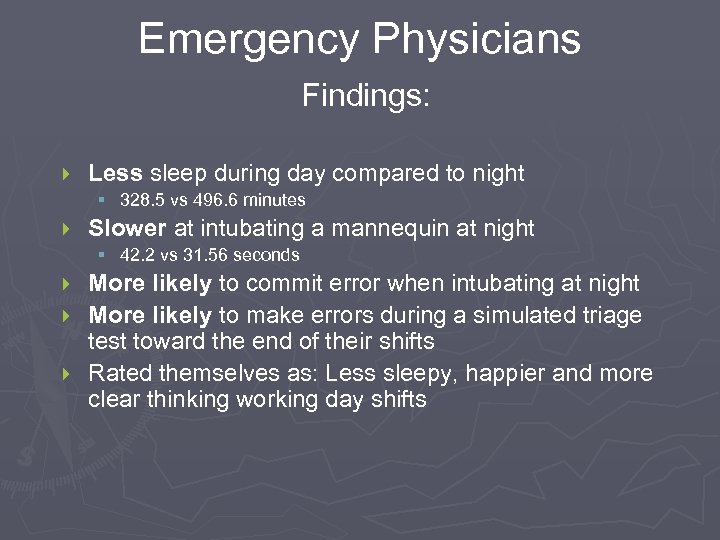 Emergency Physicians Findings: } Less sleep during day compared to night § 328. 5 vs 496. 6 minutes } Slower at intubating a mannequin at night § 42. 2 vs 31. 56 seconds More likely to commit error when intubating at night } More likely to make errors during a simulated triage test toward the end of their shifts } Rated themselves as: Less sleepy, happier and more clear thinking working day shifts }
 Emergency Physicians: Conclusion: } “emergency physicians get less sleep and are less effective when performing manual and cognitive tests while working night shifts with day sleep compared with working day shifts with night sleep”
 Emergency Physicians } Smith-Coggins et al. Rotating Shift work Schedules: Can we enhance physician adaptation to night shifts? Acad Emerg Med. 1997; 4: 951 -961 } Prospective, double-blind, placebo controlled trial of fatigue counter-measure program § Two groups of 3 emergency physicians § intervention, washout period, crossed over
 Emergency Physicians Intervention: One group had experimental intervention: 1. 2 hour education session 2. Work schedule based on chronobiologic principles 3. Provided with 31 countermeasure strategies to maintain alertness and performance during work } Other group ate a special placebo diet }
 Emergency Physicians Measurements: Subjective logbook regarding level of alertness, mood, quantity and quality of sleep obtained 2. Polysomnographic recordings 3. Performance tests 4 x/day: 1. a. b. c. Psychomotor vigilance test: ECG/rhythm interpretation Intubation skills
 Emergency Physicians Findings: Subjects slept more after both interventions } The experimental interventions did not significantly improve the physician’s performance, or mood on the night shift } No difference on ECG analysis and interpretation } Time required to intubate a mannequin was significantly slower during the night shift }
 Emergency Physicians Conclusion: } “Circadian-mediated disruptions of waking neurobehavioral functions and sleep deprivation are problems in emergency physicians”
 Emergency Physicians } Dula et al. The effect of working serial night shifts on the cognitive functioning of emergency physicians. Ann of Emerg Med. Vol 38, no 2 August 2001 p. 152 Does working 5 serial night shifts in the ED result in a decline in physician performance? } Compared cognitive functioning of EP that worked the day shift vs. the night shift } 16 Emerg Residents } § Tested half while working days, the other half while working nights § 2 month interval § Crossed over
 Emergency Physicians } The Fluid Scale of the Kaufman Adolescent and Adult Intelligence Test § measures a person’s adaptability and flexibility when faced with new problems using both verbal and nonverbal stimuli “The Fluid Scale measures hypothesis testing and decision making, 2 areas of extreme importance to individuals functioning in the ED” } Every physician but one had a decline in performance after working 5 consecutive night shifts }
 Emergency Physicians Conclusion: } “Working a series of 5 nights results in a substantial decline in cognitive performance in physicians working in the ED. ”
 However… None of these studies looked directly at fatigue and errors in the department } They only indicate that as emergency physicians become fatigued their cognitive function decreases } Difficult to link fatigue directly with error } § At what point in the medical process does the error actually occur?
 Ideas to Cope With Shift Work
 Melatonin } “Several studies have examined the effectiveness of oral melatonin use in emergency medicine physicians working night shifts have failed to document a significant effect” § Sleep, Alertness, and Fatigue Education in Residency (SAFER) Program, Speaker’s Guide, American Academy of Sleep Medicine 2003
 Sleep Before a Night Shift } 40 subjects in two experiments § One group: kept awake for 28 hours § Other: consumed 10 -15 g of alcohol at 30 min intervals from 8 am until blood alcohol level was 0. 1% } Measured cognitive psychomotor performance at half hour intervals § Computer-administered test of hand-eye coordination
 Sleep Before a Night Shift } “After 17 hours of sustained wakefulness (0300 h) cognitive psychomotor performance decreased to a level equivalent to the performance impairment observed at a blood alcohol concentration of 0. 05%” § Fatigue, alcohol and performance impairment. Dawson et al. Nature vol 388 17 july 1997, p. 235
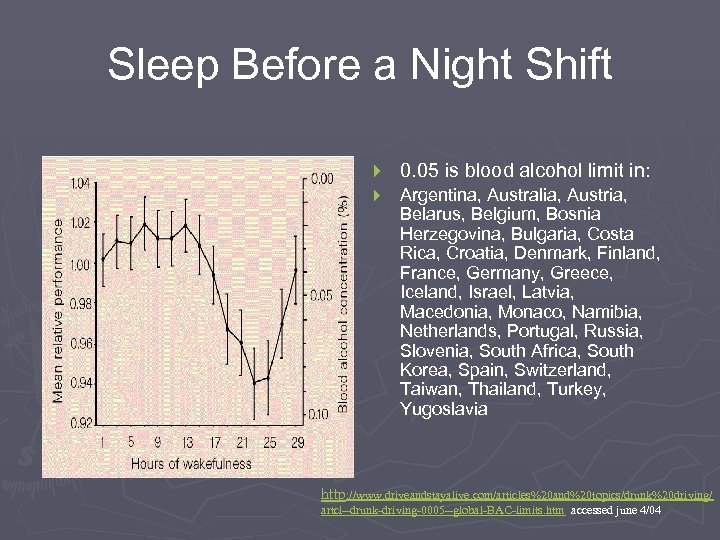 Sleep Before a Night Shift } 0. 05 is blood alcohol limit in: } Argentina, Australia, Austria, Belarus, Belgium, Bosnia Herzegovina, Bulgaria, Costa Rica, Croatia, Denmark, Finland, France, Germany, Greece, Iceland, Israel, Latvia, Macedonia, Monaco, Namibia, Netherlands, Portugal, Russia, Slovenia, South Africa, South Korea, Spain, Switzerland, Taiwan, Thailand, Turkey, Yugoslavia http: //www. driveandstayalive. com/articles%20 and%20 topics/drunk%20 driving/ artcl--drunk-driving-0005 --global-BAC-limits. htm accessed june 4/04
 Sleep Before a Night Shift } At 0800 h “performance decreased to a level equivalent to the performance deficit observed at a blood alcohol concentration of roughly 0. 1%” § Fatigue, alcohol and performance impairment. Dawson et al. Nature vol 388 17 july 1997, p. 235 USA limit is 0. 1% } Swaziland limit is 0. 15% } § http: //www. driveandstayalive. com/articles%20 and%20 topics/drunk%20 driving/a rtcl--drunk-driving-0005 --global-BAC-limits. htm accessed june 4/04
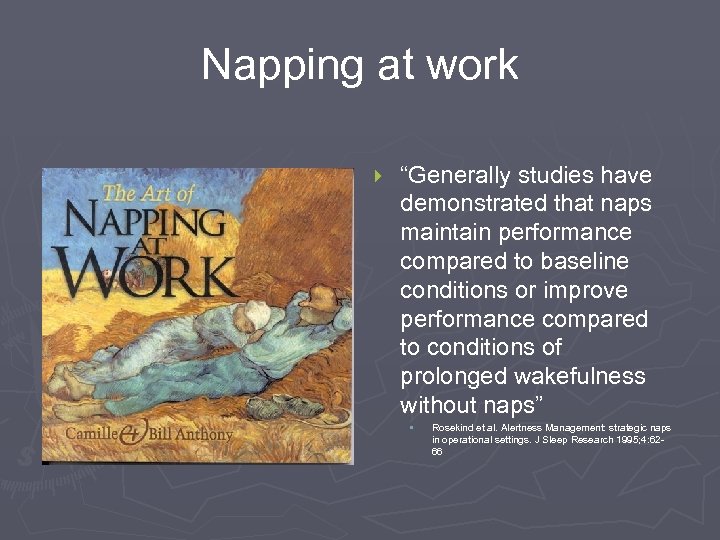 Napping at work } “Generally studies have demonstrated that naps maintain performance compared to baseline conditions or improve performance compared to conditions of prolonged wakefulness without naps” § Rosekind et al. Alertness Management: strategic naps in operational settings. J Sleep Research 1995; 4: 6266
 Napping at work Not appropriate during a shift with demand for “potential emergency” } Sleep inertia } Must consider the timing of the nap with respect to the circadian rhythm } Rosekind et al. Alertness Management: strategic naps in operational settings. J Sleep Research 1995; 4: 62 -66
 Decrease the number of nights with increasing age } Older physicians are less tolerant § Has been suggested that workers begin to show deterioration in job function on night shifts in the 45 -50 yr age range Akerstedt T et al. Fiedl studies of shift work: II Temporal patterns in psychophysiological activation in workers alternating between night and day work. Ergonomics 1977; 20: 621 -631 Younger physicians more tolerant, need more money to pay off debts } Seniority factor } § In some specialties physicians with >20 yrs of service don’t do call
 Casino Shifts } Silver Dollar Casino, Calgary, AB § Not open 24 h/day Casino. Rama, Ontario } Circus and Bally’s in Las Vegas } § Won’t return my emails, phone calls
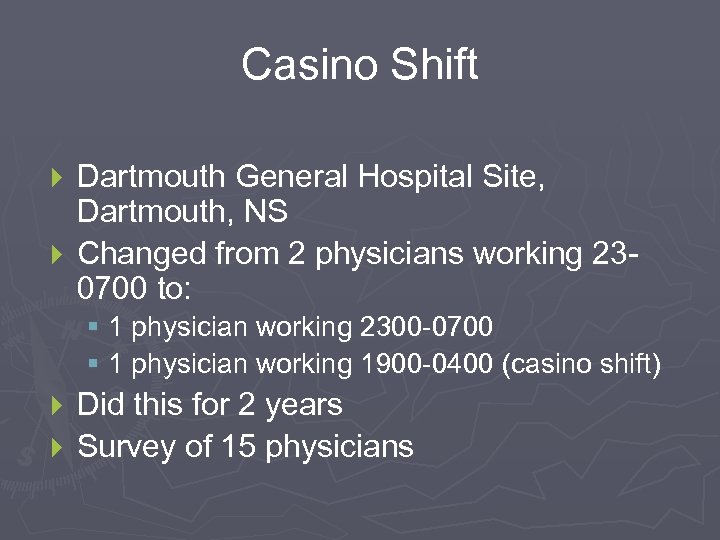 Casino Shift Dartmouth General Hospital Site, Dartmouth, NS } Changed from 2 physicians working 230700 to: } § 1 physician working 2300 -0700 § 1 physician working 1900 -0400 (casino shift) Did this for 2 years } Survey of 15 physicians }
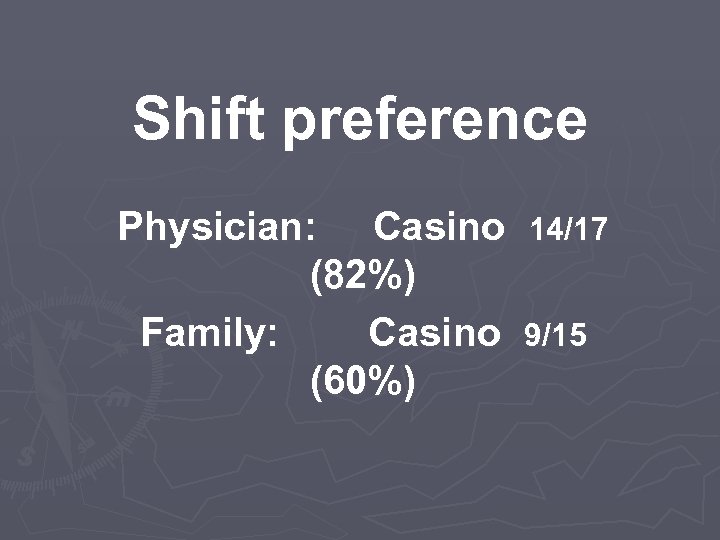 Shift preference Physician: Casino (82%) Family: Casino (60%) 14/17 9/15
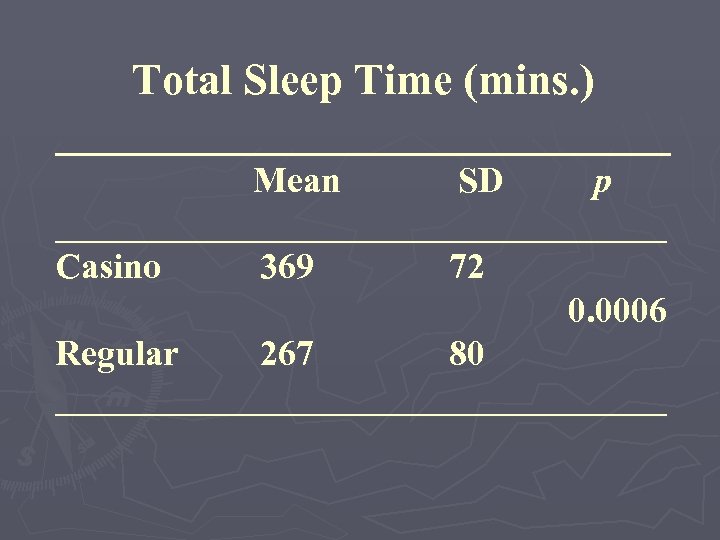 Total Sleep Time (mins. ) ______________ Mean SD p _________________ Casino 369 72 0. 0006 Regular 267 80 _________________
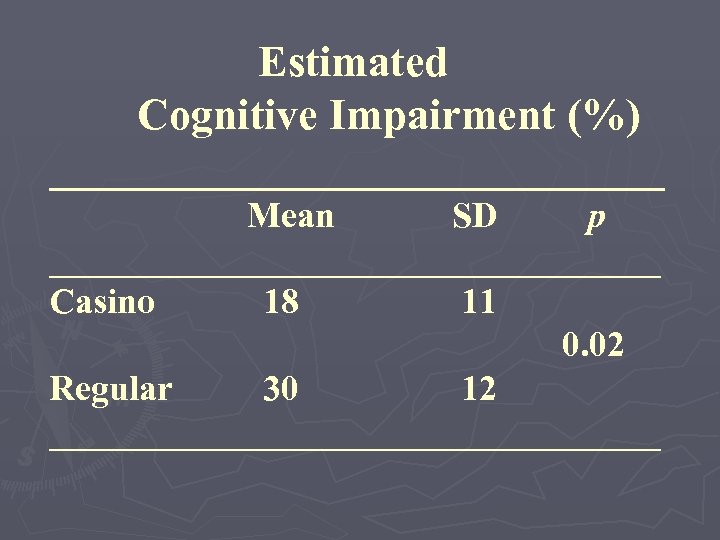 Estimated Cognitive Impairment (%) ______________ Mean SD p _________________ Casino 18 11 0. 02 Regular 30 12 _________________
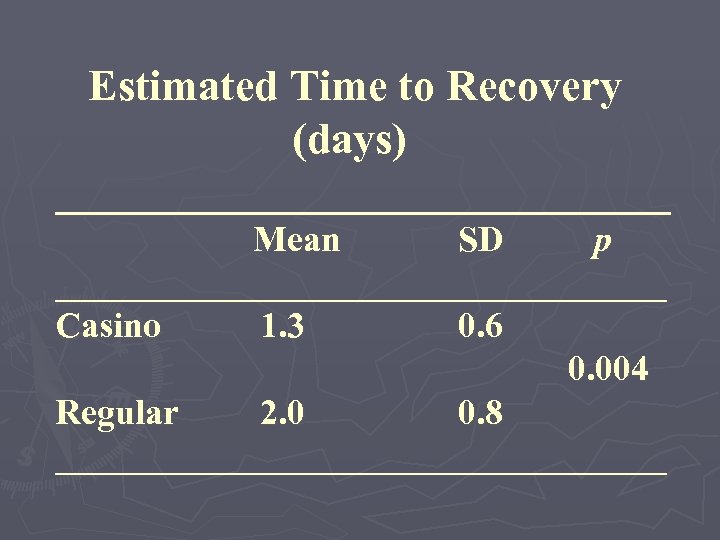 Estimated Time to Recovery (days) ______________ Mean SD p _________________ Casino 1. 3 0. 6 0. 004 Regular 2. 0 0. 8 _________________
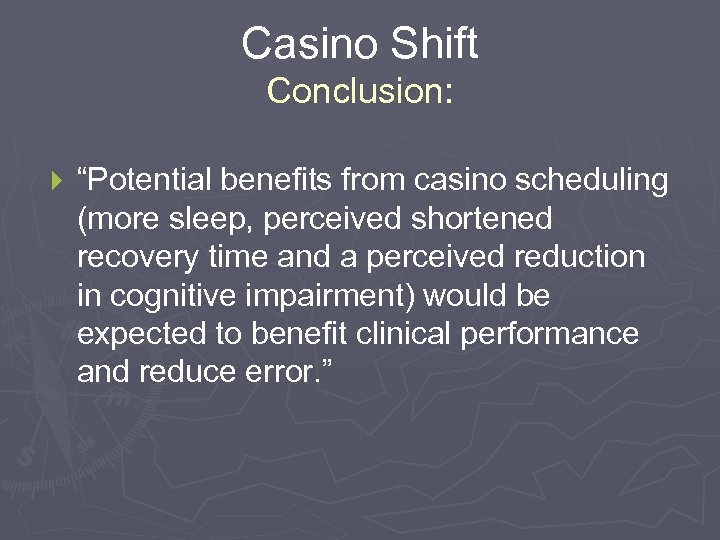 Casino Shift Conclusion: } “Potential benefits from casino scheduling (more sleep, perceived shortened recovery time and a perceived reduction in cognitive impairment) would be expected to benefit clinical performance and reduce error. ”
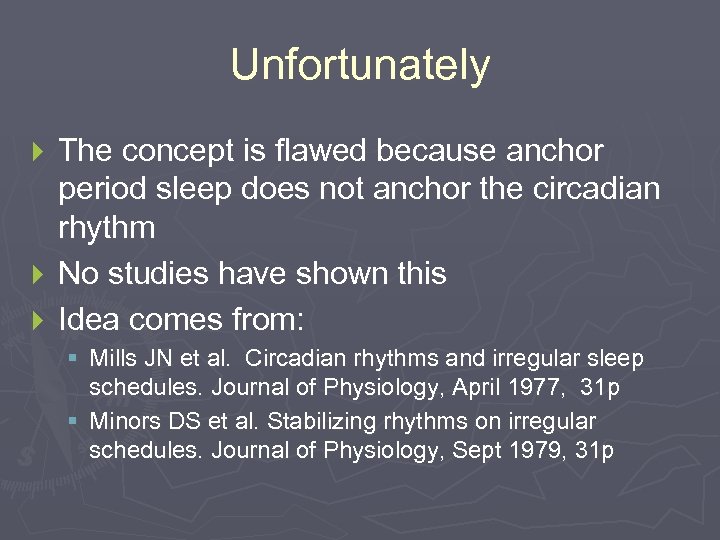 Unfortunately The concept is flawed because anchor period sleep does not anchor the circadian rhythm } No studies have shown this } Idea comes from: } § Mills JN et al. Circadian rhythms and irregular sleep schedules. Journal of Physiology, April 1977, 31 p § Minors DS et al. Stabilizing rhythms on irregular schedules. Journal of Physiology, Sept 1979, 31 p
 Suggestions
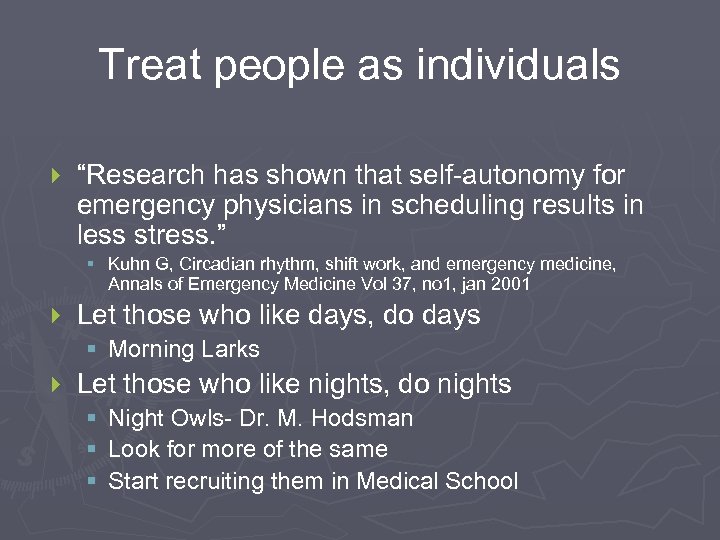 Treat people as individuals } “Research has shown that self-autonomy for emergency physicians in scheduling results in less stress. ” § Kuhn G, Circadian rhythm, shift work, and emergency medicine, Annals of Emergency Medicine Vol 37, no 1, jan 2001 } Let those who like days, do days § Morning Larks } Let those who like nights, do nights § Night Owls- Dr. M. Hodsman § Look for more of the same § Start recruiting them in Medical School
 Maximize Circadian Rhythms Shift rotation } Rapid vs Slow Rotations } Lighting in the Emergency Department }
 Shift Rotation } Easy to stay up later § delay sleep } More difficult to try to fall asleep earlier § advance sleep } This the principle behind forward (clockwise) rotation of shifts § Day Evening Night
 Rapid Rotation 1 to 2 night shifts in a row } Favored by those who wish to keep the circadian rhythm diurnal } Isolated night shifts are easier for some workers because there is no resetting of the circadian rhythms }
 Slow rotation } “At least a week is required for the circadian system to switch from a diurnal to a nocturnal pattern” § Monk TK. Advantages and Disadvantages of Rapidly rotating shift schedules-A Circadian Viewpoint Human Factors 1986, 28(5) 553 -557 21 to 28 day rotation } Then do no nights for a year }
 Lighting in the Emergency Department } Bright light between 7000 and 12000 lux at night significantly increases subjective alertness and cognitive performance in shift workers § Czeisler C et al. Exposure to bright light and darkness to treat physiologic maladaptation to night work. NEJM 1990; 322: 1253 -1259 } “The United States Nuclear Regulatory Commission has implemented bright lighting for its night workers and found less fatigue and better alertness on the job” § Agency for Healthcare Research and Quality http: //www. ahcpr. gov/clinic/ptsafety/ accessed June 1/2004 p. 524
 Lighting in the Emergency Department New FMC department will have sky lights } Bad idea } As it gets darker at night so will department } § Staff will want to sleep
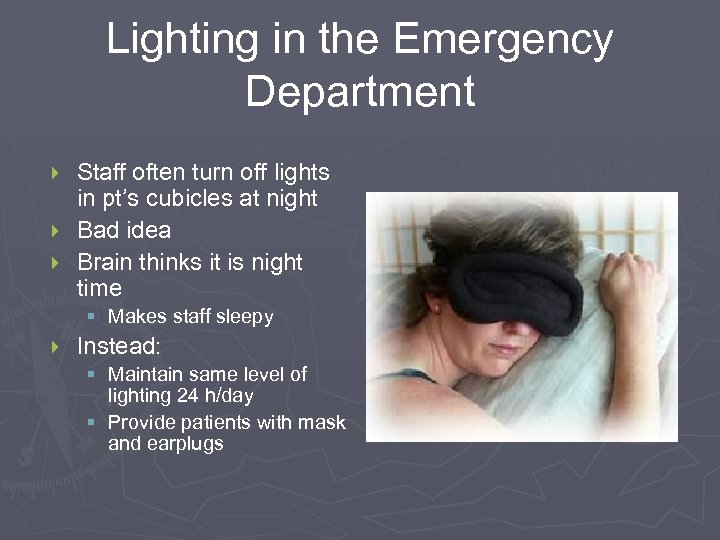 Lighting in the Emergency Department Staff often turn off lights in pt’s cubicles at night } Bad idea } Brain thinks it is night time } § Makes staff sleepy } Instead: § Maintain same level of lighting 24 h/day § Provide patients with mask and earplugs
 Conclusion
 Unfortunately… There is no great panacea for the problems associated with shift work } “The most important thing a shift worker can do is protect their sleep time” } § Dr. C. Samuels May 5, 2004
 Sleep when you are tired } “A(n afternoon) siesta will produce a higher proportion of REM than sleep at other times because of the circadian nature of REM sleep” Whitehead DC et al A Rational Approach to Shift Work in Emergency Medicine, Annals of Emergency Medicine Oct 1992 Vol 21 1250 -1258
 Exercise } “Vigorous aerobic exercise after rising may diminish the time needed to adjust to new shifts” § Whitehead DC et al A Rational Approach to Shift Work in Emergency Medicine, Annals of Emergency Medicine Oct 1992 Vol 21 1250 -1258 } But… § avoid exercising 2 to 4 hours before sleep
 Maximize sleep potential } Avoid morning light stimulus § Consider sleeping at hospital § Drive home with sunglasses on } Avoid light in general § Room in basement § Dark blinds in room Cool environment } Quiet } § Earplugs § Room away from household activity
 Communicate } } Put do not disturb notes on front door Turn off telephone Don’t schedule events during planned sleep time Don’t plan strenuous events after a series of nights § More sleep will be required to make up the sleep debt
 Summary 1. 2. 3. 4. 5. Shift work has detrimental health effects Lack of literature regarding emergency physicians and shift work Lack of literature regarding emergency department error related to fatigue No easy solution to the problem of shift work Maximize sleep hygiene to get the most out of sleep
 Thanks Dr. A. Anton } Dr. G. Curry } Dr. M. Hodsman } Dr. J. Mclellan } Dr. J. Nation } Dr. T. Rich } Dr. C. Samuels } Dr. B. Young }
 References } } } } } Akerstedt T et al. Fiedl studies of shift work: II Temporal petterns in phsychophysiological activation in workers alternating between night and day work. Ergnonomics 1977; 20: 621 -631 http: //www. emedicine. com/emerg/topic 835. htm accessed april 6/04 Croskerry P Emergency et al, Casino Shift-Scheduling in the Department - A Strategy for Abolishing the Night Shift? , Abstract Personal correspondence with Dr. P. Croskerry May 17, 2004 Fatigue, alcohol and performance impairment. Dawson et al. Nature vol 388 17 july 1997, p. 235 Heselgrave R. Asleep at the Switch: Coping with shift work. The canadian journal of Diagnosis. Feb 1998 p. 78 Personal Corrrespondence with Dr. J. Mclellan, Shift Coordinator Rocky Mountian Emergency Services April 19, 2004 Personal Correspondence: Dr. A. Anton, Medical Director of Calgary EMS April 16, 2004 Rungta K. Sleepless on the shift. The Canadian Journal of Diagnosis/ Feb 1998. P. 1
 References } } } } Mitler M et al Catastrophes, sleep and public policy: consensus report, SLEEP, 1988 11: 100 -109 Smith-Coggins R et al, Relationship of Day Versus Night Sleep to Physician Performance and Mood, Ann of Emerg Med, vol 24, no 5, November 1994 p 928934 Smith-Coggins et al. Rotating Shiftwork Schedules: Can we enhance physician adaptation to night shifts? Acad Emerg Med. 1997; 4: 951 -961 Weinger M et at. Sleep Deprivation and Clinical Performance JAMA feb 27, 2002 vol 287, no 8 Sleep, Alertness, and Fatigue Education in Residency (SAFER) Program, Speaker’s Guide, American Academy of Sleep Medicine 2003 Whitehead DC et al A Rational Approach to Shift Work in Emergency Medicine, Annals of Emergency Medicine Oct 1992 Vol 21 1250 -1258 Drunk Driving Blood Alcohol Limits Worldwide http: //www. driveandstayalive. com/articles%20 and%20 topics/drunk%20 driving/artcl-drunk-driving-0005 --global-BAC-limits. htm accessed june 4/04
 References } } } } } Gaba M et al. Fatigue among clinicians and the safety of patients. NEJM vol 347, 16, Oct 17, 02 Klompas M et a. Patients Working Shifts: Treating the Chronic Effects. The Canadian Journal of Diagnosis. Feb 1998 p. 95 Leach DC. Residents’work hours: Achilles heel of the profession? Acad Med 2000; 75: 1156 -7 Monk TK. Advantages and Disadvantages of Rapidly rotating shift schedules-A Circadian Viewpoint Human Factors 1986, 28(5) 553 -557 Kuhn G, Circadian rhythm, shift work, and emergency medicine, Annals of Emergency Medicine Vol 37, no 1, jan 2001 Rosekind et al. Alertness Management: strategic naps in operational settings. J Sleep Research 1995; 4: 62 -66 Samuels C, Fatigue and Sleep: Making the Connection. The Canadian Journal of CME. Oct. 2001. P. 51 -61 Smith Coggins et al. Rotating Shiftwork Schedules: Can we enhance physician adaptation to night shifts? Acad Emerg Med. 1997; 4: 951 -961 Smith L et al. The perceptions and feelings of shiftworkers’partners. Ergonomics 1993; 36 (1 -3): 299 -305
 end
end