


 Скачать презентацию Slavic Immigration passport to another life Alice Paul
30dd25f44002ad1c29599fbc46874b16.ppt
- Количество слайдов: 17
 Slavic Immigration passport to another life Alice Paul, Melissa Cotignola, Jenny Bayard, and Rachel Christensen
 As persecution and poverty became issues in the Slavic countries, many began to immigrate to the United States, seeking jobs and privileges. However, often times their lack of education and agricultural knowledge left them with unskilled, low paying jobs and inadequate living. Because of the emphasis on a better life for their children, they adapted to the American lifestyle but in the end it became a struggle to assimilate to society while retaining national identity.
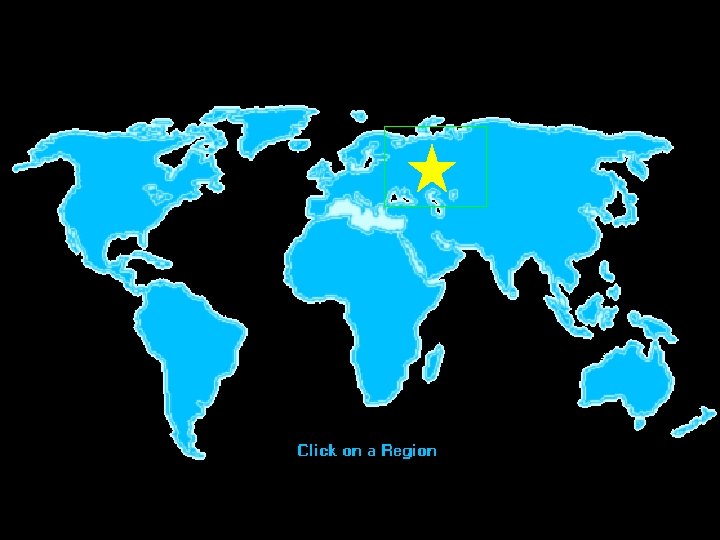
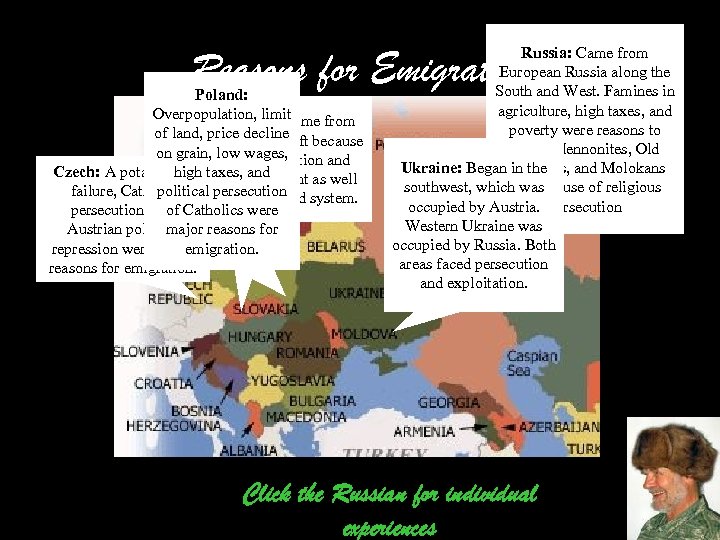 Reasons for Emigration Poland: Overpopulation, limit Slovakia: Came from of land, price decline rural areas. Left because on grain, low wages, of high inflation and high taxes, and Czech: A potato crop unemployment as well failure, Catholic political persecution as the landlord system. persecution, and of Catholics were major reasons for Austrian political repression were major emigration. reasons for emigration. Russia: Came from European Russia along the South and West. Famines in agriculture, high taxes, and poverty were reasons to leave. Mennonites, Old Ukraine: Began in the Velievers, and Molokans left because of religious southwest, which was occupied by Austria. persecution Western Ukraine was occupied by Russia. Both areas faced persecution and exploitation. Click the Russian for individual experiences
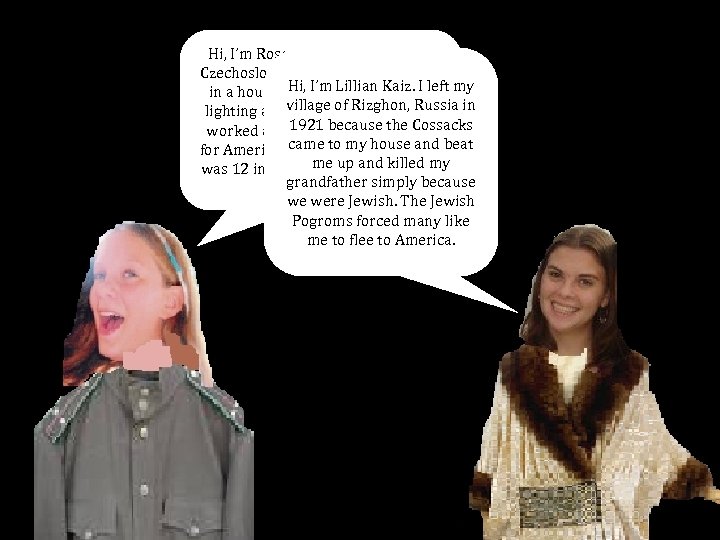 Hi, I’m Rose Gillman. I grew up in Czechoslovakia in a well to do town Hi, I’m Lillian electric in a house complete with Kaiz. I left my lighting andvillage of Rizghon, Russia in plumbing. My mother 1921 because dad Cossacks worked at a bakery as my the left came to my house and for America to work. We left when I beat me up and killed my was 12 in 1916 to join him after six grandfather simply because years. we were Jewish. The Jewish Pogroms forced many like me to flee to America.
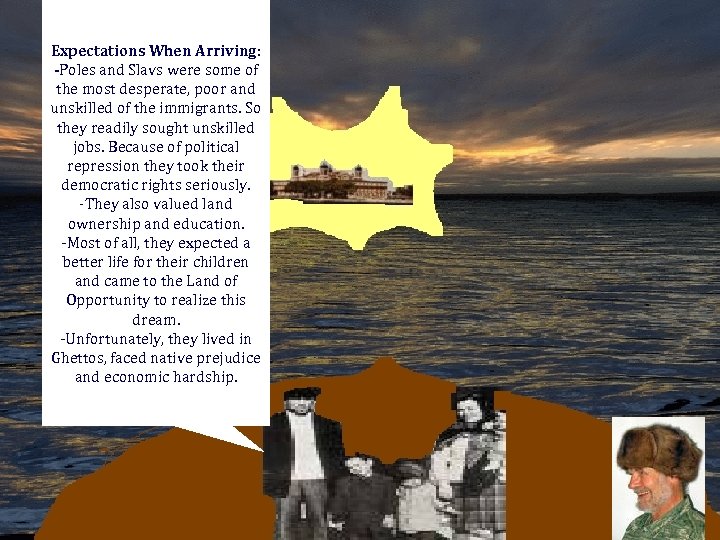 Expectations When Arriving: -Poles and Slavs were some of the most desperate, poor and unskilled of the immigrants. So they readily sought unskilled jobs. Because of political repression they took their democratic rights seriously. -They also valued land ownership and education. -Most of all, they expected a better life for their children and came to the Land of Opportunity to realize this dream. -Unfortunately, they lived in Ghettos, faced native prejudice and economic hardship.
 Trends of Immigration -Majority of Slavs emigrated between 1901 and 1920 -Between 1881 and 1914, 3. 2 million Russians entered the U. S. -Immigration trickled after Bolshevik Revolution in Russia because of strict government codes. Johnson-Reed Act of 1927 established immigrant quotas per year -The quotas for the years 1924 -1925 were: 671 Yugoslavians 3, 073 Czechoslovakians 5, 982 Poles 124 Armenians -Following WWII, immigrant refugees were allowed into the country through the 1948 Displaced Person’s Act and the 1953 Refugee Relief Act. -Immigrants were labeled upon arrival by their state of origin (I. e. Bulgars, Serbs, Croats). -Many Slavs have come to America since 1980 because of the fall of communism
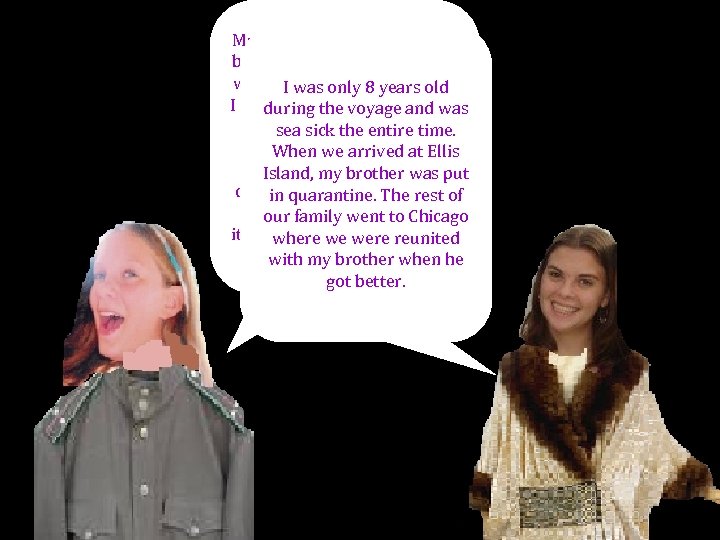 My trip lasted two weeks and because I rode second class it was mostly enjoyable forold I was only 8 years me. I looked forward to seeing my during the voyage and was father again. I traveled with sea sick the entire time. my sisters, brother, and When we arrived at Ellis mother. my brotherfew put Island, I packed a was dresses, three pairs of shoes, in quarantine. The rest of a coat, family went to Chicago our boots, and religious items. Upon we were reunited where arrival we stayed for two daysbrother Island. he with my at Ellis when got better.
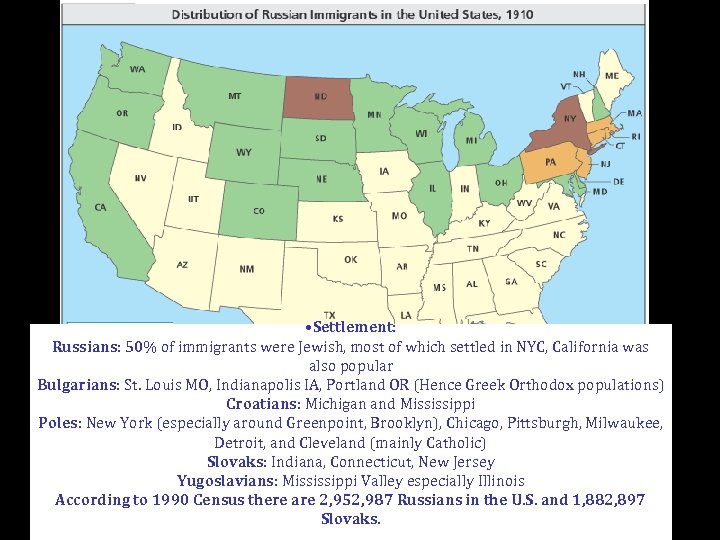 • Settlement: Russians: 50% of immigrants were Jewish, most of which settled in NYC, California was also popular Bulgarians: St. Louis MO, Indianapolis IA, Portland OR (Hence Greek Orthodox populations) Croatians: Michigan and Mississippi Poles: New York (especially around Greenpoint, Brooklyn), Chicago, Pittsburgh, Milwaukee, Detroit, and Cleveland (mainly Catholic) Slovaks: Indiana, Connecticut, New Jersey Yugoslavians: Mississippi Valley especially Illinois According to 1990 Census there are 2, 952, 987 Russians in the U. S. and 1, 882, 897 Slovaks.
 Labor: Then: Slavic Immigrants worked primarily in steel/iron mills, coal mines, and factories. Russians were tailors, merchants, and laborers. Bohemians were farmers, agricultural laborers, and tailors. The meatpacking industry and sweatshops in Chicago primarily employed Poles. Jewish Slavic immigrants worked as artisans and businessmen. Because in their homelands, they were restricted by laws that prohibited them from owning land farming they had little experience. Now: The majority of Slavs hold “white collar jobs”
 We settled in Chicago My father worked selling religious where we lived in a small shawls apartment. My father in Chicago, but the profit he expected to variety of far more worked a earn was jobs to than what he could accomplish. support our family. He My mother laterdeli, worked a owned a opened a bakery. Still they managed to have enough newspaper stand was a money to spoil me withalso local policeman. I piano lessons and college tuition. worked after I dropped out of high school. . Times were tough because of the depression.
 Customs that have affected the U. S. : From Russia- Nesting dolls, Russian ballet, Christmas eggs, and Faberge eggs. From Poland: The Polka From Ukraine: Easter egg painting Also, the food (like borsht!) has influenced our cuisine. Slavs also helped influence the American Vaudeville and Tin Pan Alley (New York Music Publishing District) with composes like Sophie Tucker and Irving Berlin. Al Johnson helped influence ragtime and Samuel Goldwyn from Poland, controlled film industry in the early 20 th century.
 SOME STEREOTYPES ¨ All Russians are communists or were communist spies during WWII. ¨ All Russians are in the Russian Mafia. ¨ All Slavic immigrants are gypsies. ¨ Poles are dirty, disorderly, and drunks. · While it is true that it wasn’t until the mid-20 th century that the move of Polish immigrants toward education took place, many Poles came to the U. S. to purchase land make money and thus had a strong work ethic. · Because of the large number of immigrants to the U. S. during the early 20 th century and their inability to speak English, many Poles were forced to take jobs in factories, resulting in the view that they were “dirty”. · Polish immigrants were also very religious, establishing the Polish National Church in the United States and many continue to worship in it today. ¨ All Jews are “shylocks”. · As Jews came to the U. S. they also were captured by the dream of economic freedom and prosperity, as every immigrant was, and thus it may appear as though their only interest was in gaining money. · During the late 19 th century, 65% worked in the Dressing and Textile industry, not in banking or as moneylenders.
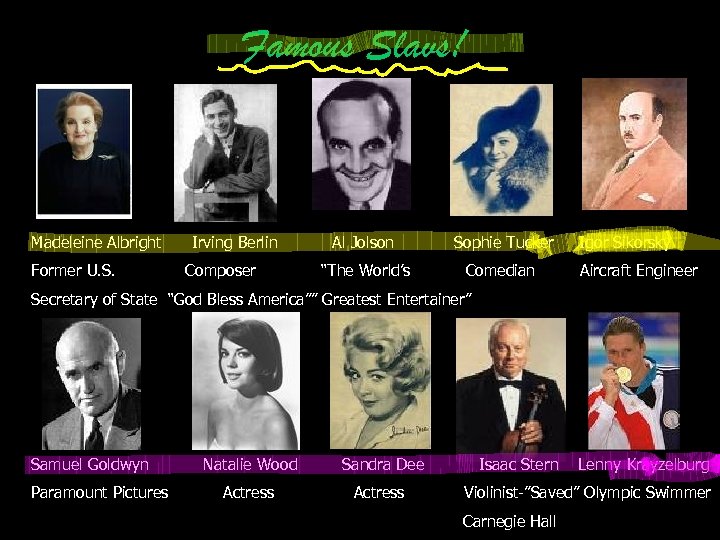 Famous Slavs! Madeleine Albright Former U. S. Irving Berlin Composer Al Jolson Sophie Tucker “The World’s Comedian Igor Sikorsky Aircraft Engineer Secretary of State “God Bless America”” Greatest Entertainer” Samuel Goldwyn Paramount Pictures Natalie Wood Sandra Dee Actress Isaac Stern Lenny Krayzelburg Violinist-”Saved” Olympic Swimmer Carnegie Hall
 • Al Also the man who was killed by a bullet meant for Franklin Delano Roosevelt and the parents of the man who shot Mc. Kinley were Slavic immigrants.
 Credits • Alice Paul- where they emigrated from and reasons for leaving • Rachel Christensen- expectations and trends of immigration • Melissa Cotignola- where they settled and the jobs • Jenny Bayard- customs, famous people, and stereotypes • Alice, Rachel, + Melissa- Personal Experiences
 Bibliography • • • • Alexander, June G. "Slovaks Abroad and the Diaspora. " Slovakia. org. 5 Nov. 2006