


 Скачать презентацию Slavery and Western Expansion Chapter 8 Section 1
00b7e1ed1927db06061d460a52b5e92b.ppt
- Количество слайдов: 27
 Slavery and Western Expansion Chapter 8 Section 1
 Impact of War w/Mexico • Heightened sectional tensions – Opened new lands to the issue of slavery • CURRENT LAW – MISSOURI COMPROMISE – Southerners wanted new laws to help return runaway slaves – Polk – believed the expansion of slavery a null and void issue – dry climate of southwest not suitable for growing cash crops – Ultimately – he believes slavery will destroy the Democrats & Union
 Wilmot Proviso • Originally – Appropriations bill – started in the House --- amendment --- no slavery or involuntary servitude in land acquired through war • Passed in the House – Northern • Rejected --- Senate – balanced • Calhoun Resolution --– States own the United States – Fed Had no right to make laws in the states or territories
 Popular Sovereignty • Allowing citizens to decide for themselves the issue of slavery --- idea of Michigan Senator Lewis Cass • Free Soilers – combination of two groups Northern “Conscience” Whigs & Northern Democrats – Whigs divided – “Cotton” vs “Conscience” – Democrats Divided – Northern vs Southern
 What caused the development of the free soil party?
 Election of 1848 • Cotton Whigs & Southern Dem – nominate Zahary Taylor • Free Soilers – Nominate – Martin Van Buren • Democrats – Lewis Cass • Zachary Taylor wins the Election
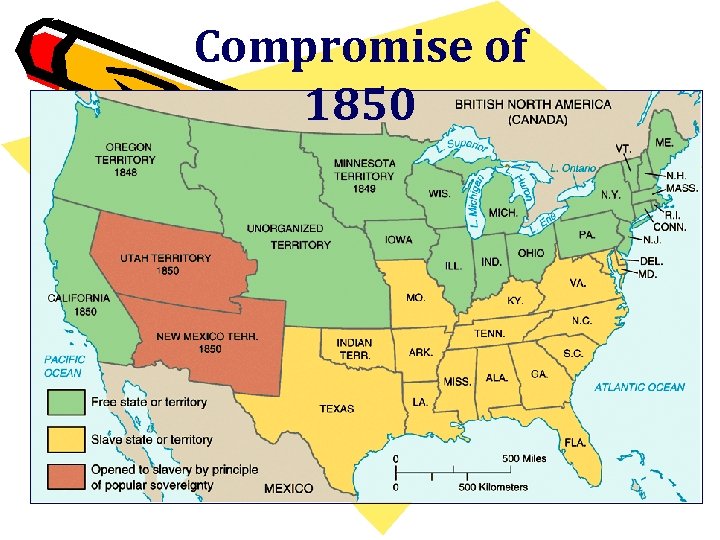
 California • Slavery brought to the forefront early on in Taylor’s Presidency • 1849 – California Gold Rush – 80, 000 people up an went to California – apply for statehood – (popular sovereignty) • 1849 – California applied as a Free State
 Great Debate (Southern Position) • 1. slaveholding states would be a minority in the senate • 2. northerners would dominate national politics • 3. threat of secession – • ** need for Compromise --- Henry Clay
 Other Issues dealing w/ slavery in Congress • Texas / NM – border --- extend or stop slavery • District of Columbia – slavery in the nation’s capital • Slave trade within the US -regulate or not
 Clay’s Compromise • Offered as a package plan – A. Allow Calif – free state/ organize rest of Mexican cession w/out any restrictions (popular sovereignty) – B. settles border disputes bt/ Texas & NM – favored NM – gov’t acquired Texas’ debts. – Outlawed slave trade in D. C. – did not outlaw slavery itself – Congress would not interfere in domestic slave trade --- enforce a Stiffer Fugitive Slave Act
 Results of Compromise • 1. did not pass originally – because it was offered as a package deal – Makeup of Congress Changes • Calhoun Dies of TB • Taylor who opposed Clay’s Compromise – suddenly dies • VP – Millard Filmore now President supports Henry Clay • Webster – states right activist – Sect. of State • Clay – leaves the Senate
 • Stephen Douglass – 33 yr old devises a plan – offer each idea individually – attain majority support – pass – -Known as Compromise of 1850
 Compromise of 1850
 How did the Gold Rush affect the issue of slavery?
 Uncle Tom’s Cabin • Written by Harrier Beecher Stowe came out (book form) 1852 – sold 300, 000 copies – Presented African American as – real people suffering form dreadful circumstances – – It depicted the harshness of the institution of slavery – She was motivated to write this book by the Fugitive Slave Act of 1850 – part of 1850 Compromise
 Fugitive Slave Act • • • 1. all fugitives were not entitled to a trial by jury, despite the 6 th Amendment – 2. fugitives could not testify on their own behalf 3. A statement by the slaveowner describing the escapee was all that was needed to have a slave returned 4. Federal commissioners that enforced the law – granted $10 only $5 if they were let free 5. anyone convicted of helping a fugitive – $1, 000 fine 6. anyone could be compelled to help capture runaways – deputize on spot
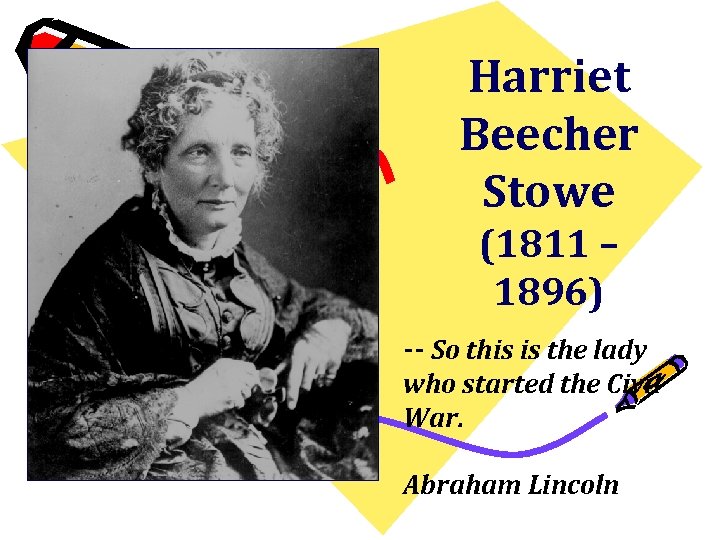 Harriet Beecher Stowe (1811 – 1896) -- So this is the lady who started the Civil War. Abraham Lincoln
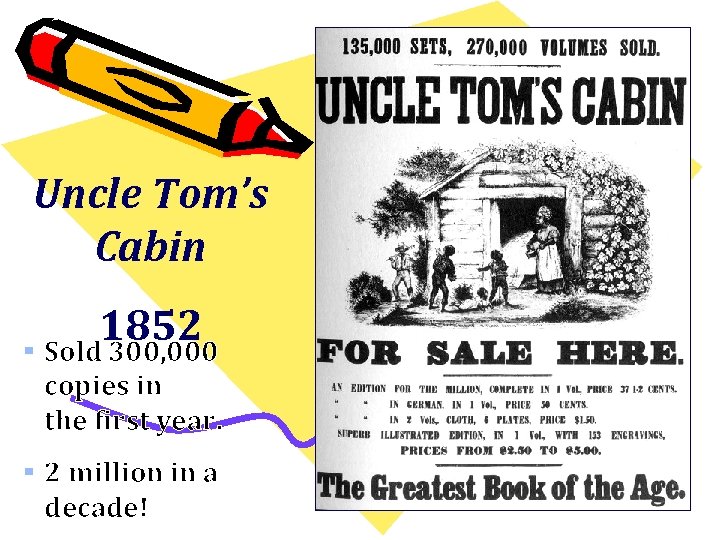 Uncle Tom’s Cabin 1852 § Sold 300, 000 copies in the first year. § 2 million in a decade!
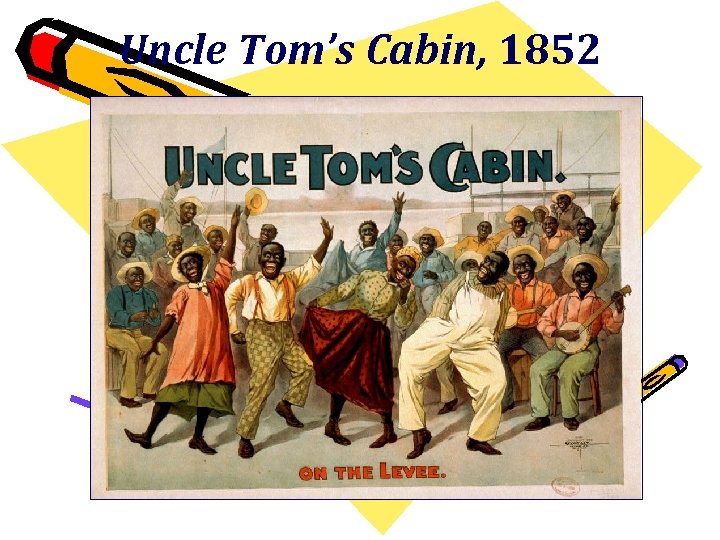 Uncle Tom’s Cabin, 1852
 Northern Resistance • Frederick Douglass – • Henry David Thoreau • C. The Underground Railroad – well organized system of freeing slaves – transporting them from the south – north. – Conductors • • Harriet Tubman Levi Coffin
 Continuing issue of Slavery • As people moved west with the opening of Calif, Oregon and the acquiring of new western territory – people didn’t lose their identity – pro/ anti slavery • One item everybody wanted – Transcontinental Railroad – reduced traveling time to 4 days – – Wagon (months) – Sailing around S. America - month
 What was an unintended consequence of the fugitive slave act?
 Problem w/ Transcontinental Railroad • People argued over its starting point – Many southerners favored a starting point in New Orleans --- required the railroad to travel through the northern part of Mexico – – Gadsen Purchase ---$10, 000 – Douglass – wanted the HUB to be in Chicago – his home state of Illinois – • • • land west had to be organized into territories/ states Prepared the Nebraska Bill Passes in House – repealed in Senate
 Sectionalism over the Railroad • Southern Position – if US creates new territories – they should be open to slavery – like the territories acquired by war – if this happens they will agree to railroad beginning in the North • Stephen Douglass – knows that any attempt to repeal compromise – will divide the country
 Douglas’ proposal • He proposed the – repeal Missouri Compromise , divide territories in 2 – Kansas -south/ Nebraska - north • Existing Laws – Missouri Compromise – for territories not acquired through war/ states – Compromise of 1850 – popular sovereignty for states acquired through war – ***Passed Congress 1854 – as Kansas/ Nebraska Act
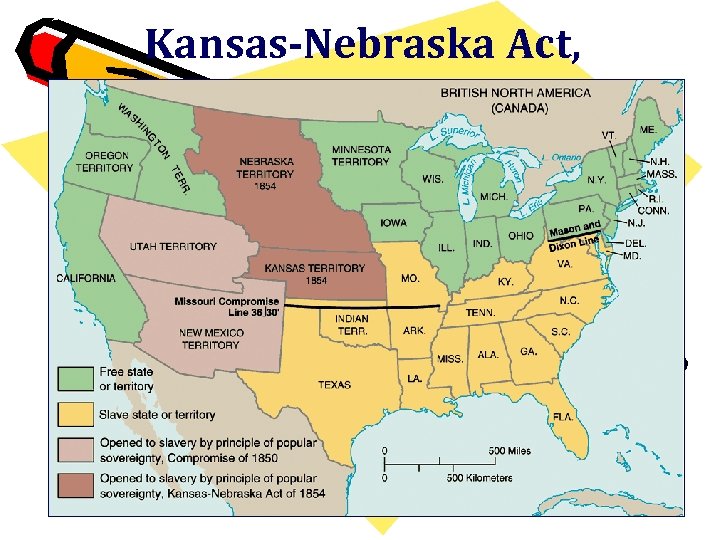 Kansas-Nebraska Act, 1854
 Use the graphic organizer below to list the main elements of the compromise of 1850 Compromise of 1850