 Скачать презентацию SLAC Accelerator Research Program Tor Raubenheimer SLUO Meeting
148b4cf7adbb01278a05037558b0aad3.ppt
- Количество слайдов: 34



SLAC Accelerator Research Program Tor Raubenheimer SLUO Meeting, July 17, 2009
What is Accelerator Research? • Accelerators are throughout medicine, science, & industry – Accelerator research is basis for future development • Analogous to laser research – Motivated by the applications as well as the science • The R&D is broad both in topic and timescale – Materials surface physics, magnet design, Hamiltonian dynamics – Direct accelerator improvements to concept exploration with application more than 20 -years in the future • Accelerator R&D is usually directed towards applications – Results can have broad impact, e. g. L-band & C-band linear collider R&D provided the basis for DESY and Spring-8 XFEL’s – High Energy Physics is one of the greatest challenges SLUO Meeting July 16, 2009 Page 2 / 25
Key Challenges in Accelerator Physics • Beam brightness and control peak luminosity and radiation source brightness – Brightness is flux divided by 6 -D phase space volume (emittance) which should be conserved after beam creation • Beam energy reach or radiation wavelength – Critical problem for HEP requiring new cost-effective concepts – Novel concepts will enable new applications elsewhere as well • Beam power average luminosity or brightness – Power (average current times energy) is frequently measured in megawatts and has both technical and physical limitations • SLAC Accelerator Research group has effort in all areas SLUO Meeting July 16, 2009 Page 3 / 25
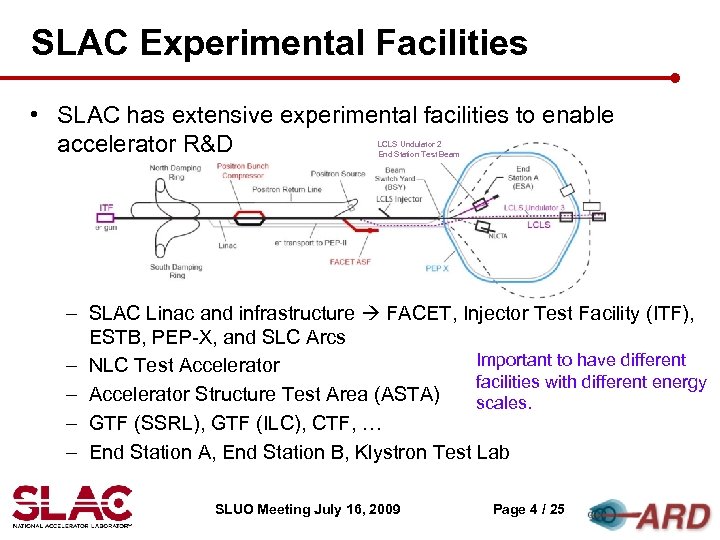
SLAC Experimental Facilities • SLAC has extensive experimental facilities to enable accelerator R&D LCLS Undulator 2 End Station Test Beam – SLAC Linac and infrastructure FACET, Injector Test Facility (ITF), ESTB, PEP-X, and SLC Arcs Important to have different – NLC Test Accelerator facilities with different energy – Accelerator Structure Test Area (ASTA) scales. – GTF (SSRL), GTF (ILC), CTF, … – End Station A, End Station B, Klystron Test Lab SLUO Meeting July 16, 2009 Page 4 / 25
SLAC Accelerator Research Program • Broad program – Working on LCLS, SPEAR-III, and LHC – Efforts on upgrades for LCLS and LHC; Design efforts on ILC, CLIC, Super-B, Project-X, PEP-X, and test facilities – R&D towards higher brightness, higher gradient, and higher power • Program takes advantage of SLAC facilities, expertise and core competencies – High power RF; beam theory and computing; Stanford University • Strong programs at international facilities – – CERN on CLIC / CTF 3 and LHC KEK on ATF / ATF 2 INFN on Super-B Smaller collaborations with IHEP, DESY, … SLUO Meeting July 16, 2009 Page 5 / 25
LHC R&D (Subject of later talks) • Novel collimators (building prototype LHC collimator) – Spin off of Linear Collider R&D program – R&D uses Klystron Department and beam theory expertise – Engagement has led to R&D on new concepts such as crystal collimation which may have impact for LC and future rad. sources • Electron Cloud and E-cloud Feedback – Application of R&D on e+/e- colliders • Low level RF – Application of concepts and technologies developed for PEP-II • Crab cavity design – Synergistic with LC; utilizes beam theory expertise; broad use • Program keeps engagement in premier HEP accelerator SLUO Meeting July 16, 2009 Page 6 / 25
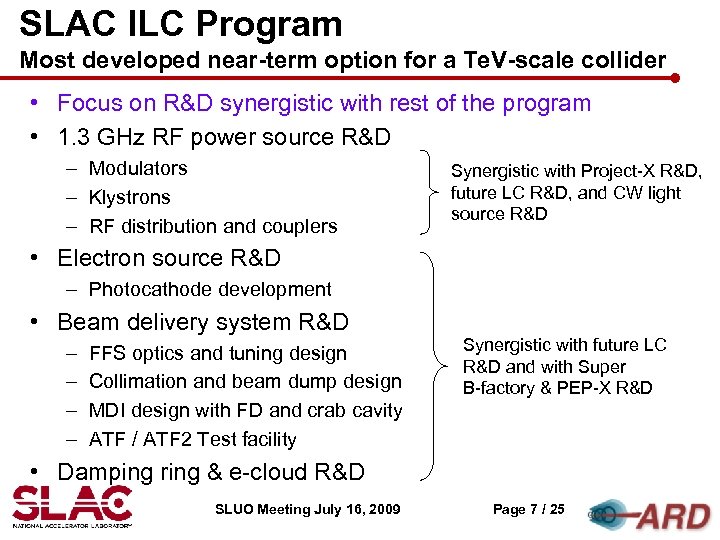
SLAC ILC Program Most developed near-term option for a Te. V-scale collider • Focus on R&D synergistic with rest of the program • 1. 3 GHz RF power source R&D – Modulators – Klystrons – RF distribution and couplers Synergistic with Project-X R&D, future LC R&D, and CW light source R&D • Electron source R&D – Photocathode development • Beam delivery system R&D – – FFS optics and tuning design Collimation and beam dump design MDI design with FD and crab cavity ATF / ATF 2 Test facility Synergistic with future LC R&D and with Super B-factory & PEP-X R&D • Damping ring & e-cloud R&D SLUO Meeting July 16, 2009 Page 7 / 25
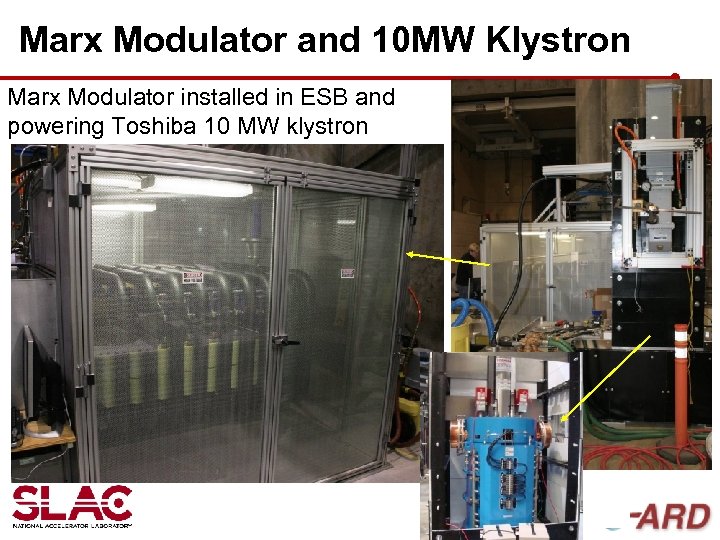
Marx Modulator and 10 MW Klystron Marx Modulator installed in ESB and powering Toshiba 10 MW klystron SLUO Meeting July 16, 2009 Page 8 / 25
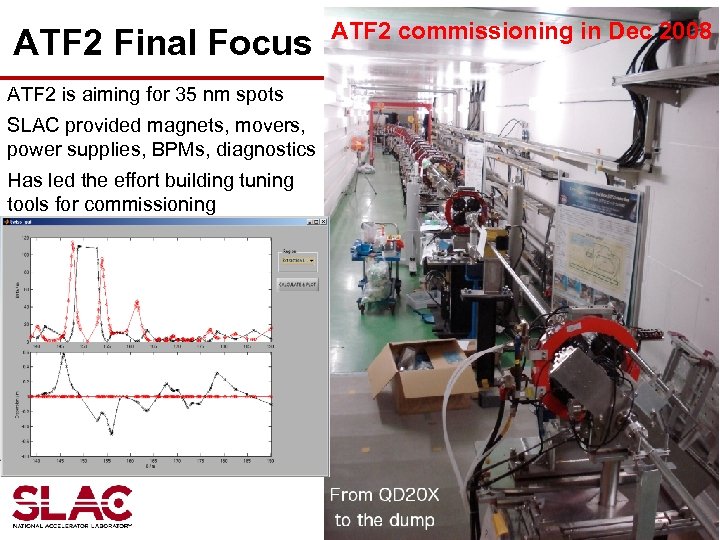
ATF 2 Final Focus ATF 2 commissioning in Dec 2008 ATF 2 is aiming for 35 nm spots SLAC provided magnets, movers, power supplies, BPMs, diagnostics Has led the effort building tuning tools for commissioning SLUO Meeting July 16, 2009 Page 9 / 25
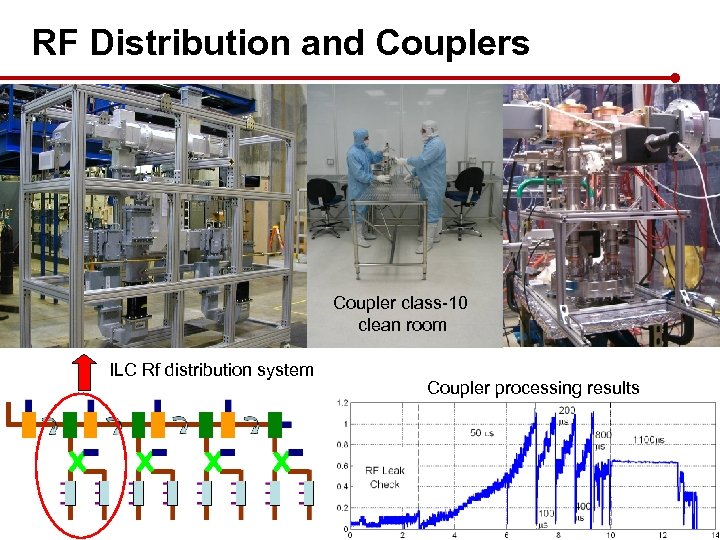
RF Distribution and Couplers Coupler class-10 clean room ILC Rf distribution system SLUO Meeting July 16, 2009 Coupler processing results Page 10 / 25
Accelerator Science Program • Beam theory and Computing – Echo-enhanced harmonic gain; EM design of LHC crab cavity • High gradient X-band program – RF testing of CLIC PETS structure in ASTA – Tested two high gradient structures in NLCTA – Study of materials for high gradient performance • Direct laser acceleration – Reconfiguring experiment for the PBG fiber experiment • Plasma wakefield effort is focused on the FACET project SLUO Meeting July 16, 2009 Page 11 / 25
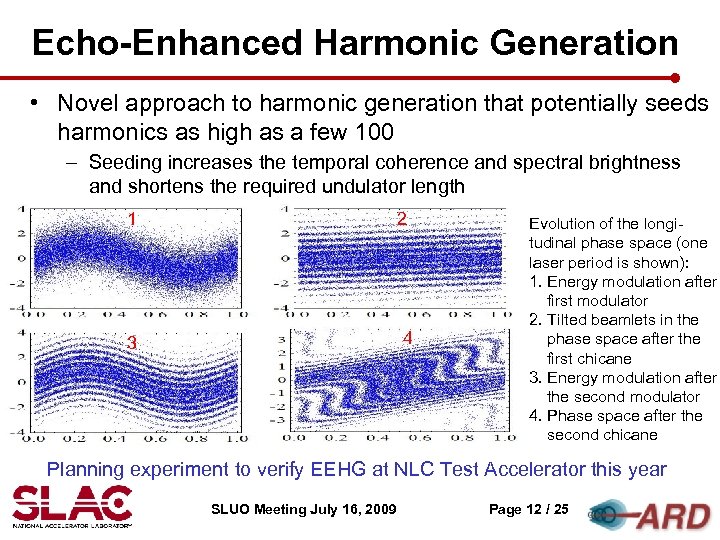
Echo-Enhanced Harmonic Generation • Novel approach to harmonic generation that potentially seeds harmonics as high as a few 100 – Seeding increases the temporal coherence and spectral brightness and shortens the required undulator length 1 2 4 3 Evolution of the longitudinal phase space (one laser period is shown): 1. Energy modulation after first modulator 2. Tilted beamlets in the phase space after the first chicane 3. Energy modulation after the second modulator 4. Phase space after the second chicane Planning experiment to verify EEHG at NLC Test Accelerator this year SLUO Meeting July 16, 2009 Page 12 / 25
High Gradient R&D • P 5 noted that a future lepton collider will be a necessary complement to the LHC – The science case remains strong • SLAC has been developing LC concepts for 30 years • Many options for the next-generation collider with different levels of risk and different costs – – ILC: most developed, lowest risk but high cost High gradient klystron: medium risk with significant cost savings Drive-beam microwave: higher risk with probably greater savings Dielectric or Plasma acceleration: much higher risk but with potential for much lower costs • R&D programs on these different options have broad applicability across Office of Science SLUO Meeting July 16, 2009 Page 13 / 25
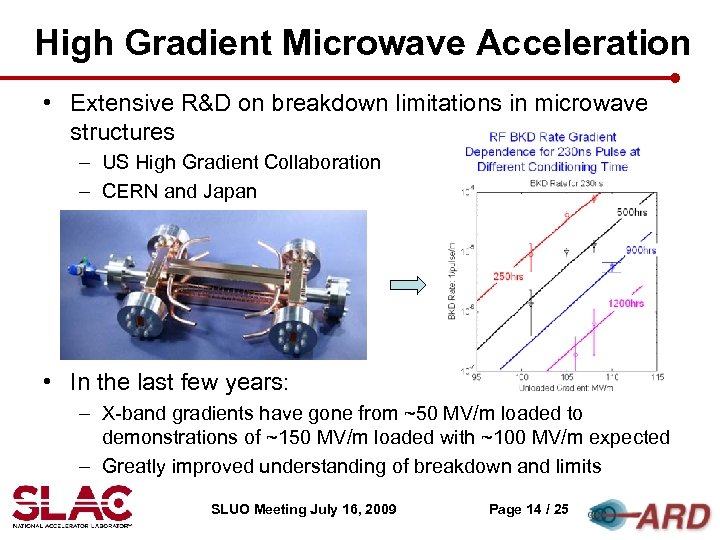
High Gradient Microwave Acceleration • Extensive R&D on breakdown limitations in microwave structures – US High Gradient Collaboration – CERN and Japan • In the last few years: – X-band gradients have gone from ~50 MV/m loaded to demonstrations of ~150 MV/m loaded with ~100 MV/m expected – Greatly improved understanding of breakdown and limits SLUO Meeting July 16, 2009 Page 14 / 25
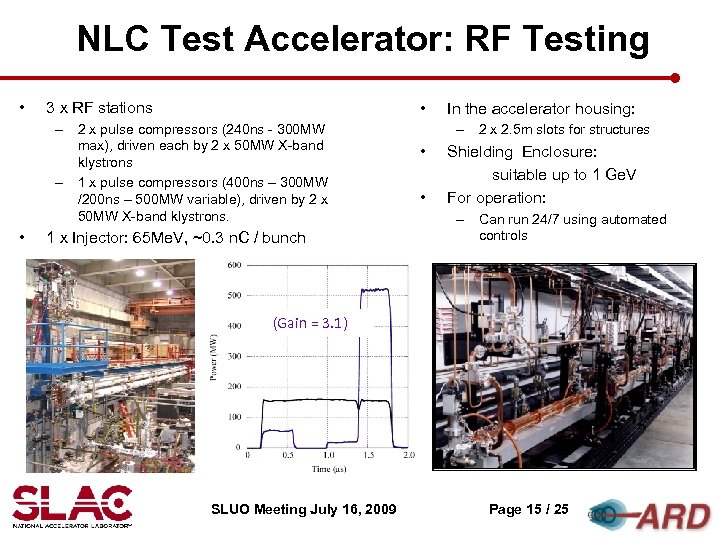
NLC Test Accelerator: RF Testing • 3 x RF stations • – 2 x pulse compressors (240 ns - 300 MW max), driven each by 2 x 50 MW X-band klystrons – 1 x pulse compressors (400 ns – 300 MW /200 ns – 500 MW variable), driven by 2 x 50 MW X-band klystrons. • 1 x Injector: 65 Me. V, ~0. 3 n. C / bunch In the accelerator housing: – 2 x 2. 5 m slots for structures • • Shielding Enclosure: suitable up to 1 Ge. V For operation: – Can run 24/7 using automated controls (Gain = 3. 1) SLUO Meeting July 16, 2009 Page 15 / 25
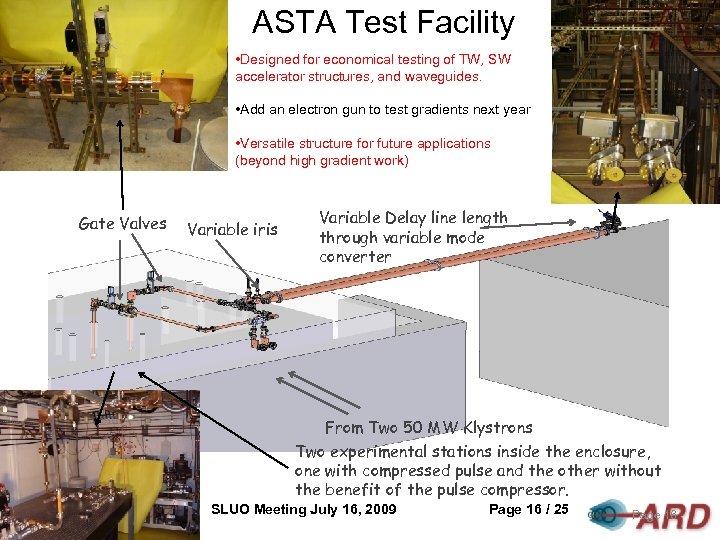
ASTA Test Facility • Designed for economical testing of TW, SW accelerator structures, and waveguides. • Add an electron gun to test gradients next year • Versatile structure for future applications (beyond high gradient work) Gate Valves Variable iris Variable Delay line length through variable mode converter From Two 50 MW Klystrons Two experimental stations inside the enclosure, one with compressed pulse and the other without the benefit of the pulse compressor. July 8, 2008 SLUO Meeting July 16, 2009 Page 16 / 25 Page 16
High Gradient Acceleration with Lasers • Laser capability improving rapidly – Billion $ industrial development effort • Two acceleration approaches using lasers: – Laser wakefield (plasma) acceleration, i. e BELLA (10 GV/m) – Direct laser (dielectric) acceleration, i. e. E-163 (1 GV/m) • Real challenges for both approaches • Very different laser requirements – Both require high average power must generate beam power • Laser-wakefield acceleration requires high peak laser power – Lasers are most efficient and cost effective near CW operation • CW operation is best use of expensive amplification medium SLAC is pursuing direct laser acceleration with ~10, 000 times lower peak power requirements more favorable cost scaling SLUO Meeting July 16, 2009 Page 17 / 25
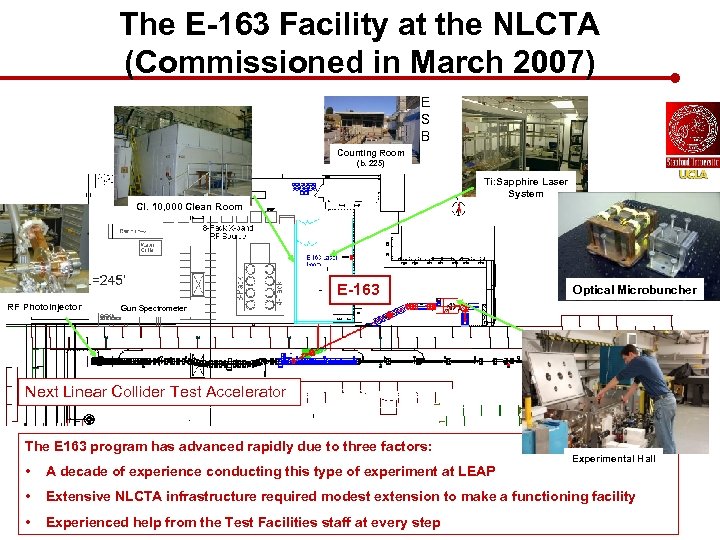
The E-163 Facility at the NLCTA (Commissioned in March 2007) E S B Counting Room (b. 225) Ti: Sapphire Laser System Cl. 10, 000 Clean Room E-163 RF Photo. Injector Optical Microbuncher Gun Spectrometer Next Linear Collider Test Accelerator The E 163 program has advanced rapidly due to three factors: Experimental Hall • A decade of experience conducting this type of experiment at LEAP • Extensive NLCTA infrastructure required modest extension to make a functioning facility SLUO Meeting July 16, 2009 Page 18 / 25 Experienced help from the Test Facilities staff at every step •
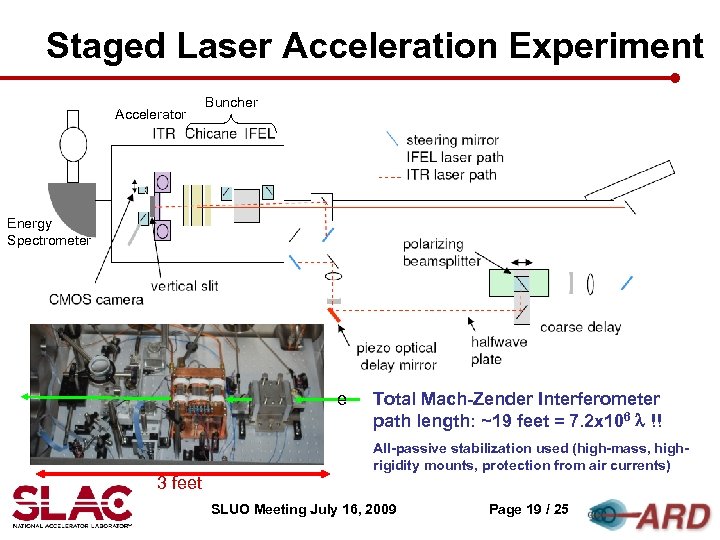
Staged Laser Acceleration Experiment Accelerator Buncher Energy Spectrometer e Total Mach-Zender Interferometer path length: ~19 feet = 7. 2 x 10⁶ l !! All-passive stabilization used (high-mass, highrigidity mounts, protection from air currents) 3 feet SLUO Meeting July 16, 2009 Page 19 / 25
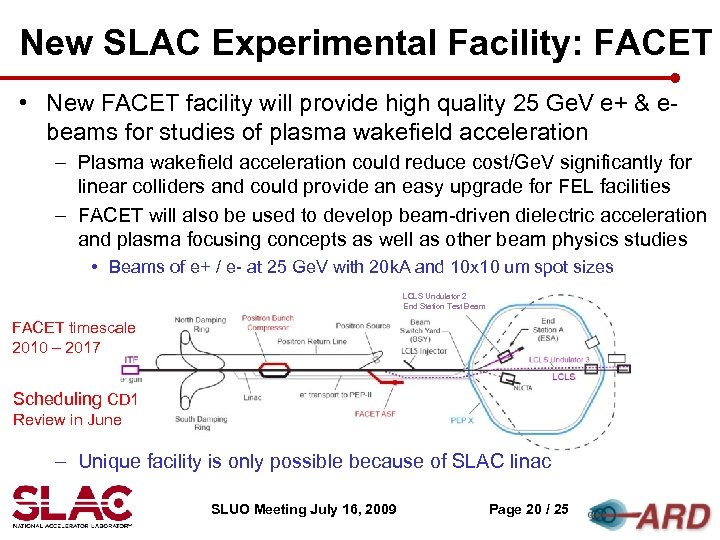
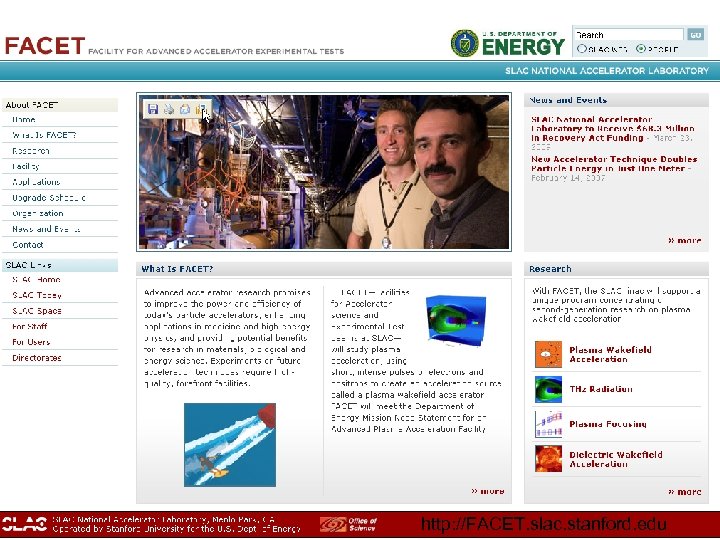
New SLAC Experimental Facility: FACET • New FACET facility will provide high quality 25 Ge. V e+ & ebeams for studies of plasma wakefield acceleration – Plasma wakefield acceleration could reduce cost/Ge. V significantly for linear colliders and could provide an easy upgrade for FEL facilities – FACET will also be used to develop beam-driven dielectric acceleration and plasma focusing concepts as well as other beam physics studies • Beams of e+ / e- at 25 Ge. V with 20 k. A and 10 x 10 um spot sizes LCLS Undulator 2 End Station Test Beam FACET timescale 2010 – 2017 Scheduling CD 1 Review in June – Unique facility is only possible because of SLAC linac SLUO Meeting July 16, 2009 Page 20 / 25
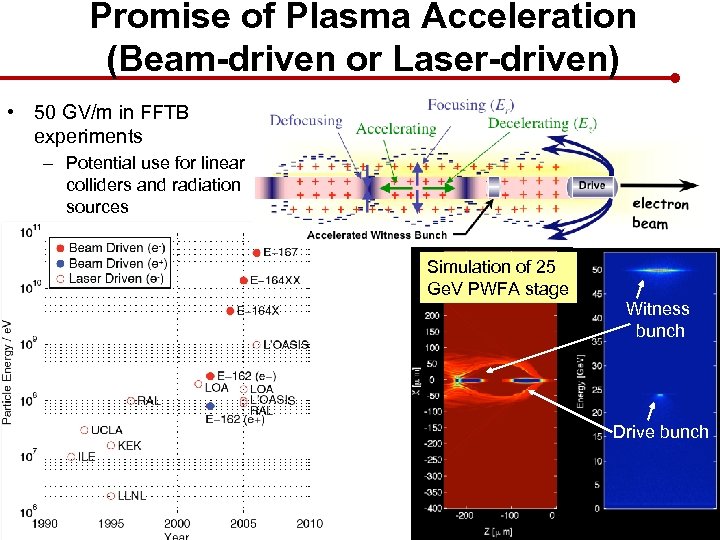
Promise of Plasma Acceleration (Beam-driven or Laser-driven) • 50 GV/m in FFTB experiments – Potential use for linear colliders and radiation sources Simulation of 25 Ge. V PWFA stage Witness bunch Drive bunch SLUO Meeting July 16, 2009 Page 21 / 25
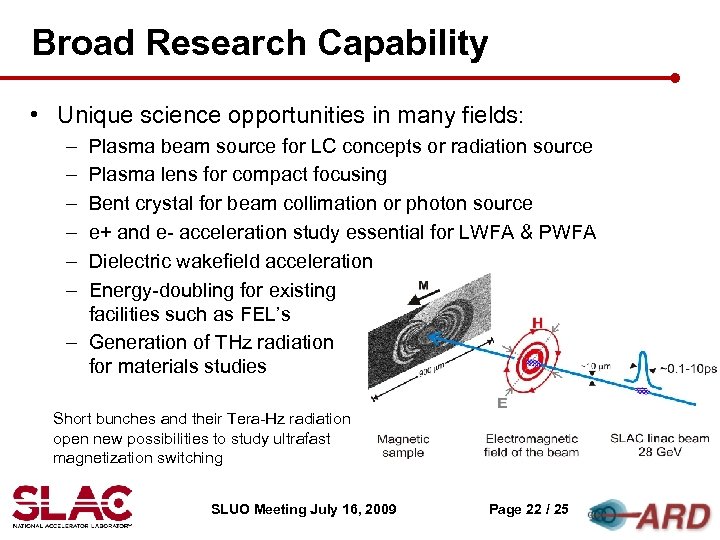
Broad Research Capability • Unique science opportunities in many fields: – – – Plasma beam source for LC concepts or radiation source Plasma lens for compact focusing Bent crystal for beam collimation or photon source e+ and e- acceleration study essential for LWFA & PWFA Dielectric wakefield acceleration Energy-doubling for existing facilities such as FEL’s – Generation of THz radiation for materials studies Short bunches and their Tera-Hz radiation open new possibilities to study ultrafast magnetization switching SLUO Meeting July 16, 2009 Page 22 / 25
FACET Program Development • FACET is aimed at R&D on Plasma Wakefield Acceleration however unique beams will be used for broader research – Originally proposed a 3: 1 ratio between PWFA and other programs • Present PWFA collaboration (UCLA, USC, SLAC) is developing new formal collaboration structure – Will grow collaborations to support full PWFA R&D program • Two workshops planned on Advanced Accelerator / PWFA – ICFA Mini-Workshop on Novel Concepts for Linear Accelerators and Colliders, July 8 -10, 2009 – Workshop on PWFA and FACET Research Opportunities, Feb 2010 • Creating external advisory committee to review the SLAC Accelerator Research program as well as FACET SLUO Meeting July 16, 2009 Page 23 / 25
SLUO Meeting July 16, 2009 Page 24 / 25 http: //FACET. slac. stanford. edu
Summary of SLAC Accelerator Research • Excellent research programs in Accelerator Science: – High gradient acceleration: microwave structures, direct laser acceleration, plasma wakefield acceleration – High brightness sources; Beam physics and computing • Strong programs on existing and next generation accelerators at SLAC and world-wide • Laboratory has unique experimental facilities – End Stations A and B, SLAC Linac, ASTA, Klystron Test stations, NLC Test Accelerator with FACET and ITF in the future • Excellent technical support and fabrication capabilities and strong ties to Stanford University • SLAC accelerator research is key to the future of the laboratory and to the international accelerator program SLUO Meeting July 16, 2009 Page 25 / 25
Backup • END OF TALK SLUO Meeting July 16, 2009 Page 26 / 25
Potential for Near-term Development • ASTA photo cathode test facility as well as rf test facility – Supports high brightness source development and LCLS upgrades • NLCTA support quick Acc Science experiments as well as rf testing and DLA programs – Not planning to convert NLCTA into full fledged user facility • SLAC Linac FACET and Injector Test Facility (ITF) – FACET will support plasma acceleration and intense beam R&D – ITF will be able to support a broad program of beam manipulation • LCLS End Station Test Beams and LCLS Undulator #2 – User facility for HEP and BES using End Station A SLUO Meeting July 16, 2009 Page 27 / 25
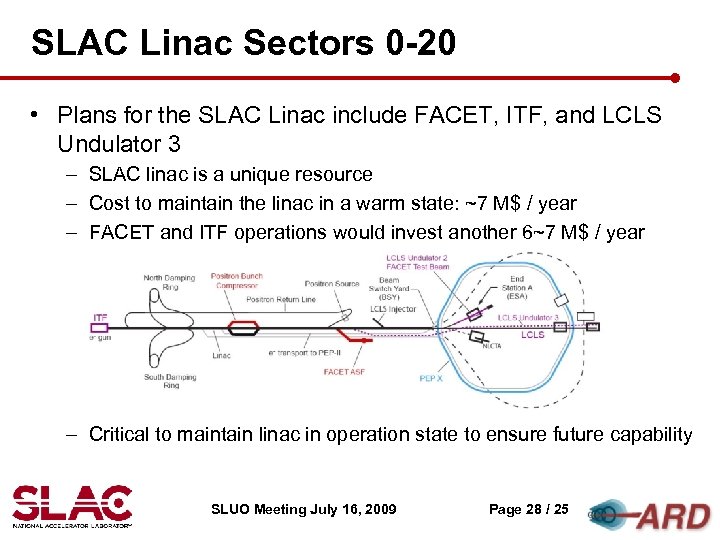
SLAC Linac Sectors 0 -20 • Plans for the SLAC Linac include FACET, ITF, and LCLS Undulator 3 – SLAC linac is a unique resource – Cost to maintain the linac in a warm state: ~7 M$ / year – FACET and ITF operations would invest another 6~7 M$ / year – Critical to maintain linac in operation state to ensure future capability SLUO Meeting July 16, 2009 Page 28 / 25
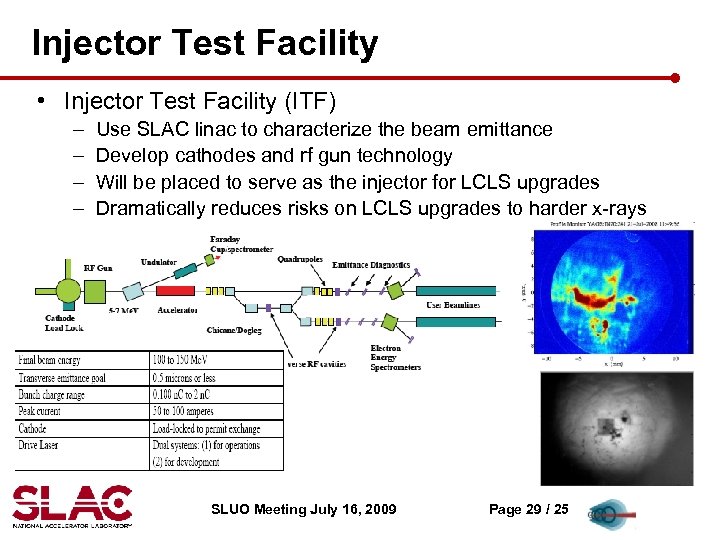
Injector Test Facility • Injector Test Facility (ITF) – – Use SLAC linac to characterize the beam emittance Develop cathodes and rf gun technology Will be placed to serve as the injector for LCLS upgrades Dramatically reduces risks on LCLS upgrades to harder x-rays SLUO Meeting July 16, 2009 Page 29 / 25
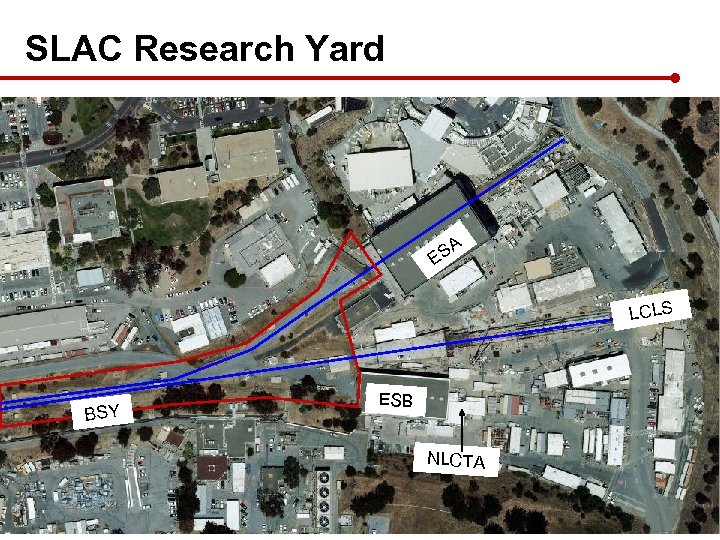
SLAC Research Yard SA E LCLS BSY ESB NLCTA SLUO Meeting July 16, 2009 Page 30 / 25
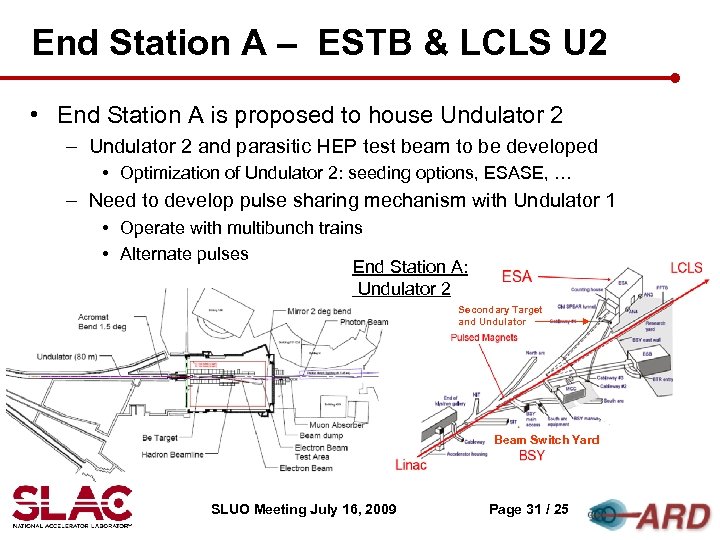
End Station A – ESTB & LCLS U 2 • End Station A is proposed to house Undulator 2 – Undulator 2 and parasitic HEP test beam to be developed • Optimization of Undulator 2: seeding options, ESASE, … – Need to develop pulse sharing mechanism with Undulator 1 • Operate with multibunch trains • Alternate pulses End Station A: Undulator 2 Secondary Target and Undulator Beam Switch Yard SLUO Meeting July 16, 2009 Page 31 / 25
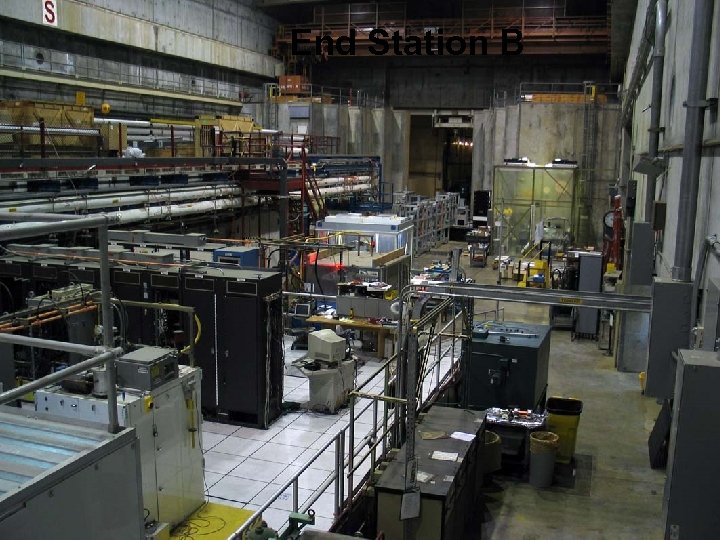
End Station B SLUO Meeting July 16, 2009 Page 32 / 25
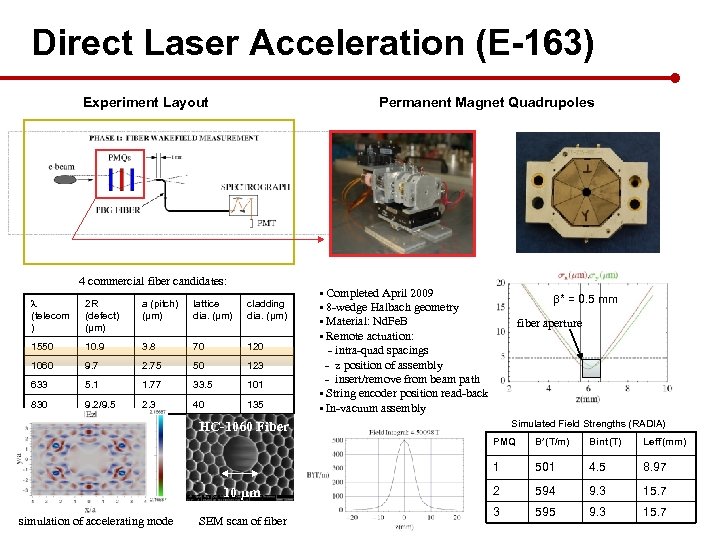
Direct Laser Acceleration (E-163) Experiment Layout Permanent Magnet Quadrupoles 4 commercial fiber candidates: l (telecom ) 2 R (defect) (µm) a (pitch) (µm) lattice dia. (µm) cladding dia. (µm) 1550 10. 9 3. 8 70 120 1060 9. 7 2. 75 50 123 633 5. 1 1. 77 33. 5 101 830 9. 2/9. 5 2. 3 40 135 • Completed April 2009 • 8 -wedge Halbach geometry • Material: Nd. Fe. B • Remote actuation: - intra-quad spacings - z position of assembly - insert/remove from beam path • String encoder position read-back • In-vacuum assembly b* = 0. 5 mm fiber aperture Simulated Field Strengths (RADIA) HC-1060 Fiber PMQ simulation of accelerating mode SEM scan of fiber Bint(T) Leff(mm) 1 10 µm SLUO Meeting July 16, 2009 B’(T/m) 501 4. 5 8. 97 2 594 9. 3 15. 7 Page 33 / 25 3 595
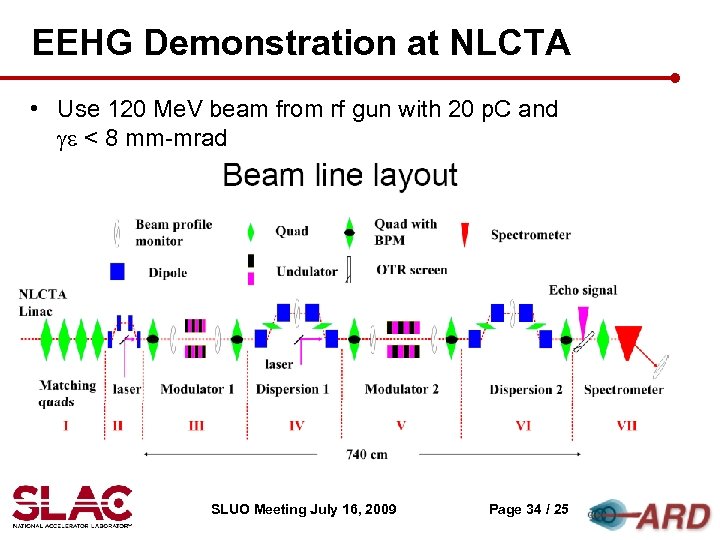
EEHG Demonstration at NLCTA • Use 120 Me. V beam from rf gun with 20 p. C and ge < 8 mm-mrad SLUO Meeting July 16, 2009 Page 34 / 25
Скачать презентацию SLAC Accelerator Research Program Tor Raubenheimer SLUO Meeting
148b4cf7adbb01278a05037558b0aad3.ppt