 Скачать презентацию SLA Annual Conference June 8 2004 Stephen Abram
2195c80733bbc8efc3c2c5ada21db043.ppt
- Количество слайдов: 70



SLA Annual Conference, June 8, 2004 Stephen Abram, VP Innovation, Sirsi Corporation Personas: The Person Behind the Glass
Can personas help deliver great information experiences? Designing for desktops vs. understanding the person behind the glass


Light at the End of the Tunnel
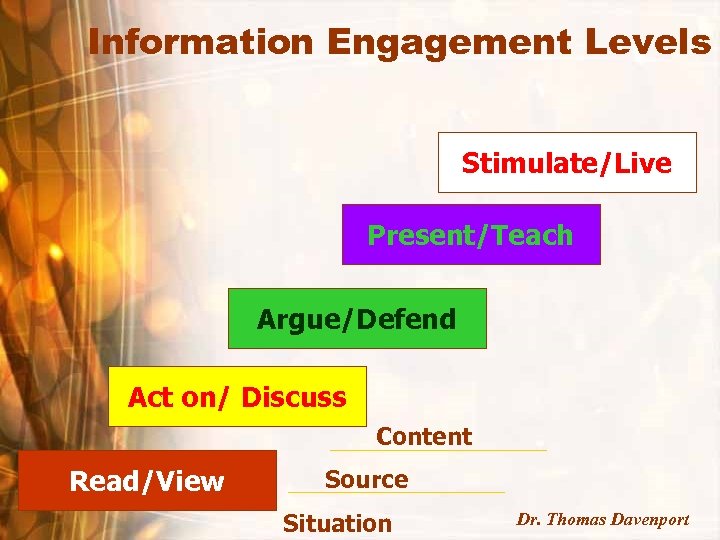
Information Engagement Levels Stimulate/Live Present/Teach Argue/Defend Act on/ Discuss Content Read/View Source Situation Dr. Thomas Davenport
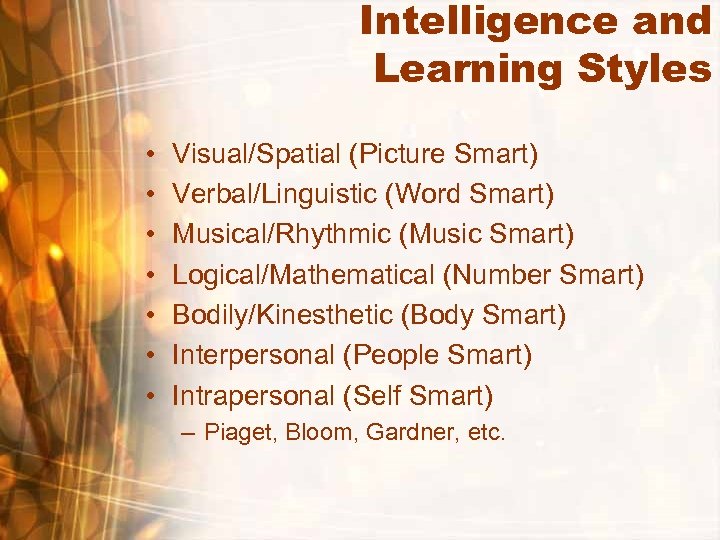
Intelligence and Learning Styles • • Visual/Spatial (Picture Smart) Verbal/Linguistic (Word Smart) Musical/Rhythmic (Music Smart) Logical/Mathematical (Number Smart) Bodily/Kinesthetic (Body Smart) Interpersonal (People Smart) Intrapersonal (Self Smart) – Piaget, Bloom, Gardner, etc.
Information Literacy • Standard Curriculum Components – Mathematics / Arithmetic – Science, Biology, Physics & Chemistry – English, Languages – History, Geography, Politics, Sociology – Music, Art, Phys ed. – Guidance, Religion
Information Literacy • Information literacy is integrally tied every aspect of the curriculum: – Mathematical logical thinking skills - Math and Arithmetic – Scientific method - Sciences – Criticism, interpretation and comprehension - English and languages – Analytical thinking - History, Geography – Interpretive and imaginative- music, art & phys ed. – Inter and Intrapersonal skills - Religion, Guidance, etc. – There is an imperative for people to have a lifelong curriculum - a personal learning strategy
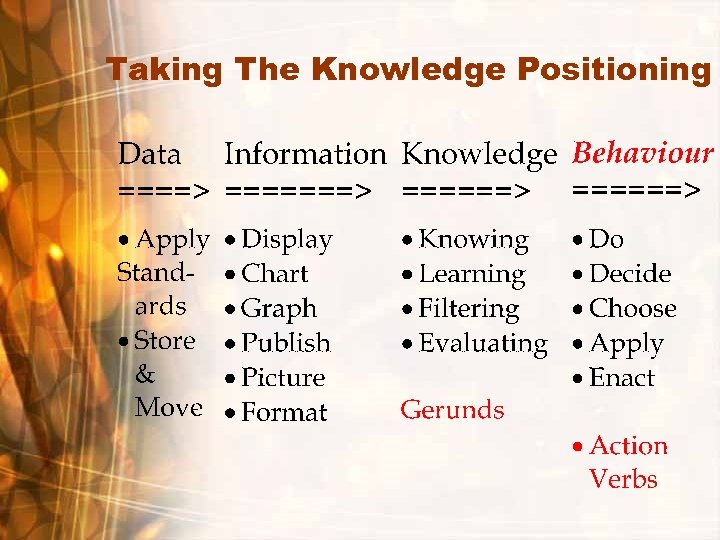
Taking The Knowledge Positioning
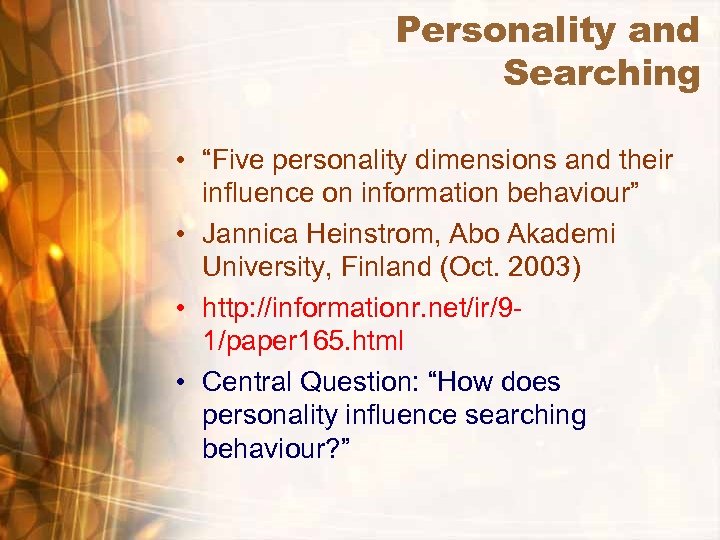
Personality and Searching • “Five personality dimensions and their influence on information behaviour” • Jannica Heinstrom, Abo Akademi University, Finland (Oct. 2003) • http: //informationr. net/ir/91/paper 165. html • Central Question: “How does personality influence searching behaviour? ”
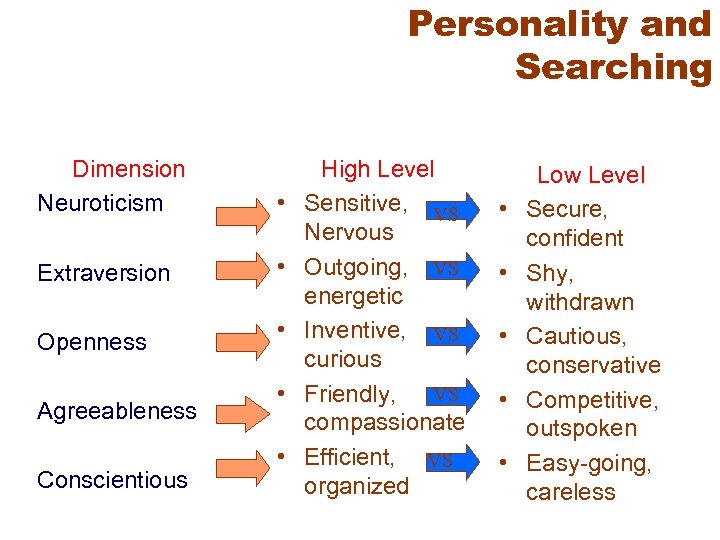
Personality and Searching Dimension Neuroticism • Extraversion • Openness • Agreeableness Conscientious • • High Level Sensitive, VS Nervous Outgoing, VS energetic Inventive, VS curious VS Friendly, compassionate Efficient, VS organized • • • Low Level Secure, confident Shy, withdrawn Cautious, conservative Competitive, outspoken Easy-going, careless
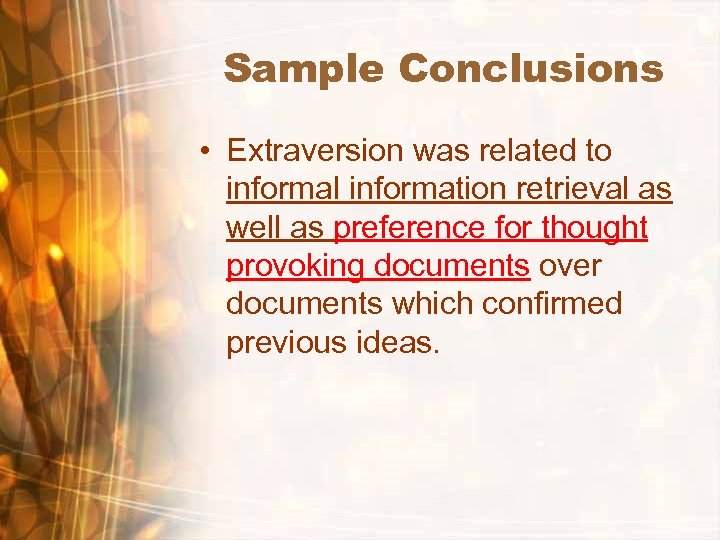
Sample Conclusions • Extraversion was related to informal information retrieval as well as preference for thought provoking documents over documents which confirmed previous ideas.
Sample Conclusions • Openness to experience was related to broad information seeking, incidental information acquisition, critical information judgement, preference of thought provoking documents instead of documents which confirmed previous results. Conservativeness was related to problems with relevance judgement and preference for confirming documents.
Sample Conclusions • Competitiveness was related to lack of time being a barrier to information retrieval, problems with relevance judgement and competence in critical analysis of information. Low levels of agreeableness forms a base for skeptical and critical thinking.
Sample Conclusions • Conscientiousness was related to preference for thought provoking documents instead of documents that confirmed previous ideas and use of effort in information seeking. Carelessness, on the other hand was related to problems with relevance judgement, feeling that lack of time was a barrier to information retrieval and preference for documents that confirm previous ideas.
Assumption • All organizations who are market leaders excel in one of three primary dimensions* and perform well in the other two: • Customer intimacy • Product leadership • Operational excellence • AND they fully exploit knowledge, expertise and ideas. *The Discipline of Market Leaders: Choose Your Customers, Narrow Your Focus, Dominate Your Market by Michael Treacy, Fred Wiersema 1995 ISBN 0 -201 -40648 -9 Addison-Wesley.
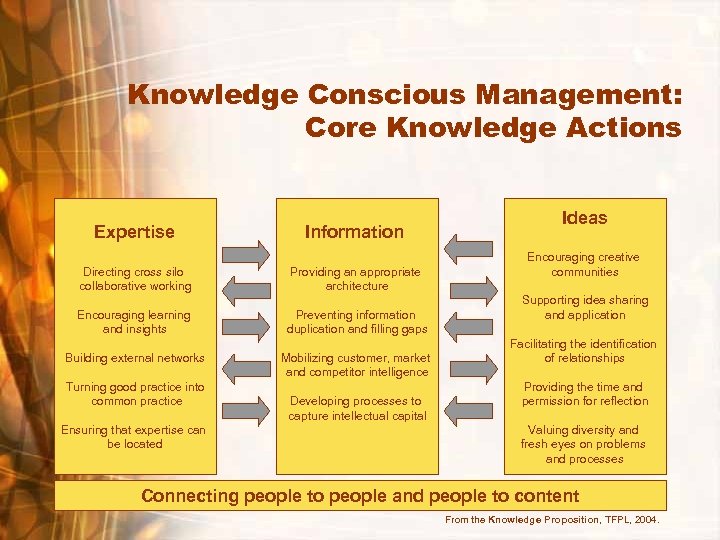
Knowledge Conscious Management: Core Knowledge Actions Expertise Information Directing cross silo collaborative working Providing an appropriate architecture Encouraging learning and insights Preventing information duplication and filling gaps Building external networks Turning good practice into common practice Ensuring that expertise can be located Mobilizing customer, market and competitor intelligence Developing processes to capture intellectual capital Ideas Encouraging creative communities Supporting idea sharing and application Facilitating the identification of relationships Providing the time and permission for reflection Valuing diversity and fresh eyes on problems and processes Connecting people to people and people to content From the Knowledge Proposition, TFPL, 2004.
Organizational Success What a portal can do… And what it can’t
Portal Credibility and Longevity • Critical success factors: – Support organizational objectives in a measurable way. – Be owned and managed by a credible, authoritative source. – Include opportunities (as appropriate) for: • Learning • Knowledge transfer (peer-to-peer, experts, coaches, teachers) • Transaction or task-based activities – Offer structured access to internal and external content that is relevant to one or more target audiences.
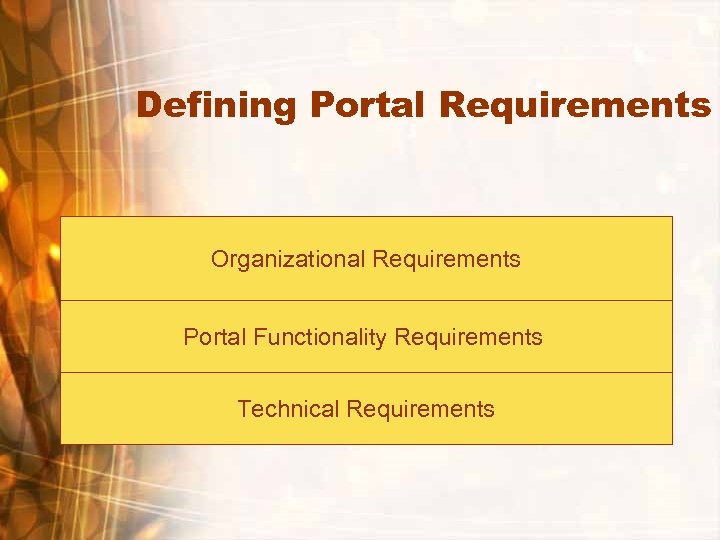
Defining Portal Requirements Organizational Requirements Portal Functionality Requirements Technical Requirements
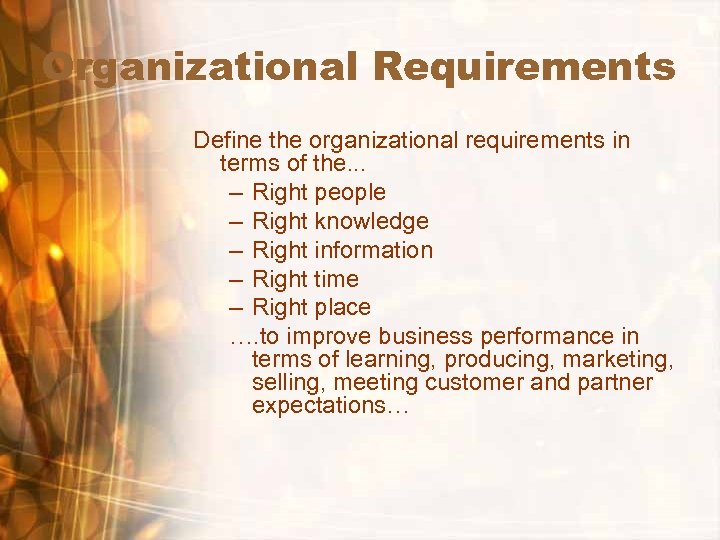
Organizational Requirements Define the organizational requirements in terms of the. . . – Right people – Right knowledge – Right information – Right time – Right place …. to improve business performance in terms of learning, producing, marketing, selling, meeting customer and partner expectations…
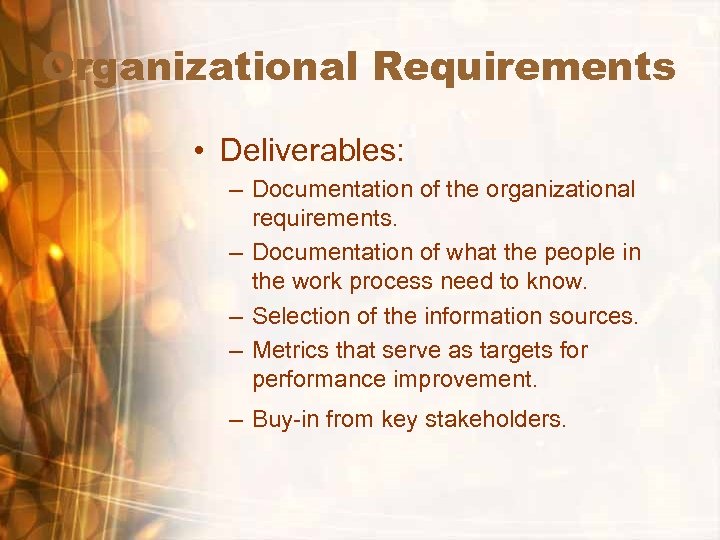
Organizational Requirements • Deliverables: – Documentation of the organizational requirements. – Documentation of what the people in the work process need to know. – Selection of the information sources. – Metrics that serve as targets for performance improvement. – Buy-in from key stakeholders.
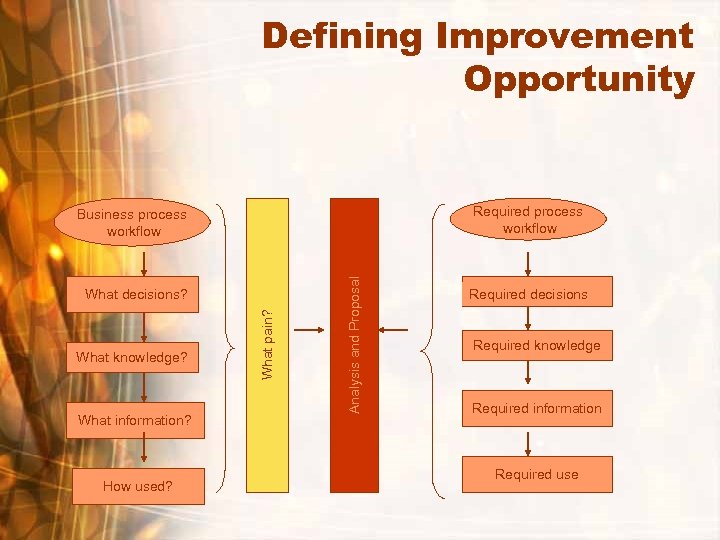
Defining Improvement Opportunity Required process workflow What knowledge? What information? How used? What pain? What decisions? Analysis and Proposal Business process workflow Required decisions Required knowledge Required information Required use
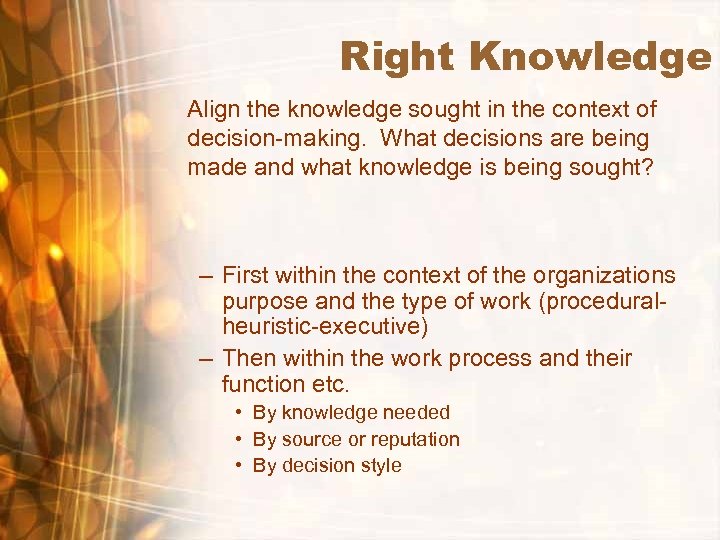
Right Knowledge Align the knowledge sought in the context of decision-making. What decisions are being made and what knowledge is being sought? – First within the context of the organizations purpose and the type of work (proceduralheuristic-executive) – Then within the work process and their function etc. • By knowledge needed • By source or reputation • By decision style
Best Information Sources ü Relevance • Credibility • Reliability • Accuracy • Maintainability • Usability/reuse/format How do you know?
Summary: Know the Portal Audience • Work purpose (customers, products, organizational efficiency) • Type of work (procedural, heuristic, executive) • Work processes – formal and informal • Role • Function • Demographics (geography, language, time in organization etc. ) • Decisions and decision style • Knowledge needed to make decisions • Information needed to support the knowledge needed • Motivation factors/value • Comfort with technology (ies)
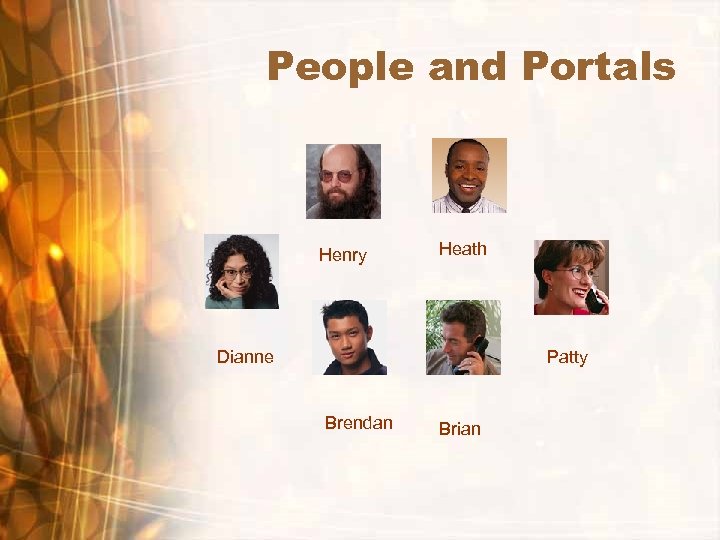
People and Portals Henry Heath Dianne Patty Brendan Brian
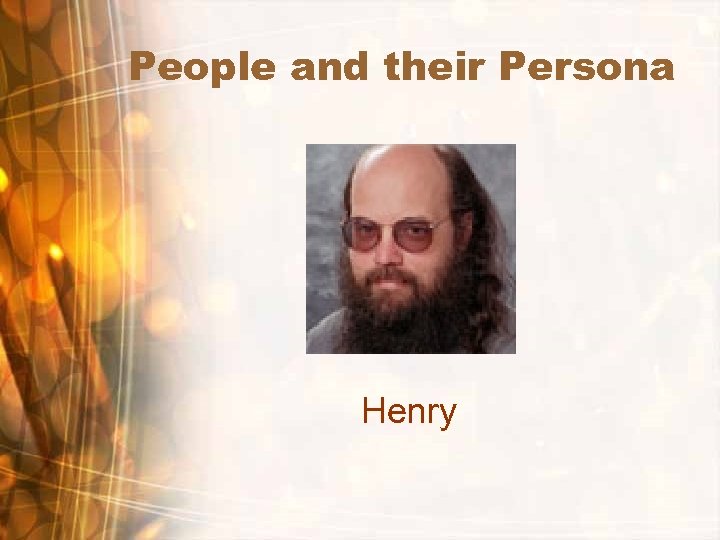
People and their Persona Henry
Look at your Ecology. . .
View the Relationships
How is learning happening?
Innovation and Creativity occur when?
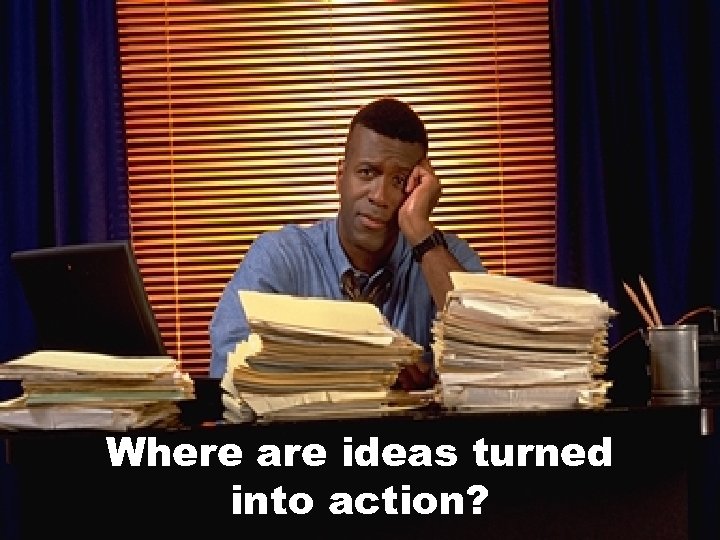
Where are ideas turned into action?
Pre-Boomer 1934 -1945 Workplace Character • • • Traditional work ethic Work first Born to lead Loyal to employer Independent by conventional Value working well with others Technically competent Believe in mission Strong chain of command Want to win
Boomer 1946 -1959 Workplace Character • • • Money / work ethic Work first Expect to lead Loyal to employer Care deeply what others think Want others to work for them Technically challenged Lip service to mission Chain of command I win, you lose
Cusper 1960 -1968 Workplace Character • • • Money / principle Work and lifestyle Lead and follow Loyal to employer and skills Ambivalent about what others think Want others to work for them Technically challenged Care about mission Mixed about command individual Want to win
Buster 1969 -1978 Workplace Character • • • Principal / Satisfaction Lifestyle first No need to lead Loyal to skills Don’t care what others think Prefer to work alone Technically savvy Must have mission Individual first I win, you win
Nester 1979 -1984 Workplace Character • • • Principal / Satisfaction Lifestyle first Lead of necessary Loyal to skills Care little what others think Like small groups State of the art technically Must have mission Individual first I win, you win
Pre-Boomer 1934 -1945 Motivation • • Money Responsibility Public Recognition Accomplishment Desire to lead Control Organizational Loyalty
Boomer 1946 -1959 Motivation • • More Money Promotion Public Recognition Peer recognition Desire for subordinates Control Loyalty to self
Cusper 1960 -1968 Motivation • Do well by doing good • Meeting organizational goals • Recognition from boss • Bonuses • Stock options
Buster 1969 -1978 Motivation • • • Time off Meeting own goals Recognition from boss Skills training Stock options Mentioning
Nester 1979 -1984 Motivation • • • Time off Portable skills training Meeting own goals Stock options Mentioning Prepare for selfemployment • Sales training
Younger Worker Summary 1960 -1980 • • • “I work best alone” “I need. . . ” Blunt style “Just do it. ” Abrupt speech patterns Care little what others think “Just tell me what you want done and I’ll do it” • Don’t participate, attend meetings or need to hear others’ opinions • Recognition doesn’t work and isn’t needed.
Older Worker Summary 1935 -1959 • • • “We’re invincible as a team” “I want, would think, would like. . . ” Soft style “I’d love it if you. . . ” Long preambles. Care deeply what other’s think. Like process and talking about ideas and issues. • Highly value participation and consensus • Want people to want to be involved. • Recognition means a great deal.
Another View: Veterans • Defined by WW 2, Korea, Silver Screen, unions and born between 1922 -43 • Core values of sacrifice, dedication, hard work, conformity, law and order, patience, respect for authority, duty before pleasure, adherence to rules and honour. • Personalities are conformist, conservative, spenders, pastoriented, believe in logic not magic Ron Zemke, Training Magazine, July 2001
Another View: Boomers • Defined by their bulk, civil rights, cold war, feminism, space race and born between 1943 and 1960 • Core values include optimism, teamwork, personal gratification, heath and wellness, personal growth, youth, work and involvement. • Personalities are driven, soulsearching, willing to go the extra mile, love-hate relationship with authority. Ron Zemke, Training Magazine, July 2001
Another View: X’ers • Defined by Watergate, OJ, stagflation, single parents and born between 1960 -1980 • Core values include diversity, thinking globally, balance, technoliteracy, informality, self-reliance, pragmatism. • Personalities are risk-taking, skeptical, family-oriented, focused on job - not work hours. Ron Zemke, Training Magazine, July 2001
Another View: Nexters • Defined by Internet, school violence, terrorism, multiculturalism, media and born after 1980 • Core values include confidence, civic duty, achievement, sociability, morality, diversity and street smarts • Personalities are optimistic, prefer collective action and tenacious Ron Zemke, Training Magazine, July 2001
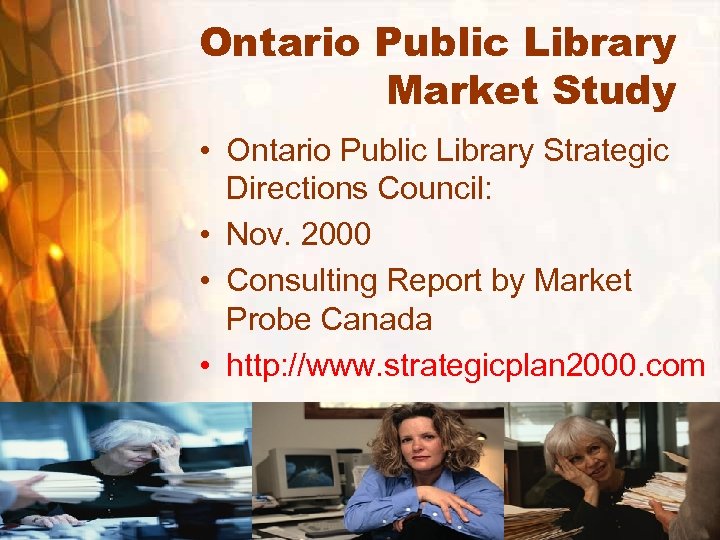
Ontario Public Library Market Study • Ontario Public Library Strategic Directions Council: • Nov. 2000 • Consulting Report by Market Probe Canada • http: //www. strategicplan 2000. com
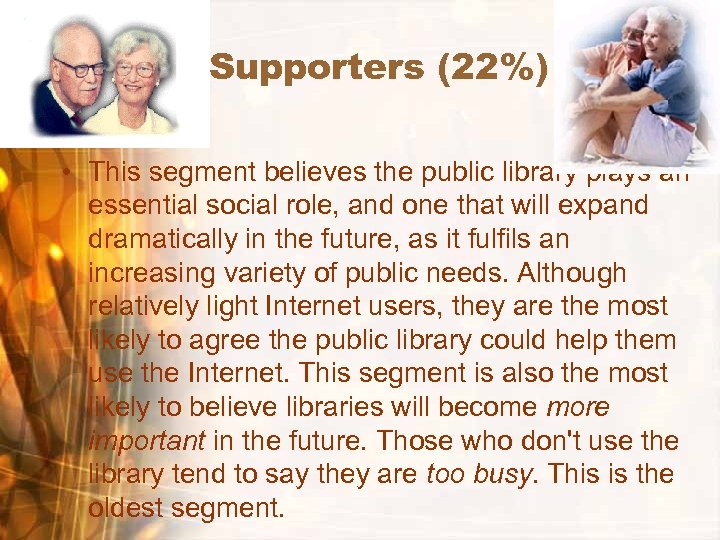
Supporters (22%) • This segment believes the public library plays an essential social role, and one that will expand dramatically in the future, as it fulfils an increasing variety of public needs. Although relatively light Internet users, they are the most likely to agree the public library could help them use the Internet. This segment is also the most likely to believe libraries will become more important in the future. Those who don't use the library tend to say they are too busy. This is the oldest segment.
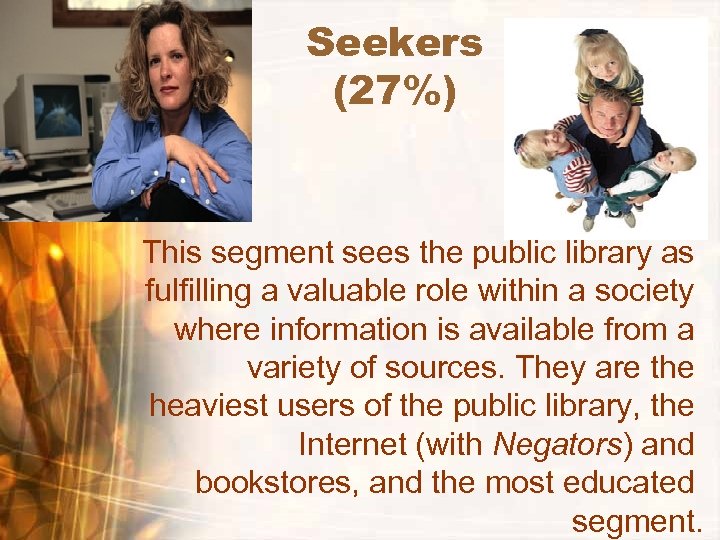
Seekers (27%) This segment sees the public library as fulfilling a valuable role within a society where information is available from a variety of sources. They are the heaviest users of the public library, the Internet (with Negators) and bookstores, and the most educated segment.
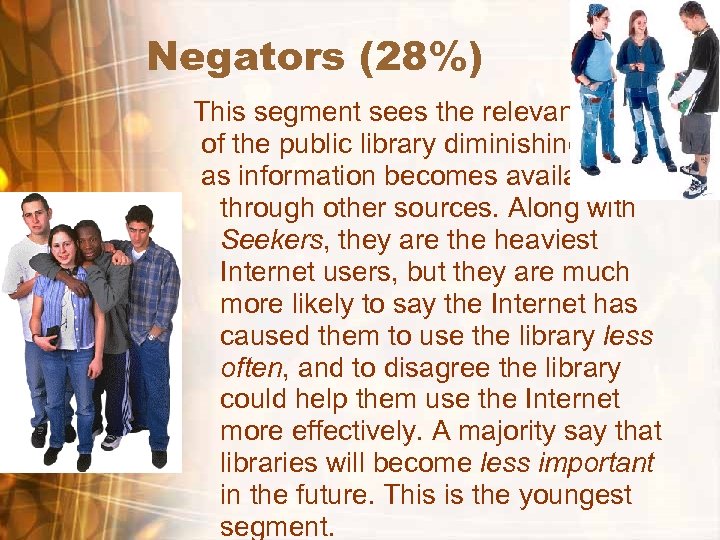
Negators (28%) This segment sees the relevance of the public library diminishing as information becomes available through other sources. Along with Seekers, they are the heaviest Internet users, but they are much more likely to say the Internet has caused them to use the library less often, and to disagree the library could help them use the Internet more effectively. A majority say that libraries will become less important in the future. This is the youngest segment.
Tweens (% n/a) • This segment was added to the group since school age children are such key targets for libraries (school and public). They may not have their opinions of the Internet and libraries fully formed yet and there is hope.
Portal Functionality • In terms of the exchange of ideas, expertise and information through: – – – – Collaboration Communication Publishing Sharing Finding Learning Meeting Etc.
Sample Portal Functionality • • Expertise – People directories – Communities of Practice – Online training – Knowledge bases – Online help Information – – – – – • Online transactions Access to office maps Glossary tool Access to policies, procedures News delivery Market research tools Customer profiles Product specification management Self-service tools Ideas – – Discussions Web meetings Editorial features Blogging One could also view this in terms of the required verb: find, collaborate, communicate…
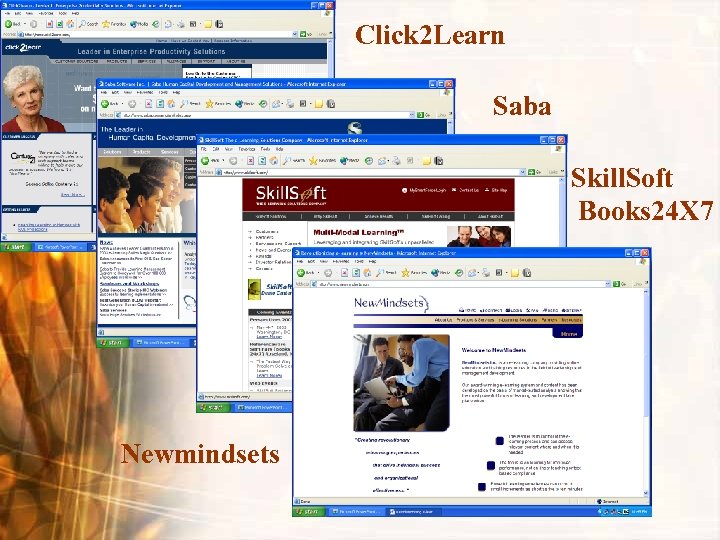
Click 2 Learn Saba Skill. Soft Books 24 X 7 Newmindsets
E-Learning
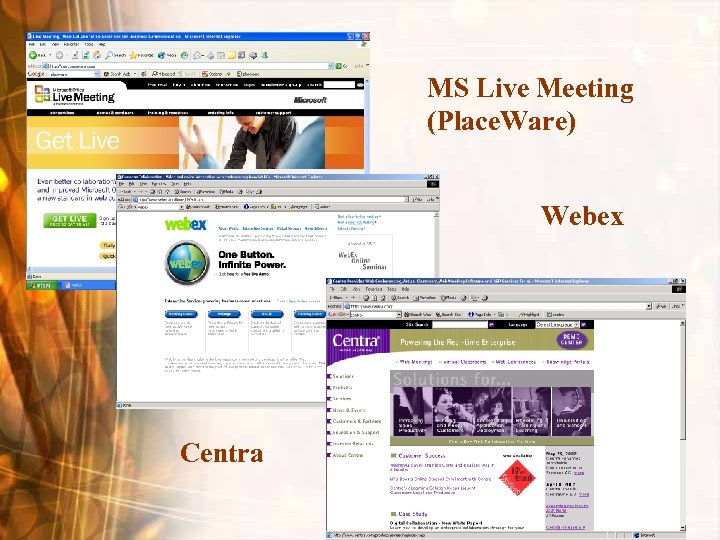
MS Live Meeting (Place. Ware) Webex Centra
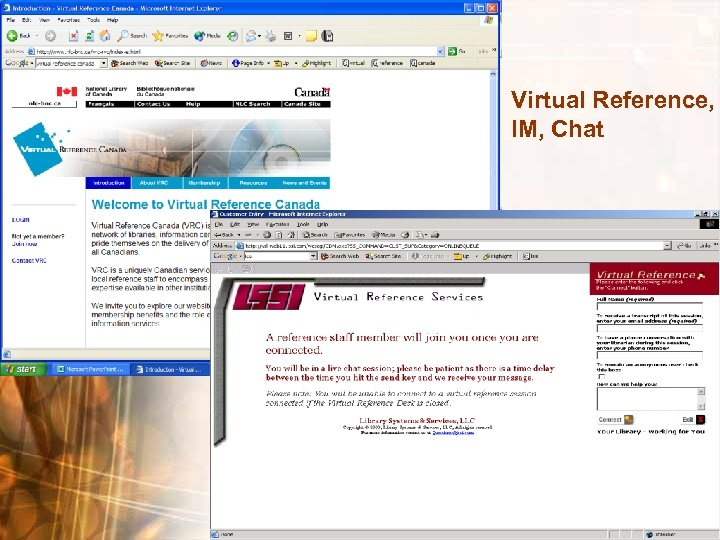
Virtual Reference, IM, Chat
Video Games, PC Gamers Goals, scaffolds and learning Decision trees and Problem solving
It’s an Information Ocean, not a Highway.
It’s an “Exploration Space” not a collection space.
Context is King, not Content.
What is context? • It’s not about the Library! • It is about. . . • Learning • Research • Community • Workplace
Zac’s Media and ‘Zine • • 8. 5 hours digital media Downloads MP 3’s Downloads mainstream media Assembles and publishes 1 hour TV show with ads – But, also • Publishes a zine in dead tree format too. • Small Feedback loop in IM and e. Mail
Sydney’s Publishing • • 3, 000 IM Buddies Small website Original MP 3 files Rock Band concerts
Thanks Stephen Abram, MLS Sirsi Corporation 416 -669 -4855 stephen. abram@sirsi. com http: //www. sirsi. com
Скачать презентацию SLA Annual Conference June 8 2004 Stephen Abram
2195c80733bbc8efc3c2c5ada21db043.ppt