 Скачать презентацию Skull Brain and Cranial Nerves Head and Neck
Skull, Brain, CN.ppt
- Количество слайдов: 65



Skull, Brain and Cranial Nerves Head and Neck Continued
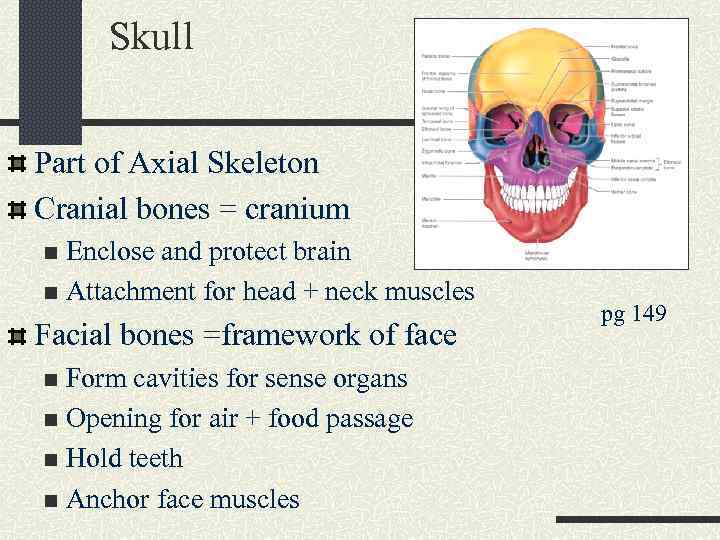
Skull Part of Axial Skeleton Cranial bones = cranium Enclose and protect brain n Attachment for head + neck muscles n Facial bones =framework of face Form cavities for sense organs n Opening for air + food passage n Hold teeth n Anchor face muscles n pg 149
Bones of Skull Flat bones: thin, flattened, some curve Sutures: immovable joints joining bones Calvaria = Skullcap =Vault n Superior, Lateral, Posterior part of skull Floor = Base n Inferior part of skull 85 openings in skull n Spinal cord, blood vessels, nerves
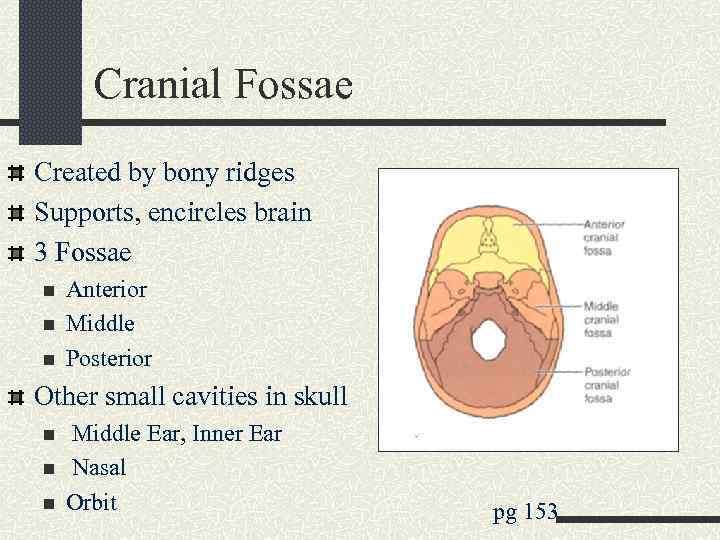
Cranial Fossae Created by bony ridges Supports, encircles brain 3 Fossae n n n Anterior Middle Posterior Other small cavities in skull n n n Middle Ear, Inner Ear Nasal Orbit pg 153
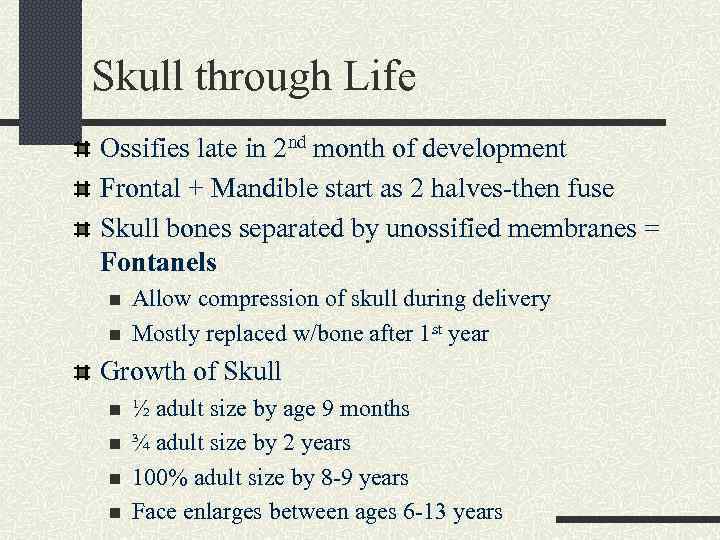
Skull through Life Ossifies late in 2 nd month of development Frontal + Mandible start as 2 halves-then fuse Skull bones separated by unossified membranes = Fontanels n n Allow compression of skull during delivery Mostly replaced w/bone after 1 st year Growth of Skull n n ½ adult size by age 9 months ¾ adult size by 2 years 100% adult size by 8 -9 years Face enlarges between ages 6 -13 years
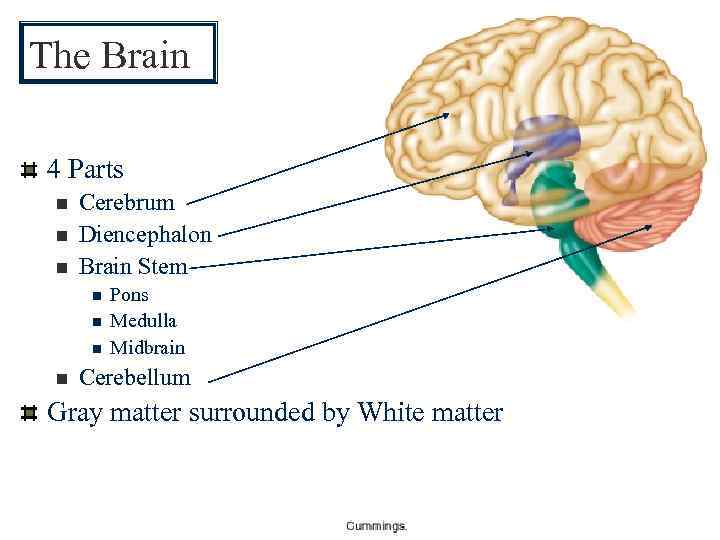
The Brain 4 Parts n n n Cerebrum Diencephalon Brain Stem n n Pons Medulla Midbrain Cerebellum Gray matter surrounded by White matter pg 348
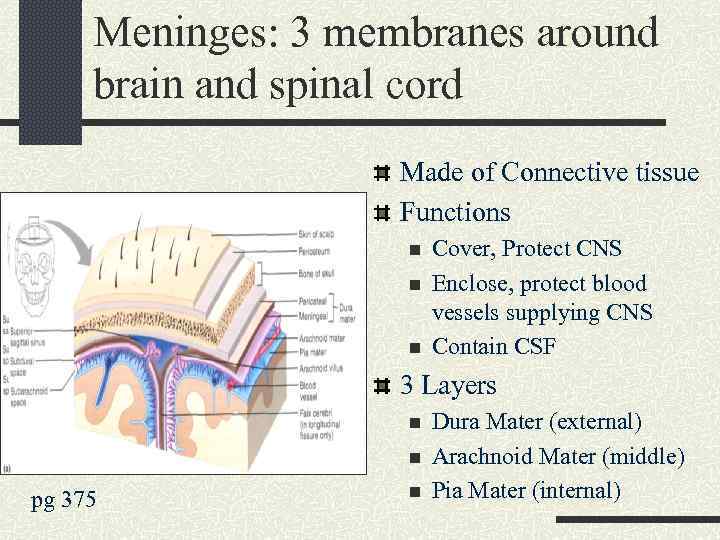
Meninges: 3 membranes around brain and spinal cord Made of Connective tissue Functions n n n Cover, Protect CNS Enclose, protect blood vessels supplying CNS Contain CSF 3 Layers n n pg 375 n Dura Mater (external) Arachnoid Mater (middle) Pia Mater (internal)
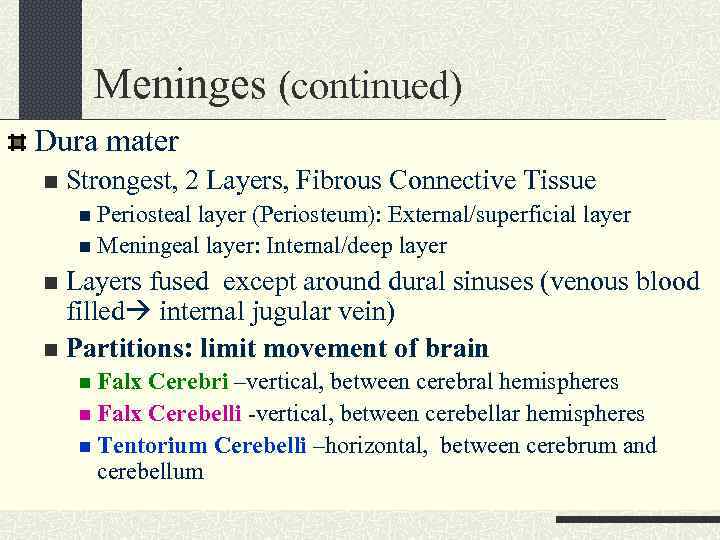
Meninges (continued) Dura mater n Strongest, 2 Layers, Fibrous Connective Tissue n Periosteal layer (Periosteum): External/superficial layer n Meningeal layer: Internal/deep layer Layers fused except around dural sinuses (venous blood filled internal jugular vein) n Partitions: limit movement of brain n n Falx Cerebri –vertical, between cerebral hemispheres n Falx Cerebelli -vertical, between cerebellar hemispheres n Tentorium Cerebelli –horizontal, between cerebrum and cerebellum
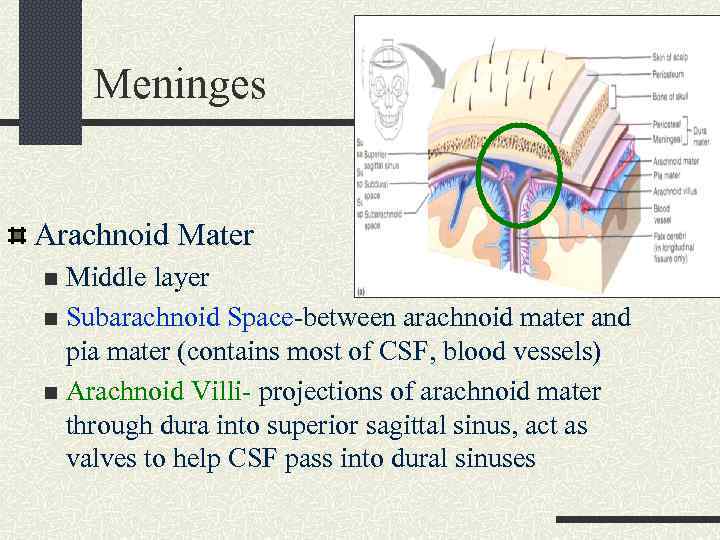
Meninges Arachnoid Mater Middle layer n Subarachnoid Space-between arachnoid mater and pia mater (contains most of CSF, blood vessels) n Arachnoid Villi- projections of arachnoid mater through dura into superior sagittal sinus, act as valves to help CSF pass into dural sinuses n
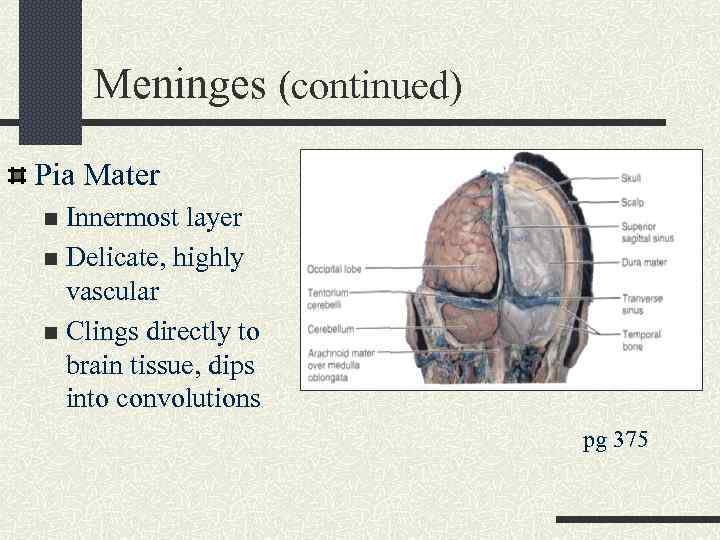
Meninges (continued) Pia Mater Innermost layer n Delicate, highly vascular n Clings directly to brain tissue, dips into convolutions n pg 375
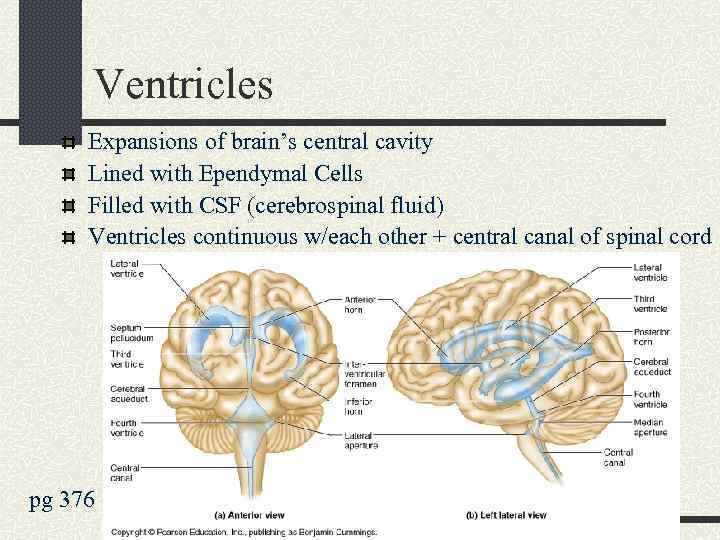
Ventricles Expansions of brain’s central cavity Lined with Ependymal Cells Filled with CSF (cerebrospinal fluid) Ventricles continuous w/each other + central canal of spinal cord pg 376
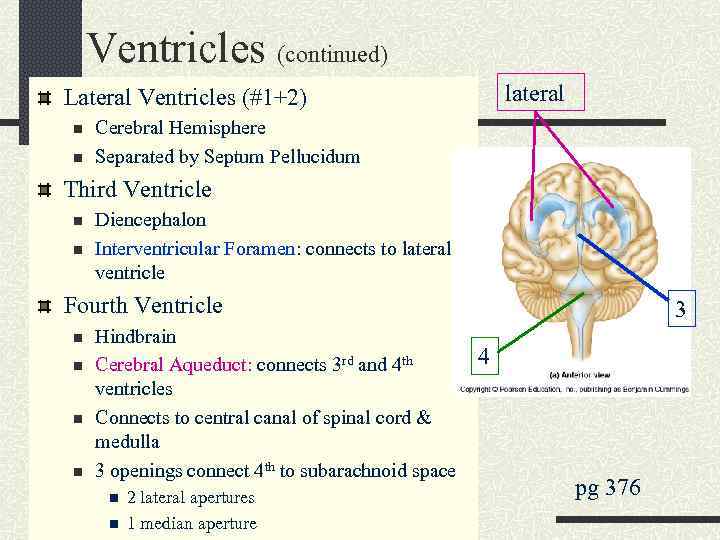
Ventricles (continued) lateral Lateral Ventricles (#1+2) n n Cerebral Hemisphere Separated by Septum Pellucidum Third Ventricle n n Diencephalon Interventricular Foramen: connects to lateral ventricle Fourth Ventricle n n Hindbrain Cerebral Aqueduct: connects 3 rd and 4 th ventricles Connects to central canal of spinal cord & medulla 3 openings connect 4 th to subarachnoid space n n 2 lateral apertures 1 median aperture 3 4 pg 376
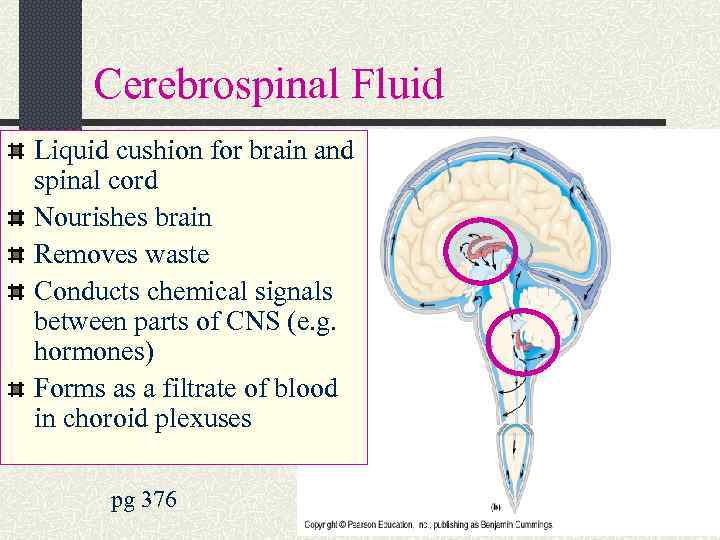
Cerebrospinal Fluid Liquid cushion for brain and spinal cord Nourishes brain Removes waste Conducts chemical signals between parts of CNS (e. g. hormones) Forms as a filtrate of blood in choroid plexuses pg 376
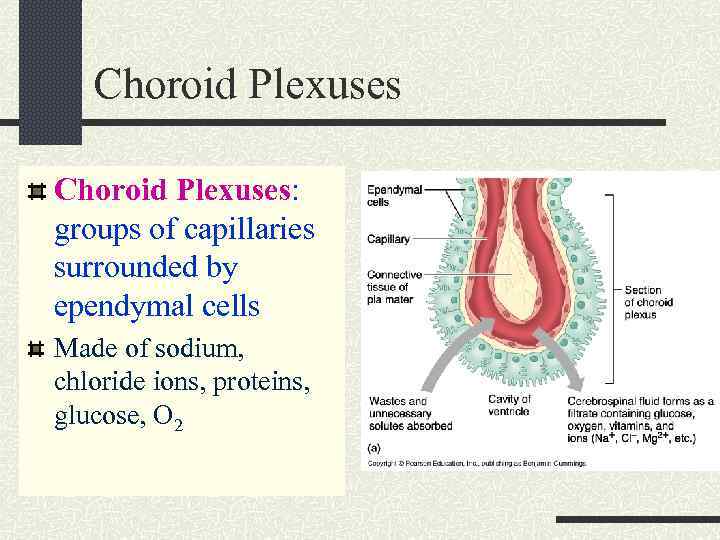
Choroid Plexuses: groups of capillaries surrounded by ependymal cells Made of sodium, chloride ions, proteins, glucose, O 2
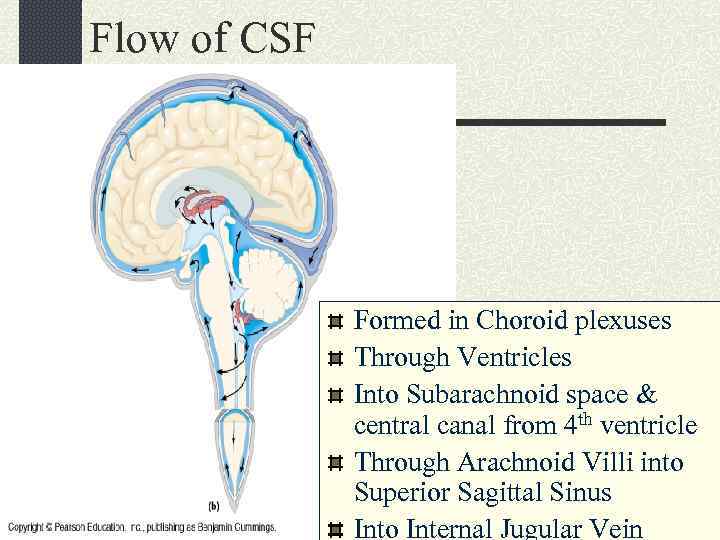
Flow of CSF Formed in Choroid plexuses Through Ventricles Into Subarachnoid space & central canal from 4 th ventricle Through Arachnoid Villi into Superior Sagittal Sinus Into Internal Jugular Vein
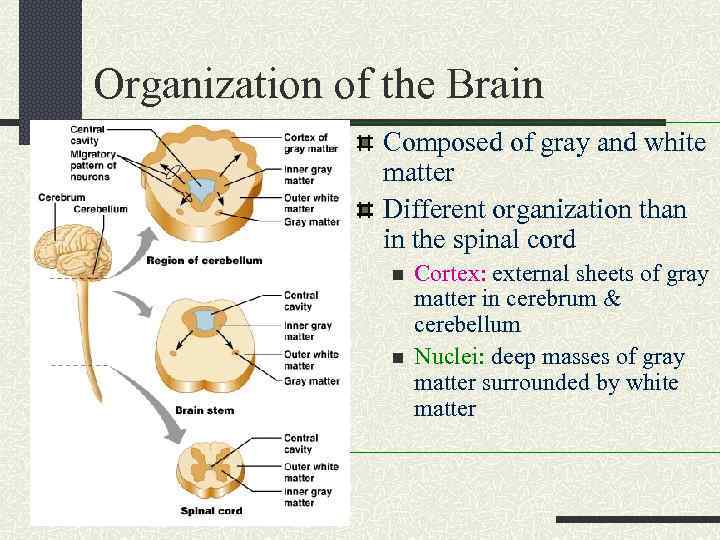
Organization of the Brain Composed of gray and white matter Different organization than in the spinal cord n n Cortex: external sheets of gray matter in cerebrum & cerebellum Nuclei: deep masses of gray matter surrounded by white matter
Cerebrum “Executive Suite” of nervous system n Self-awareness, initiate + control voluntary movements, communicate, remember, understand Made of Gray matter, White matter, Basal gangli (nuclei) Most superior region Covers diencephalon + top of brain stem like mushroom cap Many small grooves + deep fissures n n Transverse-separates cerebral hemisphere + cerebellum Longitudinal-separates right + left cerebral hemispheres Sulci – grooves on surface Gyri-ridges of brain tissue between sulci
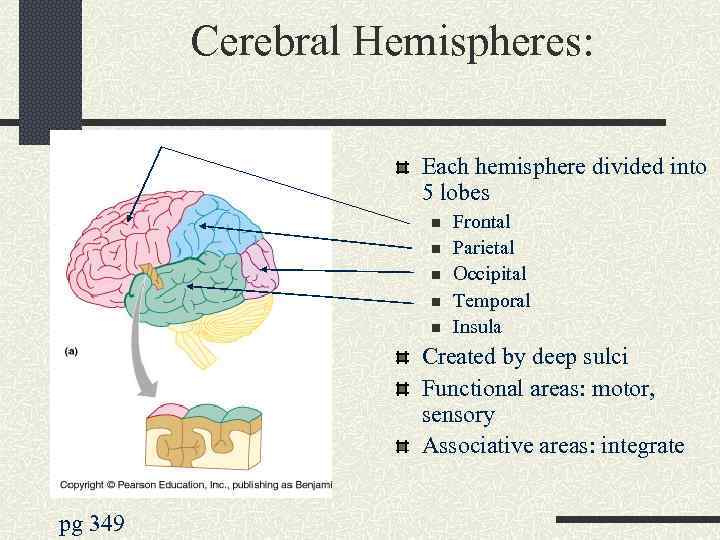
Cerebral Hemispheres: Each hemisphere divided into 5 lobes n n n Frontal Parietal Occipital Temporal Insula Created by deep sulci Functional areas: motor, sensory Associative areas: integrate pg 349
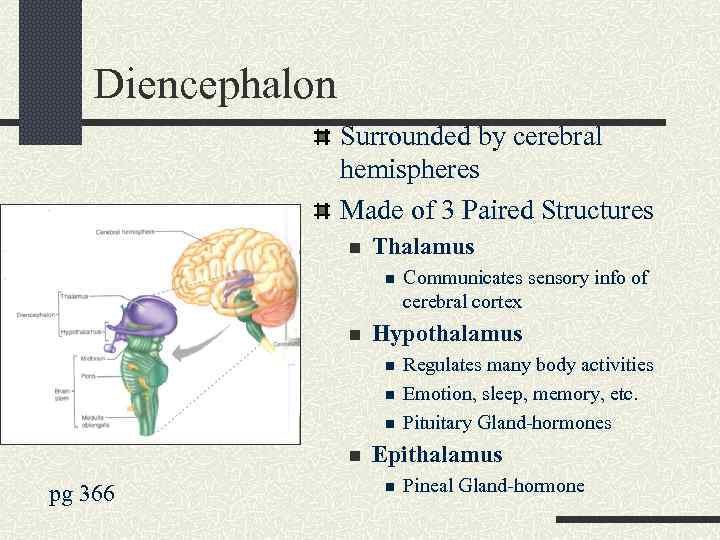
Diencephalon Surrounded by cerebral hemispheres Made of 3 Paired Structures n Thalamus n n Hypothalamus n n pg 366 Communicates sensory info of cerebral cortex Regulates many body activities Emotion, sleep, memory, etc. Pituitary Gland-hormones Epithalamus n Pineal Gland-hormone
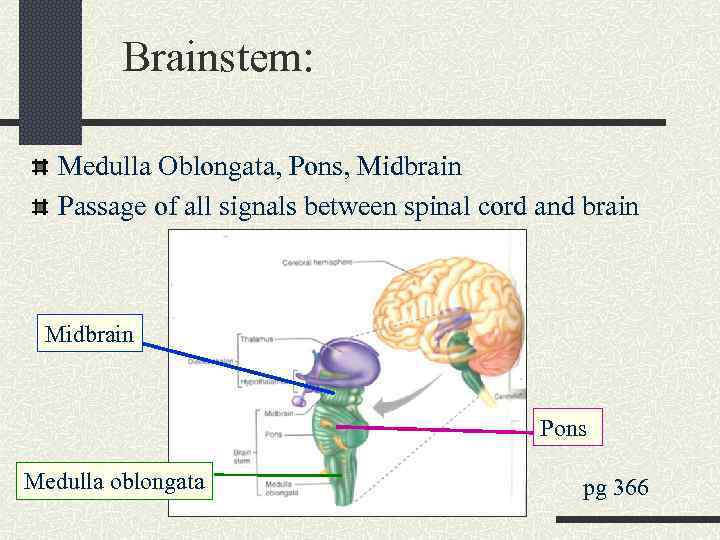
Brainstem: Medulla Oblongata, Pons, Midbrain Passage of all signals between spinal cord and brain Midbrain Pons Medulla oblongata pg 366
Brainstem: Medulla Oblongata Regulates several basic physiological functions Heartbeat (rate and force) n Blood pressure (vasoconstriction/dilation of arteries) n Breathing (rate and depth) n Others: speech, coughing, sneezing, salivation, swallowing, gagging, vomiting, sweating n Attachment of CN IX, X, XII
Brainstem: The Pons Contains many tracts carrying signals: from cerebrum to cerebellum & medulla n up to thalamus n between right and left hemispheres of cerebellum n from brainstem to cerebellum n Attachment of CN V, VII, VIII
Brainstem: Midbrain Carries signals Between higher and lower brain centers n From cerebellum to cerebral cortex n Visual and Auditory reflex centers Somatic motor Attachment for CN III, IV
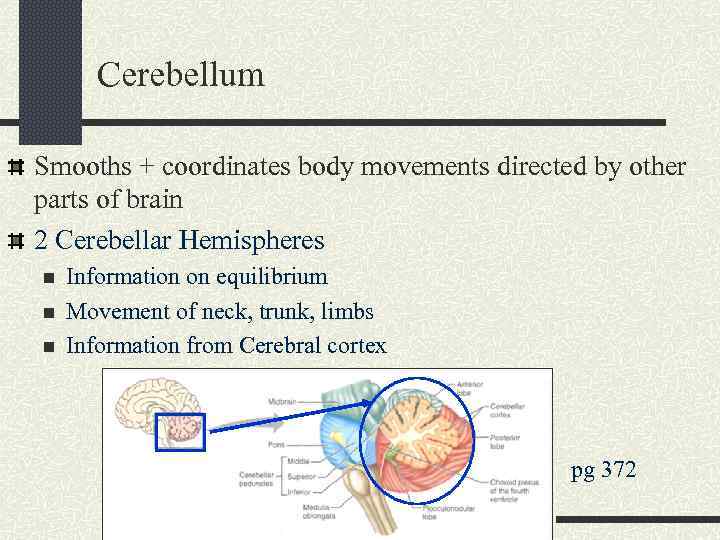
Cerebellum Smooths + coordinates body movements directed by other parts of brain 2 Cerebellar Hemispheres n n n Information on equilibrium Movement of neck, trunk, limbs Information from Cerebral cortex pg 372
Blood Brain Barrier Protects brain from blood-borne toxins (e. g. urea, food toxins, bacteria) Endothelium of brain capillaries are loaded with tight junction to decrease permeability Not complete protection, some things still have to get through (e. g. fat-soluble molecules can pass through)
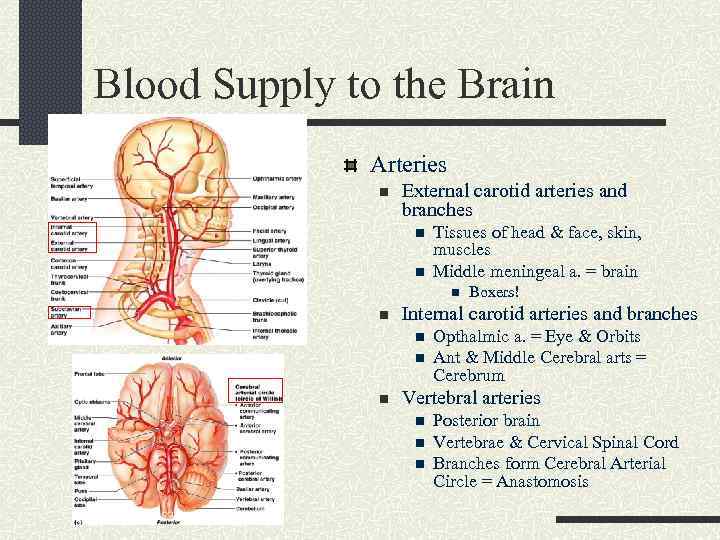
Blood Supply to the Brain Arteries n External carotid arteries and branches n n Tissues of head & face, skin, muscles Middle meningeal a. = brain n n Internal carotid arteries and branches n n n Boxers! Opthalmic a. = Eye & Orbits Ant & Middle Cerebral arts = Cerebrum Vertebral arteries n n n Posterior brain Vertebrae & Cervical Spinal Cord Branches form Cerebral Arterial Circle = Anastomosis
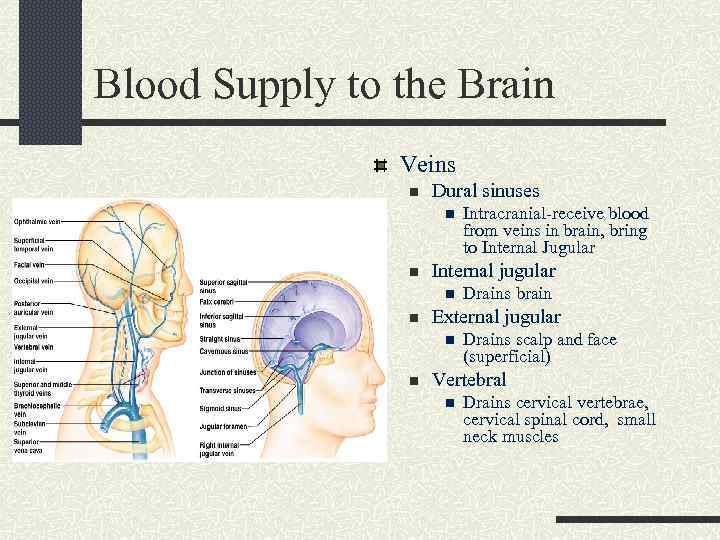
Blood Supply to the Brain Veins n Dural sinuses n n Internal jugular n n Drains brain External jugular n n Intracranial-receive blood from veins in brain, bring to Internal Jugular Drains scalp and face (superficial) Vertebral n Drains cervical vertebrae, cervical spinal cord, small neck muscles
Cranial Nerves: I - XII 12 Pairs Numbered Anterior to Posterior Attach to Ventral surface of brain Exit brain through foramina in skull I + II attach to Forebrain (cerebrum + diencephalon) III-XII attach to Brainstem (midbrain, pons, medulla) Only X goes beyond the head-neck
Foramina serving Cranial Nerves You must know what foramina each CN leaves the skull through (refer to handout in lab)
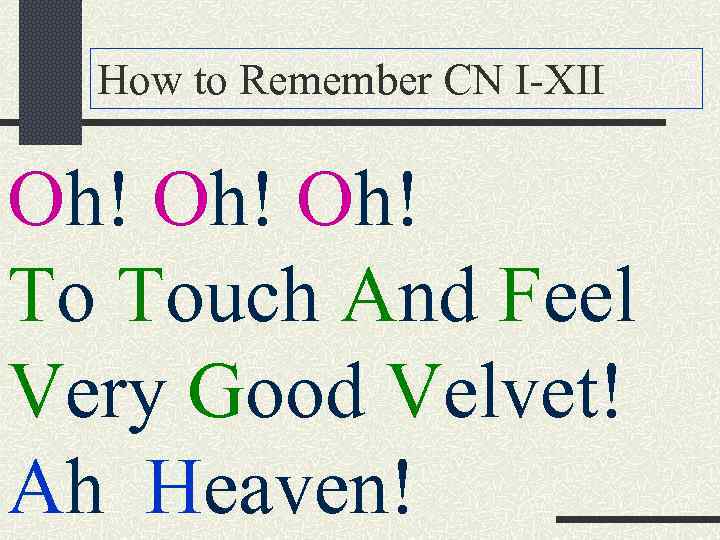
How to Remember CN I-XII Oh! Oh! To Touch And Feel Very Good Velvet! Ah Heaven!
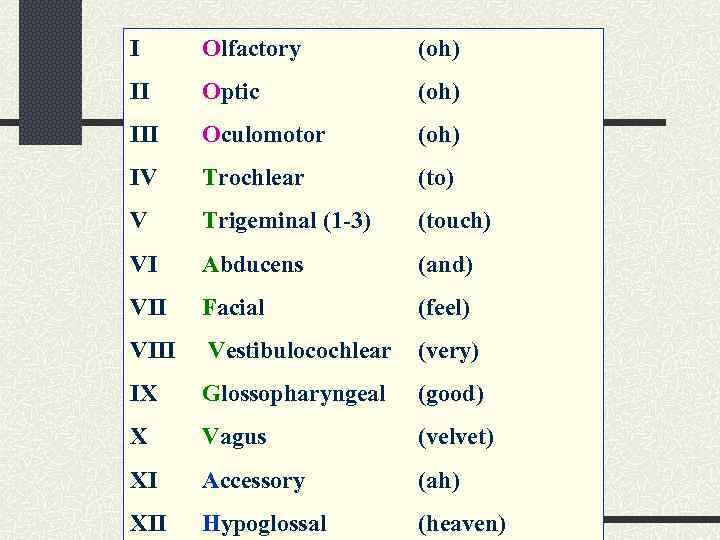
I Olfactory (oh) II Optic (oh) III Oculomotor (oh) IV Trochlear (to) V Trigeminal (1 -3) (touch) VI Abducens (and) VII Facial (feel) VIII Vestibulocochlear (very) IX Glossopharyngeal (good) X Vagus (velvet) XI Accessory (ah) XII Hypoglossal (heaven)
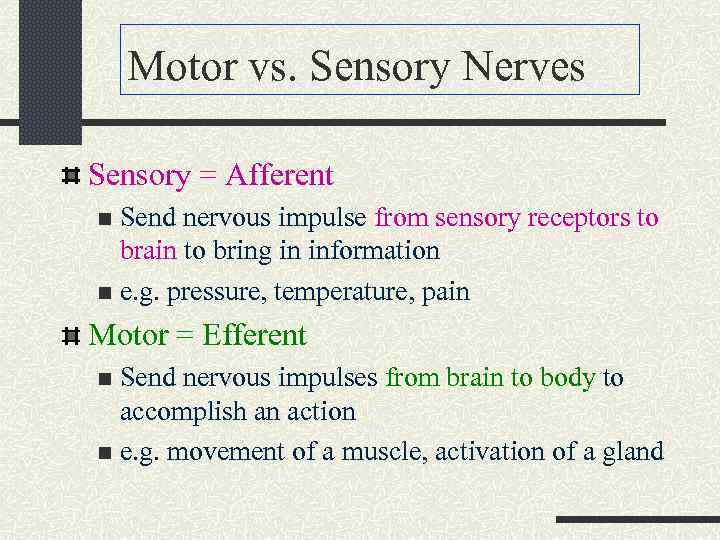
Motor vs. Sensory Nerves Sensory = Afferent Send nervous impulse from sensory receptors to brain to bring in information n e. g. pressure, temperature, pain n Motor = Efferent Send nervous impulses from brain to body to accomplish an action n e. g. movement of a muscle, activation of a gland n
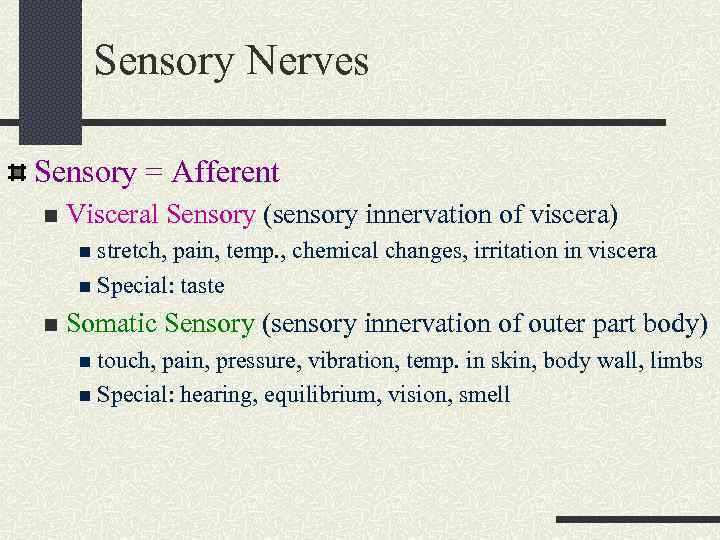
Sensory Nerves Sensory = Afferent n Visceral Sensory (sensory innervation of viscera) n stretch, pain, temp. , chemical changes, irritation in viscera n Special: taste n Somatic Sensory (sensory innervation of outer part body) n touch, pain, pressure, vibration, temp. in skin, body wall, limbs n Special: hearing, equilibrium, vision, smell
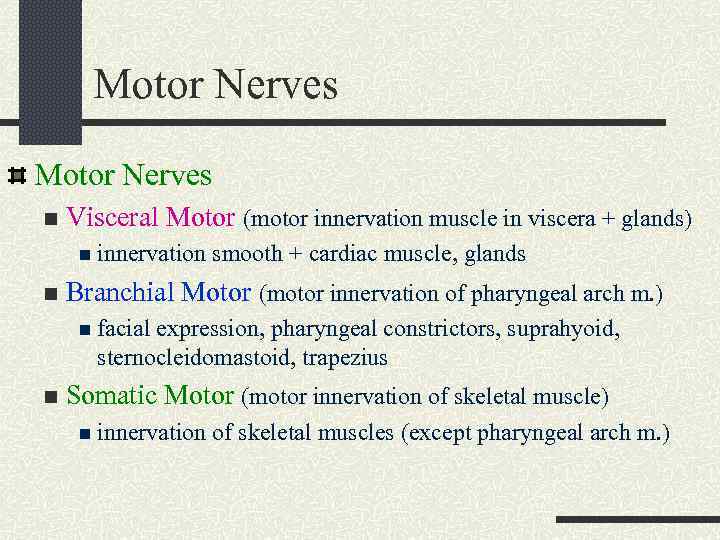
Motor Nerves n Visceral Motor (motor innervation muscle in viscera + glands) n innervation n smooth + cardiac muscle, glands Branchial Motor (motor innervation of pharyngeal arch m. ) n facial expression, pharyngeal constrictors, suprahyoid, sternocleidomastoid, trapezius n Somatic Motor (motor innervation of skeletal muscle) n innervation of skeletal muscles (except pharyngeal arch m. )
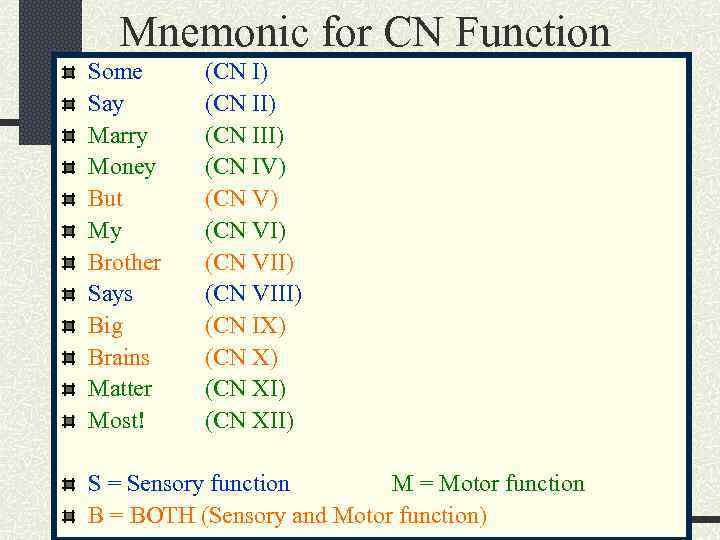
Mnemonic for CN Function Some Say Marry Money But My Brother Says Big Brains Matter Most! (CN I) (CN III) (CN IV) (CN VI) (CN VIII) (CN IX) (CN XI) (CN XII) S = Sensory function M = Motor function B = BOTH (Sensory and Motor function)
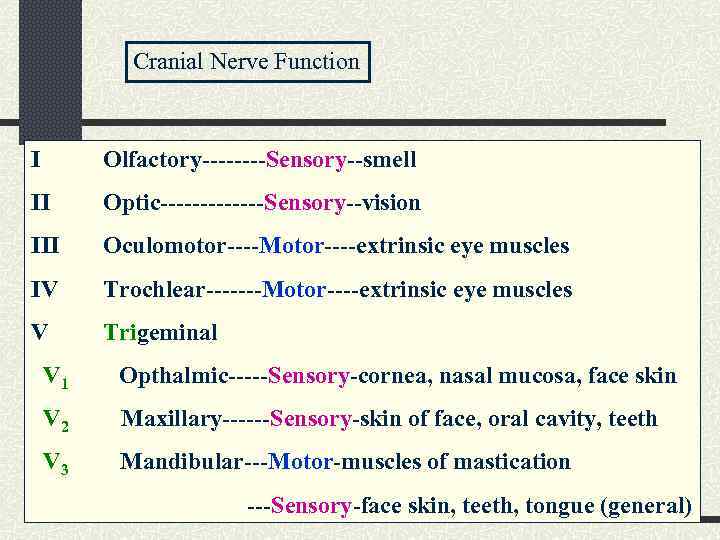
Cranial Nerve Function I Olfactory----Sensory--smell II Optic-------Sensory--vision III Oculomotor----Motor----extrinsic eye muscles IV Trochlear-------Motor----extrinsic eye muscles V Trigeminal V 1 Opthalmic-----Sensory-cornea, nasal mucosa, face skin V 2 Maxillary------Sensory-skin of face, oral cavity, teeth V 3 Mandibular---Motor-muscles of mastication ---Sensory-face skin, teeth, tongue (general)
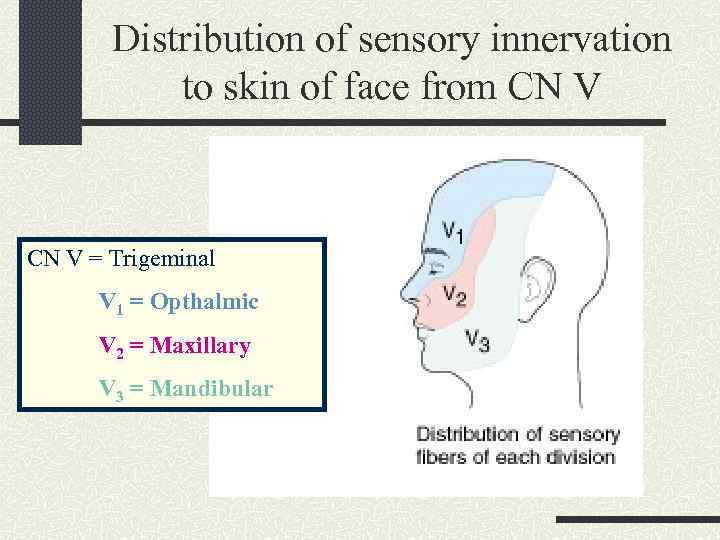
Distribution of sensory innervation to skin of face from CN V = Trigeminal V 1 = Opthalmic V 2 = Maxillary V 3 = Mandibular
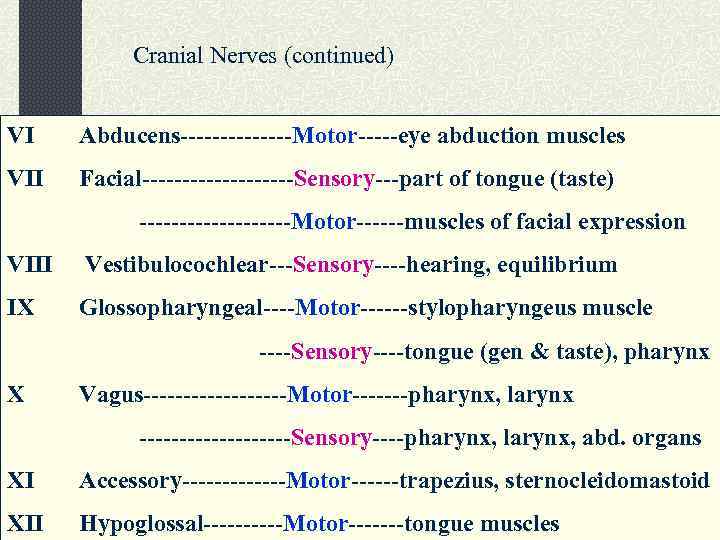
Cranial Nerves (continued) VI Abducens-------Motor-----eye abduction muscles VII Facial----------Sensory---part of tongue (taste) ----------Motor------muscles of facial expression VIII Vestibulocochlear---Sensory----hearing, equilibrium IX Glossopharyngeal----Motor------stylopharyngeus muscle ----Sensory----tongue (gen & taste), pharynx X Vagus---------Motor-------pharynx, larynx ----------Sensory----pharynx, larynx, abd. organs XI Accessory-------Motor------trapezius, sternocleidomastoid XII Hypoglossal-----Motor-------tongue muscles
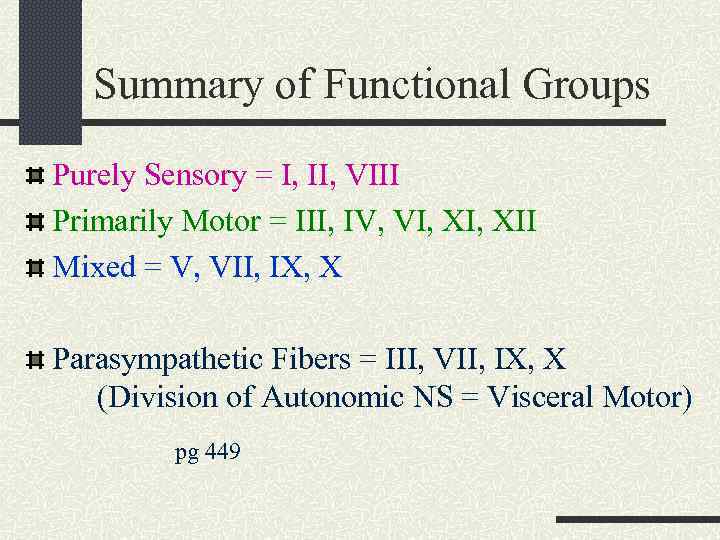
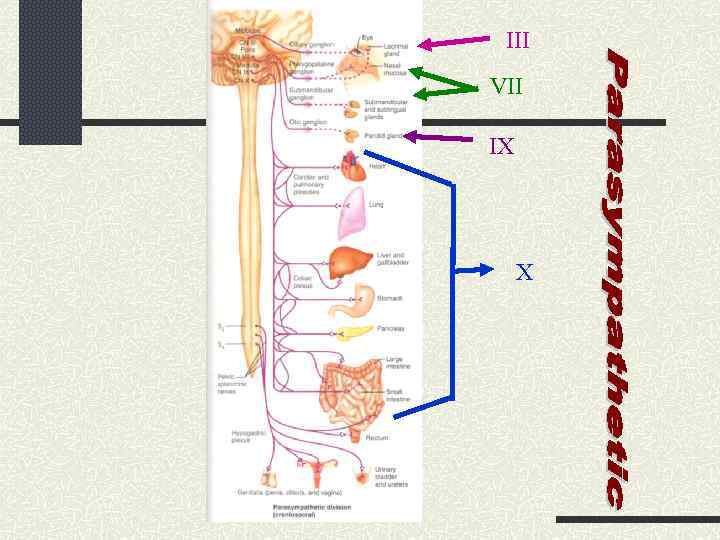
Summary of Functional Groups Purely Sensory = I, II, VIII Primarily Motor = III, IV, VI, XII Mixed = V, VII, IX, X Parasympathetic Fibers = III, VII, IX, X (Division of Autonomic NS = Visceral Motor) pg 449
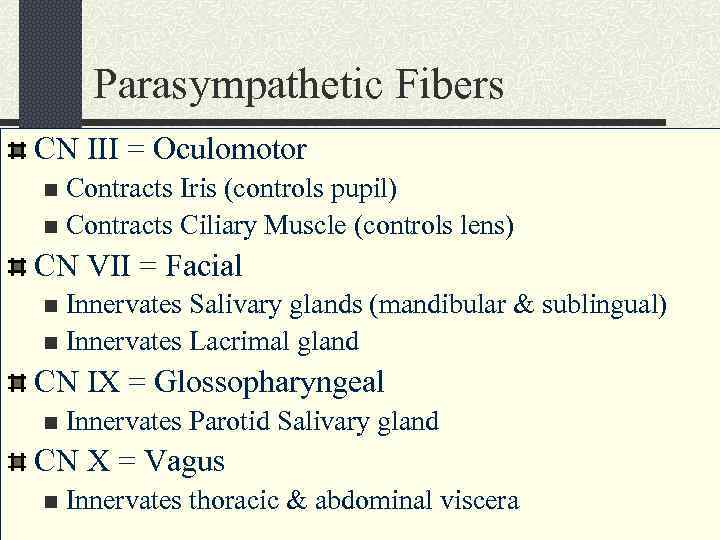
Parasympathetic Fibers CN III = Oculomotor Contracts Iris (controls pupil) n Contracts Ciliary Muscle (controls lens) n CN VII = Facial Innervates Salivary glands (mandibular & sublingual) n Innervates Lacrimal gland n CN IX = Glossopharyngeal n Innervates Parotid Salivary gland CN X = Vagus n Innervates thoracic & abdominal viscera
III VII IX X
Anatomy of the Eye and Ear
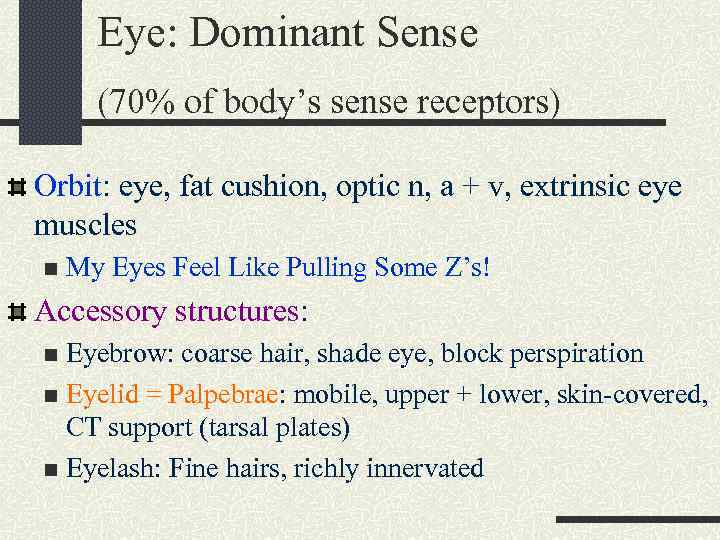
Eye: Dominant Sense (70% of body’s sense receptors) Orbit: eye, fat cushion, optic n, a + v, extrinsic eye muscles n My Eyes Feel Like Pulling Some Z’s! Accessory structures: Eyebrow: coarse hair, shade eye, block perspiration n Eyelid = Palpebrae: mobile, upper + lower, skin-covered, CT support (tarsal plates) n Eyelash: Fine hairs, richly innervated n
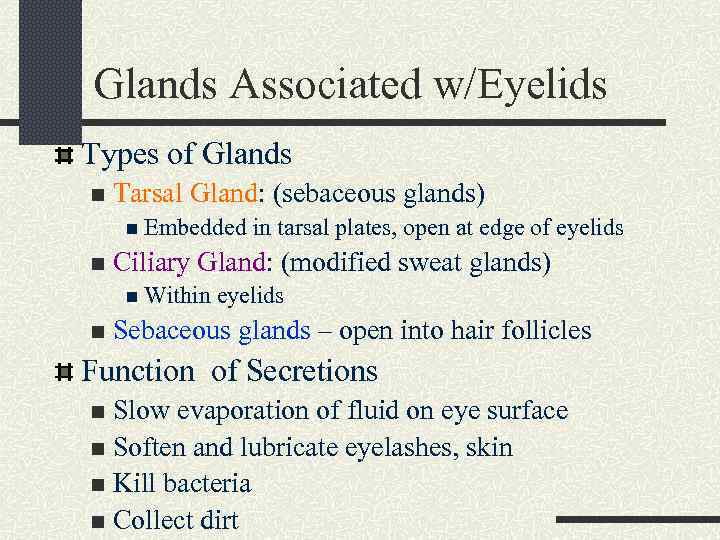
Glands Associated w/Eyelids Types of Glands n Tarsal Gland: (sebaceous glands) n Embedded n Ciliary Gland: (modified sweat glands) n Within n in tarsal plates, open at edge of eyelids Sebaceous glands – open into hair follicles Function of Secretions Slow evaporation of fluid on eye surface n Soften and lubricate eyelashes, skin n Kill bacteria n Collect dirt n
Eye (continued) More Accessory structures Conjunctiva-transparent mucous membrane on inner eyelid + anterior surface of eye, mucus keeps eye moist n Lacrimal Apparatus-gland + ducts flow into nasal cavity n n Tears-keep n n eye moist, wash out irritant Contain mucus, antibodies, lysozome Lacrimal Gland-Superolateral to eye, produce fluid n Innervated by CN VII (parasympathetic fibers)
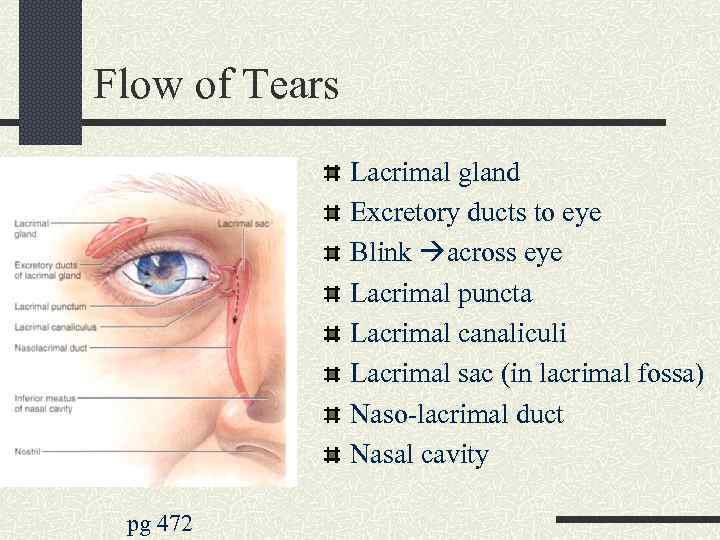
Flow of Tears Lacrimal gland Excretory ducts to eye Blink across eye Lacrimal puncta Lacrimal canaliculi Lacrimal sac (in lacrimal fossa) Naso-lacrimal duct Nasal cavity pg 472
6 Extrinsic Eye Muscles Direct gaze, hold eye in orbit O: orbit walls I: outer surface of eye 4 Rectus Muscles (turn M-L, S-I) 2 Obliques n n Superior Oblique-depresses, some lateral movement Inferior Oblique-elevates, some lateral movement Innervation n Lateral Rectus = CN VI (abducens) Middle, Superior, Inferior Rectus + Inf. Oblique = CN III (o-m) Superior Oblique = CN IV (trochlear)
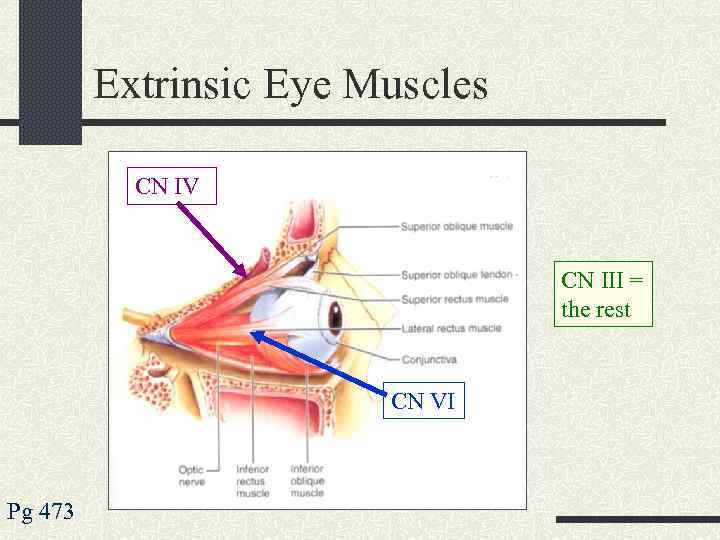
Extrinsic Eye Muscles CN IV CN III = the rest CN VI Pg 473
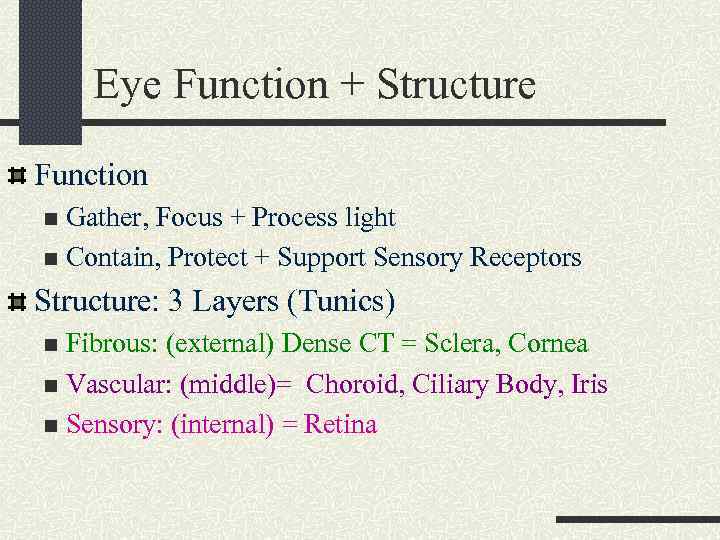
Eye Function + Structure Function Gather, Focus + Process light n Contain, Protect + Support Sensory Receptors n Structure: 3 Layers (Tunics) Fibrous: (external) Dense CT = Sclera, Cornea n Vascular: (middle)= Choroid, Ciliary Body, Iris n Sensory: (internal) = Retina n
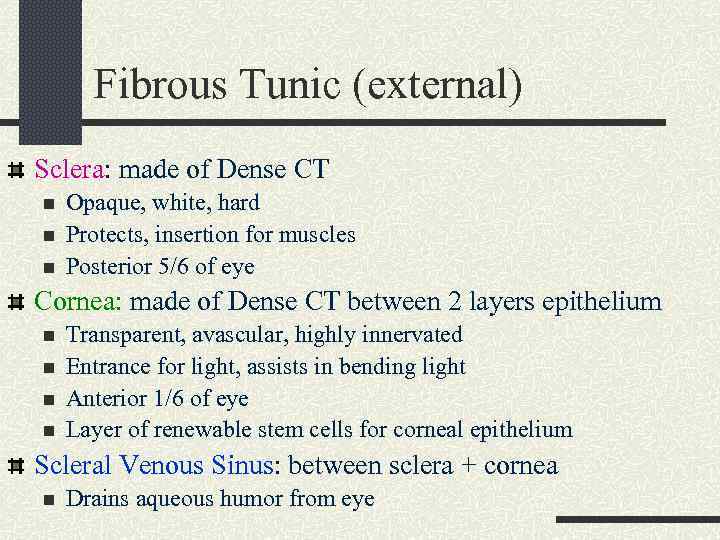
Fibrous Tunic (external) Sclera: made of Dense CT n n n Opaque, white, hard Protects, insertion for muscles Posterior 5/6 of eye Cornea: made of Dense CT between 2 layers epithelium n n Transparent, avascular, highly innervated Entrance for light, assists in bending light Anterior 1/6 of eye Layer of renewable stem cells for corneal epithelium Scleral Venous Sinus: between sclera + cornea n Drains aqueous humor from eye
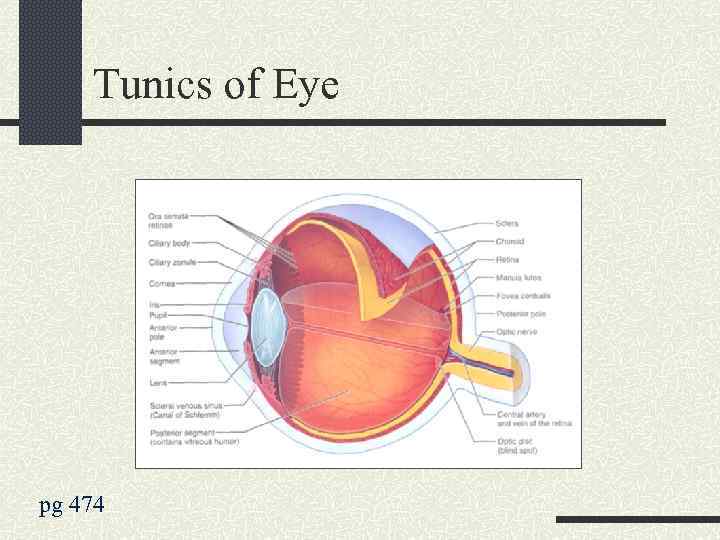
Tunics of Eye pg 474
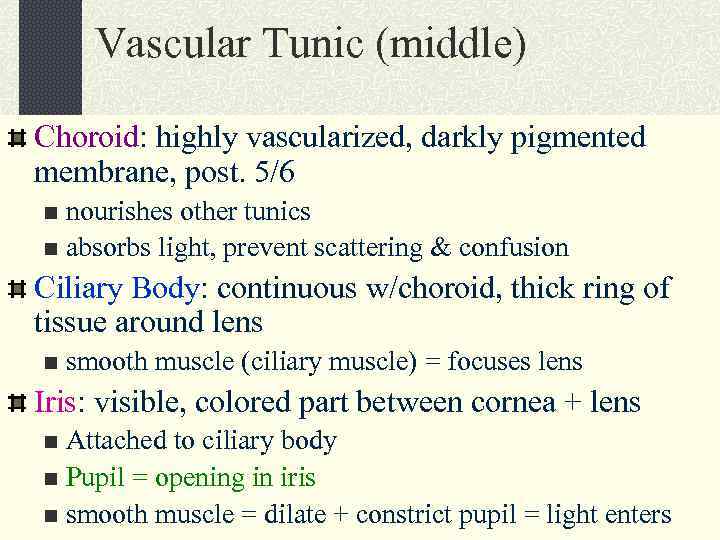
Vascular Tunic (middle) Choroid: highly vascularized, darkly pigmented membrane, post. 5/6 nourishes other tunics n absorbs light, prevent scattering & confusion n Ciliary Body: continuous w/choroid, thick ring of tissue around lens n smooth muscle (ciliary muscle) = focuses lens Iris: visible, colored part between cornea + lens Attached to ciliary body n Pupil = opening in iris n smooth muscle = dilate + constrict pupil = light enters n
Retina = Sensory Tunic (internal) Neural layer (inner) thick, sheets nervous tissue n contain photoreceptors (rods + cones) n Pigmented layer (outer) contains melanocytes n absorb light, prevent scattering n
Eye Anatomy (continued) Lens thick, transparent, biconvex disc n changes shape to focus light on retina n made of epithelium + fibers (contain proteins) n divides eye into anterior/posterior segments n Aqueous Humor: clear fluid in anterior segment n provides nutrients, O 2 to lens/cornea Vitreous Humor: jelly-like in posterior segment n transmit light, support post. surface of lens + hold 2 layers of retina together, maintain intraocular pressure
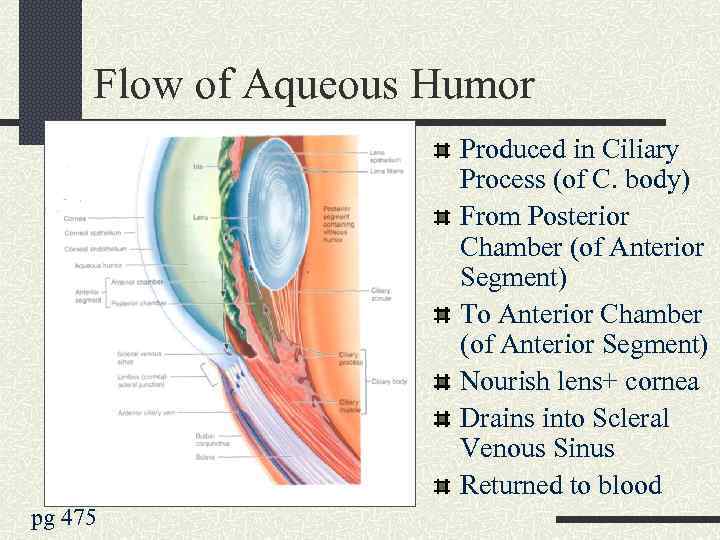
Flow of Aqueous Humor Produced in Ciliary Process (of C. body) From Posterior Chamber (of Anterior Segment) To Anterior Chamber (of Anterior Segment) Nourish lens+ cornea Drains into Scleral Venous Sinus Returned to blood pg 475
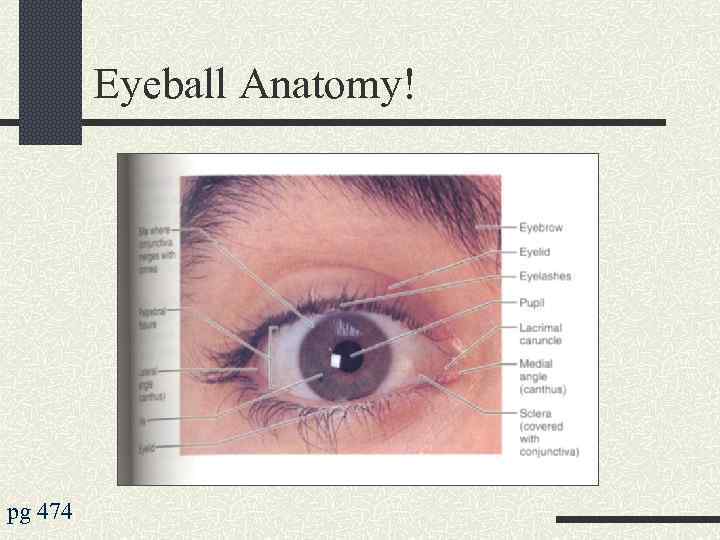
Eyeball Anatomy! pg 474
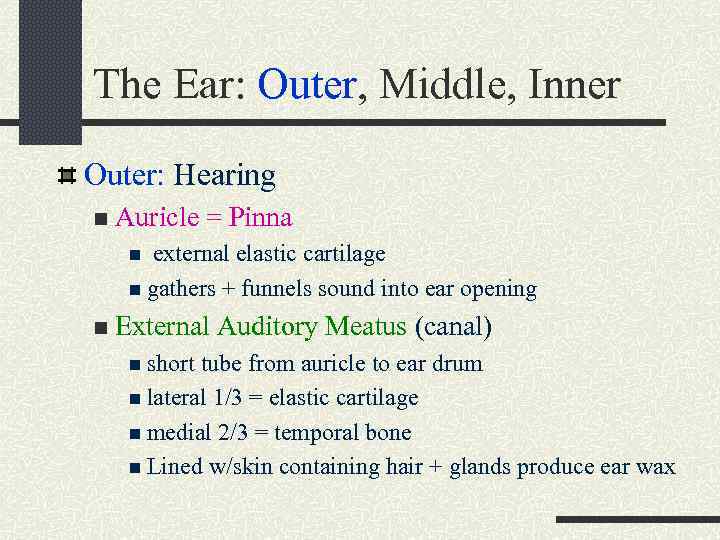
The Ear: Outer, Middle, Inner Outer: Hearing n Auricle = Pinna external elastic cartilage n gathers + funnels sound into ear opening n n External Auditory Meatus (canal) n short tube from auricle to ear drum n lateral 1/3 = elastic cartilage n medial 2/3 = temporal bone n Lined w/skin containing hair + glands produce ear wax
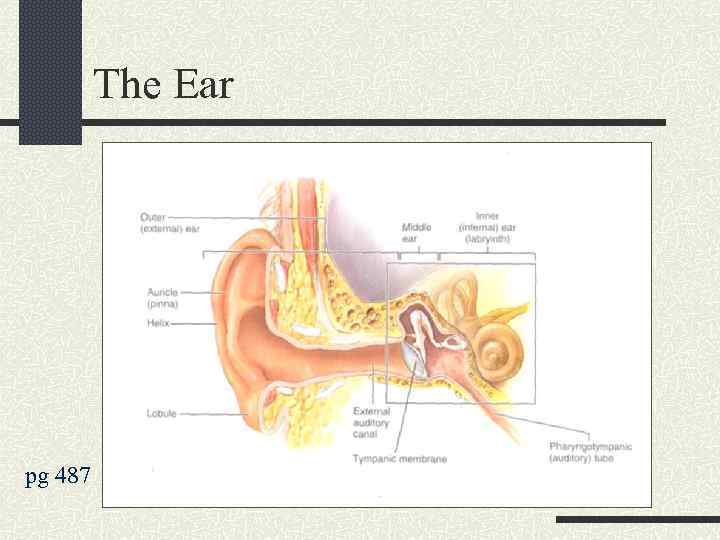
The Ear pg 487
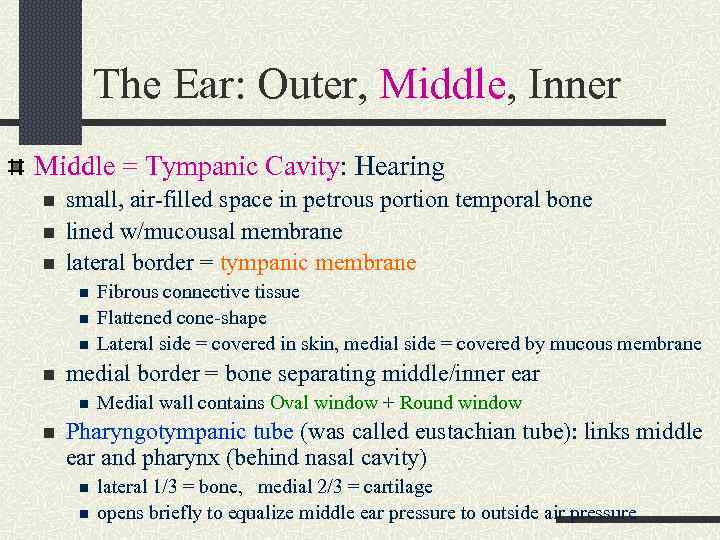
The Ear: Outer, Middle, Inner Middle = Tympanic Cavity: Hearing n n n small, air-filled space in petrous portion temporal bone lined w/mucousal membrane lateral border = tympanic membrane n n medial border = bone separating middle/inner ear n n Fibrous connective tissue Flattened cone-shape Lateral side = covered in skin, medial side = covered by mucous membrane Medial wall contains Oval window + Round window Pharyngotympanic tube (was called eustachian tube): links middle ear and pharynx (behind nasal cavity) n n lateral 1/3 = bone, medial 2/3 = cartilage opens briefly to equalize middle ear pressure to outside air pressure
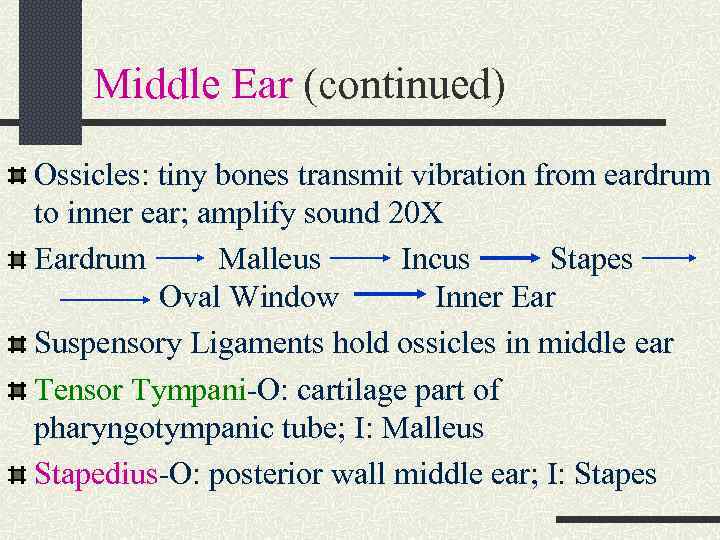
Middle Ear (continued) Ossicles: tiny bones transmit vibration from eardrum to inner ear; amplify sound 20 X Eardrum Malleus Incus Stapes Oval Window Inner Ear Suspensory Ligaments hold ossicles in middle ear Tensor Tympani-O: cartilage part of pharyngotympanic tube; I: Malleus Stapedius-O: posterior wall middle ear; I: Stapes
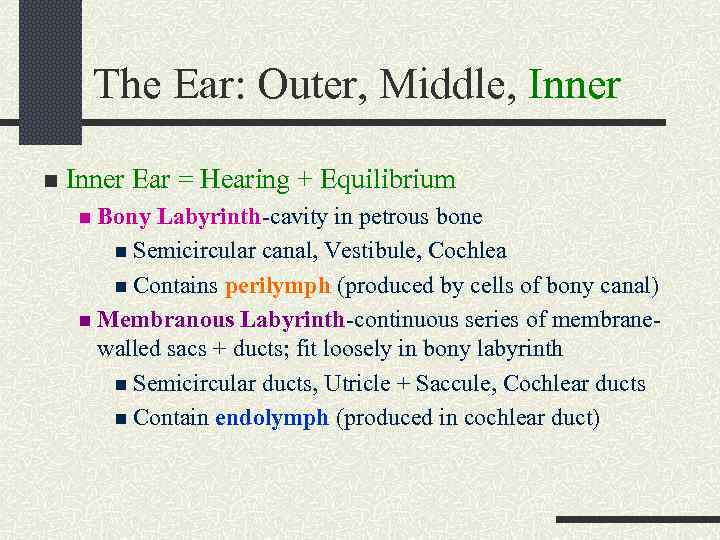
The Ear: Outer, Middle, Inner n Inner Ear = Hearing + Equilibrium n Bony Labyrinth-cavity in petrous bone n Semicircular canal, Vestibule, Cochlea n Contains perilymph (produced by cells of bony canal) n Membranous Labyrinth-continuous series of membranewalled sacs + ducts; fit loosely in bony labyrinth n Semicircular ducts, Utricle + Saccule, Cochlear ducts n Contain endolymph (produced in cochlear duct)
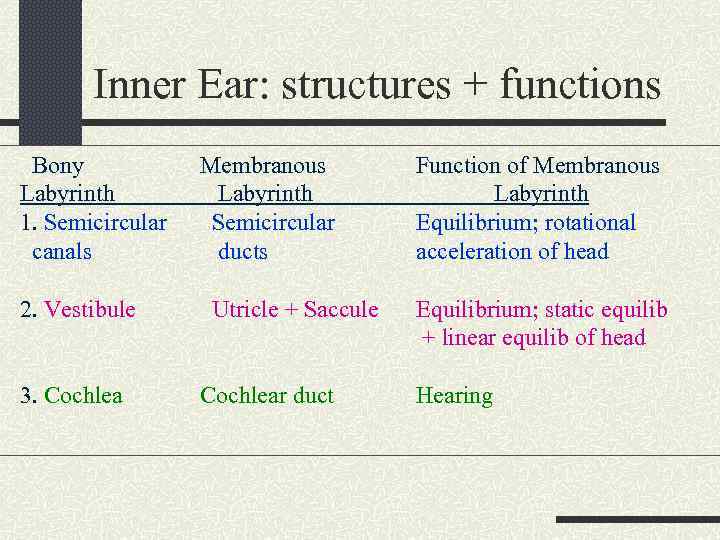
Inner Ear: structures + functions Bony Labyrinth 1. Semicircular canals 2. Vestibule 3. Cochlea Membranous Labyrinth Semicircular ducts Utricle + Saccule Cochlear duct Function of Membranous Labyrinth Equilibrium; rotational acceleration of head Equilibrium; static equilib + linear equilib of head Hearing
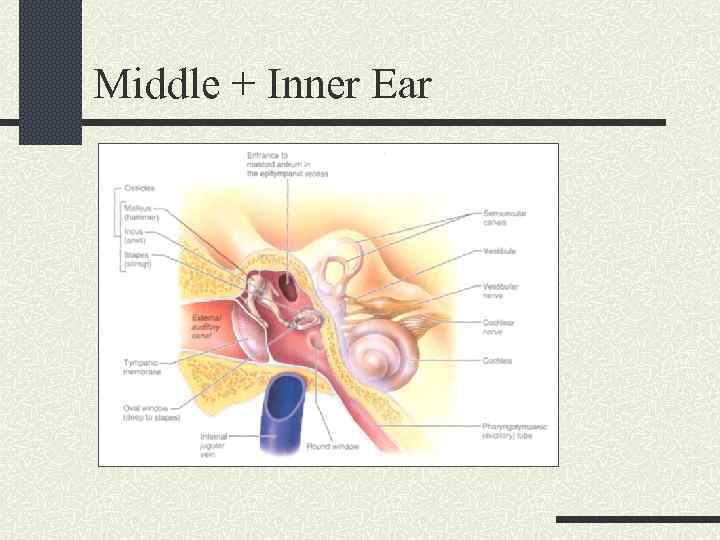
Middle + Inner Ear
STOP
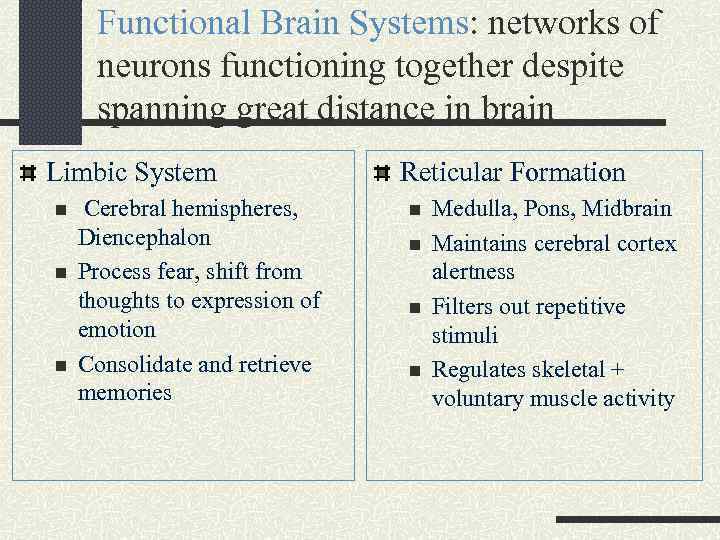
Functional Brain Systems: networks of neurons functioning together despite spanning great distance in brain Limbic System n n n Cerebral hemispheres, Diencephalon Process fear, shift from thoughts to expression of emotion Consolidate and retrieve memories Reticular Formation n n Medulla, Pons, Midbrain Maintains cerebral cortex alertness Filters out repetitive stimuli Regulates skeletal + voluntary muscle activity
Скачать презентацию Skull Brain and Cranial Nerves Head and Neck
Skull, Brain, CN.ppt