 Скачать презентацию Skills for Sustainability Presentation to the CEET Conference
bc4ba9c9fd2d728a7ce3054625122ebd.ppt
- Количество слайдов: 21



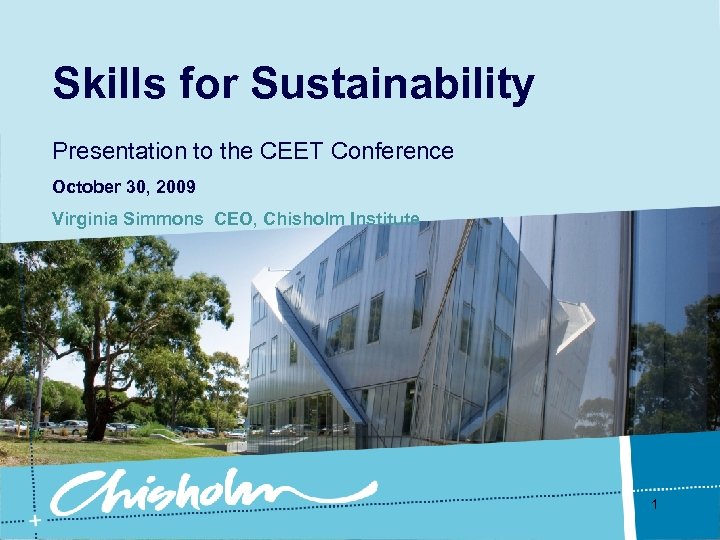
Skills for Sustainability Presentation to the CEET Conference October 30, 2009 Virginia Simmons CEO, Chisholm Institute 1
Purpose To provide an overview of the ‘state of play’ with respect to the government expectations and actions concerning the implementation of ‘Green Skills’ in VET. This involves: § The Prime Minister and Deputy Prime Minister § The Ministerial Council for Tertiary Education and Employment (MCTEE), previously MCVTE § Multiple federal and state government departments § The National Quality Council § Industry Skills Councils 2
Sustainability Skills – a National Priority In November 2008 the Ministerial Council requested the National Quality Council to incorporate a Green Skills strategy into its 2009 workplan: § to give priority to developing flexible and responsive training products that include embedding sustainability skills in all training packages, skills sets and customised short accredited courses § to develop appropriate standards as part of the Australian Quality Training Framework for voluntary certification of RTOs as providers of Green Skills § and report on progress by November 2009 3
International Pressure Bonn Declaration - UNESCO The UNESCO World Conference on Education for Sustainable Development held in April 2009 announced that there is a need to: §Re-orient education and training systems to address sustainability concerns through coherent policies at national and local levels 4
International Pressure Copenhagen Climate Change Conference December 7 – 18, 2009 Legislation setting up an Emissions Trading Scheme (ETS), also known as a carbon pollution reduction scheme (CPRS) – is being debated in the lower house this week where Labor has the numbers to force its passage to the Senate. 5
Clean Sustainable Skills Package $94 m On July 30, 2009 the Prime Minister announced: § 10, 000 places for young job seekers to build their skills through participating in an environmental work experience and training program § 30, 000 apprentices in carbon exposed industries will graduate over the next two years with qualifications that include clean and green skills, and all new apprentices commencing after 1 January 2010 will graduate with a core set of green skills, knowledge and training § 4, 000 training opportunities for insulation installers upon completion of their employment in this field § 6, 000 local green jobs in projects funded by the Local Jobs stream of the Jobs Fund 6
Key Documents and Stakeholders Each state and territory has its own policy requirements for RTOs. For example, the Our Environment, Our Future Sustainability Action Statement 2006, Department of Sustainability and Environment Victoria is the basis for Skills Victoria’s sustainability targets for TAFE Institutes 7
Key Documents and Stakeholders Living Sustainably: Australian Government’s National § Strategy 2: Re-orienting Education Systems to Sustainability Action Plan for Education for Sustainability 2009 – Department of Environment, Water, Heritage & the Arts • Objective: The VET sector incorporates sustainability in all national training packages and implements sustainable campus management • 6 actions to support this objective § Parallel approaches for schools and Higher Education 8
Key Documents and Stakeholders Environmental Industry Skills Councils § Produced by. Sustainability: An Industry Response, May 2009 § Identifies 120+ specific units of competency relating to sustainability in 25 training packages, referenced to about 270 qualifications § Identifies issues to consider in different industries 9
Key Documents and Stakeholders National VET under four headings: 24 key actions. Sector Sustainability Policy and Action Plan (2009 -2012) – auspiced by MCTEE and produced § Developing a Workforce Skilled for Sustainability by the National VET Sector Sustainability Action Group § Providing VET system products and services that support skills for sustainability § Encouraging the adoption of sustainability values, principles and practices by VET leaders, partners and champions § Reducing the VET sector carbon footprint 10
National Green Skills Agreement § Draft prepared in September by National VET Sector Sustainability Action Group, consisting of senior officials from all States and territories § Considers the skills and training implications of transitioning to a low carbon, sustainable economy § Presented by the Deputy Prime Minister at a Forum on October 23. To be considered by MCTEE in November and COAG in December § Trigger for requirement that ISCs embed sustainability skills in all Training Packages by March 31, 2010. 11
National Green Skills Agreement Major focus on VET with four key objectives: § Embedding sustainability practice and teaching in VET within the national regulatory framework § Up-skilling of of VET instructors and teachers to deliver skills for sustainability § Strategic review of training packages to embed sustainability knowledge skills and principles § Implementing a transition strategy to re-skill vulnerable workers 12
NQC Responses (1) 1. Sustainability Skills Stocktake and Gap Analysis § Analysis complete, progress report received and consultations underway § Possible points of intervention foreshadowed: § Identify gaps in units/qualifications and fill them § Modify existing units/qualifications § Add resource materials to focus on inferred sustainability skills § Conduct PD for trainers/assessors/others § Prioritise occupations and apply 1 – 4 above § Create a single reference point for communication 13
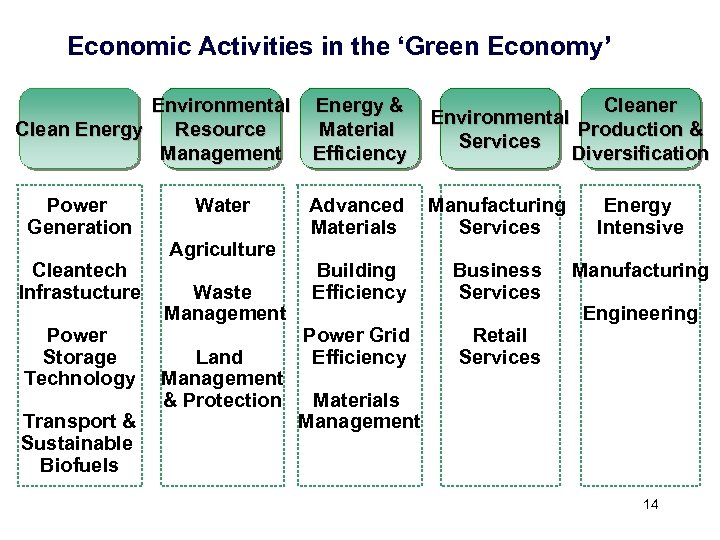
Economic Activities in the ‘Green Economy’ Environmental Clean Energy Resource Management Power Generation Cleantech Infrastucture Power Storage Technology Transport & Sustainable Biofuels Water Agriculture Waste Management Land Management & Protection Energy & Material Efficiency Cleaner Environmental Production & Services Diversification Advanced Materials Manufacturing Services Energy Intensive Building Efficiency Business Services Manufacturing Power Grid Efficiency Retail Services Engineering Materials Management 14
NQC Responses (2) 2. AQTF Standards Framework for Green Skills Providers § 10 draft standards developed, ready to be tested § Matching against AQTF Excellence Criteria: Leadership (2), Learning & Assessment (2), People Development (2), Relationship Management (2), Integrated Information Management (2) § Key issues identified for feedback from RTOs and users of the training system 15
Standards for Green Skills Providers Narrow focus on green skills delivery, not operations or infrastructure - carbon footprint. Delivery issues include responding to: § Creation of new jobs e. g. a carbon auditor §Job substitution e. g. shifting from land filling and incineration of waste to waste minimisation and recycling § Job realignment e. g. a builder whose existing skills are increasingly applied to creating more energy efficient buildings 16
Some Standards Issues § Green stands aligned with or separate from AQTF Excellence Criteria - aligned § Green standards pre-requisite to or independent of assessment against Excellence Criteria? independent § Assessment at RTO or industry sector level? – industry sector § Emphasis on green skills needs to emphasised – not a comment on the carbon footprint 17
Some Sustainability Issues for NQC § Mindset or learnt skill? - mindset § ‘Built in’ (culture) or ‘bolt on’ (compliance)? – culture § Enduring or ‘flavor of the month’? – enduring: parallel with quality § Existing or new skills - both § Training Packages vs accredited programs contentious § How to support Clean Sustainable Skills Package priorities – emphasis on apprenticeships 18
Some Employer Issues § Sustainability: sound business practice or green for its own sake? § Waste minimisation is bottom-line in some industries, less so in others § Employers will respond to consumer demand § Role of incentives e. g. rebates 19
Some Provider Issues § Perceived value of obtaining a ‘green tick’ § Predicting and responding to new and emerging occupations § Training packages and accredited programs – speed of response § Scope of registration may influence which ‘green’ units of competency can be imported into training packages 20

Thank you 21
Скачать презентацию Skills for Sustainability Presentation to the CEET Conference
bc4ba9c9fd2d728a7ce3054625122ebd.ppt