


 Скачать презентацию Skills Development a real world update Gizelle Mc
ce0c4b2b2b7a1efddd5d4bf277501ea7.ppt
- Количество слайдов: 41
 Skills Development: a real world update Gizelle Mc Intyre The Institute of People Development
 Institute of People Development (IPD) The Institute of People Development (IPD) is committed to an ongoing process of achieving and maintaining its status as a "centre for learning excellence". • Primary Aim – • To enhance the quality of workplace learning provision through the development of managers, supervisors and learning development practitioners. The Institute strives to be a "change agent" by – – – Providing qualifications to managers, supervisors and learning & development practitioners Offering recognition of prior learning (RPL) services to experienced learning & development practitioners Conducting research projects designed to generate best practice products and processes through a continuous professional development (CPD) programme Expanding the field of learning & development practices to the wider public through seminars, media releases, on-line resources and communities of practice workshops and consulting Making available its learning facilities and resources in Midrand to its clients and stakeholders for the purposes of high quality learning provision
 • General and Further Education and Training Quality Assurance Amendment Act No. 50 of 2008 • • create a single integrated national framework for learning achievements; • • facilitate access to, and mobility and progression within, education and training career paths; • • enhance the quality of education and training; Copyright; The Institute of People Development 2004
 Introduction • An update on arena of Skills Development. • Overview of the skills development strategy • Skills-levy Institutions and implementation mechanisms • Professional vs Academic Qualifications • PIVOTAL programmes, workplace learning and RPL • What does the future hold?
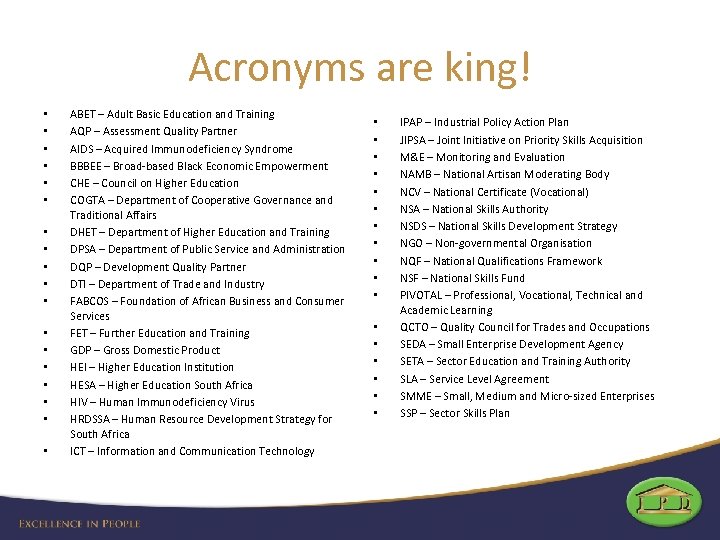 Acronyms are king! • • • • • ABET – Adult Basic Education and Training AQP – Assessment Quality Partner AIDS – Acquired Immunodeficiency Syndrome BBBEE – Broad-based Black Economic Empowerment CHE – Council on Higher Education COGTA – Department of Cooperative Governance and Traditional Affairs DHET – Department of Higher Education and Training DPSA – Department of Public Service and Administration DQP – Development Quality Partner DTI – Department of Trade and Industry FABCOS – Foundation of African Business and Consumer Services FET – Further Education and Training GDP – Gross Domestic Product HEI – Higher Education Institution HESA – Higher Education South Africa HIV – Human Immunodeficiency Virus HRDSSA – Human Resource Development Strategy for South Africa ICT – Information and Communication Technology • • • • • IPAP – Industrial Policy Action Plan JIPSA – Joint Initiative on Priority Skills Acquisition M&E – Monitoring and Evaluation NAMB – National Artisan Moderating Body NCV – National Certificate (Vocational) NSA – National Skills Authority NSDS – National Skills Development Strategy NGO – Non-governmental Organisation NQF – National Qualifications Framework NSF – National Skills Fund PIVOTAL – Professional, Vocational, Technical and Academic Learning QCTO – Quality Council for Trades and Occupations SEDA – Small Enterprise Development Agency SETA – Sector Education and Training Authority SLA – Service Level Agreement SMME – Small, Medium and Micro-sized Enterprises SSP – Sector Skills Plan
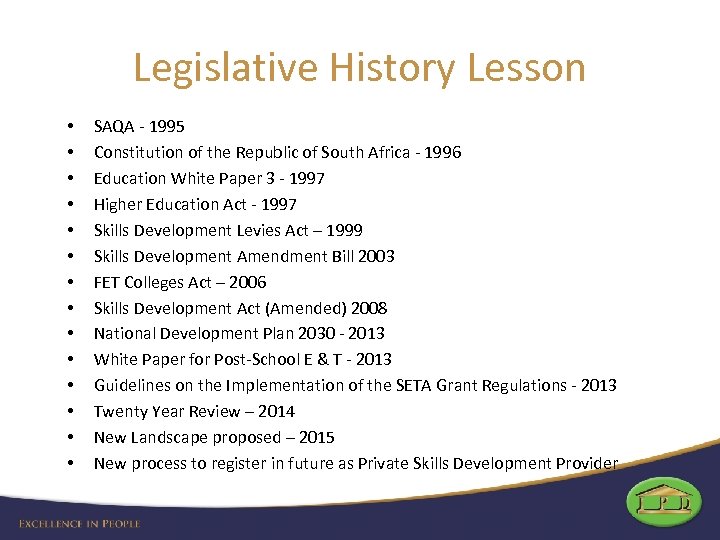 Legislative History Lesson • • • • SAQA - 1995 Constitution of the Republic of South Africa - 1996 Education White Paper 3 - 1997 Higher Education Act - 1997 Skills Development Levies Act – 1999 Skills Development Amendment Bill 2003 FET Colleges Act – 2006 Skills Development Act (Amended) 2008 National Development Plan 2030 - 2013 White Paper for Post-School E & T - 2013 Guidelines on the Implementation of the SETA Grant Regulations - 2013 Twenty Year Review – 2014 New Landscape proposed – 2015 New process to register in future as Private Skills Development Provider
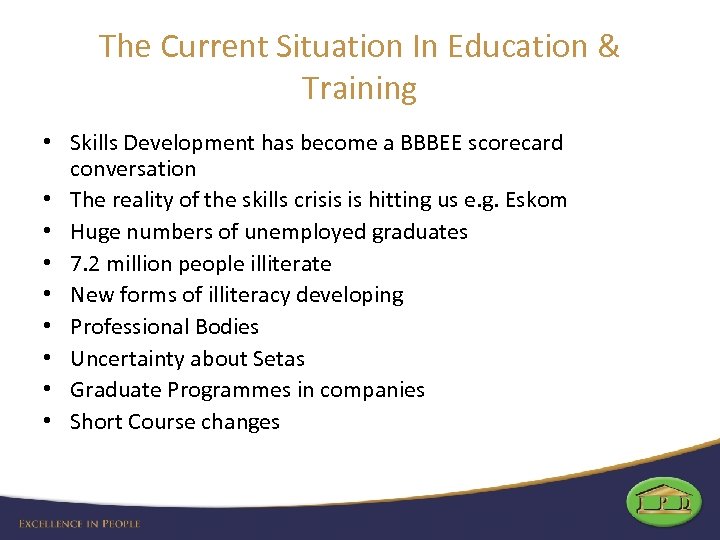 The Current Situation In Education & Training • Skills Development has become a BBBEE scorecard conversation • The reality of the skills crisis is hitting us e. g. Eskom • Huge numbers of unemployed graduates • 7. 2 million people illiterate • New forms of illiteracy developing • Professional Bodies • Uncertainty about Setas • Graduate Programmes in companies • Short Course changes
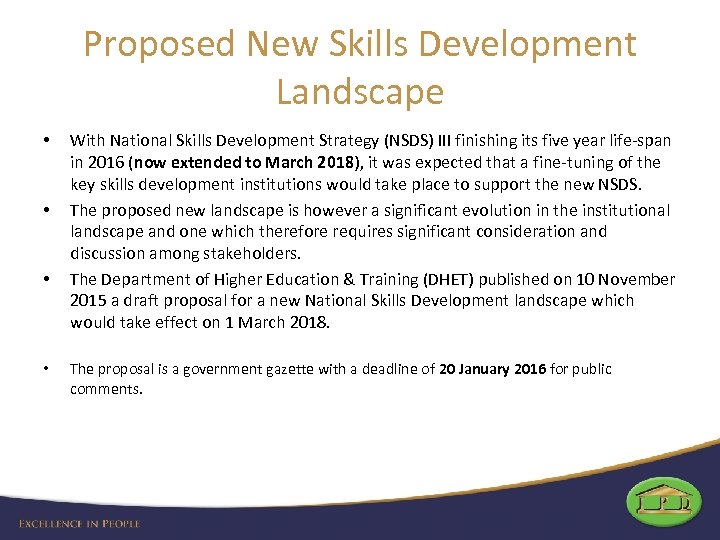 Proposed New Skills Development Landscape • • With National Skills Development Strategy (NSDS) III finishing its five year life-span in 2016 (now extended to March 2018), it was expected that a fine-tuning of the key skills development institutions would take place to support the new NSDS. The proposed new landscape is however a significant evolution in the institutional landscape and one which therefore requires significant consideration and discussion among stakeholders. The Department of Higher Education & Training (DHET) published on 10 November 2015 a draft proposal for a new National Skills Development landscape which would take effect on 1 March 2018. The proposal is a government gazette with a deadline of 20 January 2016 for public comments.
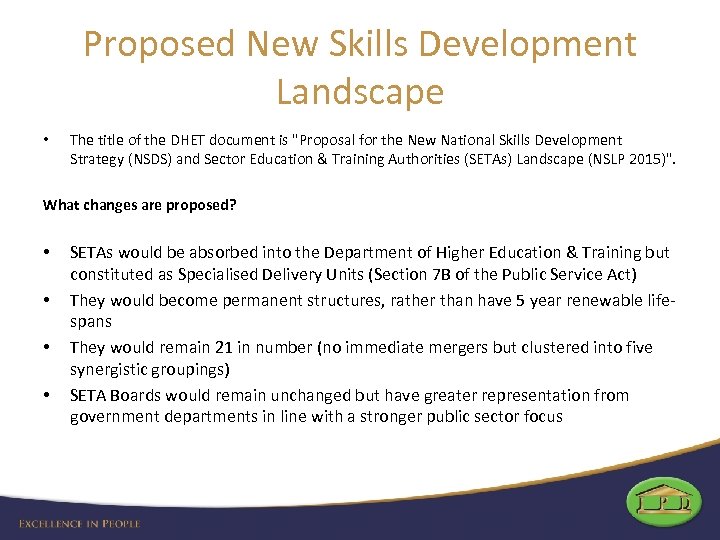 Proposed New Skills Development Landscape • The title of the DHET document is "Proposal for the New National Skills Development Strategy (NSDS) and Sector Education & Training Authorities (SETAs) Landscape (NSLP 2015)". What changes are proposed? • • SETAs would be absorbed into the Department of Higher Education & Training but constituted as Specialised Delivery Units (Section 7 B of the Public Service Act) They would become permanent structures, rather than have 5 year renewable lifespans They would remain 21 in number (no immediate mergers but clustered into five synergistic groupings) SETA Boards would remain unchanged but have greater representation from government departments in line with a stronger public sector focus
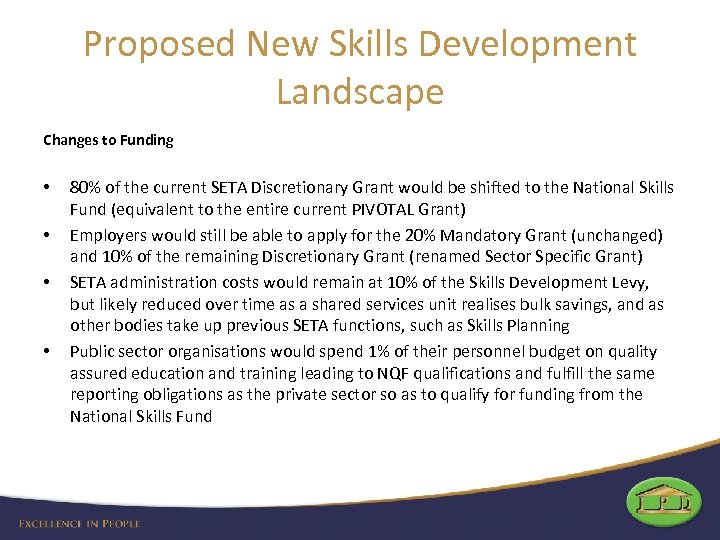 Proposed New Skills Development Landscape Changes to Funding • • 80% of the current SETA Discretionary Grant would be shifted to the National Skills Fund (equivalent to the entire current PIVOTAL Grant) Employers would still be able to apply for the 20% Mandatory Grant (unchanged) and 10% of the remaining Discretionary Grant (renamed Sector Specific Grant) SETA administration costs would remain at 10% of the Skills Development Levy, but likely reduced over time as a shared services unit realises bulk savings, and as other bodies take up previous SETA functions, such as Skills Planning Public sector organisations would spend 1% of their personnel budget on quality assured education and training leading to NQF qualifications and fulfill the same reporting obligations as the private sector so as to qualify for funding from the National Skills Fund
 Say your say! • Public comment is due by 20 January 2016. Please email your comments to the DHET at setalandscape@dhet. gov. za. • Enquiries can be directed to any of the following DHET officials: – Ms M. Erra on 012 312 5432 – Ms V. Patuleni on 012 312 5295 – Mr N. Radzilani on 012 312 6088 • The SA Board for People Practice is also coordinating a submission which you can give input to by emailing Naren Vassan (LQA Manager) with the subject of the email beginning "Comments to Proposed SETA Landscape".
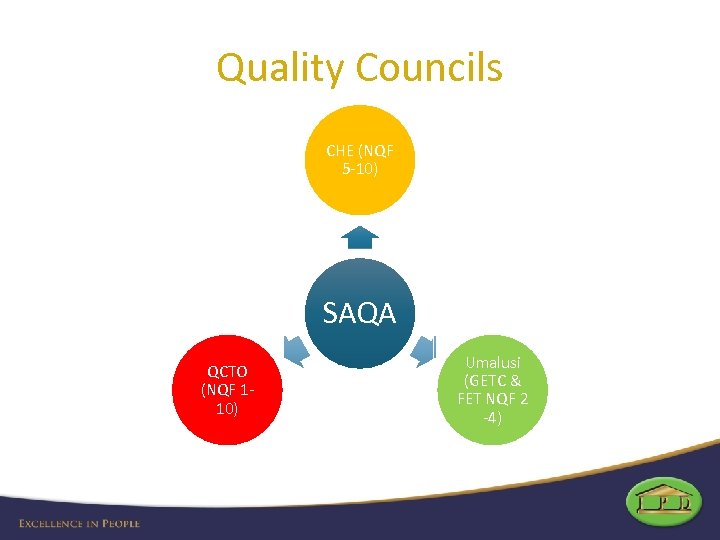 Quality Councils CHE (NQF 5 -10) SAQA QCTO (NQF 110) Umalusi (GETC & FET NQF 2 -4)
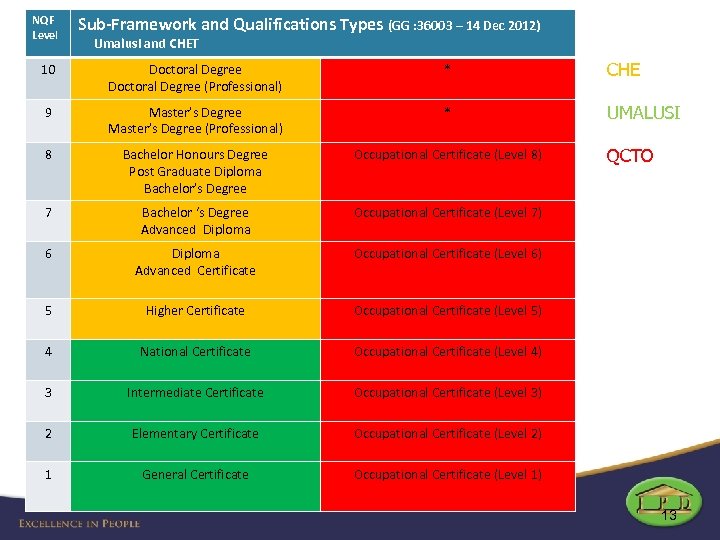 NQF Level Sub-Framework and Qualifications Types (GG : 36003 – 14 Dec 2012) Umalusi and CHET 10 Doctoral Degree (Professional) * CHE 9 Master’s Degree (Professional) * UMALUSI 8 Bachelor Honours Degree Post Graduate Diploma Bachelor’s Degree Occupational Certificate (Level 8) 7 Bachelor ‘s Degree Advanced Diploma Occupational Certificate (Level 7) 6 Diploma Advanced Certificate Occupational Certificate (Level 6) 5 Higher Certificate Occupational Certificate (Level 5) 4 National Certificate Occupational Certificate (Level 4) 3 Intermediate Certificate Occupational Certificate (Level 3) 2 Elementary Certificate Occupational Certificate (Level 2) 1 General Certificate Occupational Certificate (Level 1) QCTO 13
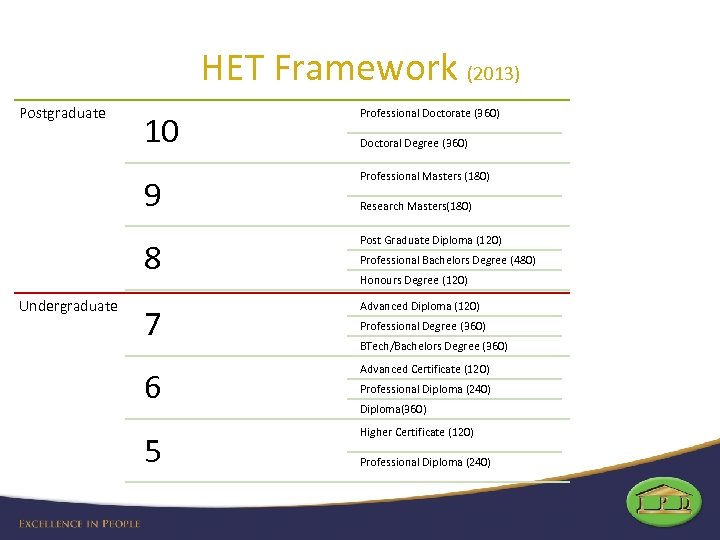 HET Framework (2013) Postgraduate 9 Professional Masters (180) 8 Undergraduate 10 Professional Doctorate (360) Post Graduate Diploma (120) 7 Advanced Diploma (120) 6 Advanced Certificate (120) 5 Higher Certificate (120) Doctoral Degree (360) Research Masters(180) Professional Bachelors Degree (480) Honours Degree (120) Professional Degree (360) BTech/Bachelors Degree (360) Professional Diploma (240) Diploma(360) Professional Diploma (240)
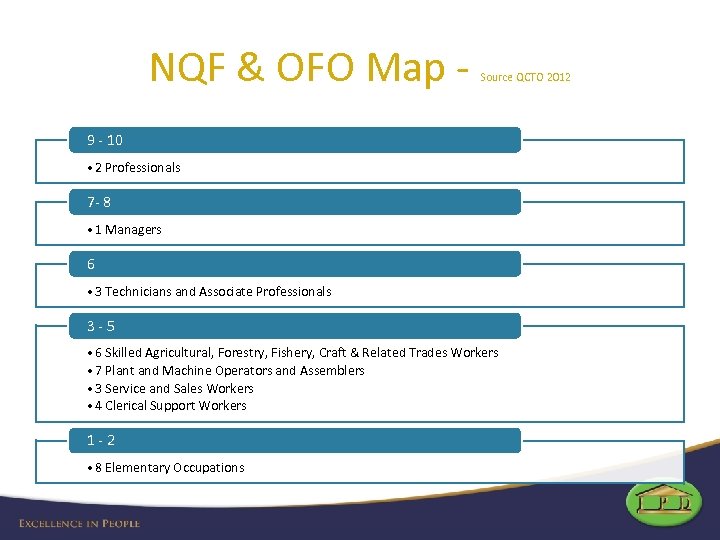 NQF & OFO Map - Source QCTO 2012 9 - 10 • 2 Professionals 7 - 8 • 1 Managers 6 • 3 Technicians and Associate Professionals 3 -5 • 6 Skilled Agricultural, Forestry, Fishery, Craft & Related Trades Workers • 7 Plant and Machine Operators and Assemblers • 3 Service and Sales Workers • 4 Clerical Support Workers 1 -2 • 8 Elementary Occupations
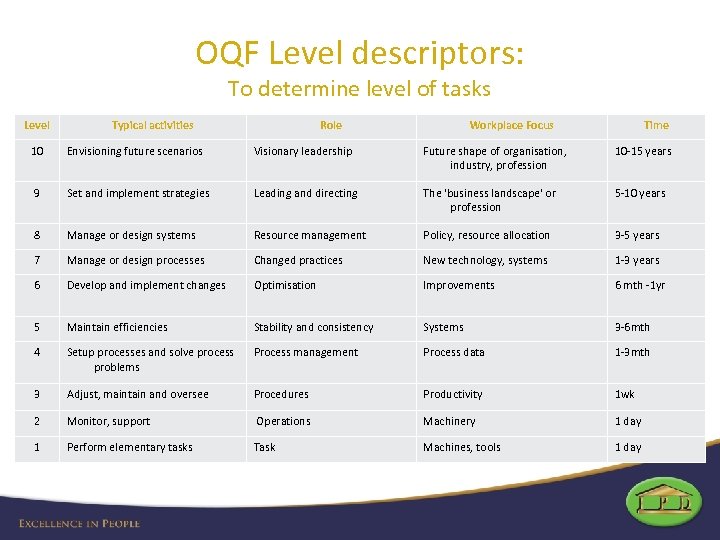 OQF Level descriptors: To determine level of tasks Level Typical activities Role Workplace Focus Time 10 Envisioning future scenarios Visionary leadership Future shape of organisation, industry, profession 10 -15 years 9 Set and implement strategies Leading and directing The 'business landscape' or profession 5 -10 years 8 Manage or design systems Resource management Policy, resource allocation 3 -5 years 7 Manage or design processes Changed practices New technology, systems 1 -3 years 6 Develop and implement changes Optimisation Improvements 6 mth -1 yr 5 Maintain efficiencies Stability and consistency Systems 3 -6 mth 4 Setup processes and solve process problems Process management Process data 1 -3 mth 3 Adjust, maintain and oversee Procedures Productivity 1 wk 2 Monitor, support Operations Machinery 1 day 1 Perform elementary tasks Task Machines, tools 1 day
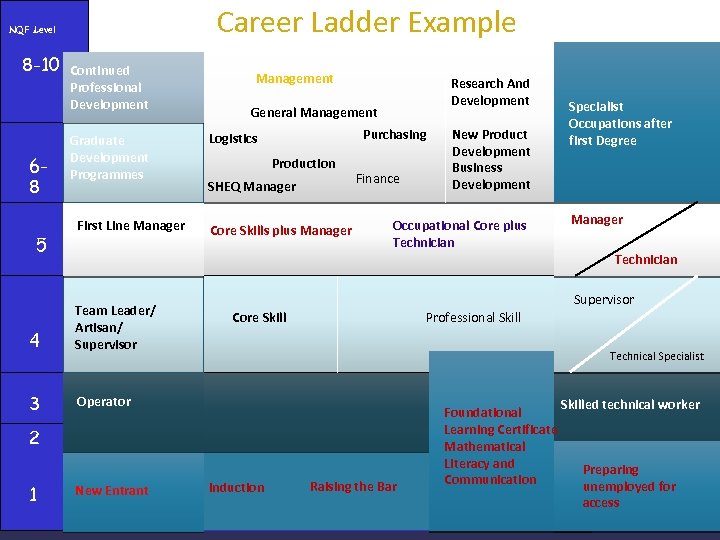 Career Ladder Example NQF Level 8 -10 68 5 Continued Professional Development Graduate Development Programmes First Line Manager Management Research And Development General Management Purchasing Logistics Production SHEQ Manager Core Skills plus Manager Finance Occupational Core plus Technician Manager Technician 4 Team Leader/ Artisan/ Supervisor 3 Supervisor Operator Core Skill Professional Skill Technical Specialist 2 1 New Product Development Business Development Specialist Occupations after first Degree New Entrant Induction Raising the Bar Foundational Learning Certificate Mathematical Literacy and Communication Skilled technical worker Preparing unemployed for access
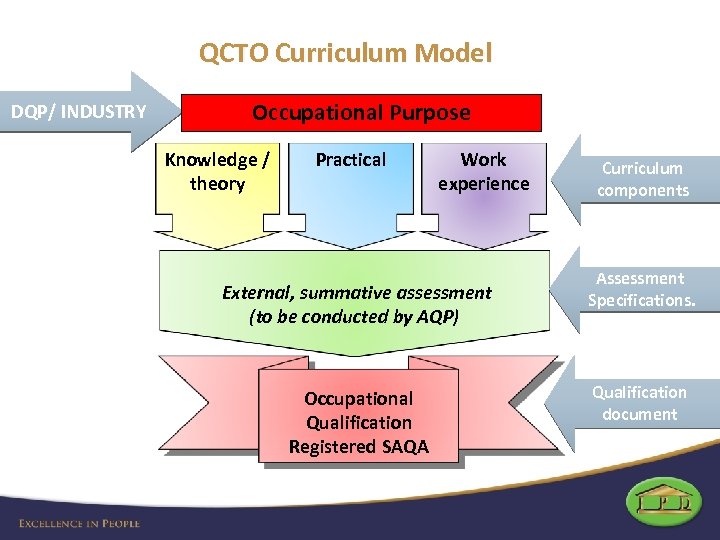 QCTO Curriculum Model DQP/ INDUSTRY Occupational Purpose Knowledge / theory Practical Work experience External, summative assessment (to be conducted by AQP) Occupational Qualification Registered SAQA Curriculum components Assessment Specifications. Qualification document
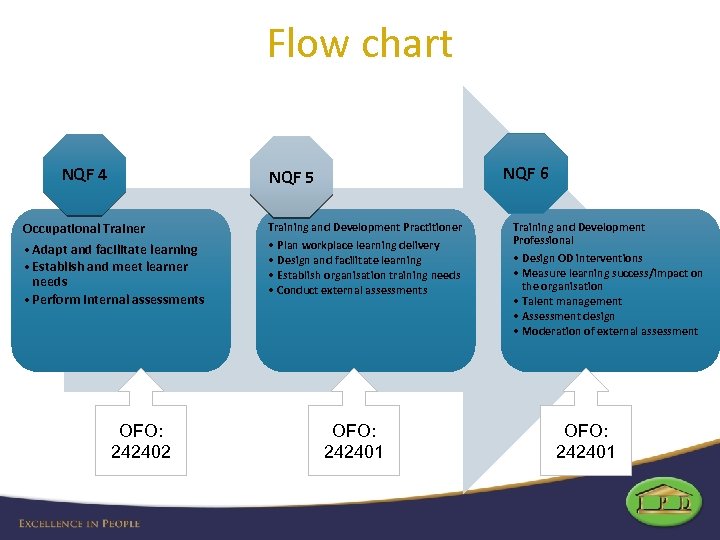 Flow chart NQF 4 NQF 6 NQF 5 Occupational Trainer • Adapt and facilitate learning • Establish and meet learner needs • Perform internal assessments OFO: 242402 Training and Development Practitioner • Plan workplace learning delivery • Design and facilitate learning • Establish organisation training needs • Conduct external assessments OFO: 242401 Training and Development Professional • Design OD interventions • Measure learning success/impact on the organisation • Talent management • Assessment design • Moderation of external assessment OFO: 242401
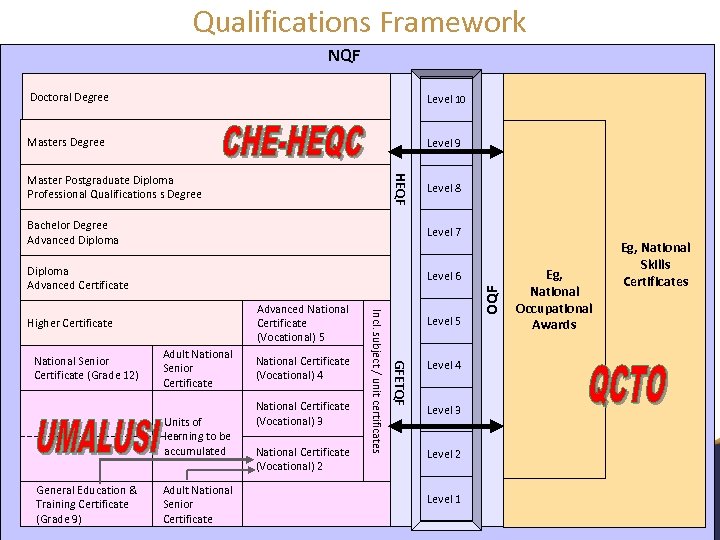 Qualifications Framework NQF Doctoral Degree Level 10 Masters Degree Level 9 HEQF Master Postgraduate Diploma Professional Qualifications s Degree Level 8 Level 7 Diploma Advanced Certificate Level 6 Adult National Senior Certificate Units of learning to be accumulated General Education & Training Certificate (Grade 9) Adult National Senior Certificate National Certificate (Vocational) 4 National Certificate (Vocational) 3 National Certificate (Vocational) 2 Level 5 GFETQF National Senior Certificate (Grade 12) Incl. subject / unit certificates Advanced National Certificate (Vocational) 5 Higher Certificate Level 4 Level 3 Level 2 Level 1 OQF Bachelor Degree Advanced Diploma Eg, National Occupational Awards Eg, National Skills Certificates
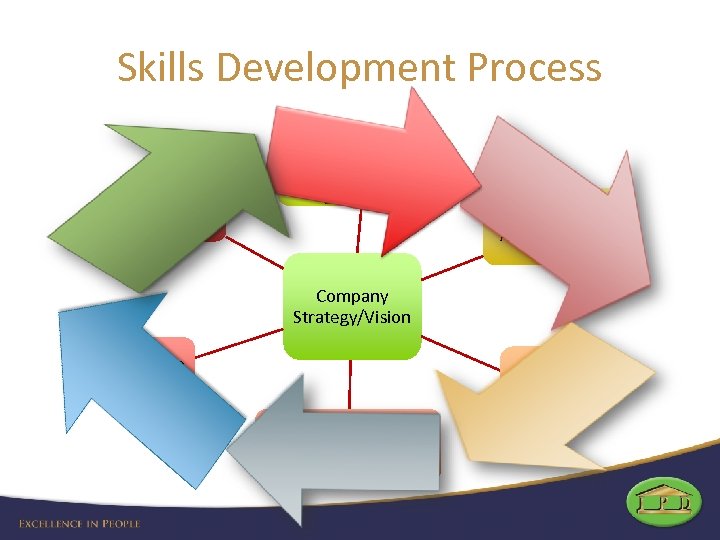 Skills Development Process Assessment (Performanc e Managemen t) Skills Needed to fulfil strategy Do needs analysis/Skills Audits of current staff Company Strategy/Vision Workplace Application Design Solutions Implement Solutions (Training/Coaching/Mentoring)
 Mandatory Grants • Mandatory Grants are a fixed percentage (50 % of levies paid to the Receiver of revenue) that can be claimed by an employer by submitting: – the Annual Training Report (ATR) for the previous year training completed combined with – a Workplace Skills Plan (WSP) for planning of training for the next scheme year. • If an application is approved, the employer will receive 50 % of the total levies paid to SARS by the employer for a scheme year.
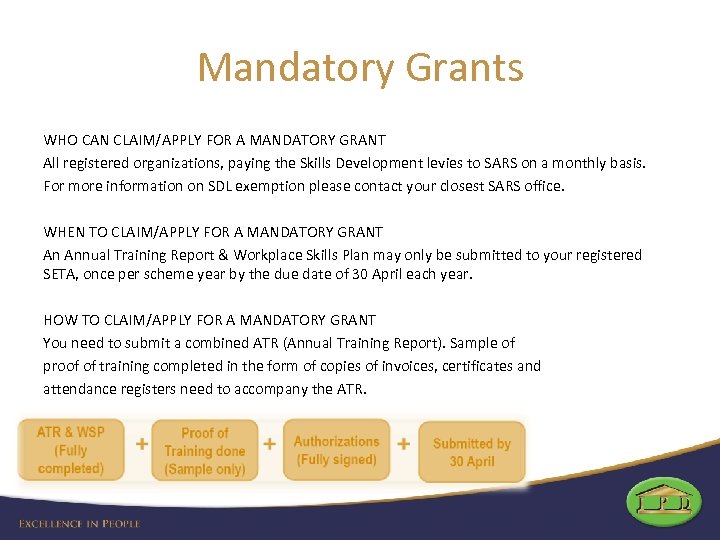 Mandatory Grants WHO CAN CLAIM/APPLY FOR A MANDATORY GRANT All registered organizations, paying the Skills Development levies to SARS on a monthly basis. For more information on SDL exemption please contact your closest SARS office. WHEN TO CLAIM/APPLY FOR A MANDATORY GRANT An Annual Training Report & Workplace Skills Plan may only be submitted to your registered SETA, once per scheme year by the due date of 30 April each year. HOW TO CLAIM/APPLY FOR A MANDATORY GRANT You need to submit a combined ATR (Annual Training Report). Sample of proof of training completed in the form of copies of invoices, certificates and attendance registers need to accompany the ATR.
 PIVOTAL Programmes • • Government Gazette No. 35940 of 3 December 2012 on Sector Education and Training Authorities(SETAs) Grant Regulations regarding monies received by a SETA and related matters, published by the Minister of the Department of Higher Education and Training (DHET). National Skills Development Strategy III (NSDS III) 2011 – 2016. The PIVOTAL grant is aimed at: • Improving the quality and quantity of labour market information received by the various SETAs in the form of workplace skills plans, annual training reports and PIVOTAL training reports to inform planning. • Promoting National Qualifications Framework (NQF) registered and quality assured PIVOTAL programmes that address priority scarce and critical skills identified in the various SETA Sector Skills Plan (SSP).
 PIVOTAL Programmes PIVOTAL programmes definition • Professional, vocational, technical and academic learning programmes that result in qualifications or part qualifications registered on the National Qualifications Framework (NQF) that address critical and scarce skills needs.
 PIVOTAL Programmes • Professional learning programmes shall mean programmes that lead to designations that are registered by professional bodies. • Vocational learning programmes shall mean programmes that lead to a trade and/or the National Certificate Vocational (NCV). • Technical learning programmes shall mean programmes that are occupationally-directed and registered by the SETA; such programmes include apprenticeships, Learnerships and skills programmes. • Academic learning programmes shall mean programmes that lead to academic qualifications such as certificates, Higher Certificates, Diplomas and Degrees.
 Scarce and Critical Skills • “Scarce and critical skills refer to an absolute or relative demand, current or future, for skilled, qualified and experienced people to fill particular • roles/professions/occupations or specializations in the labour market. ” • Scarce skill: – an absolute or relative demand for skilled people to fill a particular role, profession or occupation for example doctors • Absolute demand: – means that suitable skilled people are not available • Relative demand: – means that there are suitable skilled people available, but they do not meet other employment criteria • Critical skills: – refers to the demand for an element of practical or fundamental competence which allows for specialization – in essence it refers to “top-up” skills for example the doctor needs to understand invoicing/time management/communication skills
 Workplace Integrated Learning Constructive workplace learning is directed at shifting the individual from being merely competent to becoming proficient or expert (Dreyfus and Dreyfus).
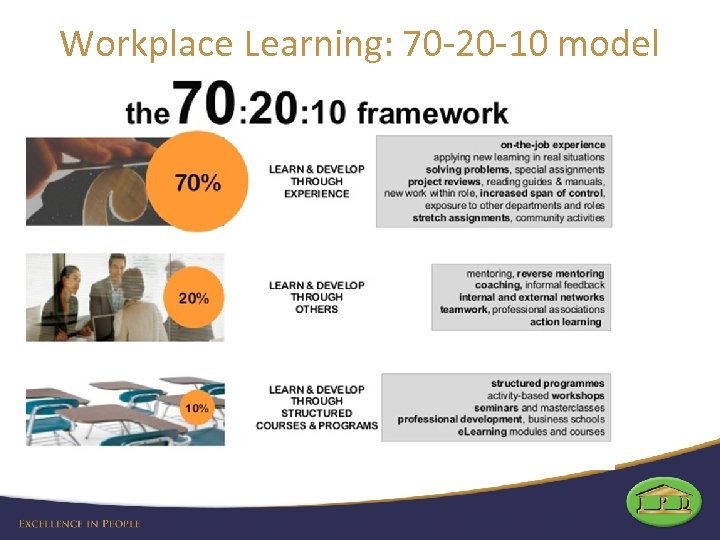
 What is Workplace Learning? • Workplace learning is the highly individual foundation-stone of life-long learning. It results from engagement in practice. Both experienced practitioners and novices engage in workplace learning. They receive, process and incorporate information (sensory, factual and codified or abstract) related to: – – – The work environment, the stimuli and the conditions which affect work performance Social intercourse, e. g. conversations, role modelling and guidance involving co-practitioners, seniors and juniors, customers and clients, and those who are incidentally part of the work process An underlying, conscious or unconscious feeling or perception of gaps, lacks, difficulties and challenges (70: 20: 10 Learning Framework) Incidental, accidental and serendipitous events, interactions and readings Participation in meetings, programmes, interventions and actions related to problem-solving, change or improvement Testing out new activities, procedures (in the sense of a medical intervention, not as a work instruction), processes and systems
 What is Workplace Learning? • Work also needs to be understood as a range of real-time activities in social, community and organisational settings. • All of the above may include formal education and training processes. The notion that accidental or incidental learning is restricted to informal learning arises from a misperception about how people acquire their personal knowledge, skills and attitudes. Even in formal learning situations people may acquire accidental and incidental learning which lies outside the scope of the formal learning objectives.
 What is Workplace Learning? • The best workplace learning happens when practitioners are engaged in work activities that: – – • Involve the injection of some formal, bite-sized chunks of "theory" Are based on a collaborative, multi-functional team effort Involve stretch activities related to improvement, change, or challenges Workplace learning for novices is fundamentally different from that for competent, proficient or expert practitioners (Dreyfus and Dreyfus) Workplace learning may be a positive force when viewed from an organisational perspective but it can equally be a negative force when the motivation of the learner is to compromise, undermine and sabotage the efforts of the organisational leaders. In workplace learning there is often a tension between the interests of the learner and the interests of the employer. This is most evident in organisations which are built on a command-control culture. In organisations where there is an encourage-and-engage culture the outcomes of workplace learning will be more in line with organisational aspirations and objectives.
 Workplace Learning: 70 -20 -10 model •
 Workplace Readiness • Work readiness is the transitional process from education or unemployment to effective engagement in work processes • A “work ready” individual possesses the foundational skills needed in order to be able to engage in work processes. • After this they are then able to develop the specific skills to become job fit. • Work readiness is built into organisational process by providing the tools, methods, processes to attract, select and support the new entrant through this transition. • Work readiness includes an understanding of how organisations function
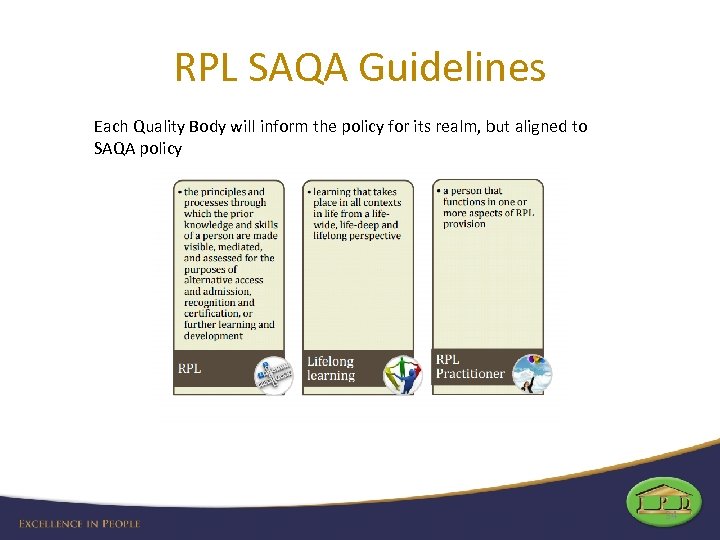 RPL SAQA Guidelines Each Quality Body will inform the policy for its realm, but aligned to SAQA policy 34
 Skills Development Levy (SDL) SDL is a levy imposed to encourage learning and development in South Africa and is determined by an employer's salary bill. Who must pay SDL? • If the company has staff registered for PAYE and the annual payroll exceeds R 500 000 per annum, the company must register with SARS and pay a skills levy of 1% of the monthly payroll. If the company does not fall within these criteria, it does not have to pay levies or register with SARS. • Where an employer expects that the total salaries will be more than R 500 000 over the next 12 months, that employer becomes liable to pay SDL.
 Skills Development Levy (SDL) How much do you need to pay? • 1% of the total amount paid in salaries to employees (including overtime payments, leave pay, bonuses, commissions and lump sum payments). How to determine which SETA your company belongs too? • Each SETA has a mandate to serve the Sector Industry Classification Codes (Sic Codes) under its control as determined by the Department of Higher Education from time to time. (See Government Gazette 33756 dated 11 November 2010) What happens to the SDL Levy? • The levies are distributed via SETA.

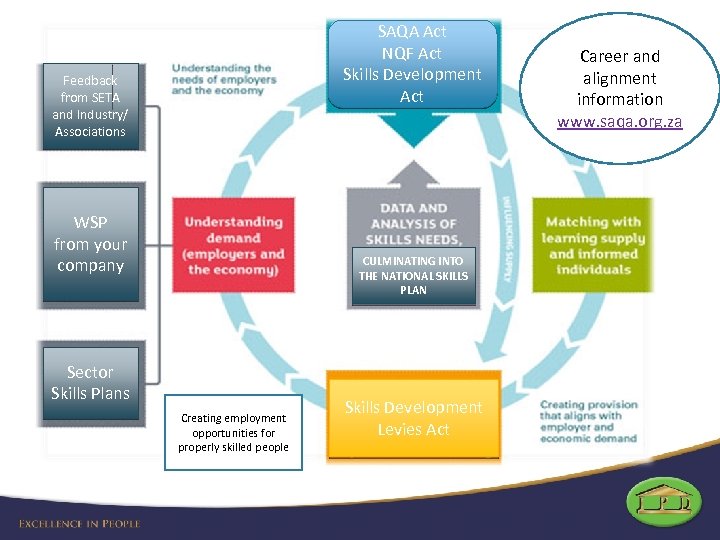 SAQA Act NQF Act Skills Development Act Feedback from SETA and Industry/ Associations WSP from your company CULMINATING INTO THE NATIONAL SKILLS PLAN Sector Skills Plans Creating employment opportunities for properly skilled people Skills Development Levies Act Career and alignment information www. saqa. org. za
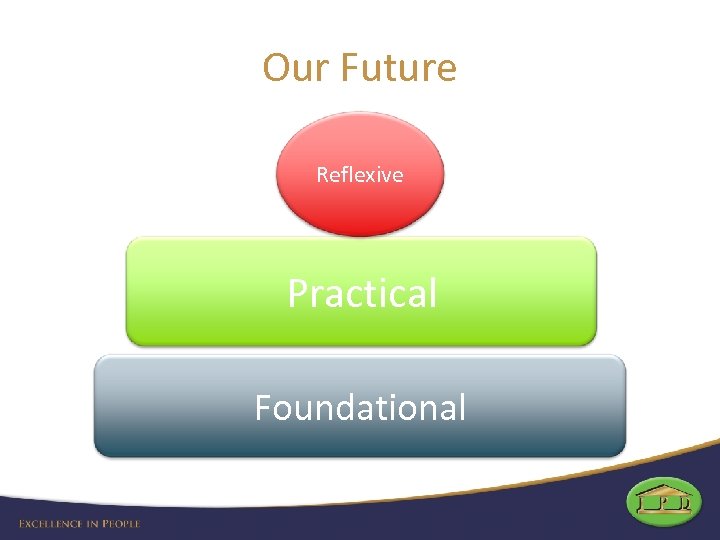 Our Future Reflexive Practical Foundational
 Thank you! “Man often becomes what he believes himself to be. If I keep on saying to myself that I cannot do a certain thing, it is possible that I may end by really becoming incapable of doing it. On the contrary, if I have the belief that I can do it, I shall surely acquire the capacity to do it even if I may not have it at the beginning. ” ― Mahatma Gandhi
 Contact Details Institute of People Development 011 315 2913 www. peopledev. co. za gizellem@peopledev. co. za