 Скачать презентацию Skills Challenges Experienced by Students in the use
d80175a1fb8bbddfc963c30819e278d2.ppt
- Количество слайдов: 40



Skills Challenges Experienced by Students in the use of Educational Technology / e-learning Some Perspectives on Skills Requirements, Needs Analysis and Development in an e-learning context. Paul Catherall
Aims of this Presentation To consider. . . n n n a brief overview of Learning Technology and e-Learning the Agenda for Skills development in Higher Education the role of Skills in Learning Technology current Research on Skills requirements for e-learning frameworks for developing / evaluating Skills requirements a proposal for research considering Skills requirements in a Part Time study context
1. Brief overview of Learning Technology and E-Learning : A Brief History of Learning Technology n Facet of educational experience for decades. n Grown from marginal to pervasive presence throughout 90 s. n Remote study via networked facilities only recently realised with VLEs. n Possibility of distance learning via networked facilities. n Possibility for distributed model (conventional study supported by e-learning). n n n Characterised by remote study, web-based interface, online collaboration, online assessment & submission, online conferencing, online communities. . . Other forms of Information Technology merging with e-learning via the Web (library management system, e-journals, commercial accounts, Student Records System, email). Uncharted territory for pedagogy - relationships and processes in online learning.
1. Brief overview of Learning Technology and E-Learning: Definitions n n n n E-learning Usually a holistic term for learning via technology, “covering. . . Web based learning, computer-based learning, virtual classrooms, and digital collaboration" (Erskine 2003). Learning Technology Hardware or Software facilitating education, the “black box” view (Atherton 1999). VLE (Virtual Learning Environment) Typically Web based synthesis of communication, collaboration and content dissemination features. Online Learning Study via the medium of the Web, or the Internet generally. Blended Learning (Distributed Learning) Study context facilitated both by learning technology and traditional teaching methods. Ubiquitous Learning The computer is an essential tool that must be available on demand wherever we expect to support learners. " (Skill and Young 2002). Mobile Learning Use of hand-held Portable Digital Assistants, Pagers, Laptops and other devices in the context of Wi. LAN (Wireless Local Area Network) or Internet - via WAP (Wireless Access Protocol) or GPRS (General Packet Radio Service).
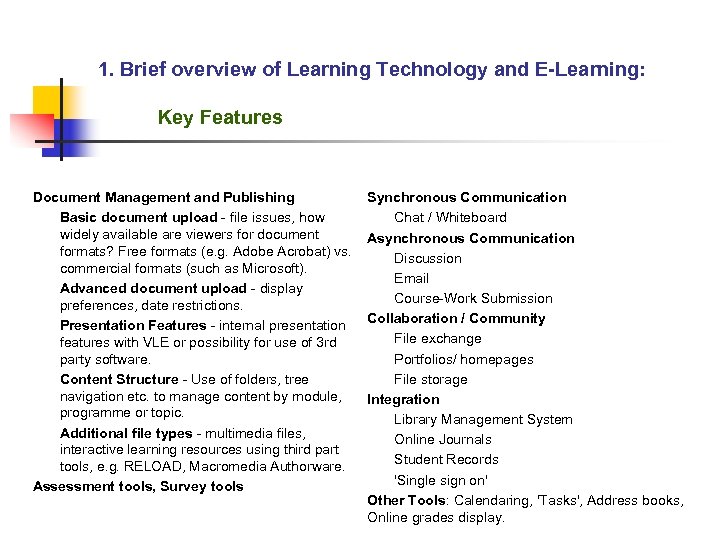
1. Brief overview of Learning Technology and E-Learning: Key Features Document Management and Publishing Basic document upload - file issues, how widely available are viewers for document formats? Free formats (e. g. Adobe Acrobat) vs. commercial formats (such as Microsoft). Advanced document upload - display preferences, date restrictions. Presentation Features - internal presentation features with VLE or possibility for use of 3 rd party software. Content Structure - Use of folders, tree navigation etc. to manage content by module, programme or topic. Additional file types - multimedia files, interactive learning resources using third part tools, e. g. RELOAD, Macromedia Authorware. Assessment tools, Survey tools Synchronous Communication Chat / Whiteboard Asynchronous Communication Discussion Email Course-Work Submission Collaboration / Community File exchange Portfolios/ homepages File storage Integration Library Management System Online Journals Student Records 'Single sign on' Other Tools: Calendaring, 'Tasks', Address books, Online grades display.
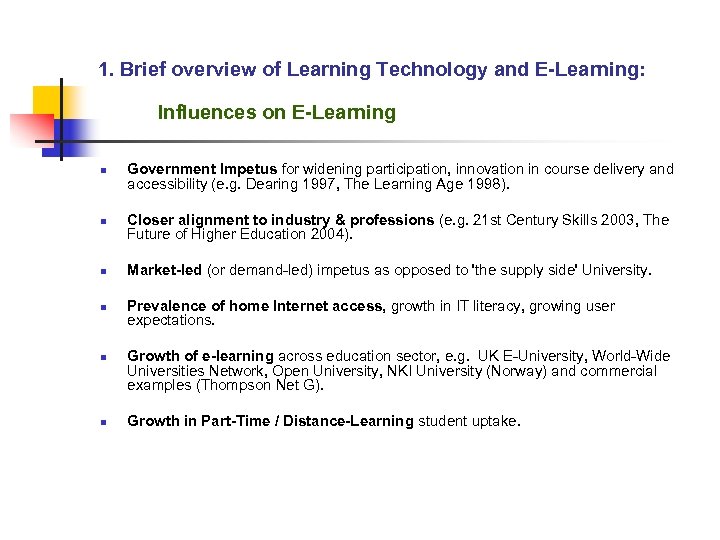
1. Brief overview of Learning Technology and E-Learning: Influences on E-Learning n n n Government Impetus for widening participation, innovation in course delivery and accessibility (e. g. Dearing 1997, The Learning Age 1998). Closer alignment to industry & professions (e. g. 21 st Century Skills 2003, The Future of Higher Education 2004). Market-led (or demand-led) impetus as opposed to 'the supply side' University. Prevalence of home Internet access, growth in IT literacy, growing user expectations. Growth of e-learning across education sector, e. g. UK E-University, World-Wide Universities Network, Open University, NKI University (Norway) and commercial examples (Thompson Net G). Growth in Part-Time / Distance-Learning student uptake.
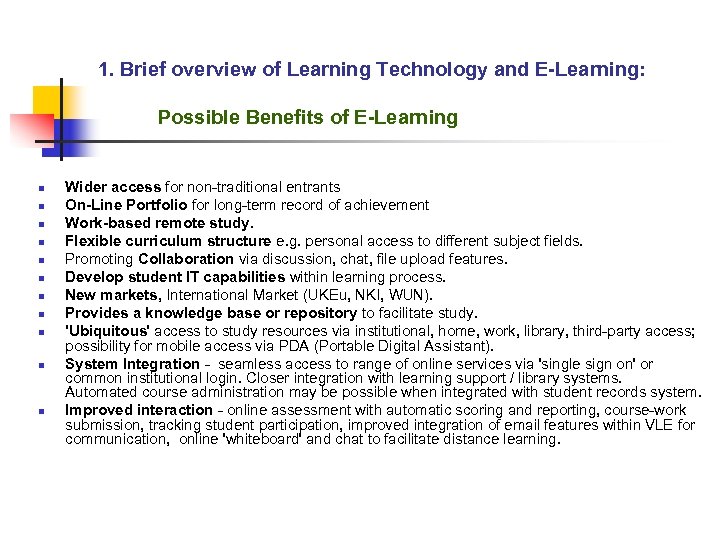
1. Brief overview of Learning Technology and E-Learning: Possible Benefits of E-Learning n n n Wider access for non-traditional entrants On-Line Portfolio for long-term record of achievement Work-based remote study. Flexible curriculum structure e. g. personal access to different subject fields. Promoting Collaboration via discussion, chat, file upload features. Develop student IT capabilities within learning process. New markets, International Market (UKEu, NKI, WUN). Provides a knowledge base or repository to facilitate study. 'Ubiquitous' access to study resources via institutional, home, work, library, third-party access; possibility for mobile access via PDA (Portable Digital Assistant). System Integration - seamless access to range of online services via 'single sign on' or common institutional login. Closer integration with learning support / library systems. Automated course administration may be possible when integrated with student records system. Improved interaction - online assessment with automatic scoring and reporting, course-work submission, tracking student participation, improved integration of email features within VLE for communication, online 'whiteboard' and chat to facilitate distance learning.
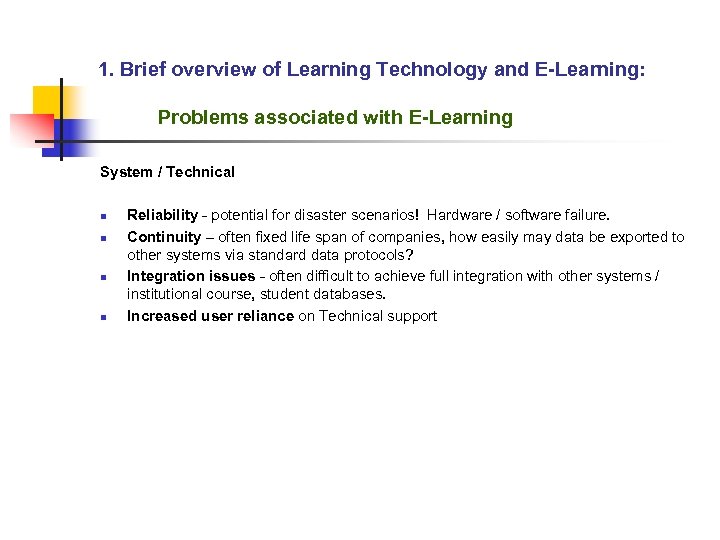
1. Brief overview of Learning Technology and E-Learning: Problems associated with E-Learning System / Technical n n Reliability - potential for disaster scenarios! Hardware / software failure. Continuity – often fixed life span of companies, how easily may data be exported to other systems via standard data protocols? Integration issues - often difficult to achieve full integration with other systems / institutional course, student databases. Increased user reliance on Technical support
1. Brief overview of Learning Technology and E-Learning: Problems associated with E-Learning The Student n Lack of personal Internet connection may restrict access. n Greater reliance on self-discipline of student, e. g. self-directed study via VLE. n Reduced face-to-face peer contact, possible impact on peer-support, collaboration, problem solving n Reduced face-to-face tutor contact, possibly reduced student-tutor relationship. n Technical / User Support queries difficult to resolve in low contact context. n n Accessibility / Usability - Is there any unusual interface design or operations requiring specialist training? Is the system tested for accessibility standards (WCAG)? And Web standards (e. g. XHTML 1. 0). Does the system function in a range of browsers/ assistive technology. Off-loading of printing costs on the student, an easy alternative to handouts?
1. Brief overview of Learning Technology and E-Learning: Problems associated with E-Learning The Lecturer / Learning Support n n n Pedagogical Effectiveness - how far is system informed by research in academic practice? Is system company responsive to academic input? Are there issues regarding US vs. UK academic practice, conventions, terminology? Is system appropriate to educational level? Academic / User Support - possible increase for academic / learning support. Study / Cultural issues - Will the use of an e-learning 'repository' discourage attendance at classes? Will the provision of a VLE discourage personal research and traditional study methods? Increased availability of non-directed resources on the Web (Information Overload), need to maintain authoritative content / links. Appropriateness of learning in digital context, only a limited range of subjects can be delivered purely through multimedia - problems associated with Humanities and Arts subjects. Issues of security and plagiarism.
1. Brief overview of Learning Technology and E-Learning: How does e-learning Work? Three Models Britain & Liber (1999) - three models for delivery of e-learning: n n n Content and Support Model n E-learning as a repository-focused resource n Support provided by tutor support, but low interaction via system n Conventional class teaching n Less radical change in culture for tutors / learners. Wrap-Around Model n Integration of conventional activities with system features n Use of discussion tools to facilitate collaboration n Often referred to as 50/50 model n Increasing electronic submission of coursework, use of email for tutor support, online assessments. n Conventional tutor support available, but emphasis on electronic support. Integrated Model n Course is defined by collaborative activities, discussions, group work. n Course content is uploaded in response to group needs. n Participation by tutors within collaboration in participatory / mentor role rather than as a conventional teacher. (Jones and Fitzgibbon 2002).
2. The Agenda for Skills Development in Higher Education Many definitions of 'skills' for Higher Education: Transferable skills, Key Skills, Common Skills, Personal Skills etc. n n n Dearing Report (1997): focussed on communication, numeracy, ICT and learning how to learn, recommended that all Higher Education (HE) programmes should provide opportunities for students to develop Key Skills and record achievements (NCIHE, 1997). Influence of Government Policy emphasising Key Skills: The Learning Age (1998), ICT Skills: 21 st Century Skills 2003, The Future of Higher Education (2004). Qualification Curriculum Authority: ‘Key Skills Descriptors' in response to Dearing: n communication, n application of number (numeracy), n information and communications technology (ICT), n improving own learning and performance, n working with others, and problem-solving. n Reflected in Edexcel Key Skills Framework The National Qualifications Framework n Framework for Higher Education Qualification levels (FHEQ), including advocacy for common skills.

2. The Agenda for Skills Development in Higher Education n QAA (Quality Assurance Agency for Higher Education) - Key Policies: Code of practice for the assurance of academic quality and standards in higher education B 4. Collaborative provision and flexible and distributed learning (including e-learning) Students should have access to: n a schedule for any learner support available to them through timetabled activities, for example tutorial sessions or web-based conferences; n clear and up to date information about the learning support available to them locally and remotely for their FDL programme or elements of study; n documents that set out their own responsibilities as learners, and the commitments of the awarding institution and the support provider (if appropriate) for the support of an FDL programme or element of study. n Frameworks for higher education qualifications in England, Wales and Northern Ireland, and in Scotland. n Subject benchmark statements Key Skills are defined when discussing curricular-based skills to be assessed as part of a programme of study. n Progress files – intended to help make the outcomes, or results of learning in Higher Education more explicit, identify the achievements of learning, and support the concept that learning is a lifetime activity. n
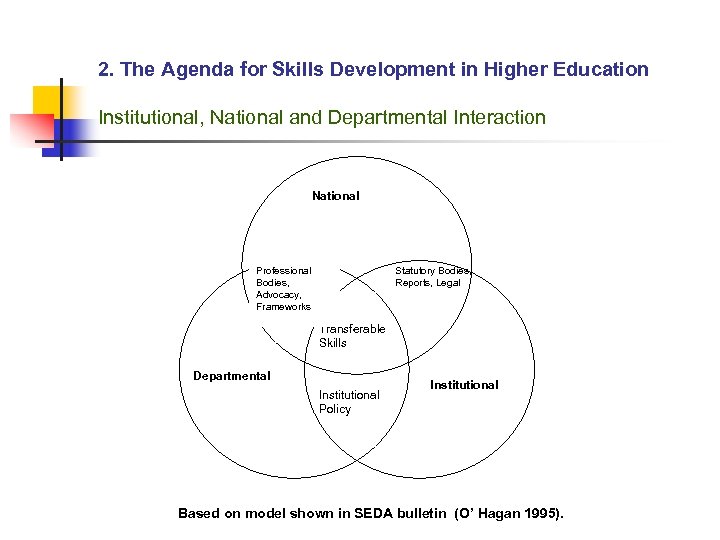
2. The Agenda for Skills Development in Higher Education Institutional, National and Departmental Interaction National Statutory Bodies, Reports, Legal Professional Bodies, Advocacy, Frameworks Transferable Skills Departmental Institutional Policy Institutional Based on model shown in SEDA bulletin (O’ Hagan 1995).
3. The Role of Skills in Learning Technology Skills Facilitating Learning n n n Technology Skills for e-learning ('Black Box' skills) Keyboard, mouse, software applications, file management, use of email software, use of Search Engines and the World Wide Web for information retrieval, use of Information Gateways, online journals and other sources of information, use of online library catalogues (OPACs), basic software configuration and preferences, use of removable media (Zip, 3. 5 “ diskette, CD-ROM), use of Graphics, Multimedia, Video or Sound files, Use of application formats (e. g. . doc, . ppt) and viewers, e. g. Adobe Acrobat, downloading and installing software, Security / Virus protection, Basic PC maintenance, use of individual features within an online learning environment (VLE). Organisational and Social Skills Managing digital resources, maintaining backups, downloading, saving and printing files, engaging in online debate or group work, developing a rapport online with tutors / peers, communicating effectively via email, chat or discussion forums, use of online essay submission features, assimilating core IT skills with social / system-specific skills. Self-Regulated Study Zimmerman lists the following characteristics of a student who is a self-regulated learner: selfevaluation, organization and transformation, goal setting and planning, information seeking, record keeping, self-monitoring, environment structuring, giving self-consequences, rehearsing, memorizing, seeking social assistance, and reviewing. These characteristics show actively involved a self-regulated learner must be. They do not complete work and then simply move onto the next task. They consume what they are involved with, learn it , know it, wait for feedback and then if necessary revise or redo it (Zimmerman 1990).
3. The Role of Skills in Learning Technology Self-Regulated Learning Lidner and Harris (1993) identify six dimensions of self-regulated learning. n n n Epistemological beliefs: a person's own understanding of their system of knowing. Knowing about this gives a person the ability to see where they fit into learning or how it influences them. It also influences confidence. The more the learner understands about a particular situation the more success they will experience. Motivation: The will to learn or get better at learning has to come from internal or external motivation. In the case of the self-regulated learner this motivation comes from recognizing the importance of the task at hand through personal development. Metacognition: Awareness of one's own thinking and learning. This fits with the use of learning strategies. The student must know what tools they have in the tool box and how well they use them. Learning strategies: Strategies the learner is aware of and how they utilize them. Students need the skills to handle various learning situations. Contextual sensitivity: The ability to understand a particular learning situation and how to identify the problem and solve it. This skill can be developed by showing the learner how to identify problems. Working through examples will build this skill. Environmental utilization/control: Use of external resources to achieve solutions. Personal experience and knowledge can add to a person's ability to reach a solution.
3. The Role of Skills in Learning Technology The Relationship between Skills and Learning via Technology Some Questions. . . n n How does teaching theory inform e-learning when the context is dissimilar from traditional learning environment? Is it possible to simply translate teaching experience into the Educational technology environment? n Does the medium matter? n Aren't organisational and cultural issues more important than teaching approaches? n Is learning theory defined by systems anyway?
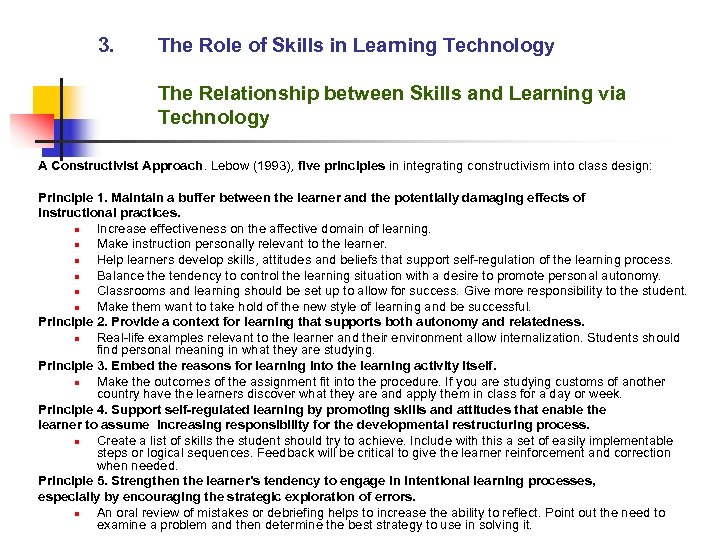
3. The Role of Skills in Learning Technology The Relationship between Skills and Learning via Technology A Constructivist Approach. Lebow (1993), five principles in integrating constructivism into class design: Principle 1. Maintain a buffer between the learner and the potentially damaging effects of instructional practices. n Increase effectiveness on the affective domain of learning. n Make instruction personally relevant to the learner. n Help learners develop skills, attitudes and beliefs that support self-regulation of the learning process. n Balance the tendency to control the learning situation with a desire to promote personal autonomy. n Classrooms and learning should be set up to allow for success. Give more responsibility to the student. n Make them want to take hold of the new style of learning and be successful. Principle 2. Provide a context for learning that supports both autonomy and relatedness. n Real-life examples relevant to the learner and their environment allow internalization. Students should find personal meaning in what they are studying. Principle 3. Embed the reasons for learning into the learning activity itself. n Make the outcomes of the assignment fit into the procedure. If you are studying customs of another country have the learners discover what they are and apply them in class for a day or week. Principle 4. Support self-regulated learning by promoting skills and attitudes that enable the learner to assume increasing responsibility for the developmental restructuring process. n Create a list of skills the student should try to achieve. Include with this a set of easily implementable steps or logical sequences. Feedback will be critical to give the learner reinforcement and correction when needed. Principle 5. Strengthen the learner's tendency to engage in intentional learning processes, especially by encouraging the strategic exploration of errors. n An oral review of mistakes or debriefing helps to increase the ability to reflect. Point out the need to examine a problem and then determine the best strategy to use in solving it.
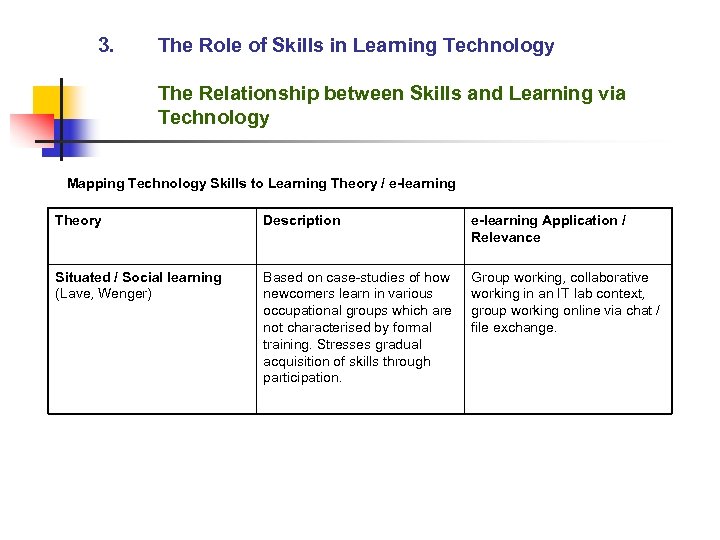
3. The Role of Skills in Learning Technology The Relationship between Skills and Learning via Technology Mapping Technology Skills to Learning Theory / e-learning Theory Description e-learning Application / Relevance Situated / Social learning (Lave, Wenger) Based on case-studies of how newcomers learn in various occupational groups which are not characterised by formal training. Stresses gradual acquisition of skills through participation. Group working, collaborative working in an IT lab context, group working online via chat / file exchange.
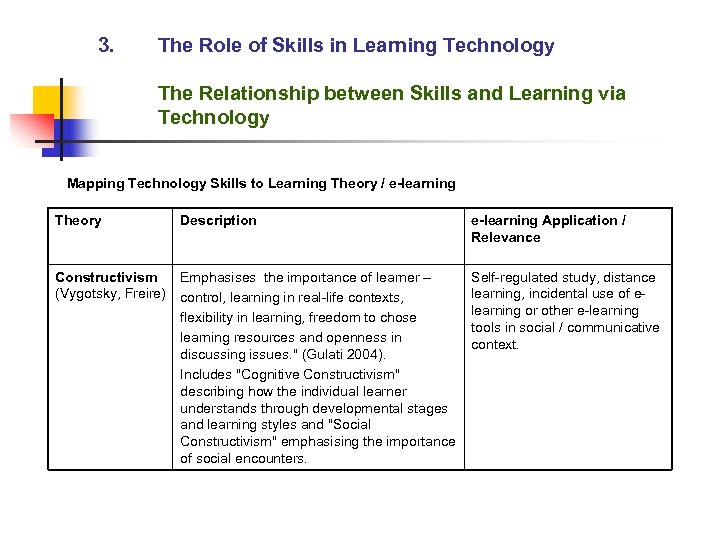
3. The Role of Skills in Learning Technology The Relationship between Skills and Learning via Technology Mapping Technology Skills to Learning Theory / e-learning Theory Description e-learning Application / Relevance Constructivism (Vygotsky, Freire) Emphasises the importance of learner – control, learning in real-life contexts, flexibility in learning, freedom to chose learning resources and openness in discussing issues. " (Gulati 2004). Includes "Cognitive Constructivism" describing how the individual learner understands through developmental stages and learning styles and "Social Constructivism" emphasising the importance of social encounters. Self-regulated study, distance learning, incidental use of elearning or other e-learning tools in social / communicative context.
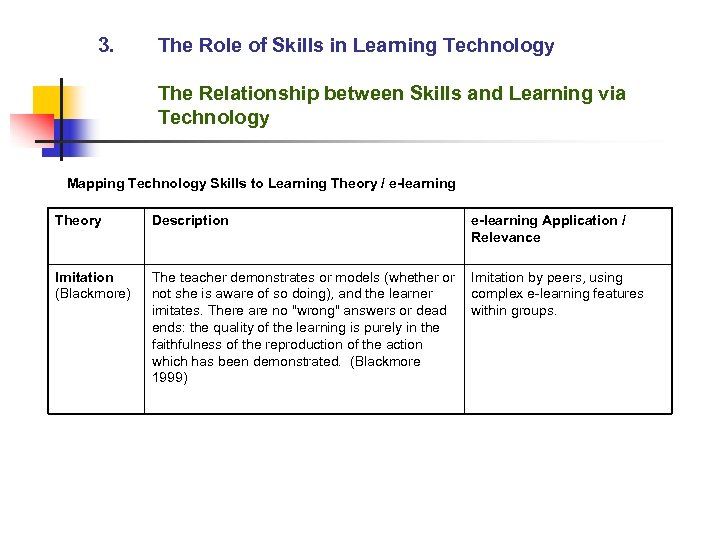
3. The Role of Skills in Learning Technology The Relationship between Skills and Learning via Technology Mapping Technology Skills to Learning Theory / e-learning Theory Description Imitation (Blackmore) The teacher demonstrates or models (whether or Imitation by peers, using not she is aware of so doing), and the learner complex e-learning features imitates. There are no "wrong" answers or dead within groups. ends: the quality of the learning is purely in the faithfulness of the reproduction of the action which has been demonstrated. (Blackmore 1999) e-learning Application / Relevance
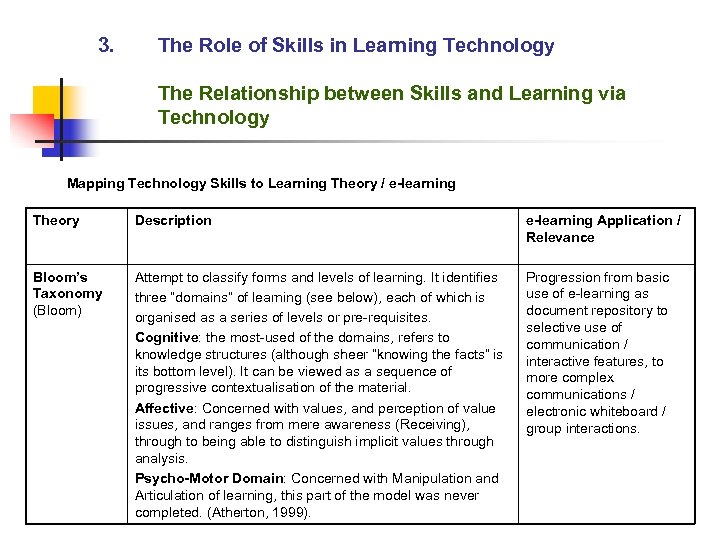
3. The Role of Skills in Learning Technology The Relationship between Skills and Learning via Technology Mapping Technology Skills to Learning Theory / e-learning Theory Description e-learning Application / Relevance Bloom’s Taxonomy (Bloom) Attempt to classify forms and levels of learning. It identifies three “domains” of learning (see below), each of which is organised as a series of levels or pre-requisites. Cognitive: the most-used of the domains, refers to knowledge structures (although sheer “knowing the facts” is its bottom level). It can be viewed as a sequence of progressive contextualisation of the material. Affective: Concerned with values, and perception of value issues, and ranges from mere awareness (Receiving), through to being able to distinguish implicit values through analysis. Psycho-Motor Domain: Concerned with Manipulation and Articulation of learning, this part of the model was never completed. (Atherton, 1999). Progression from basic use of e-learning as document repository to selective use of communication / interactive features, to more complex communications / electronic whiteboard / group interactions.
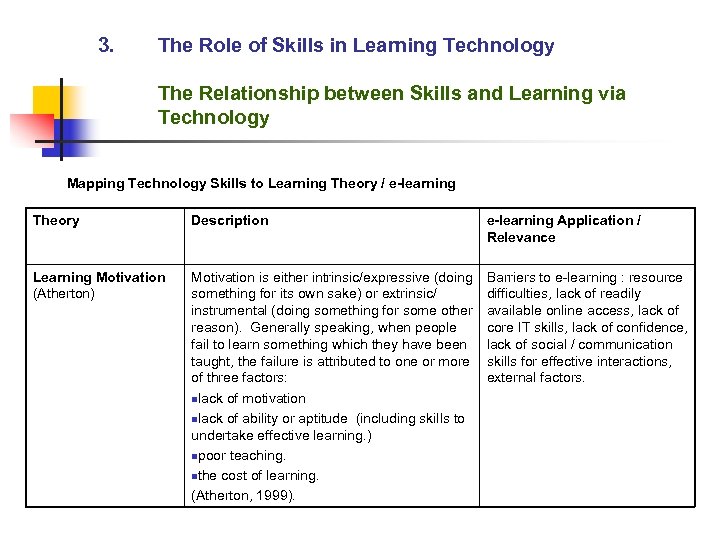
3. The Role of Skills in Learning Technology The Relationship between Skills and Learning via Technology Mapping Technology Skills to Learning Theory / e-learning Theory Description e-learning Application / Relevance Learning Motivation (Atherton) Motivation is either intrinsic/expressive (doing something for its own sake) or extrinsic/ instrumental (doing something for some other reason). Generally speaking, when people fail to learn something which they have been taught, the failure is attributed to one or more of three factors: nlack of motivation nlack of ability or aptitude (including skills to undertake effective learning. ) npoor teaching. nthe cost of learning. (Atherton, 1999). Barriers to e-learning : resource difficulties, lack of readily available online access, lack of core IT skills, lack of confidence, lack of social / communication skills for effective interactions, external factors.
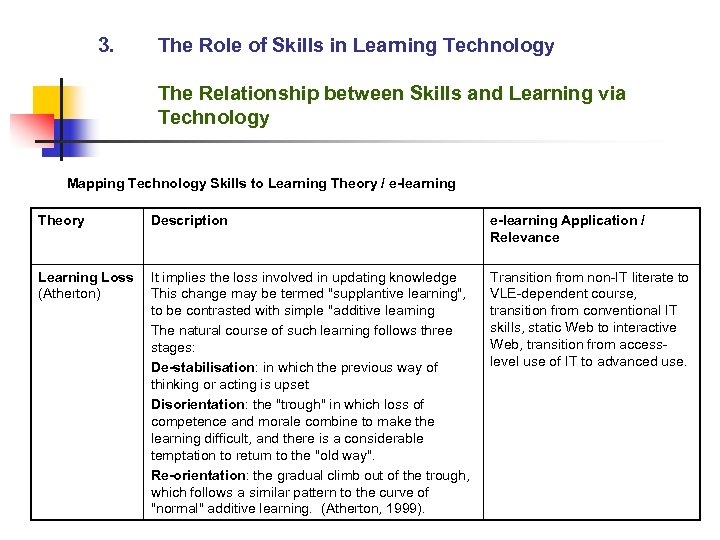
3. The Role of Skills in Learning Technology The Relationship between Skills and Learning via Technology Mapping Technology Skills to Learning Theory / e-learning Theory Description e-learning Application / Relevance Learning Loss (Atherton) It implies the loss involved in updating knowledge This change may be termed "supplantive learning", to be contrasted with simple "additive learning The natural course of such learning follows three stages: De-stabilisation: in which the previous way of thinking or acting is upset Disorientation: the "trough" in which loss of competence and morale combine to make the learning difficult, and there is a considerable temptation to return to the "old way". Re-orientation: the gradual climb out of the trough, which follows a similar pattern to the curve of "normal" additive learning. (Atherton, 1999). Transition from non-IT literate to VLE-dependent course, transition from conventional IT skills, static Web to interactive Web, transition from accesslevel use of IT to advanced use.
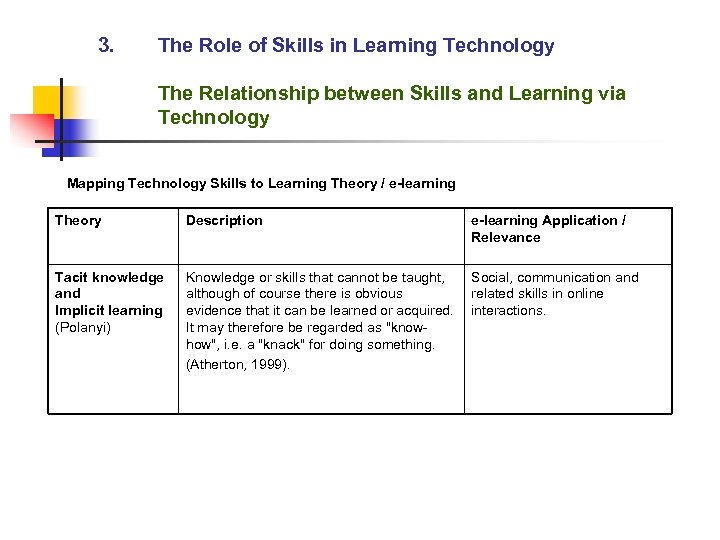
3. The Role of Skills in Learning Technology The Relationship between Skills and Learning via Technology Mapping Technology Skills to Learning Theory / e-learning Theory Description e-learning Application / Relevance Tacit knowledge and Implicit learning (Polanyi) Knowledge or skills that cannot be taught, Social, communication and although of course there is obvious related skills in online evidence that it can be learned or acquired. interactions. It may therefore be regarded as "knowhow", i. e. a "knack" for doing something. (Atherton, 1999).
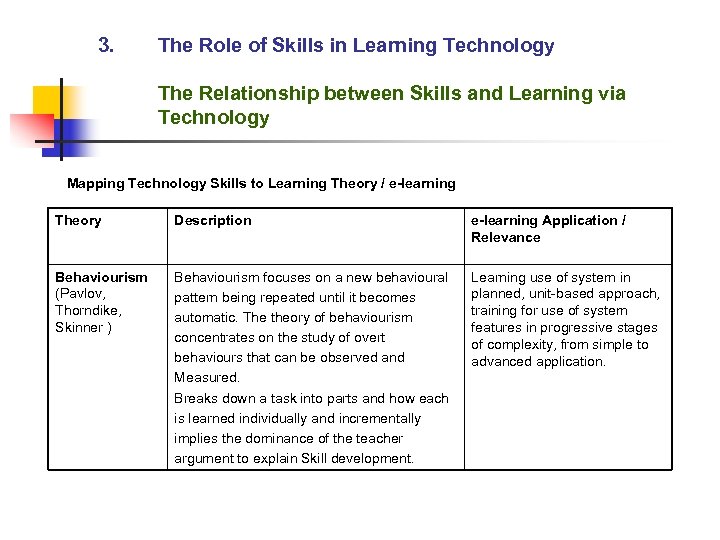
3. The Role of Skills in Learning Technology The Relationship between Skills and Learning via Technology Mapping Technology Skills to Learning Theory / e-learning Theory Description e-learning Application / Relevance Behaviourism (Pavlov, Thorndike, Skinner ) Behaviourism focuses on a new behavioural pattern being repeated until it becomes automatic. The theory of behaviourism concentrates on the study of overt behaviours that can be observed and Measured. Breaks down a task into parts and how each is learned individually and incrementally implies the dominance of the teacher argument to explain Skill development. Learning use of system in planned, unit-based approach, training for use of system features in progressive stages of complexity, from simple to advanced application.
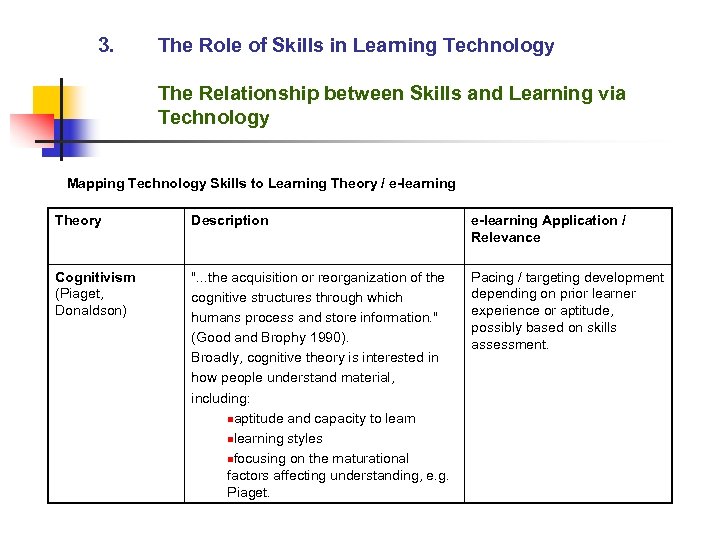
3. The Role of Skills in Learning Technology The Relationship between Skills and Learning via Technology Mapping Technology Skills to Learning Theory / e-learning Theory Description e-learning Application / Relevance Cognitivism (Piaget, Donaldson) ". . . the acquisition or reorganization of the cognitive structures through which humans process and store information. " (Good and Brophy 1990). Broadly, cognitive theory is interested in how people understand material, including: naptitude and capacity to learn nlearning styles nfocusing on the maturational factors affecting understanding, e. g. Piaget. Pacing / targeting development depending on prior learner experience or aptitude, possibly based on skills assessment.
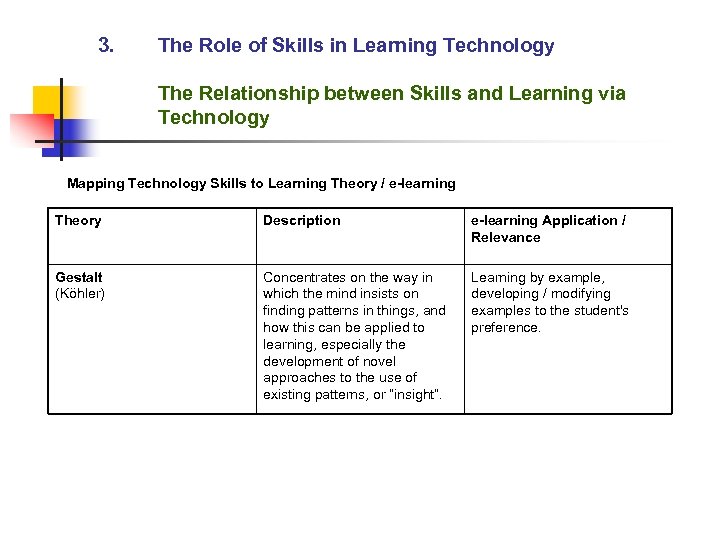
3. The Role of Skills in Learning Technology The Relationship between Skills and Learning via Technology Mapping Technology Skills to Learning Theory / e-learning Theory Description e-learning Application / Relevance Gestalt (Köhler) Concentrates on the way in which the mind insists on finding patterns in things, and how this can be applied to learning, especially the development of novel approaches to the use of existing patterns, or “insight”. Learning by example, developing / modifying examples to the student's preference.
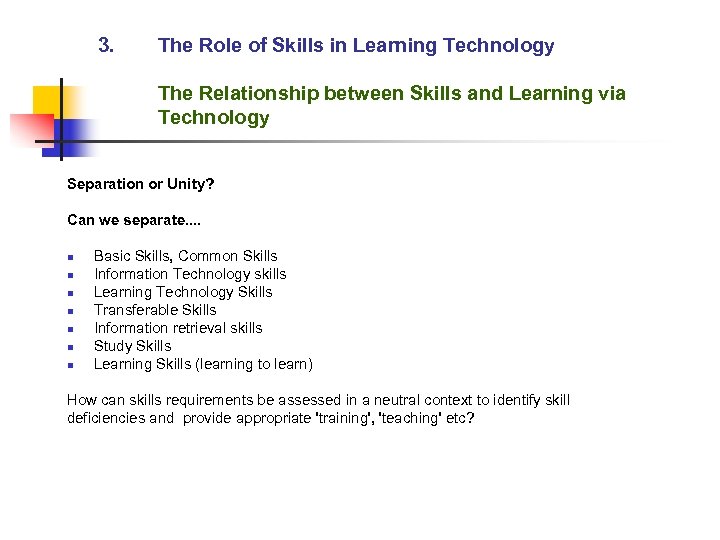
3. The Role of Skills in Learning Technology The Relationship between Skills and Learning via Technology Separation or Unity? Can we separate. . n n n n Basic Skills, Common Skills Information Technology skills Learning Technology Skills Transferable Skills Information retrieval skills Study Skills Learning Skills (learning to learn) How can skills requirements be assessed in a neutral context to identify skill deficiencies and provide appropriate 'training', 'teaching' etc?
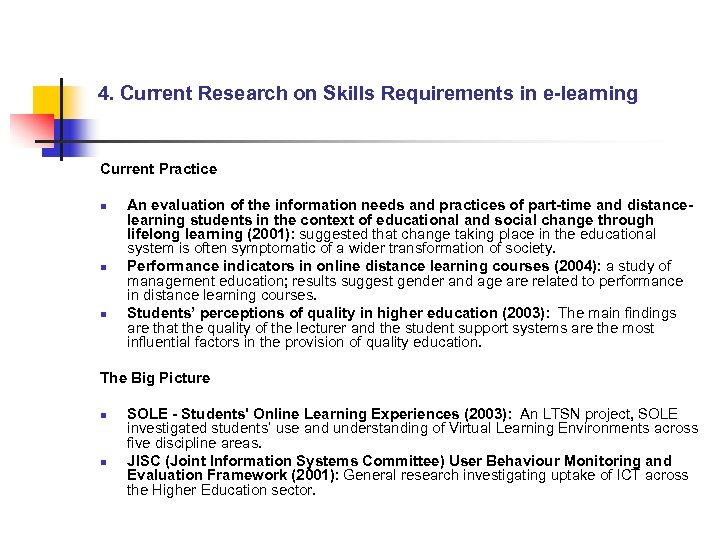
4. Current Research on Skills Requirements in e-learning Current Practice n n n An evaluation of the information needs and practices of part-time and distancelearning students in the context of educational and social change through lifelong learning (2001): suggested that change taking place in the educational system is often symptomatic of a wider transformation of society. Performance indicators in online distance learning courses (2004): a study of management education; results suggest gender and age are related to performance in distance learning courses. Students’ perceptions of quality in higher education (2003): The main findings are that the quality of the lecturer and the student support systems are the most influential factors in the provision of quality education. The Big Picture n n SOLE - Students' Online Learning Experiences (2003): An LTSN project, SOLE investigated students’ use and understanding of Virtual Learning Environments across five discipline areas. JISC (Joint Information Systems Committee) User Behaviour Monitoring and Evaluation Framework (2001): General research investigating uptake of ICT across the Higher Education sector.
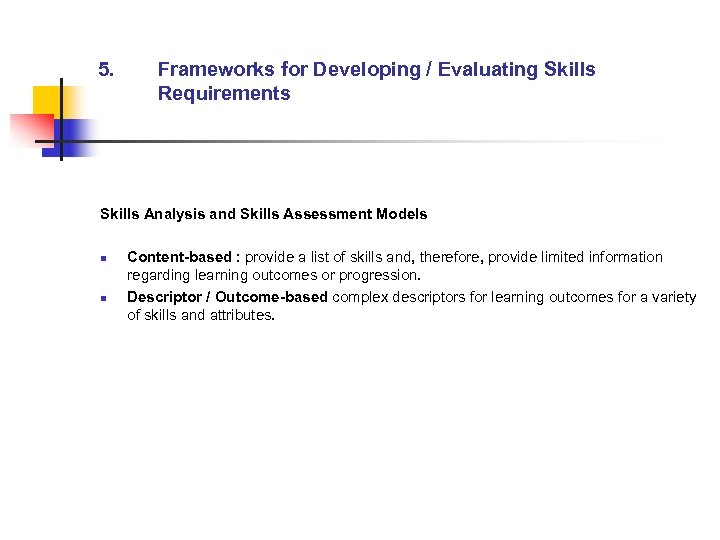
5. Frameworks for Developing / Evaluating Skills Requirements Skills Analysis and Skills Assessment Models n n Content-based : provide a list of skills and, therefore, provide limited information regarding learning outcomes or progression. Descriptor / Outcome-based complex descriptors for learning outcomes for a variety of skills and attributes.
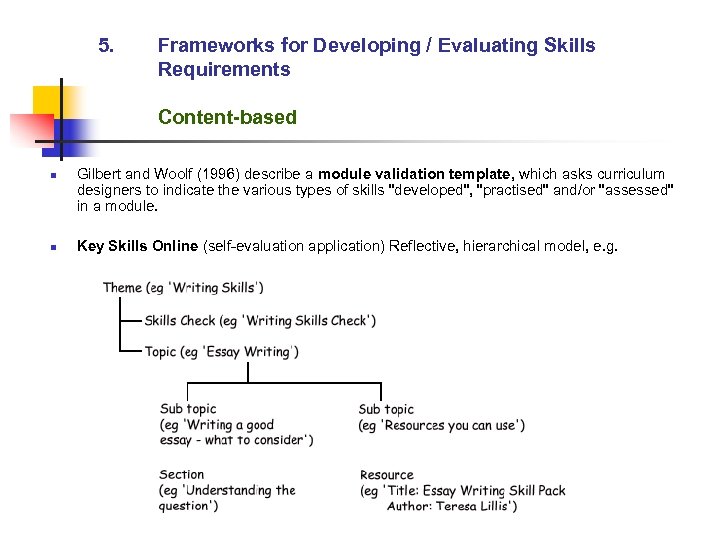
5. Frameworks for Developing / Evaluating Skills Requirements Content-based n n Gilbert and Woolf (1996) describe a module validation template, which asks curriculum designers to indicate the various types of skills "developed", "practised" and/or "assessed" in a module. Key Skills Online (self-evaluation application) Reflective, hierarchical model, e. g.
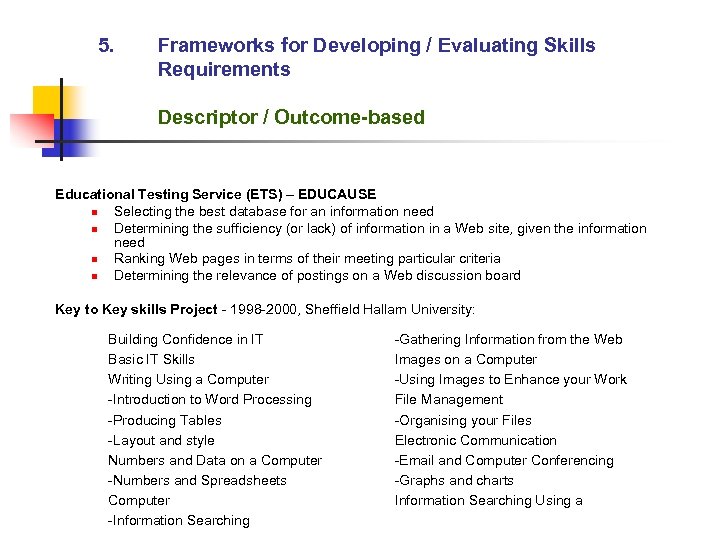
5. Frameworks for Developing / Evaluating Skills Requirements Descriptor / Outcome-based Educational Testing Service (ETS) – EDUCAUSE n Selecting the best database for an information need n Determining the sufficiency (or lack) of information in a Web site, given the information need n Ranking Web pages in terms of their meeting particular criteria n Determining the relevance of postings on a Web discussion board Key to Key skills Project - 1998 -2000, Sheffield Hallam University: Building Confidence in IT Basic IT Skills Writing Using a Computer -Introduction to Word Processing -Producing Tables -Layout and style Numbers and Data on a Computer -Numbers and Spreadsheets Computer -Information Searching -Gathering Information from the Web Images on a Computer -Using Images to Enhance your Work File Management -Organising your Files Electronic Communication -Email and Computer Conferencing -Graphs and charts Information Searching Using a
5. Frameworks for Developing / Evaluating Skills Requirements Descriptor / Outcome-based n n University of Glamorgan: Key Skills in E-Learning Project. Compared face to face versus on-line teaching of Edexcel common skills and Qualification Curriculum Authority (QCA) Key Skills - challenges the view that soft skills are difficult to develop on line (Jones and Fitzgibbon 2002). ECDL: provides training programme for IT skills, including Keyboard, Web, Communication, File Management and document creation/ editing skills - has been integrated into curriculum within some institutions.
6. A Proposal for Research considering Skills requirements in a Part Time study context What are the skills and learning challenges faced by students in the use of educational technology? Perceptions of undergraduate students studying professional courses in a part-time, distributed study context.
6. A Proposal for Research considering Skills requirements in a Part Time study context General Overview n n n Provide Original Research n Contribute to existing research in the area of technology skills requirements, by examining students' perceptions of skills requirements for study. n To compare these perceptions with government, industry, sector and institutional views derived from the literature review and practical research elements. Overview of Aims n Define generic, discipline-specific and context-based educational technology skills requirements. n Define the role and importance of educational technology training / assessment and continuous development. n Contribute to the development of a tool to query educational technology skills requirements within a distributed study context. Practical Research Element n Conducted in the context of a Higher Education provider facilitating the UK Government widening participation agenda via innovative strategy, teaching and technology. n Part-time student groups selected across a range of professional-related disciplines.
6. A Proposal for Research considering Skills requirements in a Part Time study context Methods n n n Literature review n Define formal prerequisites within official bodies (Objectives 1 and 2) and a selected Higher Education provider (Objective 3). n To assist in categorising educational technology skills to develop a skills assessment matrix (Objectives 5 and 6). Student Questionnaires n 3 -5 part-time, undergraduate student groups of 30 -50 persons (Objective 4). n Across several professional disciplines (e. g. Education, Nursing). n Delivered at 3 key stages in academic year (enrolment, mid-year, end of year). Staff Interviews (Semi-Structured) n 3 -5 academic staff teaching the student survey groups, to investigate staff perceptions of educational study skills (Objective 3). n Open-ended comment. n Delivered at 3 key stages in academic year (enrolment, mid-year, end of year). n 8 -10 support staff will also be selected for interviewing (Objective 3) at similar stages. Pilot. . for all questionnaires and interviews - used before deployment. Synthesis n Using ‘Grounded theory' (Leedy and Ormond 2005). n To establish a theoretical framework for analysis based on trends in the primary data. n SPSS will be used for recording, analysis and presentation of findings.
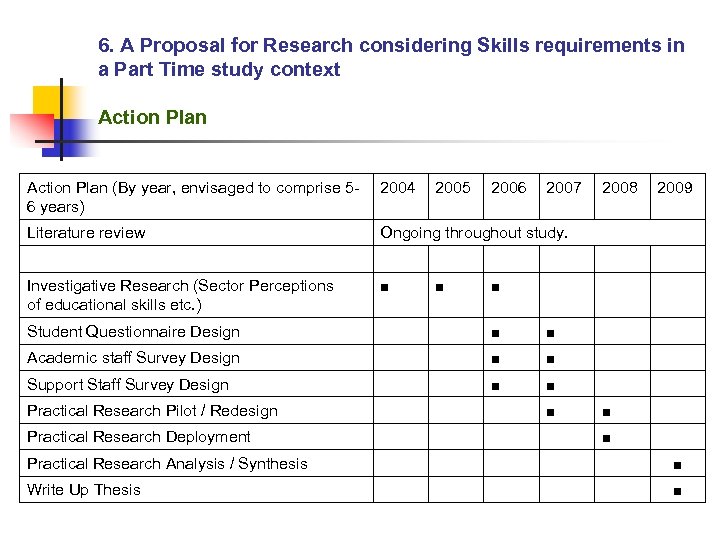
6. A Proposal for Research considering Skills requirements in a Part Time study context Action Plan (By year, envisaged to comprise 56 years) 2004 2005 Literature review Ongoing throughout study. Investigative Research (Sector Perceptions of educational skills etc. ) ■ ■ 2006 2007 2008 2009 ■ Student Questionnaire Design ■ ■ Academic staff Survey Design ■ ■ Support Staff Survey Design ■ ■ Practical Research Pilot / Redesign Practical Research Deployment ■ ■ ■ Practical Research Analysis / Synthesis ■ Write Up Thesis ■
7. Conclusions n n Wide range of perspectives on Skills requirements - Advocacy, Frameworks, ‘Tools’, Training Courses. Higher Education: Lots of advocacy, less consensus / detail. Skills and Learning processes can be defined as separate, but in practice, these are inseparable when considering learning scenarios / models. Differing learning theories can suggest new perspectives on skills requirements. Thank You for listening to this Presentation ! For further information see: http: //draigweb. co. uk/elearning
Bibliography / References n n n n Alstete, J. W. and Beutell, N. J. (2004). Performance indicators in online distance learning courses: a study of management education Quality Assurance in Education, 12 (1). p. 6 -14 Atherton, J. S. (1999). Teaching and Learning. May 2005: http: //www. learningandteaching. info Blackmore, S (1999) The Meme Machine Oxford: Oxford University Press Catherall, P. (2004) Delivering E-Learning for Information Services in Higher Education Oxford: Chandos Publishing Chris O' Hagan (1995) Empowering Teachers and Learners through Technology, SEDA paper 90 Birmingham: SEDA Gulati, S. (2004). Constructivism and emerging online learning pedagogy: a discussion formal to acknowledge and promote the informal, Paper presented at the Annual Conference of the Universities Association for Continuing Education, University of Glamorgan, 5 -7 April 2004 Erskine, J. (2003). Learning and Teaching Support Network. Resource Guide in Virtual Learning Environments (VLEs). October 2004: http: //www. hlst. ltsn. ac. uk/projects/Specialists/erskine. pdf Gilbert, J. and Woolf, H. (1996). Personal transferable skills and an undergraduate modular curriculum, Modular Higher Education in the UK - In Focus, p. 88 -91 Hill, Y. , Lomas, L. and Mac. Gregor J. (2003). Students’ perceptions of quality in higher education Quality Assurance in Education, 11 (1), p. 15 -20 Jones, N and Fitzgibbon, K. (2002). For Better or Worse? The Marriage of Key Skills Development and On-Line Learning Journal of Vocational Education and Training 54 (3), p. 395 -411 Lebow, D. (1993). Constructivist values for instructional systems design: Five principles toward a new mindset Educational Technology Research and Development, 41, 4 -16 Lidner, R. W. and Harris, B. R. (1993). Teaching self-regulated learning strategies. In M. R. Simonson and K. Abu-Omar (Eds. ). Proceedings of Selected Research and Development Presentations at the 1993 National Convention of the Association for Educational Communications and Technology, New Orleans, AECT, p. 641 -654 Rowland, F. and Rubbert, I. (2001). An Evaluation Of The Information Needs And Practices Of Part-Time And Distance-Learning Students In The Context Of Educational And Social Change Through Lifelong Learning Journal of Documentation 57 (6), p. 741762 Skill, D. and Young, A. (2002). Embracing the hybrid model: Working at the intersections of virtual and physical learning spaces New Directions for Teaching and Learning (92), p. 23 -32 Zimmerman, B. J. (1990). Self-regulated learning and academic achievement: An overview Educational Psychologist, 25, 3 -17
Скачать презентацию Skills Challenges Experienced by Students in the use
d80175a1fb8bbddfc963c30819e278d2.ppt