


 Скачать презентацию Skadden Understanding the Ethical and Statutory Requirements for
0127dc8e82ede0f8bf7e9501b92d9be9.ppt
- Количество слайдов: 25
 Skadden Understanding the Ethical and Statutory Requirements for Non-U. S. Lawyers Resident in the United States Paul T. Schnell Lawrence S. Spiegel Skadden, Arps, Slate, Meagher & Flom LLP The discussion set forth herein is general in nature. It is not intended to, and it does not, constitute legal advice. © 2011 P. Schnell, L. Spiegel March 8, 2011 www. skadden. com
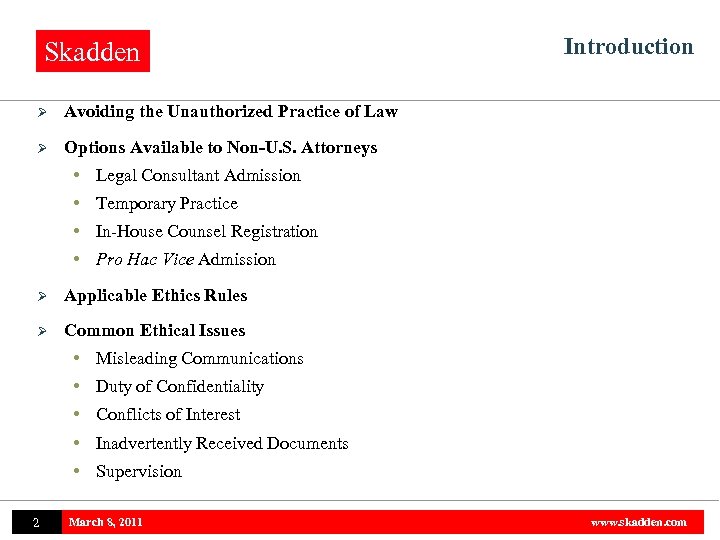 Skadden Ø Avoiding the Unauthorized Practice of Law Ø Introduction Options Available to Non-U. S. Attorneys • Legal Consultant Admission • Temporary Practice • In-House Counsel Registration • Pro Hac Vice Admission Ø Applicable Ethics Rules Ø Common Ethical Issues • Misleading Communications • Duty of Confidentiality • Conflicts of Interest • Inadvertently Received Documents • Supervision 2 March 8, 2011 www. skadden. com
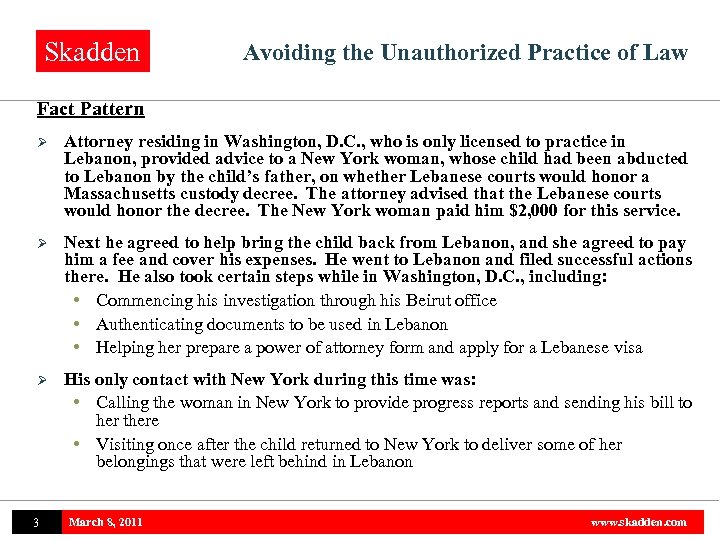 Skadden Avoiding the Unauthorized Practice of Law Fact Pattern Ø Attorney residing in Washington, D. C. , who is only licensed to practice in Lebanon, provided advice to a New York woman, whose child had been abducted to Lebanon by the child’s father, on whether Lebanese courts would honor a Massachusetts custody decree. The attorney advised that the Lebanese courts would honor the decree. The New York woman paid him $2, 000 for this service. Ø Next he agreed to help bring the child back from Lebanon, and she agreed to pay him a fee and cover his expenses. He went to Lebanon and filed successful actions there. He also took certain steps while in Washington, D. C. , including: • Commencing his investigation through his Beirut office • Authenticating documents to be used in Lebanon • Helping her prepare a power of attorney form and apply for a Lebanese visa Ø His only contact with New York during this time was: • Calling the woman in New York to provide progress reports and sending his bill to her there • Visiting once after the child returned to New York to deliver some of her belongings that were left behind in Lebanon 3 March 8, 2011 www. skadden. com
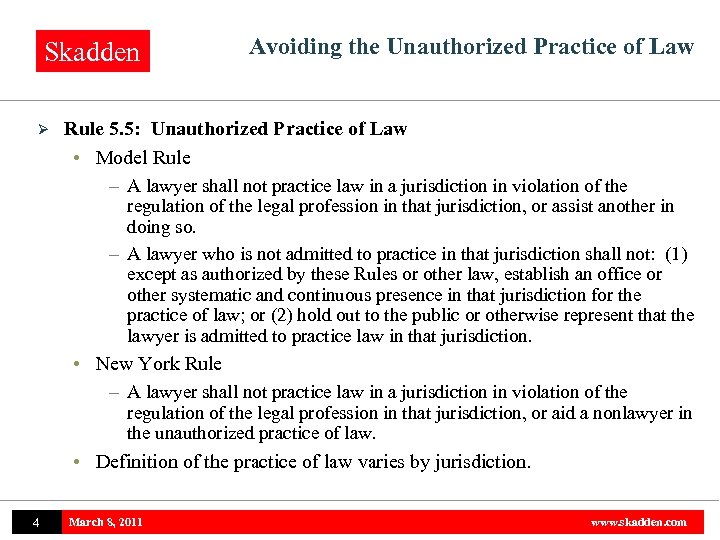 Skadden Ø Avoiding the Unauthorized Practice of Law Rule 5. 5: Unauthorized Practice of Law • Model Rule – A lawyer shall not practice law in a jurisdiction in violation of the regulation of the legal profession in that jurisdiction, or assist another in doing so. – A lawyer who is not admitted to practice in that jurisdiction shall not: (1) except as authorized by these Rules or other law, establish an office or other systematic and continuous presence in that jurisdiction for the practice of law; or (2) hold out to the public or otherwise represent that the lawyer is admitted to practice law in that jurisdiction. • New York Rule – A lawyer shall not practice law in a jurisdiction in violation of the regulation of the legal profession in that jurisdiction, or aid a nonlawyer in the unauthorized practice of law. • Definition of the practice of law varies by jurisdiction. 4 March 8, 2011 www. skadden. com
 Skadden Options Available to Non-U. S. Attorneys Practicing in Certain U. S. Jurisdictions Ø There are four potential options available to non-U. S. attorneys who wish to provide legal services in certain jurisdictions in the United States, but have not sat for a bar examination and fulfilled other requirements to obtain full admission status. • Legal Consultant Admission • Temporary Practice • In-House Counsel Registration • Pro Hac Vice Admission Ø 5 Unless providing legal services under one of these options and in compliance with the applicable rules, non-U. S. attorneys may be engaging in the unauthorized practice of law. March 8, 2011 www. skadden. com
 Skadden Ø Legal Consultant Admission ABA Model Rule for the Licensing and Practice of Foreign Legal Consultants • Allows a non-U. S. attorney to apply for a license to provide legal services in a particular jurisdiction (with certain limitations) • Initially adopted in 1993 in Report 201 H; Amended in 2006 • Comparable rule exists in 31 states and Washington, D. C. Ø New York Rule for the Licensing of Legal Consultants • Adopted in 1974 as 22 NYCRR § 521 • Almost identical to the ABA Model Rule Ø General Limitations Under Both Rules • May not appear in court, advise on local or federal law, or prepare instruments related to real estate, trusts and estates or marital and custody matters that affect U. S. residents or residents of the relevant jurisdiction 6 March 8, 2011 www. skadden. com
 Skadden Legal Consultant Admission Fact Pattern Ø Did an attorney admitted in Italy and licensed as a legal consultant under New York law engage in the unauthorized practice of law when he: • Advised clients in New York on the sale of property in Italy • Prepared bargain and sale deeds in New York real estate transactions • Advised clients on creation of corporate and business entities in New York • Represented a corporation before the FDA 7 March 8, 2011 www. skadden. com
 Skadden Temporary Practice Ø ABA Model Rule for Temporary Practice by Non-U. S. Attorneys • Allows for the temporary practice by non-U. S. attorneys on matters related to the jurisdiction in which the non-U. S. attorney is admitted to practice or in which an admitted attorney actively participates (with certain limitations) • Adopted in 2002 in Report 201 J • Comparable rule in 7 states: Delaware, Florida, Georgia, New Hampshire, North Carolina, Pennsylvania, Virginia • Comparable rule pending in Louisiana, Mississippi, and Washington, D. C. • Comparable rule under consideration in 19 states: Alaska, Arkansas, California, Hawaii, Illinois, Indiana, Iowa, Michigan, Minnesota, Montana, North Dakota, New York, Ohio, Oregon, South Carolina, South Dakota, Texas, Utah and Washington Ø Comparison to Legal Consultant Admission • Greater limitation on the permissible types of legal services • Does not require submission to an application process 8 March 8, 2011 www. skadden. com
 Skadden Ø In-House Counsel Registration ABA Model Rule for Registration of In-House Counsel • Adopted in 2008 • Requires in-house counsel not admitted to practice in the jurisdiction where they have a continuous presence to register as in-house counsel in that jurisdiction – Benefit of this requirement is that it provides a mechanism for in-house counsel to avoid the unauthorized practice of law • The ABA version does not apply to non-U. S. attorneys • The in-house counsel rules of 6 states apply to non-U. S. attorneys – Arizona, Connecticut, Delaware, Virginia, Washington, Wisconsin Ø New York Rule for Registration of In-House Counsel • Pending before the Court of Appeals • Applicable to non-U. S. attorneys in the proposed form 9 March 8, 2011 www. skadden. com
 Skadden Pro Hac Vice Admission Ø ABA Model Rule on Pro Hac Vice Admission • Allows attorneys not admitted to practice in the jurisdiction to apply to appear in a particular proceeding • Like the rules in most jurisdictions, the Model Rule does not allow non. U. S. attorneys to apply for pro hac vice admission Ø 13 jurisdictions open the option to non-U. S. attorneys • Alaska, Florida, Illinois, Maine, Michigan, New Mexico, New York, Oklahoma, Oregon, Pennsylvania, Washington, D. C. , West Virginia and Wisconsin Ø New York’s Pro Hac Vice Rule, 22 NYCRR § 520. 11 • Allows an attorney in good standing in another jurisdiction, including a non-U. S. one, to apply for admission to participate before the court in a matter in which the attorney is employed • Pro hac vice admission is valid for 18 months 10 March 8, 2011 www. skadden. com
 Skadden Ø Applicable Ethics Rules • Generally, attorneys are subject to the rules of professional conduct of the jurisdiction where practicing, including under the above practice options available to non-U. S. attorneys. • Generally, attorneys are also subject to disciplinary action for the violation of any rules of professional conduct of that jurisdiction. • This can become complicated in both national and international multijurisdictional practice, so the ABA Commission on Ethics 20/20 has examined the problem and produced an issues paper on the topic. – Issues Paper: Choice of Law in Cross-Border Practice provides possible recommendations for changes to the Model Rule provisions on disciplinary authority, imputation of conflicts, choice of law, and other relevant areas. – The Commission has requested comments from the legal community by March 15, 2011. 11 March 8, 2011 www. skadden. com
 Skadden Ø Common Ethical Issues Certain ethical issues commonly arise in any type of practice • Misleading Communications • Duty of Confidentiality • Conflicts of Interest • Inadvertently Received Documents • Supervision 12 March 8, 2011 www. skadden. com
 Skadden Misleading Communications Fact Pattern Ø Did an attorney admitted in Haiti and licensed to practice as a legal consultant in New York violate any rules when he: • Listed on his business cards certain fields of law in which his practice specialized. • Wrote in an admission application to the U. S. Supreme Court that he was admitted in New York State in response to a question of where he was admitted to practice law. • Wrote in his application that he was licensed by the Supreme Court of New York in response to a question of where he was engaged in the practice of law. • Attached to his application letters of reference stating that he was an active member in good standing of certain law societies and state authorities, including 4 bar associations. 13 March 8, 2011 www. skadden. com
 Skadden Ø Misleading Communications Model Rule 7. 1: Communications Concerning a Lawyer’s Services • A lawyer shall not make a false or misleading communication about the lawyer or the lawyer’s services. Ø Model Rule 7. 4: Communication of Fields of Practice and Specialization • A lawyer shall not state that he is a specialist in a particular field unless actually certified as such. Ø Model Rule 7. 5: Firm Names and Letterheads • A lawyer shall not use a firm name, letterhead or other professional designation that violates Rule 7. 1. Ø New York Rules 7. 1, 7. 4 and 7. 5 • Although more detailed, the New York Rules set forth similar restrictions. 14 March 8, 2011 www. skadden. com
 Skadden Duty of Confidentiality Fact Pattern Ø 15 Did a New York attorney violate any duties in the following scenario: • Attorney represents a corporation that is in settlement talks with the government over marketing improprieties for a new product. • Attorney sends confidential settlement documents to her co-counsel at another New York law firm. • In the transmittal email, she also shares several nasty rumors about the corporation that she recently heard from contacts in the marketing industry and asks if co-counsel thinks any of the rumors are true. • Later that day, co-counsel calls the attorney to ask when she will be sending the settlement documents. • Confused about why co-counsel did not receive her email, the attorney checks her sent box and realizes that she did not send the documents to cocounsel—she sent them to a reporter with the same last name whose email address was also in her auto-populate settings. March 8, 2011 www. skadden. com
 Skadden Ø Duty of Confidentiality Rule 1. 6: Confidentiality of Information • Model Rule – A lawyer shall not reveal information relating to the representation of a client unless the disclosure falls under certain exceptions. • New York Rule – A lawyer shall not knowingly reveal confidential information or use such information to the disadvantage of a client or for the advantage of the lawyer or a third person unless the disclosure falls under certain exceptions. – “Confidential information” consists of information gained during or relating to the representation of a client, whatever its source, that is (a) protected by the attorney-client privilege, (b) likely to be embarrassing or detrimental to the client if disclosed, or (c) information that the client has requested be kept confidential. – “Confidential information” does not ordinarily include (i) a lawyer’s legal knowledge or legal research or (ii) information that is generally known in the local community or in the trade, field or profession to which the information relates. 16 March 8, 2011 www. skadden. com
 Skadden Duty of Confidentiality Attorneys also owe a duty of confidentiality to prospective and former clients Ø Rule 1. 9: Duties to Former Clients • Model and New York Rules – A lawyer who has formerly represented a client in a matter shall not use information relating to the representation to the disadvantage of the former client or reveal such information except as the Rules would permit or require, or when the information has become generally known. Ø Rule 1. 18: Duties to Prospective Clients • Model and New York Rules – A person who discusses with a lawyer the possibility of forming a clientlawyer relationship with respect to a matter is a prospective client. – Even when no client-lawyer relationship ensues, a lawyer who has had discussions with a prospective client shall not use or reveal information learned in the consultation except as Rule 1. 9 would permit. 17 March 8, 2011 www. skadden. com
 Skadden Conflicts of Interest Fact Pattern Ø Should a law firm be disqualified from representing a plaintiff in a discrimination suit against the school board when: • An associate at the law firm is also the vice president of the school board. • The law firm set up an ethical wall that blocked the associate from any involvement with the discrimination suit and any access to the case files. • The plaintiff and the school board consented to this arrangement before the law firm hired the associate. • Upon being hired by the law firm, the associate recused herself from all school board discussions about the discrimination suit and stopped receiving documents related to it. 18 March 8, 2011 www. skadden. com
 Skadden Ø Conflicts of Interest Rule 1. 7: Conflicts of Interest: Current Clients • Model Rule – A lawyer shall not represent a client if the representation involves a concurrent conflict of interest, which exists if there is direct adversity between clients or a significant risk of material limitation of the lawyer’s representation due to another client, former client, third party or lawyer’s own interests. – Notwithstanding the above, a lawyer may represent a client if he reasonably believes that he will be able to provide competent and diligent representation to each affected client, the representation is not prohibited by law, he is not asserting one client’s claim against another client in the same proceeding, and each affected client gives informed consent, confirmed in writing. • New York Rule – A lawyer shall not represent a client if a reasonable lawyer would conclude that the representation would involve representing differing interests or there is a significant risk that the lawyer’s professional judgment would be adversely affected by the lawyer’s own interests. – Same exceptions apply as in the Model Rule. 19 March 8, 2011 www. skadden. com
 Skadden Conflicts of Interest In certain situations, attorneys also must avoid conflicts of interest with prospective or former clients Ø Rule 1. 9: Duties to Former Clients • Model and New York Rules – A lawyer who has formerly represented a client in a matter shall not thereafter represent another person in the same or a substantially related matter in which that person’s interests are materially adverse to the interests of the former client unless the former client gives informed consent, confirmed in writing. Ø Rule 1. 18: Duties to Prospective Clients • Model and New York Rules – A lawyer shall not represent a client with interests materially adverse to those of a prospective client in the same or a substantially related matter if the lawyer received information from the prospective client that could be significantly harmful to that person in the matter (with certain exceptions). 20 March 8, 2011 www. skadden. com
 Skadden Inadvertently Received Documents Fact Pattern Ø 21 Did in-house counsel violate any rules in the following scenario: • In-house counsel at a company received a thread of emails that had been automatically routed to the legal department because they were sent to the email address of a former employee. • In-house counsel reviewed the threads and then opened an attachment, which was a draft complaint against the company. At that point, in-house counsel realized that this was probably a privileged thread of emails between a group of former employees and counsel they had retained to represent them in litigation with the company. • In-house counsel determined that there were no great revelations in the material and did not tell anyone about it. Without realizing it, she gave outside counsel the date of a meeting that she had learned from the privileged material. Outside counsel used this information in a counterclaim. This is how the former employees realized what had happened. March 8, 2011 www. skadden. com
 Skadden Ø Inadvertently Received Documents Rule 4. 4(b): Respect for Rights of Third Persons • Model and New York Rules – A lawyer who receives a document relating to the representation of the lawyer’s client and knows or reasonably should know that the document was inadvertently sent shall promptly notify the sender. • Comment 2 to the Model and New York Rules – Whether the lawyer is required to take additional steps, such as returning the original document, is a matter of law beyond the scope of these Rules, as is the question of whether the privileged status of a document has been waived. • ABA Ethics Opinion 06 -440 – Advises a lawyer in this situation not only to notify the opponent that they received the material, but also to refrain from viewing the material any further than necessary to see what it is, and to follow the opponent's instructions on how to proceed. 22 March 8, 2011 www. skadden. com
 Skadden Supervision Fact Pattern Ø 23 Who is responsible for the actions taken in the following scenario: • Law firm was conducting a massive document review and production for discovery in a major litigation. Partners A and B selected a highly experienced senior associate to coordinate the document collection with the client and supervise the associates doing the review. • Closer to trial, the senior associate and a junior associate were preparing a client employee to testify. She mentioned to them that she had 20 emails on her laptop about a meeting in 2003 that she did not believe had been collected and produced. • The senior associate raised the issue with Partners A and B. They decided that the emails were non-responsive and did not tell anyone else about them. When the junior associate asked the senior associate what had happened, the senior associate told him that no one cared about the emails. • The next day, Partner C argued before the court that there were no documents reflecting a meeting in 2003. Partners A and B and both associates were in court, but did not do anything to correct Partner C. • The existence of the emails came to light when the employee testified a week later. March 8, 2011 www. skadden. com
 Skadden Ø Supervision Rule 5. 1: Responsibilities of Supervisory Lawyers • Model Rule – A partner in a law firm or someone with comparable managerial and/or supervisory authority, shall make reasonable efforts to ensure that the firm has in effect measures giving reasonable assurance that all lawyers in the firm conform to the Rules of Professional Conduct. • New York Rule – A law firm and lawyers with management and/or supervisory authority shall make reasonable efforts to ensure that lawyers in the firm conform to the Rules of Professional Conduct and shall ensure and provide adequate supervision. Ø Rule 5. 2: Responsibilities of a Subordinate Lawyer • Model and New York Rules – A lawyer is bound by the Rules notwithstanding that the lawyer acted at the direction of another person. 24 March 8, 2011 www. skadden. com
 Skadden Paul T. Schnell Skadden, Arps, Slate, Meagher & Flom LLP Paul. Schnell@skadden. com 212 -735 -2322 25 March 8, 2011 Conclusion Lawrence S. Spiegel Skadden, Arps, Slate, Meagher & Flom LLP Lawrence. Spiegel@skadden. com 212 -735 -4155 www. skadden. com