


 Скачать презентацию SJR Technical Working Group May 16 2006 SJR
3e63887d5016173a01bcaec506781faa.ppt
- Количество слайдов: 49
 SJR Technical Working Group May 16, 2006 SJR DO Depletion Modeling: Model Calibration, Adaptive Management, User Guidance Andy Thuman, P. E. (Hydro. Qual) Laurie De Rosa (Hydro. Qual) 201 • 529 • 5151 www. hydroqual. com
 2 Water Quality Modeling Ø Adaptive Management Strategy Simulations o Dissolved Oxygen Unit Responses o Stockton RWCF Ammonia, Algae, Upstream Carbon, SOD o Variable Flows & Stockton RWCF Nitrification o O 2 Injection o Mud Slough Flow Reduction Ø User Guidance o GIS Based Post Processor for Users o Web Viewer o ECOM, RCA Structure
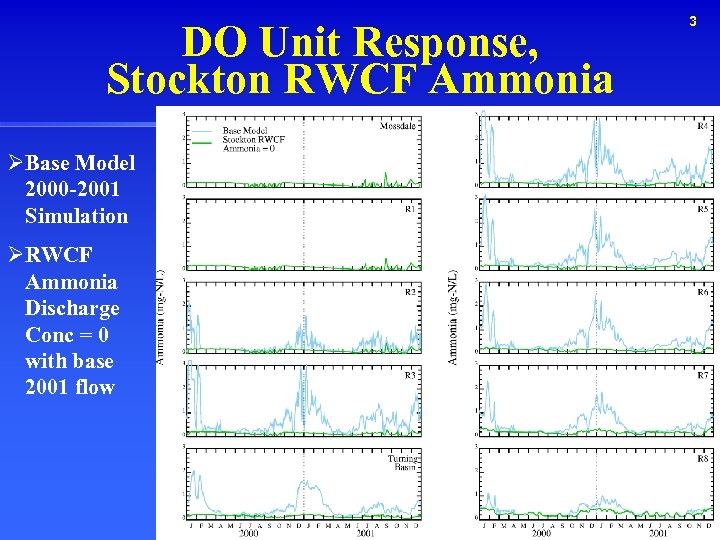 DO Unit Response, Stockton RWCF Ammonia ØBase Model 2000 -2001 Simulation ØRWCF Ammonia Discharge Conc = 0 with base 2001 flow 3
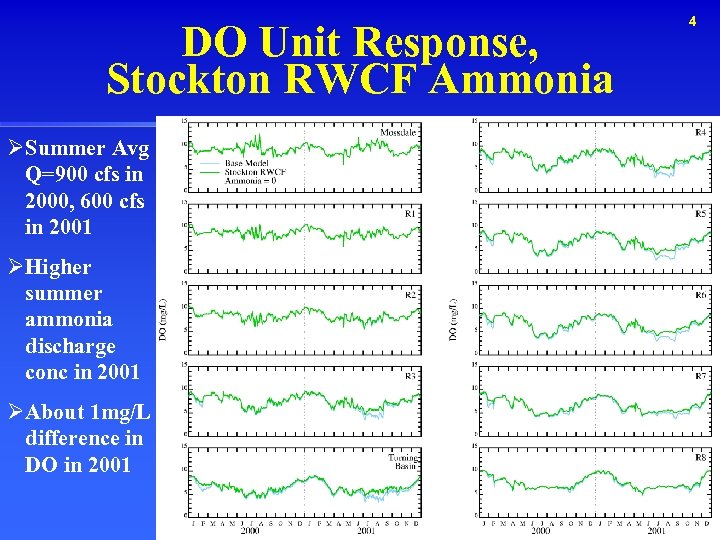 DO Unit Response, Stockton RWCF Ammonia ØSummer Avg Q=900 cfs in 2000, 600 cfs in 2001 ØHigher summer ammonia discharge conc in 2001 ØAbout 1 mg/L difference in DO in 2001 4
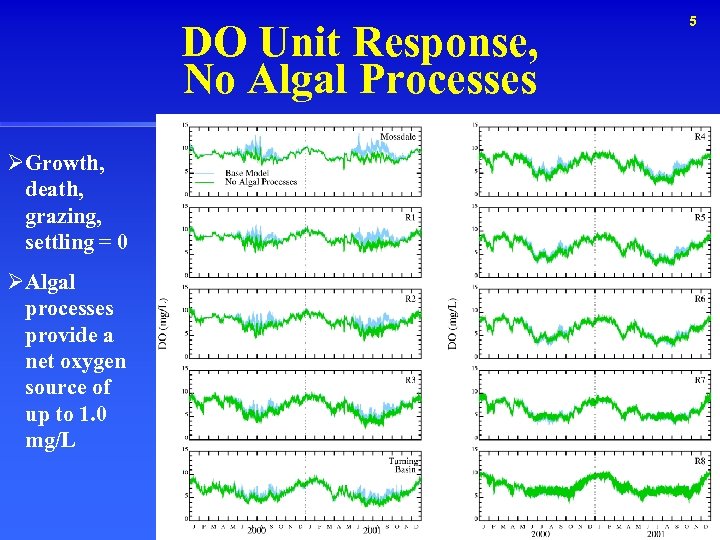 DO Unit Response, No Algal Processes ØGrowth, death, grazing, settling = 0 ØAlgal processes provide a net oxygen source of up to 1. 0 mg/L 5
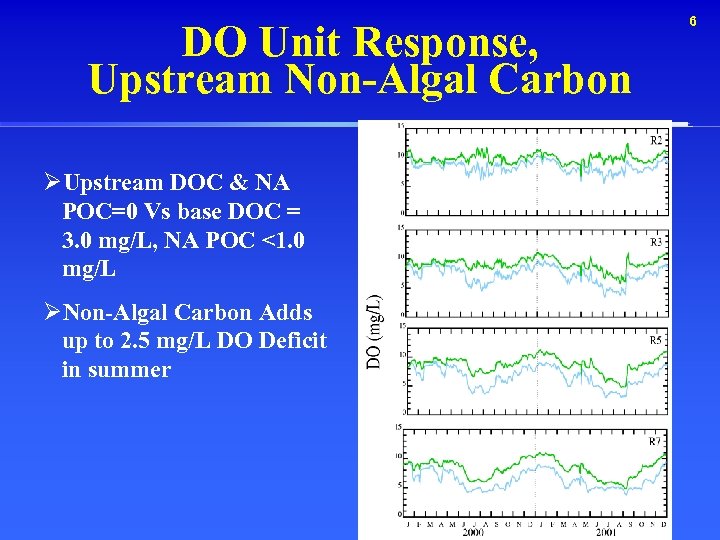 DO Unit Response, Upstream Non-Algal Carbon ØUpstream DOC & NA POC=0 Vs base DOC = 3. 0 mg/L, NA POC <1. 0 mg/L ØNon-Algal Carbon Adds up to 2. 5 mg/L DO Deficit in summer 6
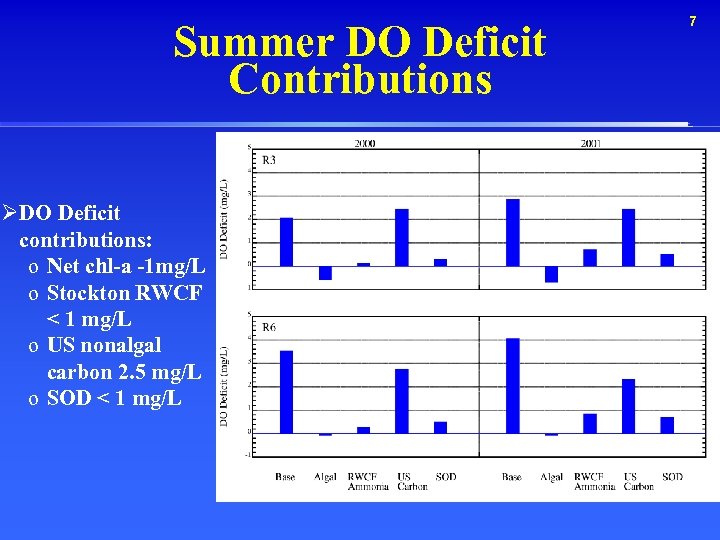 Summer DO Deficit Contributions ØDO Deficit contributions: o Net chl-a -1 mg/L o Stockton RWCF < 1 mg/L o US nonalgal carbon 2. 5 mg/L o SOD < 1 mg/L 7
 Simulations for DWSC Flows of 250, 750, 1, 250, 1, 500 & 1, 750 cfs Ø Five Summer Flow Scenarios were run from June 1 to Sept 30 o 250 to 1, 250 cfs simulate varying diversions to the Old River based on summer 2001 average 1, 400 cfs flow at Vernalis and approx 85% of SJR flow into DWSC at RRI split o 1, 500 & 1, 750 cfs simulations increased flow at Vernalis to 2, 100 cfs, adjusted boundary concentrations Ø Comparative Base Model is Summer 2001 with average flow of 425 cfs June to September Ø Five Flow Scenarios were run with the Stockton RWCF 2001 flows and concentrations and RWCF ammonia discharge concentrations = 2. 0 mg/L 8
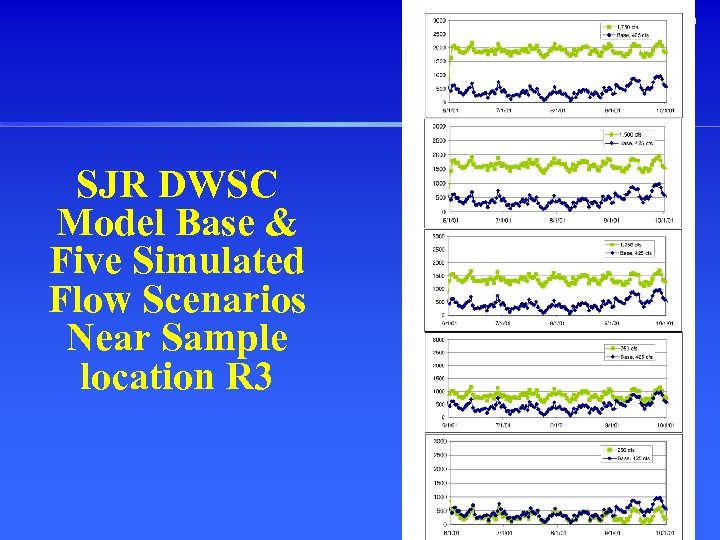 9 SJR DWSC Model Base & Five Simulated Flow Scenarios Near Sample location R 3
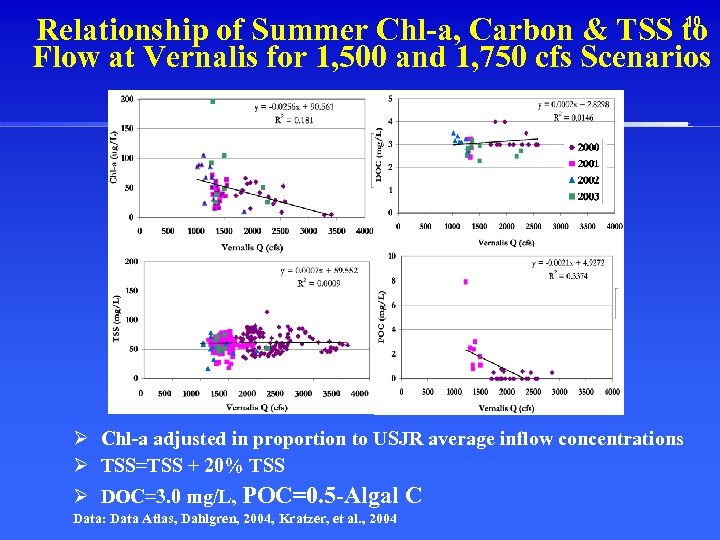 10 Relationship of Summer Chl-a, Carbon & TSS to Flow at Vernalis for 1, 500 and 1, 750 cfs Scenarios Ø Chl-a adjusted in proportion to USJR average inflow concentrations Ø TSS=TSS + 20% TSS Ø DOC=3. 0 mg/L, POC=0. 5 -Algal C Data: Data Atlas, Dahlgren, 2004, Kratzer, et al. , 2004
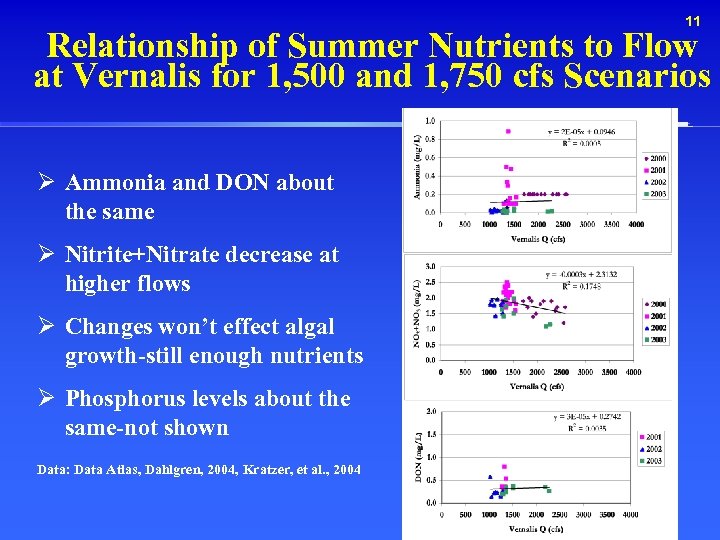 11 Relationship of Summer Nutrients to Flow at Vernalis for 1, 500 and 1, 750 cfs Scenarios Ø Ammonia and DON about the same Ø Nitrite+Nitrate decrease at higher flows Ø Changes won’t effect algal growth-still enough nutrients Ø Phosphorus levels about the same-not shown Data: Data Atlas, Dahlgren, 2004, Kratzer, et al. , 2004
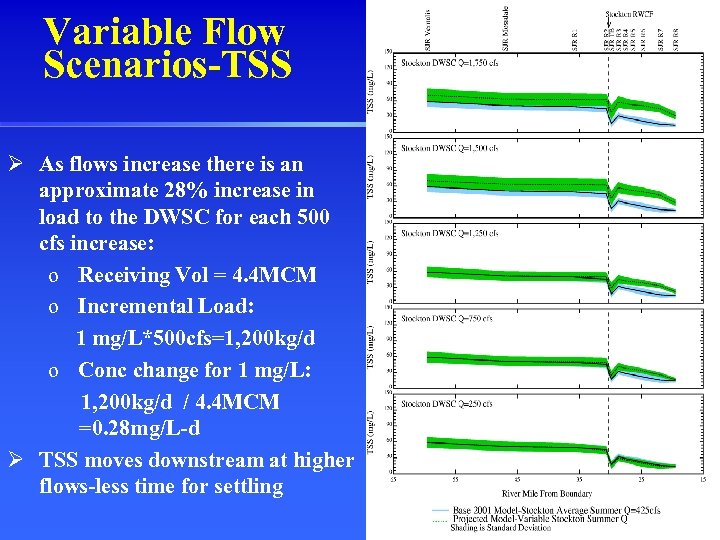 Variable Flow Scenarios-TSS Ø As flows increase there is an approximate 28% increase in load to the DWSC for each 500 cfs increase: o Receiving Vol = 4. 4 MCM o Incremental Load: 1 mg/L*500 cfs=1, 200 kg/d o Conc change for 1 mg/L: 1, 200 kg/d / 4. 4 MCM =0. 28 mg/L-d Ø TSS moves downstream at higher flows-less time for settling 12
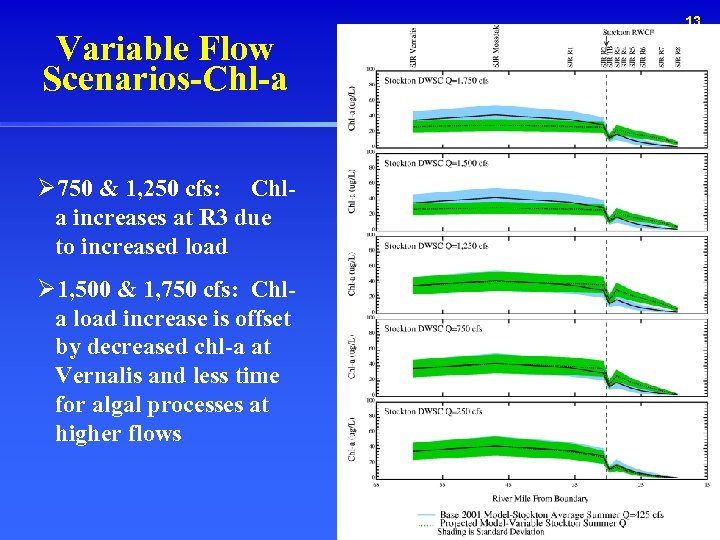 Variable Flow Scenarios-Chl-a Ø 750 & 1, 250 cfs: Chla increases at R 3 due to increased load Ø 1, 500 & 1, 750 cfs: Chla load increase is offset by decreased chl-a at Vernalis and less time for algal processes at higher flows 13
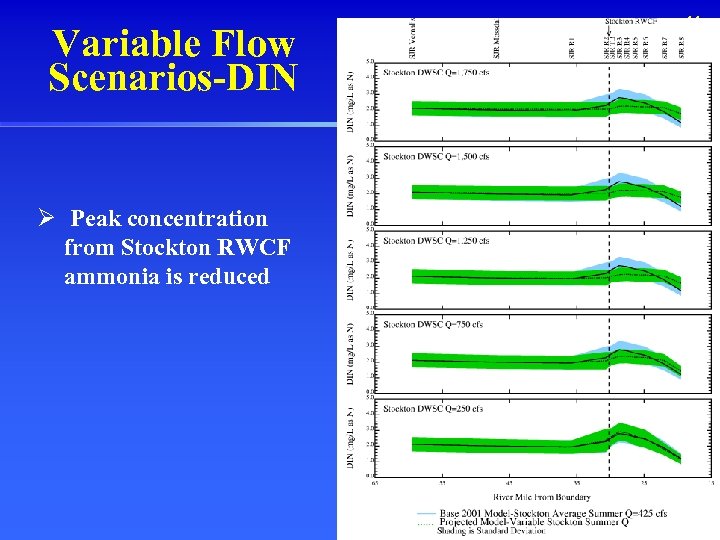 Variable Flow Scenarios-DIN Ø Peak concentration from Stockton RWCF ammonia is reduced 14
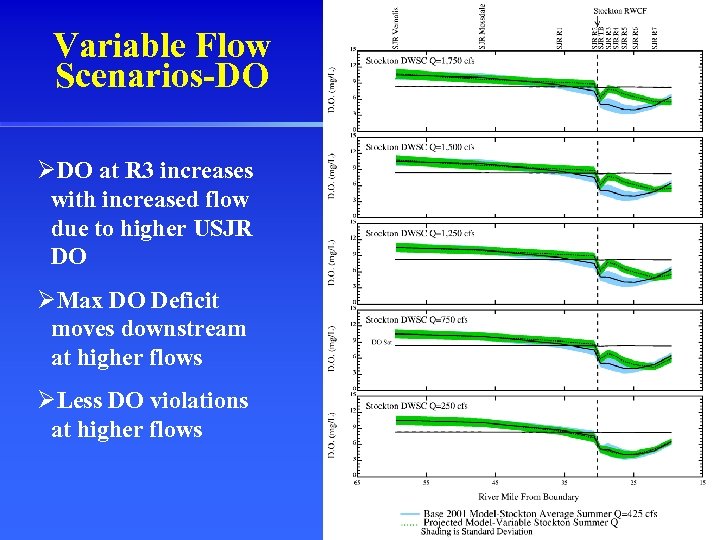 Variable Flow Scenarios-DO ØDO at R 3 increases with increased flow due to higher USJR DO ØMax DO Deficit moves downstream at higher flows ØLess DO violations at higher flows 15
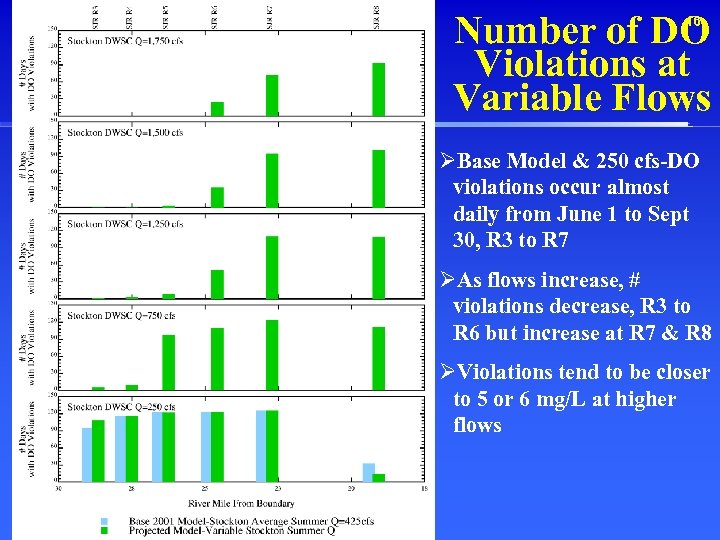 Number of DO Violations at Variable Flows 16 ØBase Model & 250 cfs-DO violations occur almost daily from June 1 to Sept 30, R 3 to R 7 ØAs flows increase, # violations decrease, R 3 to R 6 but increase at R 7 & R 8 ØViolations tend to be closer to 5 or 6 mg/L at higher flows
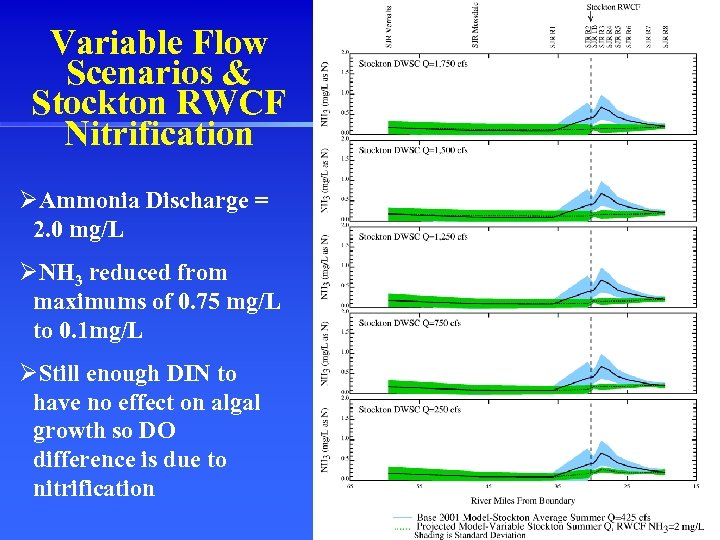 Variable Flow Scenarios & Stockton RWCF Nitrification ØAmmonia Discharge = 2. 0 mg/L ØNH 3 reduced from maximums of 0. 75 mg/L to 0. 1 mg/L ØStill enough DIN to have no effect on algal growth so DO difference is due to nitrification 17
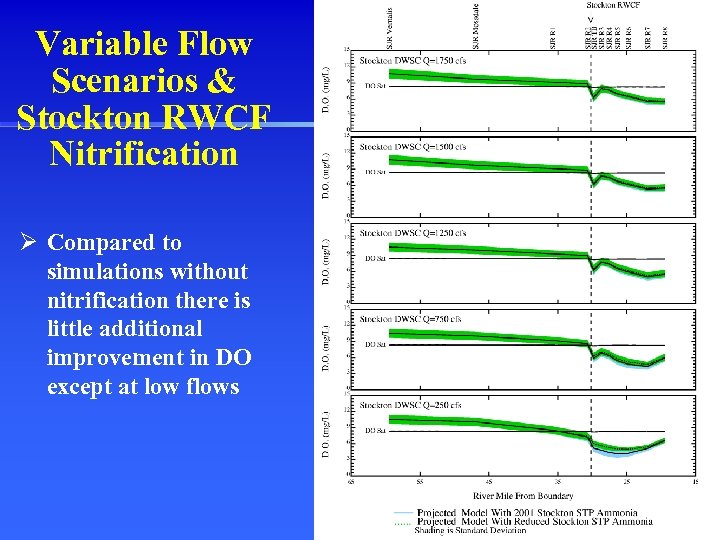 Variable Flow Scenarios & Stockton RWCF Nitrification Ø Compared to simulations without nitrification there is little additional improvement in DO except at low flows 18
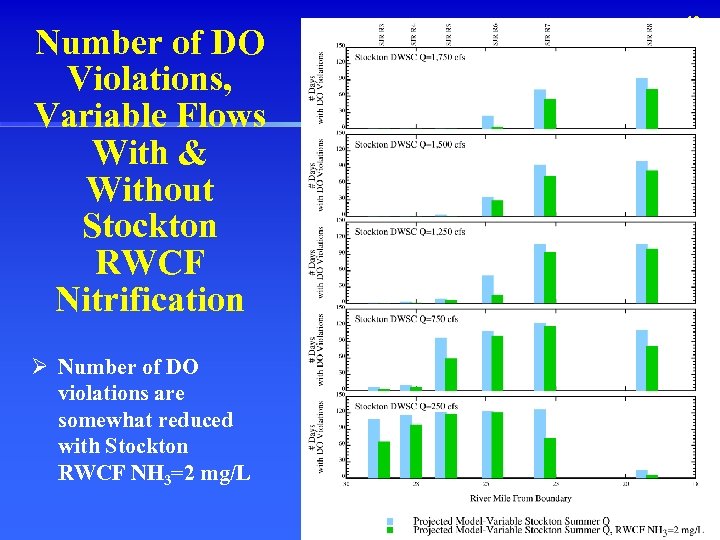 Number of DO Violations, Variable Flows With & Without Stockton RWCF Nitrification Ø Number of DO violations are somewhat reduced with Stockton RWCF NH 3=2 mg/L 19
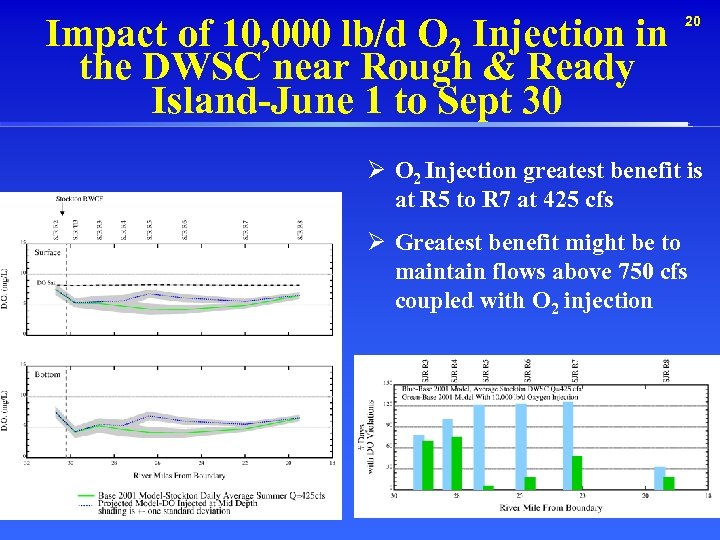 Impact of 10, 000 lb/d O 2 Injection in the DWSC near Rough & Ready Island-June 1 to Sept 30 20 Ø O 2 Injection greatest benefit is at R 5 to R 7 at 425 cfs Ø Greatest benefit might be to maintain flows above 750 cfs coupled with O 2 injection
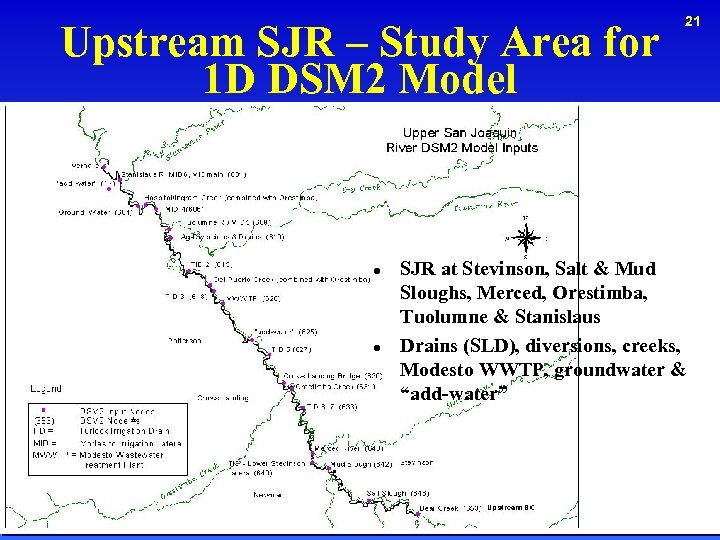 Upstream SJR – Study Area for 1 D DSM 2 Model l l 21 SJR at Stevinson, Salt & Mud Sloughs, Merced, Orestimba, Tuolumne & Stanislaus Drains (SLD), diversions, creeks, Modesto WWTP, groundwater & “add-water”
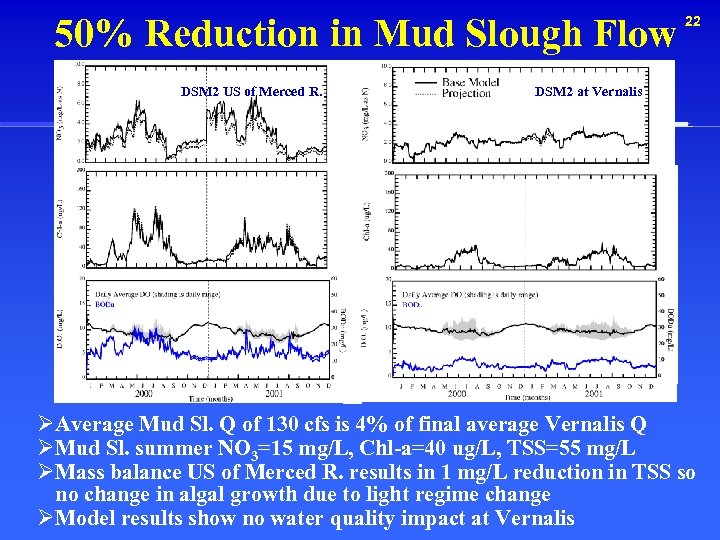 50% Reduction in Mud Slough Flow DSM 2 US of Merced R. 22 DSM 2 at Vernalis ØAverage Mud Sl. Q of 130 cfs is 4% of final average Vernalis Q ØMud Sl. summer NO 3=15 mg/L, Chl-a=40 ug/L, TSS=55 mg/L ØMass balance US of Merced R. results in 1 mg/L reduction in TSS so no change in algal growth due to light regime change ØModel results show no water quality impact at Vernalis
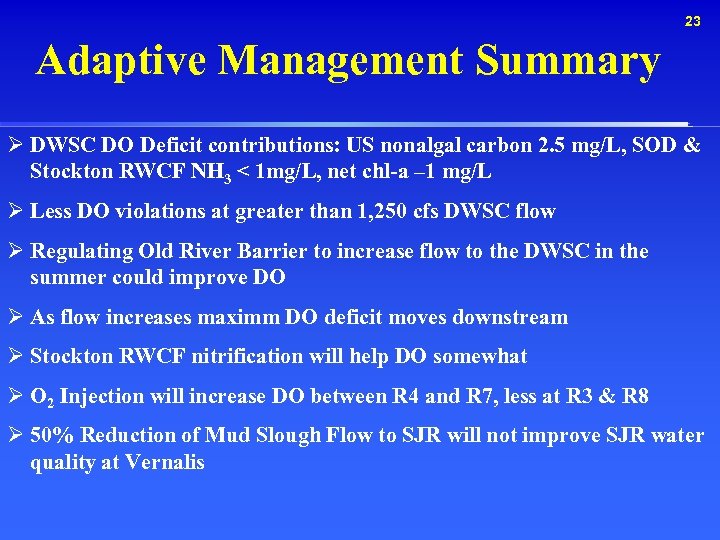 23 Adaptive Management Summary Ø DWSC DO Deficit contributions: US nonalgal carbon 2. 5 mg/L, SOD & Stockton RWCF NH 3 < 1 mg/L, net chl-a – 1 mg/L Ø Less DO violations at greater than 1, 250 cfs DWSC flow Ø Regulating Old River Barrier to increase flow to the DWSC in the summer could improve DO Ø As flow increases maximm DO deficit moves downstream Ø Stockton RWCF nitrification will help DO somewhat Ø O 2 Injection will increase DO between R 4 and R 7, less at R 3 & R 8 Ø 50% Reduction of Mud Slough Flow to SJR will not improve SJR water quality at Vernalis
 24 Additional Recommendations Ø Combination of increased DWSC flow and DO Injection would provide best improvement to DO in the DWSC Ø Lower flow scenarios – need data at lower flows for upstream boundaries Ø Use new upstream data/model results to drive boundary at Vernalis
 25 Viewing RCA Output Ø Web based viewer can be linked to the SJR DO TMDL Website o http: //www. hydroqual. com/projects/sjr/ Ø Hydro. Qual Integrated Modeling System Viewer (HIMSv) for user o Stand-alone executable program that displays Hydro. Qual model results in a GIS environment o Plan view, time series & vertical slices with animation
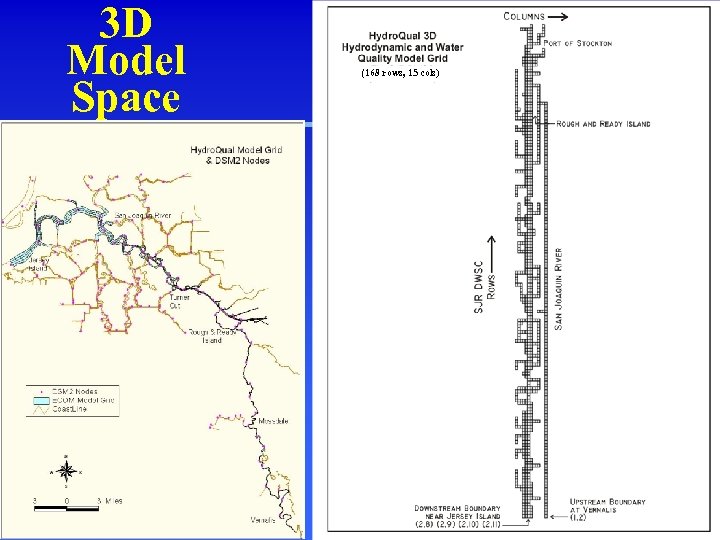 3 D Model Space 26 (168 rows, 15 cols)
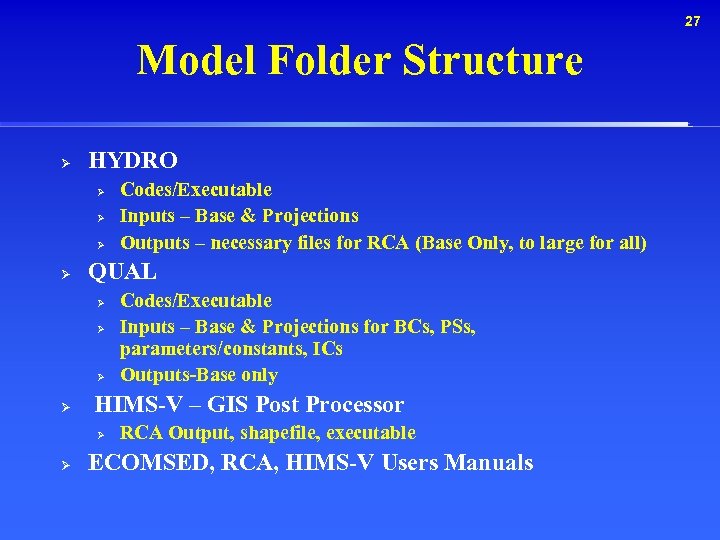 27 Model Folder Structure Ø HYDRO Ø Ø QUAL Ø Ø Codes/Executable Inputs – Base & Projections for BCs, PSs, parameters/constants, ICs Outputs-Base only HIMS-V – GIS Post Processor Ø Ø Codes/Executable Inputs – Base & Projections Outputs – necessary files for RCA (Base Only, to large for all) RCA Output, shapefile, executable ECOMSED, RCA, HIMS-V Users Manuals
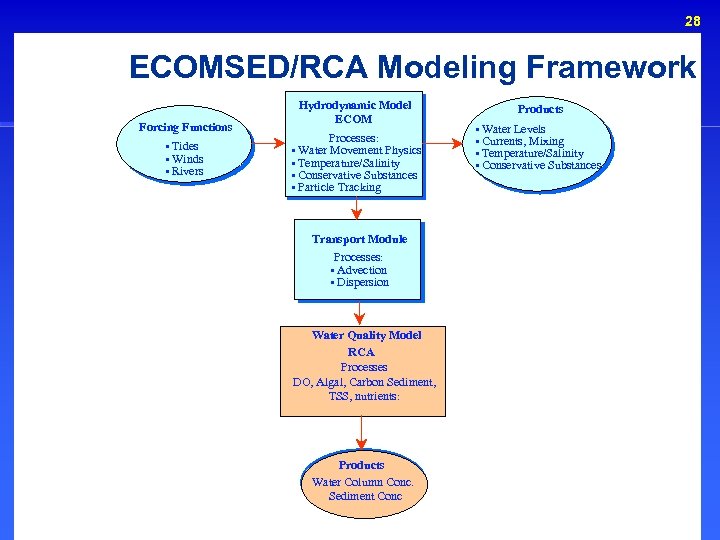 28 ECOMSED/RCA Modeling Framework Forcing Functions • Tides • Winds • Rivers Hydrodynamic Model ECOM Processes: • Water Movement Physics • Temperature/Salinity • Conservative Substances • Particle Tracking Transport Module Processes: • Advection • Dispersion Water Quality Model RCA Processes DO, Algal, Carbon Sediment, TSS, nutrients: Products Water Column Conc. Sediment Conc Products • Water Levels • Currents, Mixing • Temperature/Salinity • Conservative Substances
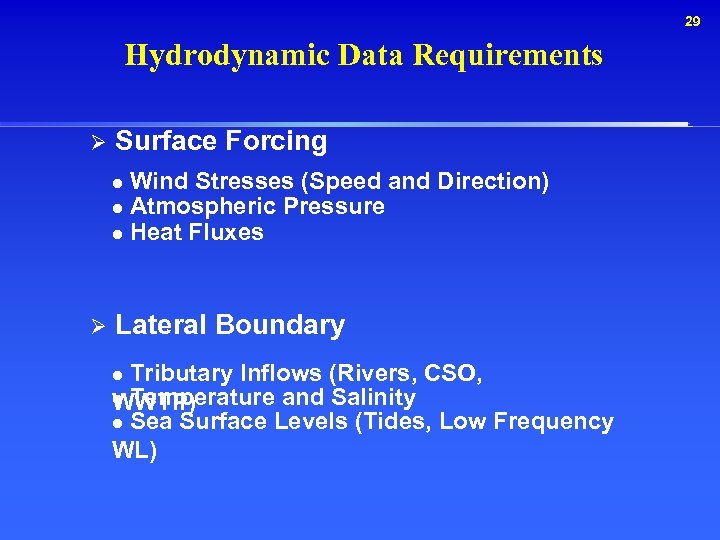 29 Hydrodynamic Data Requirements Ø Surface Forcing Wind Stresses (Speed and Direction) l Atmospheric Pressure l Heat Fluxes l Ø Lateral Boundary Tributary Inflows (Rivers, CSO, l Temperature and Salinity WWTP) l Sea Surface Levels (Tides, Low Frequency WL) l
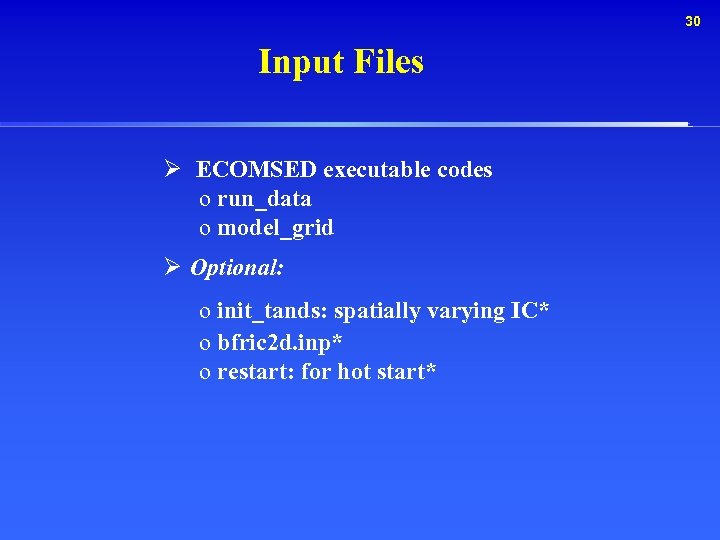 30 Input Files Ø ECOMSED executable codes o run_data o model_grid Ø Optional: o init_tands: spatially varying IC* o bfric 2 d. inp* o restart: for hot start*
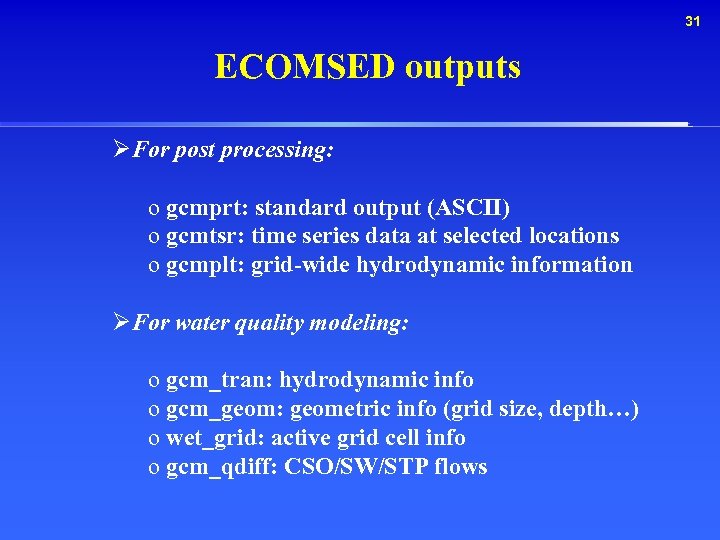 31 ECOMSED outputs ØFor post processing: o gcmprt: standard output (ASCII) o gcmtsr: time series data at selected locations o gcmplt: grid-wide hydrodynamic information ØFor water quality modeling: o gcm_tran: hydrodynamic info o gcm_geom: geometric info (grid size, depth…) o wet_grid: active grid cell info o gcm_qdiff: CSO/SW/STP flows
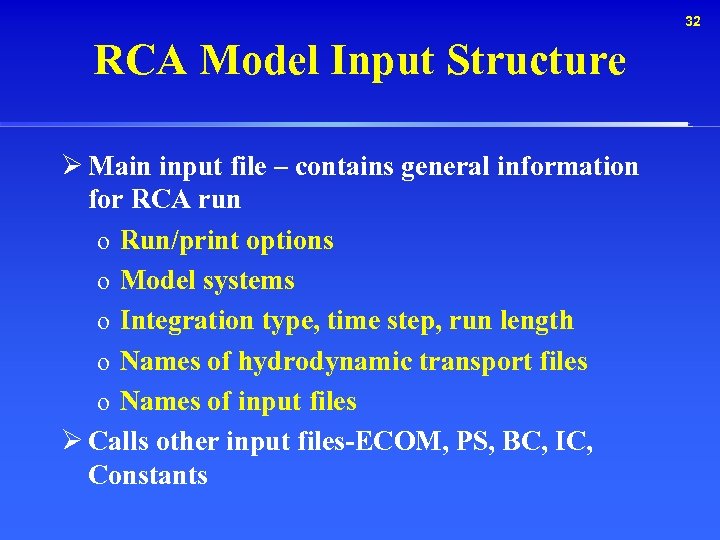 32 RCA Model Input Structure Ø Main input file – contains general information for RCA run o Run/print options o Model systems o Integration type, time step, run length o Names of hydrodynamic transport files o Names of input files Ø Calls other input files-ECOM, PS, BC, IC, Constants
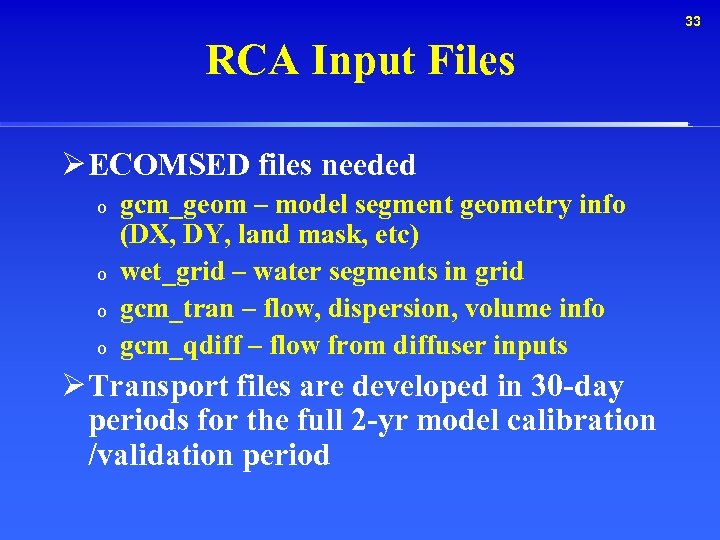 33 RCA Input Files Ø ECOMSED files needed o o gcm_geom – model segment geometry info (DX, DY, land mask, etc) wet_grid – water segments in grid gcm_tran – flow, dispersion, volume info gcm_qdiff – flow from diffuser inputs Ø Transport files are developed in 30 -day periods for the full 2 -yr model calibration /validation period
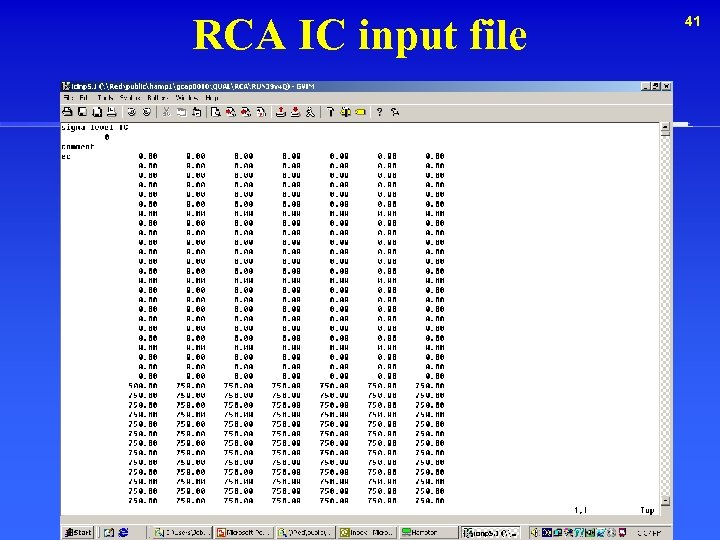
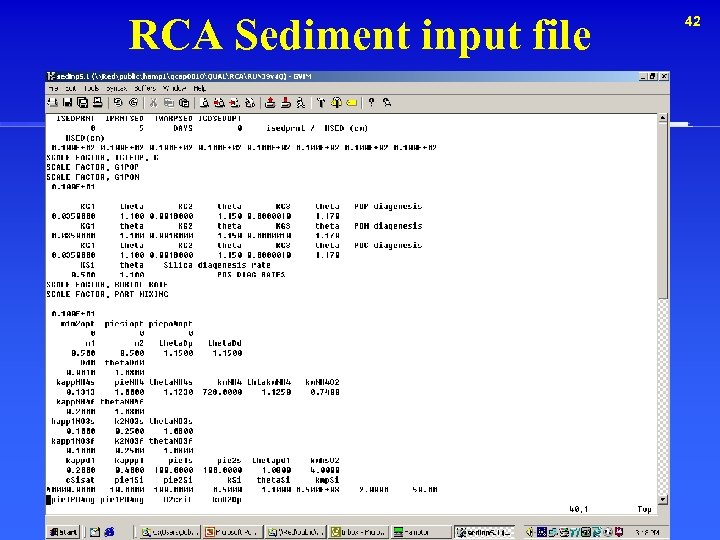
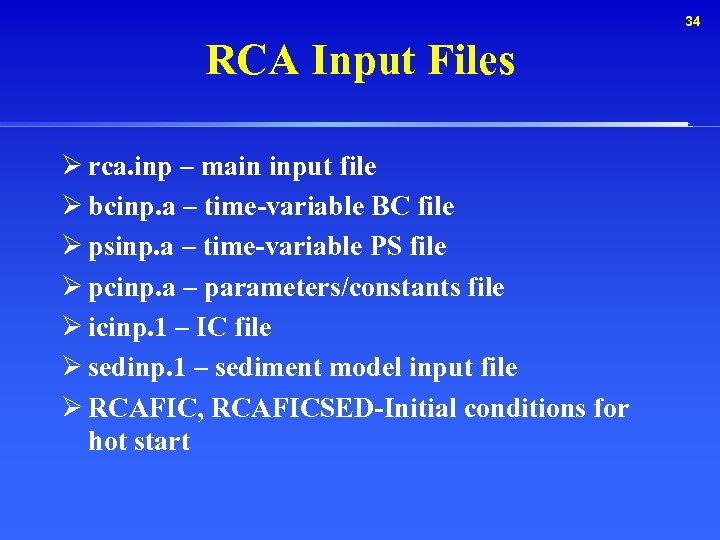 34 RCA Input Files Ø rca. inp – main input file Ø bcinp. a – time-variable BC file Ø psinp. a – time-variable PS file Ø pcinp. a – parameters/constants file Ø icinp. 1 – IC file Ø sedinp. 1 – sediment model input file Ø RCAFIC, RCAFICSED-Initial conditions for hot start
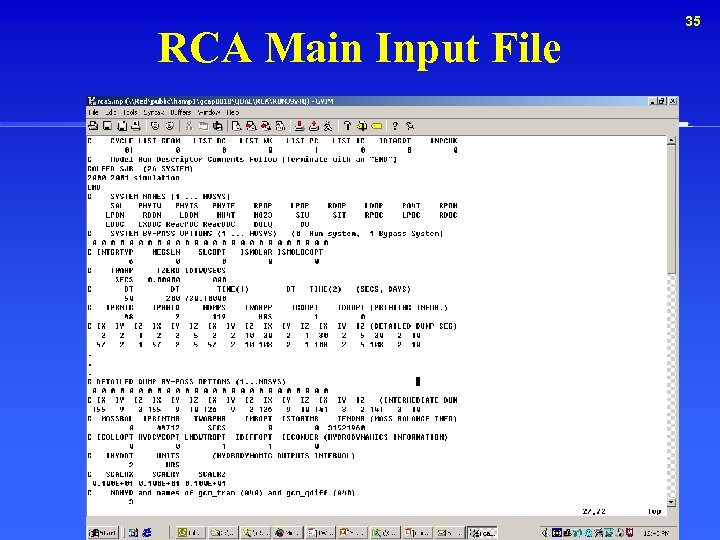 RCA Main Input File 35
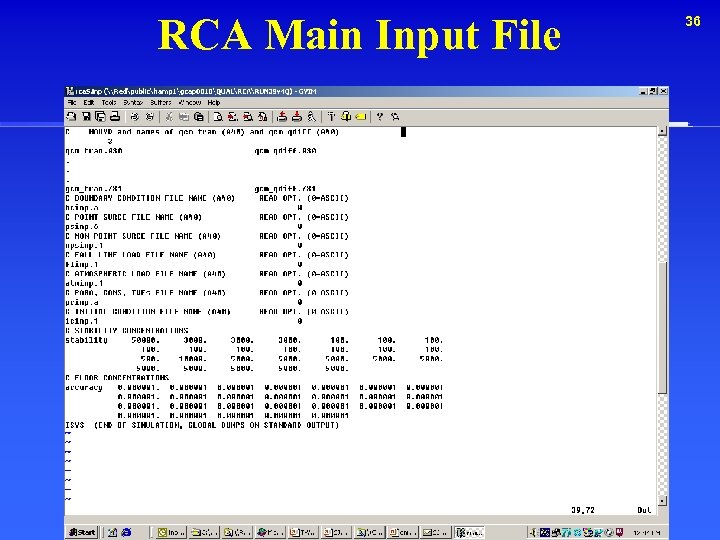 RCA Main Input File 36
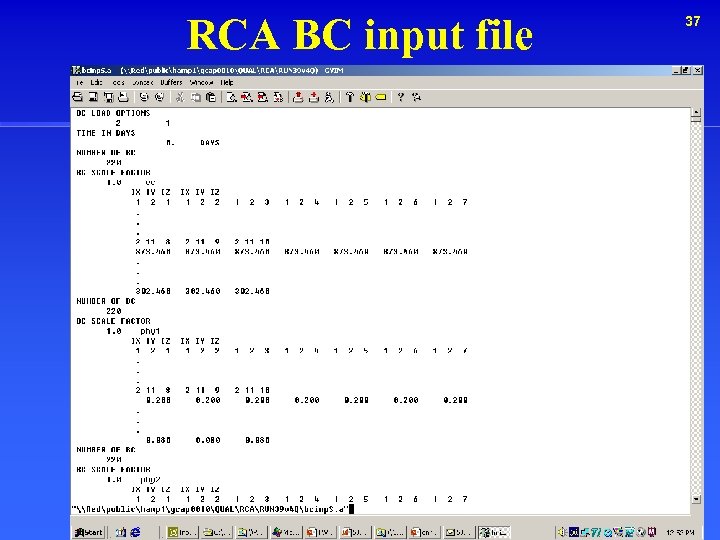 RCA BC input file 37
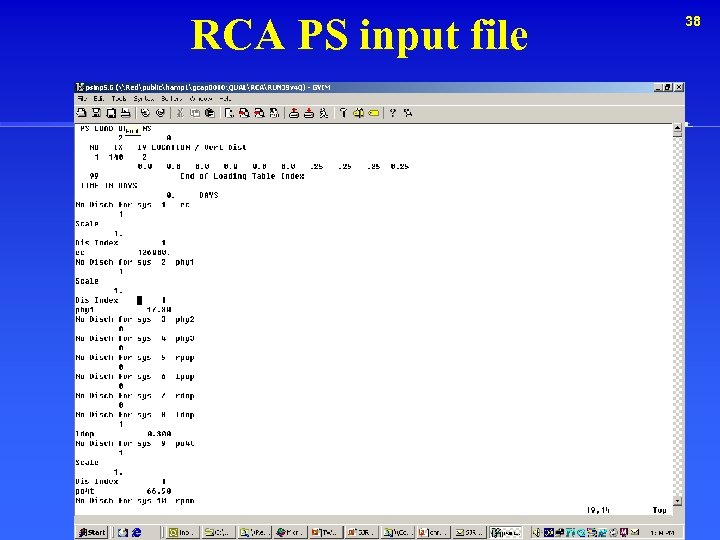 RCA PS input file 38
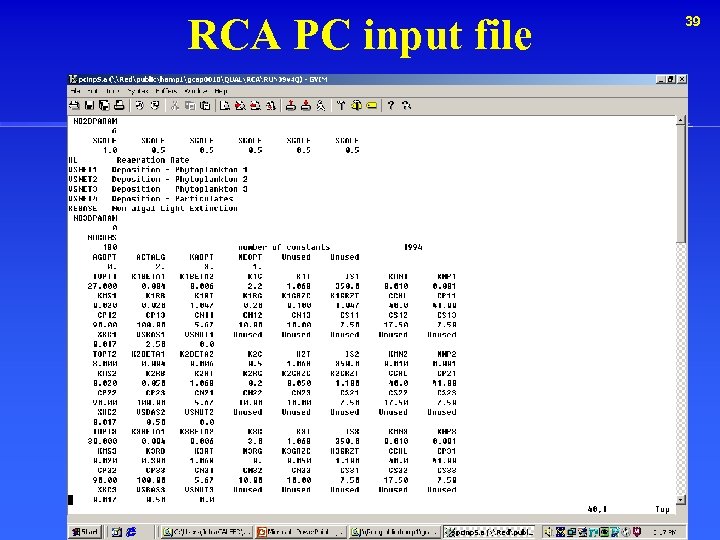 RCA PC input file 39
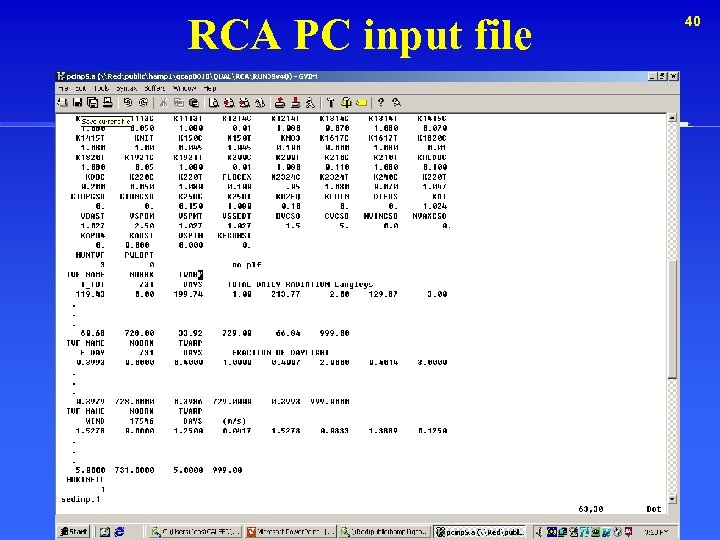 RCA PC input file 40
 RCA IC input file 41
 RCA Sediment input file 42
 43 Running RCA Model Ø Models are compiled with Fortran 77 to run on any PC Ø Most input files are created from stand alone Fortran programs that read data and format to RCA input structure Ø Once created they can be edited with a text editor (Notepad, GVIM) for minor edits or to view inputs
 44 Running RCA Model Ø Create script so that required inputs and executable are linked or copied to run folder Ø Open DOS or CYGWIN window Ø Move to run folder Ø 2 -year calibr/valid period ~18 hours on mainframe
 45 RCA Binary Output Files Ø RCAF 10 – model info & global print times Ø RCAF 11 – global output at all segments Ø RCAF 12 – detailed dump print times Ø RCAF 13 – detailed output at specific segments plus additional model output Ø RCAF 14 – sediment global output Ø RCAFIC & RCAFICSED – water column & sediment IC (end of run for hotstart)
 46 Viewing RCA Output Ø Takes a little time for output processing Ø Requires a number of programs: o GDPME – HQI in-house data processing and graphics program (reads RCA binary output files) o Requires Ghostscript and Ghostview for viewing Postscript files created by GDPME Ø RCA binary output files: RCAF*
 47 Viewing RCA Output Ø Hydro. Qual Integrated Modeling System Viewer (HIMSv) for user o Stand-alone executable program that displays Hydro. Qual model resultsint GIS environment o Plan view, time series & vertical slices with animation Ø Web based viewer can be loaded to the SJR DO TMDL Website o http: //www. hydroqual. com/projects/sjr/
 48 Questions & Answers Contact info: Andy Thuman Laurie De. Rosa Hydro. Qual, Inc. Mahwah, NJ (201) 529 -5151 x 7184 athuman@hydroqual. com
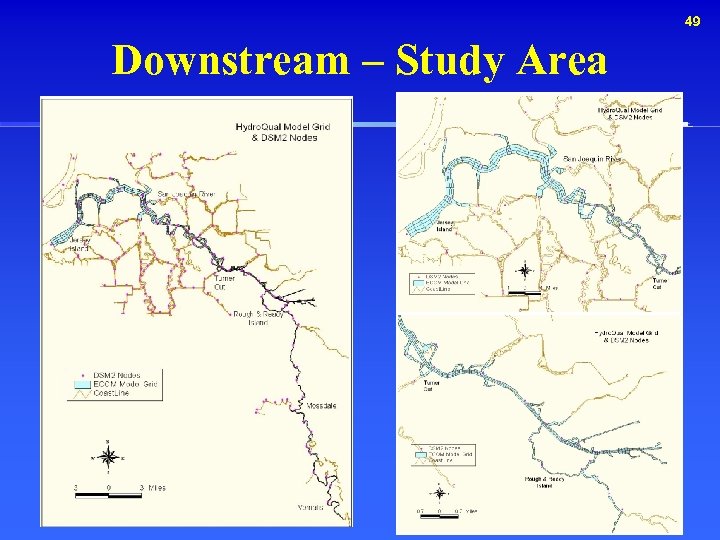 49 Downstream – Study Area