 Скачать презентацию SIZA Guide to using the Ethical Trading Handbook
3dde60a701c9caefab45b21df3b6203b.ppt
- Количество слайдов: 65



SIZA Guide to using the Ethical Trading Handbook March 2014 1
Acknowledgements The SIZA Guide to using the Ethical Trading Handbook has been produced for the SIZA programme as a tool for Ethical Trade Facilitators to present awareness sessions for farm and packhouse emplyoees on how to use the Ethical Trading Handbook. This guide also provides some background to ethical trade but its main focus is to inform people how best to access information in the Ethical Trading Handbook. We gratefully acknowledge all the people in the industry who contributed to the development of this Guide and to the South African Table Grape Industry for funding its development. 2
This pack is a guide to using the Ethical Trading Handbook for farm and packhouse employees and is support material for Ethical Trade Facilitators who run SIZA awareness and training sessions. While the focus is on how to use the Handbook it also provides useful information on the background to Ethical Trade and the SIZA programme, ethical audits and the role of the Ethical Trade Facilitator. It is divided up into 6 sessions each consisting of a number of different topics which can be used as required. 3
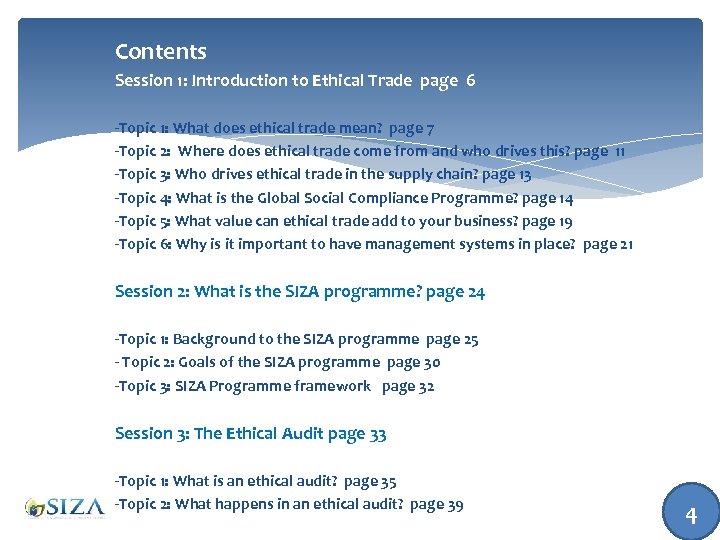
Contents Session 1: Introduction to Ethical Trade page 6 -Topic 1: What does ethical trade mean? page 7 -Topic 2: Where does ethical trade come from and who drives this? page 11 -Topic 3: Who drives ethical trade in the supply chain? page 13 -Topic 4: What is the Global Social Compliance Programme? page 14 -Topic 5: What value can ethical trade add to your business? page 19 -Topic 6: Why is it important to have management systems in place? page 21 Session 2: What is the SIZA programme? page 24 -Topic 1: Background to the SIZA programme page 25 - Topic 2: Goals of the SIZA programme page 30 -Topic 3: SIZA Programme framework page 32 Session 3: The Ethical Audit page 33 -Topic 1: What is an ethical audit? page 35 -Topic 2: What happens in an ethical audit? page 39 4
Contents Session 4: How to use the Ethical Trading Handbook page 42 -Topic 1: Introduction to the scope and content of the ET Handbook page 43 -Topic 2: Finding information in the Ethical Trading Handbook page 46 Session 5: Checklists and Improvement Plans page 51 -Topic 1: How to use the Checklist as a self-audit page 52 -Topic 2: Developing an Improvement Plan page 60 Session 6: The role of the Ethical Trade Facilitator page 63 -Topic 1: What is the role and purpose of the Ethical Trade Facilitator? page 64 -Topic 2: Tasks and responsibilities of the Ethical Trade Facilitator page 66 5
SESSION 1: INTRODUCTION TO ETHICAL TRADE 6
Topic 1: What does ethical trade mean? 7
Ethical trade can have a number of different meanings, but our focus is on ØSocial and labour ethical practices in a business’s supply chain 8
Ethical trade provides assurance to consumers that all the members of the supply chain comply with international standards Supplier commitment is shown by adopting a code of labour practice for example, the SIZA Code of Practice that measures their compliance with minimum labour standards The supplier must demonstrate that he or she is compliant by supplying evidence (for example, a payslip to prove minimum wages are paid and only legal deductions are made) 9
The SIZA Code addresses the following types of issues: Wages Hours of work Health and safety Right to join trade union * The SIZA Code of Practice is based on international conventions and South African labour laws 10
Topic 2: Where does ethical trade come from and who drives it? 11
The SIZA Code is based on: ILO conventions that prescribe minimum standards South African legislation 12
Topic 3: Who drives ethical trade in the supply chain? 13
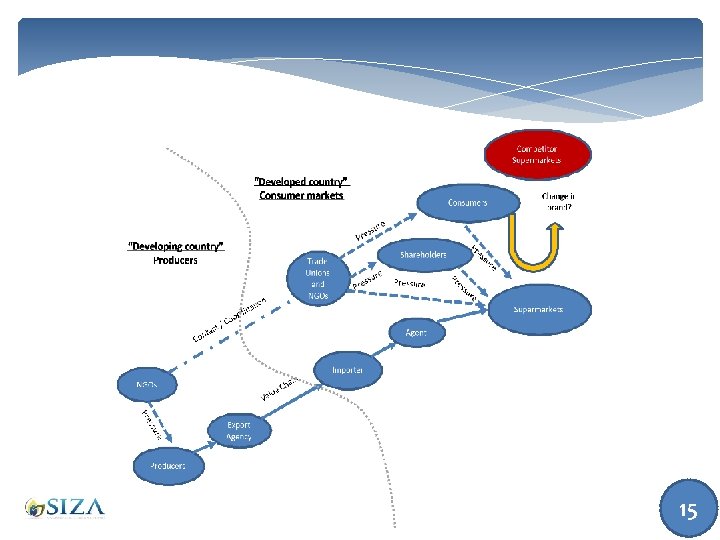
Ultimately it is the consumer that wants to know that the food they buy is being produced in an ethically sound environment Pressure to prove ethical compliance comes from consumers and civil society (NGO’s and labour unions) due to concerns over social and environmental conditions in supply chains The media and research reports tell the stories 14
15

Topic 4: What is the Global Social Compliance Programme? 16
Global Social Compliance Programme (GSCP) An initiative of retailers (eg. Tesco, M&S, Ahold, Migros) to support principles of non-duplication of ethical audits GSCP reference code combines all the principles of the international ethical codes (ETI, BSCI, SA 8 OOO) into a single reference code The reference code can be adopted by industries such as the fruit industry as a platform for their own ethical standard Fruit SA used the GSCP reference code as a platform to benchmark the SIZA Standard against international requirements and was found to be 92% equivalent Ø Aim? To reduce duplication of audits and to develop a clear, consistent message on best practice for suppliers globally Ø Why? To continuously improve conditions in the workplace 17
The South African fruit industry was proactive in its response by initiating its own ethical trade programme, using the GSCP reference tools as a globally accepted platform to benchmark its own Standard 18
Topic 5: What value can ethical trade add to your business? 19
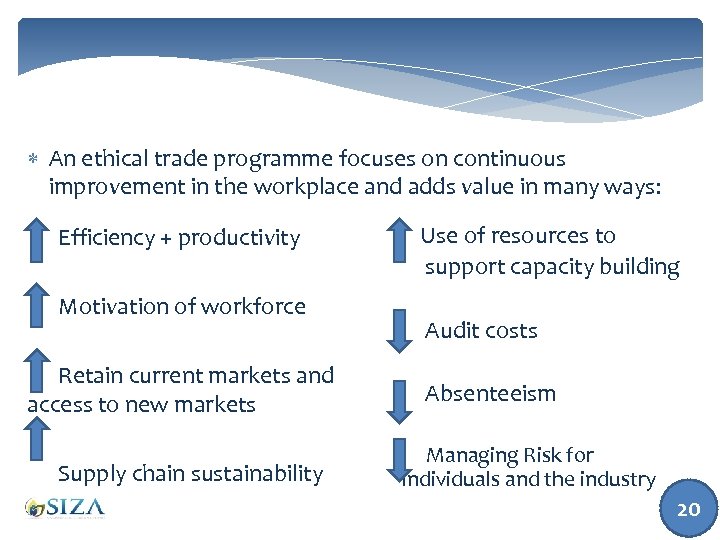
An ethical trade programme focuses on continuous improvement in the workplace and adds value in many ways: Efficiency + productivity Motivation of workforce Retain current markets and access to new markets Supply chain sustainability Use of resources to support capacity building Audit costs Absenteeism Managing Risk for individuals and the industry 20
Topic 6: Why is it important to have management systems in place? 21
Good management systems allow a business to run effectively They help to demonstrate to an auditor that the business complies with ethical standards You must be able to show proof of everything you say that you do 22
Examples that can be used as proof: Payslips – can prove how much employees have been paid Employee contracts – can prove that somebody is employed, for how long and under what conditions Workplace policies – should be visible in the workplace, explained to all employees and used to demonstrate the business’ position on critical issues such as: o Discrimination o Ethical trade o Child labour o Sexual harassment 23
SESSION 2: WHAT IS THE SIZA PROGRAMME? 24
Topic 1: Background to the SIZA Programme 25
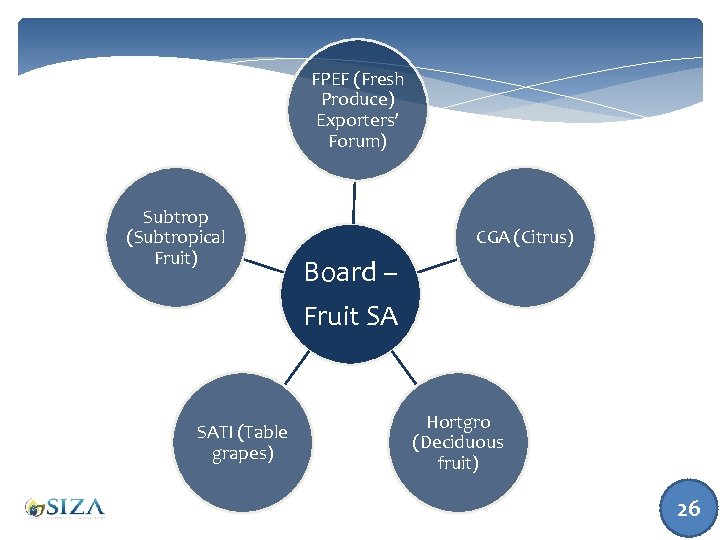
FPEF (Fresh Produce) Exporters’ Forum) Subtrop (Subtropical Fruit) CGA (Citrus) Board – Fruit SA SATI (Table grapes) Hortgro (Deciduous fruit) 26
These organizations come together to represent the industry’s interests around common issues Example: Ethical Trade FSA represents 5, 000 producers 400, 000 employees FPEF represents 110 export houses 27
FSA developed + implemented an Ethical Trade programme, later formalised as the Sustainbility Initiative of South Africa (SIZA), in response to increasing demands on growers by international retailers. SIZA Programme is: Locally managed, locally relevant Aligned to South African legislation Complies with international standards and requirements Allows growers to avoid duplication of ethical audits Allows for collection of data to inform needs Provides support for growers (capacity-building programme) Focus on continuous improvement (development-led not audit-led) 28
SIZA Programme includes: SA standard (based on GSCP reference code; aligned to SA law) Audit methodology (based on GSCP reference tool) How the audit will take place How often audits will take place How non-compliances will be verified, etc Auditor recognition (based on GSCP reference tool) Ethical Programme Guidelines Management structure Dealing with complaints (eg from audits) Capturing data Support for continuous improvement, etc 29
Topic 2: Goals of the SIZA programme 30
Goals of the SIZA Programme are: To ensure the industry drives its own ethical trade programme in a professional manner To support ongoing improvement of labour conditions on fruit farms and pack houses To help manage commercial risks allied to ethical trade matters To give retailers + other stakeholders confidence in South African supply base Reduce the number, duplication + costs of audits by converging with other ethical programmes To support ethical practices along the supply chain 31
Topic 3: The SIZA Programme Framework 32
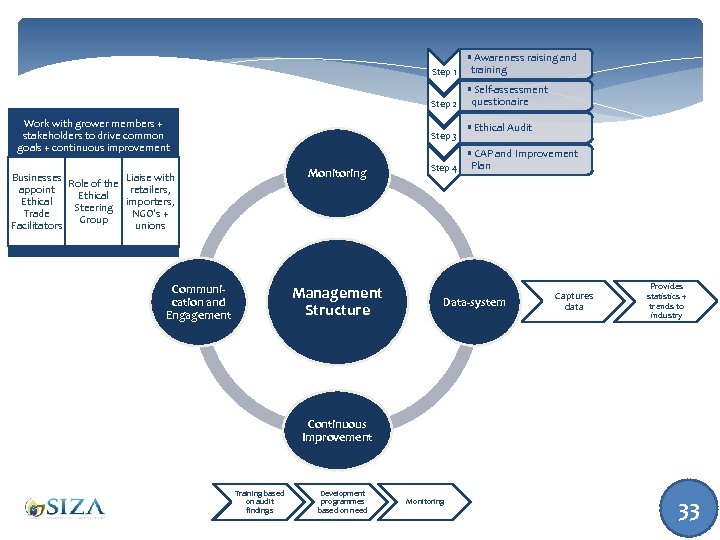
Step 1 Step 2 Work with grower members + stakeholders to drive common goals + continuous improvement • Awareness raising and training • Self-assessment questionaire Step 3 Monitoring Businesses Liaise with Role of the appoint retailers, Ethical importers, Steering Trade NGO’s + Group Facilitators unions Communication and Engagement Management Structure Step 4 • Ethical Audit • CAP and Improvement Plan Data-system Captures data Provides statistics + trends to industry Continuous Improvement Training based on audit findings Development programmes based on need Monitoring 33
SESSION 3: THE ETHICAL AUDIT 34
Topic 1: What is an Ethical Audit? 35

Ethical audit: Aims to measure current performance Identifies areas where improvements can be made Involves interviews with employees Conducted by professionally trained auditors Ø More time-consuming and costly then other audits, therefore takes place less frequently based on SIZA Audit Frequency Matrix (frequency depends on nuber of noncompliances) 36
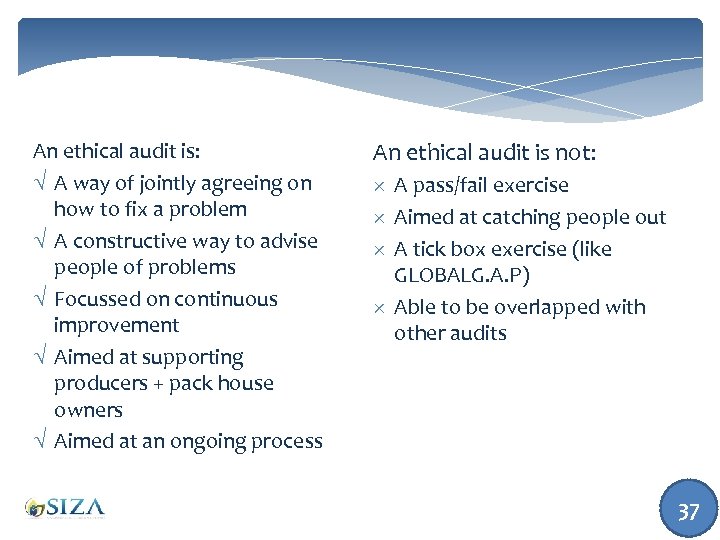
An ethical audit is: A way of jointly agreeing on how to fix a problem A constructive way to advise people of problems Focussed on continuous improvement Aimed at supporting producers + pack house owners Aimed at an ongoing process An ethical audit is not: A pass/fail exercise Aimed at catching people out A tick box exercise (like GLOBALG. A. P) Able to be overlapped with other audits 37
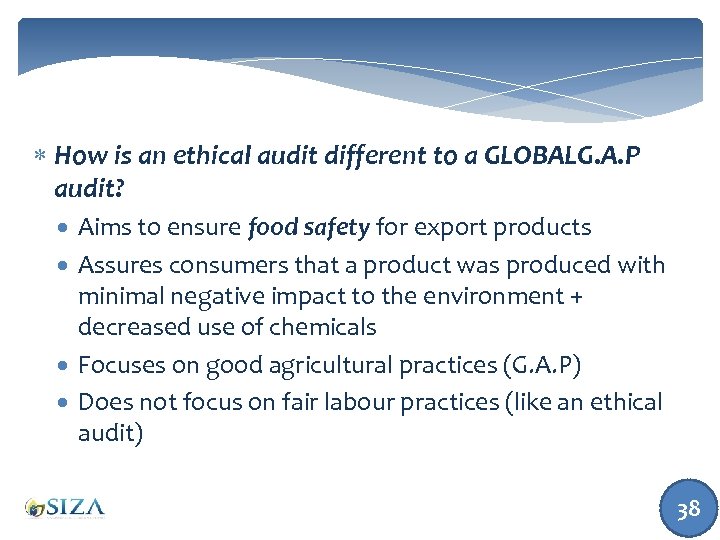
How is an ethical audit different to a GLOBALG. A. P audit? Aims to ensure food safety for export products Assures consumers that a product was produced with minimal negative impact to the environment + decreased use of chemicals Focuses on good agricultural practices (G. A. P) Does not focus on fair labour practices (like an ethical audit) 38
Topic 2: What happens in an ethical audit? 39
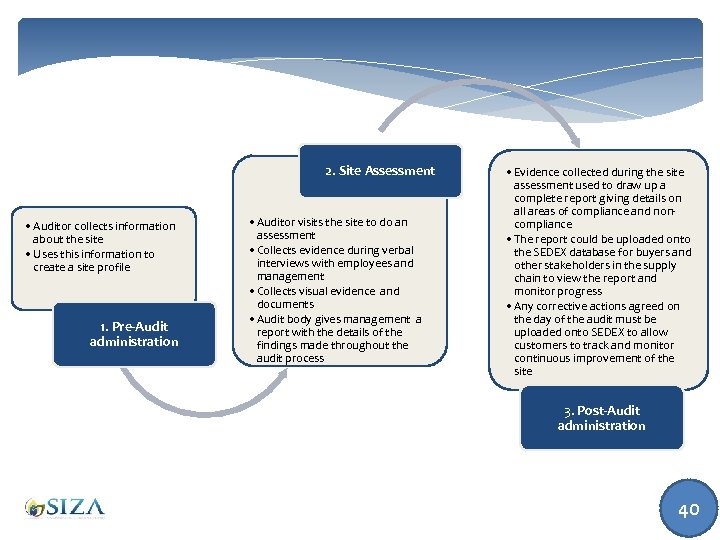
2. Site Assessment • Auditor collects information about the site • Uses this information to create a site profile 1. Pre-Audit administration • Auditor visits the site to do an assessment • Collects evidence during verbal interviews with employees and management • Collects visual evidence and documents • Audit body gives management a report with the details of the findings made throughout the audit process • Evidence collected during the site assessment used to draw up a complete report giving details on all areas of compliance and noncompliance • The report could be uploaded onto the SEDEX database for buyers and other stakeholders in the supply chain to view the report and monitor progress • Any corrective actions agreed on the day of the audit must be uploaded onto SEDEX to allow customers to track and monitor continuous improvement of the site 3. Post-Audit administration 40
What is the purpose of the feedback session? Conducted after the site assessment Between the auditors and management To discuss any non-compliances found How these can be addressed What actions will be taken + by whom Agreed by both parties Uploaded onto the system once corrective measures have been completed 41
SESSION 4: HOW TO USE THE ETHICAL TRADING HANDBOOK 42
Topic 1: Introduction to the scope and content of the Ethical Trading Handbook 43
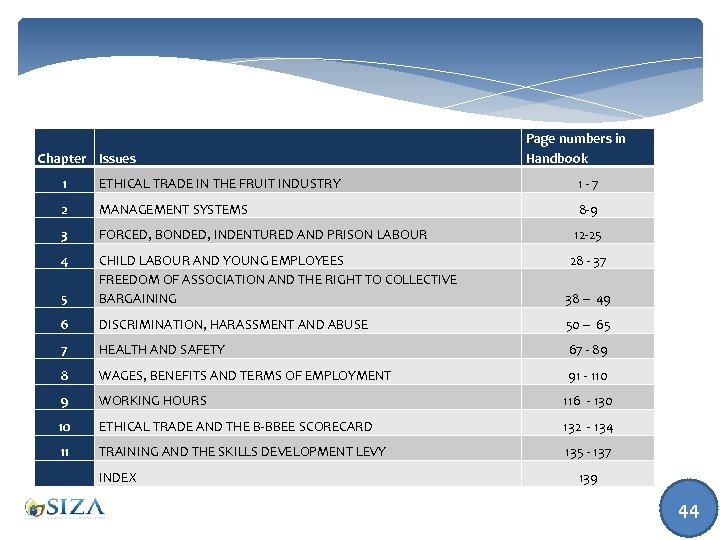
Chapter Issues Page numbers in Handbook 1 ETHICAL TRADE IN THE FRUIT INDUSTRY 1 - 7 2 MANAGEMENT SYSTEMS 8 -9 3 FORCED, BONDED, INDENTURED AND PRISON LABOUR 4 5 CHILD LABOUR AND YOUNG EMPLOYEES FREEDOM OF ASSOCIATION AND THE RIGHT TO COLLECTIVE BARGAINING 38 – 49 6 DISCRIMINATION, HARASSMENT AND ABUSE 50 – 65 7 HEALTH AND SAFETY 67 - 89 8 WAGES, BENEFITS AND TERMS OF EMPLOYMENT 91 - 110 9 WORKING HOURS 116 - 130 10 ETHICAL TRADE AND THE B-BBEE SCORECARD 132 - 134 11 TRAINING AND THE SKILLS DEVELOPMENT LEVY 135 - 137 INDEX 12 -25 28 - 37 139 44
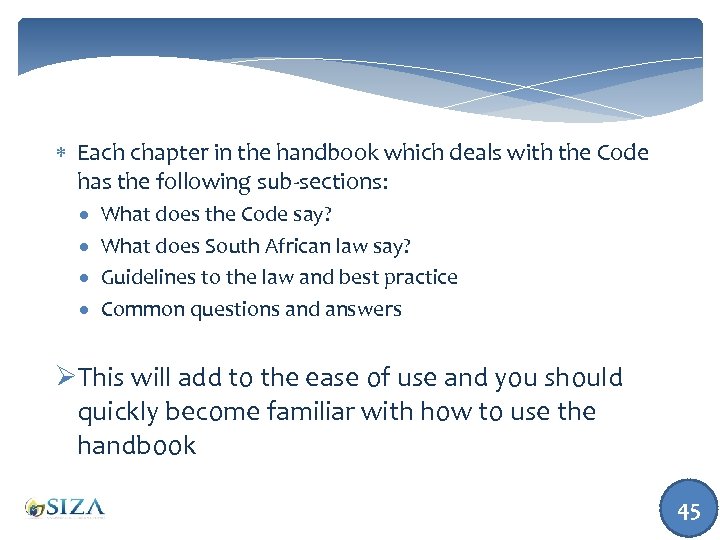
Each chapter in the handbook which deals with the Code has the following sub-sections: What does the Code say? What does South African law say? Guidelines to the law and best practice Common questions and answers ØThis will add to the ease of use and you should quickly become familiar with how to use the handbook 45
Topic 2: Finding information in the Handbook 46
1. Identify the issue that you have and need assistance with 2. Go to the index at the back of the Handbook and search for that topic (in alphabetical order) 3. Now go to the relevant page number in the Handbook ØDon’t forget there is also more information available on the website: www. fsa-ethical. org. za 47
Case Study 1: Sexual Harassment / Discrimination Sara lodged a complaint of sexual harassment with the manager of the farm. She said the supervisor in her section often came physically close to her, sometimes touching her and then making comments of a sexual nature. She stated she had complained to management before but her complaints were ignored. She also said that she believed she had been overlooked for promotion because she was a woman and that jobs which she was qualified to do had been given to men with less skills than her. Questions: What is/are the issue(s)? What does the law say? What is recommended (Best Practice)? Where did you find the information? 48
Case Study 2: Child Labour John is a producer and he employs young people over the age of 15 years to work during holidays. Fanie is one of the young boys he employs. Fanie is 16 years old and asks John for full time employment on the farm. He says he has left school because his parents can’t afford to send him and they need him to earn some money for the family. John wants to know whether it is legal to employ the young people during the school holidays and also whether he can employ Fanie seeing as he has left school and he urgently needs to earn an income. Questions: What is/are the issue(s)? What does the law say? What is recommended (Best Practice)? Where did you find the information? 49
Case Study 3: Loans / Deductions Basie is a small-scale grower with 15 permanent workers. Basie regularly loans money to his employees for them to buy food at the farm shop. He deducts this amount off their wages every week. He writes down the purchases in a small book at the shop but doesn’t get the workers to sign for this. However his workers are now complaining that he is deducting too much from their wages. Basie wants to stop making the loans. He comes to you for advice because he wants to do what is right in terms of the law. Questions: What is/are the issue(s)? What does the law say? What is recommended (Best Practice)? Where did you find the information? 50
SESSION 5: CHECKLISTS AND IMPROVEMENT PLANS 51
Topic 1: How to use the Checklist as a self-audit 52
Checklists? Found at the end of each chapter in the Handbook Reflect the requirements of the Ethical Standard Used as a form of self-audit 1. To check whether your site is compliant 2. To ensure you have all the evidence needed to prove this 53
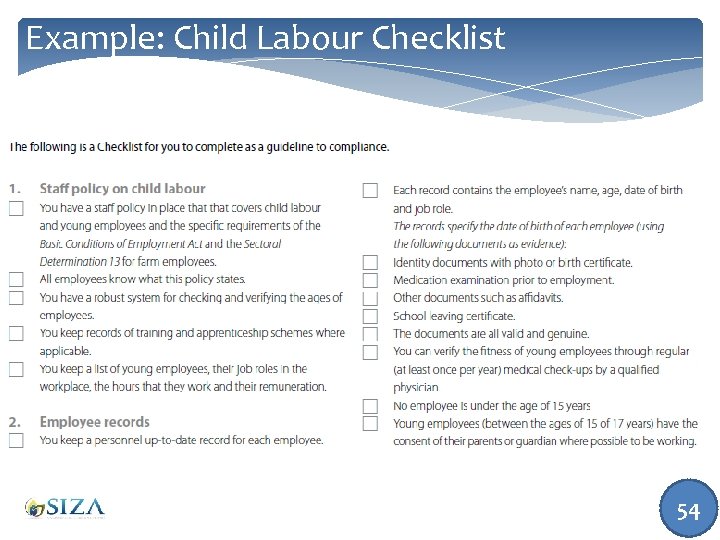
Example: Child Labour Checklist 54
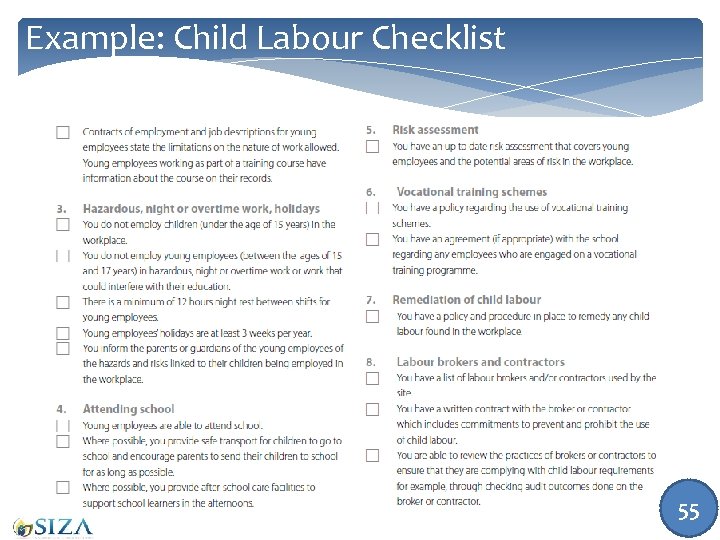
Example: Child Labour Checklist 55
Topic 2: Developing an Improvement Plan 60
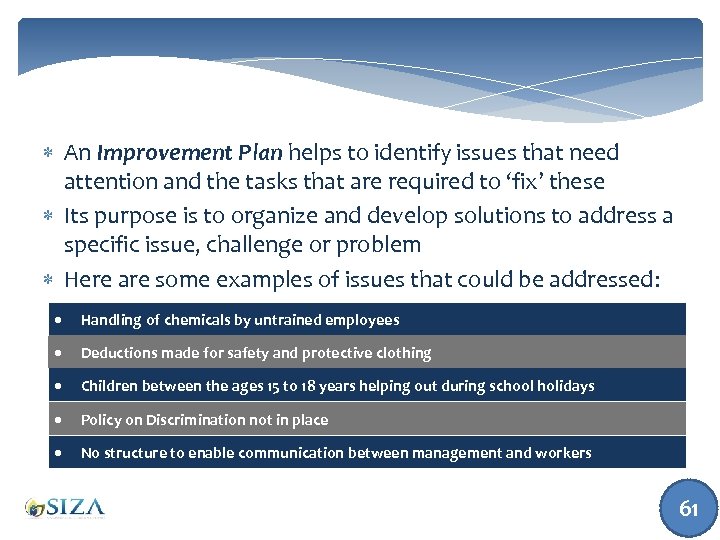
An Improvement Plan helps to identify issues that need attention and the tasks that are required to ‘fix’ these Its purpose is to organize and develop solutions to address a specific issue, challenge or problem Here are some examples of issues that could be addressed: Handling of chemicals by untrained employees Deductions made for safety and protective clothing Children between the ages 15 to 18 years helping out during school holidays Policy on Discrimination not in place No structure to enable communication between management and workers 61
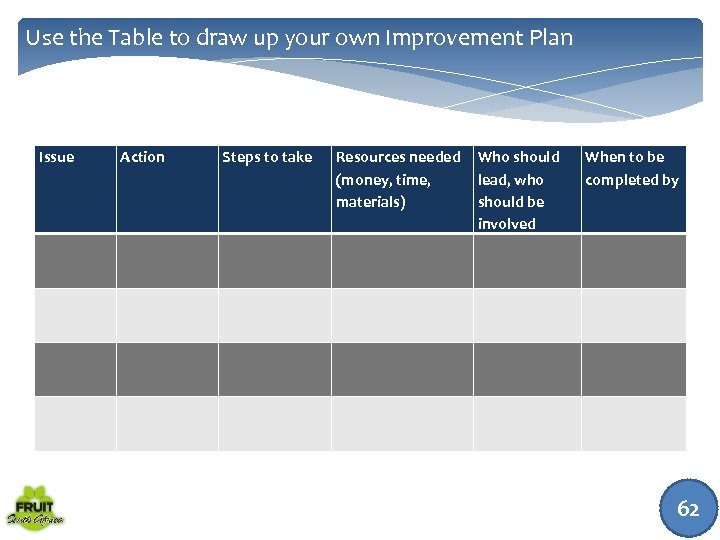
Use the Table to draw up your own Improvement Plan Issue Action Steps to take Resources needed Who should (money, time, lead, who materials) should be involved When to be completed by 62
SESSION 6: THE ROLE OF THE ETHICAL TRADE FACILITATOR 63
Topic 1: What is the role and purpose of the Ethical Trade Facilitator? 64
Ø The Ethical Trade Facilitator has a very important role to play in his/her own organization! 1. To promote understanding of ethical trade 2. To recognise people who support ethical trade in their supply chain 3. To actively participate in the SIZA programme 4. To build momentum, capability + ownership for ethical trade in the business 5. To deliver on the goals of the SIZA Programme 65
Topic 2: Tasks and Responsibilities of the Ethical Trade Facilitator 66
ØEthical Trade Facilitators play a supportive role in their own organisations or for suppliers by encouraging and building an understanding of the requirements of the ethical trade programme 67
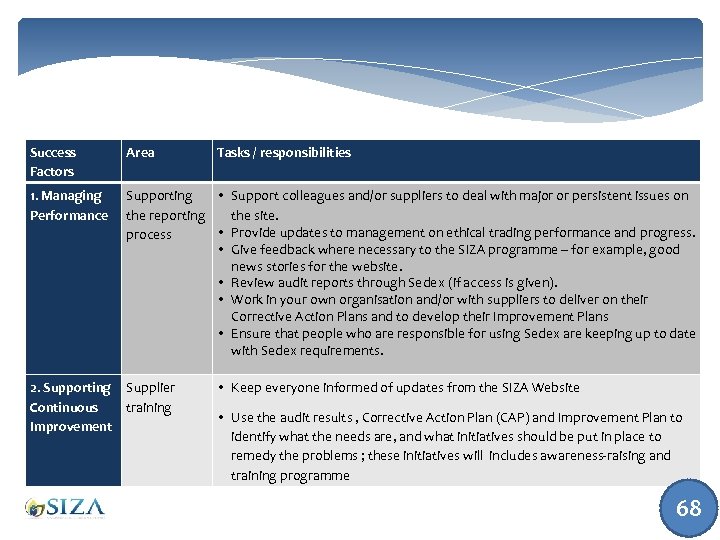
Success Factors Area 1. Managing Performance Supporting • Support colleagues and/or suppliers to deal with major or persistent issues on the reporting the site. • Provide updates to management on ethical trading performance and progress. process • Give feedback where necessary to the SIZA programme – for example, good news stories for the website. • Review audit reports through Sedex (if access is given). • Work in your own organisation and/or with suppliers to deliver on their Corrective Action Plans and to develop their Improvement Plans • Ensure that people who are responsible for using Sedex are keeping up to date with Sedex requirements. 2. Supporting Supplier Continuous training Improvement Tasks / responsibilities • Keep everyone informed of updates from the SIZA Website • Use the audit results , Corrective Action Plan (CAP) and Improvement Plan to identify what the needs are, and what initiatives should be put in place to remedy the problems ; these initiatives will includes awareness-raising and training programme 68
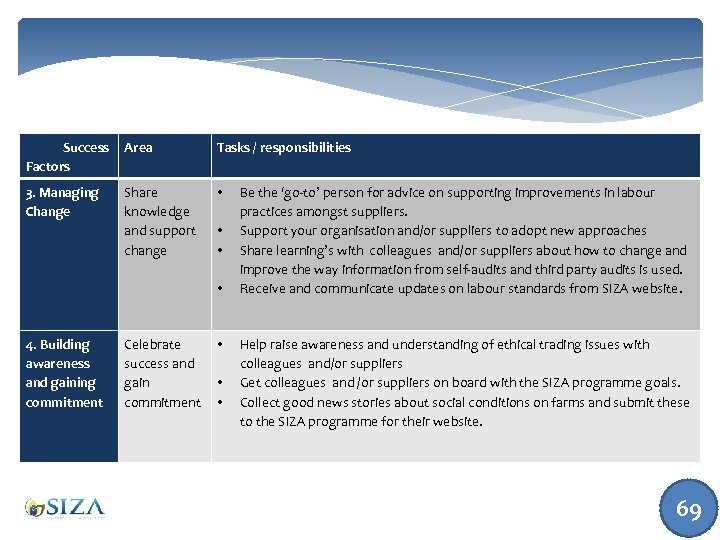
Success Area Factors Tasks / responsibilities 3. Managing Change • Share knowledge and support change • • • 4. Building awareness and gaining commitment Celebrate success and gain commitment • • • Be the ‘go-to’ person for advice on supporting improvements in labour practices amongst suppliers. Support your organisation and/or suppliers to adopt new approaches Share learning’s with colleagues and/or suppliers about how to change and improve the way information from self-audits and third party audits is used. Receive and communicate updates on labour standards from SIZA website. Help raise awareness and understanding of ethical trading issues with colleagues and/or suppliers Get colleagues and /or suppliers on board with the SIZA programme goals. Collect good news stories about social conditions on farms and submit these to the SIZA programme for their website. 69
Скачать презентацию SIZA Guide to using the Ethical Trading Handbook
3dde60a701c9caefab45b21df3b6203b.ppt