


 Скачать презентацию Sixth Framework Programme Thematic Priority 3 — NMP
1b672e14ce9a87659e004559880fefd5.ppt
- Количество слайдов: 51
 Sixth Framework Programme Thematic Priority 3 - NMP Nanotechnology & nanosciences, knowledge-based functional Materials, new Production Processes & devices Overview, Instruments and Prospects Georgios Katalagarianakis
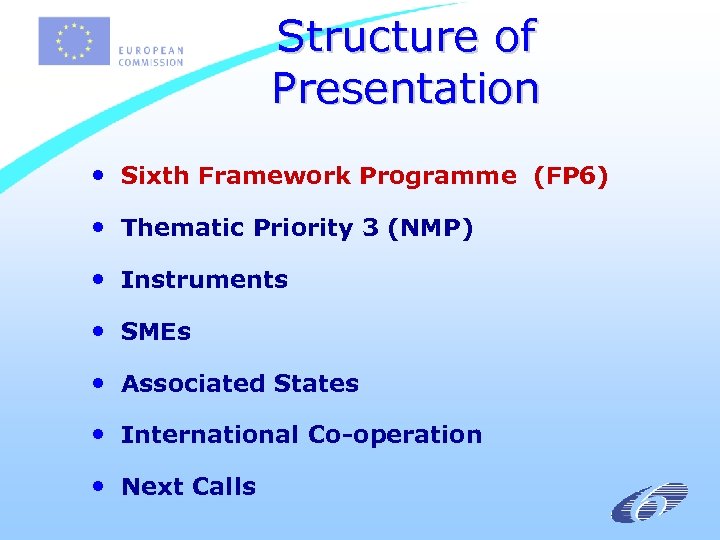 Structure of Presentation • Sixth Framework Programme (FP 6) • Thematic Priority 3 (NMP) • Instruments • SMEs • Associated States • International Co-operation • Next Calls
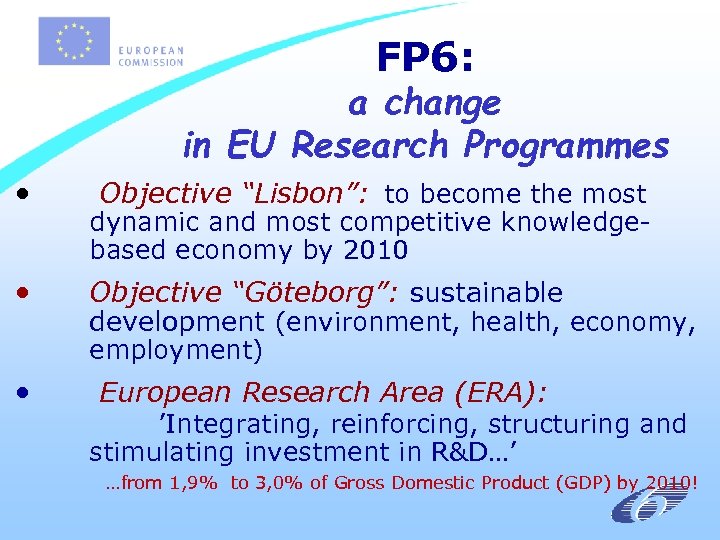 FP 6: a change in EU Research Programmes • • Objective “Lisbon”: to become the most dynamic and most competitive knowledgebased economy by 2010 Objective “Göteborg”: sustainable development (environment, health, economy, employment) • European Research Area (ERA): ’Integrating, reinforcing, structuring and stimulating investment in R&D…’ …from 1, 9% to 3, 0% of Gross Domestic Product (GDP) by 2010!
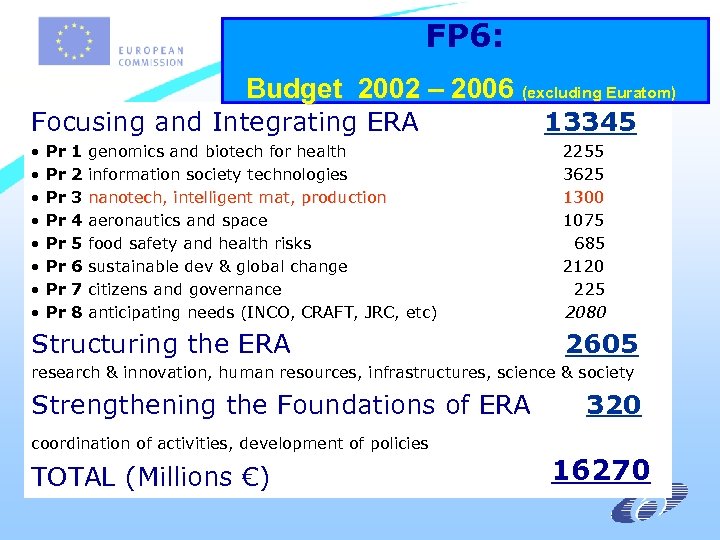 FP 6: Budget 2002 – 2006 (excluding Euratom) Focusing and Integrating ERA • • Pr Pr 1 2 3 4 5 6 7 8 genomics and biotech for health information society technologies nanotech, intelligent mat, production aeronautics and space food safety and health risks sustainable dev & global change citizens and governance anticipating needs (INCO, CRAFT, JRC, etc) Structuring the ERA 13345 2255 3625 1300 1075 685 2120 225 2080 2605 research & innovation, human resources, infrastructures, science & society Strengthening the Foundations of ERA coordination of activities, development of policies TOTAL (Millions €) 320 16270
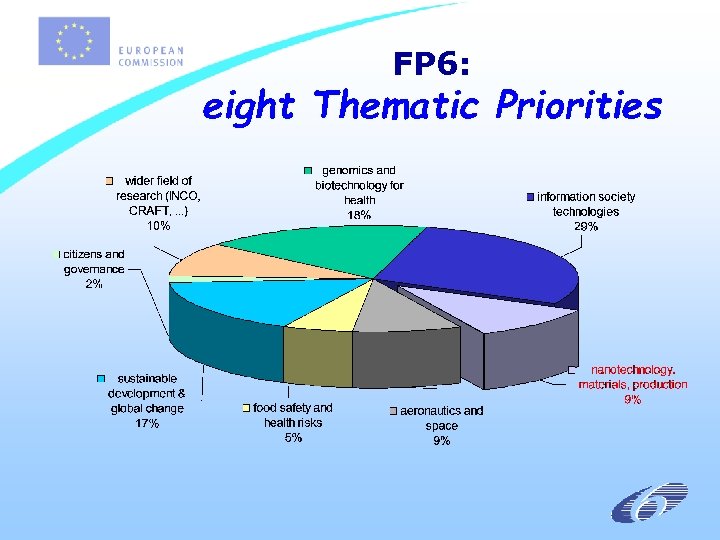 FP 6: eight Thematic Priorities
 Structure of Presentation • FP 6 • Thematic Priority 3 (NMP) • Instruments • SMEs • Associated States • International Co-operation • Next Calls
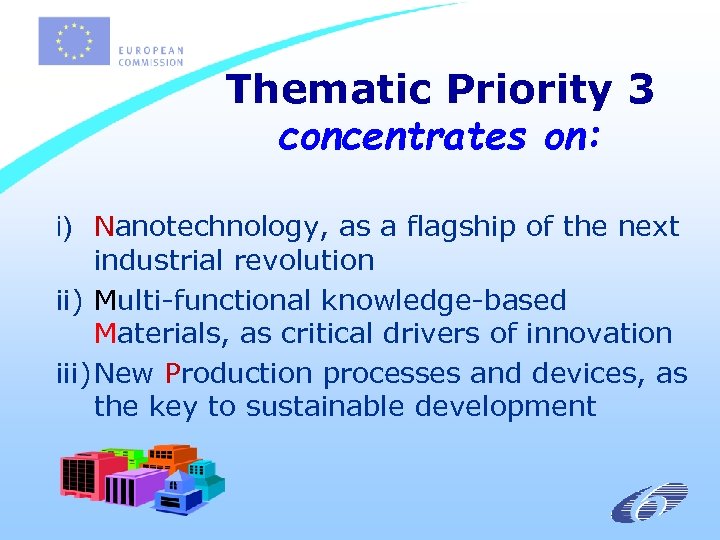 Thematic Priority 3 concentrates on: i) Nanotechnology, as a flagship of the next industrial revolution ii) Multi-functional knowledge-based Materials, as critical drivers of innovation iii)New Production processes and devices, as the key to sustainable development
 Thematic Priority 3 (1300 million €) Overall approach and general objectives To support integrated research activities on nanotechnologies, materials, production processes, instruments, devices and applications for many sectors. . . towards Knowledge-based Enterprises !
 Thematic Priority 3 Specific objectives Transformation of EU industry with a view to sustainable development • From resource-based to knowledge-based • Promote real breakthroughs not just incremental research • Integration of production and consumption patterns • Integration of education and skills development
 Structure of Presentation • FP 6 • Thematic Priority 3 (NMP) • Instruments • SMEs • Associated States • International Co-operation • Next Calls
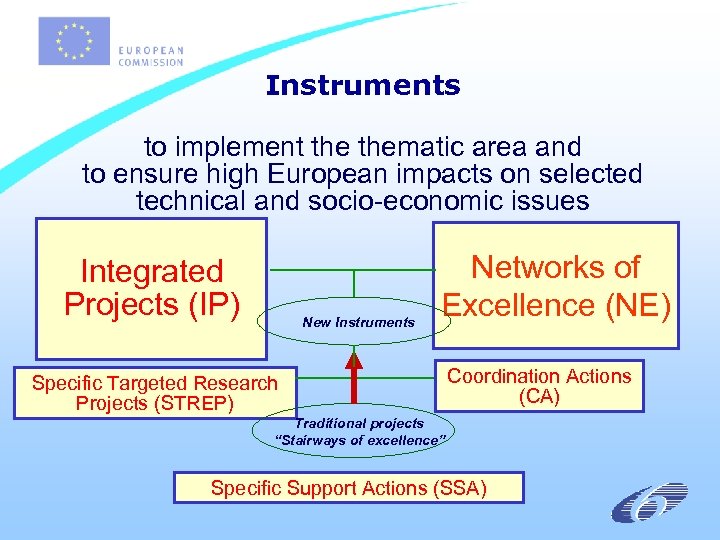 Instruments to implement thematic area and to ensure high European impacts on selected technical and socio-economic issues Integrated Projects (IP) New Instruments Networks of Excellence (NE) Specific Targeted Research Projects (STREP) Coordination Actions (CA) Traditional projects “Stairways of excellence” Specific Support Actions (SSA)
 New Instruments Integrated Projects (IP) Aim: flagship, ambitious, leading to radical innovation and transformation of industry in the long term • Strong industrial participation and even leadership • From fixed objectives to new applicable knowledge • Positive image of industrial research • Include inter-related activities
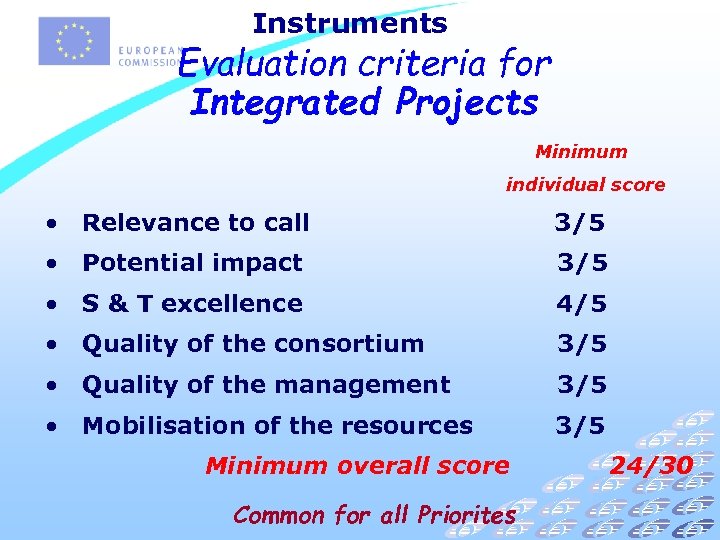 Instruments Evaluation criteria for Integrated Projects Minimum individual score • Relevance to call 3/5 • Potential impact 3/5 • S & T excellence 4/5 • Quality of the consortium 3/5 • Quality of the management 3/5 • Mobilisation of the resources 3/5 Minimum overall score Common for all Priorites 24/30
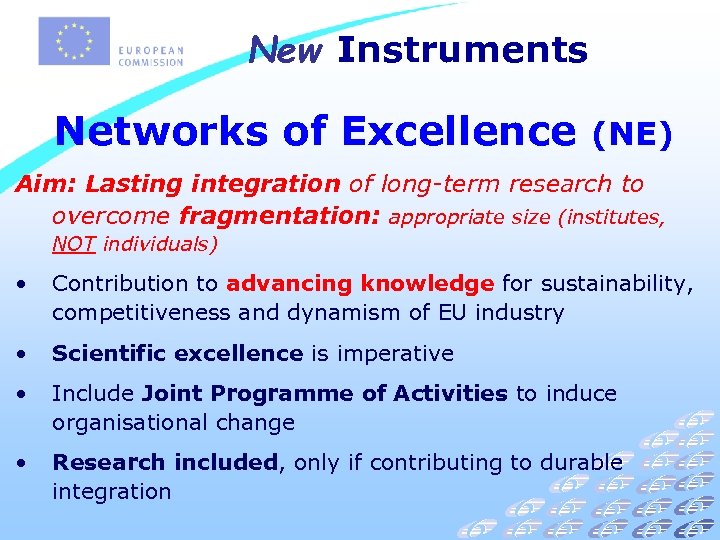 New Instruments Networks of Excellence (NE) Aim: Lasting integration of long-term research to overcome fragmentation: appropriate size (institutes, NOT individuals) • Contribution to advancing knowledge for sustainability, competitiveness and dynamism of EU industry • Scientific excellence is imperative • Include Joint Programme of Activities to induce organisational change • Research included, only if contributing to durable integration
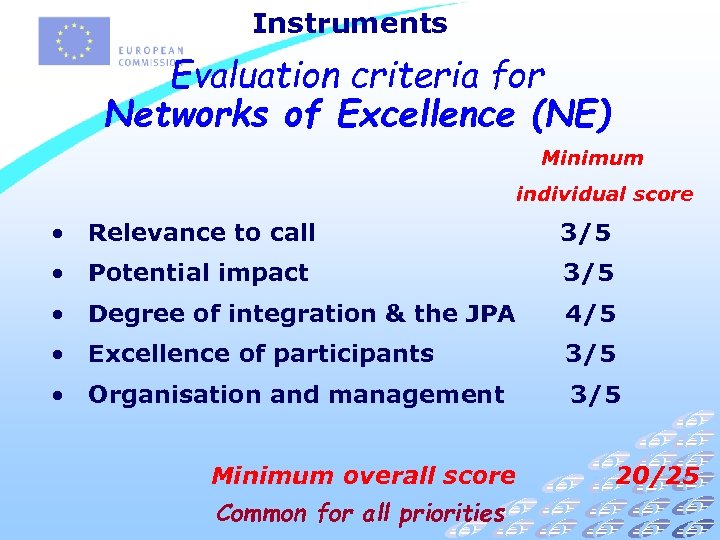 Instruments Evaluation criteria for Networks of Excellence (NE) Minimum individual score • Relevance to call 3/5 • Potential impact 3/5 • Degree of integration & the JPA 4/5 • Excellence of participants 3/5 • Organisation and management 3/5 Minimum overall score Common for all priorities 20/25
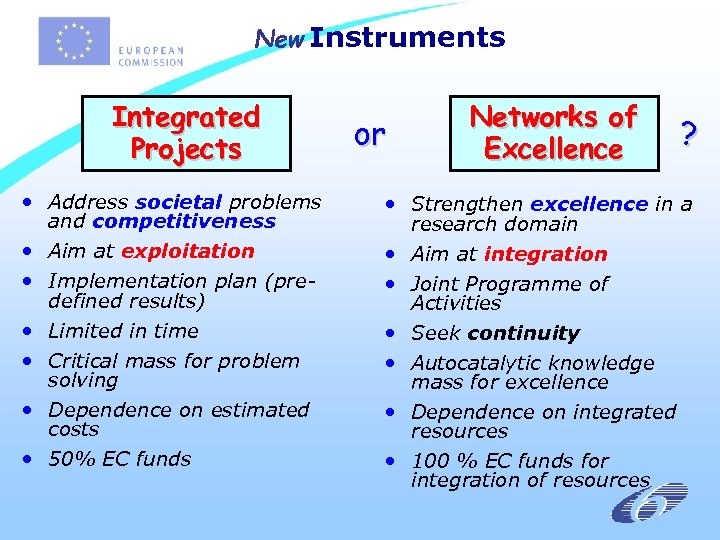 New Instruments Integrated Projects or Networks of Excellence ? • Address societal problems • Strengthen excellence in a • Critical mass for problem • Autocatalytic knowledge • Dependence on estimated • Dependence on integrated and competitiveness • Aim at exploitation • Implementation plan (predefined results) • Limited in time solving costs • 50% EC funds research domain • Aim at integration • Joint Programme of Activities • Seek continuity mass for excellence resources • 100 % EC funds for integration of resources
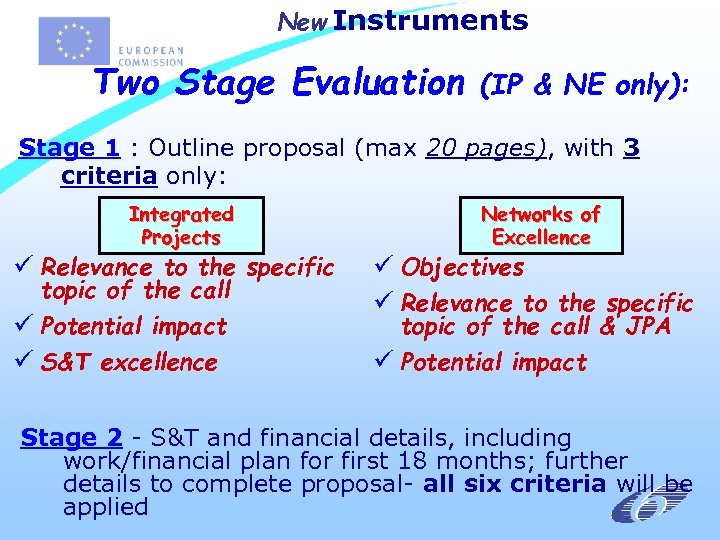 New Instruments Two Stage Evaluation (IP & NE only): Stage 1 : Outline proposal (max 20 pages), with 3 criteria only: Integrated Projects ü Relevance to the specific topic of the call ü Potential impact ü S&T excellence Networks of Excellence ü Objectives ü Relevance to the specific topic of the call & JPA ü Potential impact Stage 2 - S&T and financial details, including work/financial plan for first 18 months; further details to complete proposal- all six criteria will be applied
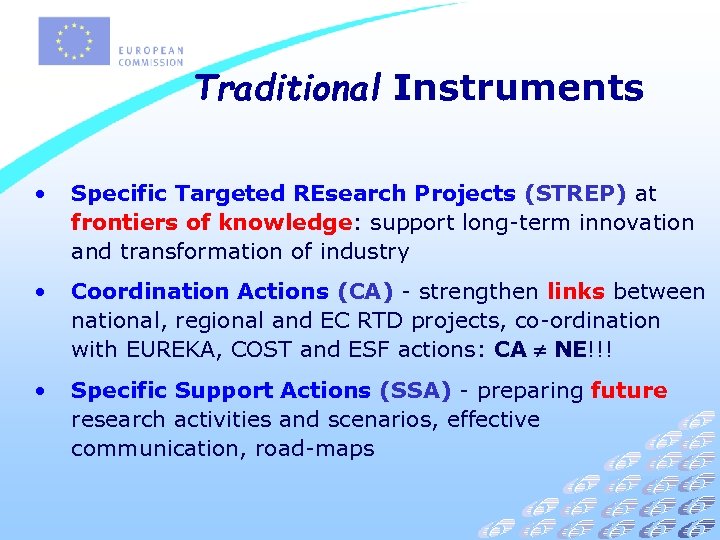 Traditional Instruments • Specific Targeted REsearch Projects (STREP) at frontiers of knowledge: support long-term innovation and transformation of industry • Coordination Actions (CA) - strengthen links between national, regional and EC RTD projects, co-ordination with EUREKA, COST and ESF actions: CA NE!!! • Specific Support Actions (SSA) - preparing future research activities and scenarios, effective communication, road-maps
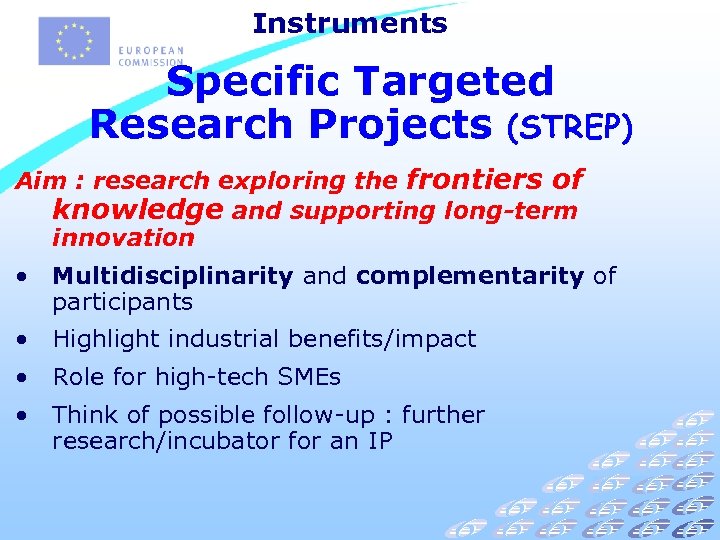 Instruments Specific Targeted Research Projects (STREP) Aim : research exploring the frontiers of knowledge and supporting long-term innovation • Multidisciplinarity and complementarity of participants • Highlight industrial benefits/impact • Role for high-tech SMEs • Think of possible follow-up : further research/incubator for an IP
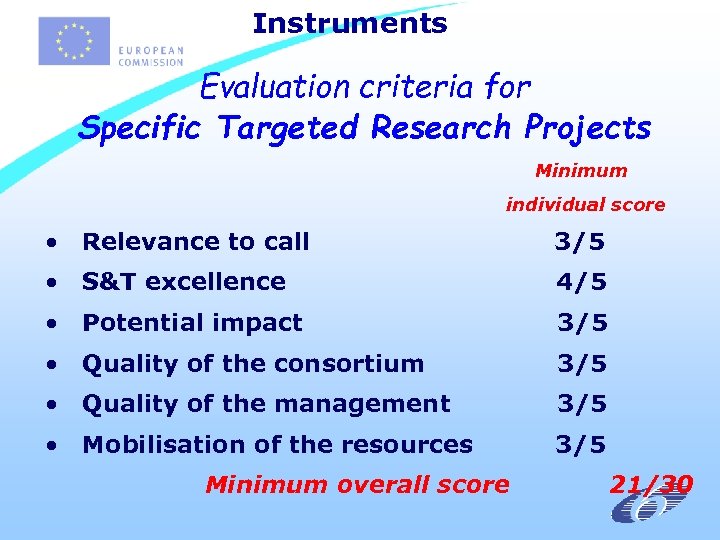 Instruments Evaluation criteria for Specific Targeted Research Projects Minimum individual score • Relevance to call 3/5 • S&T excellence 4/5 • Potential impact 3/5 • Quality of the consortium 3/5 • Quality of the management 3/5 • Mobilisation of the resources 3/5 Minimum overall score 21/30
 Instruments Coordination Actions (CA) Aim: strengthen links and coordination between different research initiatives • Multidisciplinarity and complementarity of participants (European, national, regional etc. ) • Pilot projects to explore methods of coordination with EUREKA, COST and ESF initiatives etc. are encouraged see: www. eureka. be ; www. kp. dlr. de/EUREKA/FACTORY , www. esf. org http: //cost. cordis. lu/src/home. cfm COST : European Cooperation in the field of Scientific and Technical Research ESF : European Science Foundation
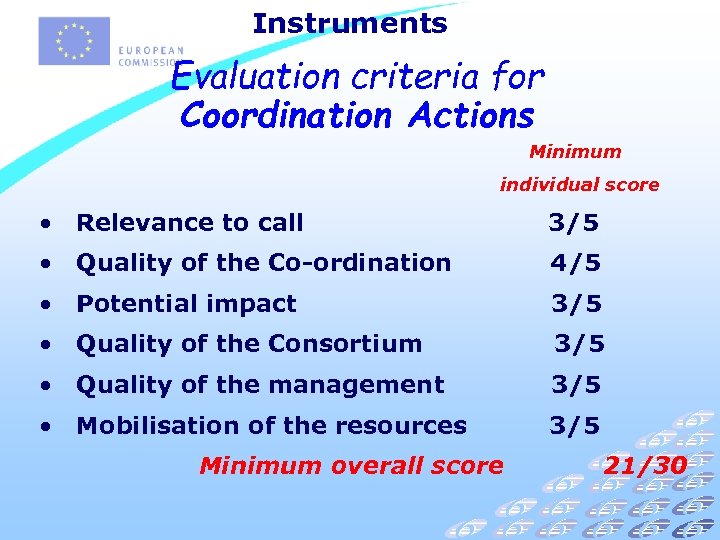 Instruments Evaluation criteria for Coordination Actions Minimum individual score • Relevance to call 3/5 • Quality of the Co-ordination 4/5 • Potential impact 3/5 • Quality of the Consortium 3/5 • Quality of the management 3/5 • Mobilisation of the resources 3/5 Minimum overall score 21/30
 Instruments Specific Support Actions (SSA) Aim: studies (time horizon 2010 -2015) to support long-term research activities • A clear international dimension is recommended • Examples: future scenarios, technology road maps, analysis of factors improving interaction between researchers and public authorities, regulators or standardisation bodies • Check in the Work Programme the areas open for SSA
 • FP 6 Structure of Presentation • Thematic Priority 3 (NMP) • Instruments • SMEs • Associated States • International Co-operation • Next Calls
 SMEs SME dedicated activities in NMP Aim: participation of SMEs, to receive at least 15% of funding w w SME dedicated modules / tasks Dedicated calls for IP for SMEs: led by SMEs with RTD potential to induce transformation and modernisation of SME-intensive traditional industries
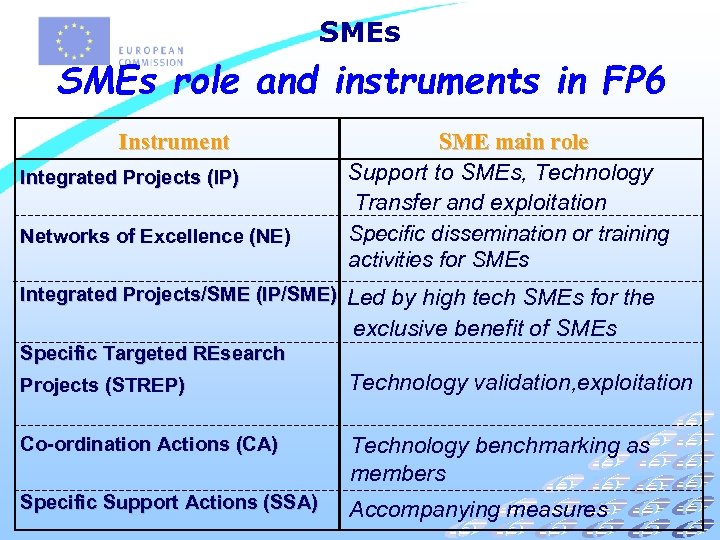 SMEs role and instruments in FP 6 Instrument Integrated Projects (IP) Networks of Excellence (NE) SME main role Support to SMEs, Technology Transfer and exploitation Specific dissemination or training activities for SMEs Integrated Projects/SME (IP/SME) Led by high tech SMEs for the exclusive benefit of SMEs Specific Targeted REsearch Projects (STREP) Technology validation, exploitation Co-ordination Actions (CA) Technology benchmarking as members Specific Support Actions (SSA) Accompanying measures
 • FP 6 Structure of Presentation • Thematic Priority 3 (NMP) • Instruments • SMEs • Associated States • International Co-operation • Next Calls
 Associated States (AS) to the Framework Programme u participation with the same rights and obligations as proposers from Member States (Norway, Iceland, Lichtenstein, Switzerland, Israel) Associated Candidate Countries (ACC) Work Programmes underline the importance of involving Associated Candidate Countries in the Community‘s research policy and in the European Research Area (ERA) (dedicated Specific Support Actions) see specific annex of the Work Programme See INCO page on Cordis: http: //www. cordis. lu/fp 6/inco. htm
 • FP 6 Structure of Presentation • Thematic Priority 3 (NMP) • Instruments • SMEs • Associated States • International Co-operation • Next Calls
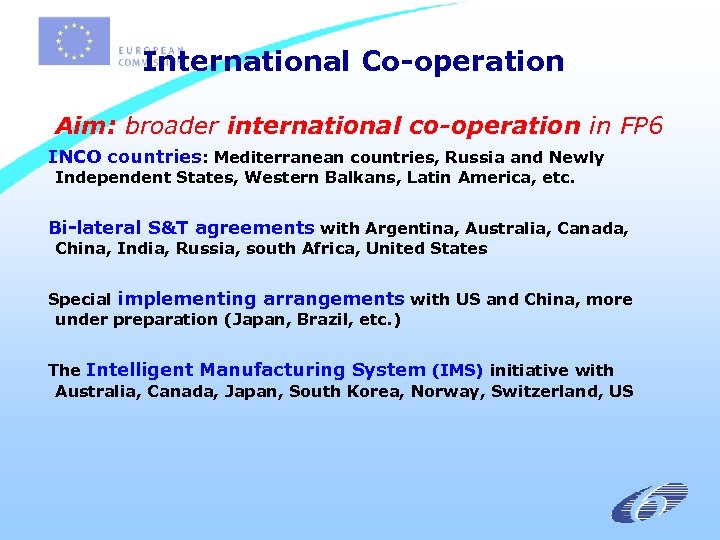 International Co-operation Aim: broader international co-operation in FP 6 INCO countries: Mediterranean countries, Russia and Newly Independent States, Western Balkans, Latin America, etc. Bi-lateral S&T agreements with Argentina, Australia, Canada, China, India, Russia, south Africa, United States Special implementing arrangements with US and China, more under preparation (Japan, Brazil, etc. ) The Intelligent Manufacturing System (IMS) initiative with Australia, Canada, Japan, South Korea, Norway, Switzerland, US
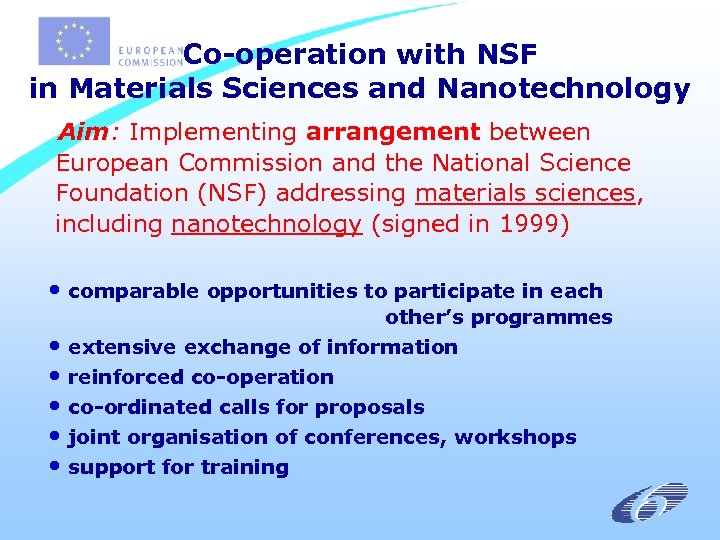 Co-operation with NSF in Materials Sciences and Nanotechnology Aim: Implementing arrangement between European Commission and the National Science Foundation (NSF) addressing materials sciences, including nanotechnology (signed in 1999) • comparable opportunities to participate in each other’s programmes • extensive exchange of information • reinforced co-operation • co-ordinated calls for proposals • joint organisation of conferences, workshops • support for training
 • FP 6 Structure of Presentation • Thematic Priority 3 (NMP) • Instruments • SMEs • Associated States • International Co-operation • Next Calls
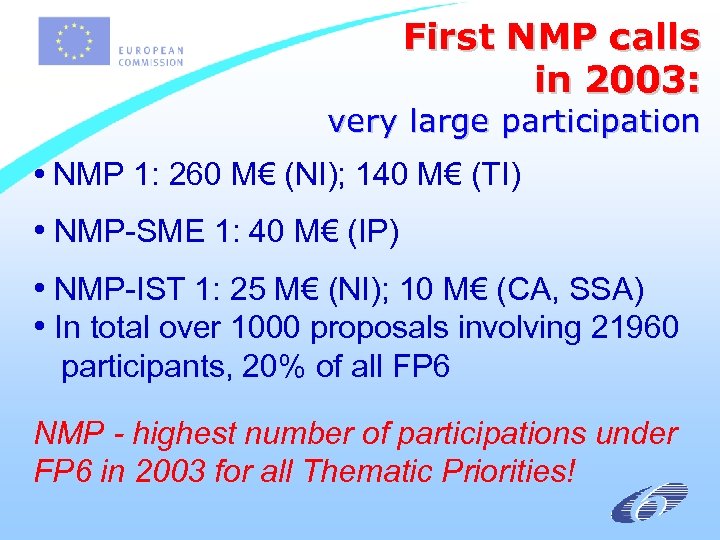 First NMP calls in 2003: very large participation • NMP 1: 260 M€ (NI); 140 M€ (TI) • NMP-SME 1: 40 M€ (IP) • NMP-IST 1: 25 M€ (NI); 10 M€ (CA, SSA) • In total over 1000 proposals involving 21960 participants, 20% of all FP 6 NMP - highest number of participations under FP 6 in 2003 for all Thematic Priorities!
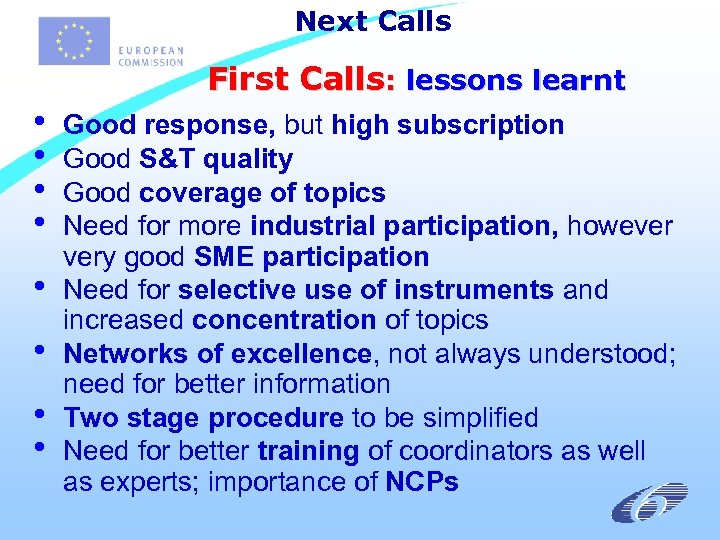 Next Calls First Calls: lessons learnt • • Good response, but high subscription Good S&T quality Good coverage of topics Need for more industrial participation, however very good SME participation Need for selective use of instruments and increased concentration of topics Networks of excellence, not always understood; need for better information Two stage procedure to be simplified Need for better training of coordinators as well as experts; importance of NCPs
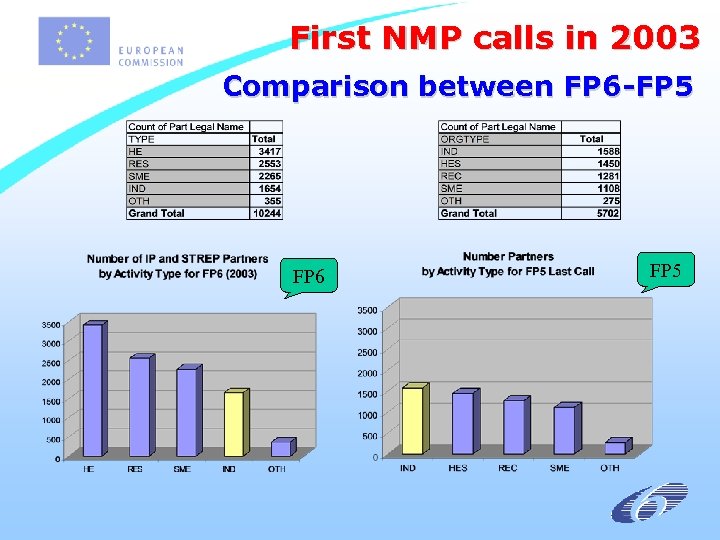 First NMP calls in 2003 Comparison between FP 6 -FP 5 FP 6 FP 5
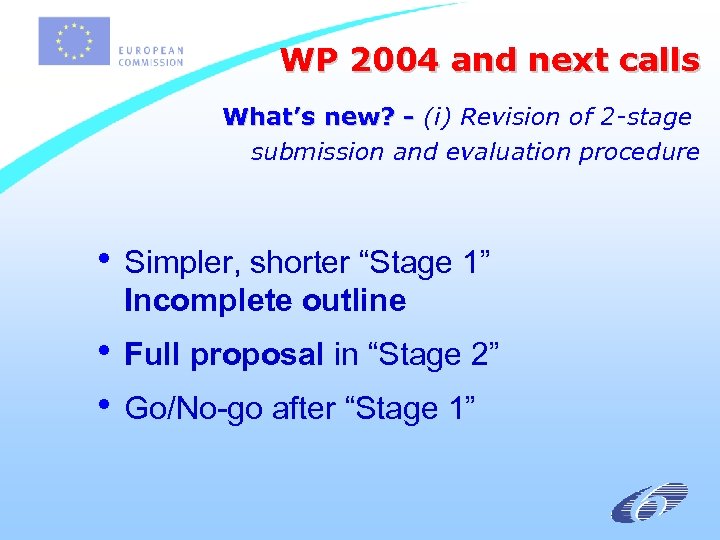 WP 2004 and next calls What’s new? - (i) Revision of 2 -stage submission and evaluation procedure • Simpler, shorter “Stage 1” Incomplete outline • Full proposal in “Stage 2” • Go/No-go after “Stage 1”
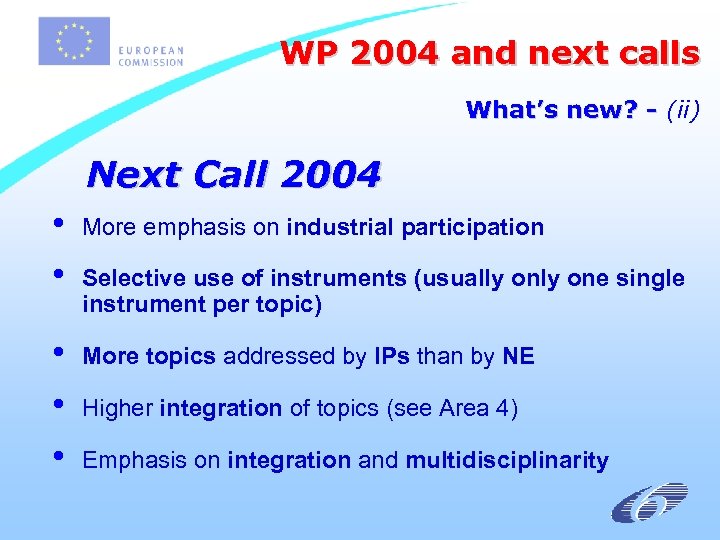 WP 2004 and next calls What’s new? - (ii) Next Call 2004 • • More emphasis on industrial participation • • • More topics addressed by IPs than by NE Selective use of instruments (usually one single instrument per topic) Higher integration of topics (see Area 4) Emphasis on integration and multidisciplinarity
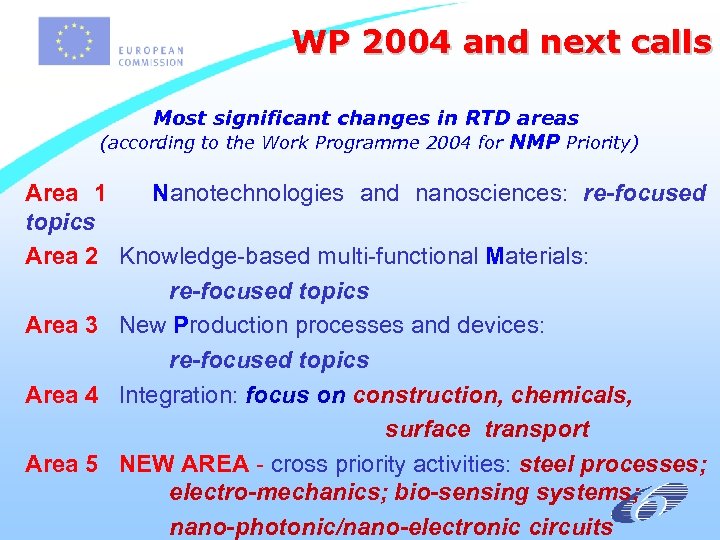 WP 2004 and next calls Most significant changes in RTD areas (according to the Work Programme 2004 for NMP Priority) Area 1 Nanotechnologies and nanosciences: re-focused topics Area 2 Knowledge-based multi-functional Materials: re-focused topics Area 3 New Production processes and devices: re-focused topics Area 4 Integration: focus on construction, chemicals, surface transport Area 5 NEW AREA - cross priority activities: steel processes; electro-mechanics; bio-sensing systems; nano-photonic/nano-electronic circuits
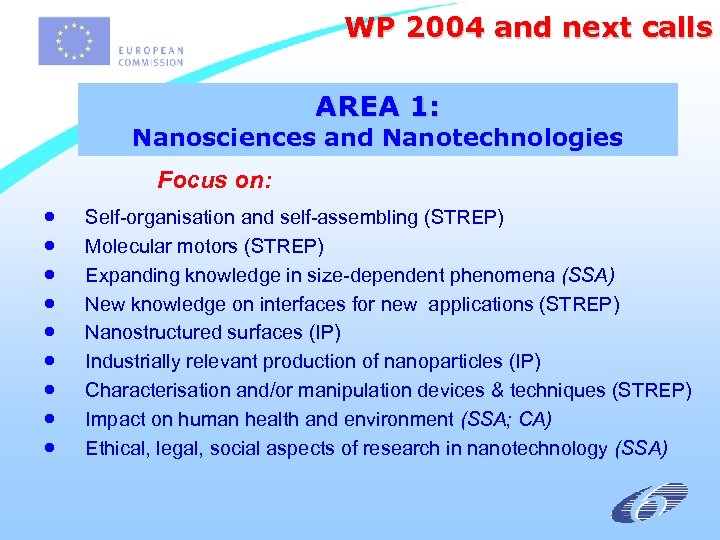 WP 2004 and next calls AREA 1: Nanosciences and Nanotechnologies Focus on: · · · · · Self-organisation and self-assembling (STREP) Molecular motors (STREP) Expanding knowledge in size-dependent phenomena (SSA) New knowledge on interfaces for new applications (STREP) Nanostructured surfaces (IP) Industrially relevant production of nanoparticles (IP) Characterisation and/or manipulation devices & techniques (STREP) Impact on human health and environment (SSA; CA) Ethical, legal, social aspects of research in nanotechnology (SSA)
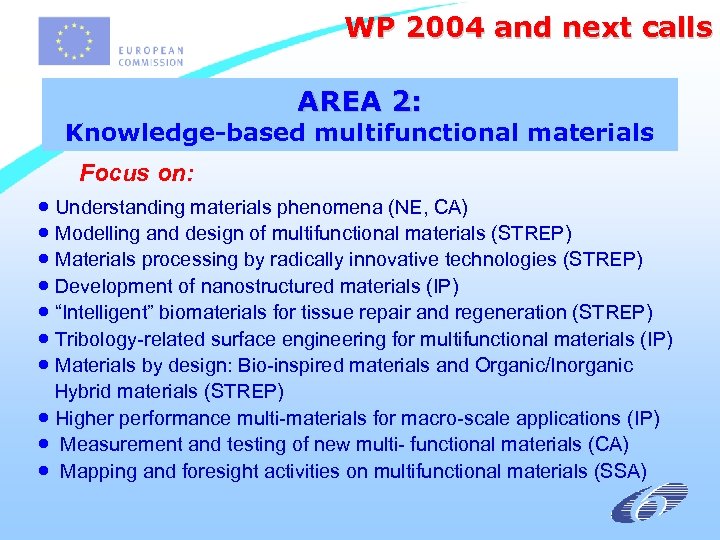 WP 2004 and next calls AREA 2: Knowledge-based multifunctional materials Focus on: · Understanding materials phenomena (NE, CA) · Modelling and design of multifunctional materials (STREP) · Materials processing by radically innovative technologies (STREP) · Development of nanostructured materials (IP) · “Intelligent” biomaterials for tissue repair and regeneration (STREP) · Tribology-related surface engineering for multifunctional materials (IP) · Materials by design: Bio-inspired materials and Organic/Inorganic Hybrid materials (STREP) · Higher performance multi-materials for macro-scale applications (IP) · Measurement and testing of new multi- functional materials (CA) · Mapping and foresight activities on multifunctional materials (SSA)
 WP 2004 and next calls AREA 3: New Production Processes and Devices Focus on: · New and user-friendly production technologies, and their incorporation into the factory of the future (IP, CA) · New production technologies for high added value products, exploiting and using nanoscale precision engineering techniques (IP) · Support to the development of new knowledge based added value products and services in traditional less RTD intensive industries (IP for SMEs) · Hazard reduction in production plant and storage sites (IP) · Support to the development of new knowledge based and sustainable processes and eco-innovation (IP for SMEs) · New life-cycle optimised safety and environmental technologies for industrial production (STREP) · Increasing the "user awareness" for sustainable consumption (CA, SSA)
 WP 2004 and next calls AREA 4 (NEW FOCUS) : Integration of NMP for improved construction, chemicals, surface transport • integration challenge • foster breakthrough applications Integrated Projects (IP) Human-friendly, safe and efficient construction, New generation of multifunctional materials and technologies for surface transport, Mastering chemicals and creating new eco-efficient processes and synthesis routes (NE also)
 WP 2004 and next calls AREA 5 (NEW FOCUS) : Cross-priorities activities and links to other research topics Focus on areas such as: • Industrial coordination across Member States (MS) and Associated Candidate Countries (ACC) with National Contact Points (NCPs) (CA) • Very low CO 2 and greenhouse gas steel production processes (IP) • Integrating technologies for fast and flexible manufacturing (IP, STREP, SSA) • “Bio-sensors” -for better diagnostics (IP, STREP) • Nano-Photonic / Nano-Electronic circuits (IP, NE, STREP) Joint/co-ordinated calls with Priority 2 and the Research Fund for Coal and Steel
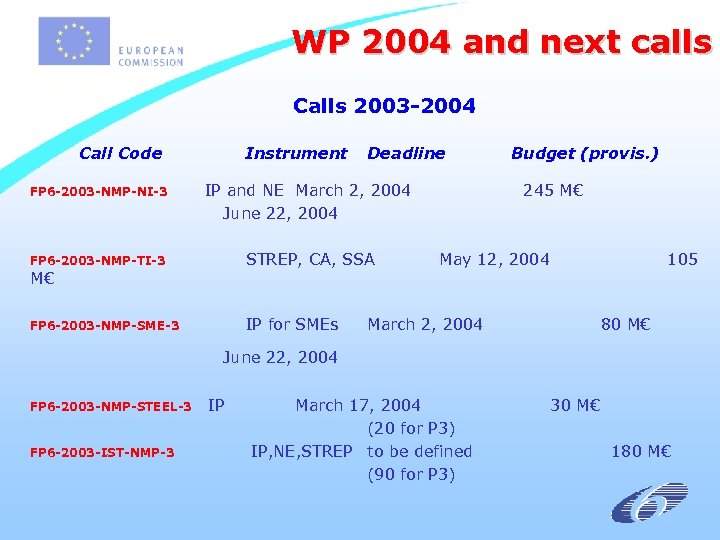 WP 2004 and next calls Calls 2003 -2004 Call Code Instrument Deadline FP 6 -2003 -NMP-NI-3 IP and NE March 2, 2004 June 22, 2004 FP 6 -2003 -NMP-TI-3 STREP, CA, SSA M€ IP for SMEs FP 6 -2003 -NMP-SME-3 Budget (provis. ) 245 M€ May 12, 2004 105 March 2, 2004 80 M€ June 22, 2004 FP 6 -2003 -NMP-STEEL-3 FP 6 -2003 -IST-NMP-3 IP March 17, 2004 (20 for P 3) IP, NE, STREP to be defined (90 for P 3) 30 M€ 180 M€
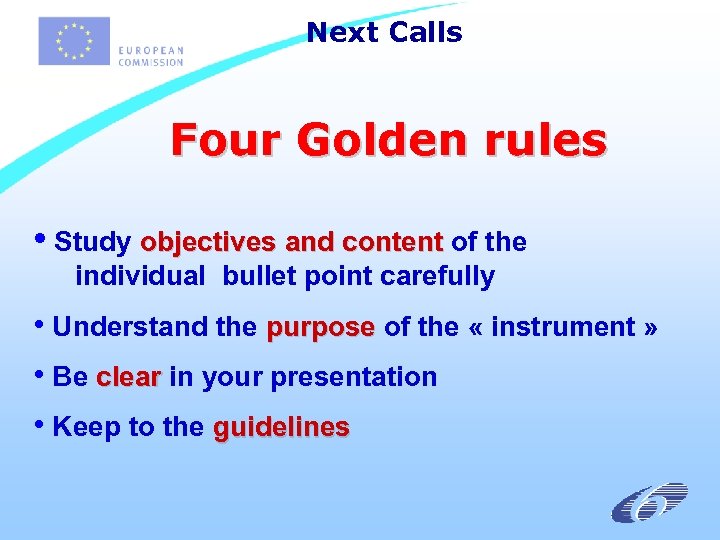 Next Calls Four Golden rules • Study objectives and content of the content individual bullet point carefully • Understand the purpose of the « instrument » purpose • Be clear in your presentation clear • Keep to the guidelines
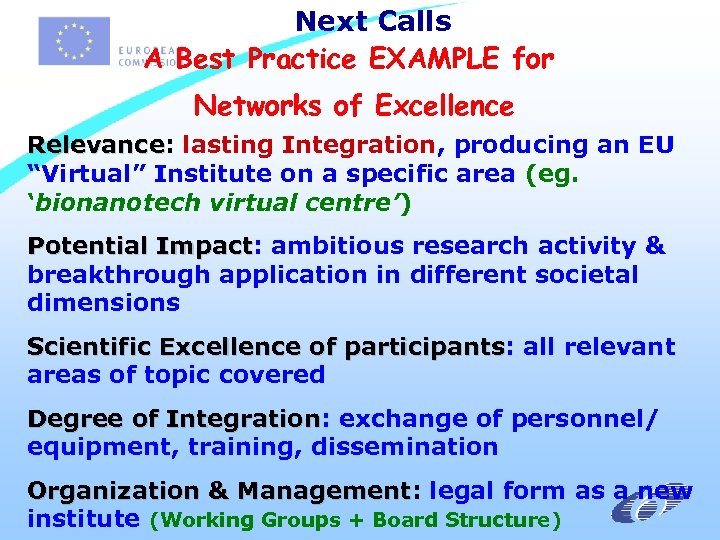 Next Calls A Best Practice EXAMPLE for Networks of Excellence Relevance: lasting Integration, producing an EU Relevance “Virtual” Institute on a specific area (eg. ‘bionanotech virtual centre’) Potential Impact: ambitious research activity & Impact breakthrough application in different societal dimensions Scientific Excellence of participants: all relevant participants areas of topic covered Degree of Integration: exchange of personnel/ Integration equipment, training, dissemination Organization & Management: legal form as a new Management institute (Working Groups + Board Structure)
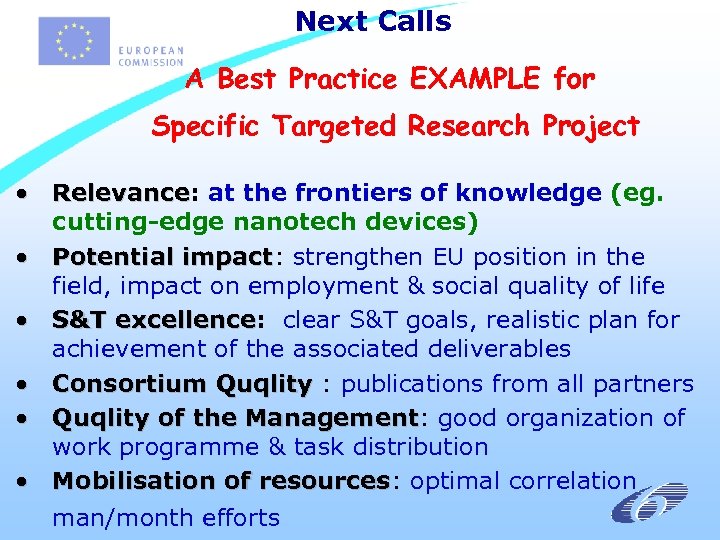 Next Calls A Best Practice EXAMPLE for Specific Targeted Research Project • Relevance: at the frontiers of knowledge (eg. Relevance cutting-edge nanotech devices) • Potential impact: strengthen EU position in the impact field, impact on employment & social quality of life • S&T excellence: clear S&T goals, realistic plan for excellence achievement of the associated deliverables • Consortium Quqlity : publications from all partners • Quqlity of the Management: good organization of Management work programme & task distribution • Mobilisation of resources: optimal correlation resources man/month efforts
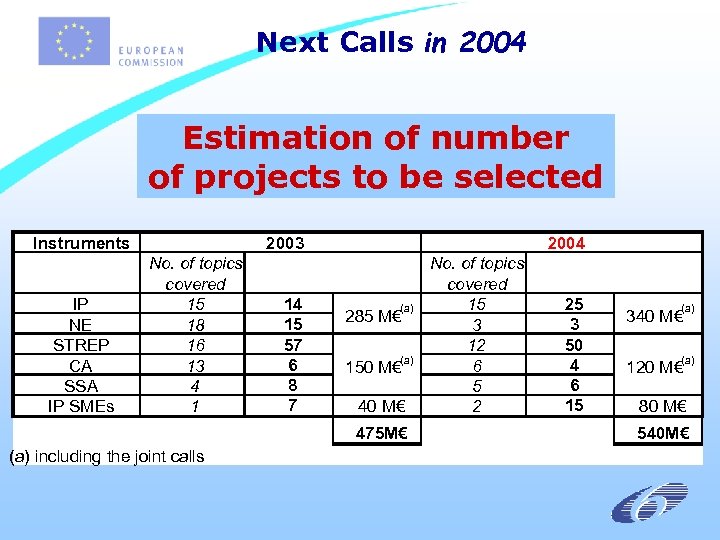 Next Calls in 2004 Estimation of number of projects to be selected Instruments IP NE STREP CA SSA IP SMEs 2003 No. of topics covered 15 18 16 13 4 1 14 15 57 6 8 7 2004 (a) 285 M€ (a) 150 M€ 475 M€ (a) including the joint calls No. of topics covered 15 3 12 6 5 2 25 3 50 4 6 15 (a) 340 M€ (a) 120 M€ 80 M€ 540 M€
 Next Calls WP 2004 and next calls Key-recommendations for submission of next proposals • Be sure that your objectives fit properly the call topic • For the New Instruments: • • • - ensure the appropriate critical mass - ensure sufficient industrial participation - be sure that supporting modules for RTD actions are included! (e. g. training, TT, spin-offs, IPR, ethics, etc. ) Develop an ambitious plan of activities Ensure effective management e. g. board of management, permanent secretariat For IP: highlight how results can be translated into products and services For NE: long lasting integration (different from coordination!) is CRUCIAL REMEMBER: in STAGE 1 only KEY-ELEMENTS of IP and NE emphasizing the ADDED VALUE for Europe
 In conclusion. . . • FP 6 represents a real change: contributing to the European Research Area (ERA) • NEW INSTRUMENTS (IP, NE) to develop this • Thematic Priority 3 (NMP) takes a long term view: NEW areas, NEW evaluation procedure and criteria • Aim: transforming European industry to increase competitiveness and sustainability • Promotes real breakthrough and not just incremental research • Continued importance of SME participation and full rights for Associated States
 Thank you for your attention! http: //www. cordis. lu http: //europa. eu. int/comm/research