 Скачать презентацию Six Universal Influence Principles Robert B Cialdini Arizona
3026e2f8a9ad30e91989f5f4d47d3f76.ppt
- Количество слайдов: 16



Six Universal Influence Principles Robert B. Cialdini, Arizona State University’ Professor of Psychology and Marketing 1) Reciprocity – the need to return a favor, gift, or service 2) Consistency – with a prior commitment 3) Social Validation (Consensus) – the behavior/opinions of similar others 4) Liking – the impact of those who express liking for “targets” • Authority – the role of legitimate authority figures, expertise 2)6) Scarcity – the value/desire for things that are rare, less available
* Reciprocity • Restaurant servers: Give 2 candies to customers = 14. 1% increase in tips • Hand written Post-it note with survey = 2 x more likely to respond; returned survey quicker and gave more information on survey • Reuse towels (Hotels): Card that said the hotel had already given money to an environmental organization = 26% increase in reuse of towels by customers
* ~ Door in the Face ~ Procedure: Very large 1 st request (refused), followed by a smaller request. Key Points: • Both requests must be made by the same person • Perception of a concession/negotiation • Feeling of satisfaction within target Another example: Blood donation example – Long-term plan (No); then. . . how about once Principle: Reciprocity (e. g. , perceived concession)
![* That’s Not All Technique [Improving the Deal] Procedure: A) Give original cost, then](https://present5.com/presentation/3026e2f8a9ad30e91989f5f4d47d3f76/image-4.jpg "* That’s Not All Technique [Improving the Deal] Procedure: A) Give original cost, then")
* That’s Not All Technique [Improving the Deal] Procedure: A) Give original cost, then reduce it before the target responds A) Give original cost, then add something “extra” before the target responds Principle: Reciprocity +
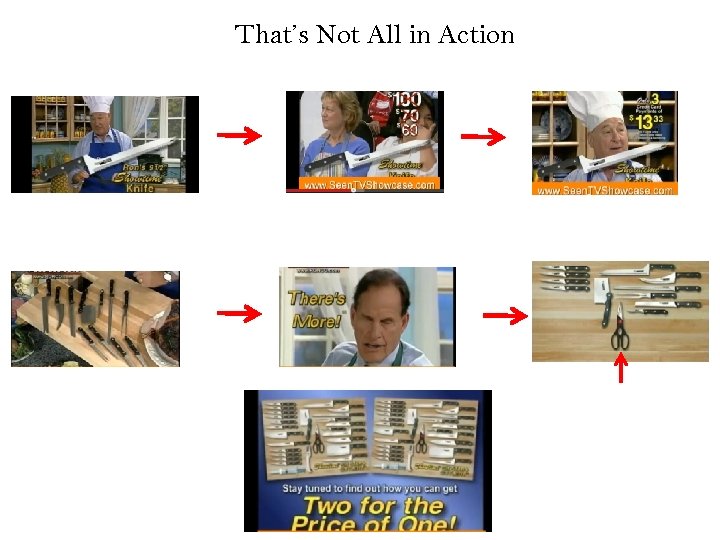
That’s Not All in Action
Ingratiation (Use of reciprocity) He did something that, on the face of it, seems foolish and costly. Each month he sent every one of his more than 13, 000 former customers a holiday greeting card containing a printed message. The greeting card changed from month to month (e. g. , “Happy New Year, ” Happy Thanksgiving”) but the message printed on the face of the card never varied. It read, “I like you. ” (Cialdini, 1988, p. 166).
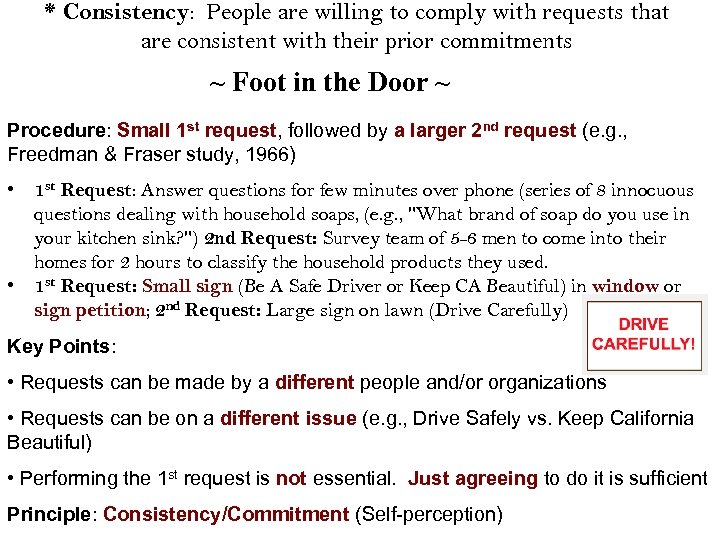
* Consistency: People are willing to comply with requests that are consistent with their prior commitments ~ Foot in the Door ~ Procedure: Small 1 st request, followed by a larger 2 nd request (e. g. , Freedman & Fraser study, 1966) • 1 st Request: Answer questions for few minutes over phone (series of 8 innocuous questions dealing with household soaps, (e. g. , "What brand of soap do you use in your kitchen sink? ") 2 nd Request: Survey team of 5 -6 men to come into their homes for 2 hours to classify the household products they used. • 1 st Request: Small sign (Be A Safe Driver or Keep CA Beautiful) in window or sign petition; 2 nd Request: Large sign on lawn (Drive Carefully) Key Points: • Requests can be made by a different people and/or organizations • Requests can be on a different issue (e. g. , Drive Safely vs. Keep California Beautiful) • Performing the 1 st request is not essential. Just agreeing to do it is sufficient Principle: Consistency/Commitment (Self-perception)
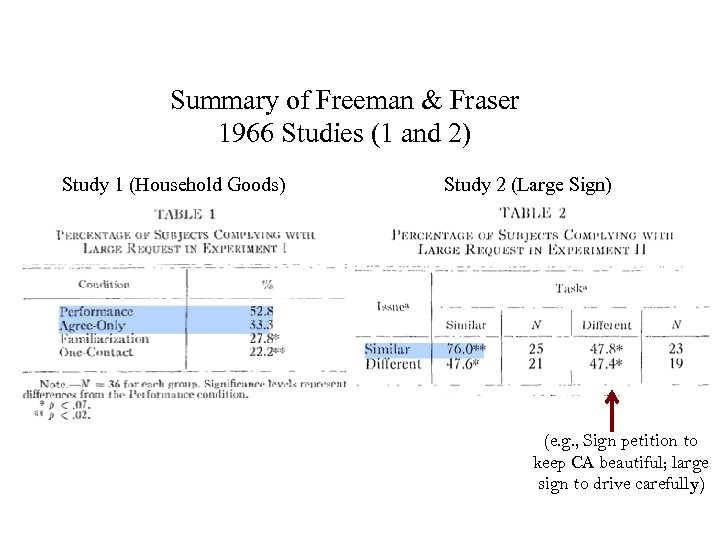
Summary of Freeman & Fraser 1966 Studies (1 and 2) Study 1 (Household Goods) Study 2 (Large Sign) (e. g. , Sign petition to keep CA beautiful; large sign to drive carefully)
* Consistency (continued) Bait and Switch Technique – go to buy an advertised product but it is of poor quality or “sold out” • Heightened likelihood we will buy something (an alternative) Low Ball Technique - Gain a commitment at “low” price -- Item then costs more than one that was agreed upon (e. g. , buying a car) • Likely to still buy item
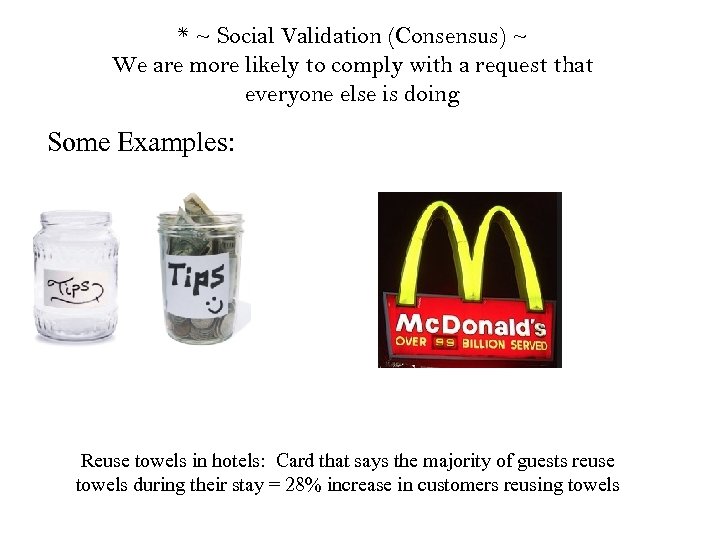
* ~ Social Validation (Consensus) ~ We are more likely to comply with a request that everyone else is doing Some Examples: Reuse towels in hotels: Card that says the majority of guests reuse towels during their stay = 28% increase in customers reusing towels
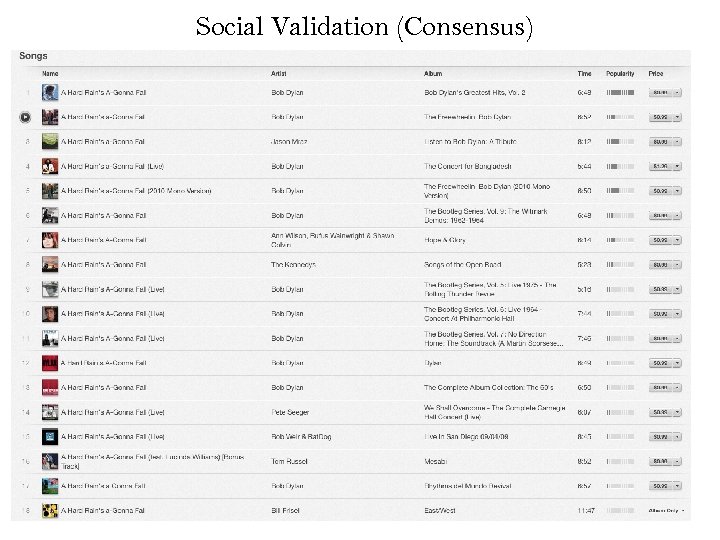
Social Validation (Consensus)
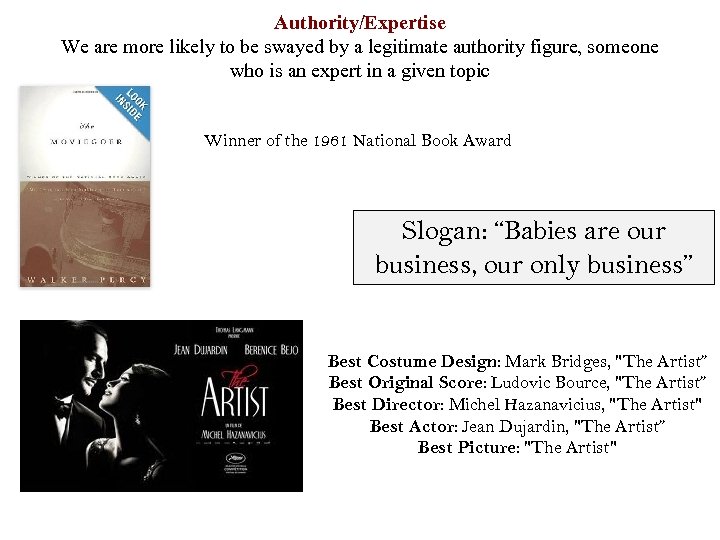
Authority/Expertise We are more likely to be swayed by a legitimate authority figure, someone who is an expert in a given topic Winner of the 1961 National Book Award Slogan: “Babies are our business, our only business” Best Costume Design: Mark Bridges, "The Artist” Best Original Score: Ludovic Bource, "The Artist” Best Director: Michel Hazanavicius, "The Artist" Best Actor: Jean Dujardin, "The Artist” Best Picture: "The Artist"
* ~ Liking~ We are more willing to comply with requests by friends or those that we like (or admire) Tupperware party example: Use of both friends and “love bombing” ~ Scarcity (Perceived or Real) ~ We desire things that are rare or dwindling Psychological Reactance Theory – threat to our personal freedom
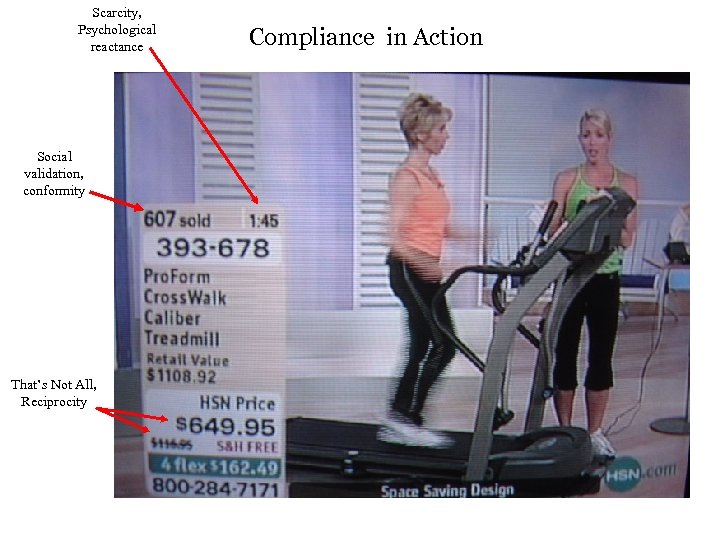
Scarcity, Psychological reactance Social validation, conformity That’s Not All, Reciprocity Compliance in Action
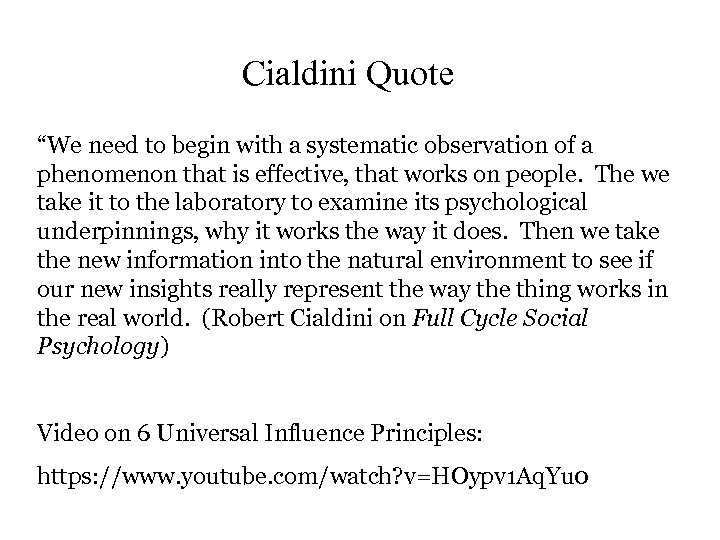
Cialdini Quote “We need to begin with a systematic observation of a phenomenon that is effective, that works on people. The we take it to the laboratory to examine its psychological underpinnings, why it works the way it does. Then we take the new information into the natural environment to see if our new insights really represent the way the thing works in the real world. (Robert Cialdini on Full Cycle Social Psychology) Video on 6 Universal Influence Principles: https: //www. youtube. com/watch? v=HOypv 1 Aq. Yu 0
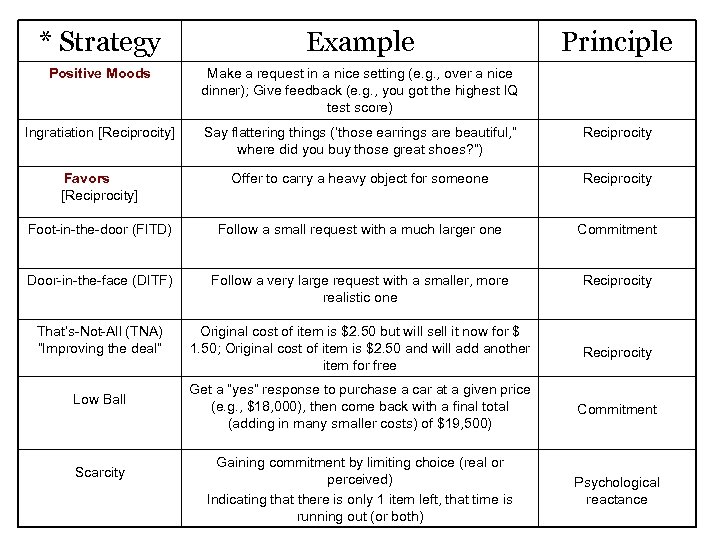
* Strategy Example Positive Moods Make a request in a nice setting (e. g. , over a nice dinner); Give feedback (e. g. , you got the highest IQ test score) Ingratiation [Reciprocity] Say flattering things (‘those earrings are beautiful, ” where did you buy those great shoes? ”) Reciprocity Favors [Reciprocity] Offer to carry a heavy object for someone Reciprocity Foot-in-the-door (FITD) Follow a small request with a much larger one Commitment Door-in-the-face (DITF) Follow a very large request with a smaller, more realistic one Reciprocity That’s-Not-All (TNA) “Improving the deal” Original cost of item is $2. 50 but will sell it now for $ 1. 50; Original cost of item is $2. 50 and will add another item for free Reciprocity Get a “yes” response to purchase a car at a given price (e. g. , $18, 000), then come back with a final total (adding in many smaller costs) of $19, 500) Commitment Gaining commitment by limiting choice (real or perceived) Indicating that there is only 1 item left, that time is running out (or both) Psychological reactance Low Ball Scarcity Principle
Скачать презентацию Six Universal Influence Principles Robert B Cialdini Arizona
3026e2f8a9ad30e91989f5f4d47d3f76.ppt