


 Скачать презентацию Sino-French workshop on Dark universe Marseille 23 Sep
9b8063b66399a45c5fd083e2d06a1f30.ppt
- Количество слайдов: 44
 Sino-French workshop on Dark universe Marseille, 23 Sep 2005 The Super. Novae Legacy Survey Overview and First results Dominique Fouchez ( Centre de physique des Particules de Marseille/ IN 2 P 3 ) On behalf of the SNLS Collaboration SNLS: Overview and First Results, Sino-French workshop, Marseille 2005
 The SNLS : Overview and First results • • Introduction Project overview Current status and first results Perspectives SNLS: Overview and First Results, Sino-French workshop, Marseille 2005
 Introduction: The cosmological paradigm • Today’s universe : Dark matter (30%) + Dark energy (70%) • Dark energy: caracterised by Equation of State w=p/r w = w(z) In the following w =constant SNLS: Overview and First Results, Sino-French workshop, Marseille 2005
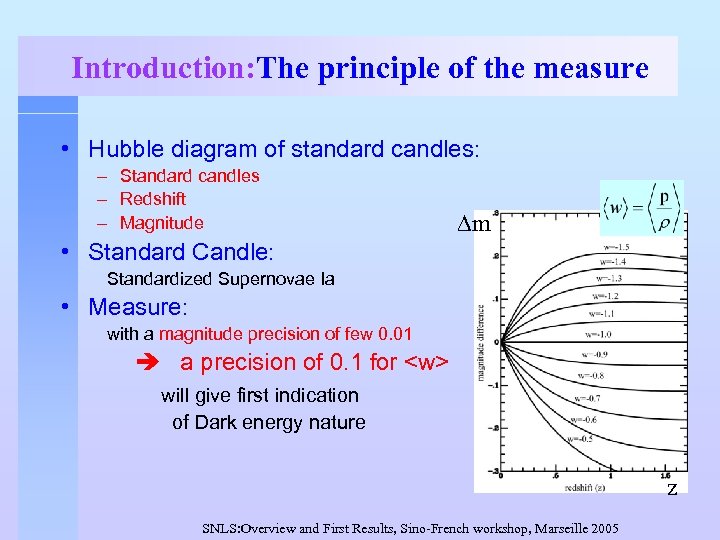 Introduction: The principle of the measure • Hubble diagram of standard candles: – Standard candles – Redshift – Magnitude m • Standard Candle: Standardized Supernovae Ia • Measure: with a magnitude precision of few 0. 01 a precision of 0. 1 for
 Project: a Super. Nova Legacy Survey • PRIMARY SCIENCE GOAL : Measurement of cosmological parameters – constraint
 Project: Requirements • 700 identified, localised, standardised and well measured high z SNIa – – – – Spectral identification of SN a maximum luminosity Spectral redshift : from host galaxy and/or SN spectrum Multicolor LC Photometry = g’, r’, i’, z’ LC well sampled (~ 5 multicolor epochs per month) Precise calibration : few percent accuracy depth, z=0. 3 -0. 9 (i’ at max < 24. 5 ) … SNLS: Overview and First Results, Sino-French workshop, Marseille 2005
 Project: Requirements • 700 identified, localised, standardised and well measured high z SNIa – – – – Spectral identification of SN a maximum luminosity Spectral redshift : from host galaxy and/or SN spectrum Multicolor LC Photometry = g’, r’, i’, z’ LC well sampled (~ 5 multicolor epochs per month) Precise calibration : few percent accuracy depth, z=0. 3 -0. 9 (i’ at max < 24. 5 ) … SNLS: Overview and First Results, Sino-French workshop, Marseille 2005
 Project: Requirements • 700 identified, localised, standardised and well measured high z SNIa – – – – Spectral identification of SN a maximum luminosity Spectral redshift : from host galaxy and/or SN spectrum Multicolor LC Photometry = g’, r’, i’, z’ LC well sampled (~ 5 multicolor epochs per month) Precise calibration : few percent accuracy depth, z=0. 3 -0. 9 (i’ at max < 24. 5 ) … SNLS: Overview and First Results, Sino-French workshop, Marseille 2005
 Project: Requirements • 700 identified, localised, standardised and well measured high z SNIa – – – – Spectral identification of SN a maximum luminosity Spectral redshift : from host galaxy and/or SN spectrum Multicolor LC Photometry = g’, r’, i’, z’ LC well sampled (~ 5 multicolor epochs per month) Precise calibration : few percent accuracy depth, z=0. 3 -0. 9 (i’ at max < 24. 5 ) … SNLS: Overview and First Results, Sino-French workshop, Marseille 2005
 Project: Requirements • 700 identified, localised, standardised and well measured high z SNIa – – – – Spectral identification of SN a maximum luminosity Spectral redshift : from host galaxy and/or SN spectrum Multicolor LC Photometry = g’, r’, i’, z’ LC well sampled (~ 5 multicolor epochs per month) Precise calibration : few percent accuracy depth, z=0. 3 -0. 9 (i’ at max < 24. 5 ) … SNLS: Overview and First Results, Sino-French workshop, Marseille 2005
 Project: Requirements • 700 identified, localised, standardised and well measured high z SNIa – – – – Spectral identification of SN a maximum luminosity Spectral redshift : from host galaxy and/or SN spectrum Multicolor LC Photometry = g’, r’, i’, z’ LC well sampled (~ 5 multicolor epochs per month) Precise calibration : few percent accuracy depth, z=0. 3 -0. 9 (i’ at max < 24. 5 ) … SNLS: Overview and First Results, Sino-French workshop, Marseille 2005
 Means SNLS: Overview and First Results, Sino-French workshop, Marseille 2005
 Means • Team : canadian-french+others (UK+US+Port. ) – about 60 collaborators • Telescope : CFHT+VLT+Gemini • Time : – about 250 H/year in both photometric and spectroscopic observations • Real time detection pipelines SNLS: Overview and First Results, Sino-French workshop, Marseille 2005
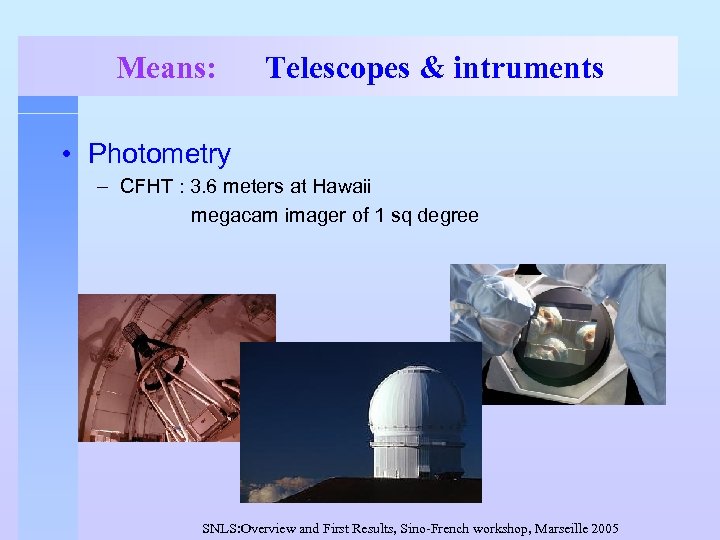 Means: Telescopes & intruments • Photometry – CFHT : 3. 6 meters at Hawaii megacam imager of 1 sq degree SNLS: Overview and First Results, Sino-French workshop, Marseille 2005
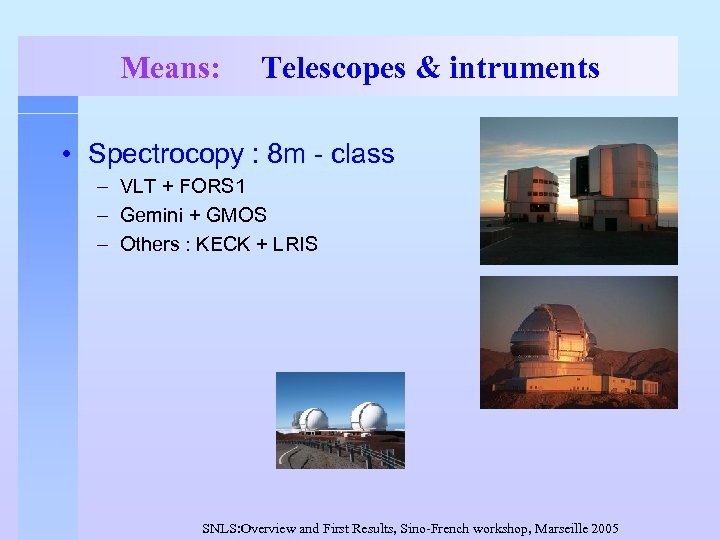 Means: Telescopes & intruments • Spectrocopy : 8 m - class – VLT + FORS 1 – Gemini + GMOS – Others : KECK + LRIS SNLS: Overview and First Results, Sino-French workshop, Marseille 2005
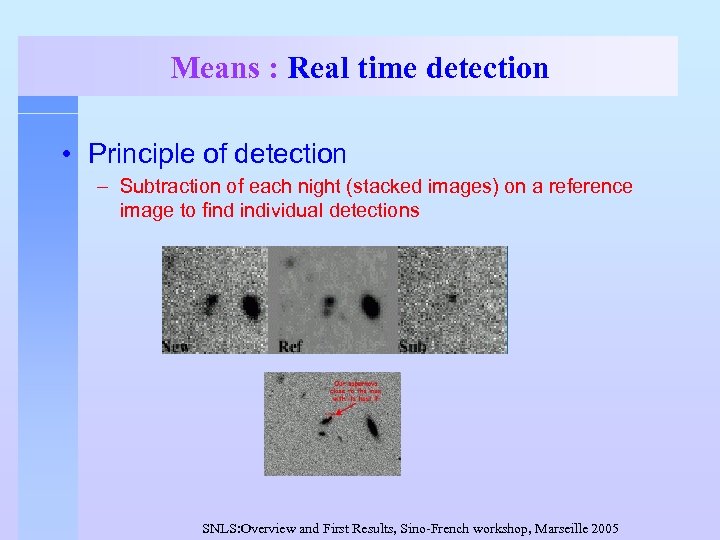 Means : Real time detection • Principle of detection – Subtraction of each night (stacked images) on a reference image to find individual detections SNLS: Overview and First Results, Sino-French workshop, Marseille 2005
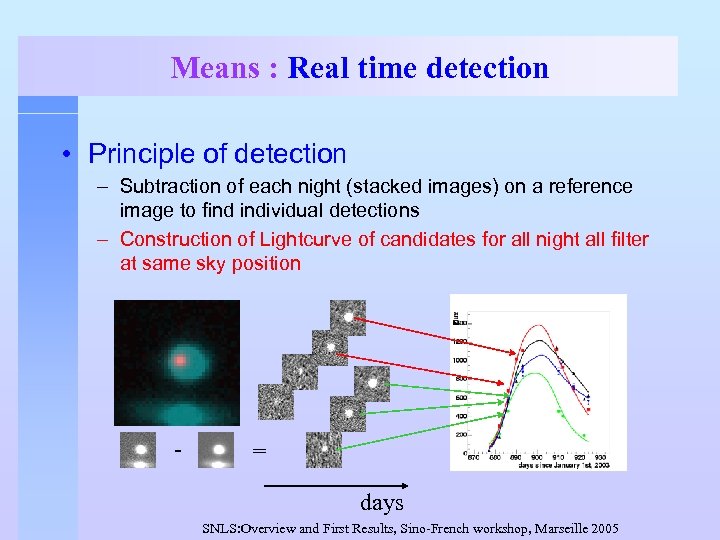 Means : Real time detection • Principle of detection – Subtraction of each night (stacked images) on a reference image to find individual detections – Construction of Lightcurve of candidates for all night all filter at same sky position - = days SNLS: Overview and First Results, Sino-French workshop, Marseille 2005
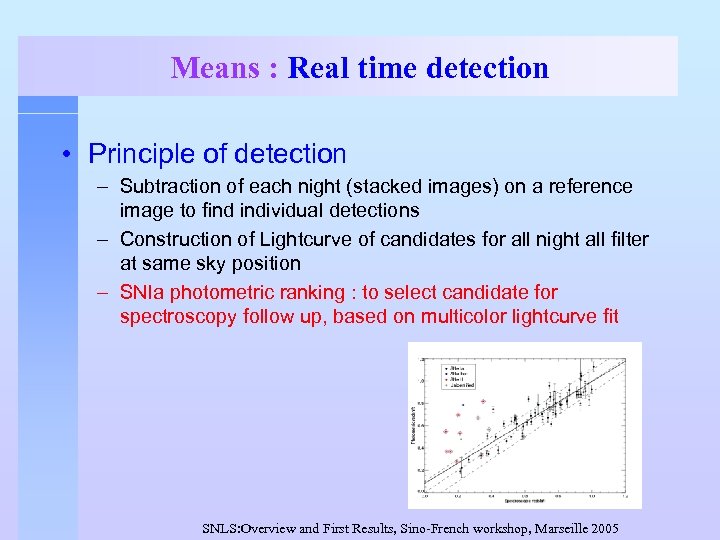 Means : Real time detection • Principle of detection – Subtraction of each night (stacked images) on a reference image to find individual detections – Construction of Lightcurve of candidates for all night all filter at same sky position – SNIa photometric ranking : to select candidate for spectroscopy follow up, based on multicolor lightcurve fit SNLS: Overview and First Results, Sino-French workshop, Marseille 2005
 Means : Real time detection • Principle of detection – Subtraction of each night (stacked images) on a reference image to find individual detections – Construction of Lightcurve of candidates for all night all filter at same sky position – SNIa photometric ranking – Two independant real time pipeline (Can & F) • crosscheck and robustness • Select candidate for spectro after each obs night Result in less than 24 H • Dataflow stream : up to 30 Go input/night and up to 10 To output/year SNLS: Overview and First Results, Sino-French workshop, Marseille 2005
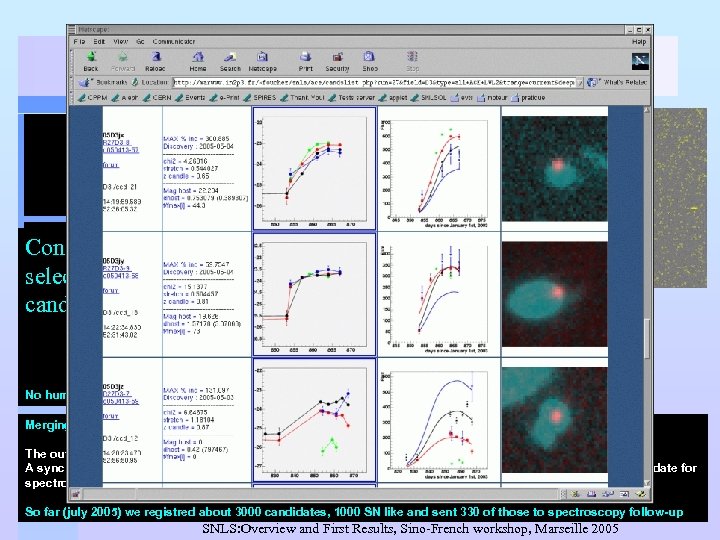 Means : a fully automated pipeline Detection on each stacked image Real time science images (Elixir) provided by CFHT automatically trigger the start of the pipeline. Image stack + subtraction is done to produce individual detections are send to event database for selection. Detection on each stacked image Construction and selection of the candidated Construction and • A manual stream (snlsdb), where a selection of used to select and the visual scanning is validate the snupernova candidatesselectioncandidates • An automated (ACE), based on neural network trained on image simulation, is used to select the good candidates (better than 90% efficient) No human intervention is necessary up to this stage to produce the candidate list. Merging with the other (canadian) pipeline The output of the pipeline is directed to the common Canada/France candidate database (based at Toronto) A synchronisation of the database is performed each hour ( 90% agreement up to i’=24. 5). The choice of candidate for spectro is made on the information collected by both French and canada pipeline So far (july 2005) we registred about 3000 candidates, 1000 SN like and sent 330 of those to spectroscopy follow-up SNLS: Overview and First Results, Sino-French workshop, Marseille 2005
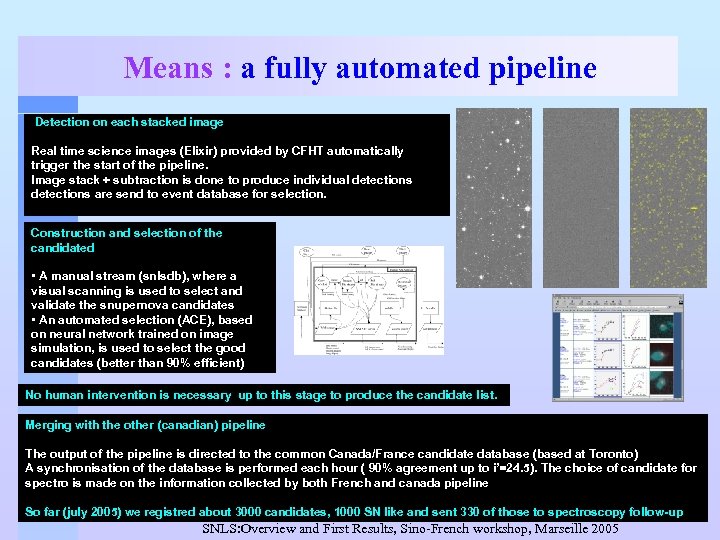 Means : a fully automated pipeline Detection on each stacked image Real time science images (Elixir) provided by CFHT automatically trigger the start of the pipeline. Image stack + subtraction is done to produce individual detections are send to event database for selection. Construction and selection of the candidated • A manual stream (snlsdb), where a visual scanning is used to select and validate the snupernova candidates • An automated selection (ACE), based on neural network trained on image simulation, is used to select the good candidates (better than 90% efficient) No human intervention is necessary up to this stage to produce the candidate list. Merging with the other (canadian) pipeline The output of the pipeline is directed to the common Canada/France candidate database (based at Toronto) A synchronisation of the database is performed each hour ( 90% agreement up to i’=24. 5). The choice of candidate for spectro is made on the information collected by both French and canada pipeline So far (july 2005) we registred about 3000 candidates, 1000 SN like and sent 330 of those to spectroscopy follow-up SNLS: Overview and First Results, Sino-French workshop, Marseille 2005
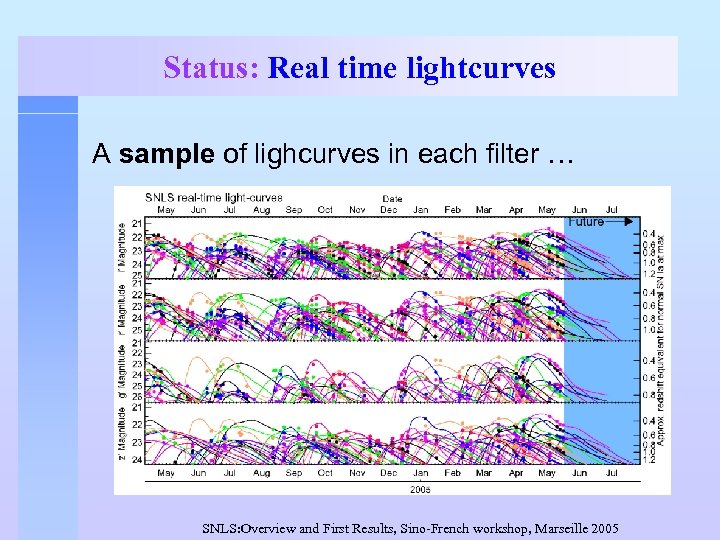 Status: Real time lightcurves A sample of lighcurves in each filter … SNLS: Overview and First Results, Sino-French workshop, Marseille 2005
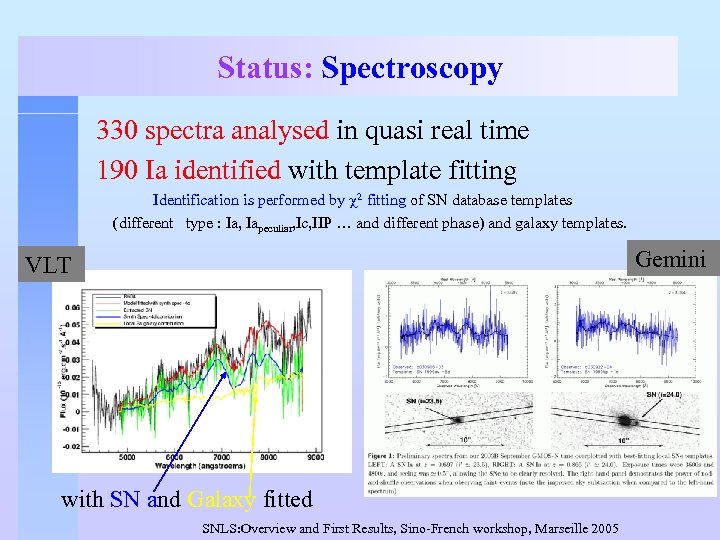 Status: Spectroscopy 330 spectra analysed in quasi real time 190 Ia identified with template fitting Identification is performed by c 2 fitting of SN database templates (different type : Ia, Iapeculiar, Ic, IIP … and different phase) and galaxy templates. Gemini VLT with SN and Galaxy fitted SNLS: Overview and First Results, Sino-French workshop, Marseille 2005
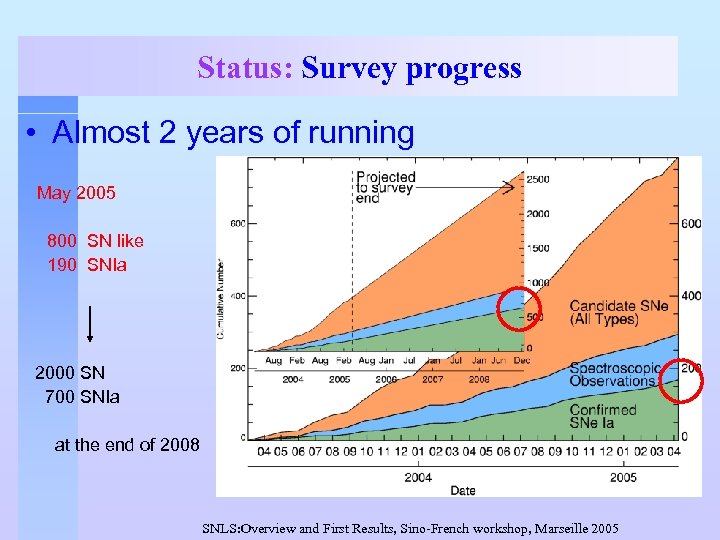 Status: Survey progress • Almost 2 years of running May 2005 800 SN like 190 SNIa 2000 SN 700 SNIa at the end of 2008 SNLS: Overview and First Results, Sino-French workshop, Marseille 2005
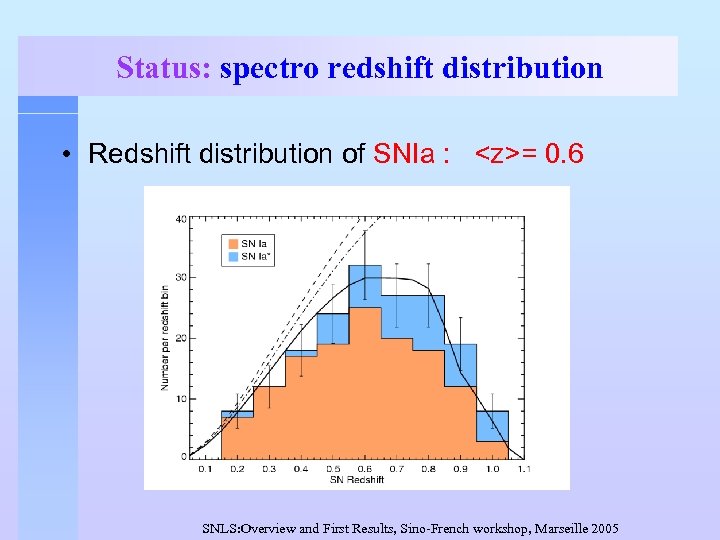 Status: spectro redshift distribution • Redshift distribution of SNIa :
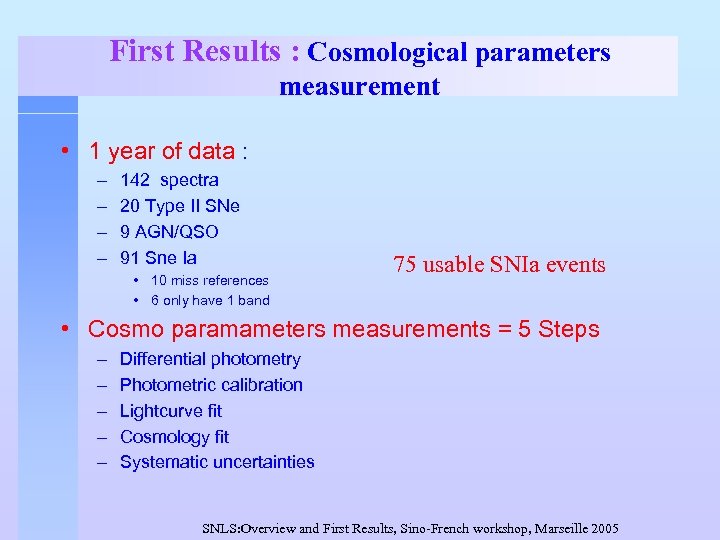 First Results : Cosmological parameters measurement • 1 year of data : – – 142 spectra 20 Type II SNe 9 AGN/QSO 91 Sne Ia • 10 miss references • 6 only have 1 band 75 usable SNIa events • Cosmo paramameters measurements = 5 Steps – – – Differential photometry Photometric calibration Lightcurve fit Cosmology fit Systematic uncertainties SNLS: Overview and First Results, Sino-French workshop, Marseille 2005
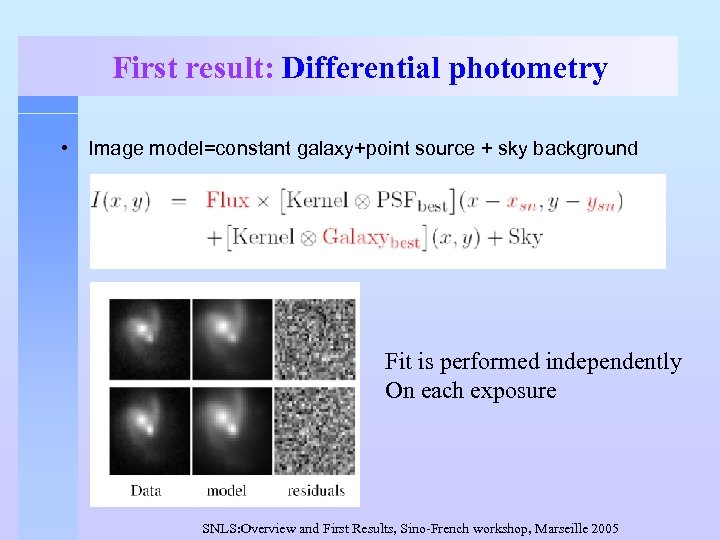 First result: Differential photometry • Image model=constant galaxy+point source + sky background Fit is performed independently On each exposure SNLS: Overview and First Results, Sino-French workshop, Marseille 2005
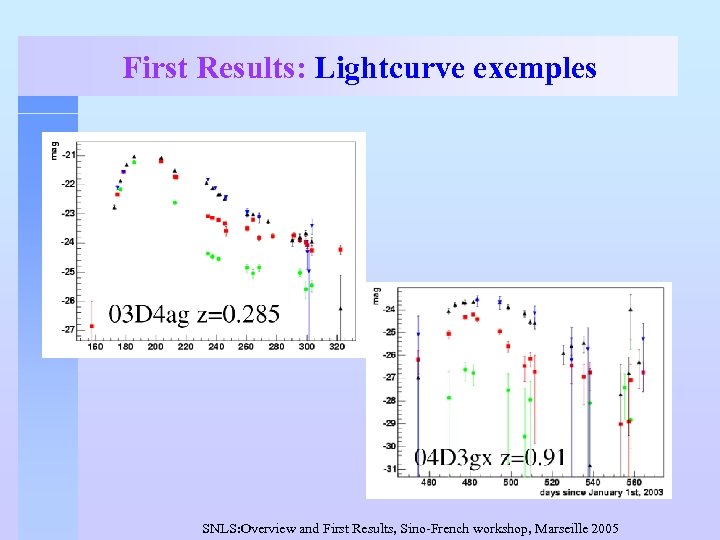 First Results: Lightcurve exemples SNLS: Overview and First Results, Sino-French workshop, Marseille 2005
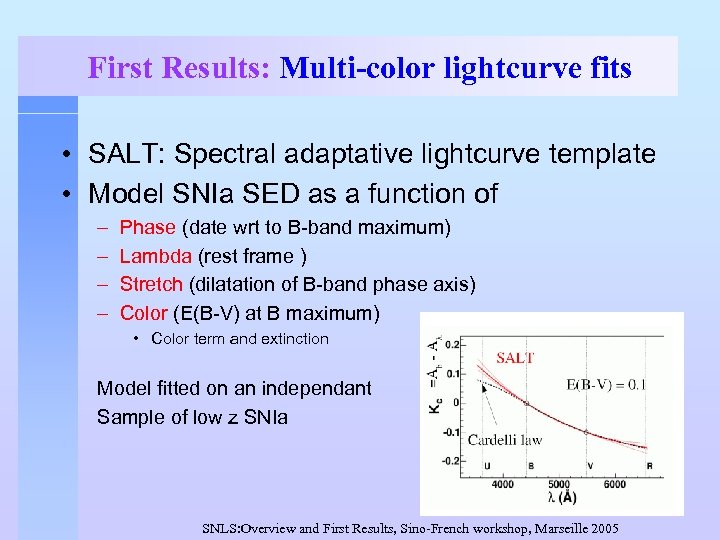 First Results: Multi-color lightcurve fits • SALT: Spectral adaptative lightcurve template • Model SNIa SED as a function of – – Phase (date wrt to B-band maximum) Lambda (rest frame ) Stretch (dilatation of B-band phase axis) Color (E(B-V) at B maximum) • Color term and extinction Model fitted on an independant Sample of low z SNIa SNLS: Overview and First Results, Sino-French workshop, Marseille 2005
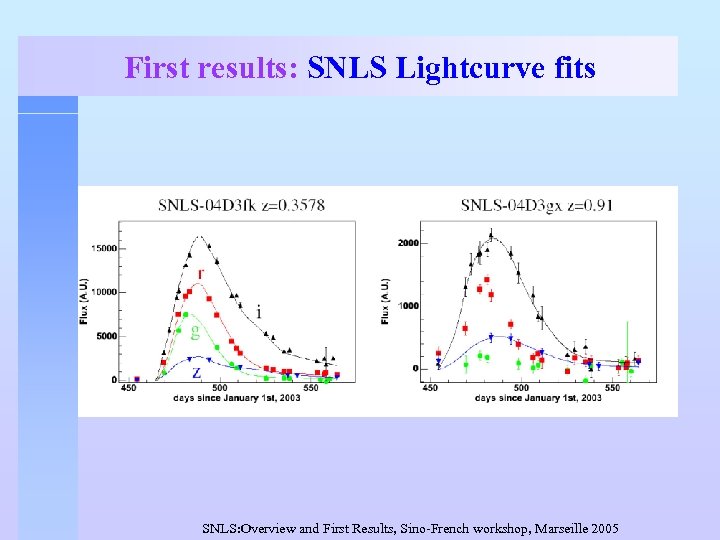 First results: SNLS Lightcurve fits SNLS: Overview and First Results, Sino-French workshop, Marseille 2005
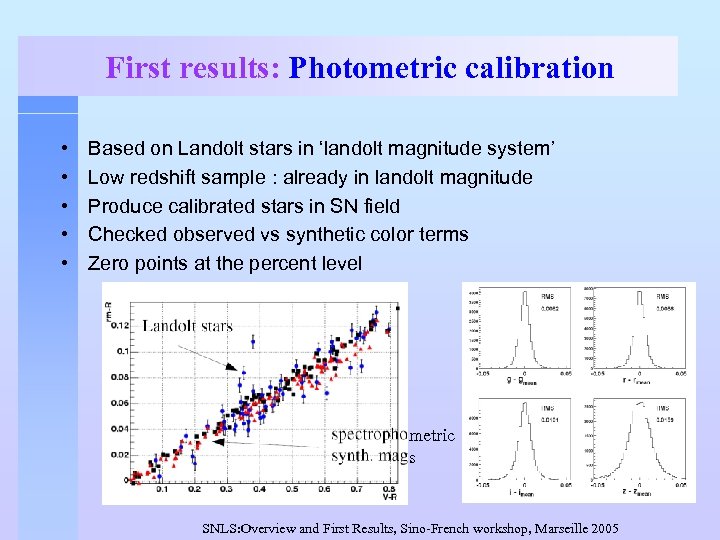 First results: Photometric calibration • • • Based on Landolt stars in ‘landolt magnitude system’ Low redshift sample : already in landolt magnitude Produce calibrated stars in SN field Checked observed vs synthetic color terms Zero points at the percent level metric s SNLS: Overview and First Results, Sino-French workshop, Marseille 2005
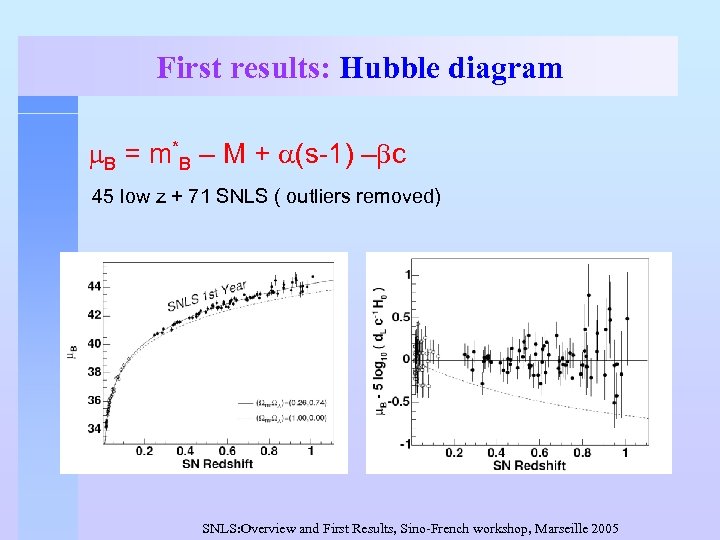 First results: Hubble diagram m. B = m*B – M + a(s-1) –bc 45 low z + 71 SNLS ( outliers removed) SNLS: Overview and First Results, Sino-French workshop, Marseille 2005
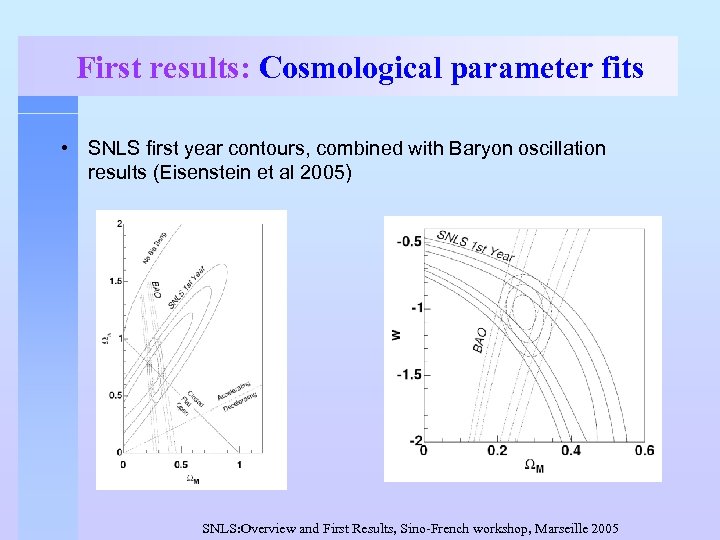 First results: Cosmological parameter fits • SNLS first year contours, combined with Baryon oscillation results (Eisenstein et al 2005) SNLS: Overview and First Results, Sino-French workshop, Marseille 2005
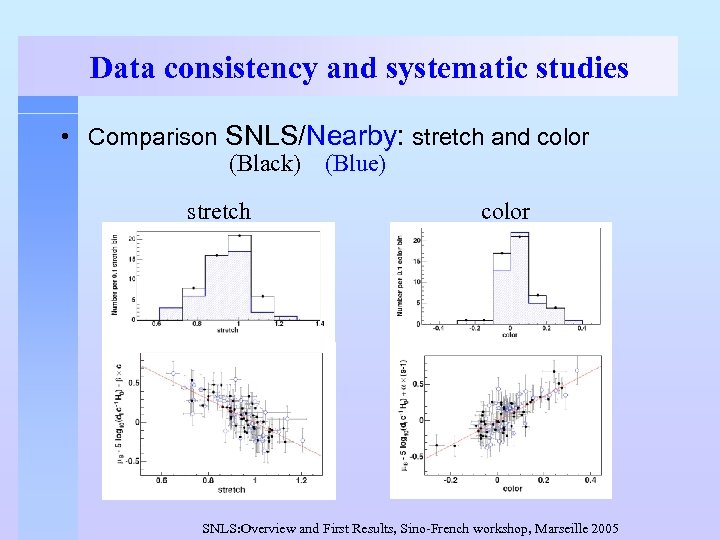 Data consistency and systematic studies • Comparison SNLS/Nearby: stretch and color (Black) (Blue) stretch color SNLS: Overview and First Results, Sino-French workshop, Marseille 2005
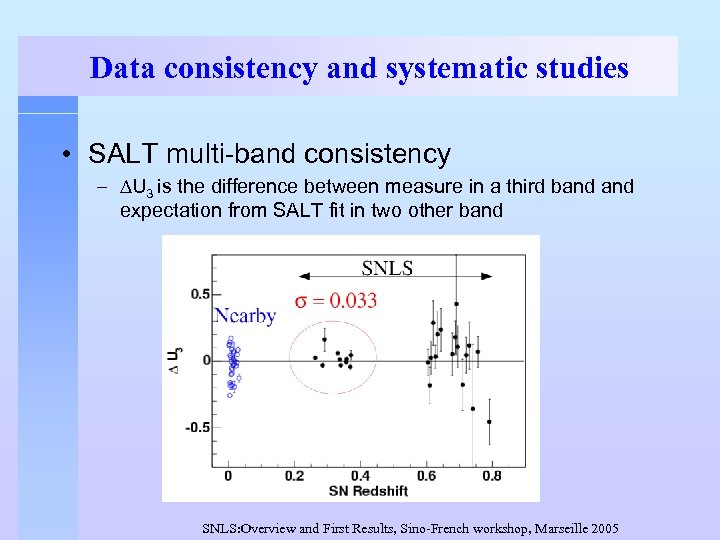 Data consistency and systematic studies • SALT multi-band consistency – U 3 is the difference between measure in a third band expectation from SALT fit in two other band SNLS: Overview and First Results, Sino-French workshop, Marseille 2005
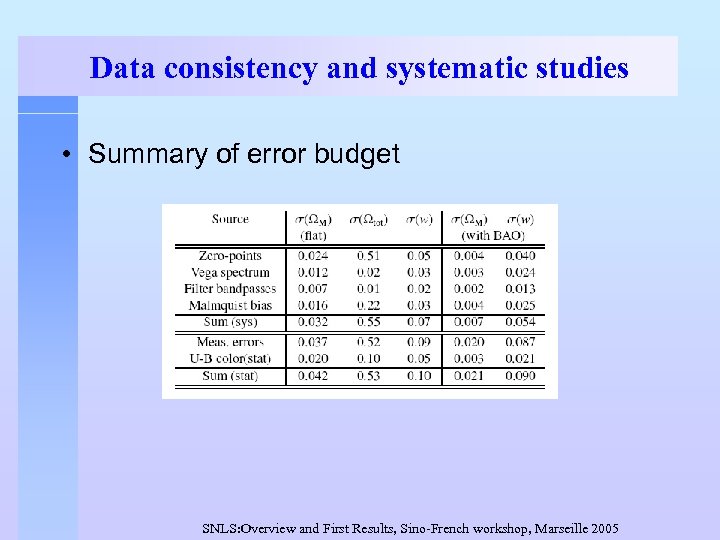 Data consistency and systematic studies • Summary of error budget SNLS: Overview and First Results, Sino-French workshop, Marseille 2005
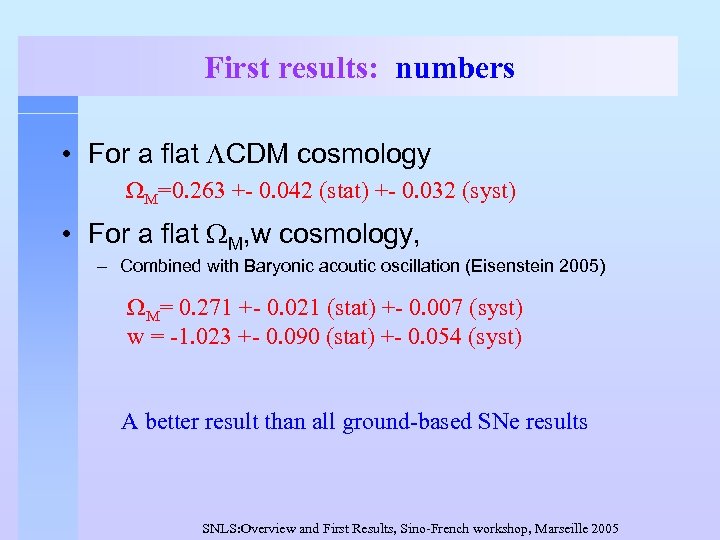 First results: numbers • For a flat LCDM cosmology WM=0. 263 +- 0. 042 (stat) +- 0. 032 (syst) • For a flat WM, w cosmology, – Combined with Baryonic acoutic oscillation (Eisenstein 2005) WM= 0. 271 +- 0. 021 (stat) +- 0. 007 (syst) w = -1. 023 +- 0. 090 (stat) +- 0. 054 (syst) A better result than all ground-based SNe results SNLS: Overview and First Results, Sino-French workshop, Marseille 2005
 Prospects : SNLS: Overview and First Results, Sino-French workshop, Marseille 2005
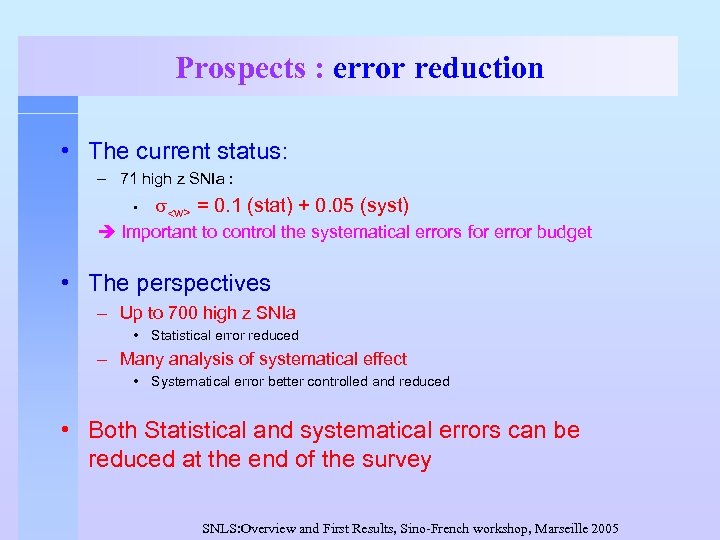 Prospects : error reduction • The current status: – 71 high z SNIa : • s
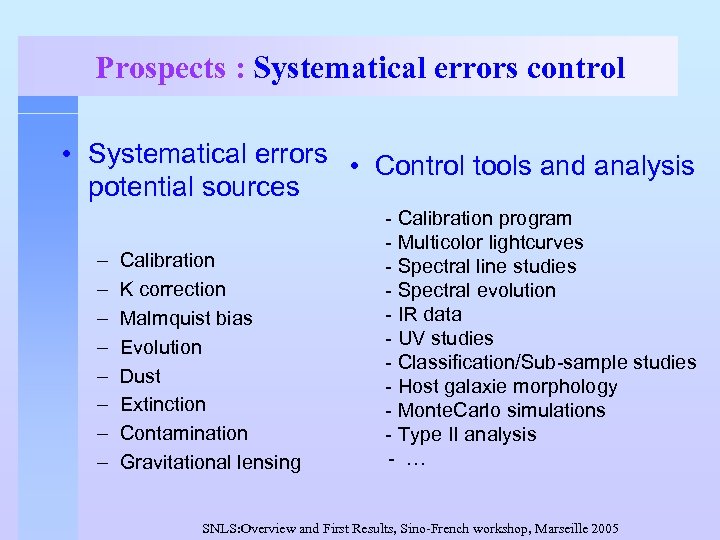 Prospects : Systematical errors control • Systematical errors Control tools and analysis • potential sources – – – – Calibration K correction Malmquist bias Evolution Dust Extinction Contamination Gravitational lensing - Calibration program - Multicolor lightcurves - Spectral line studies - Spectral evolution - IR data - UV studies - Classification/Sub-sample studies - Host galaxie morphology - Monte. Carlo simulations - Type II analysis - … SNLS: Overview and First Results, Sino-French workshop, Marseille 2005
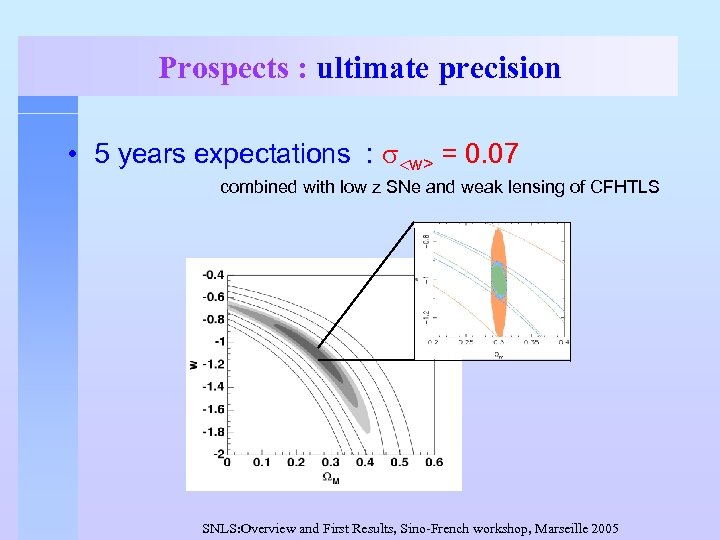 Prospects : ultimate precision • 5 years expectations : s
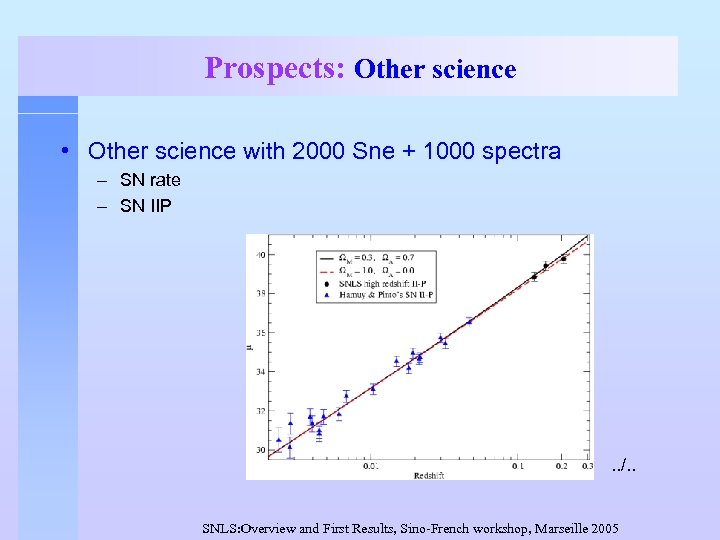 Prospects: Other science • Other science with 2000 Sne + 1000 spectra – SN rate – SN IIP . . /. . SNLS: Overview and First Results, Sino-French workshop, Marseille 2005
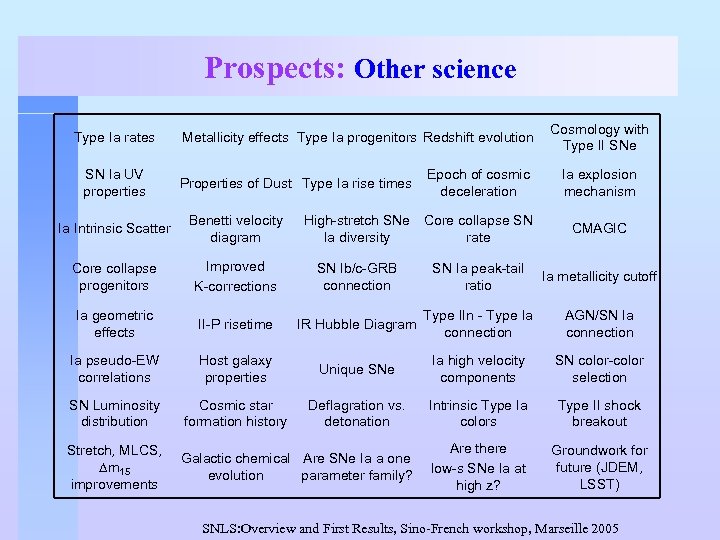 Prospects: Other science Type Ia rates SN Ia UV properties Metallicity effects Type Ia progenitors Redshift evolution Properties of Dust Type Ia rise times Epoch of cosmic deceleration High-stretch SNe Core collapse SN Ia diversity rate Cosmology with Type II SNe Ia explosion mechanism Ia Intrinsic Scatter Benetti velocity diagram Core collapse progenitors Improved K-corrections SN Ib/c-GRB connection Ia geometric effects II-P risetime IR Hubble Diagram Type IIn - Type Ia connection AGN/SN Ia connection Ia pseudo-EW correlations Host galaxy properties Unique SNe Ia high velocity components SN color-color selection SN Luminosity distribution Cosmic star formation history Deflagration vs. detonation Intrinsic Type Ia colors Type II shock breakout Stretch, MLCS, m 15 improvements Are there Galactic chemical Are SNe Ia a one evolution parameter family? low-s SNe Ia at high z? CMAGIC SN Ia peak-tail Ia metallicity cutoff ratio Groundwork for future (JDEM, LSST) SNLS: Overview and First Results, Sino-French workshop, Marseille 2005
 Conclusions • The SNLS project is entering it’s most existing phase of producing new science results : – Set up after first 2 years is well under control, in accordance to expectations : should achived designed goal after 5 years – First year result competitive with previous cosmological parameters measurements with SNIa • The SNLS is a second generation High z SNIa project – Very homegenous and complete dataset – Redondancy of multicolor lighcurve and spectroscopy – Systematical errors can be controlled and reduced • The SNLS is a legacy survey – Many other studies, related to SNe science will be possible • Many scientific results to come … Stay tuned ! SNLS: Overview and First Results, Sino-French workshop, Marseille 2005