


 Скачать презентацию SINGLE DISCIPLINARY PROJECT EVALUATION FORM FUNDAMENTAL RESEARCH GRANT
628d16733f3cde969f20148b41425e96.ppt
- Количество слайдов: 60
 (SINGLE DISCIPLINARY PROJECT) EVALUATION FORM FUNDAMENTAL RESEARCH GRANT SCHEME (FRGS) IPT EVALUATION Borang Penilaian Permohonan Skim Geran Penyelidikan Asas (FRGS) IPT
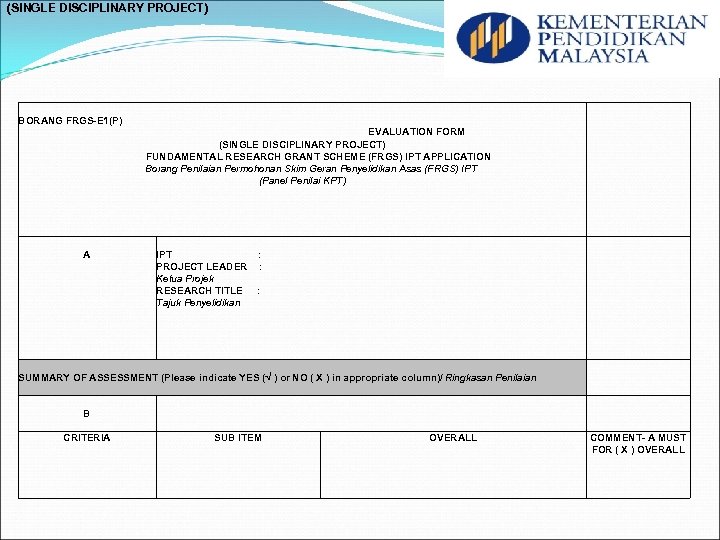 (SINGLE DISCIPLINARY PROJECT) BORANG FRGS-E 1(P) EVALUATION FORM (SINGLE DISCIPLINARY PROJECT) FUNDAMENTAL RESEARCH GRANT SCHEME (FRGS) IPT APPLICATION Borang Penilaian Permohonan Skim Geran Penyelidikan Asas (FRGS) IPT (Panel Penilai KPT) A IPT : PROJECT LEADER : Ketua Projek RESEARCH TITLE : Tajuk Penyelidikan SUMMARY OF ASSESSMENT (Please indicate YES (√ ) or NO ( X ) in appropriate column)/ Ringkasan Penilaian B CRITERIA SUB ITEM OVERALL COMMENT- A MUST FOR ( X ) OVERALL
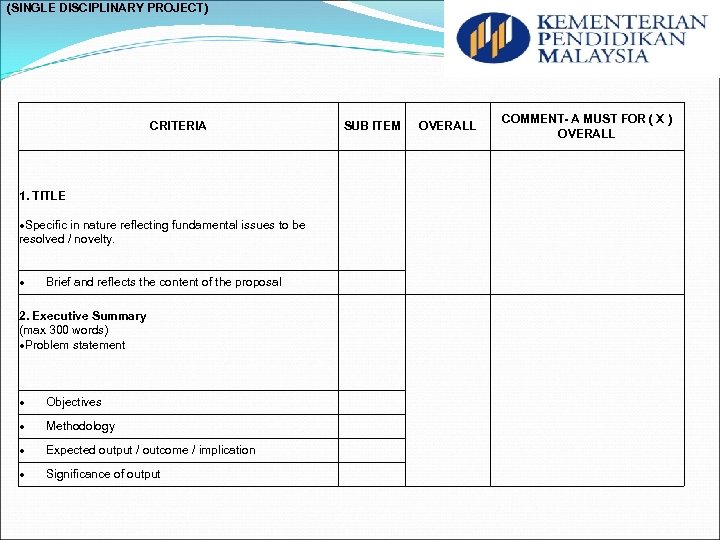 (SINGLE DISCIPLINARY PROJECT) CRITERIA 1. TITLE Specific in nature reflecting fundamental issues to be resolved / novelty. Brief and reflects the content of the proposal 2. Executive Summary (max 300 words) Problem statement Objectives Methodology Expected output / outcome / implication Significance of output SUB ITEM OVERALL COMMENT- A MUST FOR ( X ) OVERALL
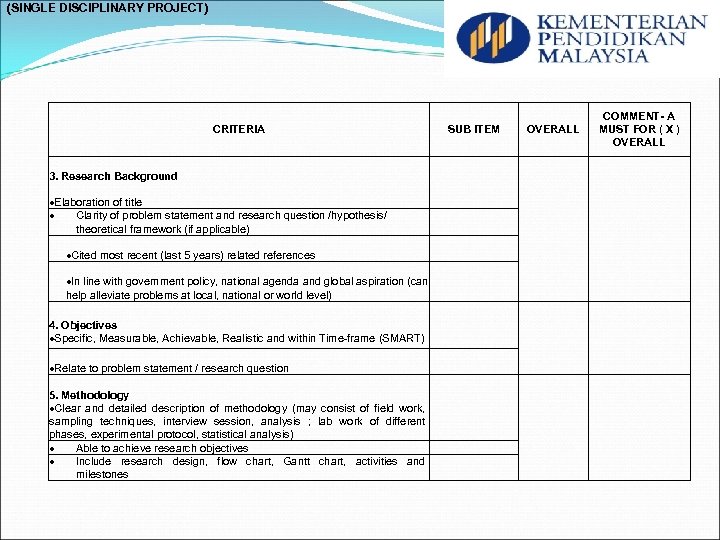 (SINGLE DISCIPLINARY PROJECT) CRITERIA 3. Research Background Elaboration of title Clarity of problem statement and research question /hypothesis/ theoretical framework (if applicable) Cited most recent (last 5 years) related references In line with government policy, national agenda and global aspiration (can help alleviate problems at local, national or world level) 4. Objectives Specific, Measurable, Achievable, Realistic and within Time-frame (SMART) Relate to problem statement / research question 5. Methodology Clear and detailed description of methodology (may consist of field work, sampling techniques, interview session, analysis ; lab work of different phases, experimental protocol, statistical analysis) Able to achieve research objectives Include research design, flow chart, Gantt chart, activities and milestones SUB ITEM OVERALL COMMENT- A MUST FOR ( X ) OVERALL
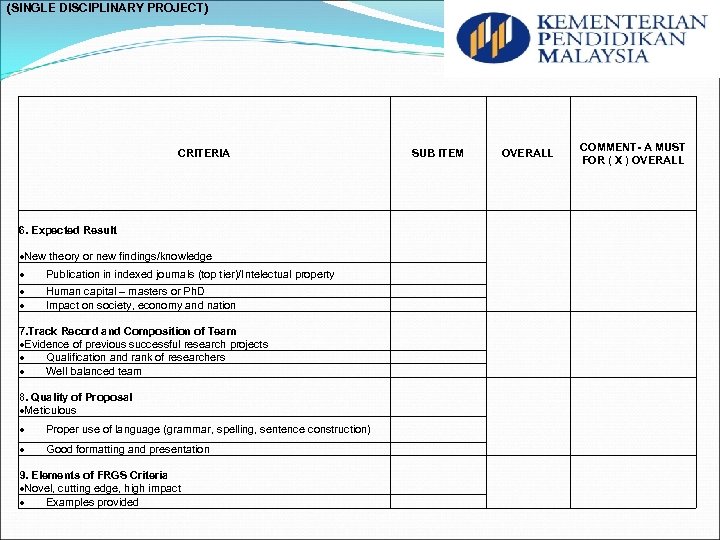 (SINGLE DISCIPLINARY PROJECT) CRITERIA 6. Expected Result New theory or new findings/knowledge Publication in indexed journals (top tier)/Intelectual property Human capital – masters or Ph. D Impact on society, economy and nation 7. Track Record and Composition of Team Evidence of previous successful research projects Qualification and rank of researchers Well balanced team 8. Quality of Proposal Meticulous Proper use of language (grammar, spelling, sentence construction) Good formatting and presentation 9. Elements of FRGS Criteria Novel, cutting edge, high impact Examples provided SUB ITEM OVERALL COMMENT- A MUST FOR ( X ) OVERALL
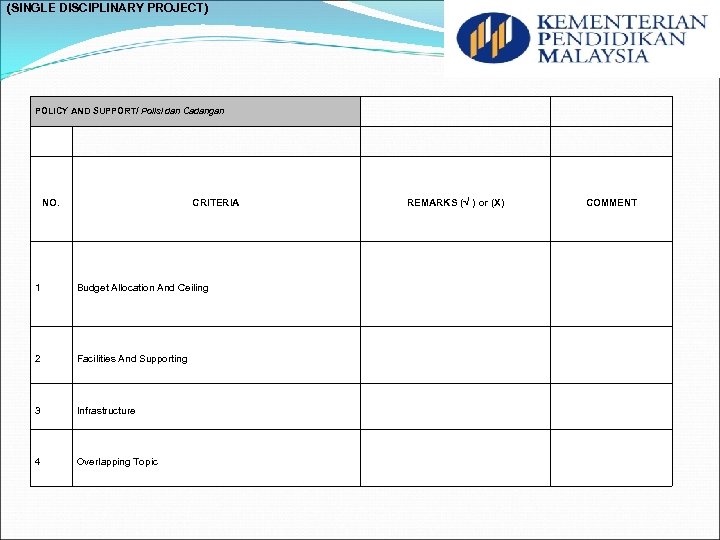 (SINGLE DISCIPLINARY PROJECT) POLICY AND SUPPORT/ Polisi dan Cadangan NO. CRITERIA 1 Budget Allocation And Ceiling 2 Facilities And Supporting 3 Infrastructure 4 Overlapping Topic REMARKS (√ ) or (X) COMMENT
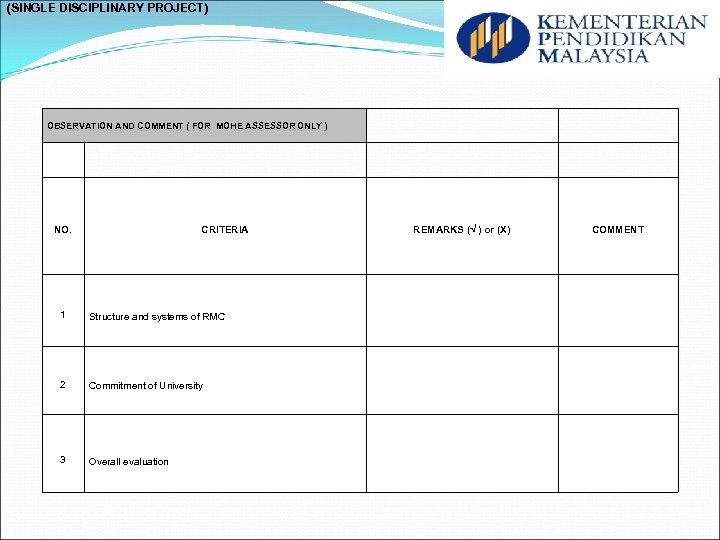 (SINGLE DISCIPLINARY PROJECT) OBSERVATION AND COMMENT ( FOR MOHE ASSESSOR ONLY ) NO. CRITERIA 1 Structure and systems of RMC 2 Commitment of University 3 Overall evaluation REMARKS (√ ) or (X) COMMENT
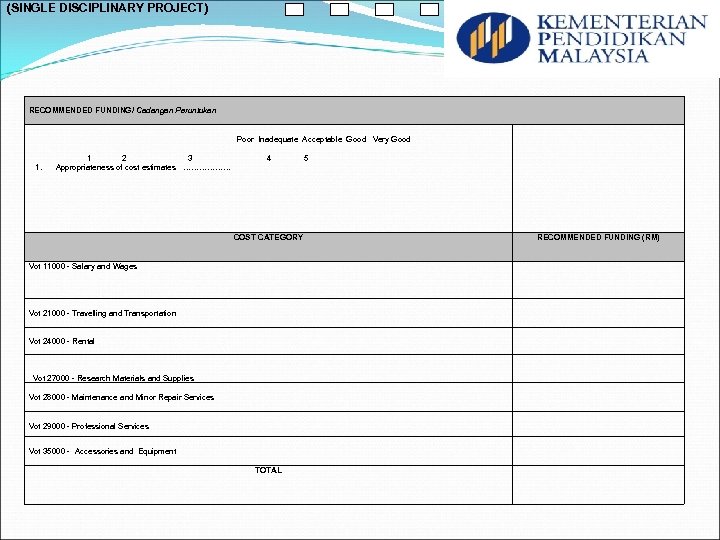 (SINGLE DISCIPLINARY PROJECT) RECOMMENDED FUNDING/ Cadangan Peruntukan Poor Inadequate Acceptable Good Very Good 1. 1 2 3 Appropriateness of cost estimates ……………… 4 5 COST CATEGORY Vot 11000 - Salary and Wages Vot 21000 - Travelling and Transportation Vot 24000 - Rental Vot 27000 - Research Materials and Supplies Vot 28000 - Maintenance and Minor Repair Services Vot 29000 - Professional Services Vot 35000 - Accessories and Equipment TOTAL RECOMMENDED FUNDING (RM)
 A IPT : PROJECT LEADER : PROGRAM TITLE : PROJECT LEADER : RESEARCH TITLE :
 Title Approved: 1. Amending phosphate fertilizers with activated carbon, humic acids, and zeolite to improve phosphorus use efficiency in acid soils. 2. Investigation of the excretory-secretory proteins (ES) produced by the filariform larvae (L 2) of Strongyloides ratti. 3. Quality improvement of vermicompost as an organic fertilizer. 4. The use of biolistic method in assessing transient expression of pathogenesis-related genes.
 Title Rejected: 1. Profil penggunaan Laman Sosial dalam kalangan pelajar Universiti. 2. Isolation and Characterization of Antioxidants From Selected Endemic Fruits of Sarawak. 3. Cloning, expression and characterization of hydrolytic enzymes encoding genes from Aspergillus flavus NSH 9 in yeast expression system. 4. Isolation of Differentially Expressed Genes of Selected Bario Rice in Different Growing Conditions
 Executive Summary Approved: Malaysian soils such as Ultisols and Oxisols, like most other tropical soils, are known to be highly weathered, acidic, and inherently low in P and have high P fixing capacities (Zaharah and Sharifuddin, 1997; Sallade and Sims, 1997; Goh and Chiew, 1995). The abundance of variable charge colloids in these soils together with low p. H and low CEC has led to the presence of high amounts of oxides and hydroxides of Fe and Al. The oxides and hydroxides fix large amounts of soluble P leading to low concentrations of available P in soil solution (Wilson et al. , 2004). Thus, large amounts of phosphate fertilizers are required to attain high yields from crops. However, this approach has not been successful because it is not only economically unsustainable but also not environmental friendly because excessive and unbalanced use of P fertilizers lead to water pollution called eutrophication. Therefore, the objectives of this study were to amend commonly used phosphate fertilizers such Triple Superphosphate, Christmas Island Rock Phosphate, and China Rock Phosphate with highly negative charged substances such as zeolite, activated carbon, and humic acid to chelate or fix Al and Fe so as to make P readily available for plants to efficiently utilize P in fertilizers. A field experiment will be carried out investigate the effect of different combinations of the aforementioned P fertilizers with zeolite, activated carbon, and humic acid on P availability and its use efficiency. The test crop will be Zea mays. Variables to be studied to indicate the success of this research are: total P, organic P, soluble and loosely bound phosphorus, aluminum phosphates, iron phosphates, reductant soluble phosphorus, calcium phosphate, strongly adsorbed iron and aluminium phosphates fractions, fresh cob yield, dry matter, soil p. H, cation exchange capacity (CEC), NPK uptake and use efficiency. It is expected that at the end of this study, P availability and use efficiency could be significantly improved thereby contributing to the reduction of the excessive use of P fertilizers and the P import bill of Malaysia and elsewhere. Additionally, the outcome of this study may contribute to reduction of environmental pollution caused by P eutrophication. Furthermore, this will ensure increase in yield without degrading the quality of the enviroment.
 Executive Summary Approved: Strongyloides stercoralis infections can be asymptomatic or cause cutaneous, gastrointestinal and pulmonary symptoms. In the immunocompromised individuals or those on corticosteroid therapy, autoinfection can go unchecked and large numbers of invasive Strongyloides larvae may disseminate widely and cause hyperinfection, which can be fatal. There is no gold standard for diagnosis of S. stercoralis and serological diagnosis such as Enzyme-linked immunosorbent assay (ELISA) using crude antigens from the filariform larvae (L 3) or adult worm of S. strecoralis has been used for diagnostic, but cross-reactivity with other helminthic infections does occur giving false positive reactions. Strongyloides ratti which is found in most wild rat (Ratus ratus) have similar life cycle and caused similar pathology in experimented rat. The objective of this study is to investigation the heterologous excretory-secretory proteins (ES) of the filariform larvae (L 2) of S. ratti. Excretory-secretory proteins (ES) will be harvested from in vitro culture of the filariform larvae (L 2) of Strongyloides ratti. These excretory-secretory proteins (ES) will be extracted and purified and then will be immunologically tested in ELISA, Western Immunoblotting and IFAT against antibody of S. strecoralis that will be experimentally induced in rat and rabbit. Excretory-secretory proteins (ES) of the filariform larvae (L 2) of S. ratti which are highly immunogenic and species specific may have the potential for the development of a highly specific antibody based diagnostic test against strongyloidiasis.
 Executive Summary Approved: Vermicompost is considered as a soil conditioner and helps to improve soil properties and regulate plant growth. Type of feeding material is the most important variable in vermicomposting. Several studies have been carried out on the effect of feeding material on the growth rate of earthworms (Edwards & Arancon, 1998), reproduction performance of epigeic species (Suthar, 2007), nutritional status and feed mixture (Butt, 1993). Unfortunately, little information is available on the effects of feeding material to the level of nutrient concentrations. It was reported that vermicompost contains low level of nutrient concentrations compared to a commercial plant growth medium. Total N, P, K and Ca were 1. 6%, 1. 1%, 2. 7% and 1. 8% respectively (Prakash, 2008). It was thought to be a limiting factor for large-scale vermicomposting application. Moreover, vermicomposts produced from livestock manure are more alkaline, whereas most of the plants prefer a growth medium which is slightly acidic. Thus, the objectives of this study are 1) to enhance physical and chemical properties of vermicompost from various source of feeding materials, 2) to evaluate the effects of vermicompost on soil properties and plant growth. This study will be conducted in UPM, Serdang. The study will initially involve vermicomposting of epigeic species on mixture of livestock manure and plant residue. Some selected vermicompost will be tested on plant species including vegetables, medicinal plants and crops. Results of the study will provide information on vermicompost quality.
 Executive Summary Approved: Isochorismate synthase (ICS) is an enzyme that is involved in the biosynthesis of various secondary metabolites and more importantly, have been shown to be involved in plant defense. ICS plays a role in plant defense through the formation of an intermediate, isochorismate, and subsequently this is used in the production of salicylic acid (SA). The induction of SA has shown to enable plants to resist or at least tolerate infection by other pathogens via the creation of transgenic plants with increased expression of pathogenesis- related proteins. Nevertheless, the creations of transgenic plants have posed the question of acceptance of food crop by the public. Although the public seemed to be more aware of genetically modified organisms and products, the safety of the transgenic are still being question by various quarters and transgenic plants may risk the sale and export of the products especially to markets such as the European Union countries (EU). Alternative to the creation of transgenic plants, transiently expressed genes can also be used via the use of biolistic method. Through this method, no integration of genes is required but expressions of target genes are still achievable. This project proposes to assess the use of transiently via biolistic method (Helios Genegun, Biorad) in order to express genes that can be use to either counter the effects of infections in plants or increase the production of internal pathogenesisrelated proteins. We have previously isolated a c. DNA fragment that encodes for isochorismate synthase that is involved in the conversion of isochorismate. The work intends to investigate the use of ICS in inducing the synthesis of SA through transiently expressing ICS in plant cells. The ICS c. DNA function will be determined and a protocol to transiently express the gene will be established.
 Executive Summary Rejected: Pengunaan laman sosial telah menjadi satu fenomena dalam kalangan penguna Internet. Penggunaan laman seumpama ini boleh mendatangkan kebaikan mahupun keburukan dalam kalangan pengguna. Kajian yang dijalankan ini adalah bertujuan membangunkan profil penggunaan laman sosial dalam kalangan pelajar di IPTA/IPTS. Kajian yang dijalankan secara tinjauan menggunakan soal selidik akan dijalankan ke atas lima buah universiti penyelidikan dan empat buah di universiti lain. Aspek yang dikaji merangkumi faktor demografi, kesihatan mental dan tujuan pengunaan laman sosial. Profil yang akan direka bentuk adalah jangkama masa menggunakan laman sosial, aktiviti kerap dijalankan semasa akses laman sosial, ketagihan facebook dan hubungan sosial pelajar. Aspek kesihatan mental pula melibatkan kesejahteraan psikologi, kemurungan (depression), kesunyian (loneliness), ketagihan (addiction), ketakutan (Anxiety) dan stres pengguna laman sosial. Seterusnya, kajian ini akan mengenalpasti tujuan penggunaan laman sosial dalam kalangan pelajar universiti dan kesannya terhadap pencapaian akademik dan aktiviti rutin seharian. Profil yang terbentuk akan dapat memberi gambaran berkaitan penggunaan laman sosial dalam kalangan pelajar aliran Sains Sosial, Sains Teras dan Kejuruteraan. Kajian ini akan dapat membantu pihak Kementerian Pengajian Tinggi dan Kementerian Pembangunan Wanita, Keluarga dan Masyarakat dan Kementerian Kesihatan dalam memantau penggunaan laman sosial dalam kalangan pelajar universiti. Kajian ini boleh menjadi asas kepada kajian yang melibatkan penggunaan laman sosial di masa hadapan. Kajian lanjutan juga boleh dijalankan kepada kelompok yang lebih besar seperti pelajar sekolah, mereka yang telah bekerja, suri rumah dan sebagainya. Selain itu kajian dari aspek gender juga boleh dilakukan bagi menentukan setiap aspek yang dikaji dari segi perbandingan antara individu lelaki dan perempuan.
 Executive Summary Rejected: Antioxidants are very useful compounds that can be used for multiple applications such as in food, cosmetic and pharmaceutical industries. Free radicals are responsible for the damage of lipids, proteins and nucleic acids in cells leading to several physiological and pathological abnormalities such as inflammation, cardiovascular disease, cancer and ageing. Frequent consumption of fruits are associated with lower risk of stroke and cancer due to micro constituent of antioxidants contained in fruits. The main objectives of this project are to isolate and characterize antioxidant compounds from endemic fruits of Sarawak. Antioxidant activities of antioxidant compounds will be evaluated based on reducing antioxidant strength, DPPH free radical scavenging activity and ferrous ion chelating activity. Isolation of antioxidant compounds will be conducted based on bioassay guided fractionation method. Structure elucidation of the compound(s) will be determined by various spectroscopy methods such as gas chromatography-mass spectrometry (GC-MS), fourier transform infrared spectrometer (FTIR) and nuclear magnetic resonance (1 H NMR, 13 C NMR) spectroscopy.
 Executive Summary Rejected: Expression cloning is a new method for fast and efficient cloning of enzyme genes from fungi that are known to produce complex enzyme mixtures. The traditional cloning methods, however dependent on knowledge of at least a partial amino acid sequence in order to synthesize appropriate DNA probes or primers. The expression cloning method solely relies on access to the reliable and sensitive enzyme assays. The method is based on the detection and isolation of enzyme genes by combining the ability of yeast to express the genes with the utilization of specific substrate enzyme assay. The enzymes of interest will be heterologously expressed, purified and characterized. Hence, the purpose of this research study is to perform expression cloning technique on Aspergillus flavus NSH 9, in order to isolate different enzyme genes such as cellulases, amylases and pectinases-degrading enzymes. From previous studies done, Aspergillus flavus NSH 9, a locally isolated fungal strain is capable of producing important hydrolytic enzymes such as raw starch degrading enzymes (RSDE) for the bioconversion of sago waste into fermentable sugars. The fermentable sugar produced in turn can be used as raw materials for the production of bioethanol, lactic acid and kojic acid. In these experiments, Aspergillus flavus NSH 9 will be fermented in sago hampas and used as the source of m. RNA to develop the c. DNA library, cloned into Escherichia coli and screened for the production of hydrolytic enzymes. Then the c. DNA that encodes the enzyme of interest will be cloned and expressed further in yeast expression system for mass production of the recombinant enzyme. Once successful the technique used would be useful for future application in the exploration and characterization of other fungal enzyme product that are known to consist of a complex mixture of different hydrolytic enzyme activities
 Executive Summary Rejected: Rice is one of the major cereal crops in the world. Conventional cross-breeding methods have been employed to improve the quality of rice with much success. Nevertheless limitations to breeding programs limited the success of developing new varieties. Genetic engineering can be used to produce rice with improved quality in a shorter period compared to conventional programs. Bario rice is one of the premium rice varieties and is commonly grown in the Kelabit Highlands of Sarawak. Bario rice is renowned because of its special eating quality such as soft texture, fine and elongated grains with mold aromas and splendid taste. Gene expressions are influenced by several factors including by the environment. Thus for Bario rice varieties that are grown in highland conditions may have developed adaptation towards environmental stresses in growing at high altitude, climate, soil and water used for irrigation. These conditions may play key roles for the production of the special Bario rice characteristics. Therefore, the isolation and characterization of genes responsible for these qualities may be beneficial for future exploitation of the rice variety. This project aims to study the genes that may be involved in the control of these characteristics through the use of differential screening of c. DNA library that are made from developing rice grains of selected variety grown in highland areas. This will be achieved via two methods; first by creating a c. DNA library of lowland Bario rice and probing it with c. DNA from highland grown Bario rice, and vice versa. Secondly, transcriptome sequencing will also be used that enables the study of gene expression in selected tissues. Developing grains will be used to determine the differentially-expressed gene(s). Specific gene involved in the production of amylose will also be targeted as this is the key modifying enzyme in starch biosynthesis. The isolation and determination of these genes have the potential to be used in future application to modify the texture and taste of rice. Just to study the genes
 Problem Statement Approved: 1. Malaysian soils such as Ultisols and Oxisols, like most other tropical soils, are known to be highly weathered, acidic, and inherently low in P and have high P fixing capacities (Zaharah and Sharifuddin, 1997; Sallade and Sims, 1997; Goh and Chiew, 1995). The abundance of variable charge colloids in these soils together with low p. H and low CEC has led to the presence of high amounts of oxides and hydroxides of Fe and Al. The oxides and hydroxides fix large amounts of soluble P leading to low concentrations of available P in soil solution (Wilson et al. , 2004). Thus, large amounts of phosphate fertilizers are required to attain high yields from crops. However, this approach has not been successful because it is not only economically unsustainable but also not environmental friendly because excessive and unbalanced use of P fertilizers lead to water pollution called eutrophication. 2. Strongyloides stercoralis infections can be asymptomatic or cause cutaneous, gastrointestinal and pulmonary symptoms. In the immunocompromised individuals or those on corticosteroid therapy, autoinfection can go unchecked and large numbers of invasive Strongyloides larvae may disseminate widely and cause hyperinfection, which can be fatal. There is no gold standard for diagnosis of S. stercoralis and serological diagnosis such as Enzyme-linked immunosorbent assay (ELISA) using crude antigens from the filariform larvae (L 3) or adult worm of S. strecoralis has been used for diagnostic, but cross-reactivity with other helminthic infections does occur giving false positive reactions.
 Problem Statement Approved: 3. Nevertheless, the creations of transgenic plants have posed the question of acceptance of food crop by the public. Although the public seemed to be more aware of genetically modified organisms and products, the safety of the transgenic are still being question by various quarters and transgenic plants may risk the sale and export of the products especially to markets such as the European Union countries (EU). Problem Statement . 4. Strongyloides stercoralis infections can be asymptomatic or cause cutaneous, gastrointestinal and pulmonary symptoms. In the immunocompromised individuals or those on corticosteroid therapy, autoinfection can go unchecked and large numbers of invasive Strongyloides larvae may disseminate widely and cause hyperinfection, which can be fatal. There is no gold standard for diagnosis of S. stercoralis and serological diagnosis such as Enzyme-linked immunosorbent assay (ELISA) using crude antigens from the filariform larvae (L 3) or adult worm of S. strecoralis has been used for diagnostic, but cross-reactivity with other helminthic infections does occur giving false positive reactions.
 Objectives Approved: 1. a) To determine the effect of zeolite, activated carbon, and humic acids as amendments in P-fixation in acid soils. b) To evaluate yield of crops through improving phosphorus uptake and use efficiency in cultivated acid soils. 2. To investigate the excretory-secretory proteins (ES) produced by the larvae (L 2) of Strongyloides ratti.
 Objectives Approved: 3. a. To enhance physical and chemical properties of vermicompost, b. To evaluate the effects of vermicompost on soil properties and plant growth. 4. a. To characterize the function of ICS c. DNA via heterologous expression in selected model systems b. To assess the efficacy of transient expression of ICS c. DNA on fungiinfected plants
 Objectives Rejected: 1 a) To evaluate the antioxidant properties of selected endemic fruits of Sarawak. 1 b) To isolate and characterize the antioxidant compounds. 1 c) To identify the antioxidant activities of isolated compounds. 2 Kajian yang dijalankan ini adalah bertujuan: 2 a) Membina profil pengguna laman sosial dalam kalangan pelajar Universiti di IPTA/IPTS 2 b) Mengenalpasti tahap kesihatan mental dan kesejahteraan psikologikal pelajar universiti yang menggunakan laman sosial 2 c) Menentukan kesan penggunaan laman sosial terhadap aktiviti akademik pelajar di universiti. 2 d) Menentukan kesan penggunaan laman sosial terhadap kesihatan mental dan kesejahteraan psikologikal pelajar.
 Objectives Rejected: This study embarks on the following objectives: 1) To determine the diversity of species available in Malaysia. 2) To describe promising novel species or new records when discoveries are made. 3)To establish inventories for recorded species including and carry out morphological descriptions, allometrical measurements and distributional data. 4)To investigate the population distribution and abundance of representative species found. 5)To determine main abiotic and biotic factors that influence selected species or population distribution and demography. 6)To describe selected anatomy characters for adaptation to the abiotic factors of the habitat i. e. eyes, cuticles, pectines and book lungs. 7)To harvest the toxin of selected species (send to professional laboratory) for implications on human beneficial studies.
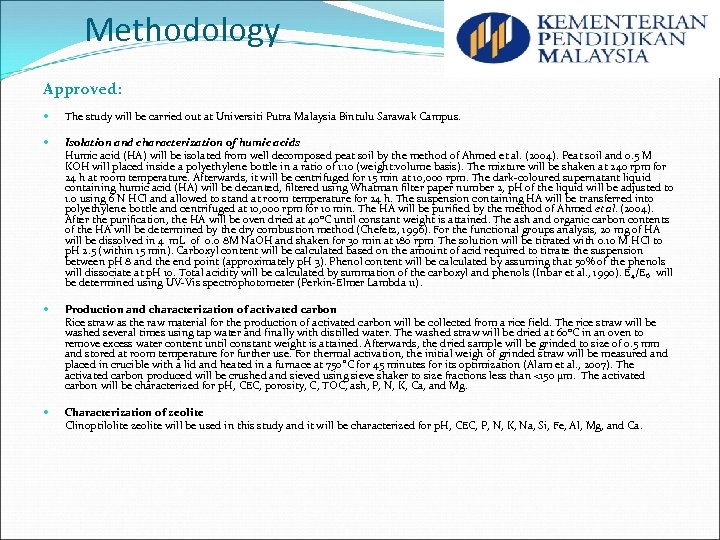 Methodology Approved: The study will be carried out at Universiti Putra Malaysia Bintulu Sarawak Campus. Production and characterization of activated carbon Rice straw as the raw material for the production of activated carbon will be collected from a rice field. The rice straw will be washed several times using tap water and finally with distilled water. The washed straw will be dried at 60°C in an oven to remove excess water content until constant weight is attained. Afterwards, the dried sample will be grinded to size of 0. 5 mm and stored at room temperature for further use. For thermal activation, the initial weigh of grinded straw will be measured and placed in crucible with a lid and heated in a furnace at 750˚C for 45 minutes for its optimization (Alam et al. , 2007). The activated carbon produced will be crushed and sieved using sieve shaker to size fractions less than <150 μm. The activated carbon will be characterized for p. H, CEC, porosity, C, TOC, ash, P, N, K, Ca, and Mg. Characterization of zeolite Clinoptilolite zeolite will be used in this study and it will be characterized for p. H, CEC, P, N, K, Na, Si, Fe, Al, Mg, and Ca. Isolation and characterization of humic acids Humic acid (HA) will be isolated from well decomposed peat soil by the method of Ahmed et al. (2004). Peat soil and 0. 5 M KOH will placed inside a polyethylene bottle in a ratio of 1: 10 (weight: volume basis). The mixture will be shaken at 240 rpm for 24 h at room temperature. Afterwards, it will be centrifuged for 15 min at 10, 000 rpm. The dark-coloured supernatant liquid containing humic acid (HA) will be decanted, filtered using Whatman filter paper number 2, p. H of the liquid will be adjusted to 1. 0 using 6 N HCl and allowed to stand at room temperature for 24 h. The suspension containing HA will be transferred into polyethylene bottle and centrifuged at 10, 000 rpm for 10 min. The HA will be purified by the method of Ahmed et al. (2004). After the purification, the HA will be oven dried at 40°C until constant weight is attained. The ash and organic carbon contents of the HA will be determined by the dry combustion method (Chefetz, 1996). For the functional groups analysis, 20 mg of HA will be dissolved in 4 m. L of 0. 0 8 M Na. OH and shaken for 30 min at 180 rpm. The solution will be titrated with 0. 10 M HCl to p. H 2. 5 (within 15 min). Carboxyl content will be calculated based on the amount of acid required to titrate the suspension between p. H 8 and the end point (approximately p. H 3). Phenol content will be calculated by assuming that 50% of the phenols will dissociate at p. H 10. Total acidity will be calculated by summation of the carboxyl and phenols (Inbar et al. , 1990). E 4/E 6 will be determined using UV-Vis spectrophotometer (Perkin-Elmer Lambda 11).
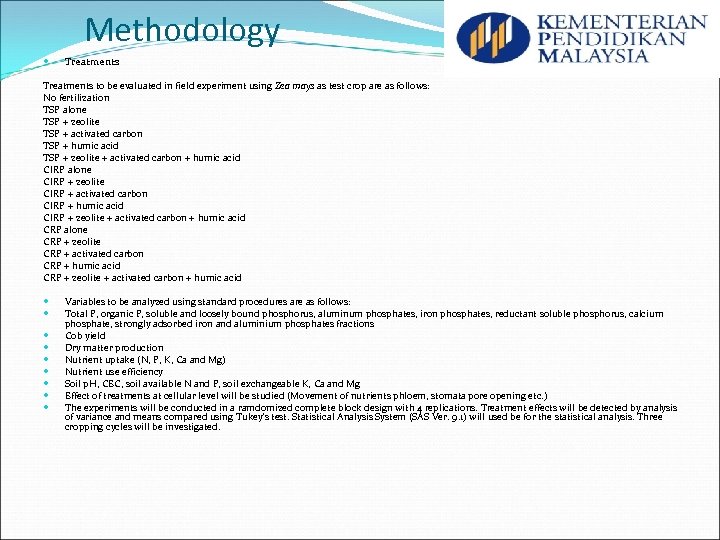 Methodology Treatments to be evaluated in field experiment using Zea mays as test crop are as follows: No fertilization TSP alone TSP + zeolite TSP + activated carbon TSP + humic acid TSP + zeolite + activated carbon + humic acid CIRP alone CIRP + zeolite CIRP + activated carbon CIRP + humic acid CIRP + zeolite + activated carbon + humic acid CRP alone CRP + zeolite CRP + activated carbon CRP + humic acid CRP + zeolite + activated carbon + humic acid Variables to be analyzed using standard procedures are as follows: Total P, organic P, soluble and loosely bound phosphorus, aluminum phosphates, iron phosphates, reductant soluble phosphorus, calcium phosphate, strongly adsorbed iron and aluminium phosphates fractions Cob yield Dry matter production Nutrient uptake (N, P, K, Ca and Mg) Nutrient use efficiency Soil p. H, CEC, soil available N and P, soil exchangeable K, Ca and Mg Effect of treatments at cellular level will be studied (Movement of nutrients phloem, stomata pore opening etc. ) The experiments will be conducted in a ramdomized complete block design with 4 replications. Treatment effects will be detected by analysis of variance and means compared using Tukey’s test. Statistical Analysis System (SAS Ver. 9. 1) will used be for the statistical analysis. Three cropping cycles will be investigated.
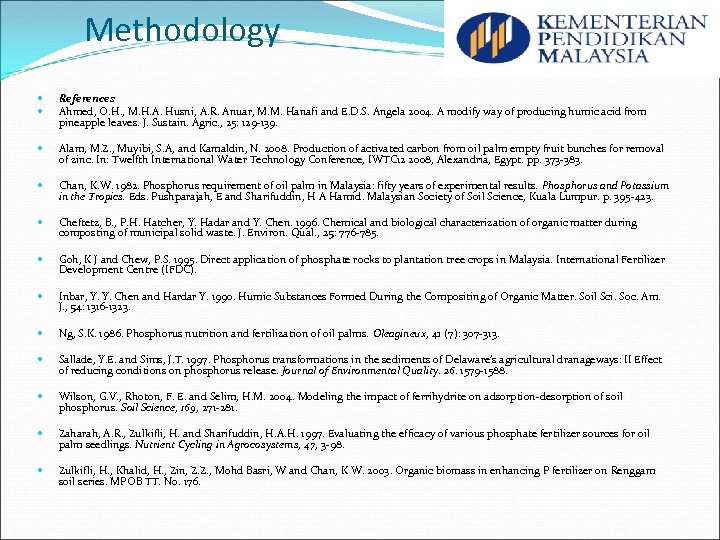 Methodology References Ahmed, O. H. , M. H. A. Husni, A. R. Anuar, M. M. Hanafi and E. D. S. Angela 2004. A modify way of producing humic acid from pineapple leaves. J. Sustain. Agric. , 25: 129 -139. Alam, M. Z. , Muyibi, S. A, and Kamaldin, N. 2008. Production of activated carbon from oil palm empty fruit bunches for removal of zinc. In: Twelfth International Water Technology Conference, IWTC 12 2008, Alexandria, Egypt. pp. 373 -383. Chan, K. W. 1982. Phosphorus requirement of oil palm in Malaysia: fifty years of experimental results. Phosphorus and Potassium in the Tropics. Eds. Pushparajah, E and Sharifuddin, H A Hamid. Malaysian Society of Soil Science, Kuala Lumpur. p. 395 -423. Cheftetz, B. , P. H. Hatcher, Y. Hadar and Y. Chen. 1996. Chemical and biological characterization of organic matter during composting of municipal solid waste. J. Environ. Qual. , 25: 776 -785. Goh, K J and Chew, P. S. 1995. Direct application of phosphate rocks to plantation tree crops in Malaysia. International Fertilizer Development Centre (IFDC). Inbar, Y. Y. Chen and Hardar Y. 1990. Humic Substances Formed During the Compositing of Organic Matter. Soil Sci. Soc. Am. J. , 54: 1316 -1323. Ng, S. K. 1986. Phosphorus nutrition and fertilization of oil palms. Oleagineux, 41 (7): 307 -313. Sallade, Y. E. and Sims, J. T. 1997. Phosphorus transformations in the sediments of Delaware’s agricultural dranageways: II Effect of reducing conditions on phosphorus release. Journal of Environmental Quality. 26. 1579 -1588. Wilson, G. V. , Rhoton, F. E. and Selim, H. M. 2004. Modeling the impact of ferrihydrite on adsorption-desorption of soil phosphorus. Soil Science, 169, 271 -281. Zaharah, A. R. , Zulkifli, H. and Sharifuddin, H. A. H. 1997. Evaluating the efficacy of various phosphate fertilizer sources for oil palm seedlings. Nutrient Cycling in Agrocosystems, 47, 3 -98. Zulkifli, H. , Khalid, H. , Zin, Z. Z. , Mohd Basri, W and Chan, K W. 2003. Organic biomass in enhancing P fertilizer on Renggam soil series. MPOB TT. No. 176.
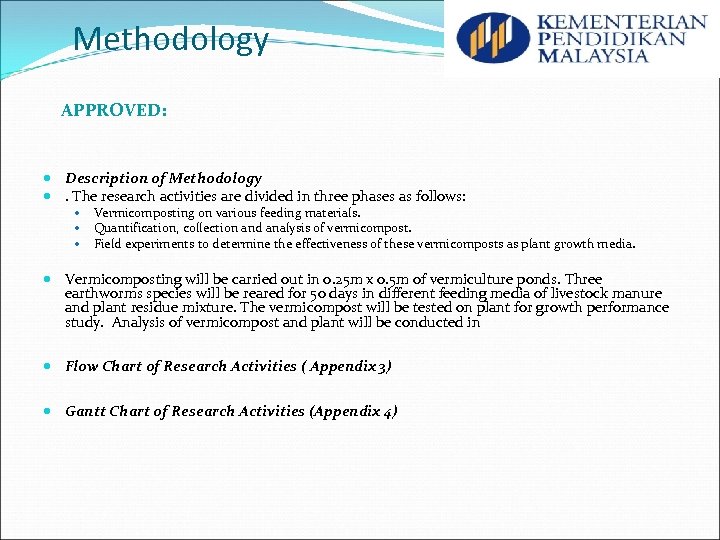 Methodology APPROVED: Description of Methodology . The research activities are divided in three phases as follows: Vermicomposting on various feeding materials. Quantification, collection and analysis of vermicompost. Field experiments to determine the effectiveness of these vermicomposts as plant growth media. Vermicomposting will be carried out in 0. 25 m x 0. 5 m of vermiculture ponds. Three earthworms species will be reared for 50 days in different feeding media of livestock manure and plant residue mixture. The vermicompost will be tested on plant for growth performance study. Analysis of vermicompost and plant will be conducted in Flow Chart of Research Activities ( Appendix 3) Gantt Chart of Research Activities (Appendix 4)
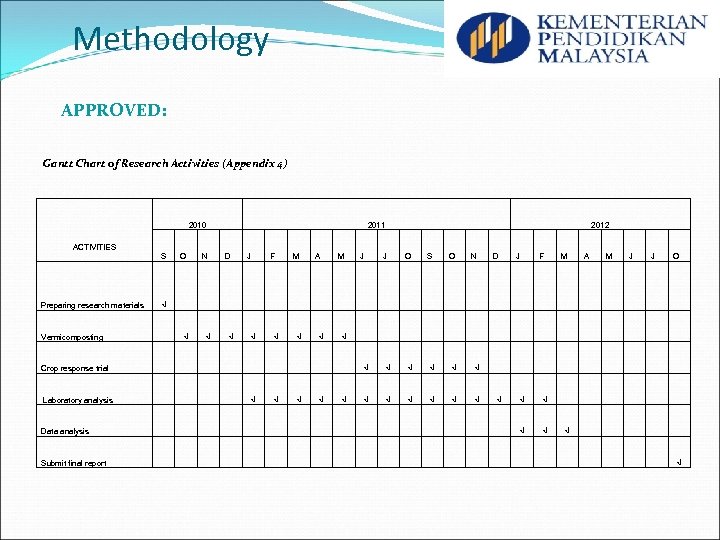 Methodology APPROVED: Gantt Chart of Research Activities (Appendix 4) 2010 2011 2012 ACTIVITIES S Preparing research materials √ Vermicomposting O √ N √ D √ J √ F √ M √ A √ M Data analysis Submit final report J O S O N √ √ √ D J F M A M J J O √ Crop response trial Laboratory analysis J √ √ √ √ √
 Methodology Approved: 1. Description of Methodology Competent Cell Preparation Competent cells are prepared from stock Escherichia coli (E. coli) either the JM 109 or XL 1 Blue strain (Stratagene). One millilitre of E. coli is inoculated into 10 ml LB broth and incubated at 37°C with shaking 150 rpm for overnight. After that, 5 ml of the overnight culture would be inoculated in 45 ml LB broth and incubated at 37°C with shaking 250 rpm, for three hours. The bacterial cell concentration would be verified every 30 minutes by using spectrophotometer at OD 600 until reading 0. 60 – 0. 80 obtained. Next, the culture would be cooled on ice for 10 – 20 minutes. After that, the cells are then centrifuged at 3500 rpm, 4°C for 5 minutes. The resulting supernatant is then discarded. Cell pellet is then gently resuspended in ice-cooled 100 m. M Ca. Cl 2 solution. The cells incubated on ice for ten minutes and re-centrifuged at 3500 rpm, 4°C for 5 minutes. The resulting supernatant is then discarded and the pellet resuspended in 2. 5 ml 100 m. M Ca. Cl 2 solution. 20% (v/v) glycerol added to the into the cell suspension and mixed. Lastly, the suspension would be snap- frozen and stored at -80°C for future use.
 Methodology Approved: S. ratti larvae will be obtained from the feces of infected wild rats (Rattus rattus) and while S. stercoralis will be obtained from the Centers for Disease Control (CDC; Atlanta, USA) and to be used to generate known positive control. The fecal samples will be mixed with an equal part of finely ground wood charcoal, moistened with water, spread equally on petri dishes and will be incubated at 25°C for 5 days. S. ratti filariform larvae (L 2) will be harvested according to the Baermann (1917)Moraes (1948) method, will be concentrated by centrifugation for 5 minutes at 1 000 g and wil be stored at – 20°C. The excretory-secretory proteins (ES) extract will be obtained from S. ratti filariform larvae (L 2) and will be resuspended in 1 ml of phosphate buffered saline (PBS) p. H 7. 2 containing protease inhibitors (1 m. M EGTA, 10 m. M EDTA, and 0. 05 m. M PMSF), and will be sonicated on ice (2 cycles of 10 s). The excretory-secretory proteins (ES) suspension will be centrifuged at 5000 rpm for 30 minutes at 4ºC, and the supernatant will be submitted to protein estimation by the Lowry et al. (1951) method. Sera from rat and rabbit that are naturally and experimentally infected with S. ratti and S. stercoralis filariform larvae (L 2) will be submitted to salt precipitation (3. 12 M amonium sulfate, p. H 6. 5) to obtain the gammaglobulin fraction. After incubation for 18 h at 4ºC the preparation will be centrifuged at 2000 rpm for 30 min at 4ºC. The pellet will be washed three times in 1. 56 M ammonium sulfate p. H 6. 5 and will be dialyzed for 24 h at 4ºC against saline solution. The uninfected rat and rabbit sera will be used as known negative control. The excretory-secretory proteins (ES) extract of the S. ratti filariform larvae (L 2) will be diluted (v/v) in sample buffer (6. 5μg of final protein content) and will be boiled for 3 minutes at 100ºC. The excretory-secretory proteins (ES) of the S. ratti filariform larvae (L 2) will be submitted to sodium dodecyl sulfate-polyacrylamide gel electrophoresis (SDS-PAGE) using a 12% resolving gel under denaturant and reducing conditions (Biorad System, US), as described by Laemmli (1970). After SDSPAGE, the gels will be stained by Silver Staining Method and will be used for nitrocellulose membranes analysis for Western Immunoblotting (0. 45μm; Sigma, US), as described by Towbin et al. (1979), using a transfer apparatus (Hoefer System, US).
 Rejected: Methodology Penyelidik akan dibantu oleh pembantu penyelidik dengan melawat university berkaitan untuk mengumpul data daripada pelajar ketiga-tiga aliran. Pelajar yang tidak dapat memulangkan soal selidik pada masa itu akan diminta memulangkan secara pos. Sampel adalah terdiri daripada pelajar tahun 2 sehingga semester akhir. Ini bertujuan memberikan mereka peluang untuk menerokai laman sosial dalam kampus masing-masing. Carta alir Metodologi Pengumpulan kajian literatur bagi mendapatkan bahan ↓ Temubual dengan beberapa pelajar berkaitan penggunaan laman sosial ↓ Kenal pasti konstruk kajian ↓ Pembentukan Instrumen ↓ Kesahan Kandungan daripada pakar ↓ Kajian rintis ↓ Kemaskini Item ↓ Pengumpulan data sebenar ↓ Penyediaan Laporan
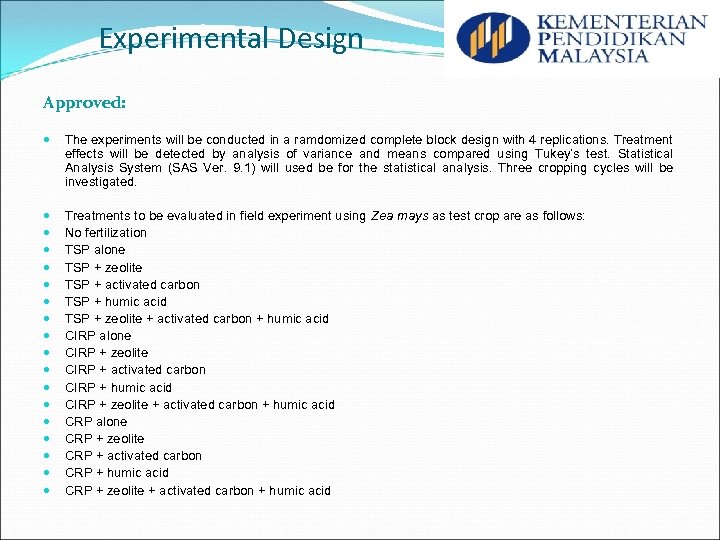 Experimental Design Approved: The experiments will be conducted in a ramdomized complete block design with 4 replications. Treatment effects will be detected by analysis of variance and means compared using Tukey’s test. Statistical Analysis System (SAS Ver. 9. 1) will used be for the statistical analysis. Three cropping cycles will be investigated. Treatments to be evaluated in field experiment using Zea mays as test crop are as follows: No fertilization TSP alone TSP + zeolite TSP + activated carbon TSP + humic acid TSP + zeolite + activated carbon + humic acid CIRP alone CIRP + zeolite CIRP + activated carbon CIRP + humic acid CIRP + zeolite + activated carbon + humic acid CRP alone CRP + zeolite CRP + activated carbon CRP + humic acid CRP + zeolite + activated carbon + humic acid
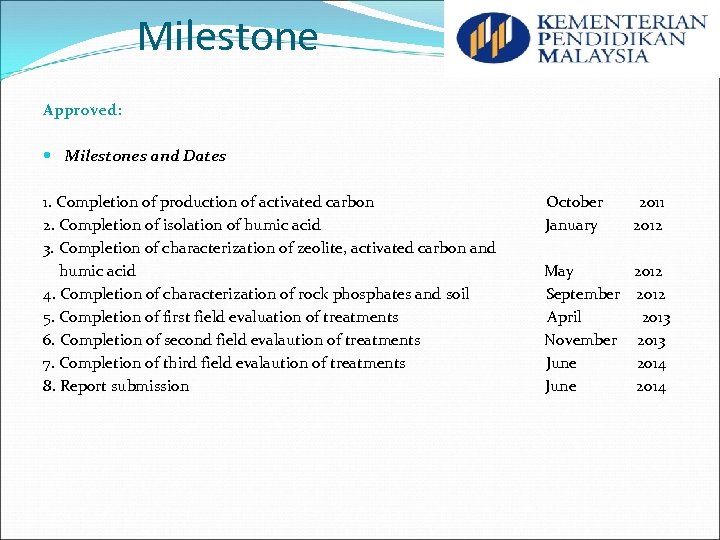 Milestone Approved: Milestones and Dates 1. Completion of production of activated carbon October 2011 2. Completion of isolation of humic acid January 2012 3. Completion of characterization of zeolite, activated carbon and humic acid May 2012 4. Completion of characterization of rock phosphates and soil September 2012 5. Completion of first field evaluation of treatments April 2013 6. Completion of second field evalaution of treatments November 2013 7. Completion of third field evalaution of treatments June 2014 8. Report submission June 2014
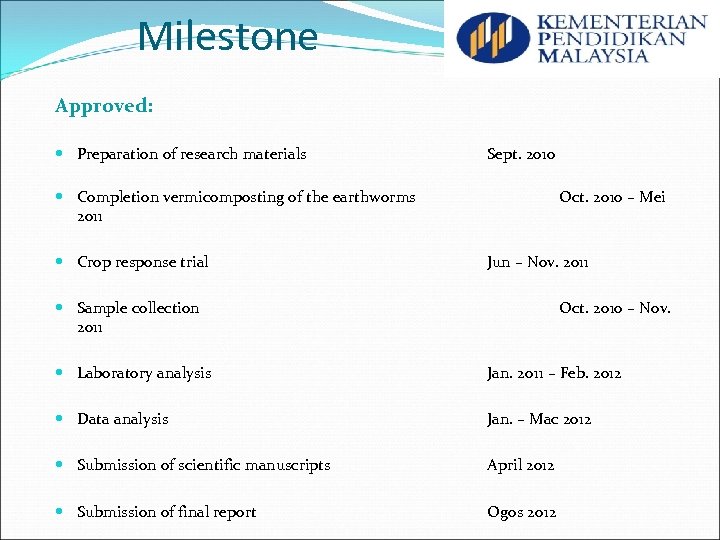 Milestone Approved: Preparation of research materials Sept. 2010 Completion vermicomposting of the earthworms 2011 Crop response trial Oct. 2010 – Mei Jun – Nov. 2011 Sample collection 2011 Oct. 2010 – Nov. Laboratory analysis Jan. 2011 – Feb. 2012 Data analysis Jan. – Mac 2012 Submission of scientific manuscripts April 2012 Submission of final report Ogos 2012
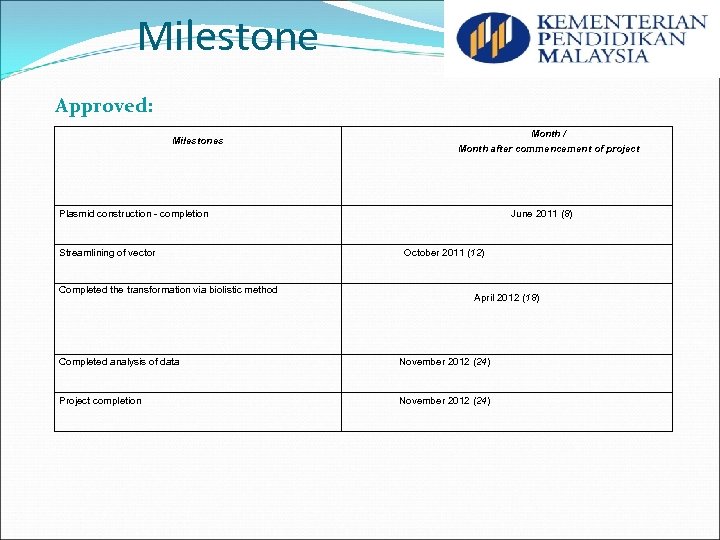 Milestone Approved: Milestones Month / Month after commencement of project Plasmid construction - completion Streamlining of vector Completed the transformation via biolistic method June 2011 (8) October 2011 (12) April 2012 (18) Completed analysis of data November 2012 (24) Project completion November 2012 (24)
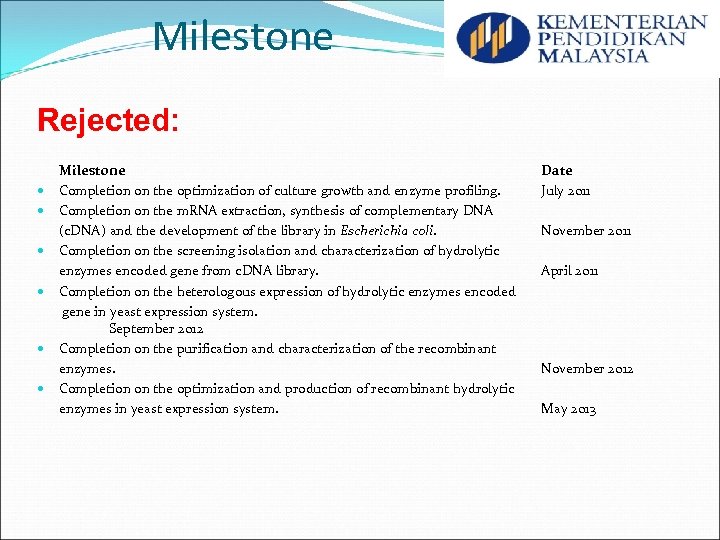 Milestone Rejected: Milestone Completion on the optimization of culture growth and enzyme profiling. Completion on the m. RNA extraction, synthesis of complementary DNA (c. DNA) and the development of the library in Escherichia coli. Completion on the screening isolation and characterization of hydrolytic enzymes encoded gene from c. DNA library. Completion on the heterologous expression of hydrolytic enzymes encoded gene in yeast expression system. September 2012 Completion on the purification and characterization of the recombinant enzymes. Completion on the optimization and production of recombinant hydrolytic enzymes in yeast expression system. Date July 2011 November 2011 April 2011 November 2012 May 2013
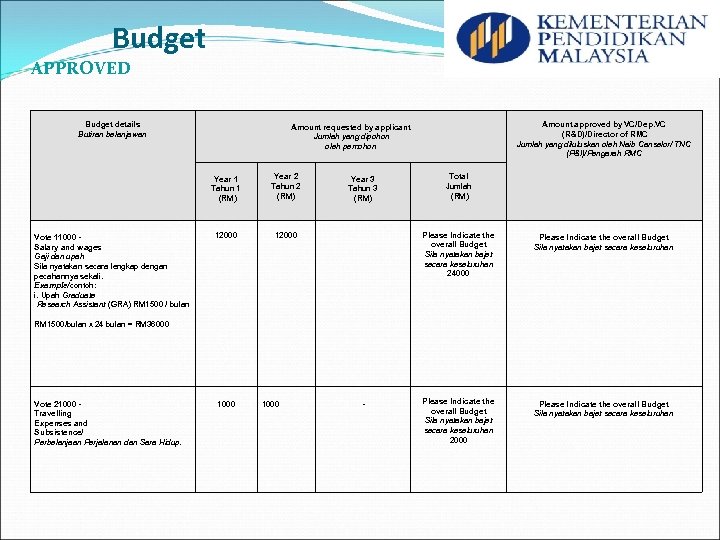 Budget APPROVED Budget details Butiran belanjawan Amount approved by VC/Dep. VC (R&D)/Director of RMC Jumlah yang diluluskan oleh Naib Canselor/ TNC (P&I)/Pengarah RMC Amount requested by applicant Jumlah yang dipohon oleh pemohon Year 1 Tahun 1 (RM) Year 2 Tahun 2 (RM) Vote 11000 Salary and wages Gaji dan upah Sila nyatakan secara lengkap dengan pecahannya sekali. Example/contoh: i. Upah Graduate Research Assistant (GRA) RM 1500 / bulan RM 1500/bulan x 24 bulan = RM 36000 12000 Vote 21000 Travelling Expenses and Subsistence/ Perbelanjaan Perjalanan dan Sara Hidup. 1000 Year 3 Tahun 3 (RM) Total Jumlah (RM) Please Indicate the overall Budget Sila nyatakan bajet secara keseluruhan 24000 - Please Indicate the overall Budget Sila nyatakan bajet secara keseluruhan 2000 Please Indicate the overall Budget Sila nyatakan bajet secara keseluruhan
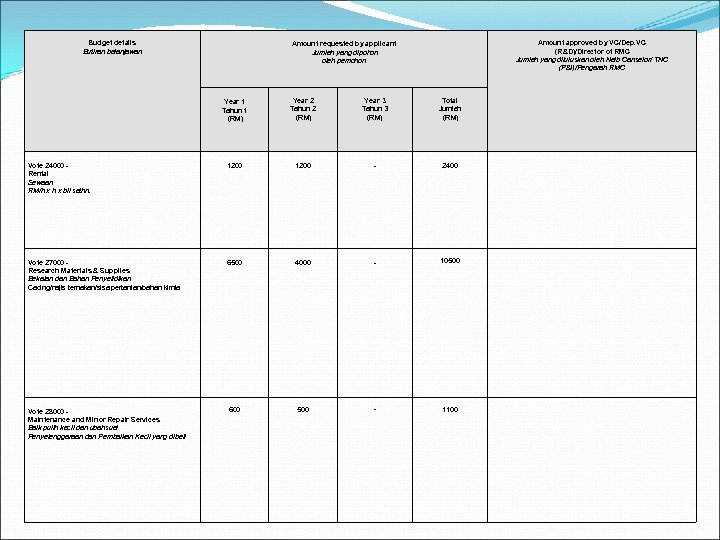 Budget details Butiran belanjawan Amount approved by VC/Dep. VC (R&D)/Director of RMC Jumlah yang diluluskan oleh Naib Canselor/ TNC (P&I)/Pengarah RMC Amount requested by applicant Jumlah yang dipohon oleh pemohon Year 1 Tahun 1 (RM) Year 2 Tahun 2 (RM) Year 3 Tahun 3 (RM) Total Jumlah (RM) Vote 24000 Rental Sewaan RM/h x bil sethn. 1200 - 2400 Vote 27000 Research Materials & Supplies Bekalan dan Bahan Penyelidikan Cacing/najis ternakan/sisa pertanian/bahan kimia 6500 4000 - 10500 Vote 28000 Maintenance and Minor Repair Services Baik pulih kecil dan ubahsuai Penyelenggaraan dan Pembaikan Kecil yang dibeli 600 500 - 1100
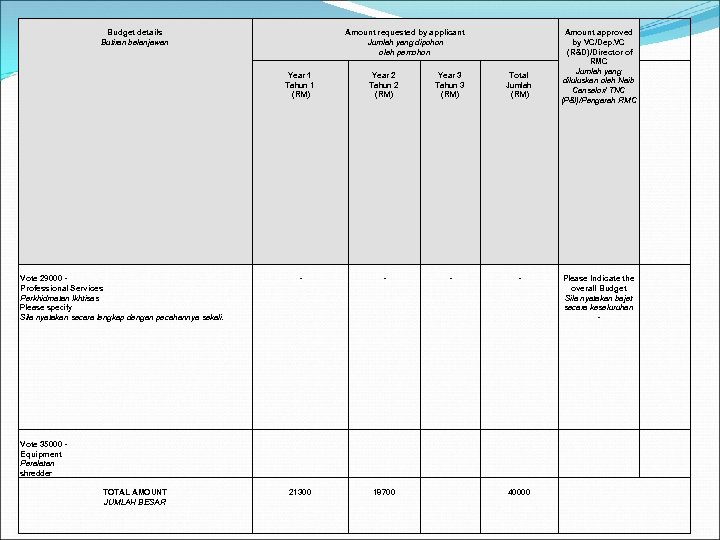 Budget details Butiran belanjawan Amount requested by applicant Jumlah yang dipohon oleh pemohon Year 1 Tahun 1 (RM) Vote 29000 Professional Services Perkhidmatan Ikhtisas Please specify Sila nyatakan secara lengkap dengan pecahannya sekali. Year 2 Tahun 2 (RM) Year 3 Tahun 3 (RM) Total Jumlah (RM) - - 21300 18700 Vote 35000 Equipment Peralatan shredder TOTAL AMOUNT JUMLAH BESAR 40000 Amount approved by VC/Dep. VC (R&D)/Director of RMC Jumlah yang diluluskan oleh Naib Canselor/ TNC (P&I)/Pengarah RMC Please Indicate the overall Budget Sila nyatakan bajet secara keseluruhan -
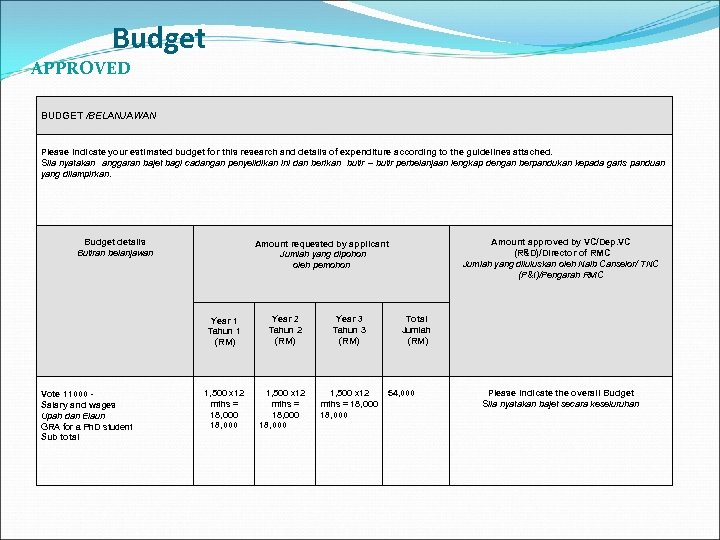 Budget APPROVED BUDGET /BELANJAWAN Please indicate your estimated budget for this research and details of expenditure according to the guidelines attached. Sila nyatakan anggaran bajet bagi cadangan penyelidikan ini dan berikan butir – butir perbelanjaan lengkap dengan berpandukan kepada garis panduan yang dilampirkan. Budget details Butiran belanjawan Year 1 Tahun 1 (RM) Vote 11000 Salary and wages Upah dan Elaun GRA for a Ph. D student Sub total Amount approved by VC/Dep. VC (R&D)/Director of RMC Jumlah yang diluluskan oleh Naib Canselor/ TNC (P&I)/Pengarah RMC Amount requested by applicant Jumlah yang dipohon oleh pemohon Year 2 Tahun 2 (RM) Year 3 Tahun 3 (RM) 1, 500 x 12 mths = 18, 000 1, 500 x 12 mths = 18, 000 Total Jumlah (RM) 54, 000 Please Indicate the overall Budget Sila nyatakan bajet secara keseluruhan
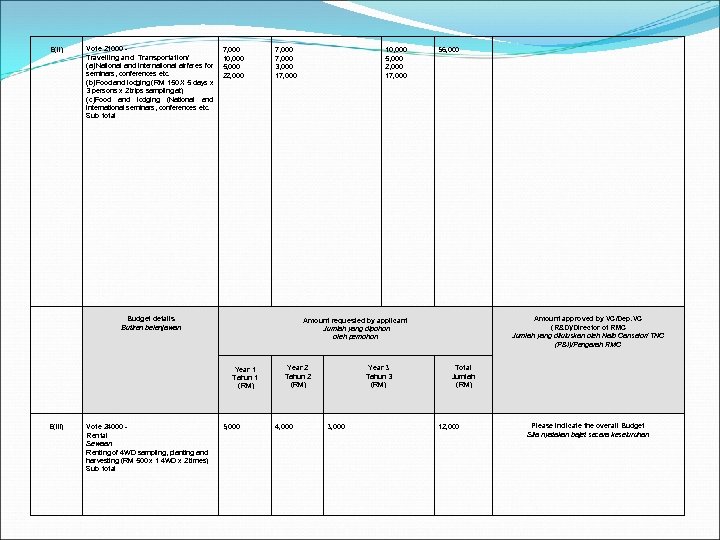 E(ii) Vote 21000 Travelling and Transportation/ (a)National and international airfares for seminars, conferences etc. (b)Food and lodging (RM 150 X 5 days x 3 persons x 2 trips sampling at) (c)Food and lodging (National and international seminars, conferences etc. Sub total 7, 000 10, 000 5, 000 22, 000 7, 000 3, 000 17, 000 Budget details Butiran belanjawan Year 1 Tahun 1 (RM) Vote 24000 Rental Sewaan Renting of 4 WD sampling, planting and harvesting (RM 500 x 1 4 WD x 2 times) Sub total 56, 000 Amount approved by VC/Dep. VC (R&D)/Director of RMC Jumlah yang diluluskan oleh Naib Canselor/ TNC (P&I)/Pengarah RMC Amount requested by applicant Jumlah yang dipohon oleh pemohon E(iii) 10, 000 5, 000 2, 000 17, 000 5, 000 Year 2 Tahun 2 (RM) 4, 000 Year 3 Tahun 3 (RM) 3, 000 Total Jumlah (RM) 12, 000 Please Indicate the overall Budget Sila nyatakan bajet secara keseluruhan
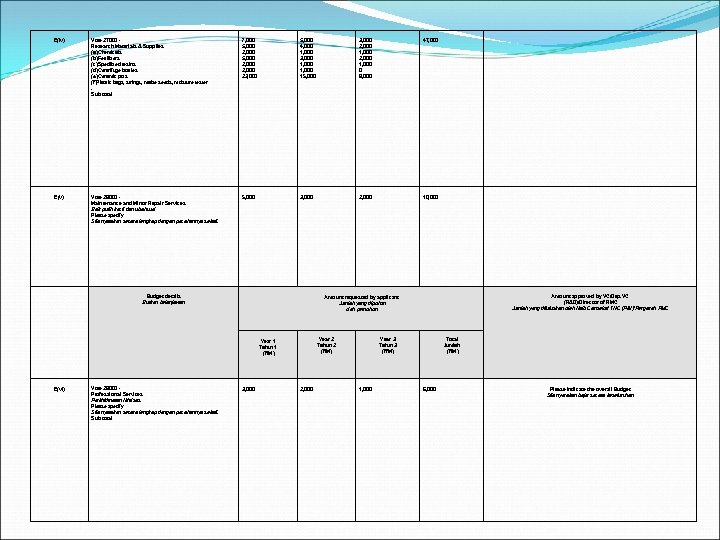 E(iv) Vote 27000 Research Materials & Supplies (a)Chemicals (b)Fertilizers (c)Specilized resins (d)Centrifuge bottles (e)Ceramic pots (f)Plastic bags, strings, maize seeds, moisture tester. Sub total 7, 000 5, 000 2, 000 23, 000 5, 000 4, 000 1, 000 3, 000 1, 000 15, 000 3, 000 2, 000 1, 000 0 9, 000 47, 000 E(v) Vote 28000 Maintenance and Minor Repair Services Baik pulih kecil dan ubahsuai Please specify Sila nyatakan secara lengkap dengan pecahannya sekali. 5, 000 3, 000 2, 000 10, 000 Budget details Butiran belanjawan Year 2 Tahun 2 (RM) Year 1 Tahun 1 (RM) E(vi) Vote 29000 Professional Services Perkhidmatan Ikhtisas Please specify Sila nyatakan secara lengkap dengan pecahannya sekali. Sub total Amount approved by VC/Dep. VC (R&D)/Director of RMC Jumlah yang diluluskan oleh Naib Canselor/ TNC (P&I)/Pengarah RMC Amount requested by applicant Jumlah yang dipohon oleh pemohon 3, 000 2, 000 Year 3 Tahun 3 (RM) 1, 000 Total Jumlah (RM) 6, 000 Please Indicate the overall Budget Sila nyatakan bajet secara keseluruhan
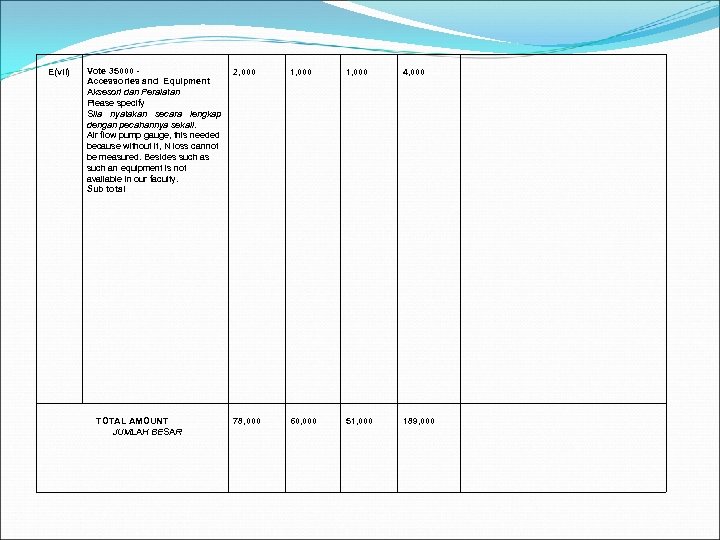 E(vii) Vote 35000 Accessories and Equipment Aksesori dan Peralatan Please specify Sila nyatakan secara lengkap dengan pecahannya sekali. Air flow pump gauge, this needed because without it, N loss cannot be measured. Besides such an equipment is not available in our faculty. Sub total TOTAL AMOUNT JUMLAH BESAR 2, 000 1, 000 4, 000 78, 000 60, 000 51, 000 189, 000
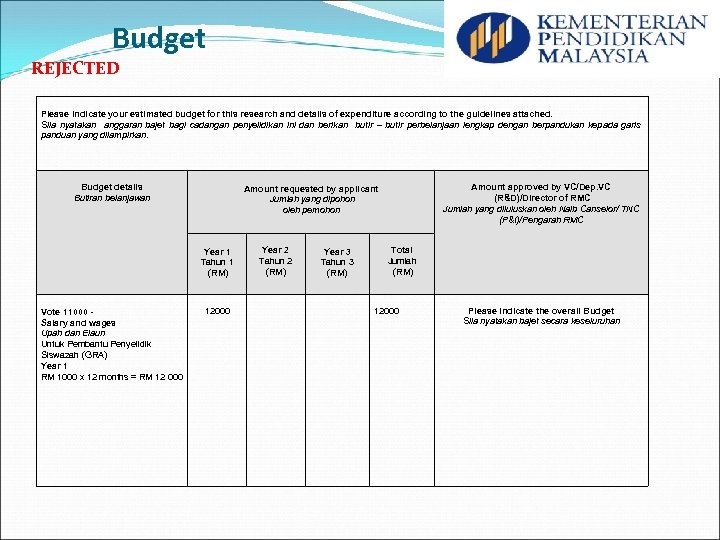 Budget REJECTED Please indicate your estimated budget for this research and details of expenditure according to the guidelines attached. Sila nyatakan anggaran bajet bagi cadangan penyelidikan ini dan berikan butir – butir perbelanjaan lengkap dengan berpandukan kepada garis panduan yang dilampirkan. Budget details Butiran belanjawan Year 1 Tahun 1 (RM) Vote 11000 Salary and wages Upah dan Elaun Untuk Pembantu Penyelidik Siswazah (GRA) Year 1 RM 1000 x 12 months = RM 12 000 Amount approved by VC/Dep. VC (R&D)/Director of RMC Jumlah yang diluluskan oleh Naib Canselor/ TNC (P&I)/Pengarah RMC Amount requested by applicant Jumlah yang dipohon oleh pemohon 12000 Year 2 Tahun 2 (RM) Year 3 Tahun 3 (RM) Total Jumlah (RM) 12000 Please Indicate the overall Budget Sila nyatakan bajet secara keseluruhan
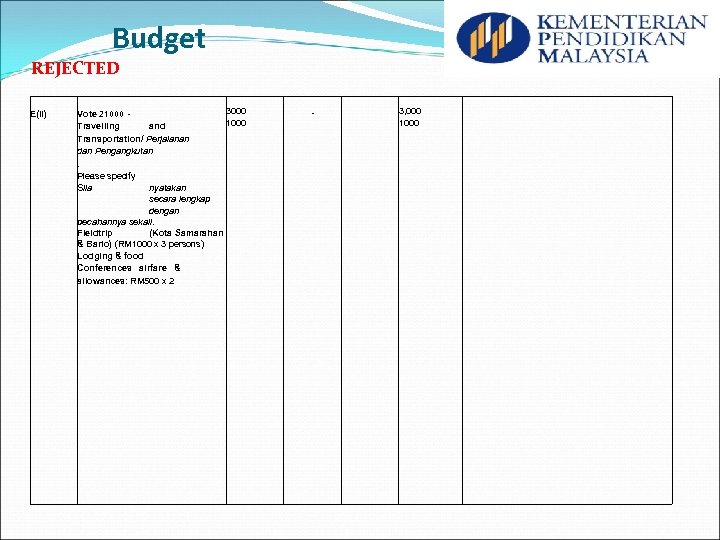 Budget REJECTED E(ii) 3000 Vote 21000 Travelling and Transportation/ Perjalanan dan Pengangkutan. Please specify Sila nyatakan secara lengkap dengan pecahannya sekali. Fieldtrip (Kota Samarahan & Bario) (RM 1000 x 3 persons) Lodging & food Conferences airfare & allowances: RM 500 x 2 - 3, 000 1000
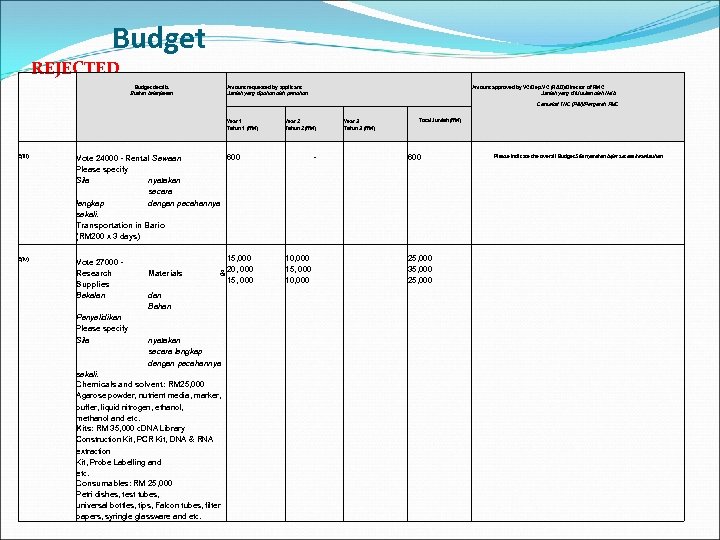 Budget REJECTED Budget details Butiran belanjawan Amount requested by applicant Jumlah yang dipohon oleh pemohon Amount approved by VC/Dep. VC (R&D)/Director of RMC Jumlah yang diluluskan oleh Naib Canselor/ TNC (P&I)/Pengarah RMC Year 1 Tahun 1 (RM) E(iii) 600 Vote 24000 - Rental Sewaan Please specify Sila nyatakan secara lengkap dengan pecahannya sekali. Transportation in Bario (RM 200 x 3 days) E(iv) Vote 27000 Research Supplies Bekalan Year 2 Tahun 2 (RM) Penyelidikan Please specify Sila 15, 000 Materials & 20, 000 15, 000 dan Bahan nyatakan secara lengkap dengan pecahannya sekali. Chemicals and solvent: RM 25, 000 Agarose powder, nutrient media, marker, buffer, liquid nitrogen, ethanol, methanol and etc. Kits: RM 35, 000 c. DNA Library Construction Kit, PCR Kit, DNA & RNA extraction Kit, Probe Labelling and etc. Consumables: RM 25, 000 Petri dishes, test tubes, universal bottles, tips, Falcon tubes, filter papers, syringle glassware and etc. - 10, 000 15, 000 10, 000 Year 3 Tahun 3 (RM) Total Jumlah (RM) 600 25, 000 35, 000 25, 000 Please Indicate the overall Budget Sila nyatakan bajet secara keseluruhan
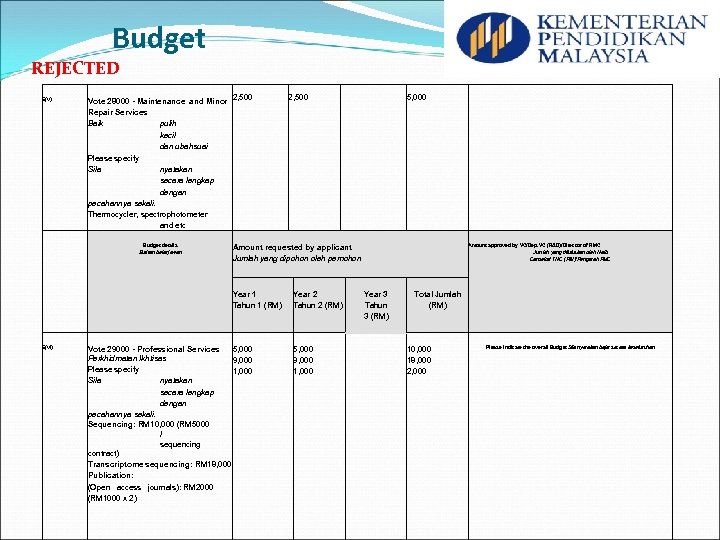 Budget REJECTED E(v) Vote 28000 - Maintenance and Minor 2, 500 Repair Services Baik pulih kecil dan ubahsuai Please specify Sila nyatakan secara lengkap dengan pecahannya sekali. Thermocycler, spectrophotometer and etc Budget details Butiran belanjawan 5, 000 Amount approved by VC/Dep. VC (R&D)/Director of RMC Jumlah yang diluluskan oleh Naib Canselor/ TNC (P&I)/Pengarah RMC Amount requested by applicant Jumlah yang dipohon oleh pemohon Year 1 Tahun 1 (RM) E(vi) 2, 500 Vote 29000 - Professional Services 5, 000 Perkhidmatan Ikhtisas 9, 000 Please specify 1, 000 Sila nyatakan secara lengkap dengan pecahannya sekali. Sequencing: RM 10, 000 (RM 5000 / sequencing contract) Transcriptome sequencing: RM 18, 000 Publication: (Open access journals): RM 2000 (RM 1000 x 2) Year 2 Tahun 2 (RM) 5, 000 9, 000 1, 000 Year 3 Tahun 3 (RM) Total Jumlah (RM) 10, 000 18, 000 2, 000 Please Indicate the overall Budget Sila nyatakan bajet secara keseluruhan
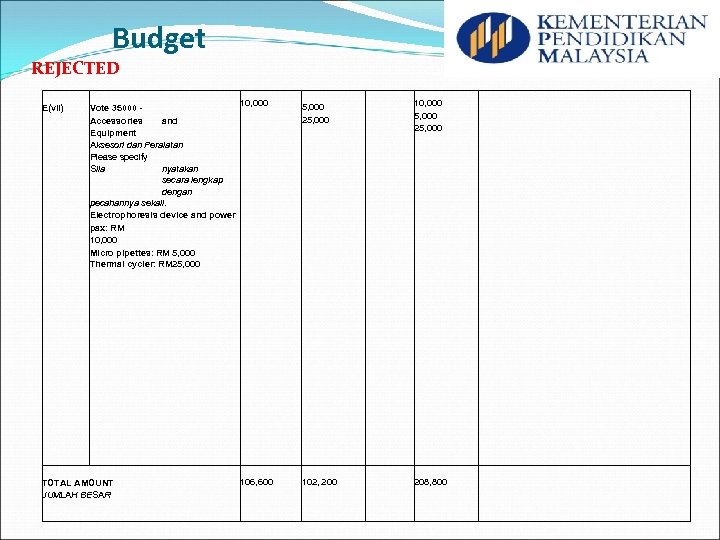 Budget REJECTED E(vii) Vote 35000 Accessories and Equipment Aksesori dan Peralatan Please specify Sila nyatakan secara lengkap dengan pecahannya sekali. Electrophoresis device and power pax: RM 10, 000 Micro pipettes: RM 5, 000 Thermal cycler: RM 25, 000 TOTAL AMOUNT JUMLAH BESAR 10, 000 5, 000 25, 000 106, 600 102, 200 208, 800
 Proper use of language (grammar, spelling, sentence construction) Example of good quality proposal: Approved: (background including Hypothesis /Research Questions and Literature Reviews) Phosphorus is naturally available in soils. However, it is usually not available in sufficient amount for optimum plant growth and development in acid soils. Phosphorus deficiency is a major limiting factor in many acid soils of the tropics including Malaysia. The amount of P in these soils are either inherently low or are fixed in forms that are unavailable to plants. As a result, high P rate is needed to overcome the high P-fixation, mainly due to high iron and aluminum oxides and hydroxides content in clay fractions (Chan, 1982; Ng, 1986; Goh and Chew, 1995). For this reason, high amounts of phosphate fertilizers are widely used to saturate P fixation. However, this approach has not been successful. There is good potential that organic based material can improve physical and chemical properties of soil to overcome the problem (Zulkifli et al. , 2003). Yet, the effectiveness of zeolite, activated carbon, and humic acids and duration of the effect after addition to soils together with phosphate fertilizers application remain un-understood. Amending phosphate fertilizers such as Triple Superphosphate, Christmas Island Rock Phosphate, Morocco Rock Phosphate, China Rock Phosphate and so on with zeolite, activated carbon, and humic acids will create a pool of negative charges around P and this process will enable chelation of aluminum and iron by zeolite, activated carbon, and humic acids instead of P. Hence, P will become readily available for efficient plant use. It is therefore hypothesized that amending commonly used phosphate fertilizers such Triple Superphosphate, Christmas Island Rock Phosphate, and China Rock Phosphate with highly negative charged substances such as zeolite, activated carbon, and humic acid will chelate or fix aluminium and Iron so to make P readily available for plants to efficiently utilize P from these fertilizers.
 Proper use of language (grammar, spelling, sentence construction) Example of good quality proposal: Approved: (Research background including Hypothesis /Research Questions and Literature Reviews) Vermicomposting is a promising method to reduce environmental problems of organic waste from industrial, agricultural and municipal activities. It involves the use of earthworms for processing organic wastes into nutrient-rich material called vermicompost. There are many reports on the influence of vermicompost on growth and productivity of plants and improvement of soil structure. It is physically characterized with a finely divided, well stabilized and humified material with high porosity, aeration and water-holding capacity (Lee, 1985; Yamaguchi & Haruki, 2003). The vermicompost is also rich in organic matter, available plant nutrients such as nitrate, phosphate and micronutrients, humic substances, plant growth regulator, enzymes and other beneficial microorganism (Barrett, 1949; Minnich, 1977). However, the concentration of nutrients available for plant growth is low in vermicompost and probably has little influence on plant growth. Dash and Patra (1979) reported that the total soluble and exchangeable nitrogen in vermicompost is only 0. 47% nitrogen. Similar amounts of phosphorus, approximately 150µg/g of available P are also found in the vermicompost (Lunt and Jacobson, 1944). This led to the question of the vermicompost quality to provide sufficient nutrient to the plant. Hence, the research will be carried out to increase the nutrient concentrations of the vermicompost by rearing the earthworms in several types of feeds.
 Proper use of language (grammar, spelling, sentence construction) Example of good quality proposal: Approved: (Research background including Hypothesis /Research Questions and Literature Reviews) Isochorismate synthase (ICS) is an enzyme important in catalyzing the conversion of chorismate to isochorismate, which is then used in the synthesis of secondary metabolites such as phylloquinone, anthraquinone and salicylic acid. According to Tegelen et al. (1999), isochorismate is an important metabolite formed at the end of the shikimate pathway, which is involved in the synthesis of both primary and secondary metabolites. It is synthesized from chorismate in a reaction catalyzed by the enzyme isochorismate synthase (ICS; EC 5. 4. 99. 6). Isochorismate also important as the derivative of salicylic acid (SA) as been found in Arabidopsis thaliana (Garcion et al. , 2008) and SA is known as important mediator of plant defense response. Isochorismate synthase from the previous study are also found to play regulatory role in pyochelin biosynthetic pathway (Gaille et al. , 2003) as the rate-limiting enzyme (the first enzyme) in Pseudomonas aeruginosa. In plants, isochorismate is generally a precursor for biosynthesis of anthraquinones, naphtoquinones, catalpalactone and alkaloid in orchids while in bacteria there are two ICS genes found in E. coli and B. subtilis which is involved in production of menaquinone and siderophore biosynthesis (Tegelen et al. , 1999). Apart from that, synthesis of 2, 3 -dihydroxybenzoic acid (DHBA) in bacteria uses isochorismate as substrate and it is the same as in plants such as Catharanthus roseus (Moreno et al. , 1994; Mustafa & Verpoorte, 2005). In C. roseus, DHBA have been shown to play a major role in the defense mechanism (Moreno, 1994) and the ICS protein that was detected has 57% homology with the ICS 1 of A. thaliana and 20% homology with bacterial ICS (Mustafa & Verpoorte, 2005). Other research also found that isochorismic acid is the first intermediate biosynthesis of ent c gene in E. coli that coding for ICS and the PCR product is then cloned into a binary vector to express chimeric gene into root cultures of R. peregrine (Lodhi et al. , 1996).
 Proper use of language (grammar, spelling, sentence construction) Example of good quality proposal: Approved: (Research background including Hypothesis /Research Questions and Literature Reviews) Strongyloides stercoralis is an opportunistic intestinal nematode parasite that causes strongyloidiasis in human which is accountable for about 60– 85% mortality rate in the immunocompromised individuals and affecting an estimated 100 million people worldwide. Strongyloidiasis is more commonly found in institutional settings, rural areas and lower socioeconomic groups. Chronic S. stercoralis infections can be asymptomatic or cause cutaneous, gastrointestinal and pulmonary symptoms. In the immunocompromised individuals or those on corticosteroid therapy, autoinfection can go unchecked and large numbers of invasive Strongyloides larvae may disseminate widely and cause hyperinfection, which can be fatal. There is no gold standard for diagnosis of S. stercoralis and serological diagnosis such as Enzyme-linked immunosorbent assay (ELISA) using crude antigens from the filariform larvae (L 3) or adult worm of S. strecoralis, Harada Mori or Agar plate coproculture are currently being used for parasitalogical diagnosis of the infection. Harada Mori or Agar plate coproculture has been reported to show high sensitivity and specificity. However, it requires a 24– 48 hours incubation time, an experienced technician to correctly identify the morphology of S. stercoralis larvae, and can represent a biohazard to the laboratory scientist. ELISA has been shown to produce high sensitivity, but cross-reactivity with other helminth parasites such as hookworms, Wuchereria bancrofti, Brugia malayi, Schistosoma spp, Paragonimus westermani, and Echinococcus granulosus have been demonstrated. One of the most important limitations for developing immunodiagnosis in strongyloidiasis is the difficulty for obtaining a large number of S. stercoralis filariform larvae (L 3). Thus, investigation of the heterologous excretory-secretory proteins (ES) of the filariform larvae (L 2) of Strongyloides ratti which can be found in the intestinal of most wild rat (Ratus ratus) is vital for the potential development of a highly specific antibody based diagnostic test against strongyloidiasis
 Proper use of language (grammar, spelling, sentence construction) Example of good quality proposal: Rejected: Expression cloning is a new method for fast and efficient cloning of enzyme genes from fungi that are known to produce complex enzyme mixtures. The traditional cloning methods, however dependent on knowledge of at least a partial amino acid sequence in order to synthesize appropriate DNA probes or primers. The expression cloning method solely relies on access to the reliable and sensitive enzyme assays. The method is based on the detection and isolation of enzyme genes by combining the ability of yeast to express the genes with the utilization of specific substrate enzyme assay. The enzymes of interest will be heterologously expressed, purified and characterized. Hence, the purpose of this research study is to perform expression cloning technique on Aspergillus flavus NSH 9, in order to isolate different enzyme genes such as cellulases, amylases and pectinases-degrading enzymes. From previous studies done, Aspergillus flavus NSH 9, a locally isolated fungal strain is capable of producing important hydrolytic enzymes such as raw starch degrading enzymes (RSDE) for the bioconversion of sago waste into fermentable sugars. The fermentable sugar produced in turn can be used as raw materials for the production of bioethanol, lactic acid and kojic acid. In these experiments, Aspergillus flavus NSH 9 will be fermented in sago hampas and used as the source of m. RNA to develop the c. DNA library, cloned into Escherichia coli and screened for the production of hydrolytic enzymes. Then the c. DNA that encodes the enzyme of interest will be cloned and expressed further in yeast expression system for mass production of the recombinant enzyme. Once successful the technique used would be useful for future application in the exploration and characterization of other fungal enzyme product that are known to consist of a complex mixture of different hydrolytic enzyme activities
 Proper use of language (grammar, spelling, sentence construction) Example of good quality proposal: Rejected: (Research background including Hypothesis /Research Questions and Literature Reviews) Antioxidants are substances that can prevent or delay oxidative damage of lipids, proteins and nucleic acids by reactive oxygen species, which include reactive free radicals such as superoxide, hydroxyl, peroxyl, alkoxyl and non-radicals such as hydrogen peroxide and hypochlorous (Lim et al. , 2007). Antioxidants terminate direct ROS attacks and radical-mediated oxidative reactions, and appear to be primarily important in the prevention of many diseases and health problems. The antioxidants are not only needed by our body to combat ROS but are also important as food additives. Primary antioxidants scavenge radicals to inhibit chain initiation and break chain propagation. Secondary antioxidants suppress the formation of radicals and protect against oxidative damage which is able to bind to metal ions strongly (Lim et al. , 2007). By forming a stable complex molecule such as iron(II) chelate, an extract or antioxidant compound with high chelating power reduces the free ferrous ion concentration thus decreasing the extent of Fenton reaction which is implicated in many diseases (Lim et al. , 2007). Based on previous research, it was reported that punicalagin is one of the natural and potent antioxidant isolated from pith of pomegranate fruit, Punica granatum (Anand et al. , 2004). Punicalagin showed potential radical scavenging activities against DPPH free radical. Mangifera pajang (bambangan) kernel extract displayed significant free radical scavenging and ferric reducing activities thus indicated that they may impart health benefits when consumed and be regarded as a valuable source of antioxidant-rich nutraceuticals (Mohd Fadzelly et al. , 2009). Antioxidant compounds such as resveratrol, lignin, flavonols and gallic acid have been proven to inhibit cancer cells proliferation, induced selective cytotoxicity and apoptosis in cancer cells in vitro (Sitti et al. , 2009).
 Proper use of language (grammar, spelling, sentence construction) Example of good quality proposal: Rejected: (Research background including and Literature Reviews) Hypothesis /Research Questions Bario Rice originate in the Kelabit Highlands of Northeast Sarawak, Malaysia. The padi field is at an altitude of 1, 100 meters with cool temperatures during the day, ranging from 19 -22 0 C, a temperature range that is unique for growing rice. The local Kelabit tribe, one of the smallest ethnic groups in Sarawak, has been for centuries transforming the mountainside terrain into narrow rice paddies and is able to sustain the livelihood of the community. The fields are generally sown in July and the rice harvested in January, which is about six months to mature and only one crop can be planted per year (Othman & Hadzim, 1992). Bario rice has earned a name for itself because of its special eating quality and has carved a niche market in Sarawak and Malaysia with prices ranging from RM 10 to RM 15 per kg in 2009 (Davidson, 2009). There is no price control on the specialty rice and as a result it fetches a good price. The Department of Agriculture initiated the Bario Rice certification Scheme in year 2003 with the objectives of maintaining the quality and authenticity of Bario Rice (www. doa. sarawak. gov. my). The Bario Rice has now been registered as product of Geographical Indication (GI) by the Intellectual Property Corporation of Malaysia (My. IPO) (Davidson, 2009).
 Novel, cutting edge and high impact Approved: A new environmental friendly technology will be developed to sustainably improve P use efficiency from phosphate fertilizers thereby recducing excessive use of these fertilizers in agriculture. This will also ensure increase in yield without degrading the quality of the enviroment. Improved vermicompost using livestock manure and plant residue as feeding materials. It is also expected that we will discover the potential usage of vermicomposting on waste management and organic farming system. Addition to national gene database. Establish a protocol for biolistic delivery of transgene into selected model plant. Assessment in the effectiveness in the use of transient expression in plant defence. Excretory-secretory proteins (ES) of the filariform larvae (L 2) of S. ratti which are highly immunogenic and species specific against S. stercoralis will be identified and isolated.
 Novel, cutting edge and high impact Rejected: A new environmental friendly technology will be developed to sustainably improve P use efficiency from phosphate fertilizers thereby recducing excessive use of these fertilizers in agriculture. This will also ensure increase in yield without degrading the quality of the enviroment. Improved vermicompost using livestock manure and plant residue as feeding materials. It is also expected that we will discover the potential usage of vermicomposting on waste management and organic farming system. Addition to national gene database. Establish a protocol for biolistic delivery of transgene into selected model plant. Assessment in the effectiveness in the use of transient expression in plant defence. Excretory-secretory proteins (ES) of the filariform larvae (L 2) of S. ratti which are highly immunogenic and species specific against S. stercoralis will be identified and isolated.
 Thank you