 Скачать презентацию Sine Nomine Associates Introduction to the NJE IP Bridge
e5cb4b0e8802dcf14c130e626a71d1eb.ppt
- Количество слайдов: 19




Sine Nomine Associates Introduction to the NJE/IP Bridge David Boyes Sine Nomine Associates Session Q 22 © 2005 Sine Nomine Associates
Sine Nomine Associates Agenda § § NJE Overview Why NJE Today? Interesting Enhancements to a Linux-based Appliance Scenarios for Using the NJE/IP Bridge – Unattended Encrypted File Transfer – Development Workstation – Delivering Mainframe Output to a Program for Post-Processing – Remote execution of Linux applications from z/OS § Demonstration (network permitting) § Q&A © 2005 SNA
Sine Nomine Associates NJE Overview § Network Job Entry (NJE) is embedded in most IBM mainframe operating systems as a method of transmitting and receiving job streams, output, and interactive messages between nodes. § Characteristics: – 8 character userid – 8 character node name § Network is fully defined at all points (with some exceptions) © 2005 SNA
Sine Nomine Associates NJE Overview § NJE supported as a application over different transports – Native BSC communications – Native CTC communications – SNA networks – TCP/IP (VM and VSE only) § Protocol governed by NJE Protocols and Formats manual © 2005 SNA
Sine Nomine Associates NJE Overview § IBM has implemented NJE capability only for mainframe and i. Series OS – No AIX – No Linux – No Windows – No non-IBM workstation OS § Large amounts of effort and expense necessary to integrate file transfer and output management capabilities between these systems © 2005 SNA
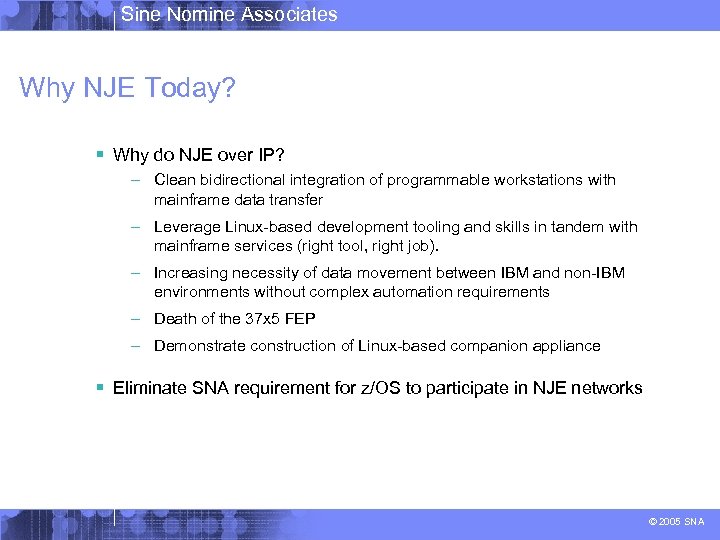
Sine Nomine Associates Why NJE Today? § Why do NJE over IP? – Clean bidirectional integration of programmable workstations with mainframe data transfer – Leverage Linux-based development tooling and skills in tandem with mainframe services (right tool, right job). – Increasing necessity of data movement between IBM and non-IBM environments without complex automation requirements – Death of the 37 x 5 FEP – Demonstrate construction of Linux-based companion appliance § Eliminate SNA requirement for z/OS to participate in NJE networks © 2005 SNA
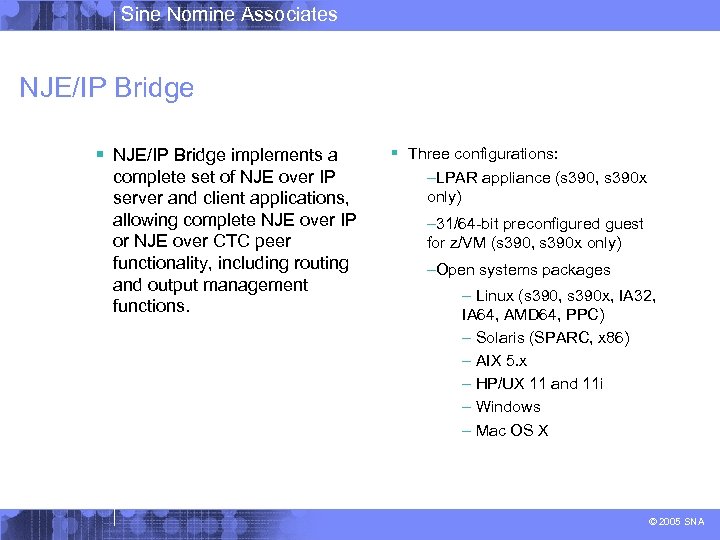
Sine Nomine Associates NJE/IP Bridge § NJE/IP Bridge implements a complete set of NJE over IP server and client applications, allowing complete NJE over IP or NJE over CTC peer functionality, including routing and output management functions. § Three configurations: –LPAR appliance (s 390, s 390 x only) – 31/64 -bit preconfigured guest for z/VM (s 390, s 390 x only) –Open systems packages – Linux (s 390, s 390 x, IA 32, IA 64, AMD 64, PPC) – Solaris (SPARC, x 86) – AIX 5. x – HP/UX 11 and 11 i – Windows – Mac OS X © 2005 SNA
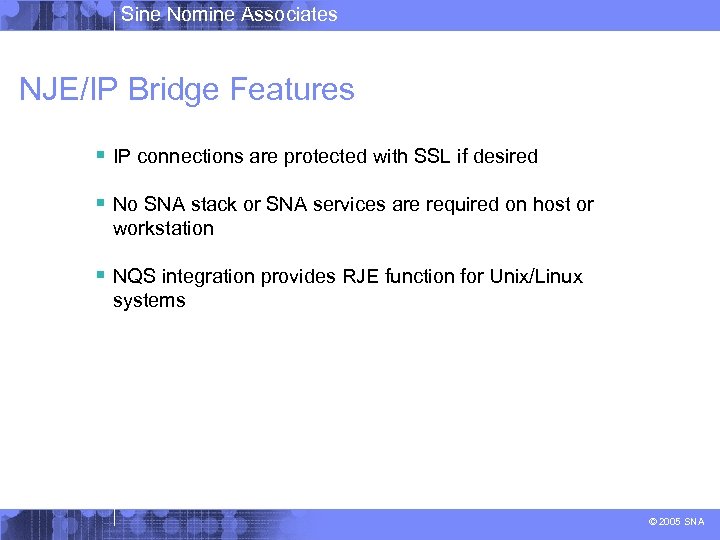
Sine Nomine Associates NJE/IP Bridge Features § IP connections are protected with SSL if desired § No SNA stack or SNA services are required on host or workstation § NQS integration provides RJE function for Unix/Linux systems © 2005 SNA
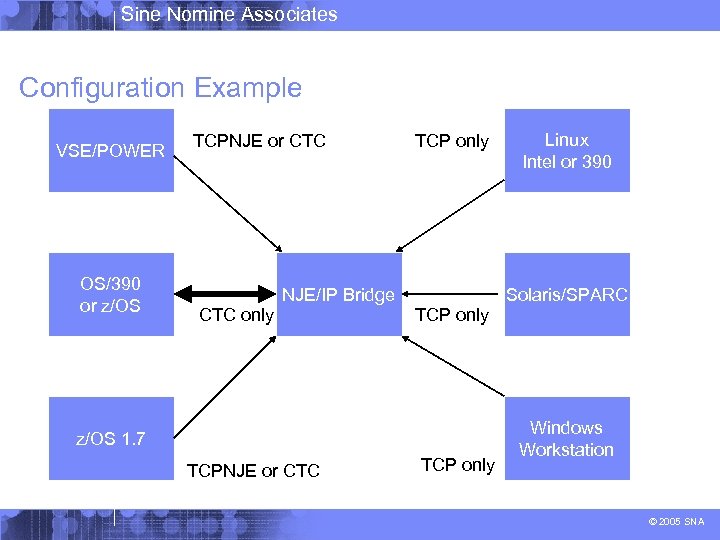
Sine Nomine Associates Configuration Example VSE/POWER OS/390 or z/OS TCPNJE or CTC TCP only NJE/IP Bridge CTC only Solaris/SPARC TCP only z/OS 1. 7 TCPNJE or CTC Linux Intel or 390 TCP only Windows Workstation © 2005 SNA
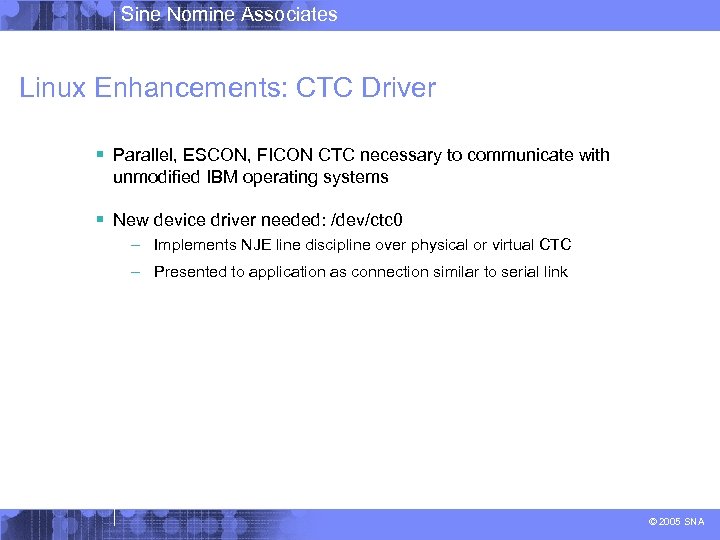
Sine Nomine Associates Linux Enhancements: CTC Driver § Parallel, ESCON, FICON CTC necessary to communicate with unmodified IBM operating systems § New device driver needed: /dev/ctc 0 – Implements NJE line discipline over physical or virtual CTC – Presented to application as connection similar to serial link © 2005 SNA
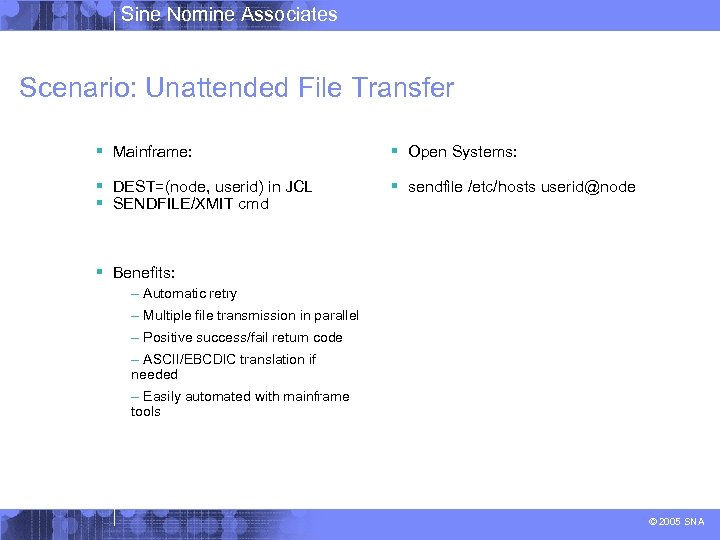
Sine Nomine Associates Scenario: Unattended File Transfer § Mainframe: § Open Systems: § DEST=(node, userid) in JCL § SENDFILE/XMIT cmd § sendfile /etc/hosts userid@node § Benefits: – Automatic retry – Multiple file transmission in parallel – Positive success/fail return code – ASCII/EBCDIC translation if needed – Easily automated with mainframe tools © 2005 SNA
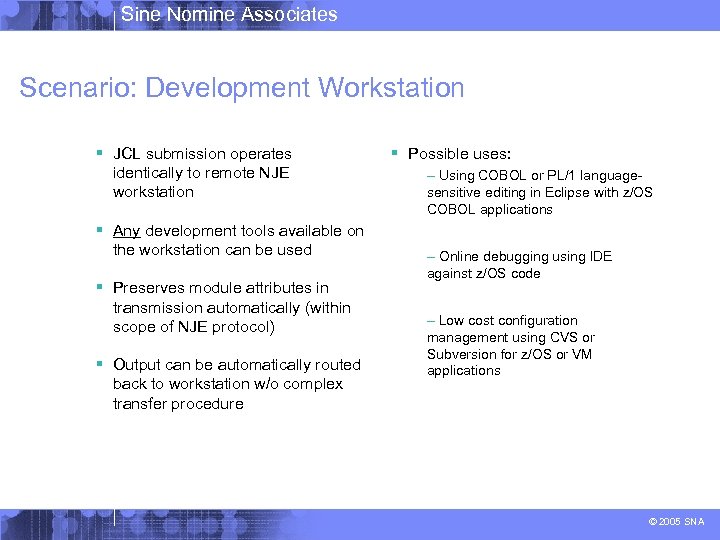
Sine Nomine Associates Scenario: Development Workstation § JCL submission operates identically to remote NJE workstation § Possible uses: – Using COBOL or PL/1 languagesensitive editing in Eclipse with z/OS COBOL applications § Any development tools available on the workstation can be used § Preserves module attributes in transmission automatically (within scope of NJE protocol) § Output can be automatically routed back to workstation w/o complex transfer procedure – Online debugging using IDE against z/OS code – Low cost configuration management using CVS or Subversion for z/OS or VM applications © 2005 SNA
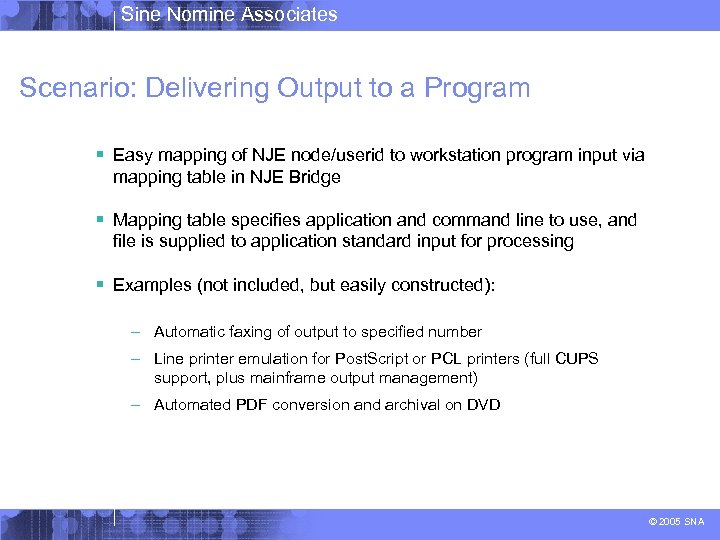
Sine Nomine Associates Scenario: Delivering Output to a Program § Easy mapping of NJE node/userid to workstation program input via mapping table in NJE Bridge § Mapping table specifies application and command line to use, and file is supplied to application standard input for processing § Examples (not included, but easily constructed): – Automatic faxing of output to specified number – Line printer emulation for Post. Script or PCL printers (full CUPS support, plus mainframe output management) – Automated PDF conversion and archival on DVD © 2005 SNA
Sine Nomine Associates Scenario: Remote Job Execution on Linux § Available only on Unix/Linux variants § Uses NQS to queue jobs and manage the remote execution. § NQS selects system from a pool, transfers the job to the execution node and returns output and status info via NJE messages § NJE/IP Bridge integration via program interface Messages and files produced by Linux application can be tracked and automated via standard mainframe tools (eg, Netview, PROP, CA products, TWS, etc) © 2005 SNA
Sine Nomine Associates Demonstration (network permitting) § § § Link Status Interactive messages Unattended file transfer Job transmission from open system to IBM system Job transmission from IBM system to open system Remote control and logging via NJE messages © 2005 SNA
Sine Nomine Associates Licensing and Packaging § z. Series appliance packages licensed by physical CEC (no perimage or per-LPAR charges), processor size neutral § Open systems packages licensed by platform (no per-seat or percopy charges) – Platform = HW processor architecture + operating system major version § Requires activation code per platform or appliance to function § Source code available © 2005 SNA
Sine Nomine Associates Summary § The NJE/IP Bridge allows all IBM and non-IBM operating systems to interoperate in a natural, supported, integrated fashion § The NJE/IP Bridge allows rapid implementation of sophisticated output and application development solutions at very low cost. § The NJE/IP Bridge enables IBM and non-IBM systems to leverage common and sophisticated system management solutions already in place in either environment § In environments where the only SNA networking in place is to support a NJE link between z/OS and a system supported by the NJE/IP Bridge, the NJE/IP Bridge can allow elimination of VTAM and SNA networking completely. © 2005 SNA
Sine Nomine Associates For More Information § Talk to any of us at BSI or Sine Nomine § Stop by the Barnard Software booth here at the z. Expo (booth 6) § Check out the BSI WWW site at www. bsiopti. com § Call +1 407 323 4773 for pricing and terms. © 2005 SNA

Sine Nomine Associates © 2005 SNA
Скачать презентацию Sine Nomine Associates Introduction to the NJE IP Bridge
e5cb4b0e8802dcf14c130e626a71d1eb.ppt