 Скачать презентацию SINCERITY CONDITION SEARLE As the obligatory condition of
Sincerity condition (SEarle).pptx
- Количество слайдов: 6



SINCERITY CONDITION (SEARLE) As the obligatory condition of successful communication.
From the earliest years of speech act theory, sincerity, or the absence of it, has been one of the defining aspects of speech acts and their uses. It remains prominent today, but models of communication often give it little function. How could a model of dialogue be designed so that the sincerity of speech acts could be defined and examined? How could natural language understanding and generation programs recognize or use insincerity? Is sincerity part of a collection of speech phenomena that could share implementation methods? What are appropriate recognition criteria for sincerity? Are the sincerity-conditions described by Austin or Searle adequate guides to recognition of insincerity? No. This presentation examines relationships between (in)sincerity and other language phenomena. Focusing on irony, exaggeration and understatement, it also identifies several others that share characteristics with sincerity, and thus might benefit from joint work on definitions, formalization and computational model building.
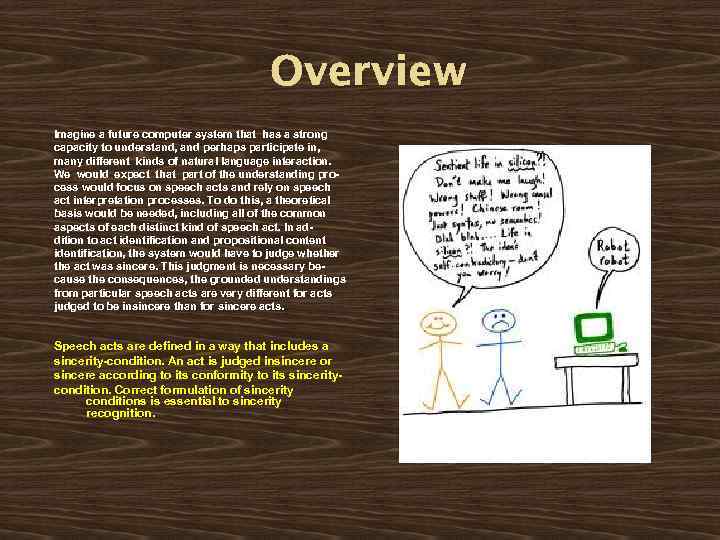
Overview Imagine a future computer system that has a strong capacity to understand, and perhaps participate in, many different kinds of natural language interaction. We would expect that part of the understanding process would focus on speech acts and rely on speech act interpretation processes. To do this, a theoretical basis would be needed, including all of the common aspects of each distinct kind of speech act. In addition to act identification and propositional content identification, the system would have to judge whether the act was sincere. This judgment is necessary because the consequences, the grounded understandings from particular speech acts are very different for acts judged to be insincere than for sincere acts. Speech acts are defined in a way that includes a sincerity-condition. An act is judged insincere or sincere according to its conformity to its sinceritycondition. Correct formulation of sincerity conditions is essential to sincerity recognition.
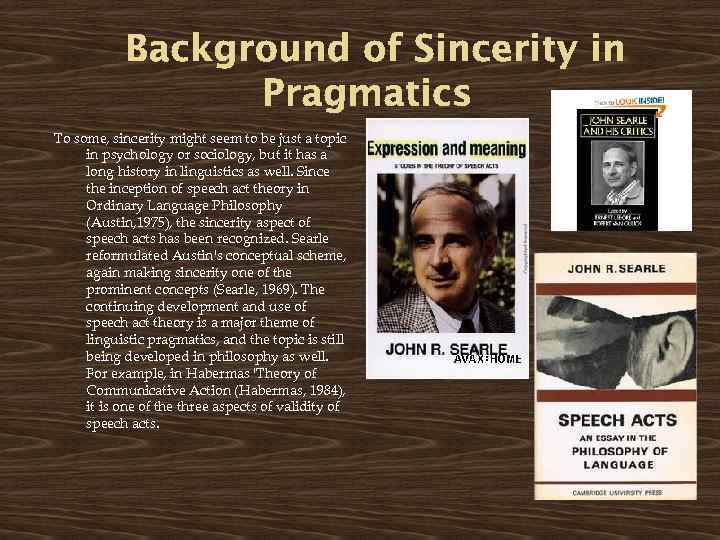
Background of Sincerity in Pragmatics To some, sincerity might seem to be just a topic in psychology or sociology, but it has a long history in linguistics as well. Since the inception of speech act theory in Ordinary Language Philosophy (Austin, 1975), the sincerity aspect of speech acts has been recognized. Searle reformulated Austin's conceptual scheme, again making sincerity one of the prominent concepts (Searle, 1969). The continuing development and use of speech act theory is a major theme of linguistic pragmatics, and the topic is still being developed in philosophy as well. For example, in Habermas 'Theory of Communicative Action (Habermas, 1984), it is one of the three aspects of validity of speech acts.
Example: More than with any other variety of speech act, people think about sincerity associated with assertions. The range of potentially insincere acts is much broader than just assertions, certainly including commissive acts (promises), and congratulations. Requests, questions, acknowledgments and various other acts also raise sincerity issues. Searle said that for certain insincere speech acts the speaker "purports to have (beliefs, intentions. . . ) that he does not have. “ This statements presumes that speech acts are based on certain mental states of the speaker, and if a particular utterance is to be sincere, it will correspond to the speaker's mental state in a certain way. Example: According to Austin and Searle, for a statement by S, "Today is Tuesday, " to be made sincerely, S must have a certain thoughts. In this case, S must believe that the day of saying the statement is Tuesday. The sincerity-condition of an assertional speech act such as this requires that the speaker believes the asserted proposition. So one of the effects of performance of the act is to communicate that the speaker believes the asserted proposition. Similarly, the sincerity-condition for commissive acts is for the speaker to intend to do what has been promised.
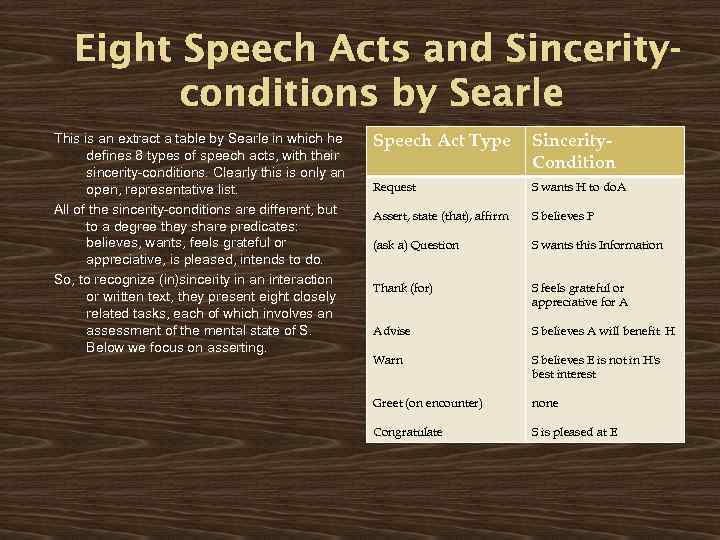
Eight Speech Acts and Sincerityconditions by Searle This is an extract a table by Searle in which he defines 8 types of speech acts, with their sincerity-conditions. Clearly this is only an open, representative list. All of the sincerity-conditions are different, but to a degree they share predicates: believes, wants, feels grateful or appreciative, is pleased, intends to do. So, to recognize (in)sincerity in an interaction or written text, they present eight closely related tasks, each of which involves an assessment of the mental state of S. Below we focus on asserting. Speech Act Type Sincerity. Condition Request S wants H to do. A Assert, state (that), affirm S believes P (ask a) Question S wants this Information Thank (for) S feels grateful or appreciative for A Advise S believes A will benefit H Warn S believes E is not in H's best interest Greet (on encounter) none Congratulate S is pleased at E
Скачать презентацию SINCERITY CONDITION SEARLE As the obligatory condition of
Sincerity condition (SEarle).pptx