 Скачать презентацию Since 1 998 Multi-Satellite Daily Bias Report How
f159d26ebd7eb5f50c5fadb00df7f1fa.ppt
- Количество слайдов: 12




Since 1 998 Multi-Satellite Daily Bias Report: How to Read and Handle it Toshimichi Otsubo Mihoko Kobayashi Hitotsubashi University Tadahiro Gotoh Toshihiro Kubo-oka National Institute of Information and Communications Technology 1 16 th International Workshop on Laser Ranging, Poznan, 13 -17 Oct, 2008.
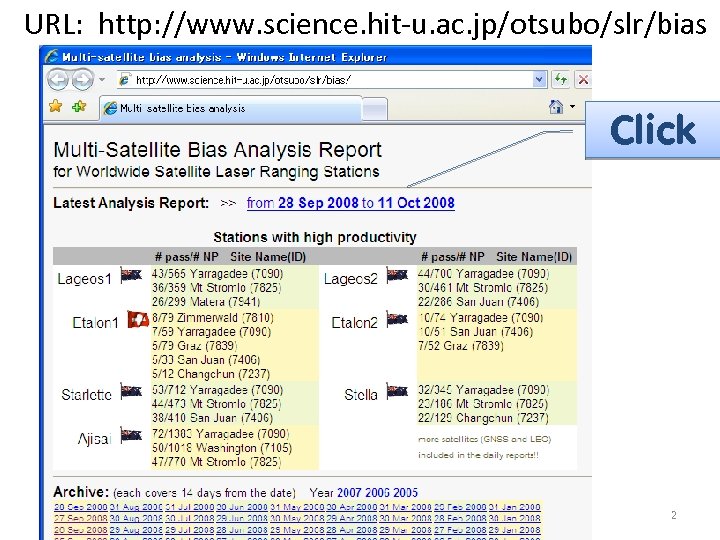
URL: http: //www. science. hit-u. ac. jp/otsubo/slr/bias Click 2
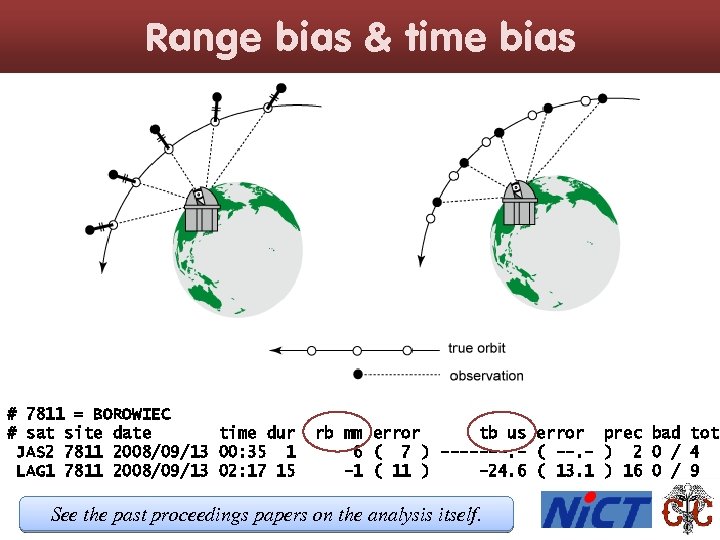
Range bias & time bias # 7811 = BOROWIEC # sat site date time dur JAS 2 7811 2008/09/13 00: 35 1 LAG 1 7811 2008/09/13 02: 17 15 rb mm error tb us error prec bad tota 6 ( 7 ) -------. - ( --. - ) 2 0 / 4 -1 ( 11 ) -24. 6 ( 13. 1 ) 16 0 / 9 See the past proceedings papers on the analysis itself. 3
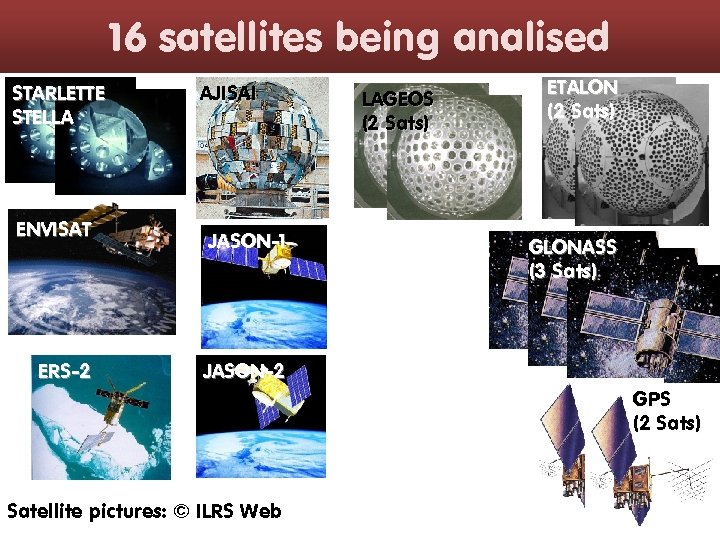
16 satellites being analised STARLETTE STELLA ENVISAT ERS-2 AJISAI JASON-1 LAGEOS (2 Sats) ETALON (2 Sats) GLONASS (3 Sats) JASON-2 GPS (2 Sats) Satellite pictures: © ILRS Web 4
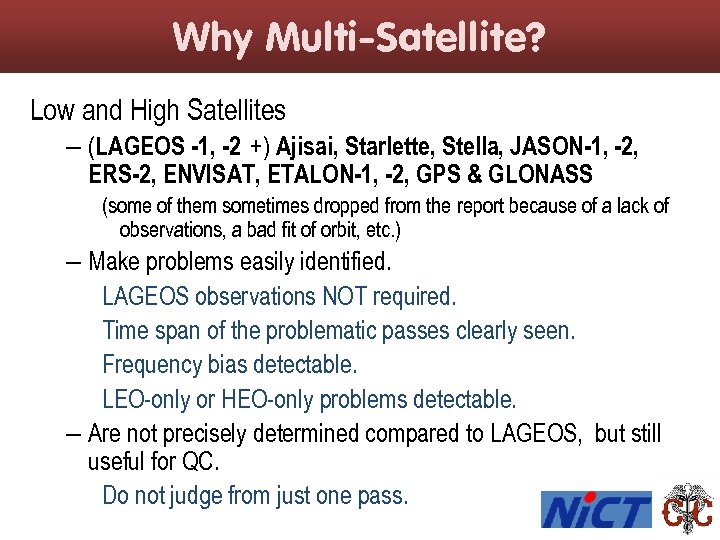
Why Multi-Satellite? Low and High Satellites – (LAGEOS -1, -2 +) Ajisai, Starlette, Stella, JASON-1, -2, ERS-2, ENVISAT, ETALON-1, -2, GPS & GLONASS (some of them sometimes dropped from the report because of a lack of observations, a bad fit of orbit, etc. ) – Make problems easily identified. LAGEOS observations NOT required. Time span of the problematic passes clearly seen. Frequency bias detectable. LEO-only or HEO-only problems detectable. – Are not precisely determined compared to LAGEOS, but still useful for QC. Do not judge from just one pass. 5
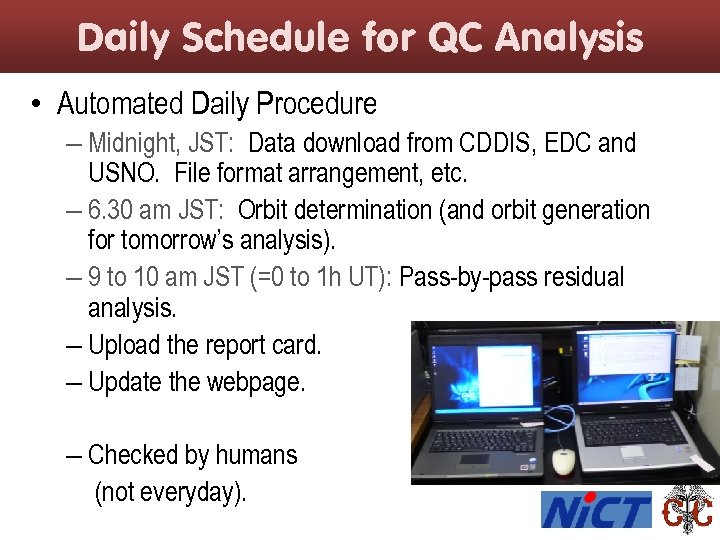
Daily Schedule for QC Analysis • Automated Daily Procedure – Midnight, JST: Data download from CDDIS, EDC and USNO. File format arrangement, etc. – 6. 30 am JST: Orbit determination (and orbit generation for tomorrow’s analysis). – 9 to 10 am JST (=0 to 1 h UT): Pass-by-pass residual analysis. – Upload the report card. – Update the webpage. – Checked by humans (not everyday). 6
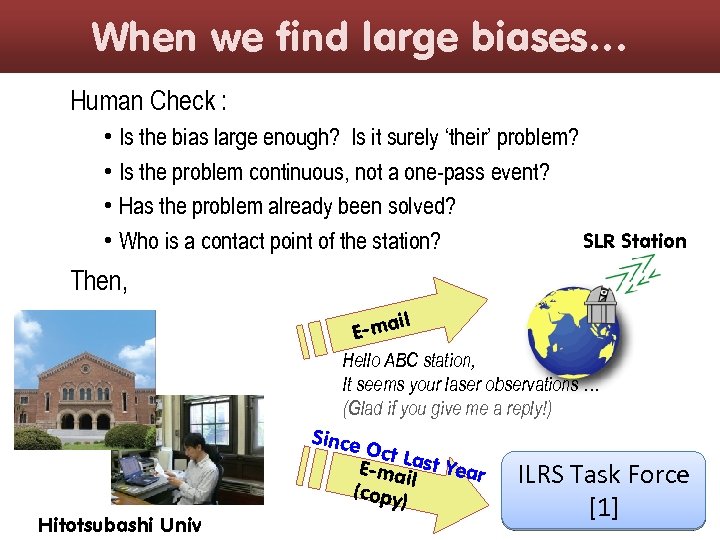
When we find large biases… Human Check : • Is the bias large enough? Is it surely ‘their’ problem? • Is the problem continuous, not a one-pass event? • Has the problem already been solved? SLR Station • Who is a contact point of the station? Then, il E-ma Hello ABC station, It seems your laser observations … (Glad if you give me a reply!) Hitotsubashi Univ Since Oct L E-ma ast Year il (copy ) ILRS Task Force [1] 7
![Obvious biases reported to stations: 2008 [Sep, 2008] 1 or 2 or 3 RB](https://present5.com/presentation/f159d26ebd7eb5f50c5fadb00df7f1fa/image-8.jpg "Obvious biases reported to stations: 2008 [Sep, 2008] 1 or 2 or 3 RB")
Obvious biases reported to stations: 2008 [Sep, 2008] 1 or 2 or 3 RB laser multipulse [Sep, 2008] < 2 m RB calibration (human) error. [Jul, 2008] 1. 2 km RB calibration error. System testing. [Jul, 2008] 200 ms TB ? ? . [Jun-Jul, 2008] 132 m RB ? ? . [Jun, 2008] -20 ms TB hardware & software problem. [Jun, 2008] 10 ms TB software (? ) Great [Apr, 2008] Non-existing station ID human error. improvement [Feb, 2008] Atm pressure error wire problem. in 10 years. [Feb, 2008] 0. 5 to 1. 7 km RB (Freq bias? ) ? ? [Jan-Feb, 2008] 1 day TB (Wrong Day) ? ? Quick feedback [Jan, 2008] 3 m RB laser multipulse. Shortening [Jan, 2008] 18. 6 ms TB event timer. error periods. 8 [Jan, 2008] < 2 m TB (LEO Only) ? ?
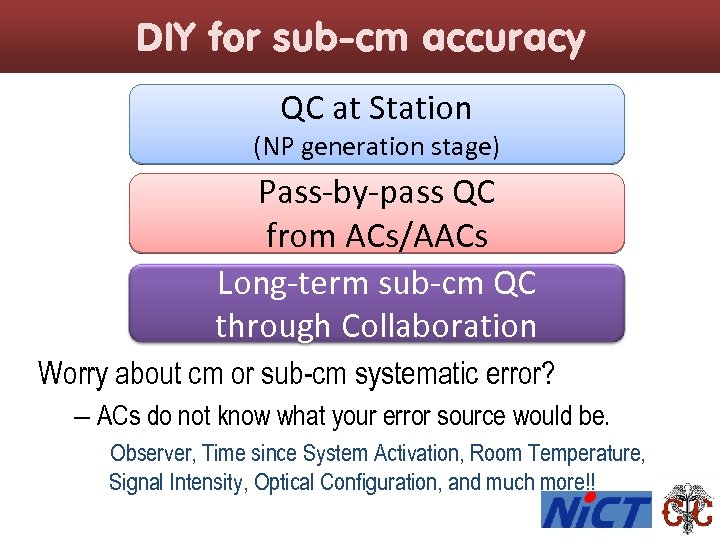
DIY for sub-cm accuracy QC at Station (NP generation stage) Pass-by-pass QC from ACs/AACs Long-term sub-cm QC through Collaboration Worry about cm or sub-cm systematic error? – ACs do not know what your error source would be. Observer, Time since System Activation, Room Temperature, Signal Intensity, Optical Configuration, and much more!! 9
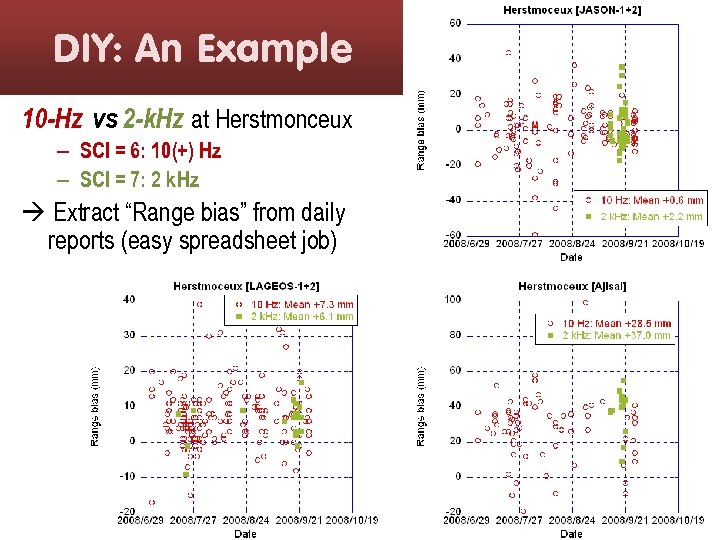
DIY: An Example 10 -Hz vs 2 -k. Hz at Herstmonceux – SCI = 6: 10(+) Hz – SCI = 7: 2 k. Hz Extract “Range bias” from daily reports (easy spreadsheet job) 10
Summary & Future works Almost 10 Years’ Continuous Run! CRL NICT HIT-U – Powerful tool for detecting various type of problems. – Many thanks to regular/occasional worldwide users! Communications between stations and ACs – Some E-mail address on ILRS Webpages was obsolete. – Face-to-face workshop is important (thanks Stanislaw!). Future works – Better TRF (SLRF 2008? Our own updates? ) – Shorter delay (24 hrs to a few hrs? ). Want to delete data? Yes, you can, with CRD. – Some cases (wrong day, wrong station ID, etc) are NOT correctable/recoverable with the current framework. – CRD: Set “Data Quality Alert Indicator” = “ 2”. 11
Leap Second on 1 Jan 2009 !! Last time: 1 Jan 2006 Stations – Perfect job last time! – 1 or 2 second time bias (even 1 -day, 1 -year time bias) seen in the past. – Check the procedure after you go back home. (ACs) – Check the software. Handling of UT 1 -UTC is tricky. 12
Скачать презентацию Since 1 998 Multi-Satellite Daily Bias Report How
f159d26ebd7eb5f50c5fadb00df7f1fa.ppt