


 Скачать презентацию Simulation Introduction Why Simulate Risk Free
87026ca729e5db5b6f3d94a073d4739d.ppt
- Количество слайдов: 22
 Simulation Introduction
 Why Simulate? • Risk Free. Innovate and explore alternative strategies and tactics. • Big Picture. Decisions and their impacts will be examined within the context of overall business operations - examined within the context of overall business operations across functional boundaries. • Develop Critical Thinking Skills. You will analyze, assess, plan, make decisions, evaluate, and adjust. • Compresses Time. Several years worth of decision-making will play out during the term. • Comprehensive Strategy. Demonstrates the importance of developing linked functional, businesslevel, and corporate strategies.
 The Business • $100 M electronic sensor manufacturing firms. All teams begin with an identical profile. • Oligopoly - market dominated by handful of firms. • No outside competitors or product substitutes. • Relatively benign environment – no disruptive new technologies or new competitors. Focus on existing competition in an even playing field.
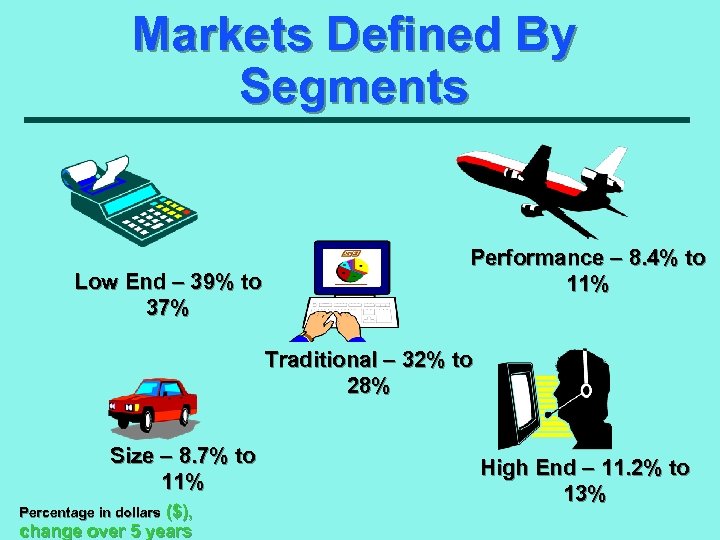 Markets Defined By Segments Low End – 39% to 37% Performance – 8. 4% to 11% Traditional – 32% to 28% Size – 8. 7% to 11% ($), change over 5 years Percentage in dollars High End – 11. 2% to 13%
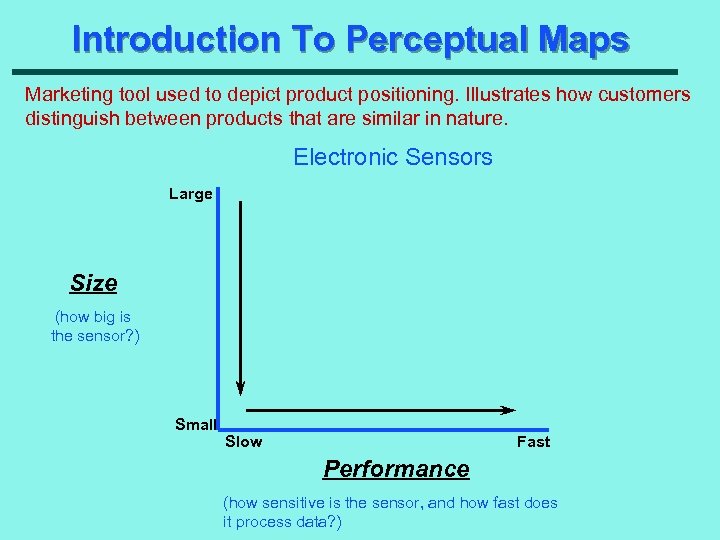 Introduction To Perceptual Maps Marketing tool used to depict product positioning. Illustrates how customers distinguish between products that are similar in nature. Electronic Sensors Large Size (how big is the sensor? ) Small Slow Fast Performance (how sensitive is the sensor, and how fast does it process data? )
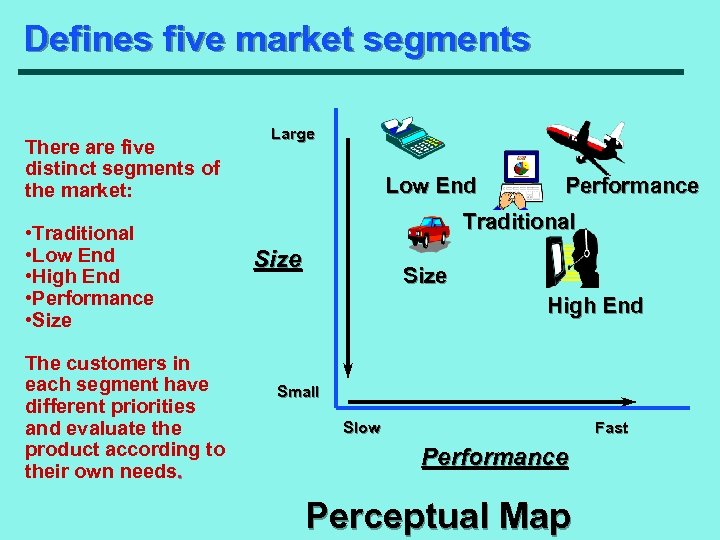 Defines five market segments There are five distinct segments of the market: • Traditional • Low End • High End • Performance • Size The customers in each segment have different priorities and evaluate the product according to their own needs. Large Low End Performance Traditional Size High End Small Slow Fast Performance Perceptual Map
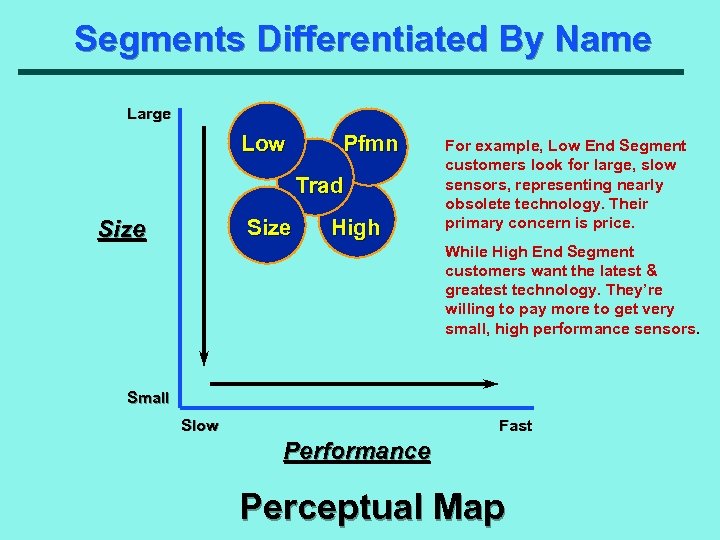 Segments Differentiated By Name Large Low Pfmn Trad Size High For example, Low End Segment customers look for large, slow sensors, representing nearly obsolete technology. Their primary concern is price. While High End Segment customers want the latest & greatest technology. They’re willing to pay more to get very small, high performance sensors. Small Slow Fast Performance Perceptual Map
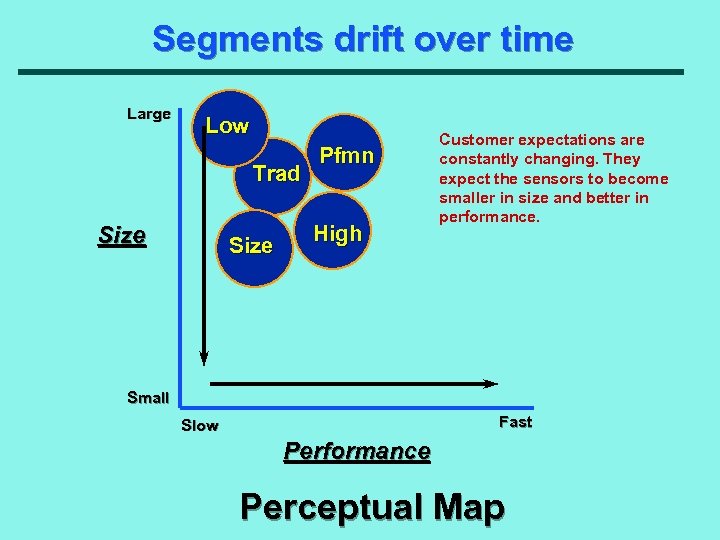 Segments drift over time Large Low Trad Size Pfmn High Customer expectations are constantly changing. They expect the sensors to become smaller in size and better in performance. Small Fast Slow Performance Perceptual Map
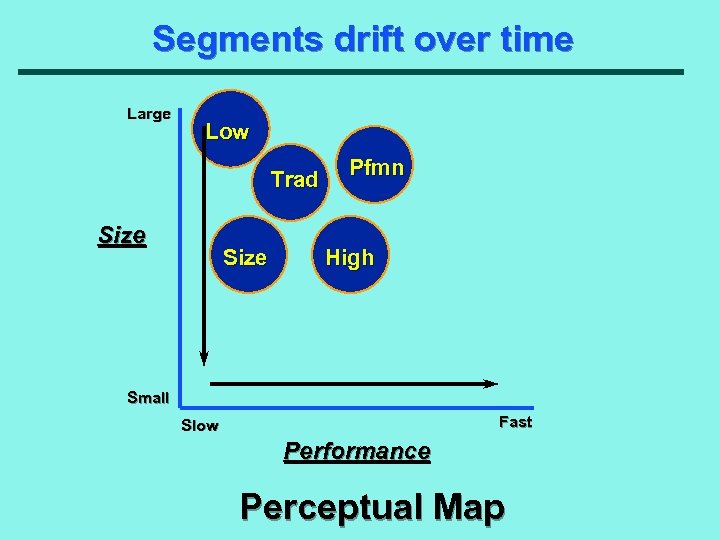 Segments drift over time Large Low Trad Size Pfmn High Small Fast Slow Performance Perceptual Map
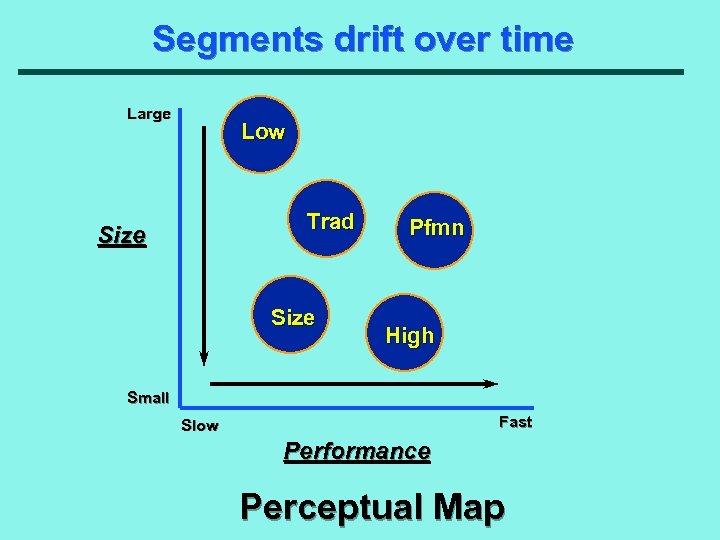 Segments drift over time Large Low Trad Size Pfmn High Small Fast Slow Performance Perceptual Map
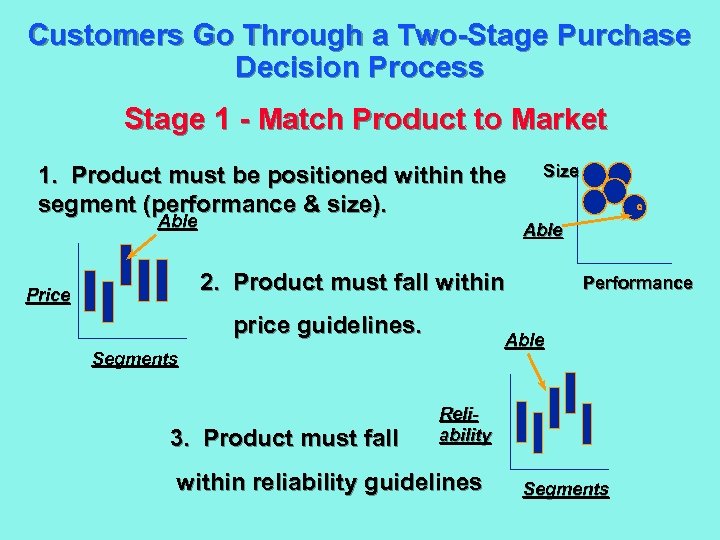 Customers Go Through a Two-Stage Purchase Decision Process Stage 1 - Match Product to Market 1. Product must be positioned within the segment (performance & size). Able Size Able 2. Product must fall within Price price guidelines. Able Segments 3. Product must fall Performance Reliability within reliability guidelines Segments
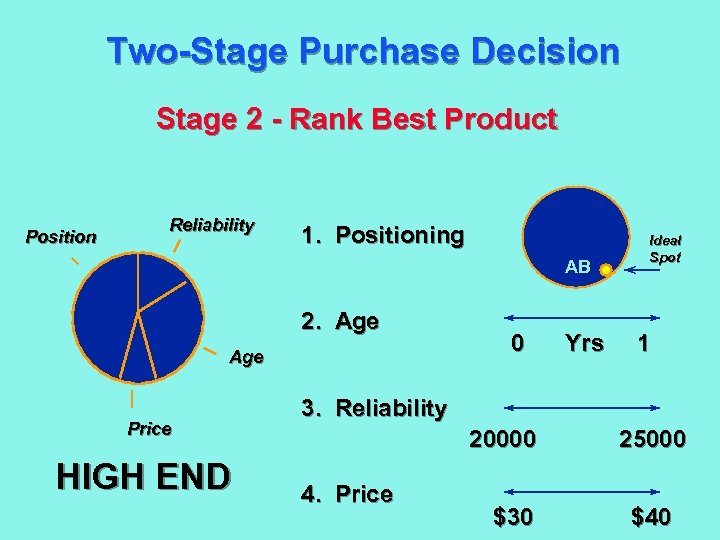 Two-Stage Purchase Decision Stage 2 - Rank Best Product Position Reliability 1. Positioning AB 2. Age Price HIGH END 0 Yrs Ideal Spot 1 3. Reliability 20000 4. Price $30 25000 $40
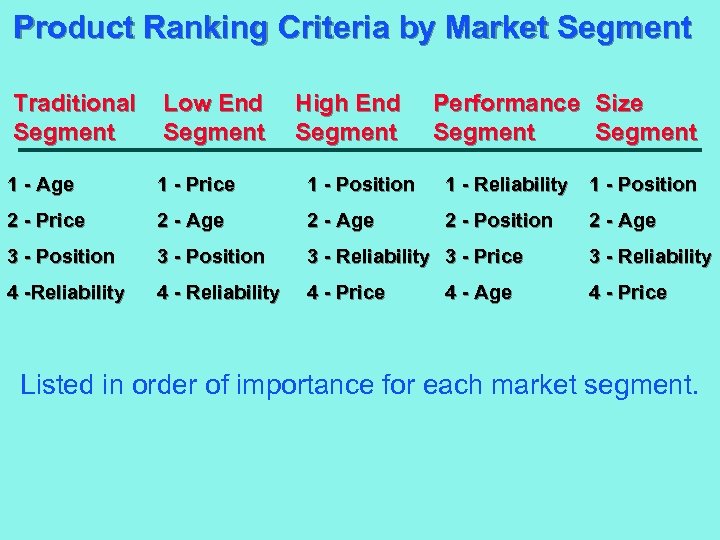 Product Ranking Criteria by Market Segment Traditional Segment Low End Segment High End Segment Performance Size Segment 1 - Age 1 - Price 1 - Position 1 - Reliability 1 - Position 2 - Price 2 - Age 2 - Position 3 - Reliability 3 - Price 3 - Reliability 4 - Price 4 - Age 2 - Age Listed in order of importance for each market segment.
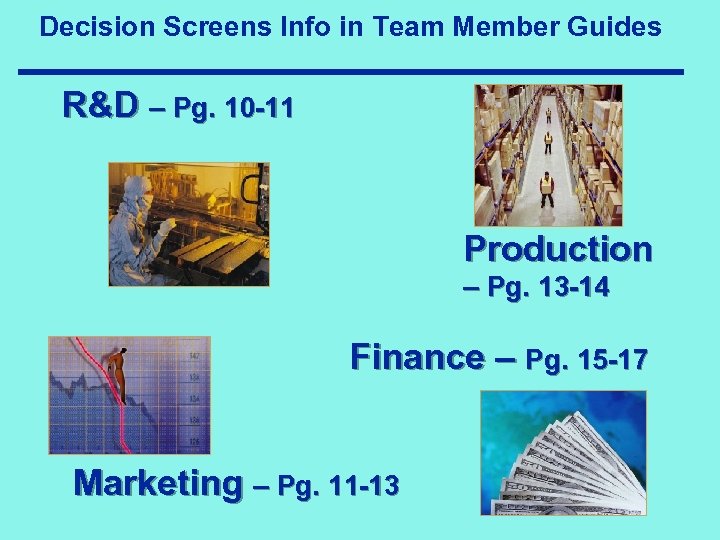 Decision Screens Info in Team Member Guides R&D – Pg. 10 -11 Production – Pg. 13 -14 Finance – Pg. 15 -17 Marketing – Pg. 11 -13
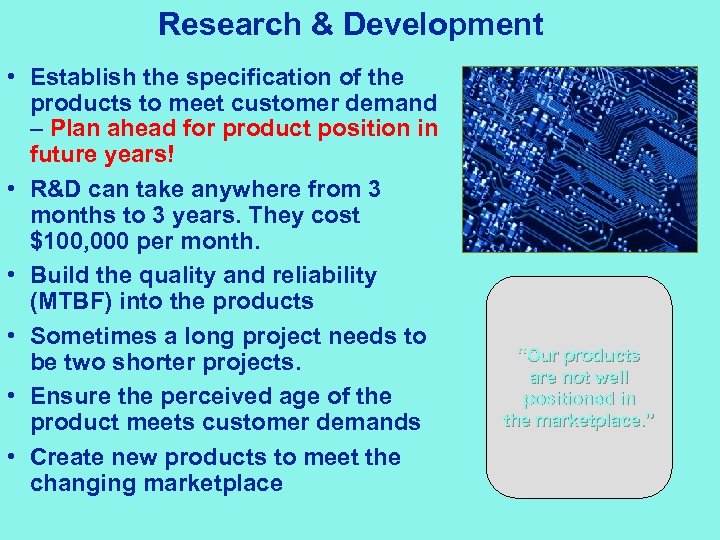 Research & Development • Establish the specification of the products to meet customer demand – Plan ahead for product position in future years! • R&D can take anywhere from 3 months to 3 years. They cost $100, 000 per month. • Build the quality and reliability (MTBF) into the products • Sometimes a long project needs to be two shorter projects. • Ensure the perceived age of the product meets customer demands • Create new products to meet the changing marketplace “Our products are not well positioned in the marketplace. ”
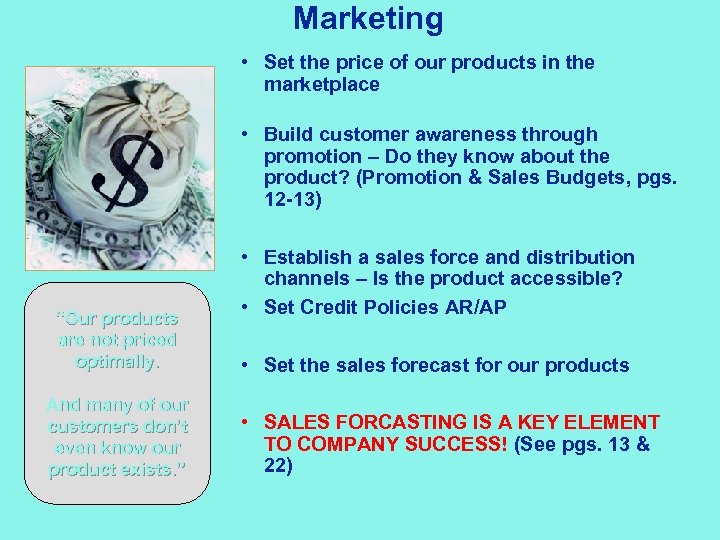 Marketing • Set the price of our products in the marketplace • Build customer awareness through promotion – Do they know about the product? (Promotion & Sales Budgets, pgs. 12 -13) “Our products are not priced optimally. And many of our customers don’t even know our product exists. ” • Establish a sales force and distribution channels – Is the product accessible? • Set Credit Policies AR/AP • Set the sales forecast for our products • SALES FORCASTING IS A KEY ELEMENT TO COMPANY SUCCESS! (See pgs. 13 & 22)
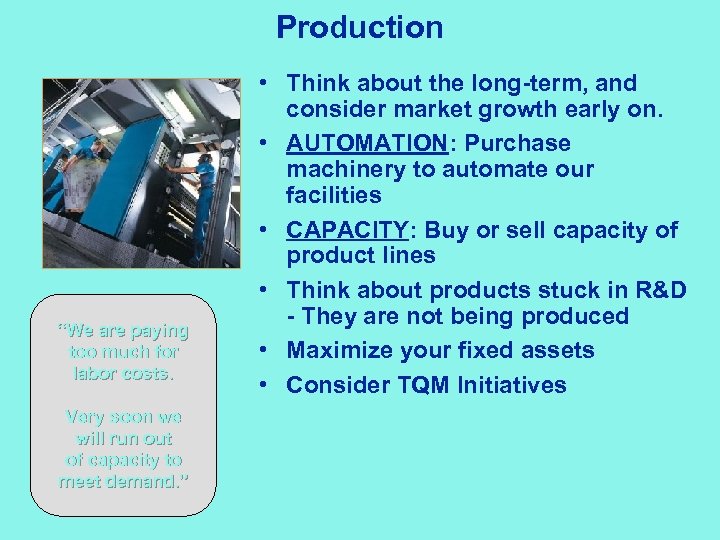 Production “We are paying too much for labor costs. Very soon we will run out of capacity to meet demand. ” • Think about the long-term, and consider market growth early on. • AUTOMATION: Purchase machinery to automate our facilities • CAPACITY: Buy or sell capacity of product lines • Think about products stuck in R&D - They are not being produced • Maximize your fixed assets • Consider TQM Initiatives
 Finance • Acquire capital to fund capital expansions – Short Term Debt – A/P, inventory expansion, more lax A/R policy – Issue Stock – Use for funding long-term investments (capacity, automation) – Issue Long Term Bonds – Use for funding longterm investments (capacity, automation) • Issue dividend to our shareholders (They do not respond to dividends greater than EPS) • Balance our debt portfolio - debt & equity • Manage our proformas – Financial information measures your success, always track ratios (Also used for success measures, understand these are optimistic estimates) • AVOID EMERGENCY LOANS AT ALL COST! THEY USUALLY OCCUR DUE TO BAD SALES FORECASTING “We have poor cash flow and substandard financial ratios. We have no financial policy statement. ”
 Other Modules Labor Negotiations TQM Human Resources
 Decision Making • Each firm begins with identical profile. • Decisions are made January 1 st each year. • Tactical plan should align with chosen success measurements (Profit, Stock Price, ROE, ROS, ROA, Asset Turnover, Market Share, Market Capitalization). • Responsibilities may be divided up by Product Manager, Functional Manager, or Market Segment Manager roles/also Intelligence Officer & Record Keeper. • Every member of the firm is able to create and upload decisions - communication and teamwork is vital!
 Simulation Vs. Real World Differences • Finite time span to re-coop investments. • Segment growth rate & demand given for each year. • Demand grows for most years of the simulation. • Domestic market only. • Price ceilings given as part of simulation structure, no sales once the ceiling is passed. • Customer preferences are homogeneous and given within all segments.
 Recommendations • Build a spreadsheet to calculate industry demand for each year & sweet spot location over the course of the simulation. • Build & offer a new product in Practice Round 1, it serves as good practice. • Divide responsibilities among your group members, but meet as a group to enter & make final decisions. • Don’t wait until the last minute to make decisions. • Develop a consistent strategy and stick with it. • Focus on both internal strategies and behaviors of competitors, avoid tunnel vision.