


 Скачать презентацию SIMS Smart Inventory Management System Group 37 Masaki
dd761f3b366d25f08d4725f23b2a3af8.ppt
- Количество слайдов: 39
 SIMS: Smart Inventory Management System Group 37 Masaki Negishi & Anthony Fai ECE 445 Senior Design April 27, 2005
 Introduction n n SIMS provides a cost effective solution for the management of inventory which leverages RFID technology. Combines an antenna array to a single RFID reader to map out an area for inventory detection
 Features n n PC serial interface Compatible with RFID Readers and Antennas Up to 8 outputs per unit Expandable, modular design
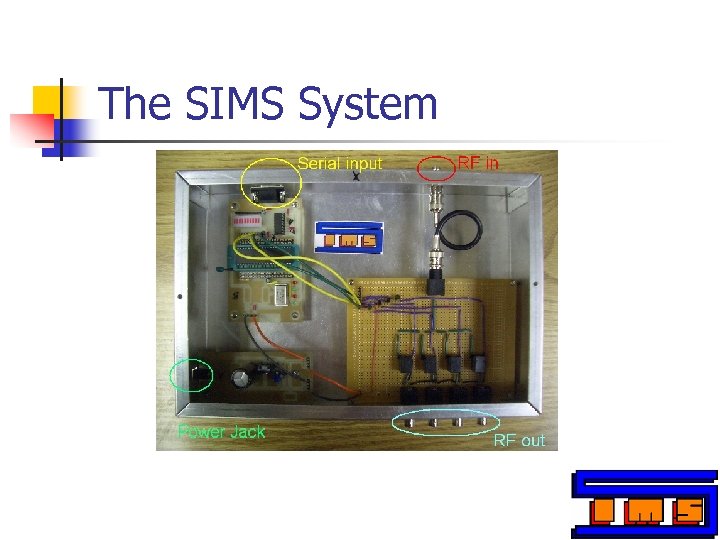 The SIMS System
 System Overview n Hardware: n n n Power Supply, PC Interface Processing Unit, RF Switching Unit TI HF RFID Reader, TI HF RFID Antenna, TI HF RFID Transponders Software: n PC control for antenna switching
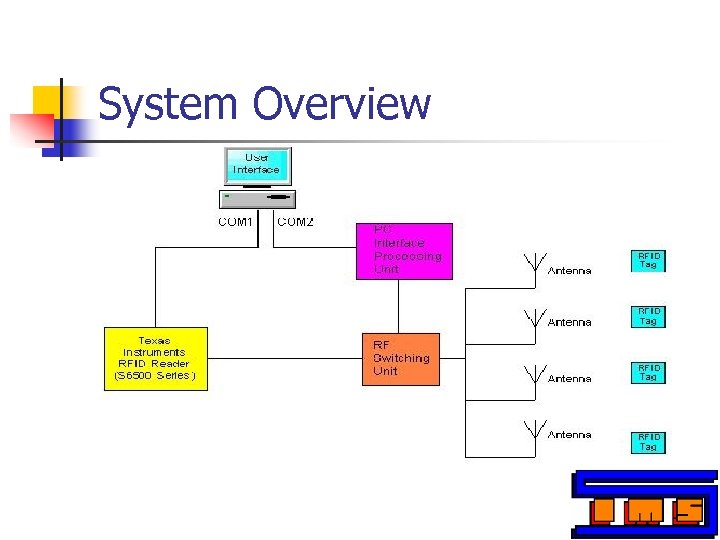 System Overview
 Hardware Overview (In House Manufactured) n Power Supply n n PC Interface Processing Unit n n Takes 6 Vdc from AC/DC wall converter and converts to stable 5 Vdc PC communication with system RF Switching Unit n Switching of RF signal from reader to selected antenna
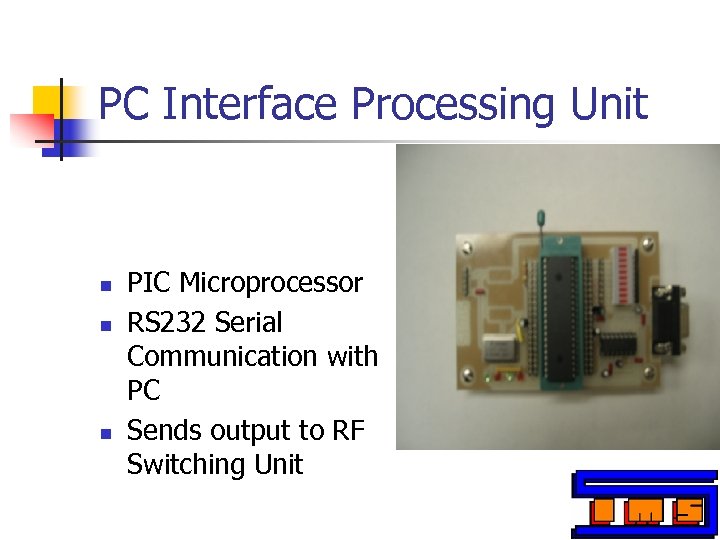 PC Interface Processing Unit n n n PIC Microprocessor RS 232 Serial Communication with PC Sends output to RF Switching Unit
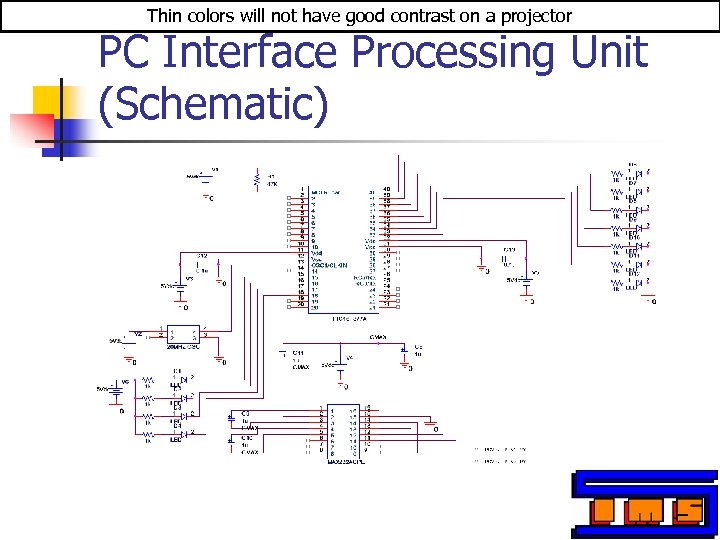 Thin colors will not have good contrast on a projector PC Interface Processing Unit (Schematic)
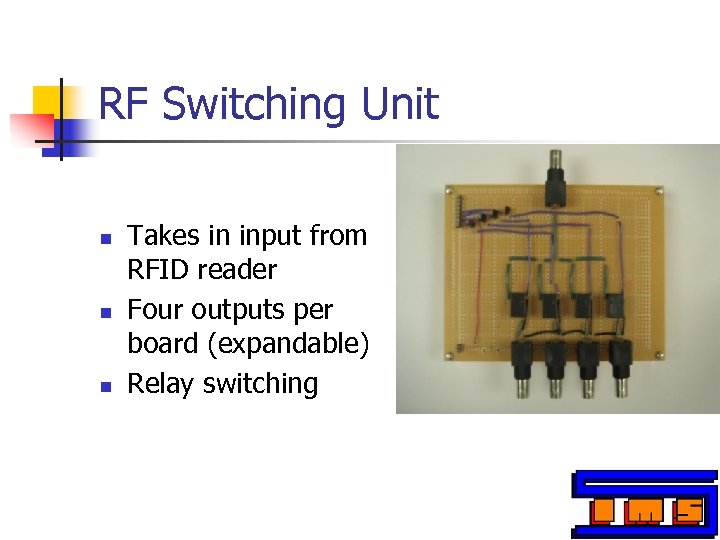 RF Switching Unit n n n Takes in input from RFID reader Four outputs per board (expandable) Relay switching
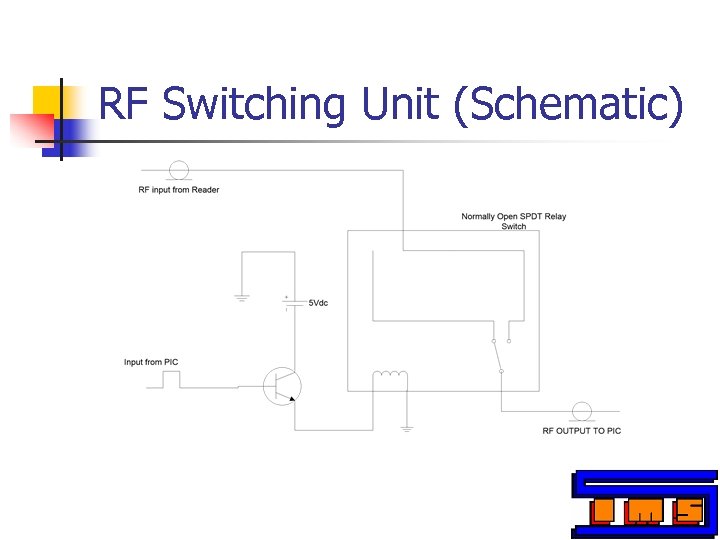 RF Switching Unit (Schematic)
 PIN Diode Switching Unit (Eliminated) n n Employ PIN Diodes for Switching Great performance for small peak to peak AC signal (low power) Poor performance for large peak to peak AC signal (high power) Introduce impedance mismatch
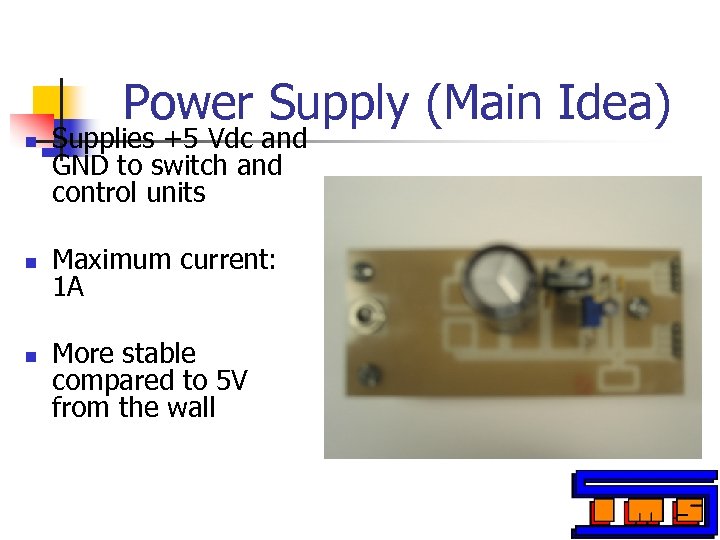 Power Supply (Main Idea) n n n Supplies +5 Vdc and GND to switch and control units Maximum current: 1 A More stable compared to 5 V from the wall
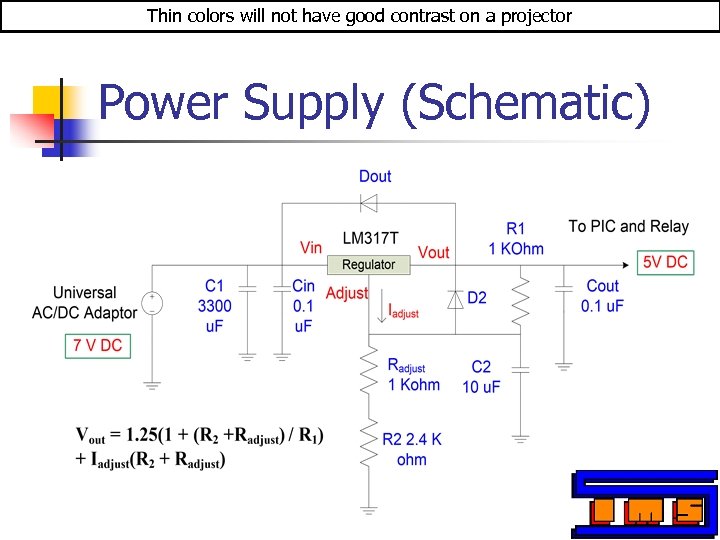 Thin colors will not have good contrast on a projector Power Supply (Schematic)
 Hardware Overview (Outsourced) n n n TI RFID S 6500 HF Reader TI RFID HF Transponders TI RFID HF 13. 56 MHz Antenna (RI-ANT-T 01 A)
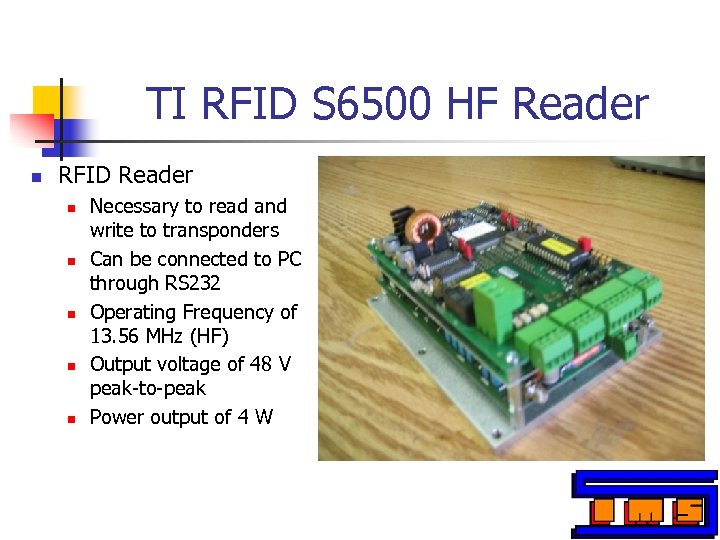 TI RFID S 6500 HF Reader n RFID Reader n n n Necessary to read and write to transponders Can be connected to PC through RS 232 Operating Frequency of 13. 56 MHz (HF) Output voltage of 48 V peak-to-peak Power output of 4 W
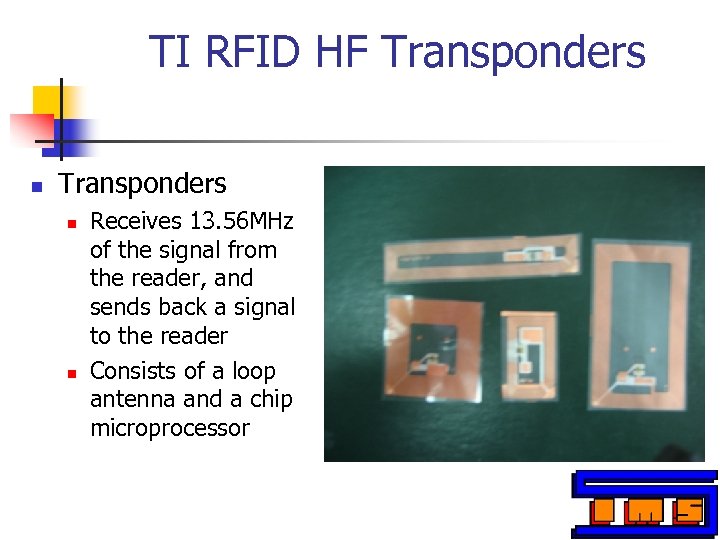 TI RFID HF Transponders n n Receives 13. 56 MHz of the signal from the reader, and sends back a signal to the reader Consists of a loop antenna and a chip microprocessor
 Factors Influencing Communication with Tags n n n Orientation of tag with respect to antenna Environment around tag (e. g. metals, liquids) Background Noise
 Recommendations for Tag Placements n n n Parallel to antenna Away from metals Within reading range of antenna (~25 cm)
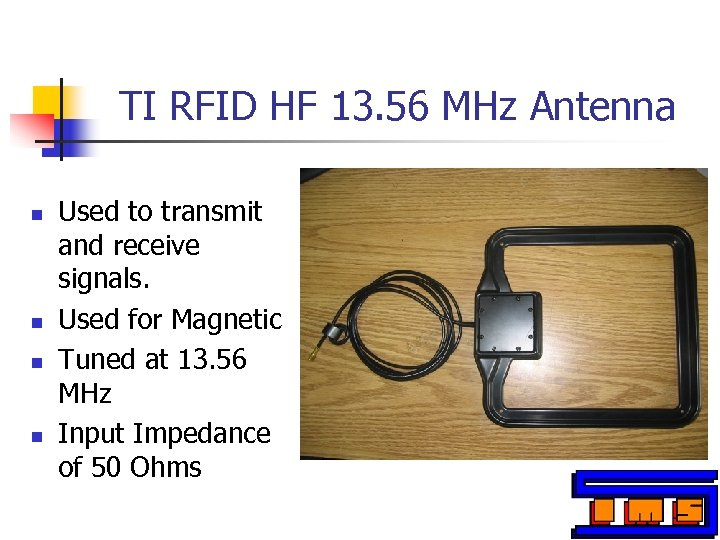 TI RFID HF 13. 56 MHz Antenna n n Used to transmit and receive signals. Used for Magnetic Tuned at 13. 56 MHz Input Impedance of 50 Ohms
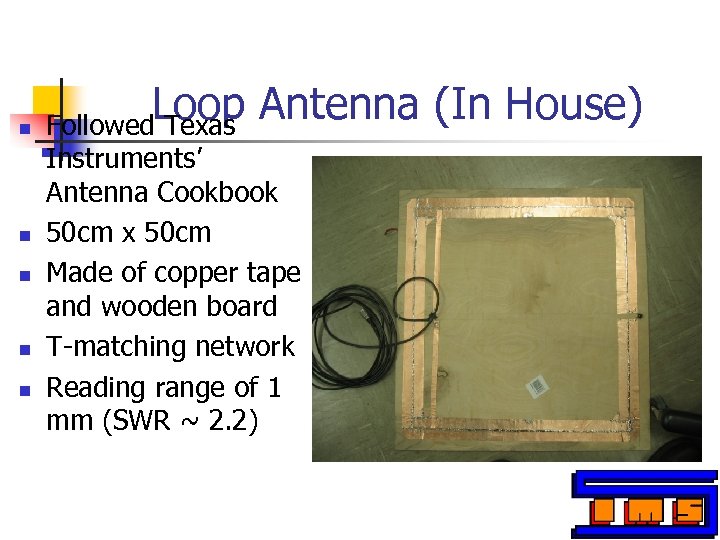 n n n Loop Antenna (In House) Followed Texas Instruments’ Antenna Cookbook 50 cm x 50 cm Made of copper tape and wooden board T-matching network Reading range of 1 mm (SWR ~ 2. 2)
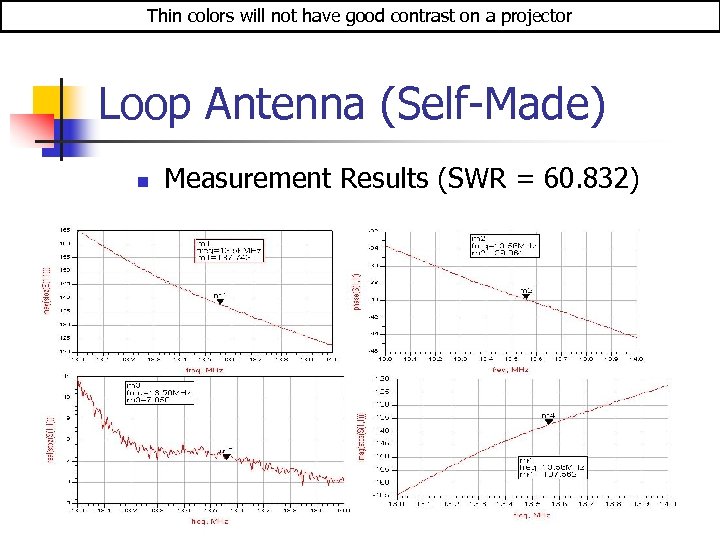 Thin colors will not have good contrast on a projector Loop Antenna (Self-Made) n Measurement Results (SWR = 60. 832)
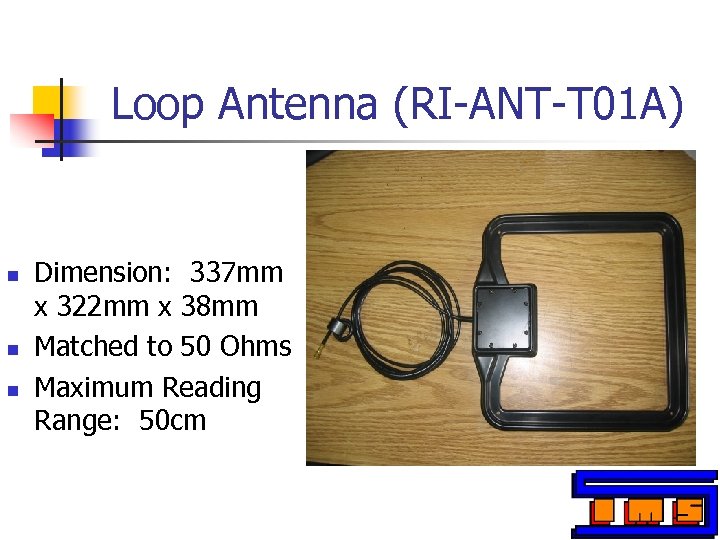 Loop Antenna (RI-ANT-T 01 A) n n n Dimension: 337 mm x 322 mm x 38 mm Matched to 50 Ohms Maximum Reading Range: 50 cm
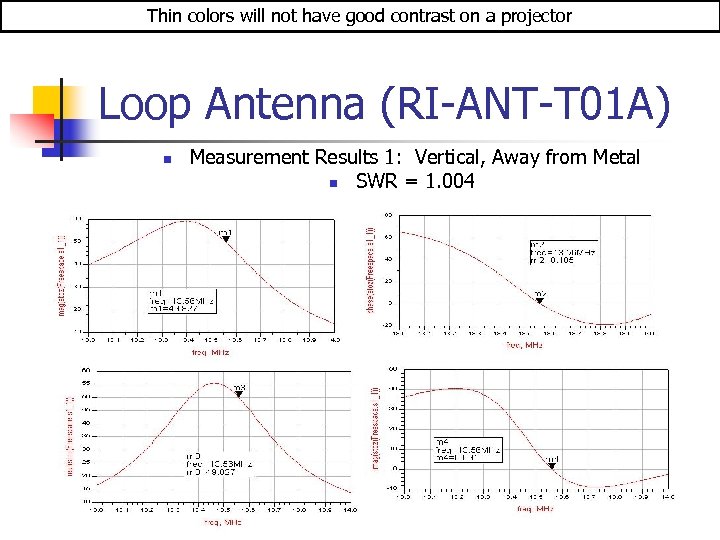 Thin colors will not have good contrast on a projector Loop Antenna (RI-ANT-T 01 A) n Measurement Results 1: Vertical, Away from Metal n SWR = 1. 004
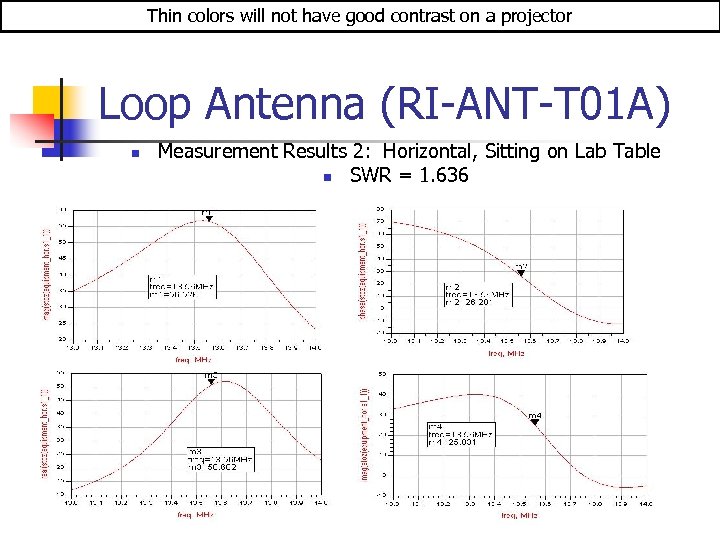 Thin colors will not have good contrast on a projector Loop Antenna (RI-ANT-T 01 A) n Measurement Results 2: Horizontal, Sitting on Lab Table n SWR = 1. 636
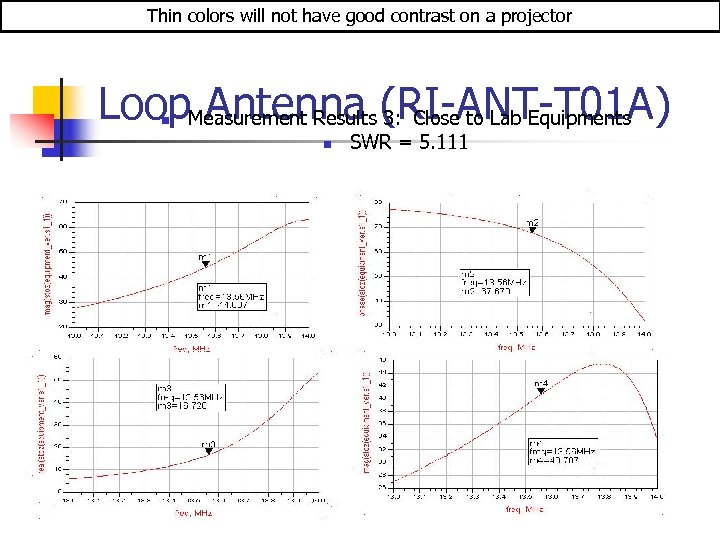 Thin colors will not have good contrast on a projector Loop. Measurement Results (RI-ANT-T 01 A) Antenna 3: Close to Lab Equipments n n SWR = 5. 111
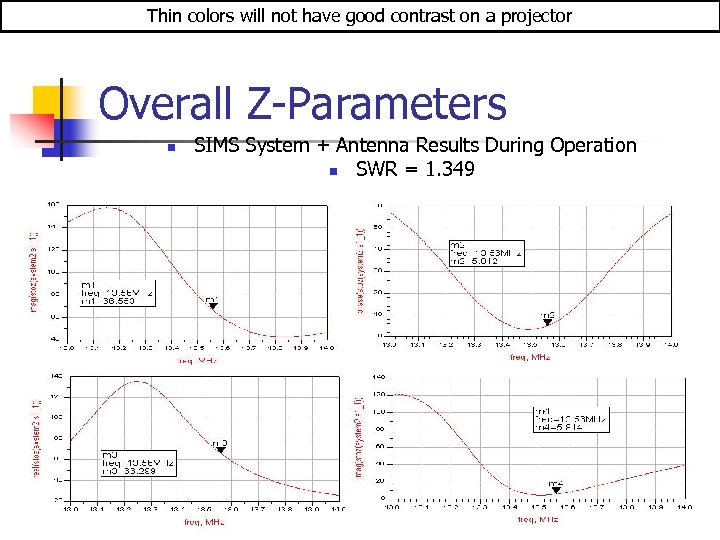 Thin colors will not have good contrast on a projector Overall Z-Parameters n SIMS System + Antenna Results During Operation n SWR = 1. 349
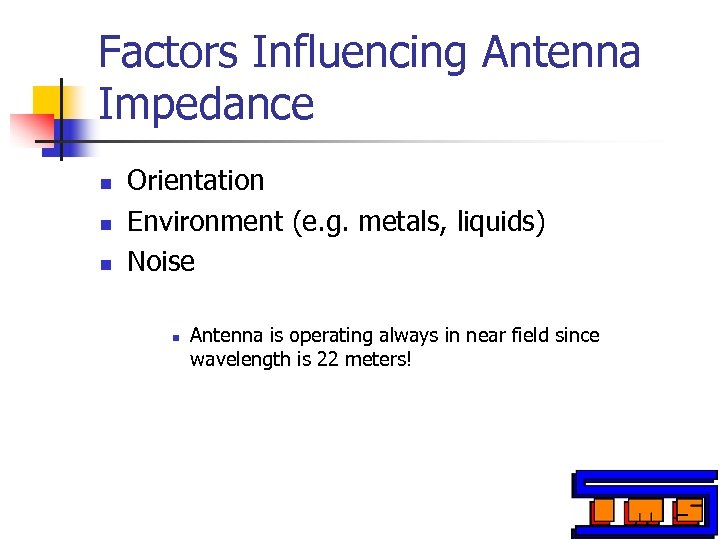 Factors Influencing Antenna Impedance n n n Orientation Environment (e. g. metals, liquids) Noise n Antenna is operating always in near field since wavelength is 22 meters!
 Too must text on this slide Antenna Recommendations n n n The antennae must be placed first, and then must be tuned to the correct frequency. May need multiple antennae at one station for more complete coverage (this would help avoid nulls from environmental factors) Will need a larger antennae to achieve a longer reading range We do not completely trust the antenna cookbooks because they are unreliable! We suggest buying one antenna first, then analyze it and make sure it meets your specifications.
 Software n PERL software n n Takes in user input and sends out two HEX digits through RS 232 serial port (I/O) PIC software n Takes in input from RS 232 serial port and sends logic high to corresponding pins
 PERL Software n Serial. pl n Takes in keyboard inputs in HEX n n n Must read header “AF” followed by two HEX digits (e. g. AF 06) Send out input from COM 2 to PIC Checks to see if PIC received correct signal
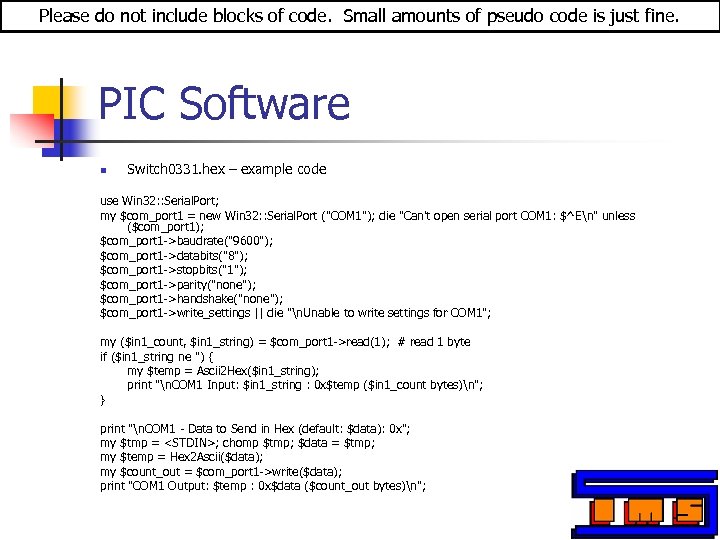 Please do not include blocks of code. Small amounts of pseudo code is just fine. PIC Software n Switch 0331. hex – example code use Win 32: : Serial. Port; my $com_port 1 = new Win 32: : Serial. Port ("COM 1"); die "Can't open serial port COM 1: $^En" unless ($com_port 1); $com_port 1 ->baudrate("9600"); $com_port 1 ->databits("8"); $com_port 1 ->stopbits("1"); $com_port 1 ->parity("none"); $com_port 1 ->handshake("none"); $com_port 1 ->write_settings || die "n. Unable to write settings for COM 1"; my ($in 1_count, $in 1_string) = $com_port 1 ->read(1); # read 1 byte if ($in 1_string ne '') { my $temp = Ascii 2 Hex($in 1_string); print "n. COM 1 Input: $in 1_string : 0 x$temp ($in 1_count bytes)n"; } print "n. COM 1 - Data to Send in Hex (default: $data): 0 x"; my $tmp =
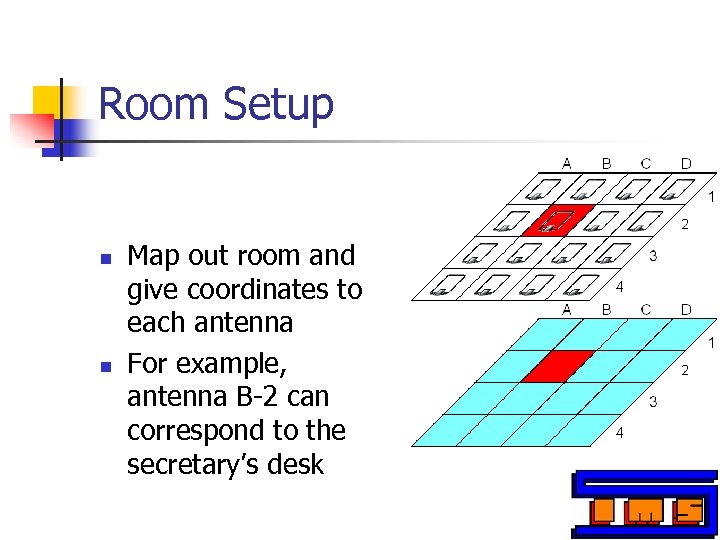 Room Setup n n Map out room and give coordinates to each antenna For example, antenna B-2 can correspond to the secretary’s desk
 Future Hardware Development n n n Improved Switching Unit for longer lifetime and higher signal isolation Increased number of antenna outputs Improved Antenna Design n n Larger loop antenna More stable impedance matching network and BALUN
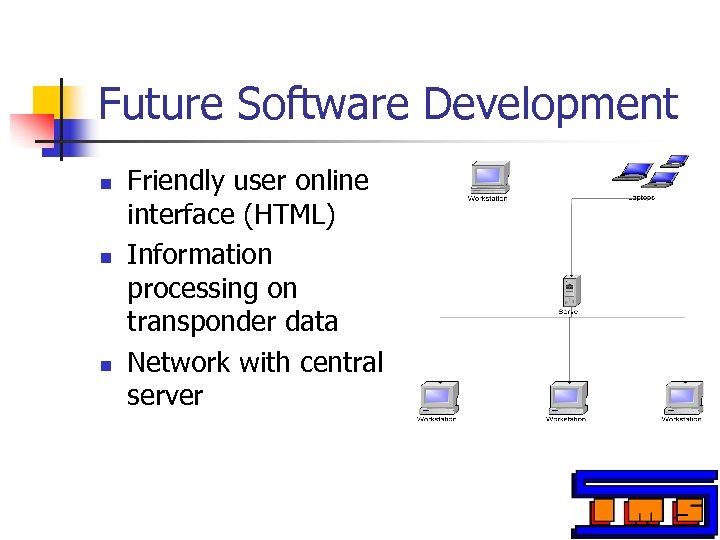 Future Software Development n n n Friendly user online interface (HTML) Information processing on transponder data Network with central server
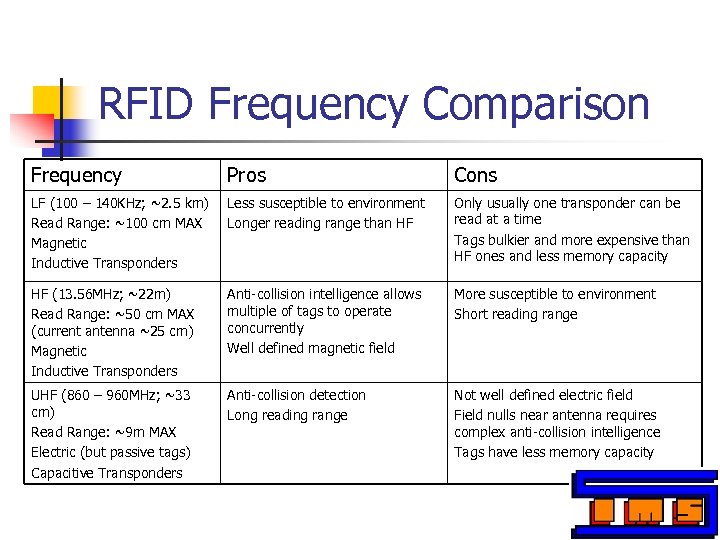 RFID Frequency Comparison Frequency Pros Cons LF (100 – 140 KHz; ~2. 5 km) Read Range: ~100 cm MAX Magnetic Inductive Transponders Less susceptible to environment Longer reading range than HF Only usually one transponder can be read at a time Tags bulkier and more expensive than HF ones and less memory capacity HF (13. 56 MHz; ~22 m) Read Range: ~50 cm MAX (current antenna ~25 cm) Magnetic Inductive Transponders Anti-collision intelligence allows multiple of tags to operate concurrently Well defined magnetic field More susceptible to environment Short reading range UHF (860 – 960 MHz; ~33 cm) Read Range: ~9 m MAX Electric (but passive tags) Capacitive Transponders Anti-collision detection Long reading range Not well defined electric field Field nulls near antenna requires complex anti-collision intelligence Tags have less memory capacity
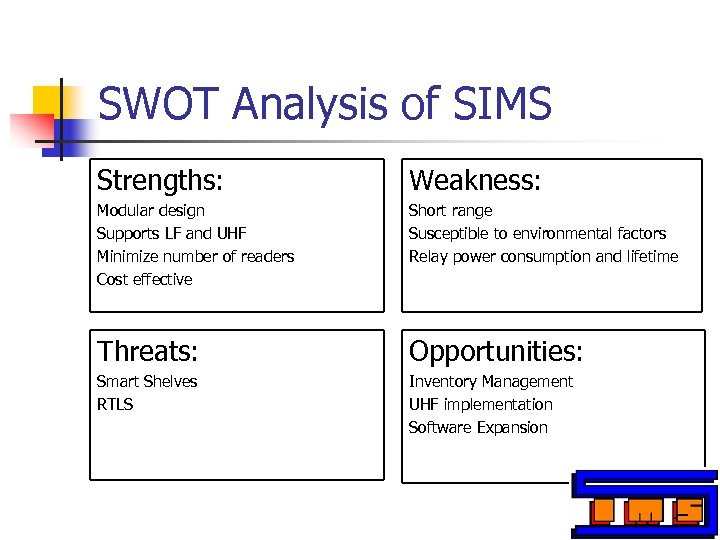 SWOT Analysis of SIMS Strengths: Weakness: Modular design Supports LF and UHF Minimize number of readers Cost effective Short range Susceptible to environmental factors Relay power consumption and lifetime Threats: Opportunities: Smart Shelves RTLS Inventory Management UHF implementation Software Expansion
 Credits n n n Mr. Richard Martin Cantzler, II Professor P. Scott Carney Mr. Nicholas Soldner Professor Jennifer T. Bernhard Professor Steven J. Franke
 Thank You