


 Скачать презентацию SIMS 2009 The 2 nd Seoul International Maritime
9874ed41a7d737f2633495a6ac3a48b7.ppt
- Количество слайдов: 32
 SIMS 2009 The 2 nd Seoul International Maritime and Shipbuilding Conference 17 September 2009 Key Issues for Shipowners Today Peter M. Swift Managing Director, INTERTANKO
 Key Issues for Shipowners Today ? • Establishing an international framework of consistent regulations and standards • Delivering best environmental performance • Ensuring availability of good people (and quality ships) • Ensuring welfare and well-being of ships’ crews • Meeting the challenges of Piracy • Surviving the financial crisis
 Establishing an international framework of consistent regulations and standards Shipowners supporting: • • International rather than unilateral legislation Ratification of IMO (and ILO) Conventions IMO Member State Audit scheme (Flag & Coastal States) Harmonisation and uniformity across Port State Control regimes • Development and Application of Common Structural Rules for Tankers & Bulkers • Classification societies’ procedural requirements, unified requirements and unified interpretations • Greater uniformity in chartering practices and standards
 Delivering best environmental performance • Air emissions - Green House Gases - Exhaust Gas emissions (Annex VI & its revisions) - VOC emissions • • • Spill Prevention and Response Planning Ballast Water management Biofouling Antifouling systems Ship Recycling Port Reception Facilities (adequacy & affordability) Waste management (onboard and ashore) Radiated Noise pollution Cetacean strikes
 Ensuring availability of good people recruitment, training and retention Both a quantity and quality challenge ! Recruitment initiatives covering: • Raising awareness of the industry: - www. maritimefoundation. com and Careers outreach programme - www. shippingfacts. com - www. careers-at-sea. org and DVD: Careers in International Shipping - www. bimco. org/Corporate%20 Area/Seascapes. aspx • Attracting entrants to the Maritime Professions (Round Table: “Human Resources strategy” and IMO: “Go to Sea” campaigns)
 Ensuring availability of good people recruitment, training and retention Both a quantity and quality challenge ! Training and retention initiatives covering: • Provision of Cadet berths and training facilities on ALL new ships and maximum utilisation of cadet berths on existing ships • Revision of STCW Convention • Development of Tanker Officer Training Standards (TOTS), covering proficiency and experience, as the industry standard • Establishment of Seafarer Focus Groups to provide feedback of experiences
 Ensuring welfare and well-being of ships’ crews Initiatives covering: • Unjustified criminalisation • Support for IMO-ILO guidelines on Fair Treatment of Seafarers (in event of Maritime Accident) • Improved conditions for shore leave and access • Reduction in number of inspections • Less bureaucracy and associated paperwork • Guidelines for safe handling of cargoes and fuels, tank cleaning and entry • Guidelines on implementing ILO Convention on “work and rest hours” • Higher standards of accommodation as industry “norms”
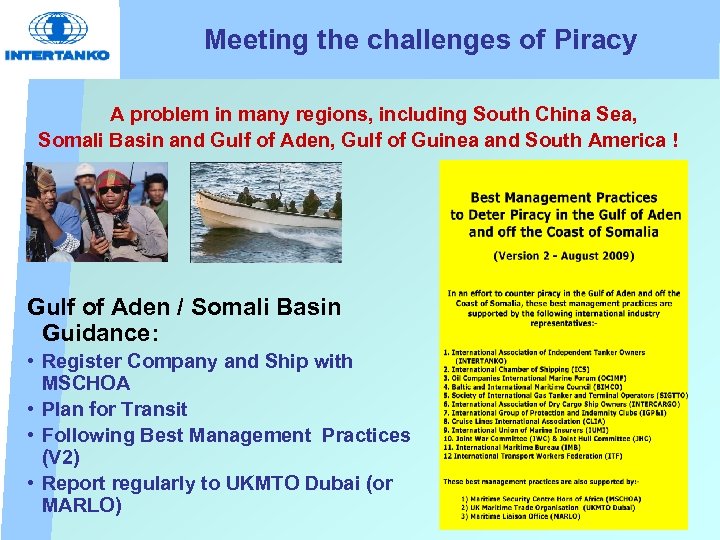 Meeting the challenges of Piracy A problem in many regions, including South China Sea, Somali Basin and Gulf of Aden, Gulf of Guinea and South America ! Gulf of Aden / Somali Basin Guidance: • Register Company and Ship with MSCHOA • Plan for Transit • Following Best Management Practices (V 2) • Report regularly to UKMTO Dubai (or MARLO)
 Surviving the financial crisis ! • Demand : World trade & by sector • Supply : Ships on Order & Fleet development • Shipbuilding capacity • Tanker market
 SIMS 2008 Issues and Challenges for Tanker Shipping Global Financial Crisis
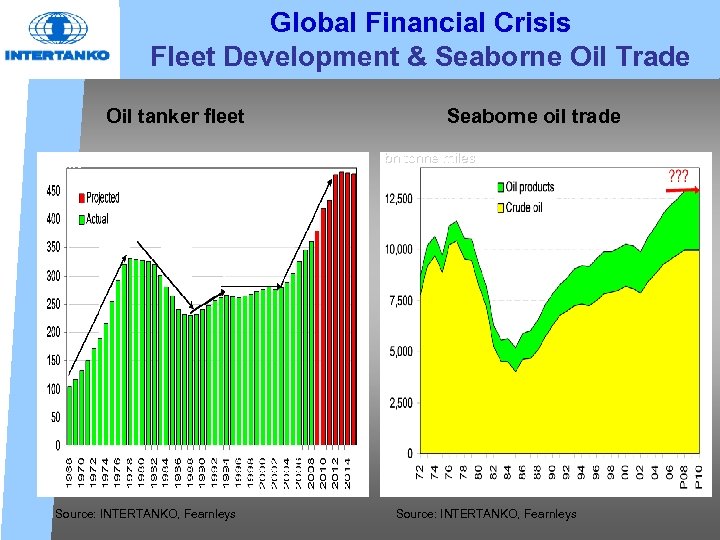 Global Financial Crisis Fleet Development & Seaborne Oil Trade Oil tanker fleet m dwt Source: INTERTANKO, Fearnleys Seaborne oil trade bn tonne miles Source: INTERTANKO, Fearnleys
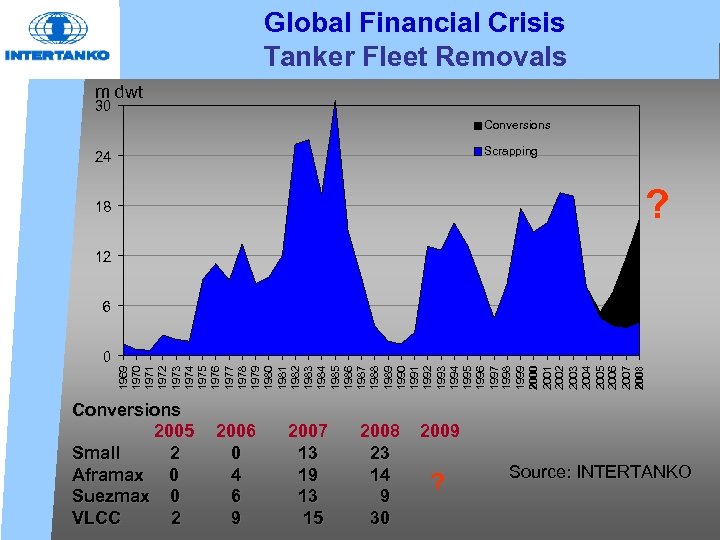 Global Financial Crisis Tanker Fleet Removals m dwt 30 Conversions Scrapping 24 ? 18 12 6 1969 1970 1971 1972 1973 1974 1975 1976 1977 1978 1979 1980 1981 1982 1983 1984 1985 1986 1987 1988 1989 1990 1991 1992 1993 1994 1995 1996 1997 1998 1999 2000 2001 2002 2003 2004 2005 2006 2007 2008 0 Conversions 2005 Small 2 Aframax 0 Suezmax 0 VLCC 2 2006 0 4 6 9 2007 13 19 13 15 2008 23 14 9 30 2009 ? Source: INTERTANKO
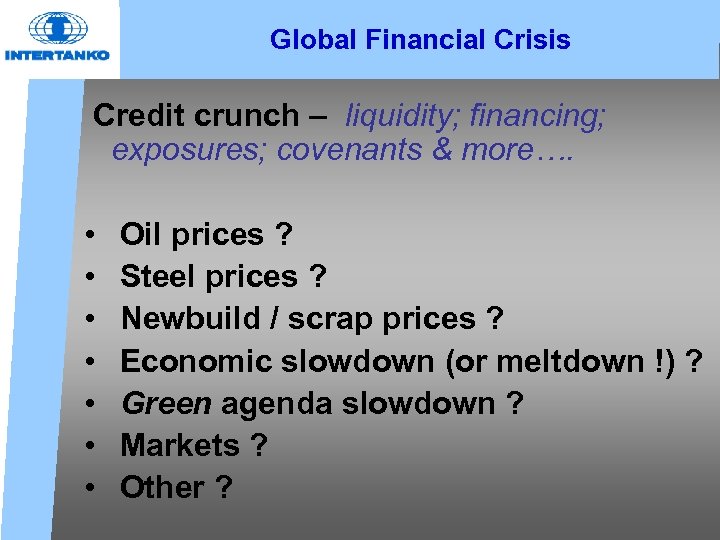 Global Financial Crisis Credit crunch – liquidity; financing; exposures; covenants & more…. • • Oil prices ? Steel prices ? Newbuild / scrap prices ? Economic slowdown (or meltdown !) ? Green agenda slowdown ? Markets ? Other ?
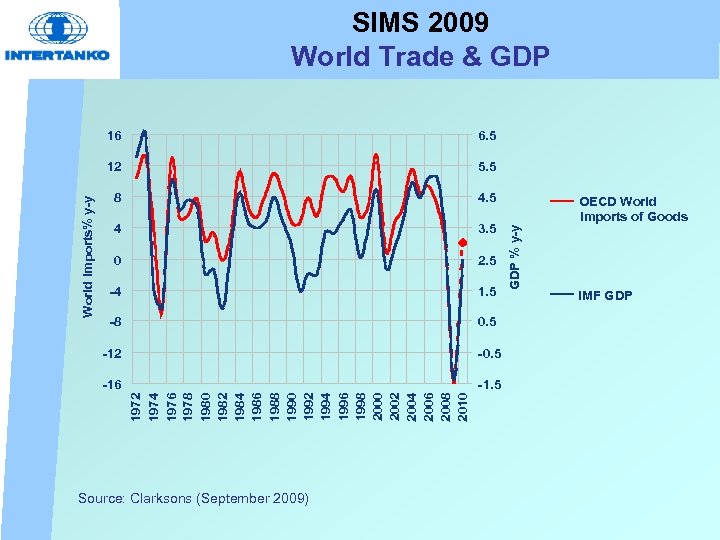 SIMS 2009 World Trade & GDP 5. 5 4 3. 5 0 2. 5 -4 1. 5 -8 0. 5 -12 -0. 5 -16 -1. 5 Source: Clarksons (September 2009) OECD World Imports of Goods GDP % y-y 8 1972 1974 1976 1978 1980 1982 1984 1986 1988 1990 1992 1994 1996 1998 2000 2002 2004 2006 2008 2010 6. 5 12 World Imports% y-y 16 IMF GDP
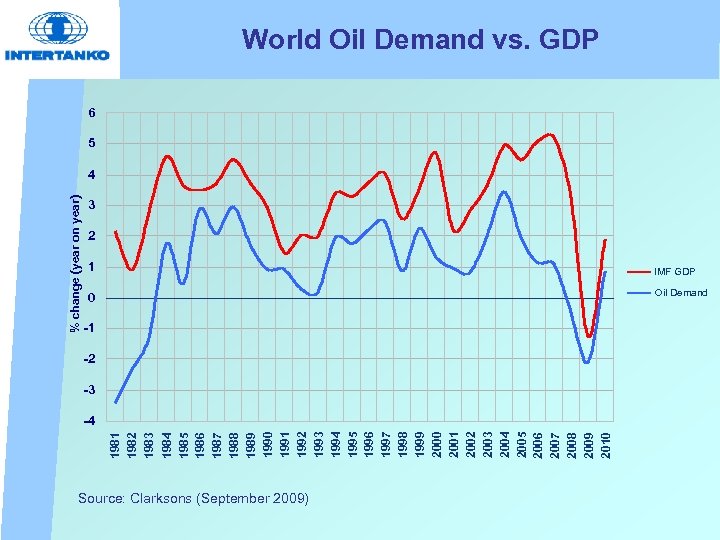 1981 1982 1983 1984 1985 1986 1987 1988 1989 1990 1991 1992 1993 1994 1995 1996 1997 1998 1999 2000 2001 2002 2003 2004 2005 2006 2007 2008 2009 2010 % change (year on year) World Oil Demand vs. GDP 6 5 4 3 2 1 IMF GDP 0 Oil Demand -1 -2 -3 -4 Source: Clarksons (September 2009)
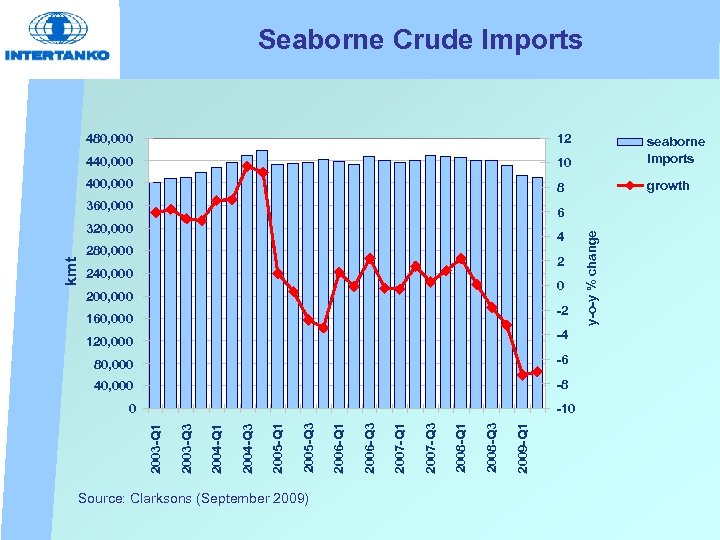 Seaborne Crude Imports 12 440, 000 10 seaborne imports 400, 000 8 growth 360, 000 6 kmt 320, 000 4 280, 000 2 240, 000 0 200, 000 -2 160, 000 120, 000 -4 80, 000 -6 40, 000 -8 Source: Clarksons (September 2009) 2009 -Q 1 2008 -Q 3 2008 -Q 1 2007 -Q 3 2007 -Q 1 2006 -Q 3 2006 -Q 1 2005 -Q 3 2005 -Q 1 2004 -Q 3 2004 -Q 1 2003 -Q 3 -10 2003 -Q 1 0 y-o-y % change 480, 000
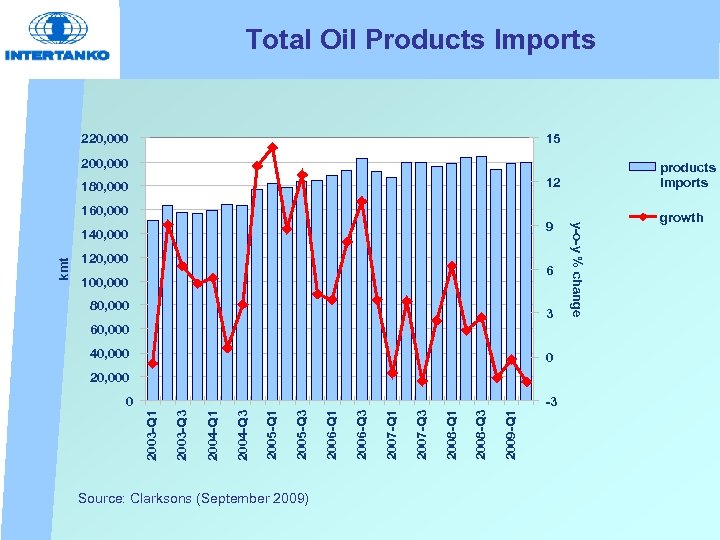 Total Oil Products Imports 220, 000 15 200, 000 products imports 12 180, 000 160, 000 120, 000 6 100, 000 80, 000 3 60, 000 40, 000 0 20, 000 Source: Clarksons (September 2009) 2009 -Q 1 2008 -Q 3 2008 -Q 1 2007 -Q 3 2007 -Q 1 2006 -Q 3 2006 -Q 1 2005 -Q 3 2005 -Q 1 2004 -Q 3 2004 -Q 1 -3 2003 -Q 3 0 2003 -Q 1 kmt 140, 000 y-o-y % change 9 growth
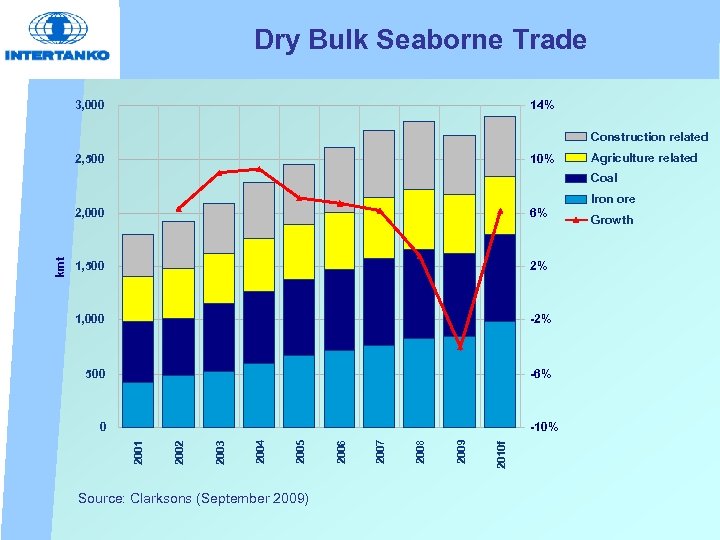 Dry Bulk Seaborne Trade 3, 000 14% Construction related 2, 500 10% Agriculture related Coal Iron ore 6% 1, 500 2% 1, 000 -2% 500 -6% Source: Clarksons (September 2009) 2010 f 2009 2008 2007 2006 2005 2004 2003 -10% 2002 0 2001 kmt 2, 000 Growth
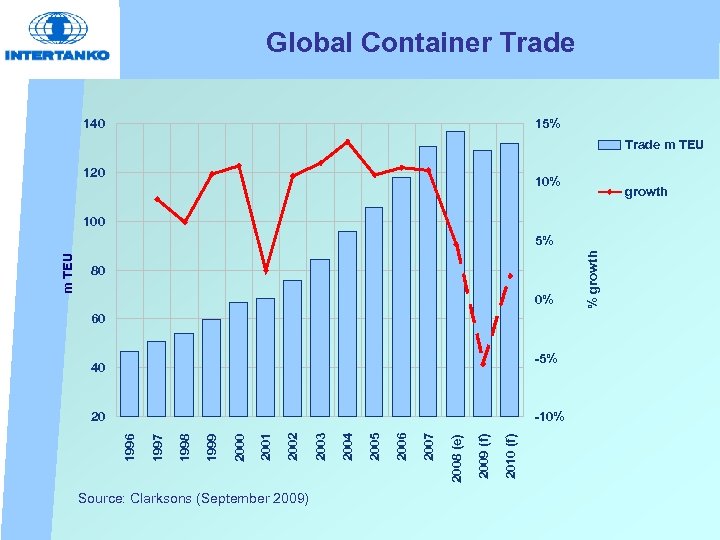 Global Container Trade 140 15% Trade m TEU 120 10% growth 100 0% 60 -5% 40 Source: Clarksons (September 2009) 2010 (f) 2009 (f) 2008 (e) 2007 2006 2005 2004 2003 2002 2001 2000 1999 1998 -10% 1997 20 % growth 80 1996 m TEU 5%
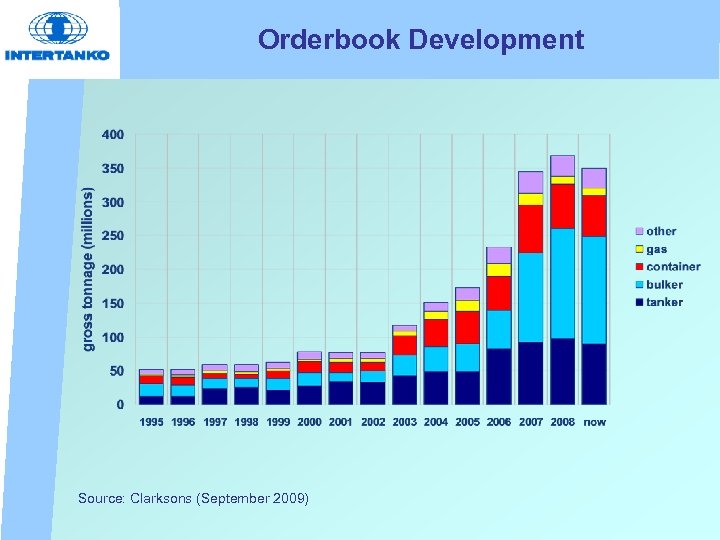 Orderbook Development Source: Clarksons (September 2009)
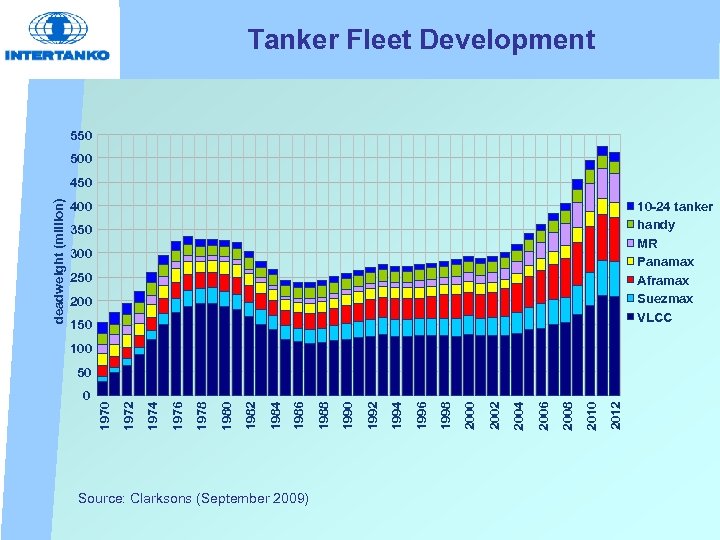 Tanker Fleet Development 550 500 10 -24 tanker handy MR Panamax Aframax Suezmax VLCC 400 350 300 250 200 150 100 Source: Clarksons (September 2009) 2012 2010 2008 2006 2004 2002 2000 1998 1996 1994 1992 1990 1988 1986 1984 1982 1980 1978 1976 1974 0 1972 50 1970 deadweight (million) 450
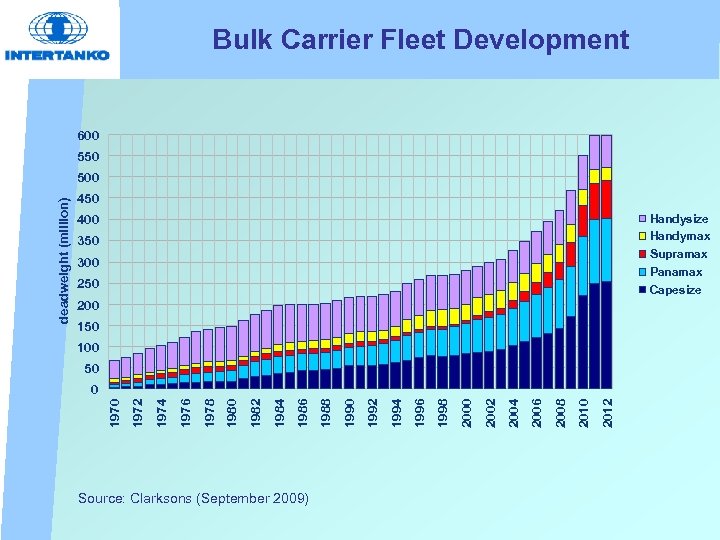 Bulk Carrier Fleet Development 600 550 450 Handysize Handymax Supramax Panamax Capesize 400 350 300 250 200 150 100 50 Source: Clarksons (September 2009) 2012 2010 2008 2006 2004 2002 2000 1998 1996 1994 1992 1990 1988 1986 1984 1982 1980 1978 1976 1974 1972 0 1970 deadweight (million) 500
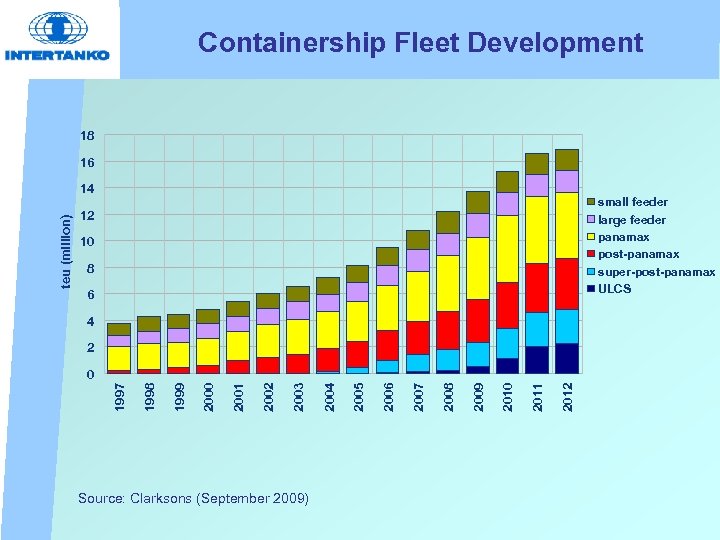 Containership Fleet Development 18 16 small feeder large feeder panamax post-panamax super-post-panamax ULCS 12 10 8 6 4 2 Source: Clarksons (September 2009) 2012 2011 2010 2009 2008 2007 2006 2005 2004 2003 2002 2001 2000 1999 1998 0 1997 teu (million) 14
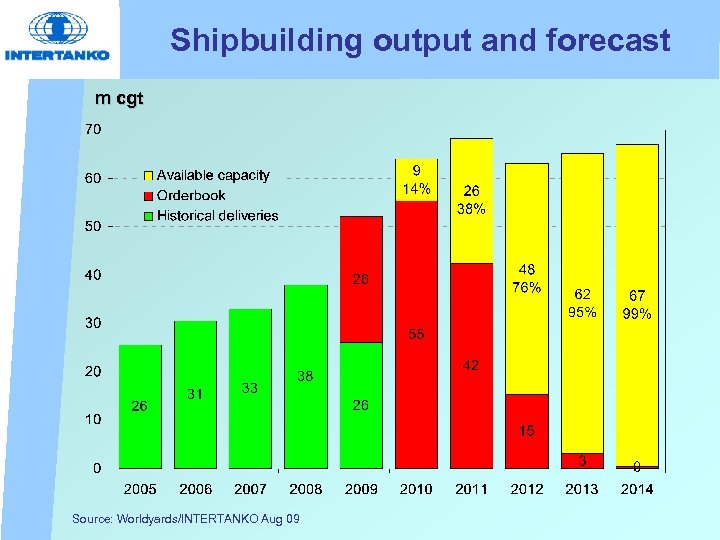 Shipbuilding output and forecast m cgt Source: Worldyards/INTERTANKO Aug 09
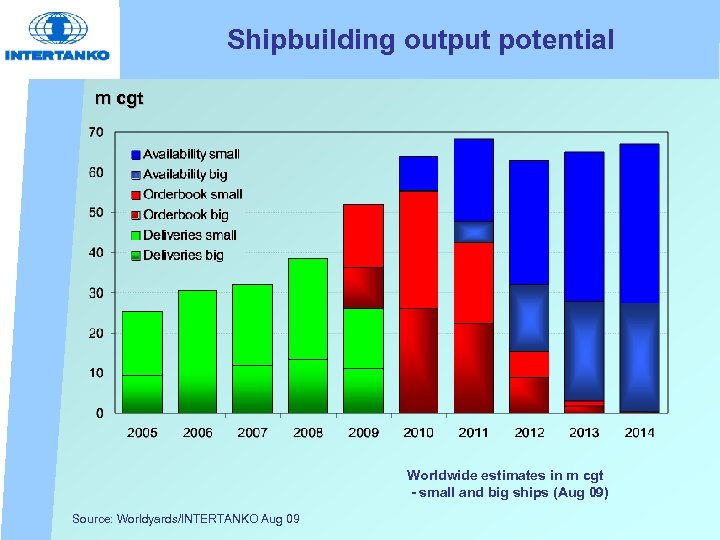 Shipbuilding output potential m cgt Worldwide estimates in m cgt - small and big ships (Aug 09) Source: Worldyards/INTERTANKO Aug 09
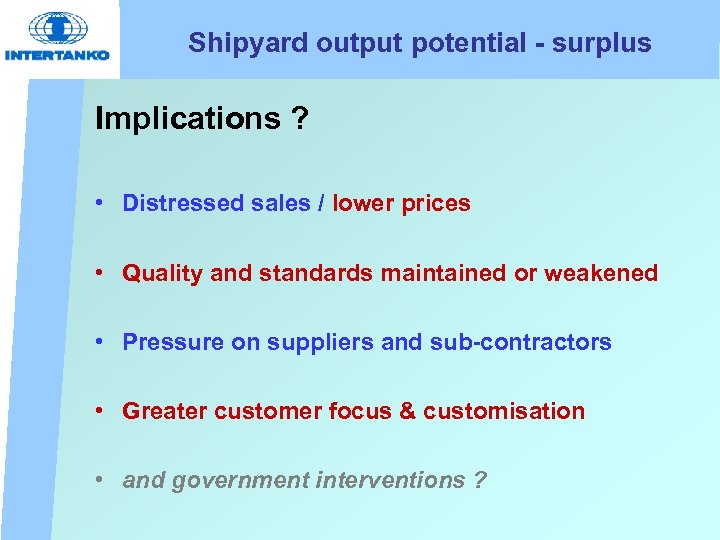 Shipyard output potential - surplus Implications ? • Distressed sales / lower prices • Quality and standards maintained or weakened • Pressure on suppliers and sub-contractors • Greater customer focus & customisation • and government interventions ?
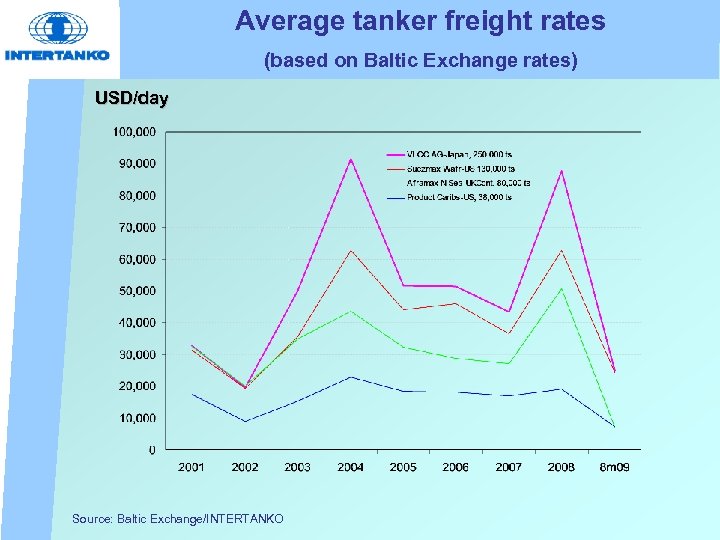 Average tanker freight rates (based on Baltic Exchange rates) USD/day Source: Baltic Exchange/INTERTANKO
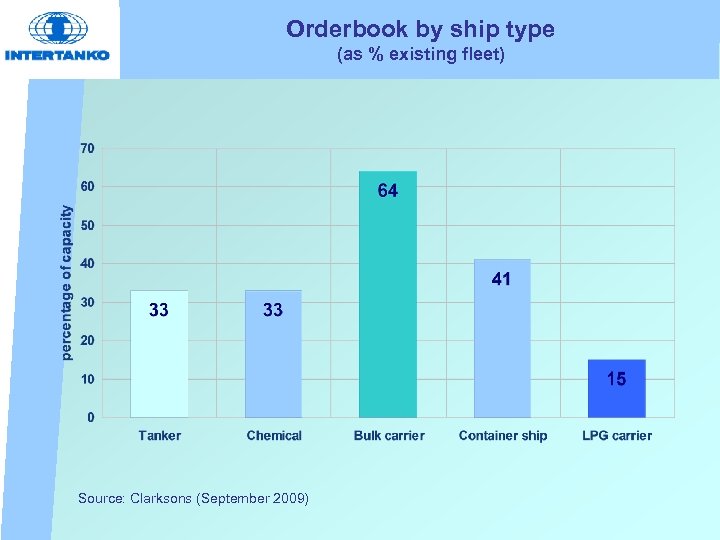 Orderbook by ship type (as % existing fleet) Source: Clarksons (September 2009)
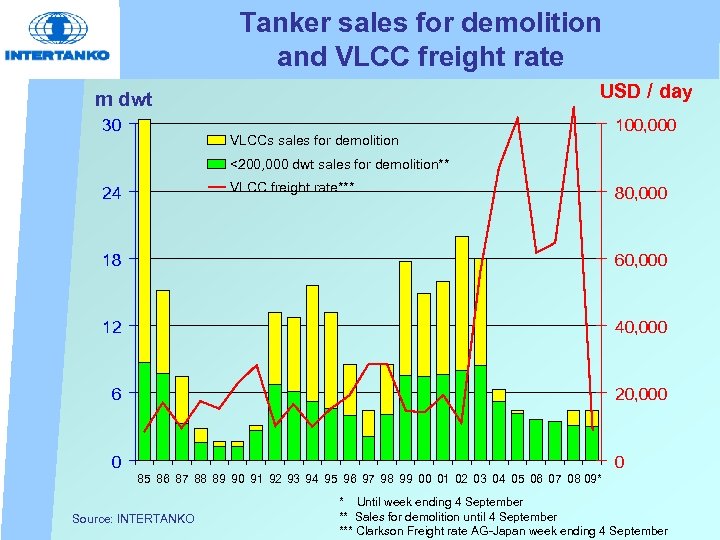 Tanker sales for demolition and VLCC freight rate USD / day m dwt 30 VLCCs sales for demolition 100, 000 <200, 000 dwt sales for demolition** VLCC freight rate*** 24 80, 000 18 60, 000 12 40, 000 6 20, 000 0 0 85 86 87 88 89 90 91 92 93 94 95 96 97 98 99 00 01 02 03 04 05 06 07 08 09* Source: INTERTANKO * Until week ending 4 September ** Sales for demolition until 4 September *** Clarkson Freight rate AG-Japan week ending 4 September
![Tanker deliveries, removals, max phase-out [All tankers > 25, 000 dwt] m dwt Assumed](https://present5.com/presentation/9874ed41a7d737f2633495a6ac3a48b7/image-30.jpg "Tanker deliveries, removals, max phase-out [All tankers > 25, 000 dwt] m dwt Assumed") Tanker deliveries, removals, max phase-out [All tankers > 25, 000 dwt] m dwt Assumed balanced market end 2008
Tanker deliveries, removals, max phase-out [All tankers > 25, 000 dwt] m dwt Assumed balanced market end 2008
 Lower Freight Rates & Fleet surpluses in ALL sectors – not just tankers Implications ? • Challenge to maintain quality and standards • Challenge to meet the issues of the day • and government interventions ? Panel Discussion to follow on: - Financial Crisis, its prospect - Role and Responsibilities of Regulators, Class, Shipbuilders, Repairers to Promote Maritime Safety and Quality Shipbuilding
 Thank you 감사합니다 For more information, please visit: www. intertanko. com www. maritimefoundation. com www. poseidonchallenge. com www. shippingfacts. com