


 Скачать презентацию Simple Rewire Protocols for Cooperation in Dynamic Networks
9e1169b55fc5e48691bb88c2151a0727.ppt
- Количество слайдов: 28
 Simple Rewire Protocols for Cooperation in Dynamic Networks David Hales, Stefano Arteconi, Ozalp Babaoglu University of Bologna, Italy Bio-Inspired Workshop, Rome, 25 th July 2006
 Evolutionary Models David Hales (University of Bologna) n n n Recent evolutionary models demonstrate desirable properties of cooperation and coordination Based on ideas coming from evolutionary / bounded rationality approaches (Simon, Arthur, Axelrod et al) Such models relax assumptions of “ideal” rationality Consider agents operate using simple heuristics Often collective learning via a (cultural) evolutionary approach The idea that (potentially random) innovations in agents are copied by others (in some way) if they improve utility (defined in some way) www. davidhales. com University of Bologna, Italy
 Evolutionary Models David Hales (University of Bologna) n n n n Such models capture self-organising and emergent processes Argued: similar to those that occur in human or animal societies Computational Social Science using agent-based simulation Obviously controversial, rarely validated Yet increasingly accepted as alternative to equilibrium analysis / ideal rational approaches More applicable to engineering applications - noise, incomplete information, high dynamicity, heterogeneous agents etc. Side-stepping controversy and validity of such models, can we steal and adapt these ideas for “engineering” of desirable properties in distributed systems? www. davidhales. com University of Bologna, Italy
 Peer-to-Peer Systems David Hales (University of Bologna) n n We have translated some of these models into protocols for use in peer-to-peer (P 2 P) systems P 2 P are generally open systems of client programs running on user machines with no central authority or control Electronically mediated and semi-automated social systems Some general motivating questions are: n How can such systems come to self-organise, cooperate and coordinate to produce productive behaviour? n How can the negative effects of free-riding and selfish behaviour be avoided - promote social good? n How can such systems scale well in a robust way? n How can the effects of malicious behaviour be minimised? www. davidhales. com University of Bologna, Italy
 tag systems David Hales (University of Bologna) n n Previous “tag” models offer a simple mechanism by which some of these questions can be addressed Both cooperation and coordination (specialisation) www. davidhales. com University of Bologna, Italy
 Evolution for Cooperation David Hales (University of Bologna) Self-Organising Cooperation in Peer-to-Peer Systems • Algorithm based on social simulation models of “tags” • Introduced by Holland early 1990’s • Developed recently by Riolo; Hales; Edmonds. • Tags are observable “markings”, labels or social cues, attached to agents (e. g. hairstyle, dress, accent) • In an evolutionary algorithm tags evolve just like any other artificial gene in the “genotype” • They are displayed directly in the “phenotype” • When agents bias interactions towards those with similar tags, even selfish evolution selects for cooperative and altruistic behaviour www. davidhales. com University of Bologna, Italy
 Evolution for Cooperation David Hales (University of Bologna) Self-Organising Cooperation in Peer-to-Peer Systems We translated the tag algorithm into a network • nodes move to find “better” neighbors • producing a kind of evolution in the network • “bad guys” become isolated Results in a “duplicate and re-wire” rule • Producing a kind of “group selection” between clusters • a functional reason for temporal structures found in the “natural” networks? www. davidhales. com University of Bologna, Italy
 SLAC Algorithm David Hales (University of Bologna) Self-Organising Cooperation in Peer-to-Peer Systems Basic Algorithm • Periodically do • Each node compare “utility” with a random node • if the other node has higher utility • copy that node’s strategy and links (reproduction) • mutate (with a small probability): change strategy (behavior) change neighborhood (links) • fi • od www. davidhales. com University of Bologna, Italy
 SLAC algorithm David Hales (University of Bologna) Self-Organising Cooperation in Peer-to-Peer Systems “Reproduction” = copying a more successful node Before Fu > A u Where Au = average utility of node A www. davidhales. com After A copies F neighbours & strategy In his case mutation has not changed anything University of Bologna, Italy
 SLAC algorithm David Hales (University of Bologna) Self-Organising Cooperation in Peer-to-Peer Systems “Mutation of the neighbourhood” = random movement in the net Before Mutation applied to F’s neighbourhood www. davidhales. com After F is wired to a randomly selected node (B) University of Bologna, Italy
 SLAC Applied to the PD David Hales (University of Bologna) Self-Organising Cooperation in Peer-to-Peer Systems Applied to a simulated Prisoner’s Dilemma Scenario: • Where selfish behavior produces poor performance – Nash Eq. • Nodes store a pure strategy, either cooperate or defect • Play the single round PD with randomly selected neighbours • Using their strategy • We take average payoff as the node utility • Mutation of strategy: flip strategy • Nodes randomly selected to play a random neighbours some number of times each period www. davidhales. com University of Bologna, Italy
 David Hales (University of Bologna) Cycles to High Cooperation www. davidhales. com University of Bologna, Italy
 SLAC Applied to PD David Hales (University of Bologna) Typical Individual Run www. davidhales. com University of Bologna, Italy
 How Does SLAC Work? David Hales (University of Bologna) Clusters www. davidhales. com University of Bologna, Italy
 SLAC Applied to File Sharing P 2 P David Hales (University of Bologna) Self-Organising Cooperation in Peer-to-Peer Systems Applied to a simulated P 2 P File Sharing Scenario: • Simplified form of that given by Q. Sun & H. Garcia-Molina 2004 • Nodes control how much capacity devoted to generating or answering queries based on P = [0. . 1] • P =1. 0 selfish (only generates queries) • P =0. 0 altruist (only answers queries) • We take as node utility the number of hits • Mutation of strategy: change P randomly • Flood fill query method, TTL’s etc www. davidhales. com University of Bologna, Italy
 SLAC Applied to P 2 P File Sharing David Hales (University of Bologna) Self-Organising Cooperation in Peer-to-Peer Systems Some simulation results Selfishness reduces Average performance increases A typical run for a 104 node network www. davidhales. com University of Bologna, Italy
 SLAC Applied to P 2 P File Sharing David Hales (University of Bologna) Self-Organising Cooperation in Peer-to-Peer Systems Some simulation results Results showing number of queries (nq) and number of hits (nh) (averaged over cycle 40. . 50) for different network sizes with 10 individual runs for each network size www. davidhales. com University of Bologna, Italy
 SLAC to SLACER David Hales (University of Bologna) • • SLAC is OK for some tasks – as we have seen But produces disconnected components This is no good when we want An “Artificial Friendship Network” to span the network Connected – such that all nodes are linked with short path Chains of trust between all nodes – preferably short also To achieve this we modify SLAC and introduce SLACER www. davidhales. com University of Bologna, Italy
 SLACER algorithm David Hales (University of Bologna) Basic Algorithm • Periodically do • Each node compare “utility” with a random node • if the other node has higher utility • copy that node’s strategy and links, probabilistically retaining some existing links • mutate (with a small probability): change strategy (behavior) change neighborhood (links), probabilistically retaining some existing links • fi • od www. davidhales. com University of Bologna, Italy
 SLAC to SLACER David Hales (University of Bologna) SLAC www. davidhales. com SLACER University of Bologna, Italy
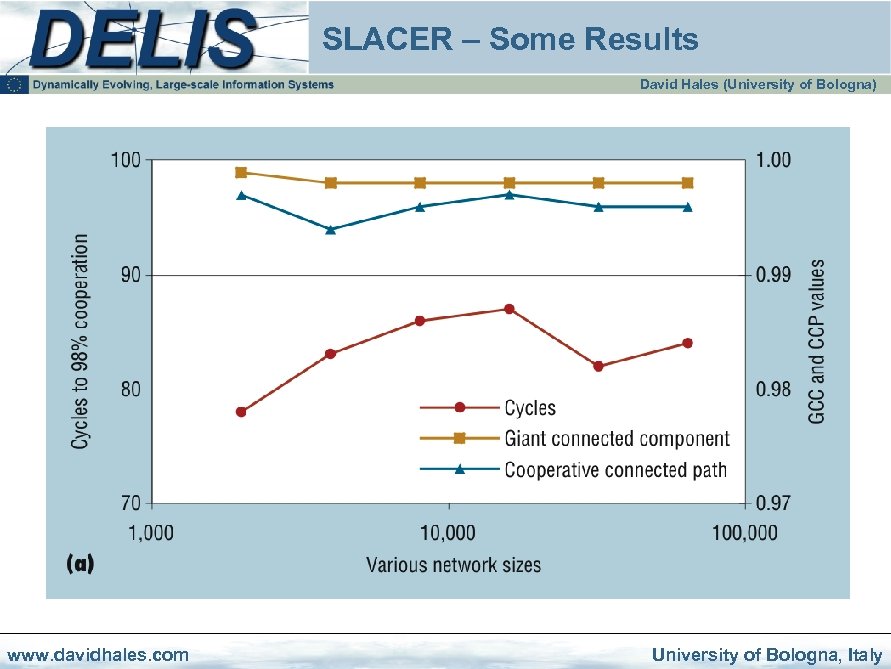 SLACER – Some Results David Hales (University of Bologna) www. davidhales. com University of Bologna, Italy
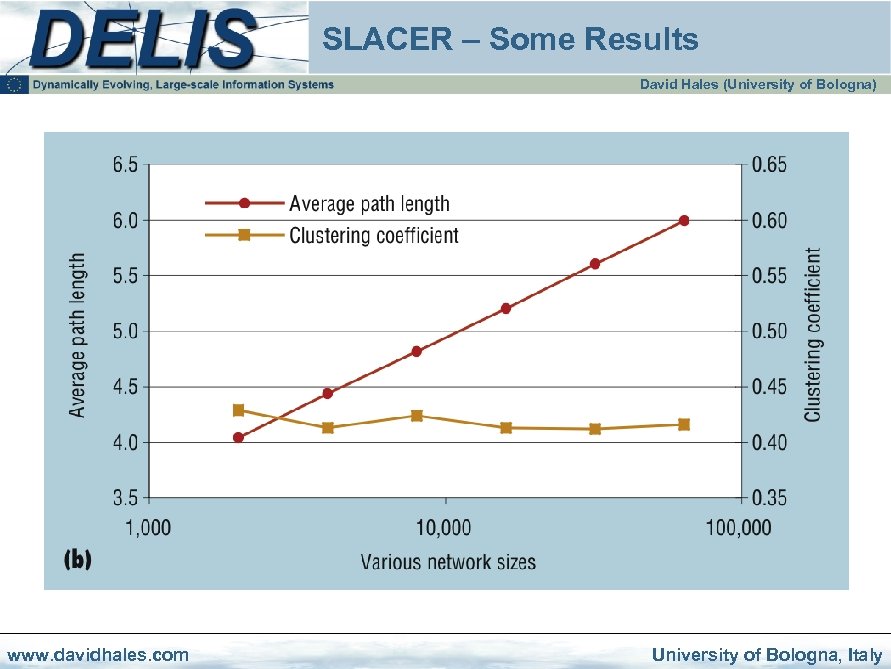 SLACER – Some Results David Hales (University of Bologna) www. davidhales. com University of Bologna, Italy
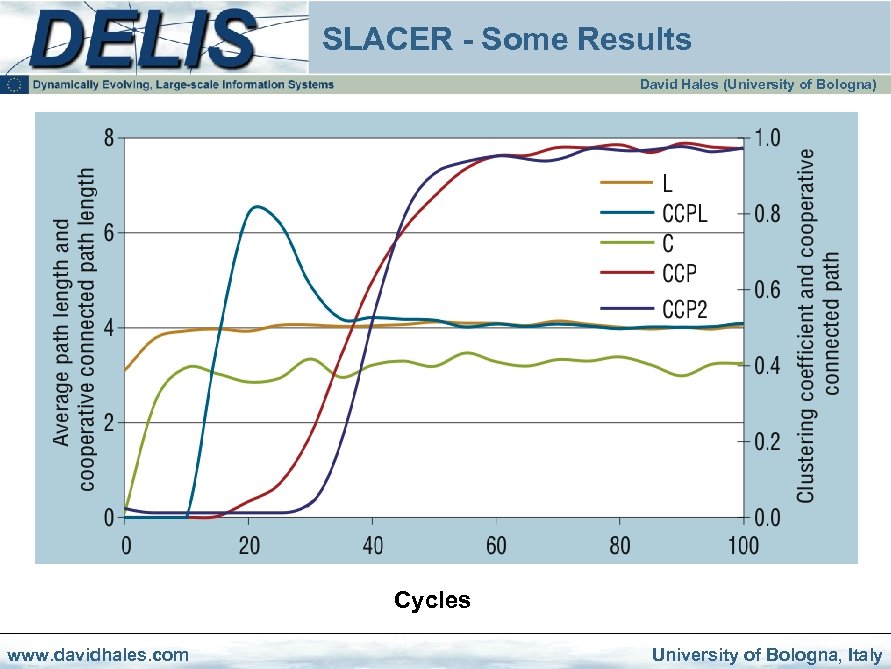 SLACER - Some Results David Hales (University of Bologna) Cycles www. davidhales. com University of Bologna, Italy
 SLACER – Future Applications David Hales (University of Bologna) • • • By establishing a fully connected “Artificial Social Network” (ASN) This can be used as input to existing P 2 P applications Specifically those that assume or require trusted social networks as input Currently harvested from e-mail contacts or “buddy lists” in chat applications Example: Collective spam filtering: J. S. Kong, P. O. Boykin, B. Rezei, N. Sarshar, and V. Roychowdhury, “Let you cyberalter ego share information and manage spam, ” 2005. Available as pre-print: http: //xxx. lanl. gov/abs/physics/0504026. www. davidhales. com University of Bologna, Italy
 Conclusion David Hales (University of Bologna) • • Simple copy and rewire algorithm No need for centralized trust or enforcement mechanism No need for knowledge of past interactions Process cooperative behavior even when nodes behave in an egotistical way, locally and greedy optimizing • Works through a kind of “group selection” – “tribal selection” • Can produce trusted and cooperative Artificial Social Networks • Could be applied to existing protocols with minor modification • Available on open source P 2 P simulation platform Peersim. www. davidhales. com University of Bologna, Italy
 Related Publications David Hales (University of Bologna) Self-Organising Cooperation in Peer-to-Peer Systems References • Hales & Edmonds (2005) “Applying a socially-inspired technique (tags) to improve cooperation in P 2 P Networks”, IEEE Transactions on Systems, Man, and Cybernetics, Part A • Hales & Arteconi (2006) “SLACER: A Self-Organizing Protocol for Coordination in P 2 P Networks”, IEEE Intelligent Systems, 21(2): 29 -35, March / April 2006. www. davidhales. com peersim. sourceforge. net www. davidhales. com University of Bologna, Italy
 SLAC and SLACER David Hales (University of Bologna) n Fini www. davidhales. com University of Bologna, Italy
 The End David Hales (University of Bologna) Thank you! www. davidhales. com University of Bologna, Italy