


 Скачать презентацию Simple Network Management Protocol SNMP Shivkumar Kalyanaraman Rensselaer
90add876322a98cdd71ea9d41b97f54d.ppt
- Количество слайдов: 20
 Simple Network Management Protocol (SNMP) Shivkumar Kalyanaraman Rensselaer Polytechnic Institute shivkuma@ecse. rpi. edu Shivkumar Kalyanaraman Rensselaer Polytechnic Institute 1
 Overview Network Management q SNMP q Management information base (MIB) q ASN. 1 Notation q RMON q Ref: Chap 25, Stallings: “SNMP, SNMPv 2 and RMON”, Addison Wesley q Shivkumar Kalyanaraman Rensselaer Polytechnic Institute 2
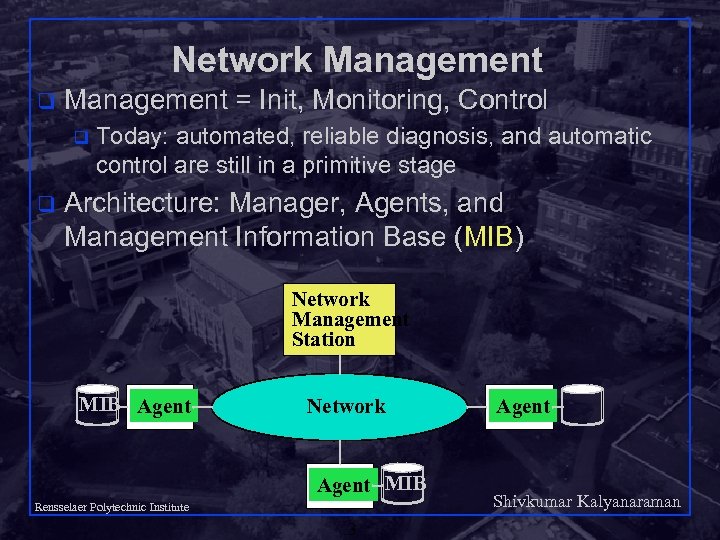 Network Management q Management = Init, Monitoring, Control q q Today: automated, reliable diagnosis, and automatic control are still in a primitive stage Architecture: Manager, Agents, and Management Information Base (MIB) Network Management Station MIB Agent Network Agent MIB Rensselaer Polytechnic Institute 3 Agent Shivkumar Kalyanaraman
 SNMP History Early: based upon ICMP messages (eg: ping, source routing, record routing) q A lot of informal network debugging is done using tcpdump, netstat, ifconfig etc q When the internet grew, Simple Gateway Management Protocol (SGMP) was developed (1987) q Shivkumar Kalyanaraman Rensselaer Polytechnic Institute 4
 SNMP History (Continued) q Build single protocol to manage OSI and IP q CMIP (an OSI protocol) over TCP/IP {called CMOT} q Goal: Keep object level same for both OSI and IP q CMOT progressed very sluggishly q SNMP: parallel effort. Very simple => grabbed the market. Shivkumar Kalyanaraman Rensselaer Polytechnic Institute 5
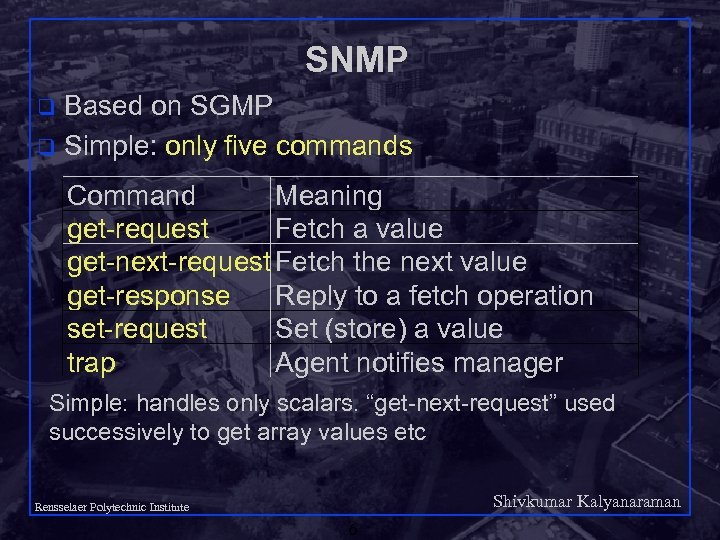 SNMP Based on SGMP q Simple: only five commands q Command Meaning get-request Fetch a value get-next-request Fetch the next value get-response Reply to a fetch operation set-request Set (store) a value trap Agent notifies manager Simple: handles only scalars. “get-next-request” used successively to get array values etc Shivkumar Kalyanaraman Rensselaer Polytechnic Institute 6
 SNMP (Continued) Simple: one management station can handle hundreds of agents q Simple: Works as an application protocol running over UDP q Agent and manager apps work on top of SNMP q Proxy-SNMP can be used to manage a variety of devices (serial lines, bridges, modems etc). q Proxy (similar to bridge) is needed because these devices may not run UDP/IP q For each new device define a new MIB. q Shivkumar Kalyanaraman Rensselaer Polytechnic Institute 7
 Management Information Base (MIB) Specifies what variables the agents maintain q Only a limited number of data types are used to define these variables q MIBs follow a fixed naming and structuring convention called “Structure of Management Information” (SMI). See next slide. q Shivkumar Kalyanaraman Rensselaer Polytechnic Institute 8
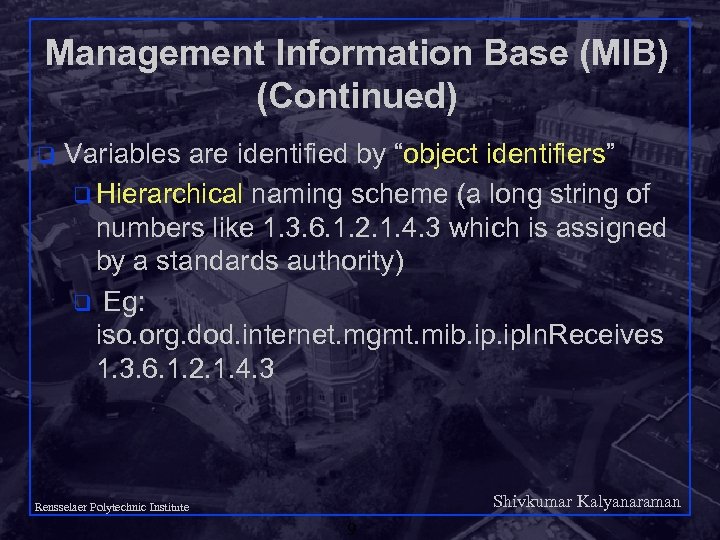 Management Information Base (MIB) (Continued) q Variables are identified by “object identifiers” q Hierarchical naming scheme (a long string of numbers like 1. 3. 6. 1. 2. 1. 4. 3 which is assigned by a standards authority) q Eg: iso. org. dod. internet. mgmt. mib. ip. In. Receives 1. 3. 6. 1. 2. 1. 4. 3 Shivkumar Kalyanaraman Rensselaer Polytechnic Institute 9
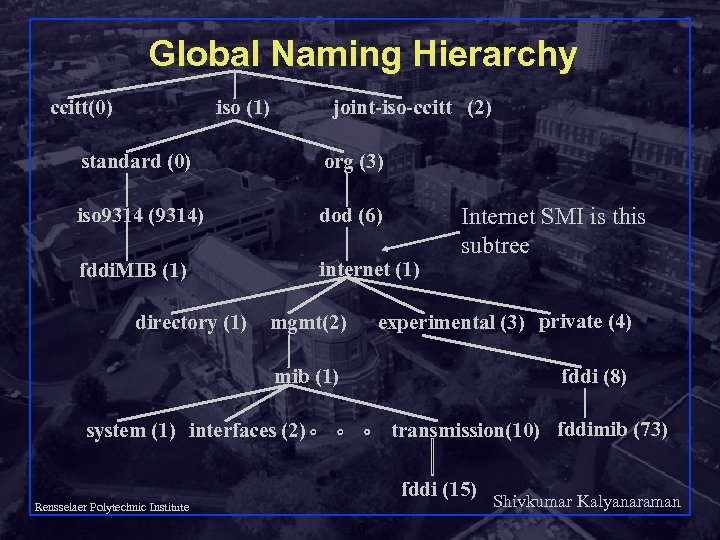 Global Naming Hierarchy ccitt(0) iso (1) joint-iso-ccitt (2) standard (0) org (3) iso 9314 (9314) dod (6) fddi. MIB (1) internet (1) directory (1) Internet SMI is this subtree experimental (3) private (4) mgmt(2) mib (1) fddi (8) transmission(10) fddimib (73) system (1) interfaces (2) fddi (15) Rensselaer Polytechnic Institute 10 Shivkumar Kalyanaraman
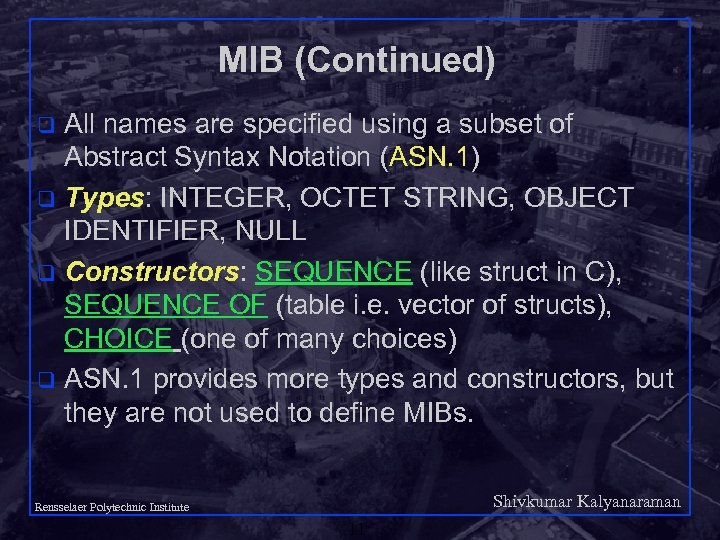 MIB (Continued) All names are specified using a subset of Abstract Syntax Notation (ASN. 1) q Types: INTEGER, OCTET STRING, OBJECT IDENTIFIER, NULL q Constructors: SEQUENCE (like struct in C), SEQUENCE OF (table i. e. vector of structs), CHOICE (one of many choices) q ASN. 1 provides more types and constructors, but they are not used to define MIBs. q Shivkumar Kalyanaraman Rensselaer Polytechnic Institute 11
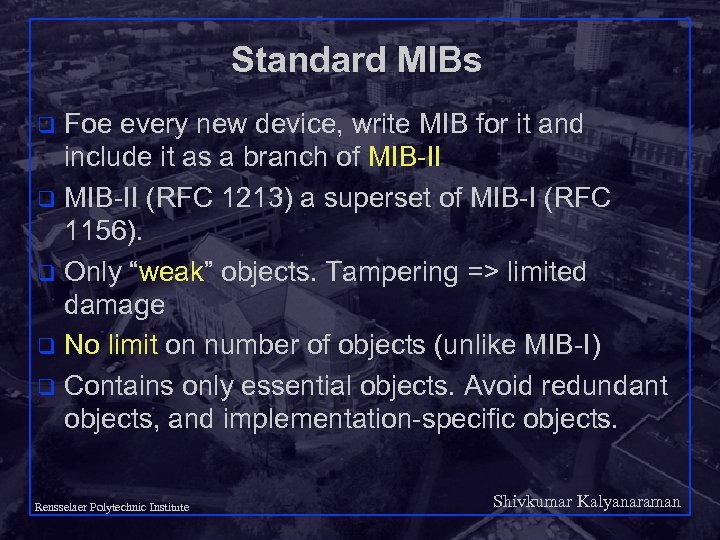 Standard MIBs Foe every new device, write MIB for it and include it as a branch of MIB-II q MIB-II (RFC 1213) a superset of MIB-I (RFC 1156). q Only “weak” objects. Tampering => limited damage q No limit on number of objects (unlike MIB-I) q Contains only essential objects. Avoid redundant objects, and implementation-specific objects. q Shivkumar Kalyanaraman Rensselaer Polytechnic Institute 12
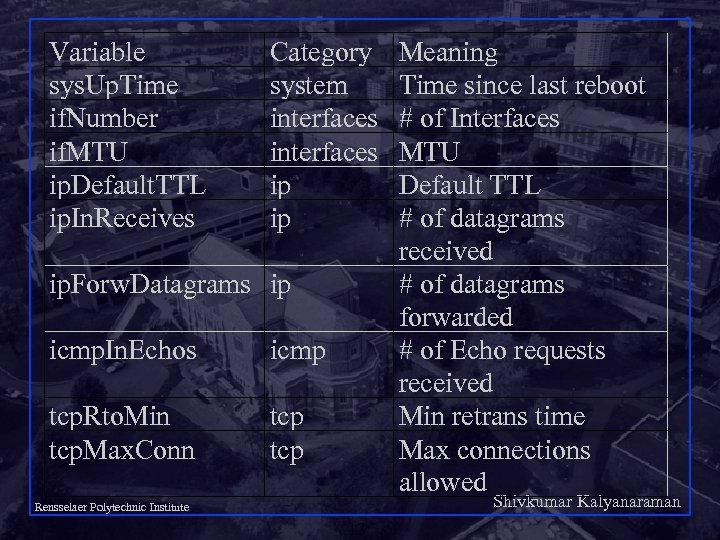 Variable sys. Up. Time if. Number if. MTU ip. Default. TTL ip. In. Receives Category system interfaces ip ip ip. Forw. Datagrams ip icmp. In. Echos icmp tcp. Rto. Min tcp. Max. Conn tcp Meaning Time since last reboot # of Interfaces MTU Default TTL # of datagrams received # of datagrams forwarded # of Echo requests received Min retrans time Max connections allowed Shivkumar Kalyanaraman Rensselaer Polytechnic Institute 13
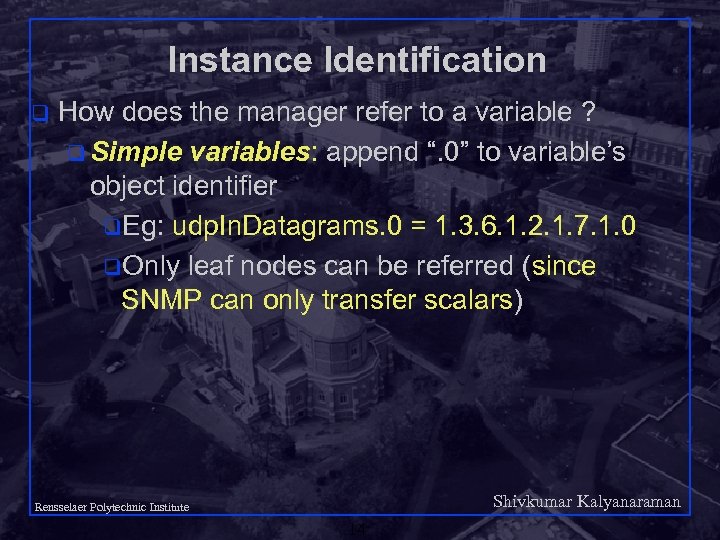 Instance Identification q How does the manager refer to a variable ? q Simple variables: append “. 0” to variable’s object identifier q. Eg: udp. In. Datagrams. 0 = 1. 3. 6. 1. 2. 1. 7. 1. 0 q. Only leaf nodes can be referred (since SNMP can only transfer scalars) Shivkumar Kalyanaraman Rensselaer Polytechnic Institute 14
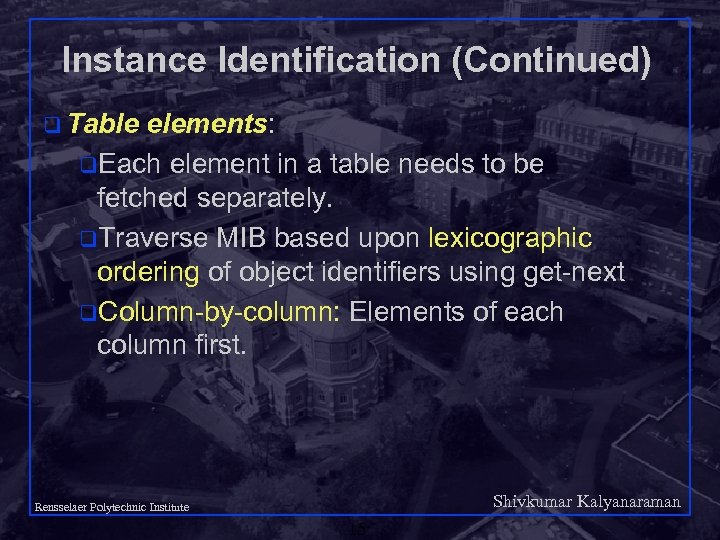 Instance Identification (Continued) q Table elements: q. Each element in a table needs to be fetched separately. q. Traverse MIB based upon lexicographic ordering of object identifiers using get-next q. Column-by-column: Elements of each column first. Shivkumar Kalyanaraman Rensselaer Polytechnic Institute 15
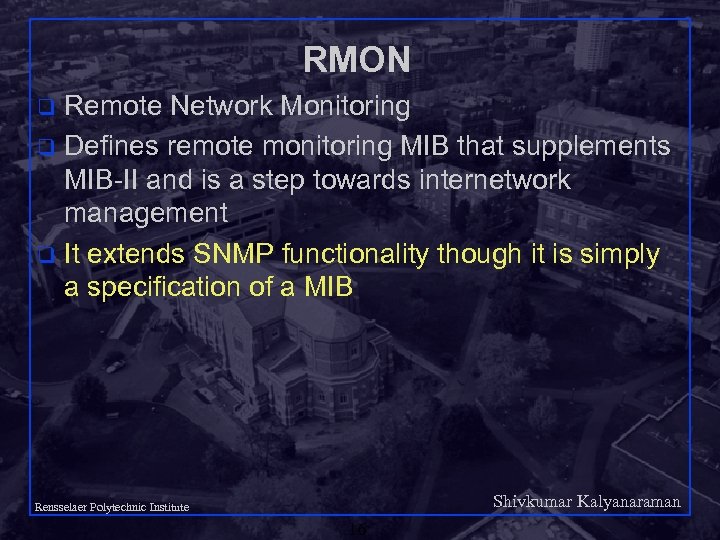 RMON Remote Network Monitoring q Defines remote monitoring MIB that supplements MIB-II and is a step towards internetwork management q It extends SNMP functionality though it is simply a specification of a MIB q Shivkumar Kalyanaraman Rensselaer Polytechnic Institute 16
 RMON (Continued) q Problem w/ MIB-II q Can obtain info that is purely local to individual devices q Cannot easily learn about LAN traffic as a whole (eg like LANanalyzers or “remote monitors”) Shivkumar Kalyanaraman Rensselaer Polytechnic Institute 17
 RMON (Continued) Functionality added: Promiscuously count, filter and store packets q System that implements RMON MIB is called an RMON probe (or less frequently, an RMON agent). q No changes to SNMP protocol. q Enhance the manager and agents only. q Shivkumar Kalyanaraman Rensselaer Polytechnic Institute 18
 RMON (Continued) RMON MIB organization: q Control table: read-write. Configures what parameters should be logged and how often. q Data table: read-only (statistics etc logged) q Other issues: shared probes, ownership of tables, concurrent table access. . . q Shivkumar Kalyanaraman Rensselaer Polytechnic Institute 19
 Summary Management = Initialization, Monitoring, and Control q SNMP = Only 5 commands q Standard MIBs defined for each object q Uses ASN. 1 encoding q RMON extends SNMP functionality through definition of a new MIB Shivkumar Kalyanaraman q Rensselaer Polytechnic Institute 20