


 Скачать презентацию Simple факт Continuous процесс Perfect результат Perfect Continuous
SIMPLE TENSES.ppt
- Количество слайдов: 21
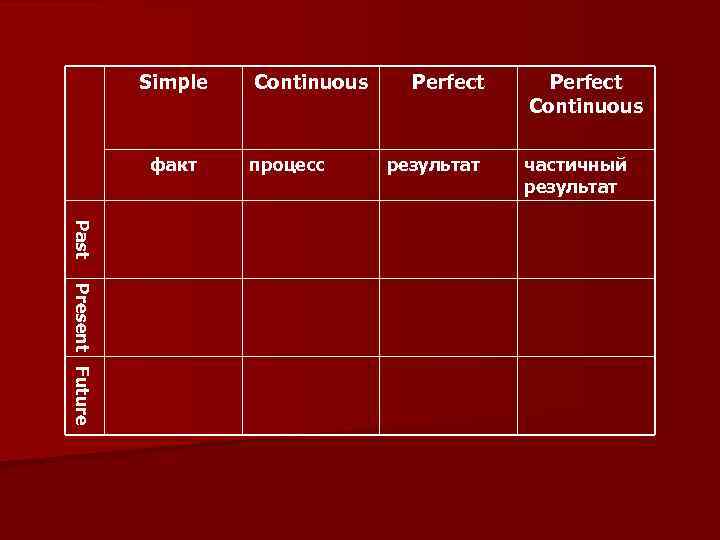 Simple факт Continuous процесс Perfect результат Perfect Continuous частичный результат Pa s t P r e s e n t Fu t u r e
 SIMPLE TENSES
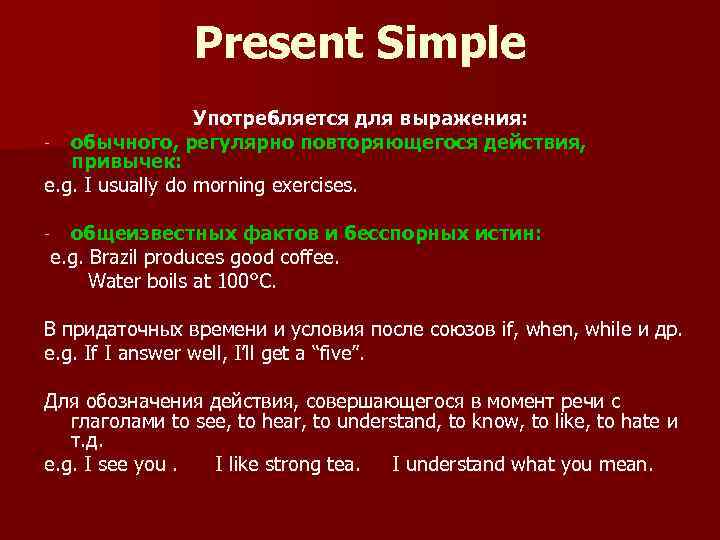 Present Simple Употребляется для выражения: - обычного, регулярно повторяющегося действия, привычек: e. g. I usually do morning exercises. общеизвестных фактов и бесспорных истин: e. g. Brazil produces good coffee. Water boils at 100°C. - В придаточных времени и условия после союзов if, when, while и др. e. g. If I answer well, I’ll get a “five”. Для обозначения действия, совершающегося в момент речи с глаголами to see, to hear, to understand, to know, to like, to hate и т. д. e. g. I see you. I like strong tea. I understand what you mean.
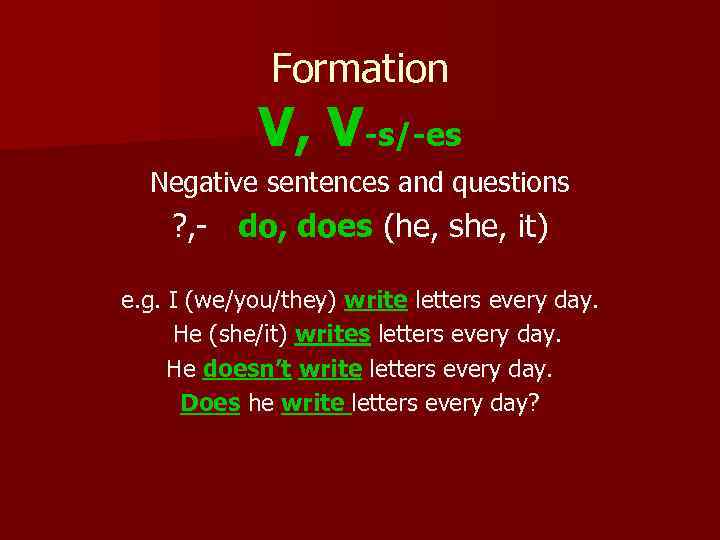 Formation V, V-s/-es Negative sentences and questions ? , - do, does (he, she, it) e. g. I (we/you/they) write letters every day. He (she/it) writes letters every day. He doesn’t write letters every day. Does he write letters every day?
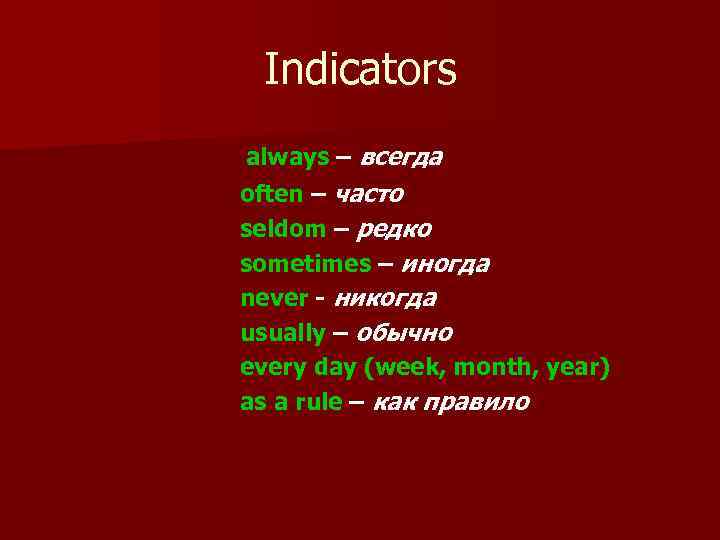 Indicators always – всегда often – часто seldom – редко sometimes – иногда never - никогда usually – обычно every day (week, month, year) as a rule – как правило
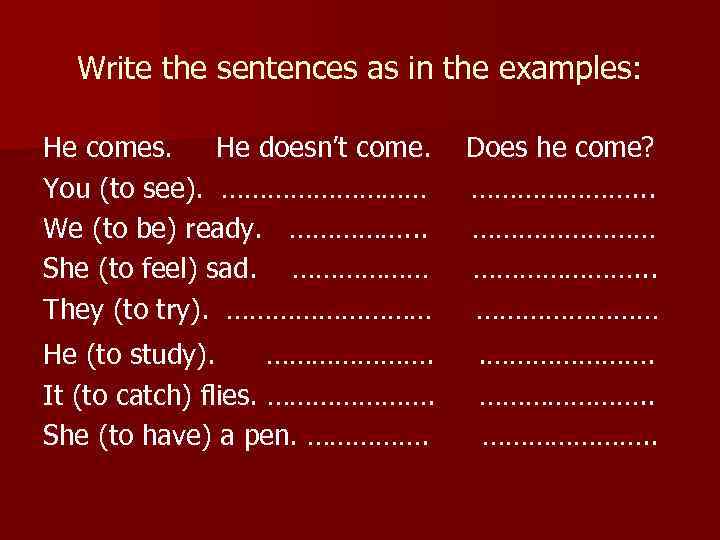 Write the sentences as in the examples: He comes. He doesn’t come. You (to see). …………… We (to be) ready. ……………. . . She (to feel) sad. ……………… They (to try). …………… Does he come? …………………. . . …………………… He (to study). …………………. It (to catch) flies. …………………. She (to have) a pen. …………………. .
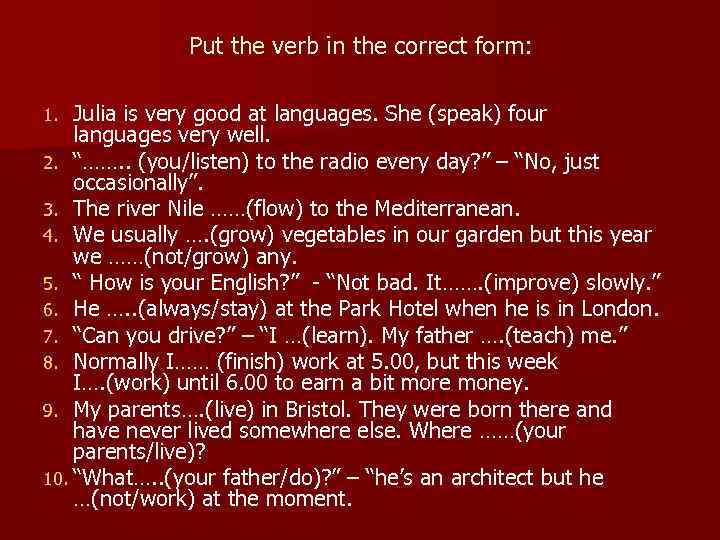 Put the verb in the correct form: Julia is very good at languages. She (speak) four languages very well. 2. “……. . (you/listen) to the radio every day? ” – “No, just occasionally”. 3. The river Nile ……(flow) to the Mediterranean. 4. We usually …. (grow) vegetables in our garden but this year we ……(not/grow) any. 5. “ How is your English? ” - “Not bad. It……. (improve) slowly. ” 6. He …. . (always/stay) at the Park Hotel when he is in London. 7. “Can you drive? ” – “I …(learn). My father …. (teach) me. ” 8. Normally I…… (finish) work at 5. 00, but this week I…. (work) until 6. 00 to earn a bit more money. 9. My parents…. (live) in Bristol. They were born there and have never lived somewhere else. Where ……(your parents/live)? 10. “What…. . (your father/do)? ” – “he’s an architect but he …(not/work) at the moment. 1.
 Future Simple Употребляется для: Выражения однократного или повторяющегося обычного действия или ряда последовательных действий в будущем
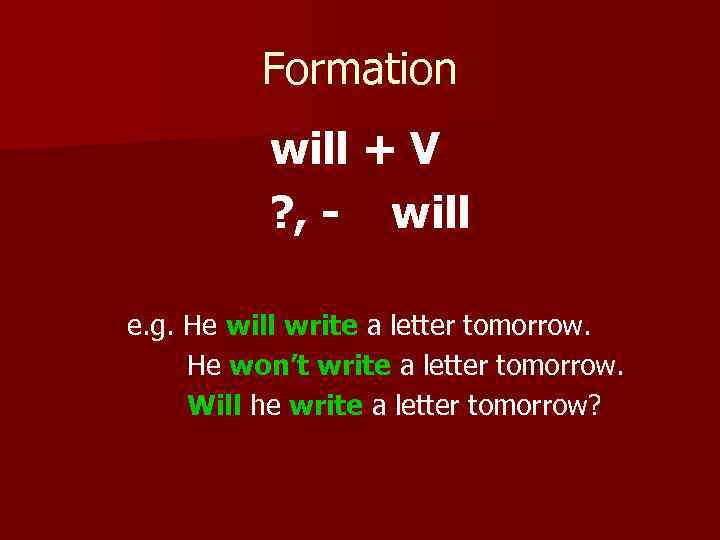 Formation will + V ? , - will e. g. He will write a letter tomorrow. He won’t write a letter tomorrow. Will he write a letter tomorrow?
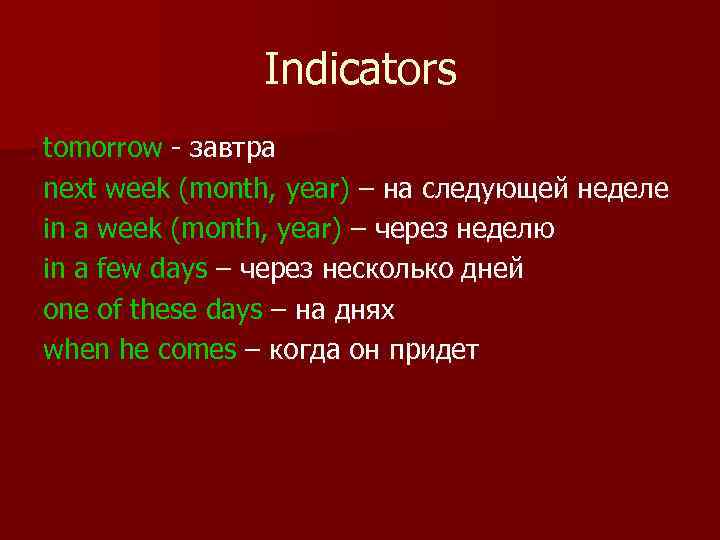 Indicators tomorrow - завтра next week (month, year) – на следующей неделе in a week (month, year) – через неделю in a few days – через несколько дней one of these days – на днях when he comes – когда он придет
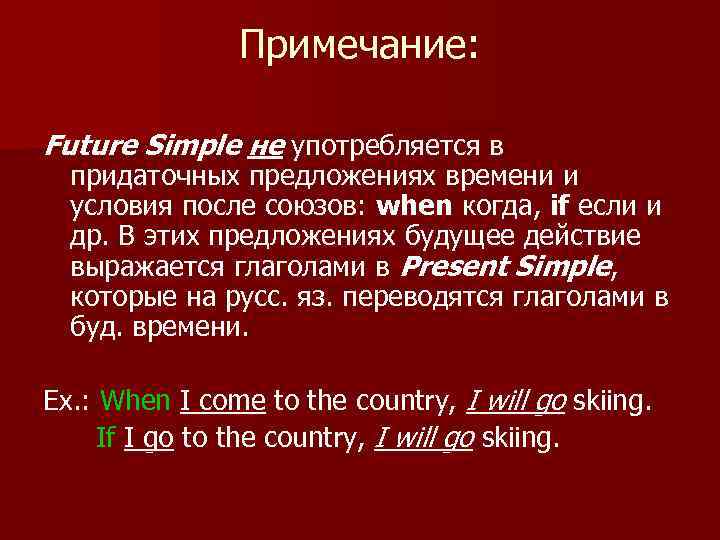 Примечание: Future Simple не употребляется в придаточных предложениях времени и условия после союзов: when когда, if если и др. В этих предложениях будущее действие выражается глаголами в Present Simple, которые на русс. яз. переводятся глаголами в буд. времени. Ex. : When I come to the country, I will go skiing. If I go to the country, I will go skiing.
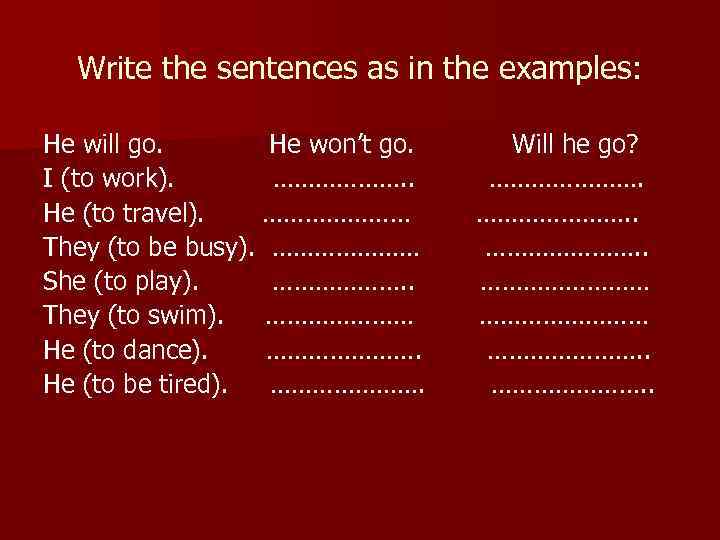 Write the sentences as in the examples: He will go. He won’t go. I (to work). ………………. . He (to travel). ………………… They (to be busy). ………………… She (to play). ………………. . They (to swim). ………………… He (to dance). …………………. He (to be tired). …………………. Will he go? …………………. . ……………………. .
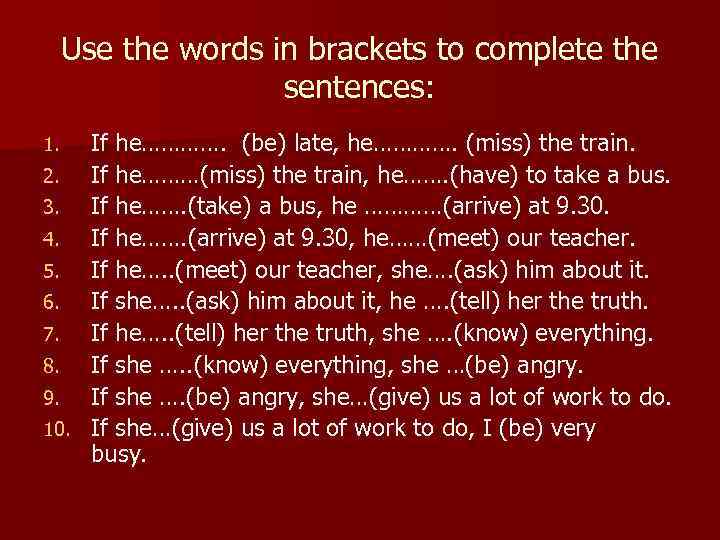 Use the words in brackets to complete the sentences: If he…………. (be) late, he…………. (miss) the train. 2. If he………(miss) the train, he……. (have) to take a bus. 3. If he……. (take) a bus, he …………(arrive) at 9. 30. 4. If he……. (arrive) at 9. 30, he……(meet) our teacher. 5. If he…. . (meet) our teacher, she…. (ask) him about it. 6. If she…. . (ask) him about it, he …. (tell) her the truth. 7. If he…. . (tell) her the truth, she …. (know) everything. 8. If she …. . (know) everything, she …(be) angry. 9. If she …. (be) angry, she…(give) us a lot of work to do. 10. If she…(give) us a lot of work to do, I (be) very busy. 1.
 Past Simple Действие происходило в прошлом, связи с настоящим нет. Ряд последовательных действий в прошлом.
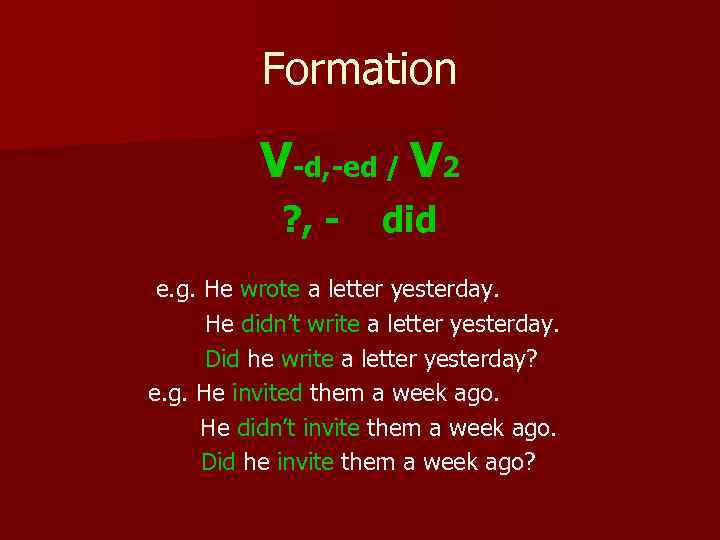 Formation V-d, -ed / V 2 ? , - did e. g. He wrote a letter yesterday. He didn’t write a letter yesterday. Did he write a letter yesterday? e. g. He invited them a week ago. He didn’t invite them a week ago. Did he invite them a week ago?
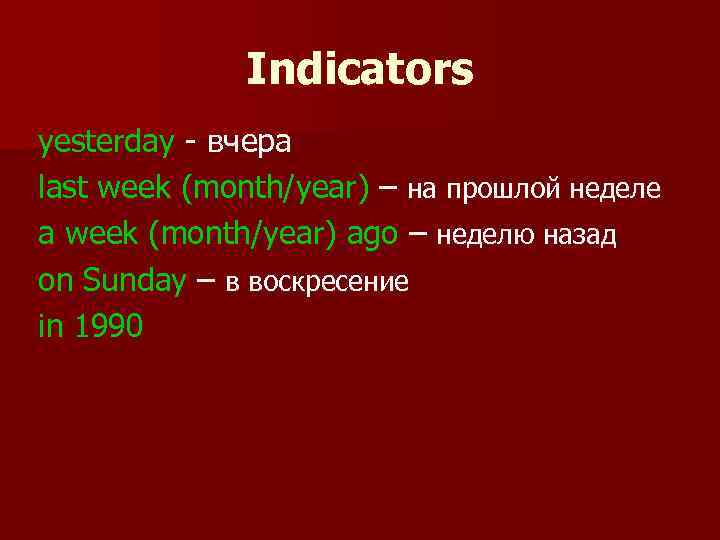 Indicators yesterday - вчера last week (month/year) – на прошлой неделе a week (month/year) ago – неделю назад on Sunday – в воскресение in 1990
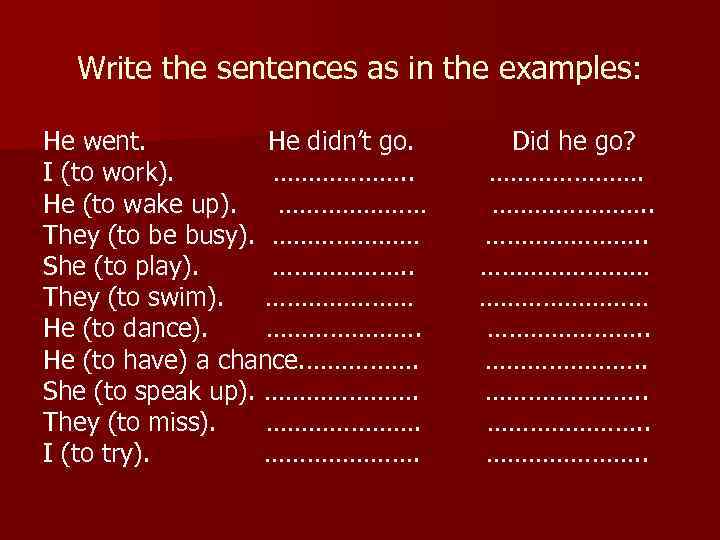 Write the sentences as in the examples: He went. He didn’t go. I (to work). ………………. . He (to wake up). ………………… They (to be busy). ………………… She (to play). ………………. . They (to swim). ………………… He (to dance). …………………. He (to have) a chance. ……………. She (to speak up). …………………. They (to miss). …………………. I (to try). …………………. Did he go? …………………. . ……………………. . …………………. .
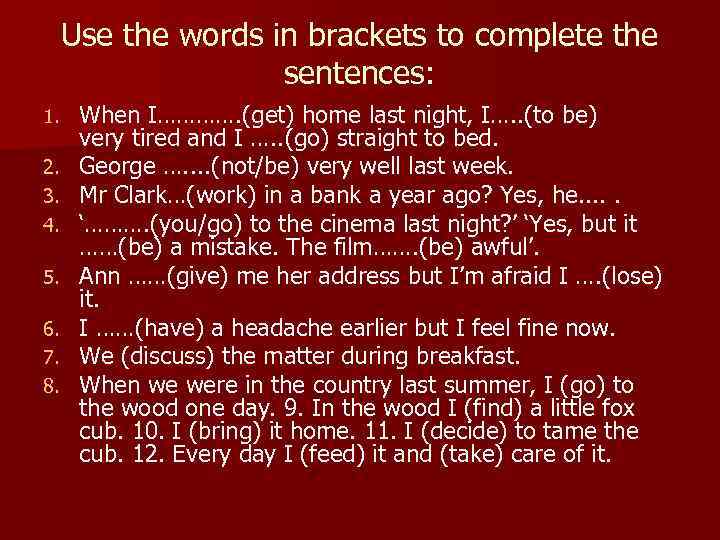 Use the words in brackets to complete the sentences: 1. 2. 3. 4. 5. 6. 7. 8. When I…………. (get) home last night, I…. . (to be) very tired and I …. . (go) straight to bed. George …. . (not/be) very well last week. Mr Clark…(work) in a bank a year ago? Yes, he. . . ‘………. (you/go) to the cinema last night? ’ ‘Yes, but it ……(be) a mistake. The film……. (be) awful’. Ann ……(give) me her address but I’m afraid I …. (lose) it. I ……(have) a headache earlier but I feel fine now. We (discuss) the matter during breakfast. When we were in the country last summer, I (go) to the wood one day. 9. In the wood I (find) a little fox cub. 10. I (bring) it home. 11. I (decide) to tame the cub. 12. Every day I (feed) it and (take) care of it.
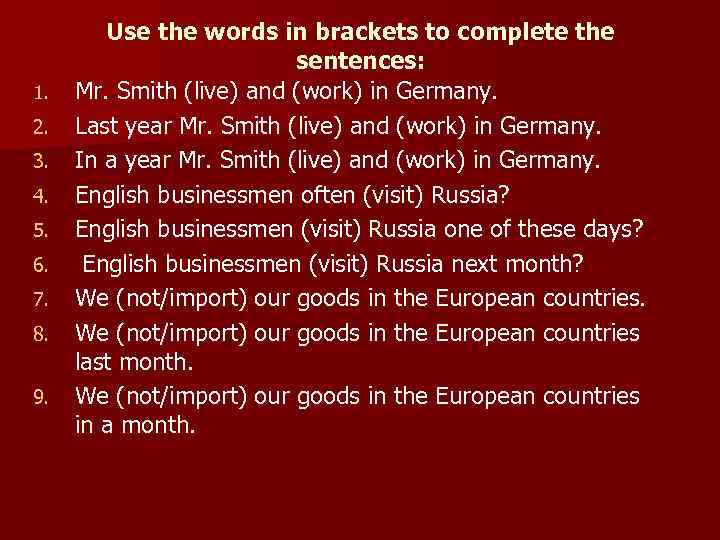 1. 2. 3. 4. 5. 6. 7. 8. 9. Use the words in brackets to complete the sentences: Mr. Smith (live) and (work) in Germany. Last year Mr. Smith (live) and (work) in Germany. In a year Mr. Smith (live) and (work) in Germany. English businessmen often (visit) Russia? English businessmen (visit) Russia one of these days? English businessmen (visit) Russia next month? We (not/import) our goods in the European countries last month. We (not/import) our goods in the European countries in a month.
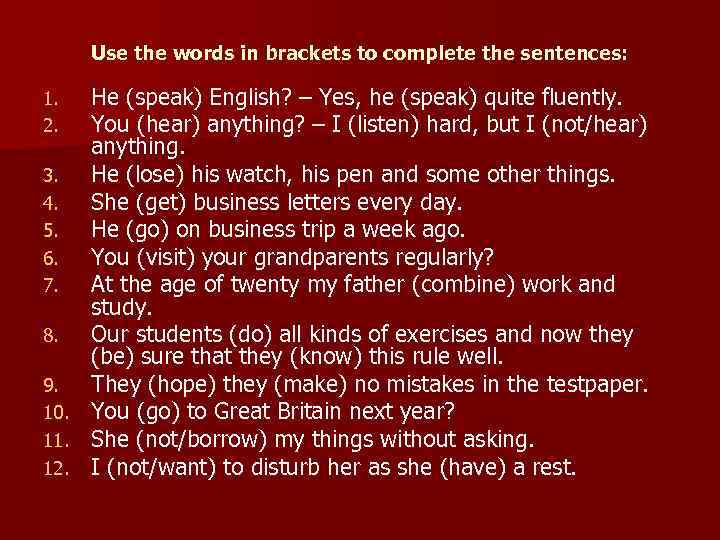 Use the words in brackets to complete the sentences: 1. 2. 3. 4. 5. 6. 7. 8. 9. 10. 11. 12. He (speak) English? – Yes, he (speak) quite fluently. You (hear) anything? – I (listen) hard, but I (not/hear) anything. He (lose) his watch, his pen and some other things. She (get) business letters every day. He (go) on business trip a week ago. You (visit) your grandparents regularly? At the age of twenty my father (combine) work and study. Our students (do) all kinds of exercises and now they (be) sure that they (know) this rule well. They (hope) they (make) no mistakes in the testpaper. You (go) to Great Britain next year? She (not/borrow) my things without asking. I (not/want) to disturb her as she (have) a rest.
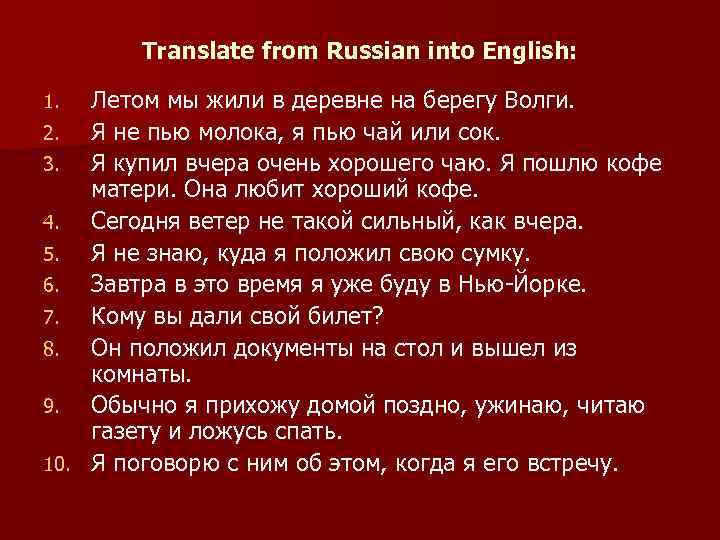 Translate from Russian into English: Летом мы жили в деревне на берегу Волги. 2. Я не пью молока, я пью чай или сок. 3. Я купил вчера очень хорошего чаю. Я пошлю кофе матери. Она любит хороший кофе. 4. Сегодня ветер не такой сильный, как вчера. 5. Я не знаю, куда я положил свою сумку. 6. Завтра в это время я уже буду в Нью-Йорке. 7. Кому вы дали свой билет? 8. Он положил документы на стол и вышел из комнаты. 9. Обычно я прихожу домой поздно, ужинаю, читаю газету и ложусь спать. 10. Я поговорю с ним об этом, когда я его встречу. 1.