


 Скачать презентацию Silver Halide Ag X Imaging Science Fundamentals Chester
5b0cf609d447aa4e55855997d9664a22.ppt
- Количество слайдов: 19
 Silver Halide (Ag. X) Imaging Science Fundamentals Chester F. Carlson Center for Imaging Science
 What is “Silver Halide”? u Silver Halide is a compound made of silver (Ag) atoms and atoms from the halide group (Cl, Br, I) of the periodic table. u The material property of a silver halide crystal changes after absorbing photons. Imaging Science Fundamentals Chester F. Carlson Center for Imaging Science
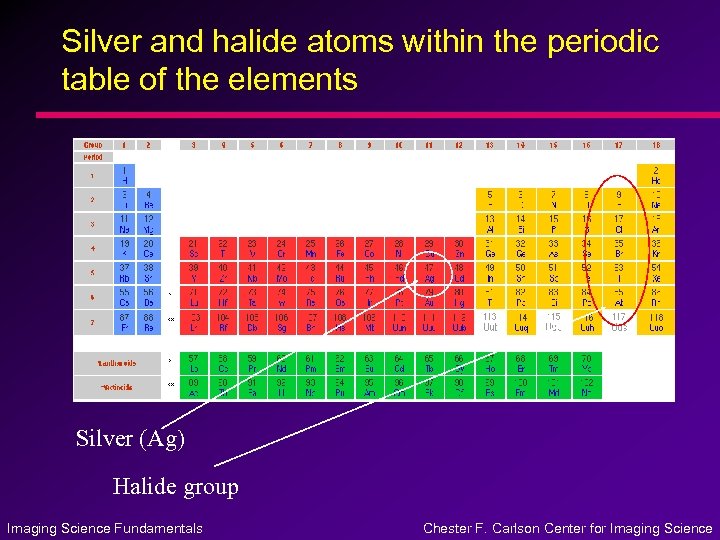 Silver and halide atoms within the periodic table of the elements Silver (Ag) Halide group Imaging Science Fundamentals Chester F. Carlson Center for Imaging Science
 Origins of Modern Photography u Silver halide was first used as an imaging material in the 1830’s by W. H. Fox Talbot, J. N. Niepce, and J. M. Daguerre. u Today’s black and white film derives from Talbot’s negative-positive process. Imaging Science Fundamentals Chester F. Carlson Center for Imaging Science
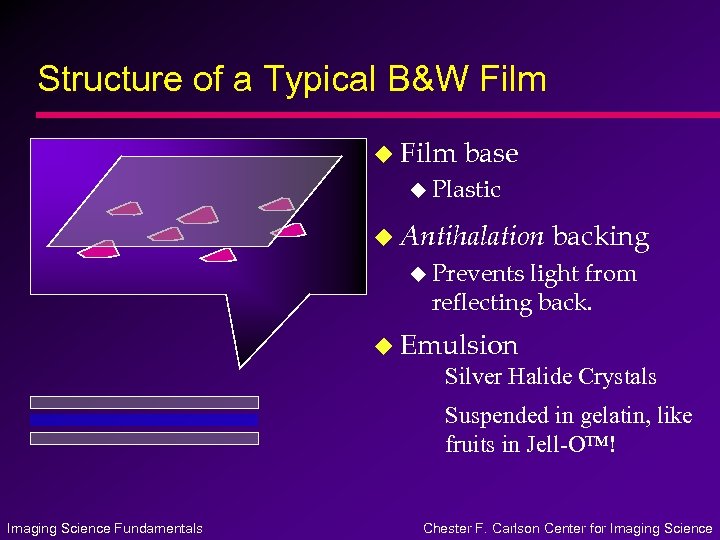 Structure of a Typical B&W Film u Film base u Plastic u Antihalation backing u Prevents light from reflecting back. u Emulsion Silver Halide Crystals Suspended in gelatin, like fruits in Jell-O™! Imaging Science Fundamentals Chester F. Carlson Center for Imaging Science
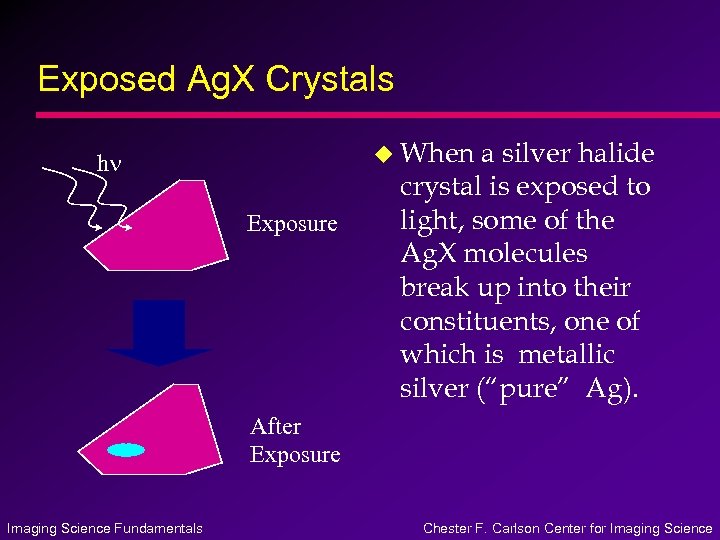 Exposed Ag. X Crystals u When hn Exposure a silver halide crystal is exposed to light, some of the Ag. X molecules break up into their constituents, one of which is metallic silver (“pure” Ag). After Exposure Imaging Science Fundamentals Chester F. Carlson Center for Imaging Science
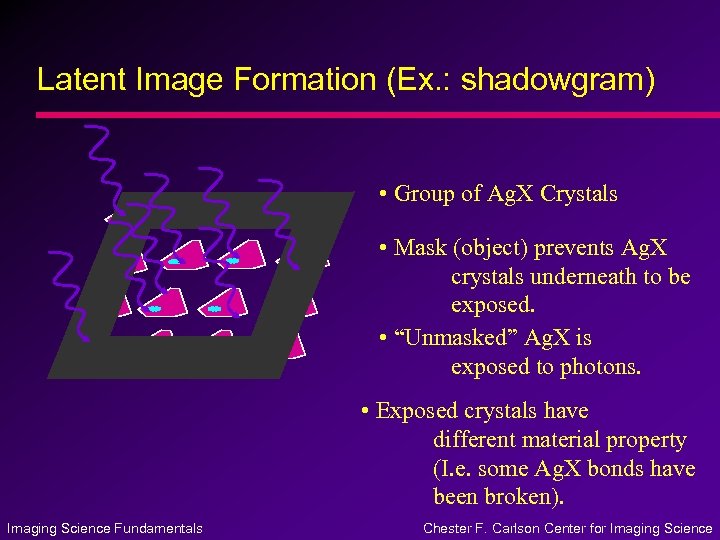 Latent Image Formation (Ex. : shadowgram) • Group of Ag. X Crystals • Mask (object) prevents Ag. X crystals underneath to be exposed. • “Unmasked” Ag. X is exposed to photons. • Exposed crystals have different material property (I. e. some Ag. X bonds have been broken). Imaging Science Fundamentals Chester F. Carlson Center for Imaging Science
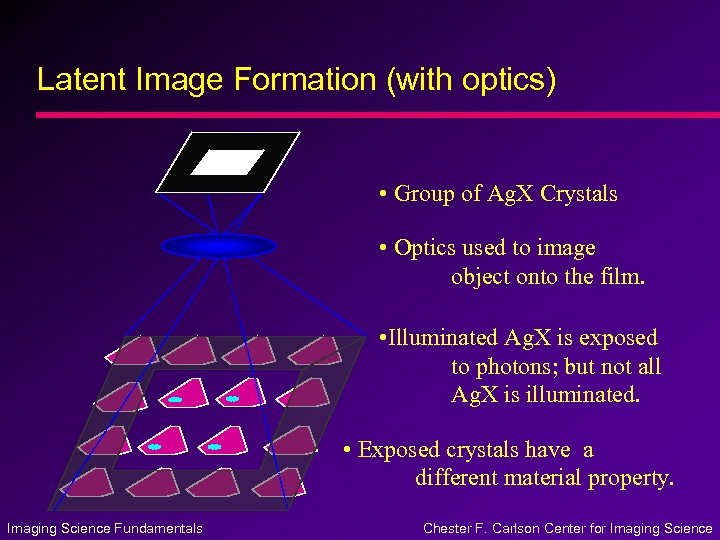 Latent Image Formation (with optics) • Group of Ag. X Crystals • Optics used to image object onto the film. • Illuminated Ag. X is exposed to photons; but not all Ag. X is illuminated. • Exposed crystals have a different material property. Imaging Science Fundamentals Chester F. Carlson Center for Imaging Science
 Processing Photographic Film u Turns latent image into visible image. u Basic steps: u Developer u Stop bath u Fix bath u All chemicals used in the process are in liquid form. Imaging Science Fundamentals Chester F. Carlson Center for Imaging Science
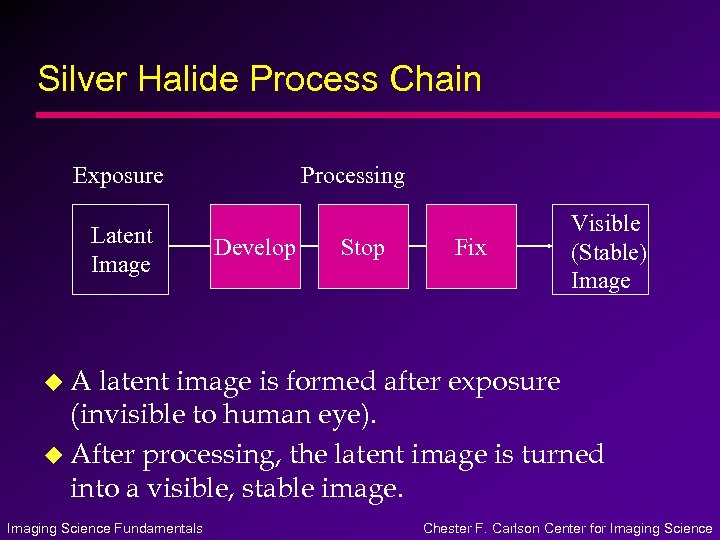 Silver Halide Process Chain Exposure Latent Image Processing Develop Stop Fix Visible (Stable) Image u. A latent image is formed after exposure (invisible to human eye). u After processing, the latent image is turned into a visible, stable image. Imaging Science Fundamentals Chester F. Carlson Center for Imaging Science
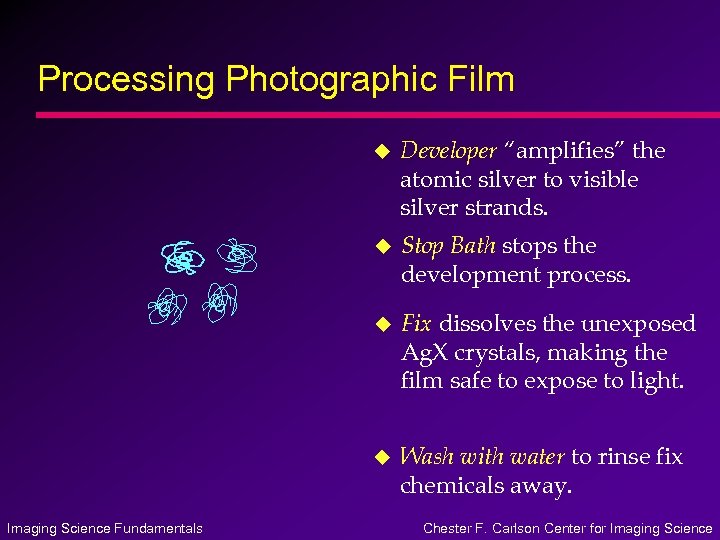 Processing Photographic Film u u Stop Bath stops the development process. u Fix dissolves the unexposed Ag. X crystals, making the film safe to expose to light. u Imaging Science Fundamentals Developer “amplifies” the atomic silver to visible silver strands. Wash with water to rinse fix chemicals away. Chester F. Carlson Center for Imaging Science
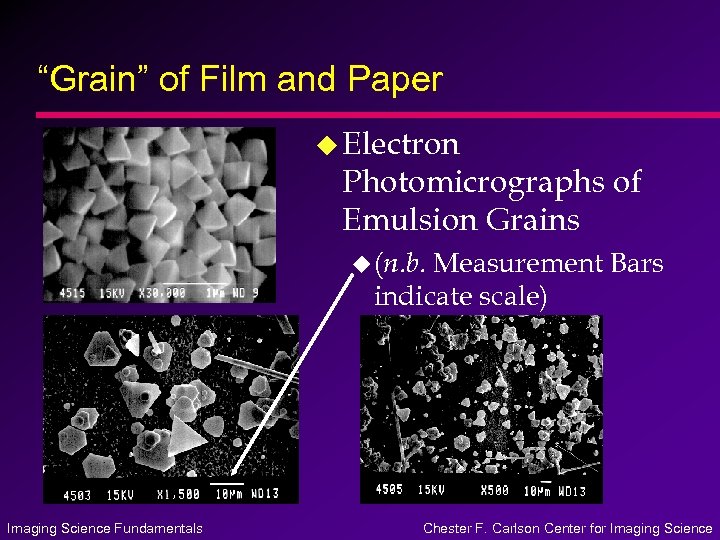 “Grain” of Film and Paper u Electron Photomicrographs of Emulsion Grains u (n. b. Measurement Bars indicate scale) Imaging Science Fundamentals Chester F. Carlson Center for Imaging Science
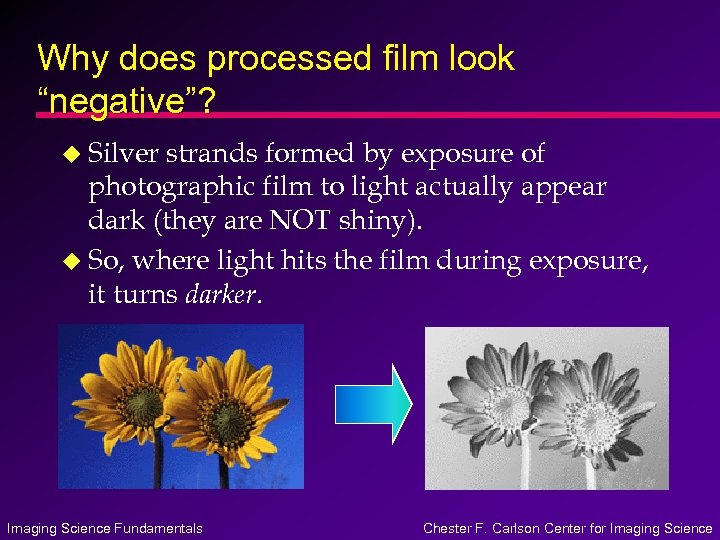 Why does processed film look “negative”? u Silver strands formed by exposure of photographic film to light actually appear dark (they are NOT shiny). u So, where light hits the film during exposure, it turns darker. Imaging Science Fundamentals Chester F. Carlson Center for Imaging Science
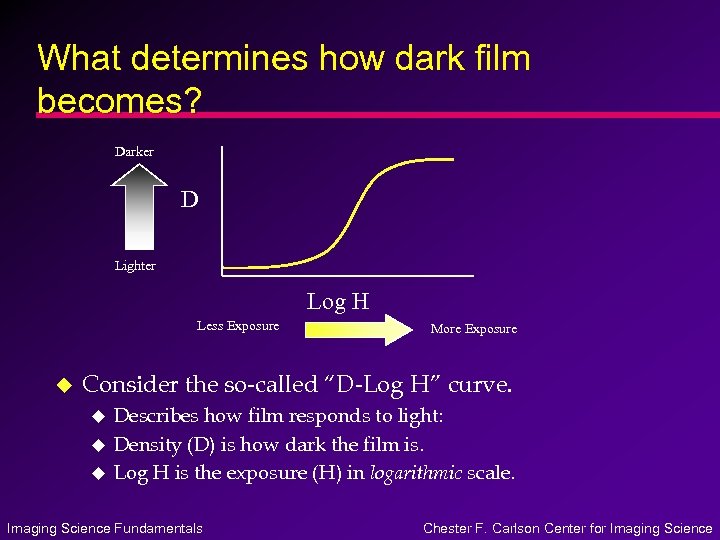 What determines how dark film becomes? Darker D Lighter Log H Less Exposure u More Exposure Consider the so-called “D-Log H” curve. u u u Describes how film responds to light: Density (D) is how dark the film is. Log H is the exposure (H) in logarithmic scale. Imaging Science Fundamentals Chester F. Carlson Center for Imaging Science
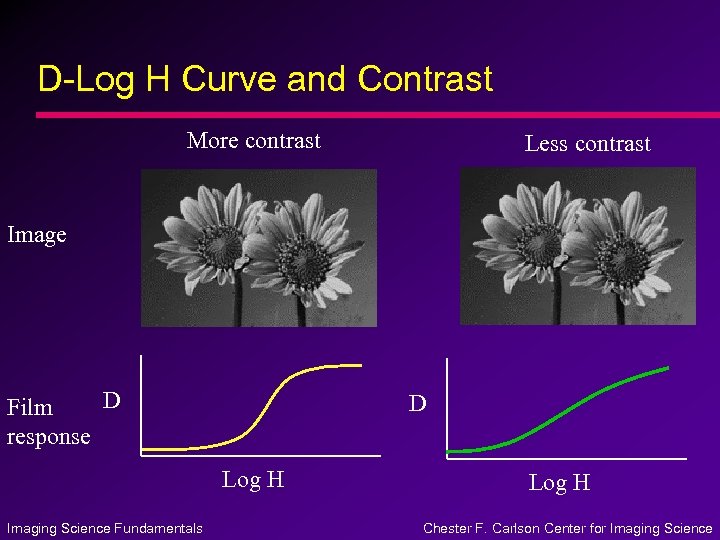 D-Log H Curve and Contrast More contrast Less contrast Image D Film response D Log H Imaging Science Fundamentals Log H Chester F. Carlson Center for Imaging Science
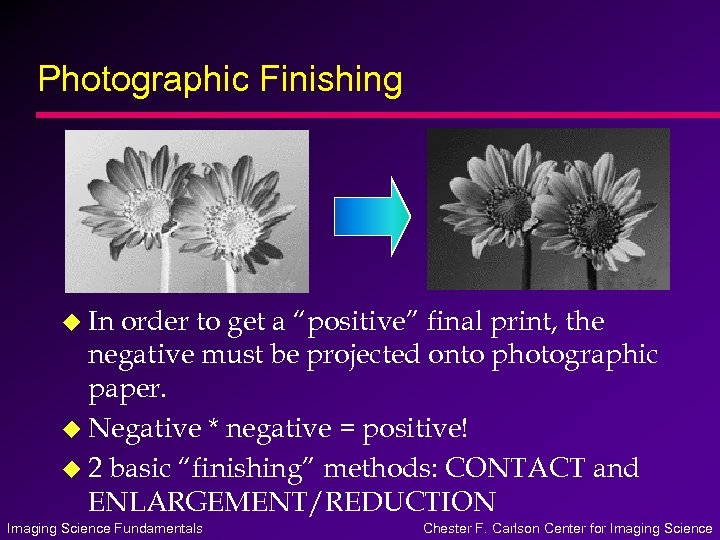 Photographic Finishing u In order to get a “positive” final print, the negative must be projected onto photographic paper. u Negative * negative = positive! u 2 basic “finishing” methods: CONTACT and ENLARGEMENT/REDUCTION Imaging Science Fundamentals Chester F. Carlson Center for Imaging Science
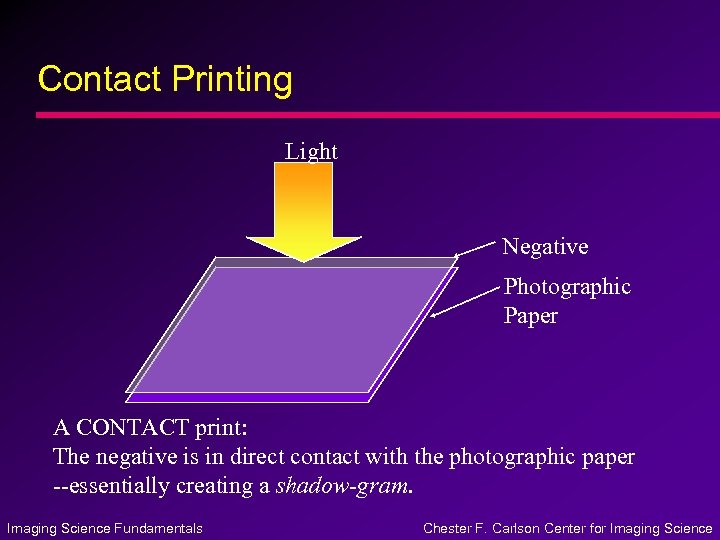 Contact Printing Light Negative Photographic Paper A CONTACT print: The negative is in direct contact with the photographic paper --essentially creating a shadow-gram. Imaging Science Fundamentals Chester F. Carlson Center for Imaging Science
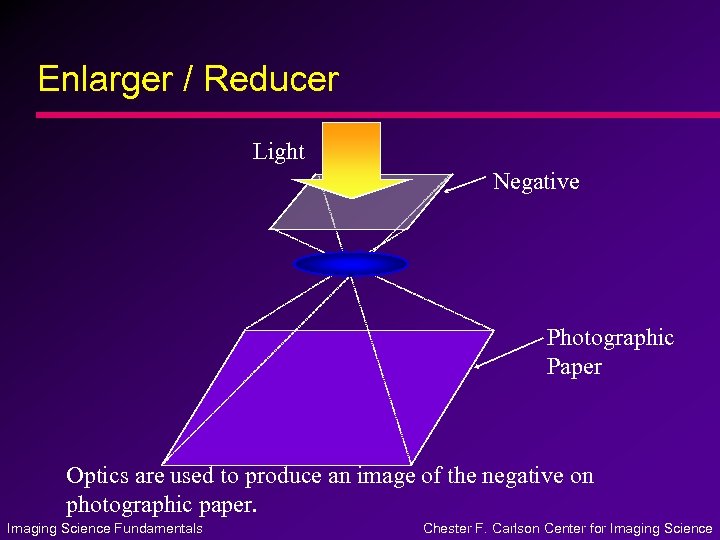 Enlarger / Reducer Light Negative Photographic Paper Optics are used to produce an image of the negative on photographic paper. Imaging Science Fundamentals Chester F. Carlson Center for Imaging Science
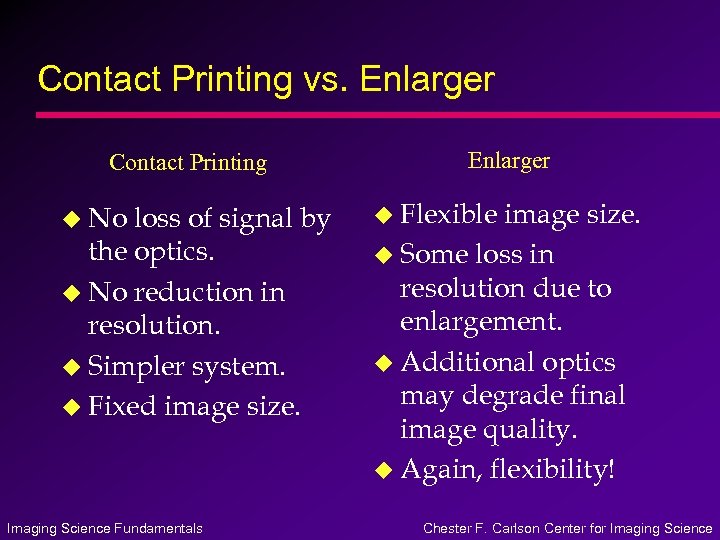 Contact Printing vs. Enlarger Contact Printing u No loss of signal by the optics. u No reduction in resolution. u Simpler system. u Fixed image size. Imaging Science Fundamentals Enlarger u Flexible image size. u Some loss in resolution due to enlargement. u Additional optics may degrade final image quality. u Again, flexibility! Chester F. Carlson Center for Imaging Science