


 Скачать презентацию Silk arterial reconstruction for intracranial aneurysms Multicentric french
4c5b88e37f7bb902e2dd4e120466474c.ppt
- Количество слайдов: 13
 Silk arterial reconstruction for intracranial aneurysms. Multicentric french study on 51 consecutive patients. Jérôme Berge, Alain Bonafé, Hervé Brunel, Emmanuel Chabert, Jean Gabrillargues, Kristof Kadziolka, Xavier Barreau, Laurent Pierrot, Vincent Dousset. Neuroradiology Departments: Bordeaux, Montpellier, Marseille, Clermont-Ferrand, Reims, France
 Aims • Clarify indications for new flow diverters – Regarding the aneurysm location – Regarding aneurysm size – Without any scientific litterature in 2009 ! • Evaluate morbi-mortality of Silk stent on a retrospective multicentric group. • Evaluate angiographic occlusion rate in post-procedure and at 6 months.
 How can we justify to take risk on a non ruptured aneurysm ? • 3 criteria to take into account: – Patient age • Life expectancy • endovascular acces faisability – aneurysm symptomatic or not ? • Seizures • Nerve palsy or compressive syndrom – Rupture rate associated with aneurysm • Risk factors – Regrowth of a previous treated aneurysm – Smoker, elevated blood pressure, history of SAH, • size and localisation of aneurysm
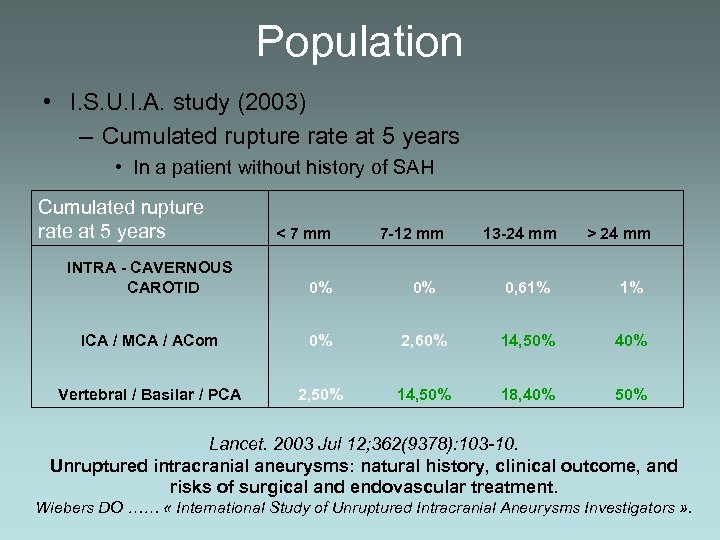 Population • I. S. U. I. A. study (2003) – Cumulated rupture rate at 5 years • In a patient without history of SAH Cumulated rupture rate at 5 years < 7 mm 7 -12 mm 13 -24 mm > 24 mm INTRA - CAVERNOUS CAROTID 0% 0% 0, 61% 1% ICA / MCA / ACom 0% 2, 60% 14, 50% 40% Vertebral / Basilar / PCA 2, 50% 14, 50% 18, 40% 50% Lancet. 2003 Jul 12; 362(9378): 103 -10. Unruptured intracranial aneurysms: natural history, clinical outcome, and risks of surgical and endovascular treatment. Wiebers DO …… « International Study of Unruptured Intracranial Aneurysms Investigators » .
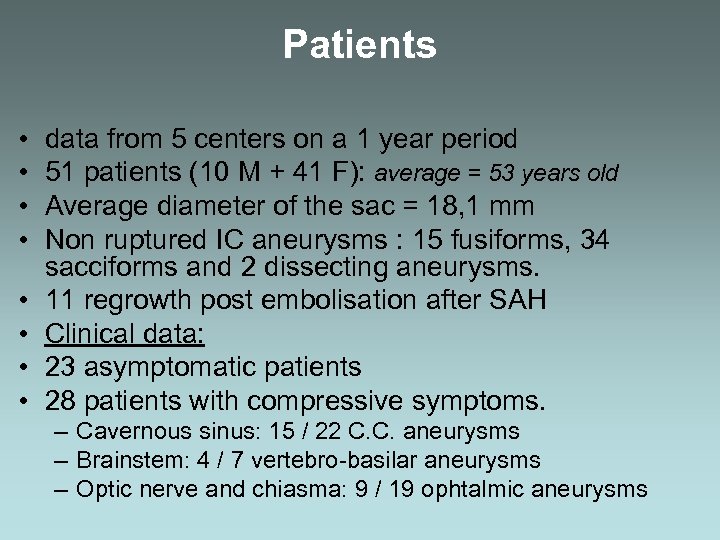 Patients • • data from 5 centers on a 1 year period 51 patients (10 M + 41 F): average = 53 years old Average diameter of the sac = 18, 1 mm Non ruptured IC aneurysms : 15 fusiforms, 34 sacciforms and 2 dissecting aneurysms. 11 regrowth post embolisation after SAH Clinical data: 23 asymptomatic patients 28 patients with compressive symptoms. – Cavernous sinus: 15 / 22 C. C. aneurysms – Brainstem: 4 / 7 vertebro-basilar aneurysms – Optic nerve and chiasma: 9 / 19 ophtalmic aneurysms
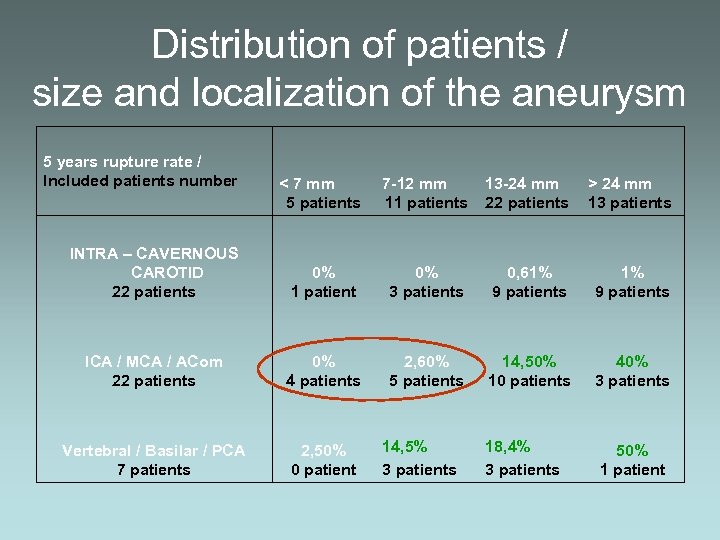 Distribution of patients / size and localization of the aneurysm 5 years rupture rate / Included patients number < 7 mm 5 patients 7 -12 mm 11 patients 13 -24 mm 22 patients > 24 mm 13 patients INTRA – CAVERNOUS CAROTID 22 patients 0% 1 patient 0% 3 patients 0, 61% 9 patients ICA / MCA / ACom 22 patients 0% 4 patients 2, 60% 5 patients 14, 50% 10 patients 40% 3 patients Vertebral / Basilar / PCA 7 patients 2, 50% 0 patient 18, 4% 3 patients 50% 1 patient 14, 5% 3 patients
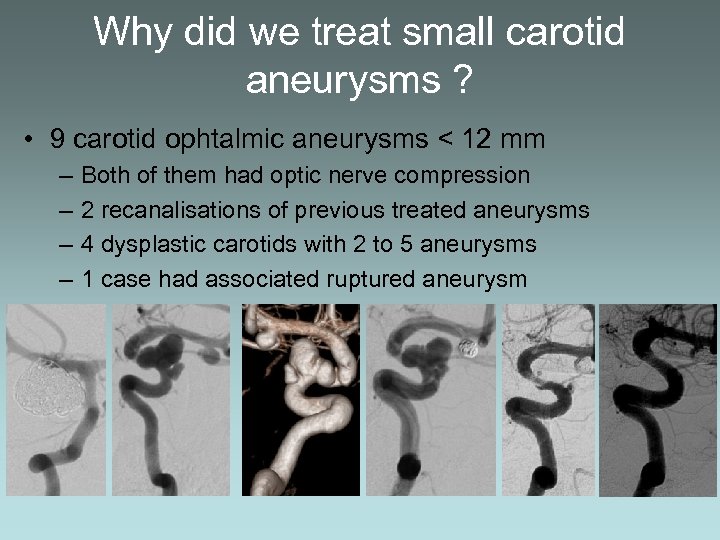 Why did we treat small carotid aneurysms ? • 9 carotid ophtalmic aneurysms < 12 mm – – Both of them had optic nerve compression 2 recanalisations of previous treated aneurysms 4 dysplastic carotids with 2 to 5 aneurysms 1 case had associated ruptured aneurysm
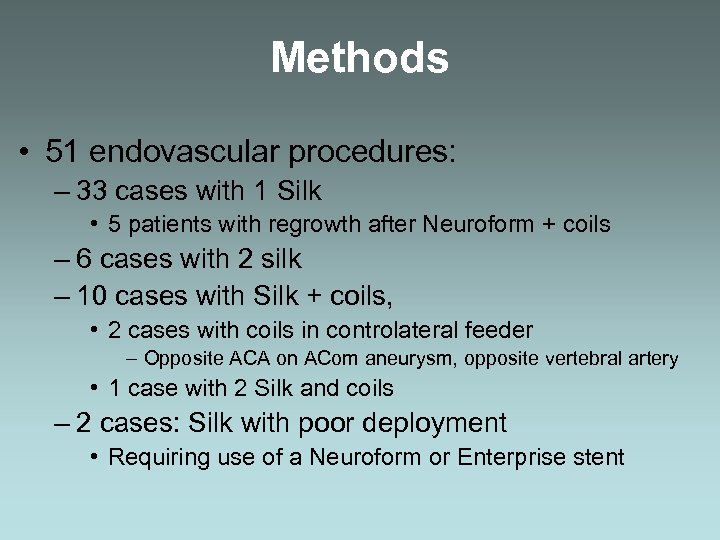 Methods • 51 endovascular procedures: – 33 cases with 1 Silk • 5 patients with regrowth after Neuroform + coils – 6 cases with 2 silk – 10 cases with Silk + coils, • 2 cases with coils in controlateral feeder – Opposite ACA on ACom aneurysm, opposite vertebral artery • 1 case with 2 Silk and coils – 2 cases: Silk with poor deployment • Requiring use of a Neuroform or Enterprise stent
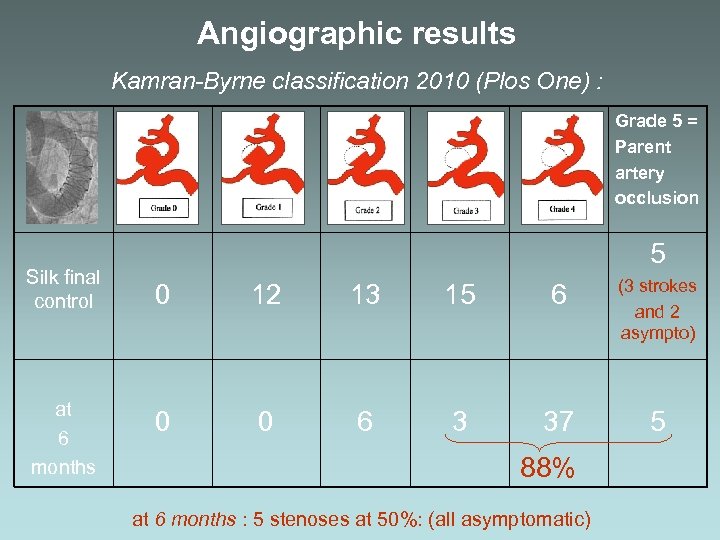 Angiographic results Kamran-Byrne classification 2010 (Plos One) : Grade 5 = Parent artery occlusion Silk final control at 6 months 5 0 12 13 15 6 (3 strokes and 2 asympto) 0 0 6 3 37 5 88% at 6 months : 5 stenoses at 50%: (all asymptomatic)
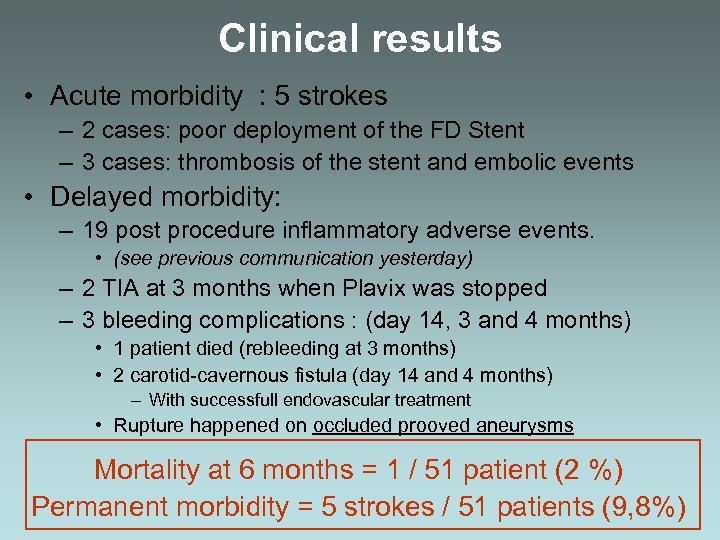 Clinical results • Acute morbidity : 5 strokes – 2 cases: poor deployment of the FD Stent – 3 cases: thrombosis of the stent and embolic events • Delayed morbidity: – 19 post procedure inflammatory adverse events. • (see previous communication yesterday) – 2 TIA at 3 months when Plavix was stopped – 3 bleeding complications : (day 14, 3 and 4 months) • 1 patient died (rebleeding at 3 months) • 2 carotid-cavernous fistula (day 14 and 4 months) – With successfull endovascular treatment • Rupture happened on occluded prooved aneurysms Mortality at 6 months = 1 / 51 patient (2 %) Permanent morbidity = 5 strokes / 51 patients (9, 8%)
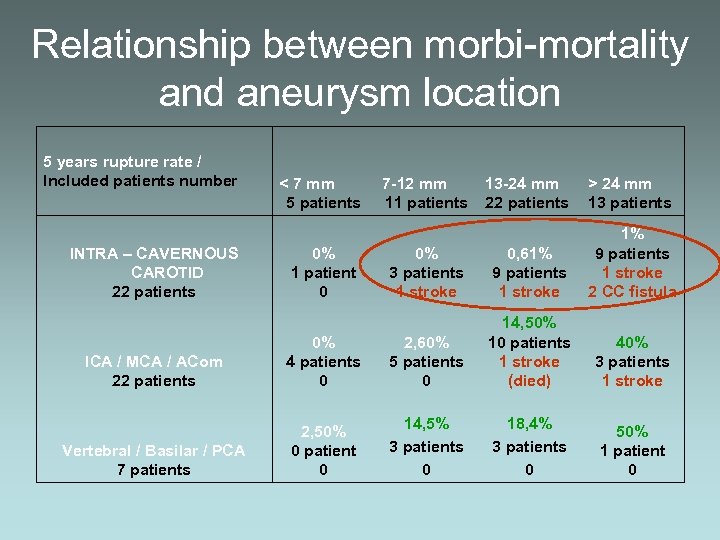 Relationship between morbi-mortality and aneurysm location 5 years rupture rate / Included patients number 13 -24 mm 22 patients > 24 mm 13 patients 0% 3 patients 1 stroke 0, 61% 9 patients 1 stroke 2 CC fistula ICA / MCA / ACom 22 patients 0% 4 patients 0 2, 60% 5 patients 0 14, 50% 10 patients 1 stroke (died) 40% 3 patients 1 stroke Vertebral / Basilar / PCA 7 patients 2, 50% 0 patient 0 14, 5% 3 patients 0 18, 4% 3 patients 0 50% 1 patient 0 INTRA – CAVERNOUS CAROTID 22 patients < 7 mm 5 patients 0% 1 patient 0 7 -12 mm 11 patients
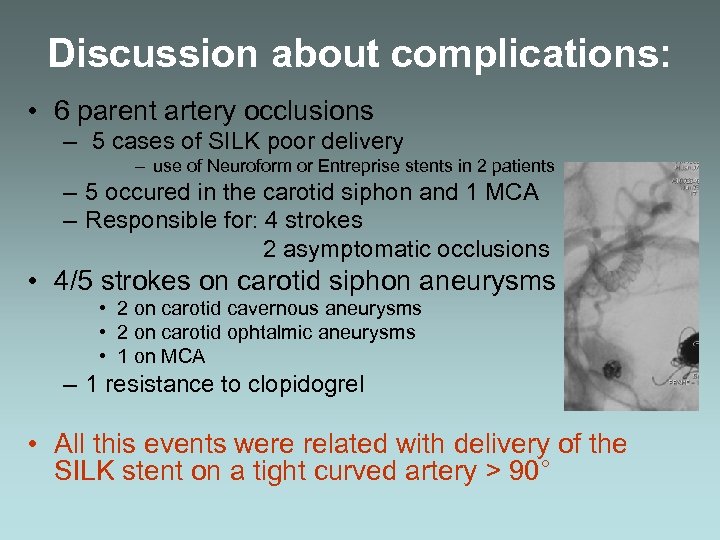 Discussion about complications: • 6 parent artery occlusions – 5 cases of SILK poor delivery – use of Neuroform or Entreprise stents in 2 patients – 5 occured in the carotid siphon and 1 MCA – Responsible for: 4 strokes 2 asymptomatic occlusions • 4/5 strokes on carotid siphon aneurysms • 2 on carotid cavernous aneurysms • 2 on carotid ophtalmic aneurysms • 1 on MCA – 1 resistance to clopidogrel • All this events were related with delivery of the SILK stent on a tight curved artery > 90°
 Conclusion • Flow diversion is a promising technique for the treatment of giant or broad neck or fusiform aneurysms. • Acute stroke is the main risk: – Related to poor deployment in curved arteries – Or resistance to antiplatelet treatment. • Transient compressive syndrom and delayed bleeding risk remain ununderstood challenges.