


 Скачать презентацию Silicon Pad Detectors for tracking and particle identification
65a80b8a66622ce6b3a746a03ae6e26b.ppt
- Количество слайдов: 46
 Silicon Pad Detectors for tracking and particle identification in heavy ion collisions Heinz Pernegger for the Phobos collaboration Massachusetts Institute of Technology March 31, 2000 June 18, 1997 Bolek Wyslouch Page
 Outline l Brief introduction of the PHOBOS experiment at RHIC Layout of silicon pad detectors l Measurement signal pad detectors l » » l Wafer parameters signal response in beam tests and lab measurements Measurement of energy loss in silicon pad detectors » » » Measurement of energy loss for low and high momentum Comparison to simulation Test of particle identification capabilities Heinz Pernegger March 2000 2
 The PHOBOS Collaboration A “small” experiment with 72 collaborators from: Argonne National Laboratory Brookhaven National Laboratory Institute of Nuclear Physics Krakow Jagiellonian University Krakow Massachusetts Institute of Technology National Central University, Taiwan University of Rochester University of Illinois Chicago University of Maryland Heinz Pernegger March 2000 3
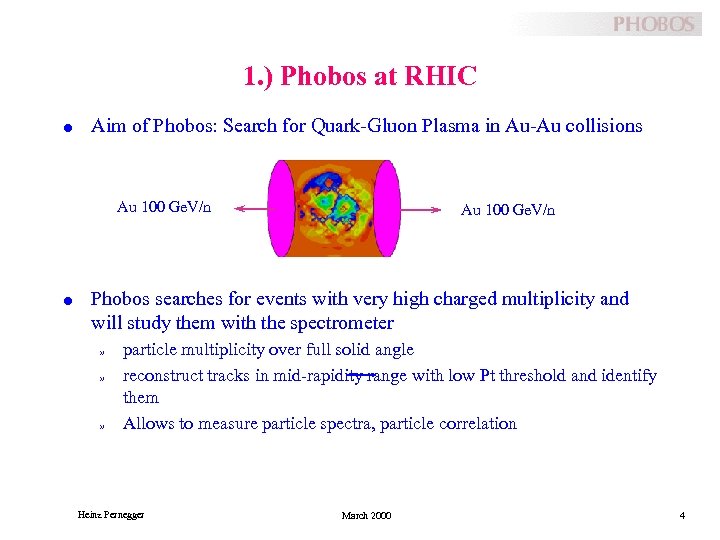 1. ) Phobos at RHIC l Aim of Phobos: Search for Quark-Gluon Plasma in Au-Au collisions Au 100 Ge. V/n l Au 100 Ge. V/n Phobos searches for events with very high charged multiplicity and will study them with the spectrometer » » » particle multiplicity over full solid angle reconstruct tracks in mid-rapidity range with low Pt threshold and identify them Allows to measure particle spectra, particle correlation Heinz Pernegger March 2000 4
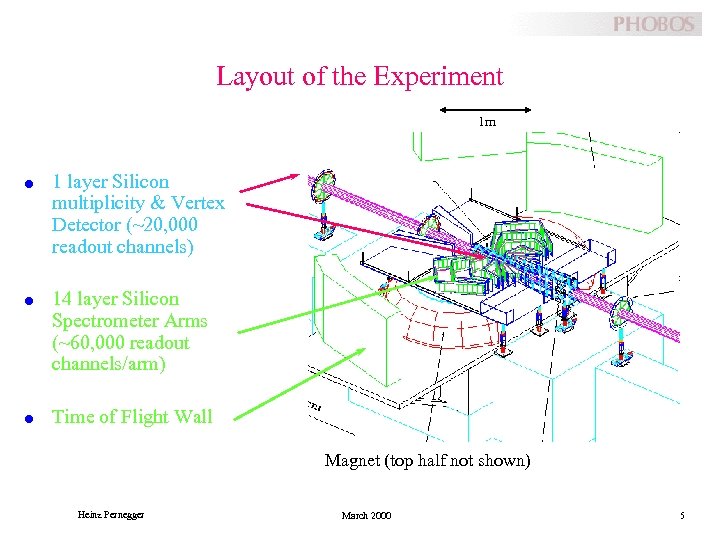 Layout of the Experiment 1 m l l l 1 layer Silicon multiplicity & Vertex Detector (~20, 000 readout channels) 14 layer Silicon Spectrometer Arms (~60, 000 readout channels/arm) Time of Flight Wall Magnet (top half not shown) Heinz Pernegger March 2000 5
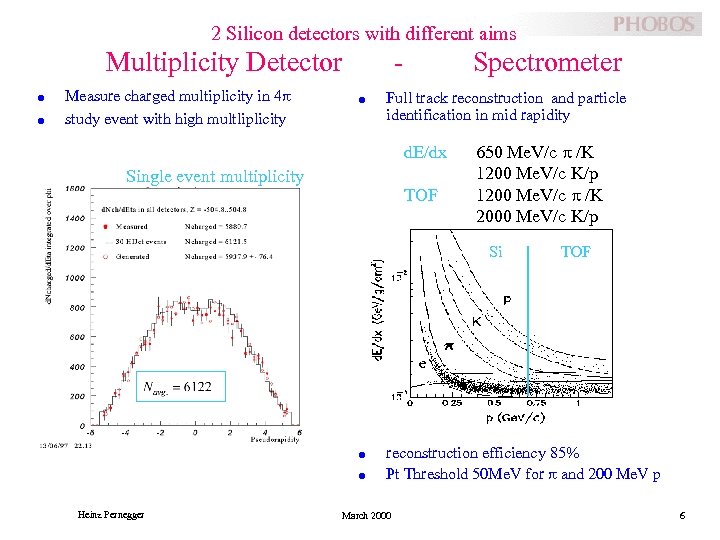 2 Silicon detectors with different aims Multiplicity Detector l l Measure charged multiplicity in 4 p study event with high multliplicity l Spectrometer Full track reconstruction and particle identification in mid rapidity d. E/dx Single event multiplicity TOF 650 Me. V/c p /K 1200 Me. V/c K/p 1200 Me. V/c p /K 2000 Me. V/c K/p Si l l Heinz Pernegger TOF reconstruction efficiency 85% Pt Threshold 50 Me. V for p and 200 Me. V p March 2000 6
 What do our silicon detectors do l The octagon and ring multiplicity detector: » » l The vertex detector: » » l 1 large layer of silicon around the beam pipe Measuring total multiplicity for charged particles expect very high occupancy (90 -100% ? ) cover pseudorapidity of -5. 5 to + 5. 5 and full phi coverage Determining the interaction point with an accuracy of 50 um in a range of +/ - 10 cm around the nominal interaction point uses 2 layers of silicon on each side of the interaction region The Spectrometer » » does 3 d-tracking of charged particles (for about 1% of full solid angle) operates inside a 2 T magnetic field uses 14 layers of highly segmented silicon detector for tracking uses the silicon signal for particle identification for pions, kaons and protons Heinz Pernegger March 2000 7
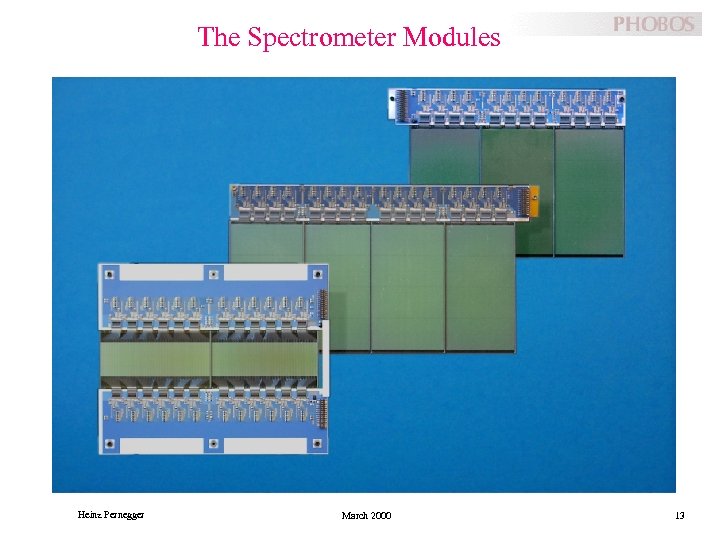
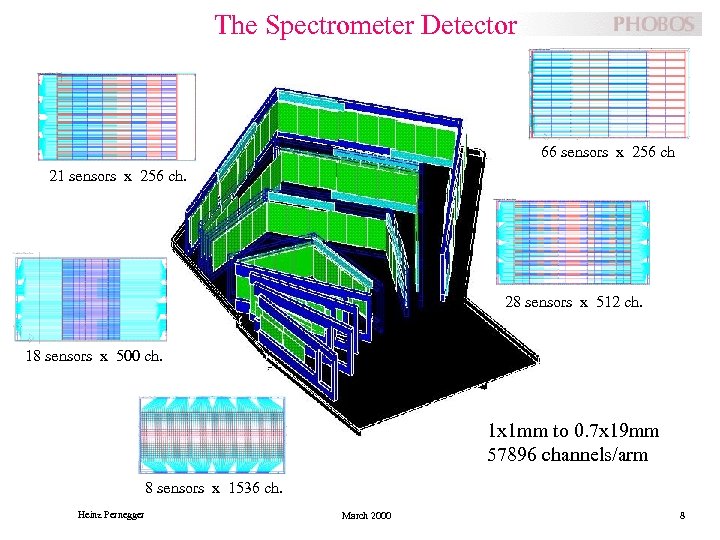 The Spectrometer Detector 66 sensors x 256 ch 21 sensors x 256 ch. 28 sensors x 512 ch. 18 sensors x 500 ch. 1 x 1 mm to 0. 7 x 19 mm 57896 channels/arm 8 sensors x 1536 ch. Heinz Pernegger March 2000 8
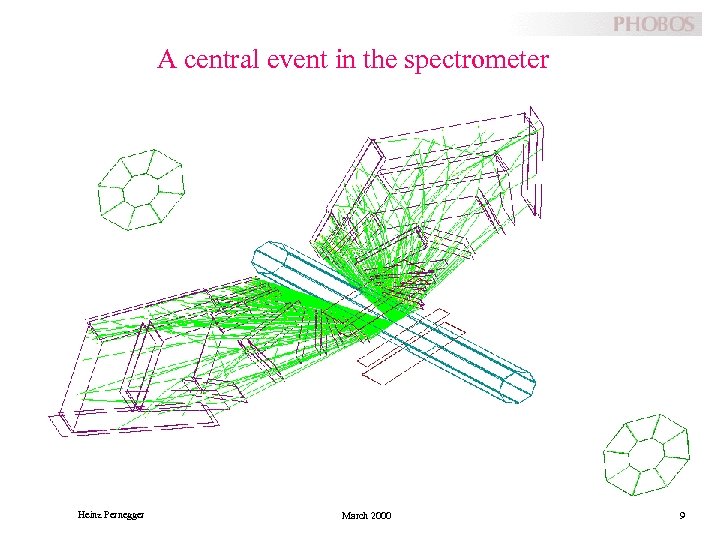 A central event in the spectrometer Heinz Pernegger March 2000 9
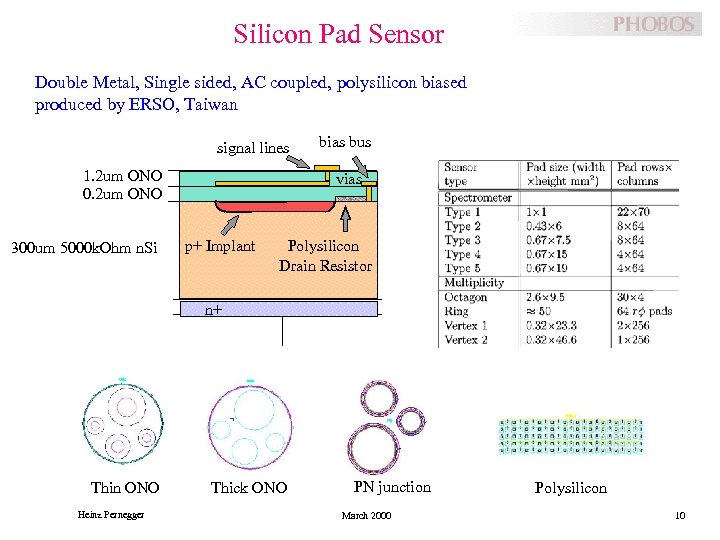 Silicon Pad Sensor Double Metal, Single sided, AC coupled, polysilicon biased produced by ERSO, Taiwan signal lines 1. 2 um ONO 0. 2 um ONO 300 um 5000 k. Ohm n. Si bias bus vias p+ Implant Polysilicon Drain Resistor n+ Thin ONO Heinz Pernegger Thick ONO PN junction March 2000 Polysilicon 10
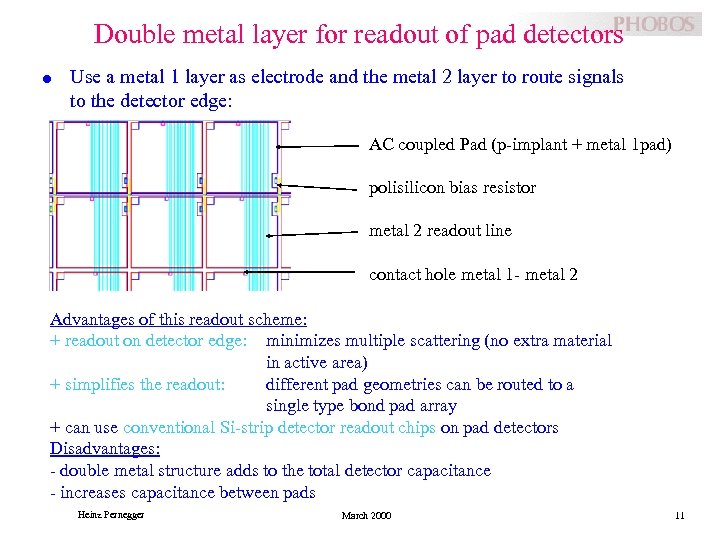 Double metal layer for readout of pad detectors l Use a metal 1 layer as electrode and the metal 2 layer to route signals to the detector edge: AC coupled Pad (p-implant + metal 1 pad) polisilicon bias resistor metal 2 readout line contact hole metal 1 - metal 2 Advantages of this readout scheme: + readout on detector edge: minimizes multiple scattering (no extra material in active area) + simplifies the readout: different pad geometries can be routed to a single type bond pad array + can use conventional Si-strip detector readout chips on pad detectors Disadvantages: - double metal structure adds to the total detector capacitance - increases capacitance between pads Heinz Pernegger March 2000 11
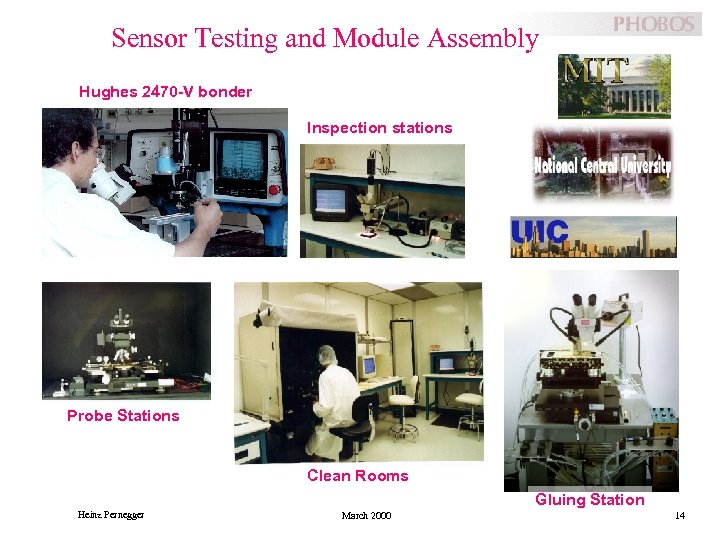
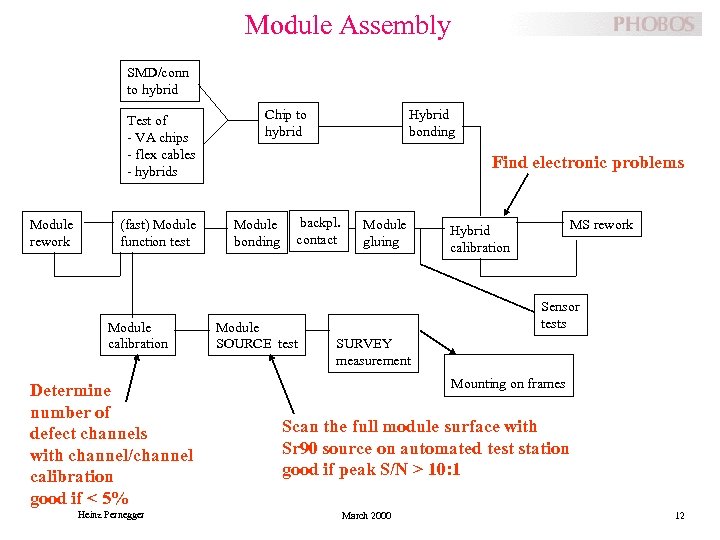 Module Assembly SMD/conn to hybrid Test of - VA chips - flex cables - hybrids Module rework (fast) Module function test Module calibration Determine number of defect channels with channel/channel calibration good if < 5% Heinz Pernegger Chip to hybrid Hybrid bonding Find electronic problems Module bonding backpl. contact Module SOURCE test Module gluing MS rework Hybrid calibration Sensor tests SURVEY measurement Mounting on frames Scan the full module surface with Sr 90 source on automated test station good if peak S/N > 10: 1 March 2000 12
 The Spectrometer Modules Heinz Pernegger March 2000 13
 Sensor Testing and Module Assembly Hughes 2470 -V bonder Inspection stations Probe Stations Clean Rooms Gluing Station Heinz Pernegger March 2000 14
 Test results of detector properties l Statistics on Silicon parameters l Tests on finished modules » » » signal uniformity for different sensor geometries cross-talk between pads noise for different geometries l Overall module performance l Readout electronics » » » VA-HDR 1 chips in 64 and 128 channel versions “Viking” type electronics produced by IDE AS, Norway consists of preamp , RC-CR shaper, track-hold stage + multiplexed analog output peaking time 1. 0 ms high dynamic range > 100 MIP input signals Heinz Pernegger March 2000 15
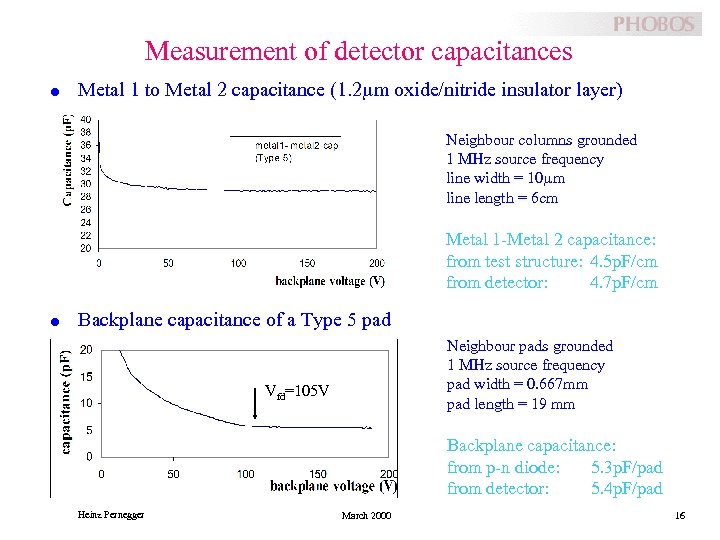 Measurement of detector capacitances l Metal 1 to Metal 2 capacitance (1. 2 mm oxide/nitride insulator layer) Neighbour columns grounded 1 MHz source frequency line width = 10 mm line length = 6 cm Metal 1 -Metal 2 capacitance: from test structure: 4. 5 p. F/cm from detector: 4. 7 p. F/cm l Backplane capacitance of a Type 5 pad Neighbour pads grounded 1 MHz source frequency pad width = 0. 667 mm pad length = 19 mm Vfd=105 V Backplane capacitance: from p-n diode: 5. 3 p. F/pad from detector: 5. 4 p. F/pad Heinz Pernegger March 2000 16
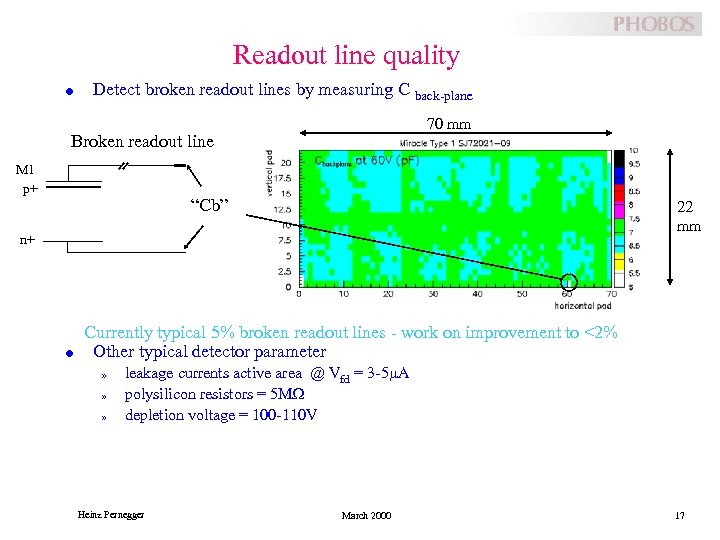 Readout line quality l Detect broken readout lines by measuring C back-plane 70 mm Broken readout line M 1 p+ “Cb” 22 mm n+ l Currently typical 5% broken readout lines - work on improvement to <2% Other typical detector parameter » » » leakage currents active area @ Vfd = 3 -5 m. A polysilicon resistors = 5 MW depletion voltage = 100 -110 V Heinz Pernegger March 2000 17
![Sensor parameters Full Depletion Voltage [V] Poly. Silicon Resistance [Mohm] Heinz Pernegger Leakage Current](https://present5.com/presentation/65a80b8a66622ce6b3a746a03ae6e26b/image-18.jpg "Sensor parameters Full Depletion Voltage [V] Poly. Silicon Resistance [Mohm] Heinz Pernegger Leakage Current") Sensor parameters Full Depletion Voltage [V] Poly. Silicon Resistance [Mohm] Heinz Pernegger Leakage Current [u. A] March 2000 Operational Range [V] 18
Sensor parameters Full Depletion Voltage [V] Poly. Silicon Resistance [Mohm] Heinz Pernegger Leakage Current [u. A] March 2000 Operational Range [V] 18
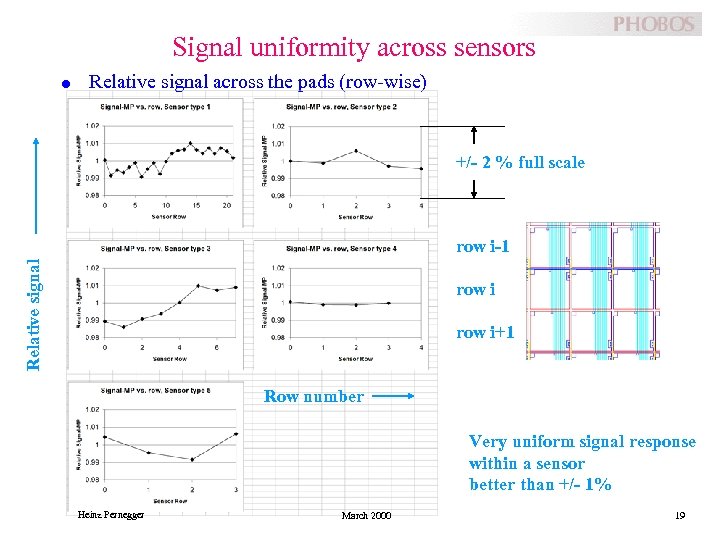 Signal uniformity across sensors l Relative signal across the pads (row-wise) +/- 2 % full scale Relative signal row i-1 row i+1 Row number Very uniform signal response within a sensor better than +/- 1% Heinz Pernegger March 2000 19
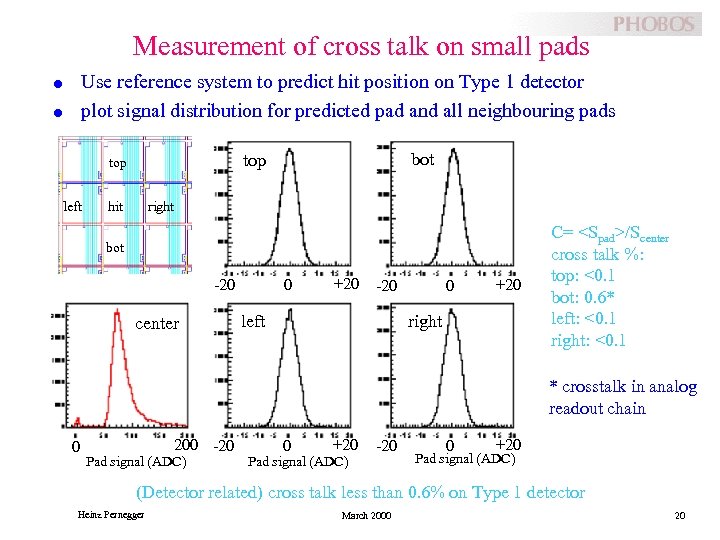 Measurement of cross talk on small pads Use reference system to predict hit position on Type 1 detector plot signal distribution for predicted pad and all neighbouring pads l l left bot top hit right bot -20 center 0 +20 -20 left 0 +20 right C=
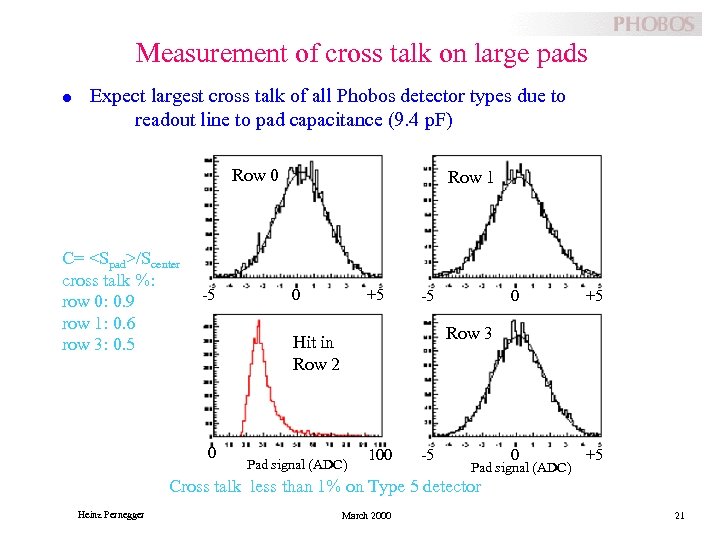 Measurement of cross talk on large pads l Expect largest cross talk of all Phobos detector types due to readout line to pad capacitance (9. 4 p. F) Row 0 C=
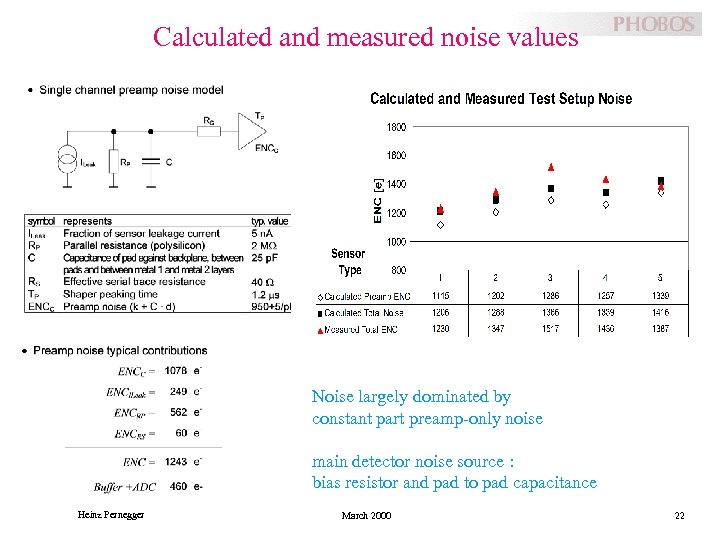 Calculated and measured noise values Noise largely dominated by constant part preamp-only noise main detector noise source : bias resistor and pad to pad capacitance Heinz Pernegger March 2000 22
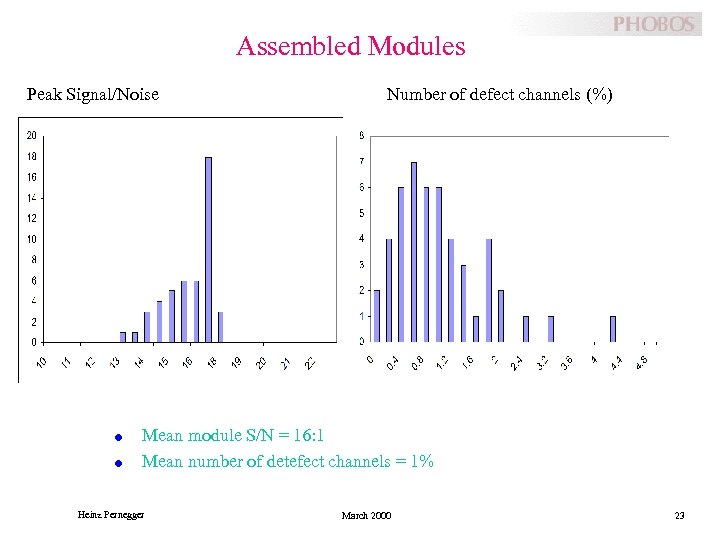 Assembled Modules Peak Signal/Noise l l Number of defect channels (%) Mean module S/N = 16: 1 Mean number of detefect channels = 1% Heinz Pernegger March 2000 23
 Measured energy loss for low momentum pions and kaons l Phobos “lives” on the Silicon analog signals » » l The aim of this measurement was » » l The multiplicity is directly calculated from the analog signal The spectrometer needs it for particle identification and track reconstruction to measure and understand the response of our detector for the low momentum pions and kaons measure the d. E/dx loss and straggling for kaon and pions versus momentum This allows us to: » » compare and tune our Geant simulation test the particle identification Heinz Pernegger March 2000 24
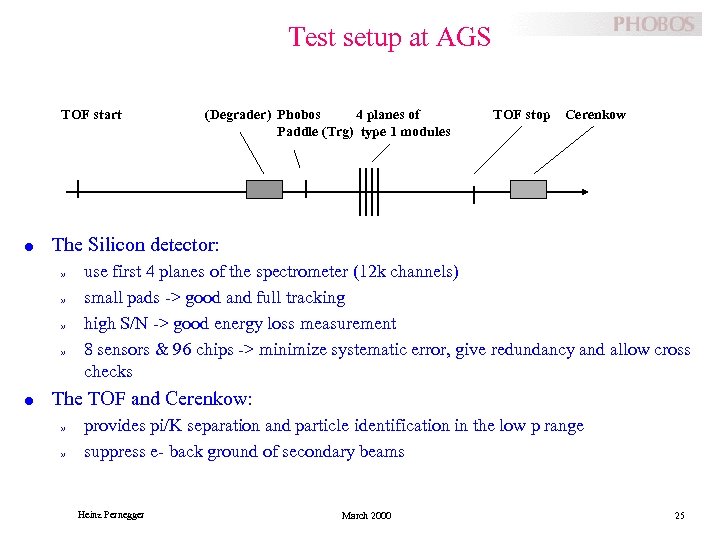 Test setup at AGS TOF start l TOF stop Cerenkow The Silicon detector: » » l (Degrader) Phobos 4 planes of Paddle (Trg) type 1 modules use first 4 planes of the spectrometer (12 k channels) small pads -> good and full tracking high S/N -> good energy loss measurement 8 sensors & 96 chips -> minimize systematic error, give redundancy and allow cross checks The TOF and Cerenkow: » » provides pi/K separation and particle identification in the low p range suppress e- back ground of secondary beams Heinz Pernegger March 2000 25
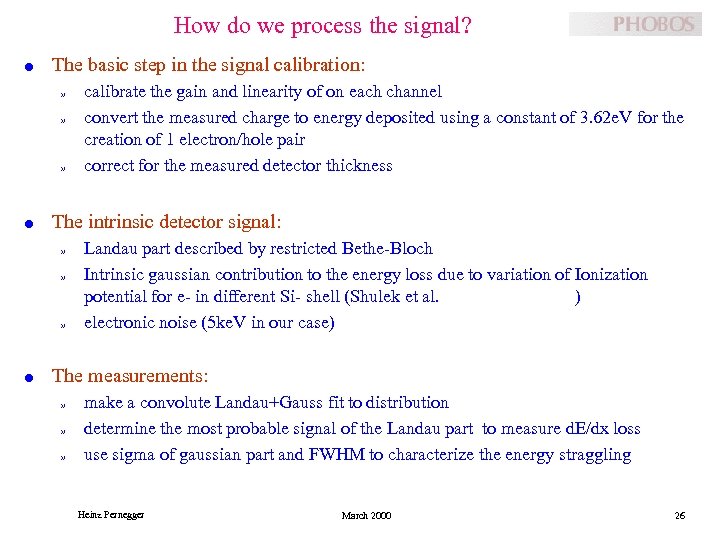 How do we process the signal? l The basic step in the signal calibration: » » » l The intrinsic detector signal: » » » l calibrate the gain and linearity of on each channel convert the measured charge to energy deposited using a constant of 3. 62 e. V for the creation of 1 electron/hole pair correct for the measured detector thickness Landau part described by restricted Bethe-Bloch Intrinsic gaussian contribution to the energy loss due to variation of Ionization potential for e- in different Si- shell (Shulek et al. ) electronic noise (5 ke. V in our case) The measurements: » » » make a convolute Landau+Gauss fit to distribution determine the most probable signal of the Landau part to measure d. E/dx loss use sigma of gaussian part and FWHM to characterize the energy straggling Heinz Pernegger March 2000 26
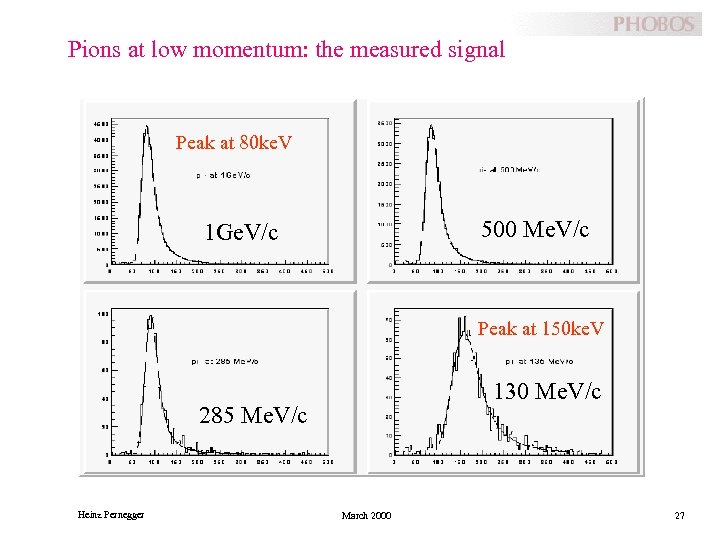 Pions at low momentum: the measured signal Peak at 80 ke. V 500 Me. V/c 1 Ge. V/c Peak at 150 ke. V 130 Me. V/c 285 Me. V/c Heinz Pernegger March 2000 27
![Landau most probable energy loss [ke. V] Most probable energy loss for high momentum](https://present5.com/presentation/65a80b8a66622ce6b3a746a03ae6e26b/image-28.jpg "Landau most probable energy loss [ke. V] Most probable energy loss for high momentum") Landau most probable energy loss [ke. V] Most probable energy loss for high momentum pions l l preliminary Data Geant We measure a 4 % logarithmic rise of d. E/dx (0. 5 - 8 Ge. V/c) for pions Geant agrees very well with our measurement Heinz Pernegger March 2000 28
Landau most probable energy loss [ke. V] Most probable energy loss for high momentum pions l l preliminary Data Geant We measure a 4 % logarithmic rise of d. E/dx (0. 5 - 8 Ge. V/c) for pions Geant agrees very well with our measurement Heinz Pernegger March 2000 28
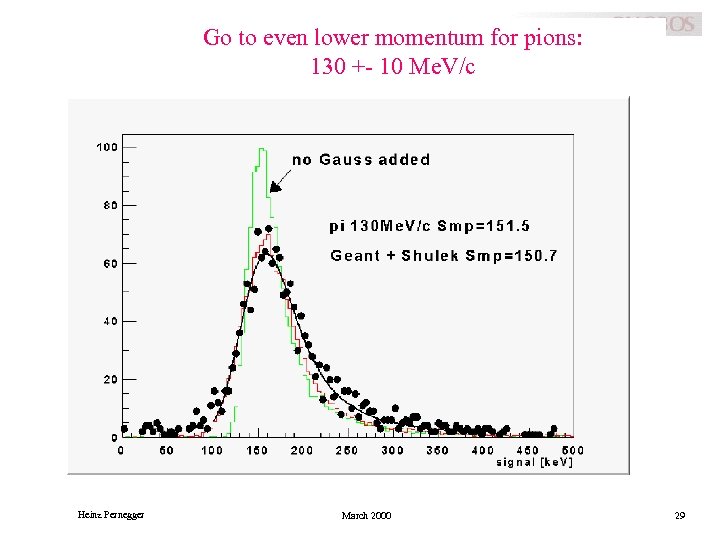 Go to even lower momentum for pions: 130 +- 10 Me. V/c Heinz Pernegger March 2000 29
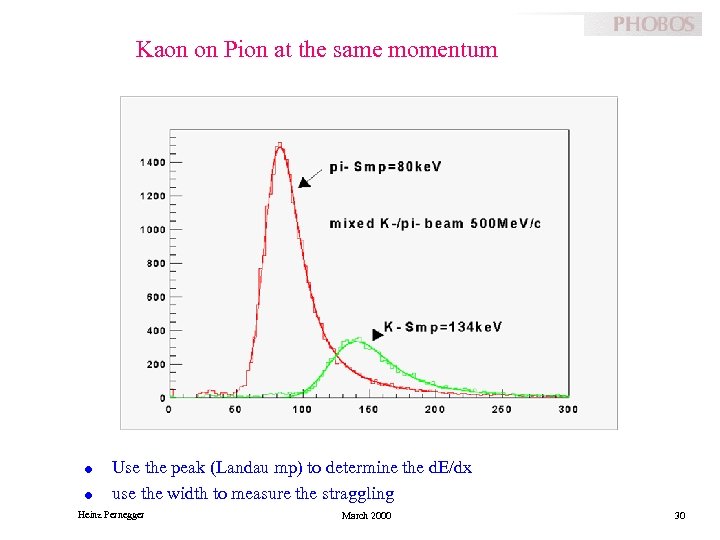 Kaon on Pion at the same momentum l l Use the peak (Landau mp) to determine the d. E/dx use the width to measure the straggling Heinz Pernegger March 2000 30
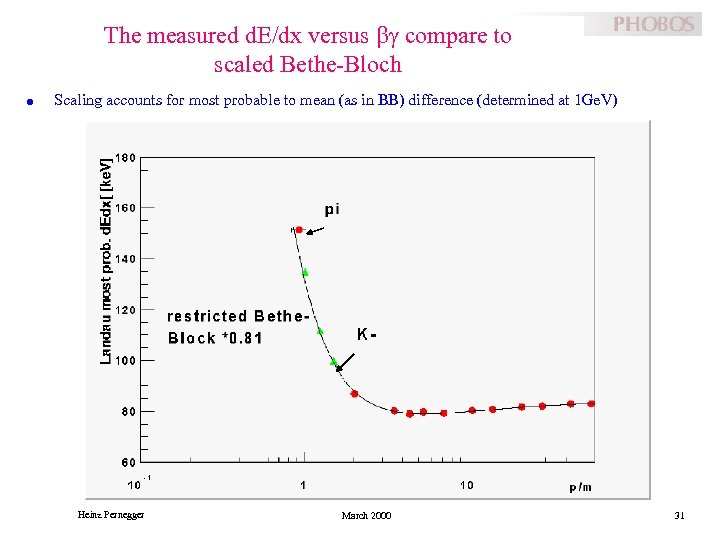 The measured d. E/dx versus bg compare to scaled Bethe-Bloch l Scaling accounts for most probable to mean (as in BB) difference (determined at 1 Ge. V) Heinz Pernegger March 2000 31
 Putting it to work: Particle Identification with 4 planes only? l l Test our particle ID capabilities with 4 of 14 on mixed kaon + pion data sample The particle momenta are nicely at the limit of our claimed pi/K separation (650 Me. V/c) Use the TOF measurement to determine efficiency and purity define: » » efficiency e(pi)= N(pi->pi)/N(pi) contamination c(pi)= N(K->pi)/N(K) – Heinz Pernegger and vise-versa for Kaons March 2000 32
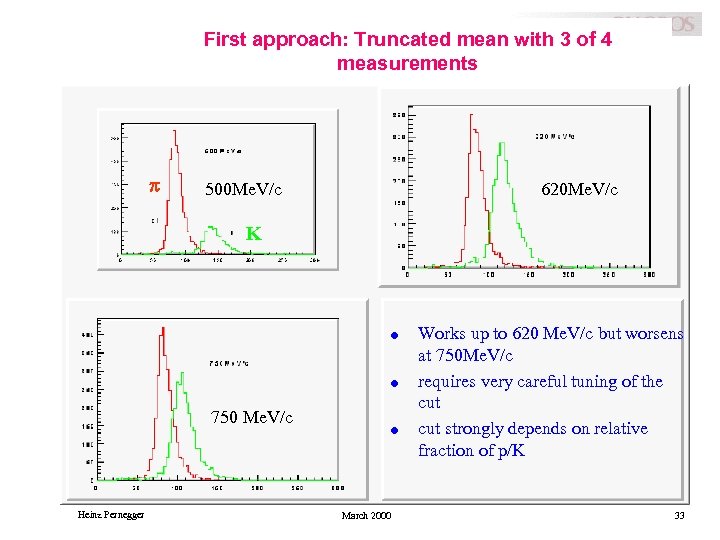 First approach: Truncated mean with 3 of 4 measurements p 500 Me. V/c 620 Me. V/c K l l 750 Me. V/c Heinz Pernegger l March 2000 Works up to 620 Me. V/c but worsens at 750 Me. V/c requires very careful tuning of the cut strongly depends on relative fraction of p/K 33
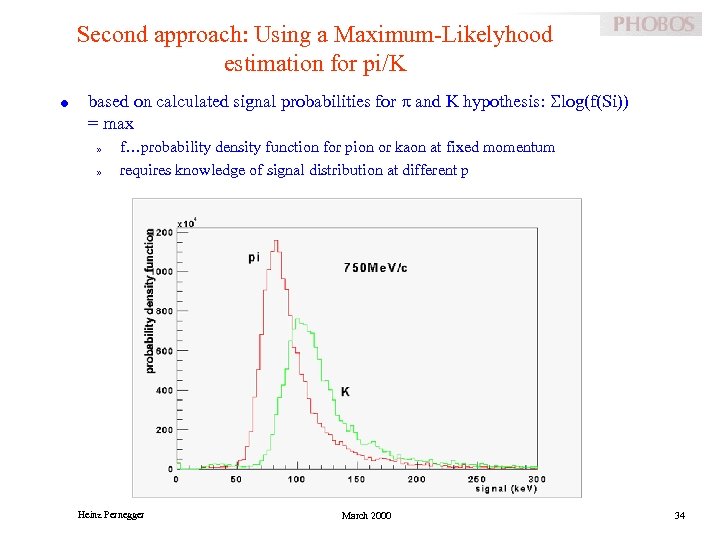 Second approach: Using a Maximum-Likelyhood estimation for pi/K l based on calculated signal probabilities for p and K hypothesis: Slog(f(Si)) = max » » f…probability density function for pion or kaon at fixed momentum requires knowledge of signal distribution at different p Heinz Pernegger March 2000 34
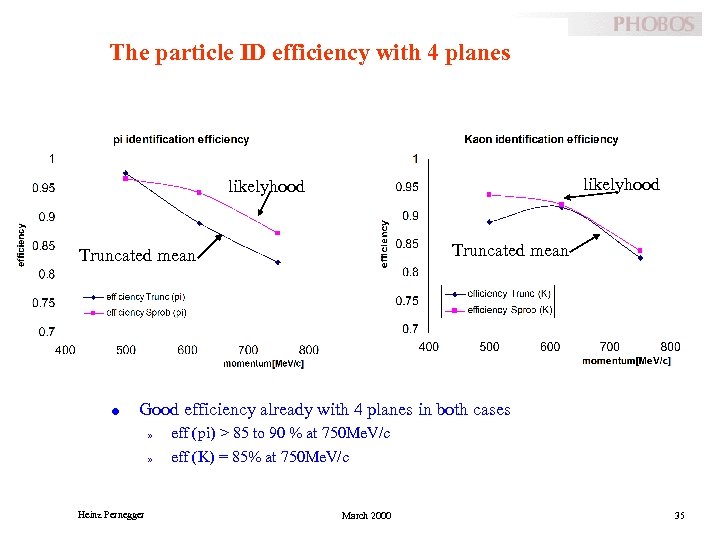 The particle ID efficiency with 4 planes likelyhood Truncated mean l Good efficiency already with 4 planes in both cases » » Heinz Pernegger eff (pi) > 85 to 90 % at 750 Me. V/c eff (K) = 85% at 750 Me. V/c March 2000 35
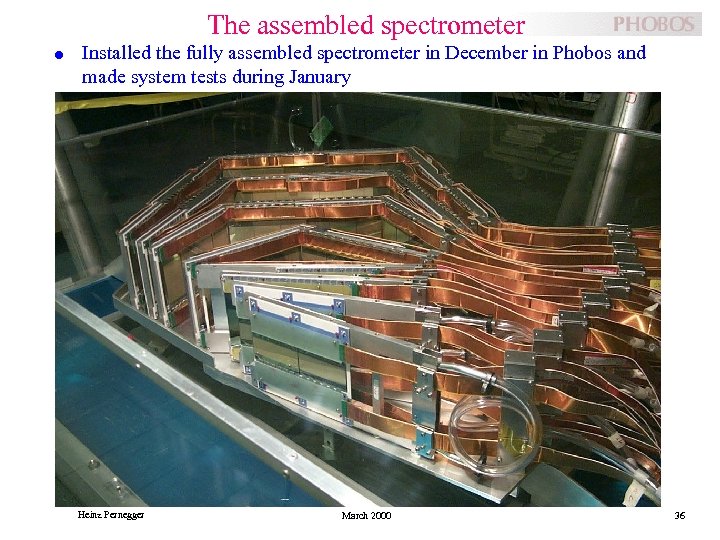 The assembled spectrometer l Installed the fully assembled spectrometer in December in Phobos and made system tests during January Heinz Pernegger March 2000 36
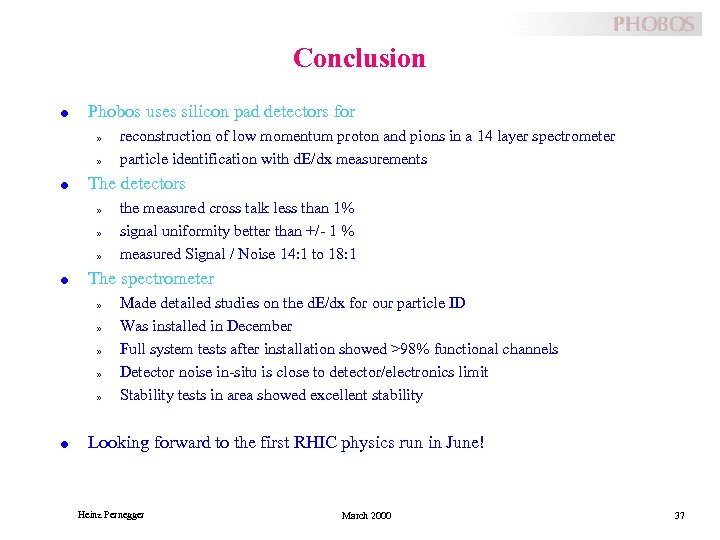 Conclusion l Phobos uses silicon pad detectors for » » l The detectors » » » l the measured cross talk less than 1% signal uniformity better than +/- 1 % measured Signal / Noise 14: 1 to 18: 1 The spectrometer » » » l reconstruction of low momentum proton and pions in a 14 layer spectrometer particle identification with d. E/dx measurements Made detailed studies on the d. E/dx for our particle ID Was installed in December Full system tests after installation showed >98% functional channels Detector noise in-situ is close to detector/electronics limit Stability tests in area showed excellent stability Looking forward to the first RHIC physics run in June! Heinz Pernegger March 2000 37
![Defects associated with double metal structure Non Func. Channels [%] Shorted Channels [%] Heinz](https://present5.com/presentation/65a80b8a66622ce6b3a746a03ae6e26b/image-38.jpg "Defects associated with double metal structure Non Func. Channels [%] Shorted Channels [%] Heinz") Defects associated with double metal structure Non Func. Channels [%] Shorted Channels [%] Heinz Pernegger Broken Signal Lines [%] March 2000 Shorted Coupling Cap [%] 38
Defects associated with double metal structure Non Func. Channels [%] Shorted Channels [%] Heinz Pernegger Broken Signal Lines [%] March 2000 Shorted Coupling Cap [%] 38
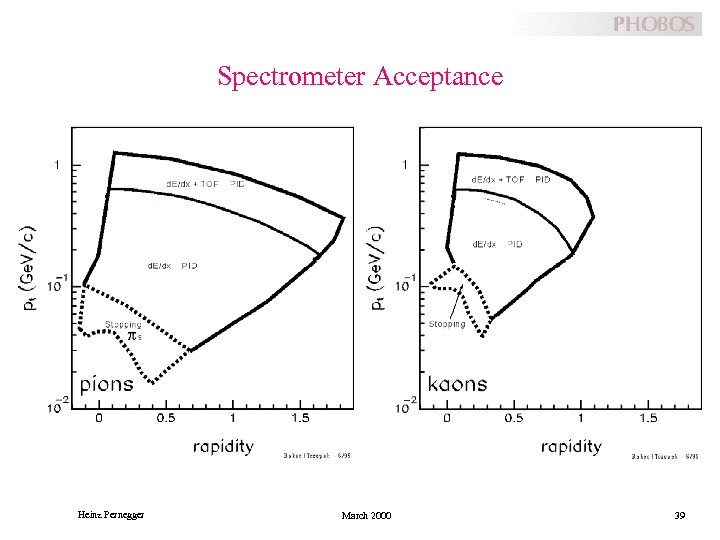 Spectrometer Acceptance Heinz Pernegger March 2000 39
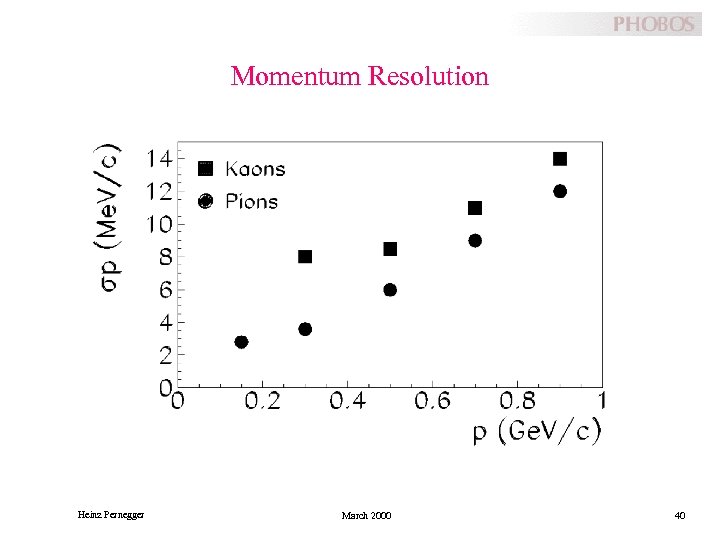 Momentum Resolution Heinz Pernegger March 2000 40
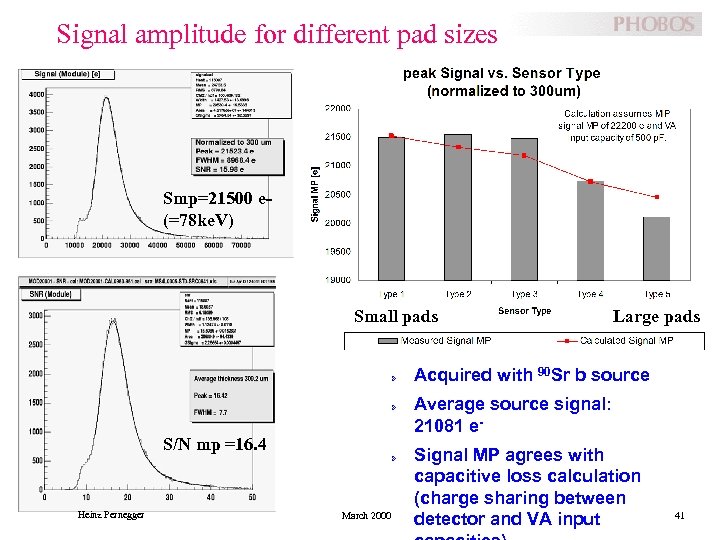 Signal amplitude for different pad sizes Smp=21500 e(=78 ke. V) Small pads » » S/N mp =16. 4 Heinz Pernegger » March 2000 Large pads Acquired with 90 Sr b source Average source signal: 21081 e. Signal MP agrees with capacitive loss calculation (charge sharing between detector and VA input 41
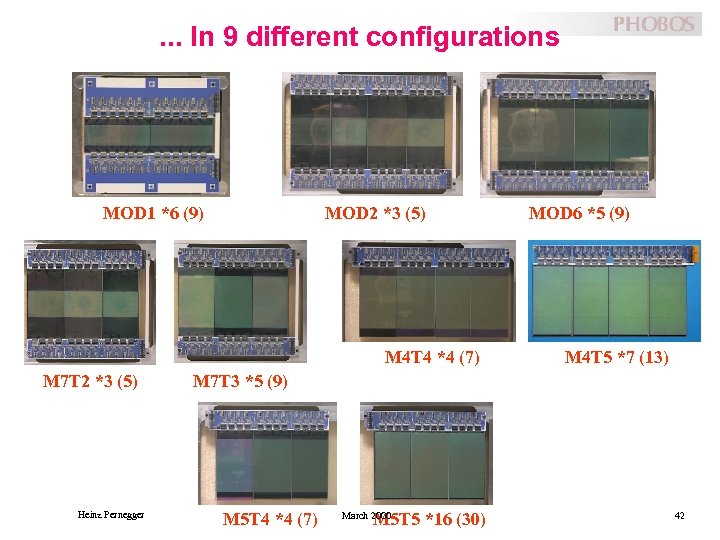 . . . In 9 different configurations MOD 1 *6 (9) MOD 2 *3 (5) M 4 T 4 *4 (7) M 7 T 2 *3 (5) Heinz Pernegger MOD 6 *5 (9) M 4 T 5 *7 (13) M 7 T 3 *5 (9) M 5 T 4 *4 (7) M 5 T 5 *16 (30) March 2000 42
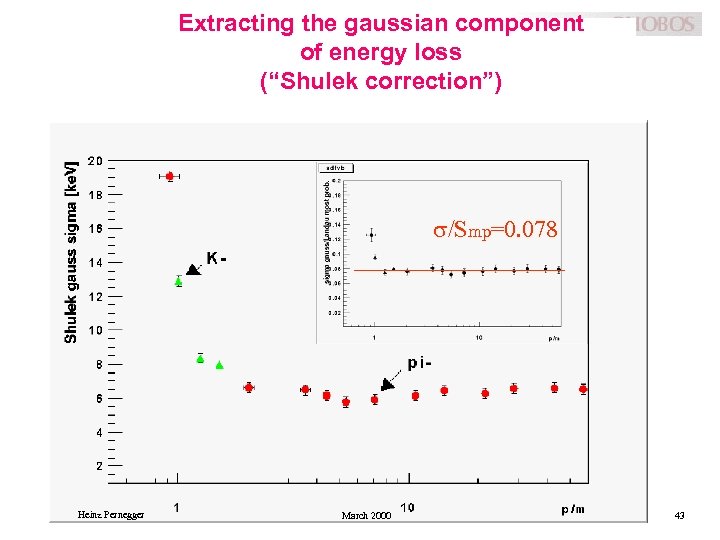 Extracting the gaussian component of energy loss (“Shulek correction”) s/Smp=0. 078 Heinz Pernegger March 2000 43
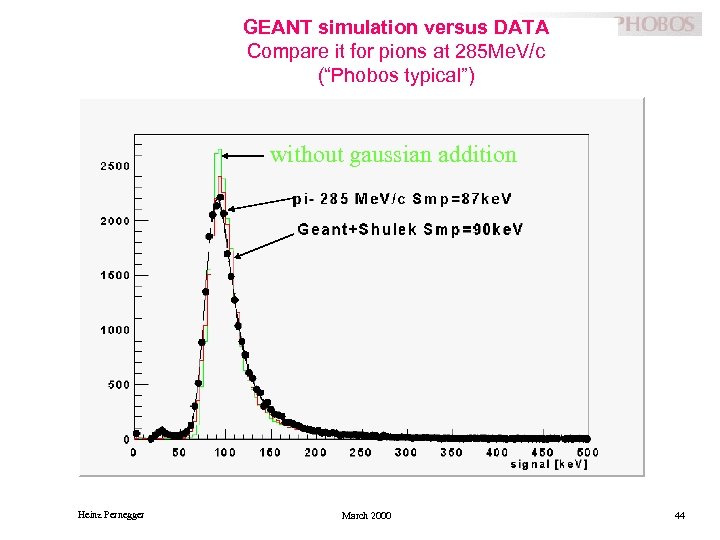 GEANT simulation versus DATA Compare it for pions at 285 Me. V/c (“Phobos typical”) without gaussian addition Heinz Pernegger March 2000 44
 The selection contamination with 4 planes l Very little contamination already with 4 planes in both cases » l c (pi) <15% % at 750 Me. V/c and reaches levels of 5% beyond 600 Me. V using Maximum Likelyhood produces slightly better purity Heinz Pernegger March 2000 45
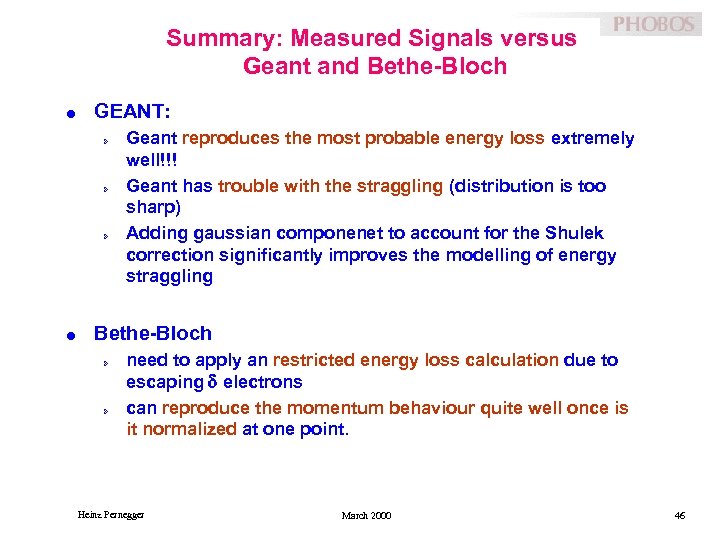 Summary: Measured Signals versus Geant and Bethe-Bloch l GEANT: » » » l Geant reproduces the most probable energy loss extremely well!!! Geant has trouble with the straggling (distribution is too sharp) Adding gaussian componenet to account for the Shulek correction significantly improves the modelling of energy straggling Bethe-Bloch » » need to apply an restricted energy loss calculation due to escaping d electrons can reproduce the momentum behaviour quite well once is it normalized at one point. Heinz Pernegger March 2000 46