 Скачать презентацию Signs of Life Pre-biotic Chemistry New Discoveries with
8acd9e31c337e3b7e85bd491601696cb.ppt
- Количество слайдов: 26



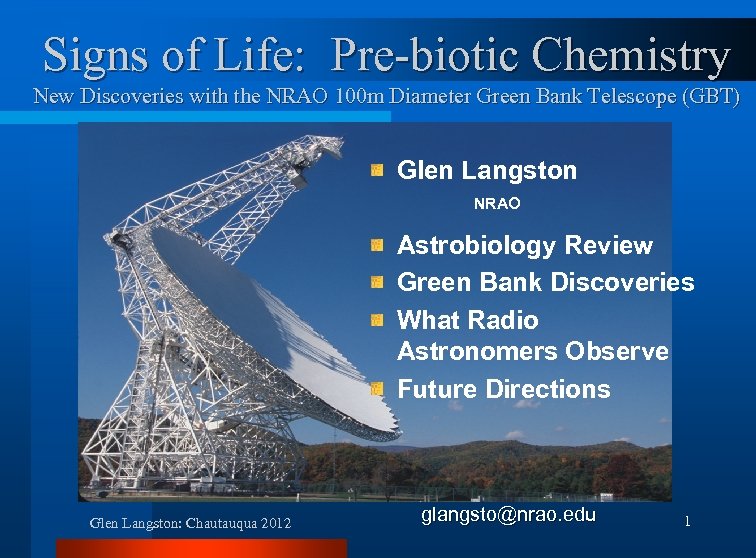
Signs of Life: Pre-biotic Chemistry New Discoveries with the NRAO 100 m Diameter Green Bank Telescope (GBT) Glen Langston NRAO Astrobiology Review Green Bank Discoveries What Radio Astronomers Observe Future Directions Glen Langston: Chautauqua 2012 glangsto@nrao. edu 1
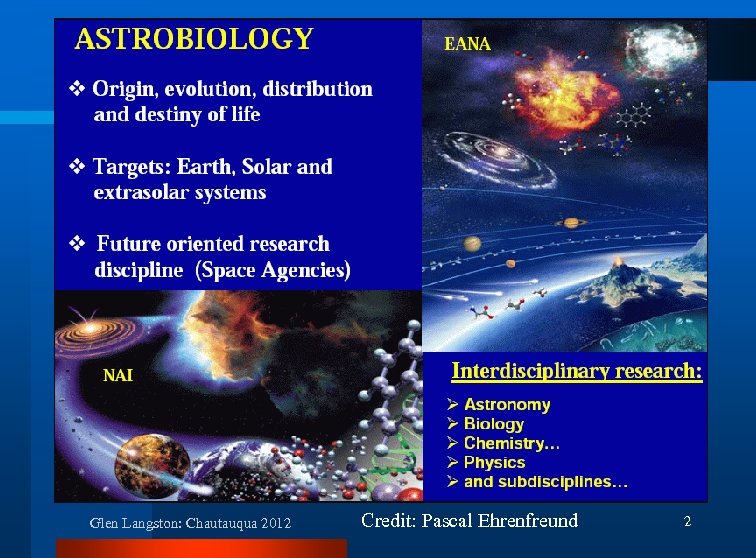
Astrobiology Glen Langston: Chautauqua 2012 Credit: Pascal Ehrenfreund 2
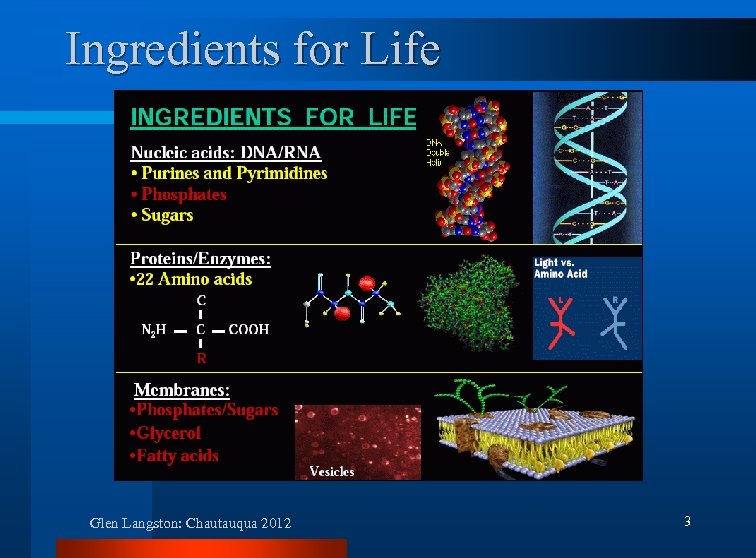
Ingredients for Life Glen Langston: Chautauqua 2012 3
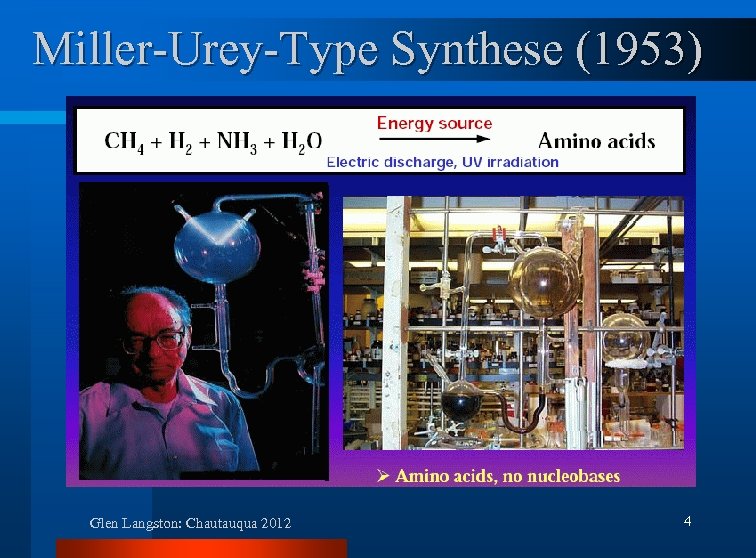
Miller-Urey-Type Synthese (1953) Glen Langston: Chautauqua 2012 4
Miller & Orgel: The origin of life on Earth, 1974 “It must be admitted from the beginning that we do not know how life began. It is generally believed that a variety of processes led to the formation of simple organic compounds on the primitive Earth. These compounds were combined together to give more and more complex structures until one was formed that could be called living. No one should be satisfied with an explanation as general as this. ” Glen Langston: Chautauqua 2012 5
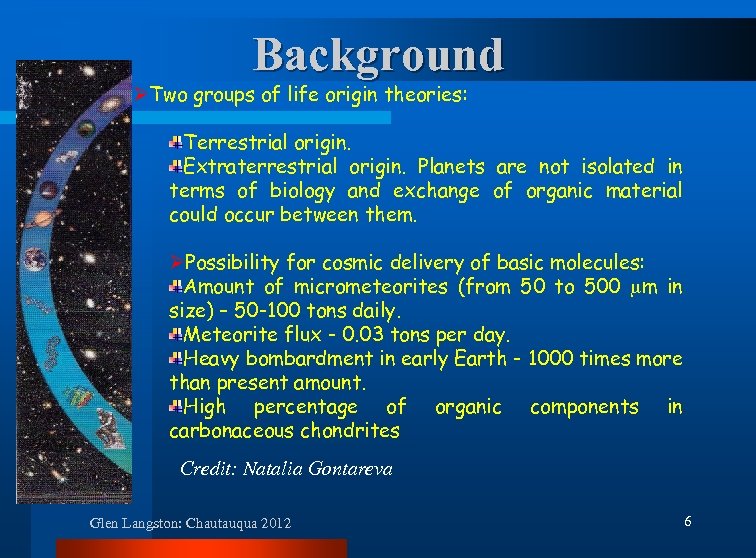
Background ØTwo groups of life origin theories: Terrestrial origin. Extraterrestrial origin. Planets are not isolated in terms of biology and exchange of organic material could occur between them. ØPossibility for cosmic delivery of basic molecules: Amount of micrometeorites (from 50 to 500 m in size) – 50 -100 tons daily. Meteorite flux - 0. 03 tons per day. Heavy bombardment in early Earth - 1000 times more than present amount. High percentage of organic components in carbonaceous chondrites Credit: Natalia Gontareva Glen Langston: Chautauqua 2012 6
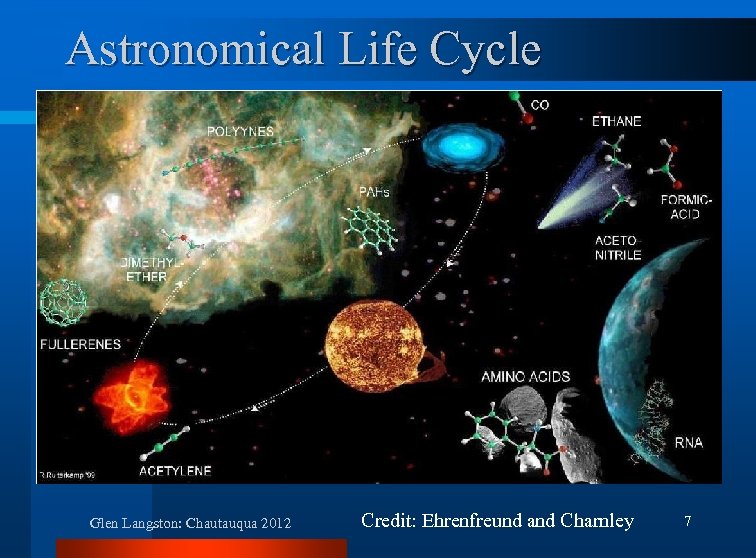
Astronomical Life Cycle Glen Langston: Chautauqua 2012 Credit: Ehrenfreund and Charnley 7
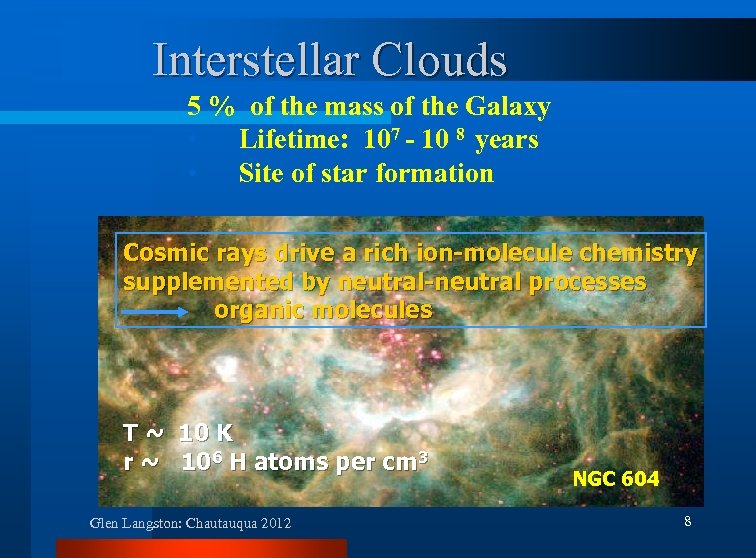
Interstellar Clouds 5 % of the mass of the Galaxy • Lifetime: 107 - 10 8 years • Site of star formation Cosmic rays drive a rich ion-molecule chemistry supplemented by neutral-neutral processes organic molecules T ~ 10 K r ~ 106 H atoms per cm 3 Glen Langston: Chautauqua 2012 NGC 604 8
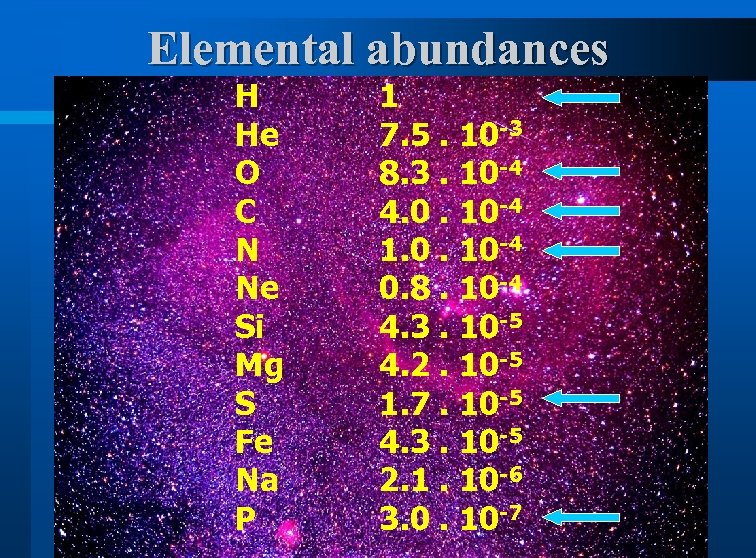
Elemental abundances H He O C N Ne Si Mg S Fe Na Glen Langston: Chautauqua 2012 P 1 7. 5. 10 -3 8. 3. 10 -4 4. 0. 10 -4 1. 0. 10 -4 0. 8. 10 -4 4. 3. 10 -5 4. 2. 10 -5 1. 7. 10 -5 4. 3. 10 -5 2. 1. 10 -6 3. 0. 10 -7 9
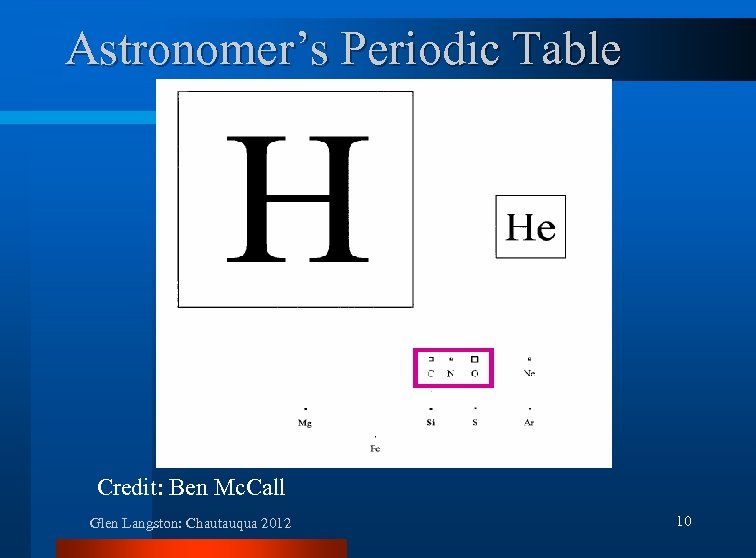
Astronomer’s Periodic Table Credit: Ben Mc. Call Glen Langston: Chautauqua 2012 10
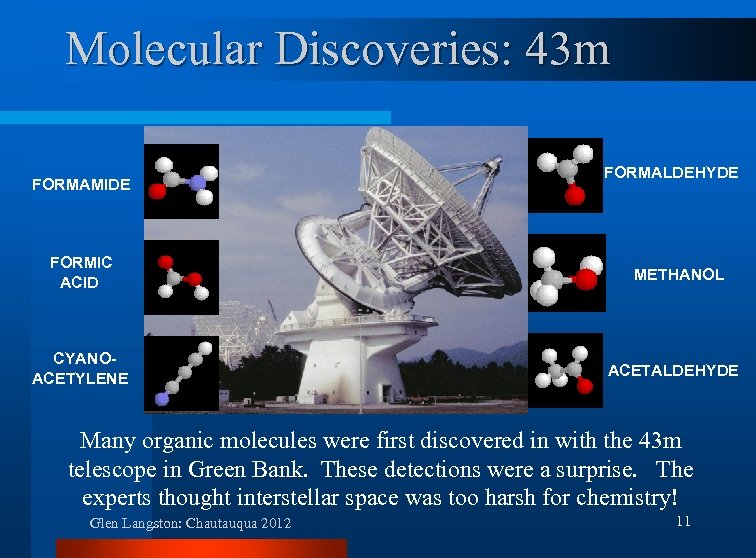
Molecular Discoveries: 43 m FORMAMIDE FORMIC ACID CYANOACETYLENE FORMALDEHYDE METHANOL ACETALDEHYDE Many organic molecules were first discovered in with the 43 m telescope in Green Bank. These detections were a surprise. The experts thought interstellar space was too harsh for chemistry! Glen Langston: Chautauqua 2012 11
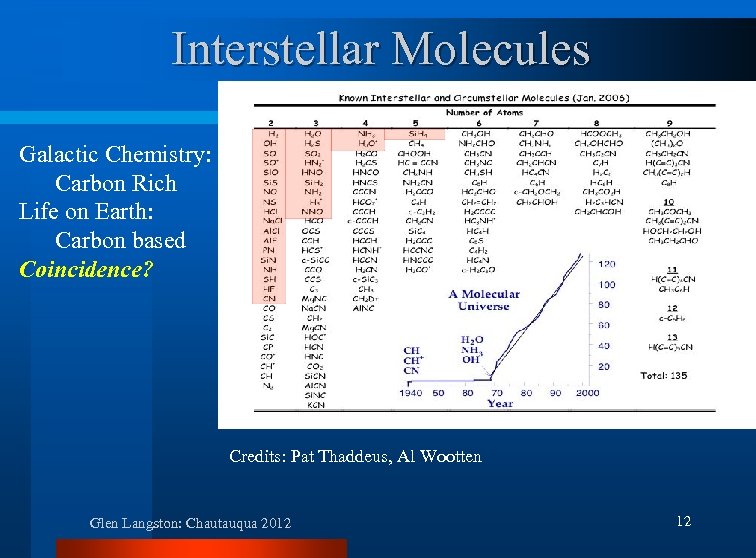
Interstellar Molecules Galactic Chemistry: Carbon Rich Life on Earth: Carbon based Coincidence? Credits: Pat Thaddeus, Al Wootten Glen Langston: Chautauqua 2012 12
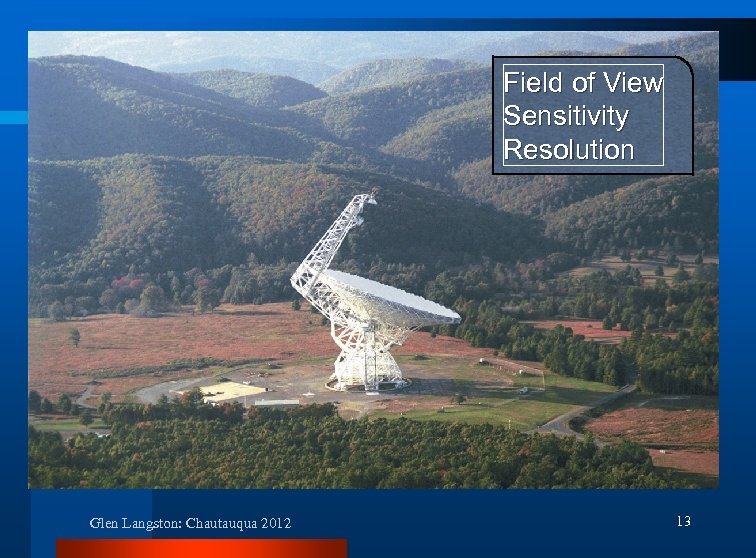
Field of View Sensitivity Resolution Glen Langston: Chautauqua 2012 13
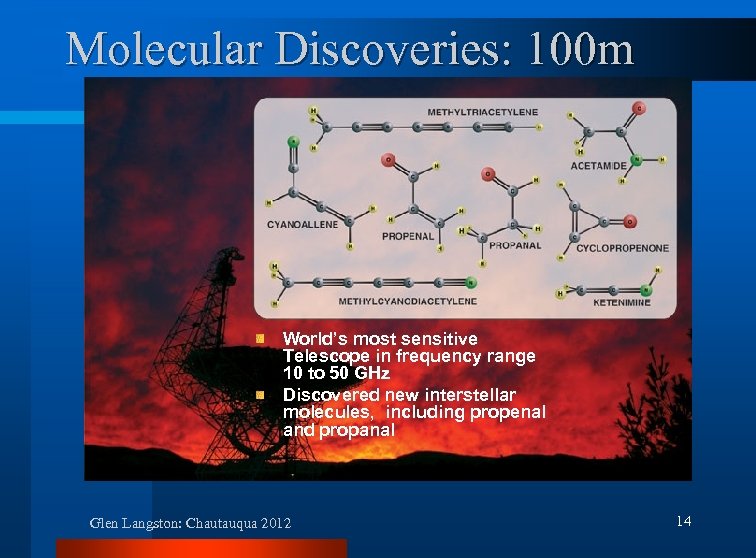
Molecular Discoveries: 100 m World’s most sensitive Telescope in frequency range 10 to 50 GHz Discovered new interstellar molecules, including propenal and propanal Glen Langston: Chautauqua 2012 14
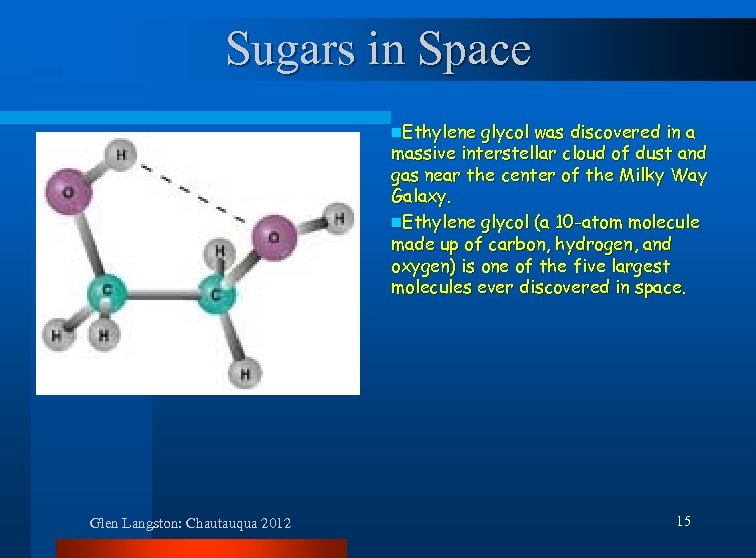
Sugars in Space n. Ethylene glycol was discovered in a massive interstellar cloud of dust and gas near the center of the Milky Way Galaxy. n. Ethylene glycol (a 10 -atom molecule made up of carbon, hydrogen, and oxygen) is one of the five largest molecules ever discovered in space. Glen Langston: Chautauqua 2012 15
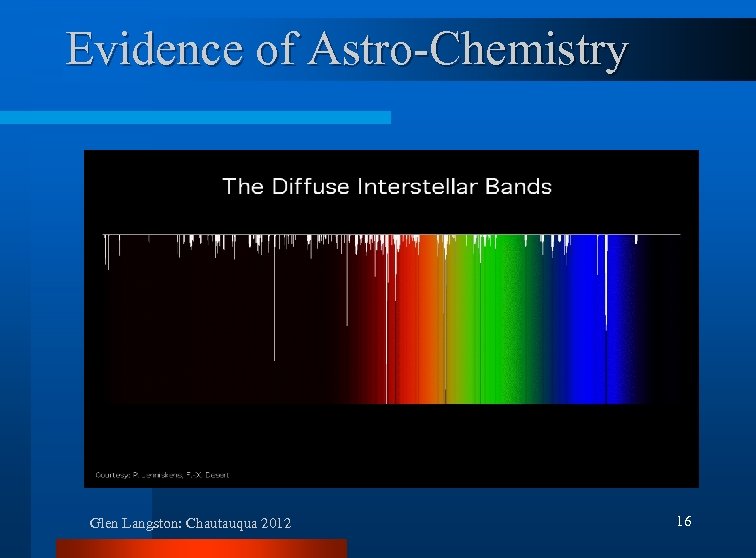
Evidence of Astro-Chemistry Glen Langston: Chautauqua 2012 16
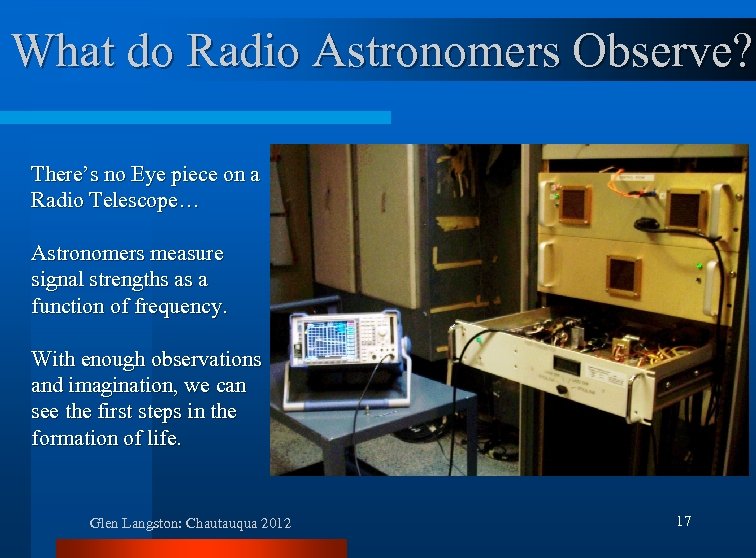
What do Radio Astronomers Observe? There’s no Eye piece on a Radio Telescope… Astronomers measure signal strengths as a function of frequency. With enough observations and imagination, we can see the first steps in the formation of life. Glen Langston: Chautauqua 2012 17
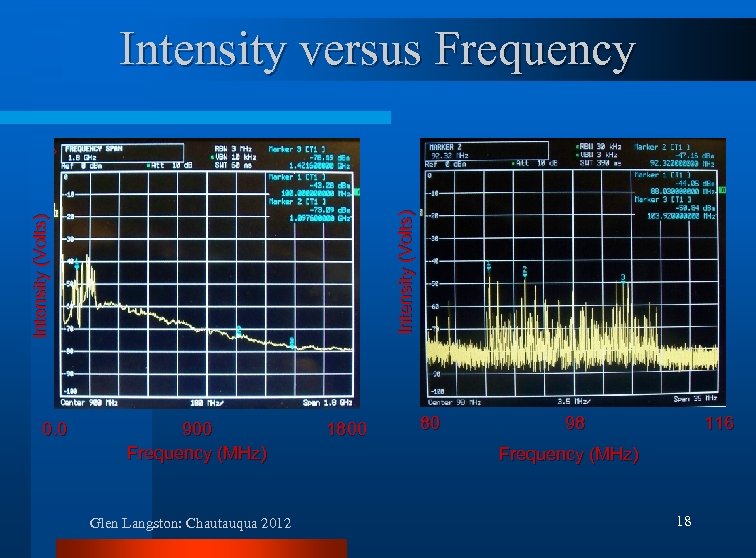
Intensity (Volts) Intensity versus Frequency 0. 0 900 Frequency (MHz) Glen Langston: Chautauqua 2012 1800 80 98 116 Frequency (MHz) 18
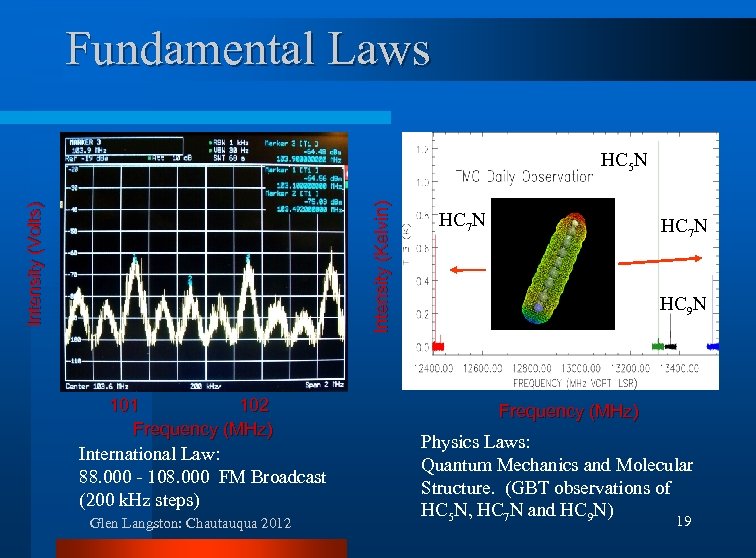
Fundamental Laws Intensity (Volts) Intensity (Kelvin) HC 5 N 101 102 Frequency (MHz) International Law: 88. 000 - 108. 000 FM Broadcast (200 k. Hz steps) Glen Langston: Chautauqua 2012 HC 7 N HC 9 N Frequency (MHz) Physics Laws: Quantum Mechanics and Molecular Structure. (GBT observations of HC 5 N, HC 7 N and HC 9 N) 19
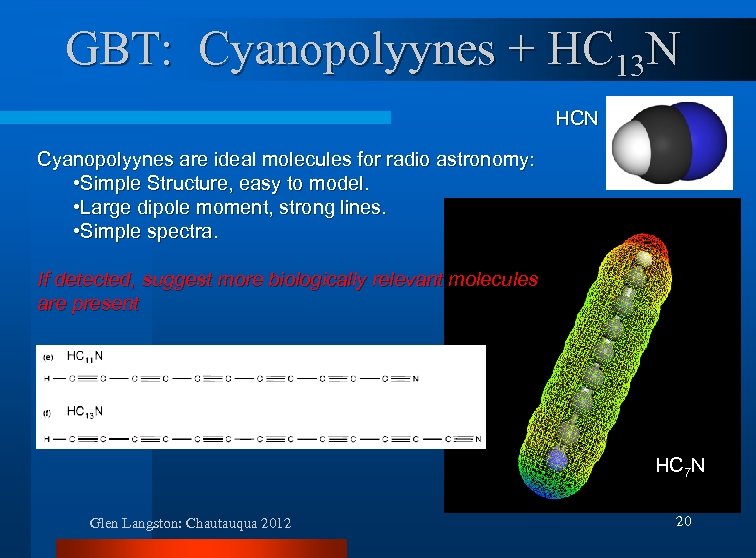
GBT: Cyanopolyynes + HC 13 N HCN Cyanopolyynes are ideal molecules for radio astronomy: • Simple Structure, easy to model. • Large dipole moment, strong lines. • Simple spectra. If detected, suggest more biologically relevant molecules are present HC 7 N Glen Langston: Chautauqua 2012 20
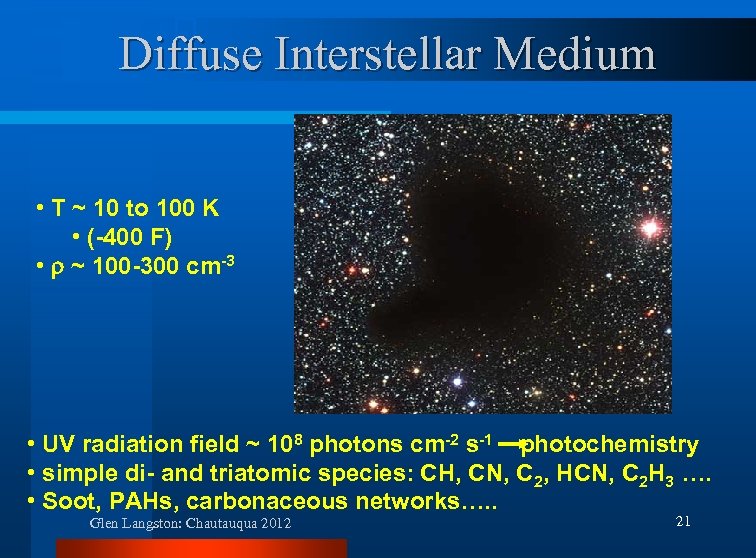
Diffuse Interstellar Medium • T ~ 10 to 100 K • (-400 F) • r ~ 100 -300 cm-3 • UV radiation field ~ 108 photons cm-2 s-1 photochemistry • simple di- and triatomic species: CH, CN, C 2, HCN, C 2 H 3 …. • Soot, PAHs, carbonaceous networks…. . Glen Langston: Chautauqua 2012 21
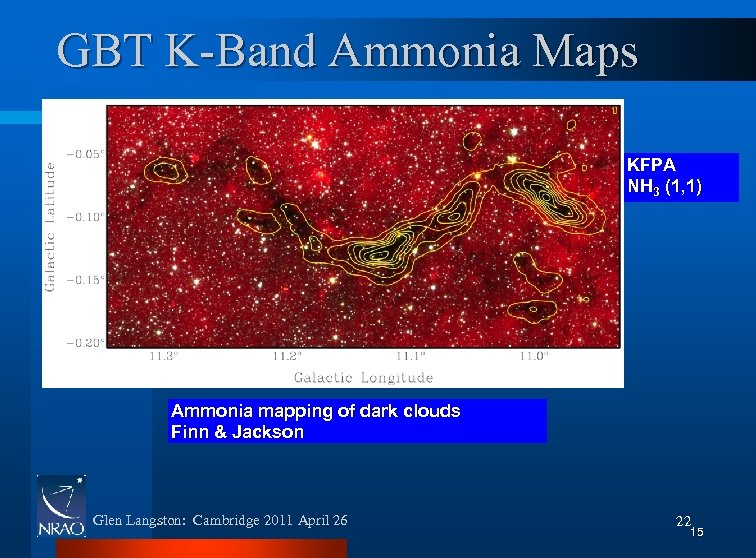
GBT K-Band Ammonia Maps KFPA NH 3 (1, 1) Ammonia mapping of dark clouds Finn & Jackson Glen Langston: Cambridge 2011 April 26 22 15
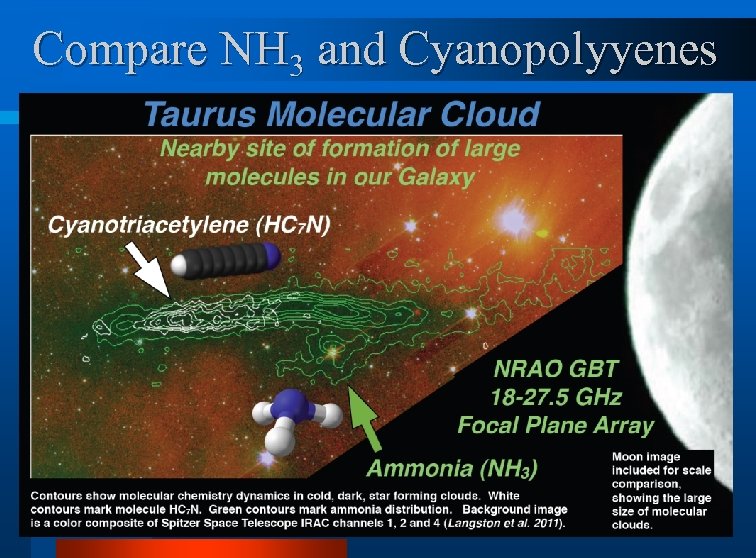
Compare NH 3 and Cyanopolyyenes Glen Langston: Chautauqua 2012 23
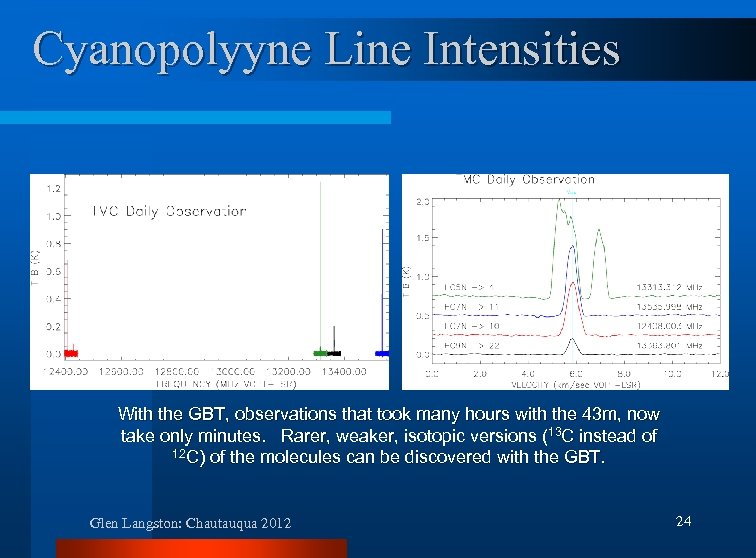
Cyanopolyyne Line Intensities With the GBT, observations that took many hours with the 43 m, now take only minutes. Rarer, weaker, isotopic versions (13 C instead of 12 C) of the molecules can be discovered with the GBT. Glen Langston: Chautauqua 2012 24
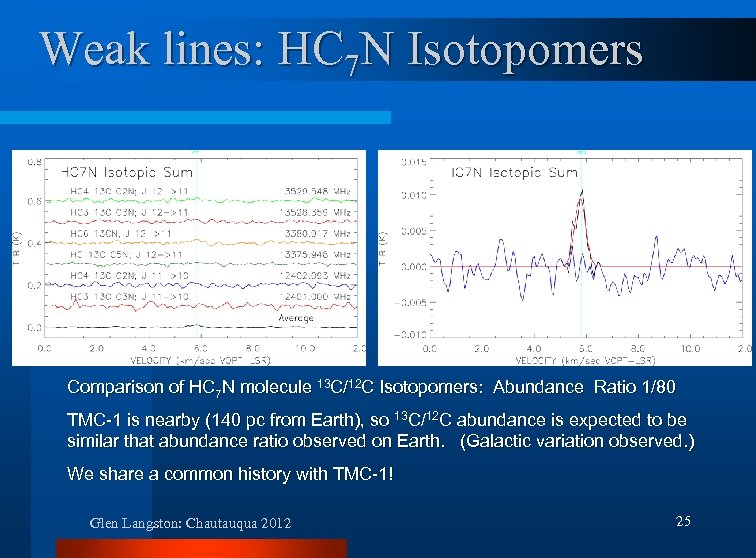
Weak lines: HC 7 N Isotopomers Comparison of HC 7 N molecule 13 C/12 C Isotopomers: Abundance Ratio 1/80 TMC-1 is nearby (140 pc from Earth), so 13 C/12 C abundance is expected to be similar that abundance ratio observed on Earth. (Galactic variation observed. ) We share a common history with TMC-1! Glen Langston: Chautauqua 2012 25
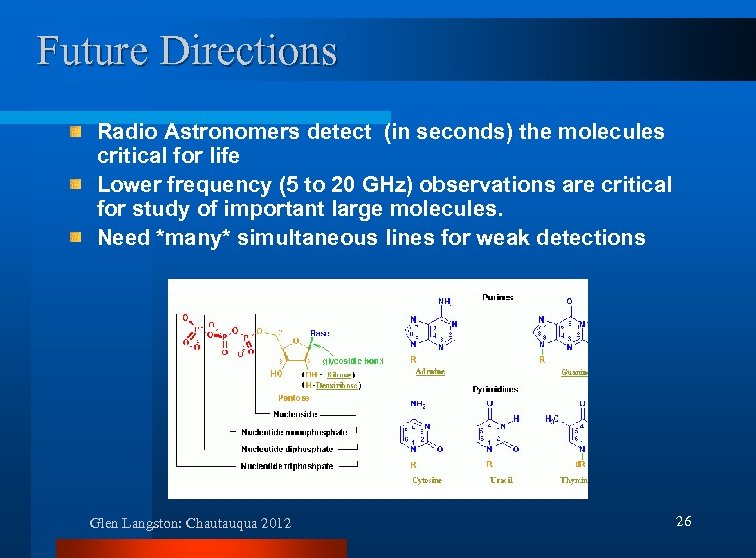
Future Directions Radio Astronomers detect (in seconds) the molecules critical for life Lower frequency (5 to 20 GHz) observations are critical for study of important large molecules. Need *many* simultaneous lines for weak detections Glen Langston: Chautauqua 2012 26
Скачать презентацию Signs of Life Pre-biotic Chemistry New Discoveries with
8acd9e31c337e3b7e85bd491601696cb.ppt