


 Скачать презентацию Significant Learners Factors and English Language Learning Ecological
e86d2d8433b3e12cdec5932db68478f0.ppt
- Количество слайдов: 43
 Significant Learners’ Factors and English Language Learning: Ecological Approach to ELT: Researcher: Achara Wongsothorn Research Assistant: Chatchada Twichatwitayakul Chulalongkorn University Language Institute 2007
 Preamble The ecological approach presented here stemmed from the work of Bronfenbrenner (1979. ( In adopting this system perspective, psychological evaluation of a student's functioning is done within the context of her/his mesosystem (immediate family, extended family, neighborhood, school, and other networks), macrosystem (community or culture), and exosystem (society/social structures. ( 3/19/2018 Presentation page 2
 Socio-Cultural Theory of Learning 4 Van Lier (2004) discusses the following issues in his ecological approach to language learning theory and practice. 4 Perception and action in semiotic contexts 4 The emergence of language abilities in meaningful activity 4 The dynamics of social interaction 4 The quality of educational experience 3/19/2018 Presentation page 3
 The paper will provide definitions and background of the study by reporting impact of related research, research methodology, results and implications. Attention will be given to the significant factors related to learning. 3/19/2018 Presentation page 4
 Background of the study This classroom centered research employs three cohorts of graduate students taking the Chulalongkorn University Language Institute’s Academic English for Graduate Studies Course” (GE 5500 -532). The purposes to study are to investigate (1) the learners’ self perception, and their attitudes towards the teacher, and the teaching-learning methods used, (2) ecological factors and classroom management, and (3) relationships between learners’ factors, namely their EQ, background, attitude and perception and their achievement. 3/19/2018 Presentation page 5
 The approach employs psycho educational intervention within the student’s sociocultural context and his/her perception of the learning environment and allows for a more accurate assessment of the student's psychological functioning and a broader understanding of the four crucial issues affecting the student’s language learning (Van Lier, 2004) 3/19/2018 Presentation page 6
 4 Both the student and the systems are continually changing. In the teaching-learning process, ecological approach adopts the concept of psychoeducational intervention focusing on the student as physiological and psychological developments. . This approach allows for a more accurate assessment of the student's psychological functioning and a broader understanding of the crucial issues affecting the student. Application of this approach in psychoeducational intervention with Southeast Asian students includes collecting and integrating information from various aspects of the sociocultural context and then developing intervention procedures or the teaching-learning system based on understanding of both this context and the student. In sum, the approach is holistic rather than analytic. 3/19/2018 Presentation page 7
 Purposes of the study 4 A research project entitled “Ecological Approach to English Language Learning Factors of Student Attitude and Perception toward their Teacher and Classroom Interaction in Chulalongkorn University Language Institute’s Academic English for Graduate Studies Course” is being conducted employing the ecological approach with the purposes to study (1) the learners’ self perception, and their attitudes towards the teacher, and the teaching-learning methods used, (2) ecological factors and classroom management, and (3) relationships between learners’ factors, namely their EQ, background, attitude and perception and their achievement. 3/19/2018 Presentation page 8
 Expected Outcomes of the Study 4 It is expected that this research would create knowledge and understanding about the roles of perception and ecological factors in ELT for academic purposes, and that learners’ micro system, ecosystem, macro system, and ecosystem impacting their ELL would be better understood. 3/19/2018 Presentation page 9
 Research Procedures 4 Subjects: 4 3 groups of graduate students taking Academic English for Graduate Studies course from ay 20052006 numbering 28, 27 and 32 respectively Instruments 1. EQ measures 2. Attitudes measures 3/19/2018 Presentation page 10
 Learner Variables Perception: Presentation to the mind in the form of an idea or image In education, it has been proven that positive selfperception, or high self-esteem, is conducive to the developmental process. Self-perception has been shown to reflect developing cognitive abilities and social circumstances (Dusek & Flaherty, 1981; Stanwyck, 1983). 3/19/2018 Presentation page 11
 College Student Self-Perception 4 More specifically, academic self-concept refers to a student's perceptions of his or her academic abilities (House, 1992). 4 Hamachek, 1995 and House, 1993 show that students' self concept is significantly associated with academic achievement. 4 Loeb and Magee (1992) suggest that students with low self-esteem who find it difficult adjusting to college academics may benefit from contextual support resulting in their satisfaction with college and improved self-image. 4 Contextural support comes from such sources as faculty, peers, and family. 3/19/2018 Presentation page 12
 Bernat (2005) discusses research results revealing that attitudes toward learning, and the perceptions and beliefs that determine them, may have a profound influence on learning behavior. 3/19/2018 Presentation page 13
 Support and interaction with faculty may be related to students' academic achievement and selfconcept (Gerdes and Mallinckrodt (1994). 3/19/2018 Presentation page 14
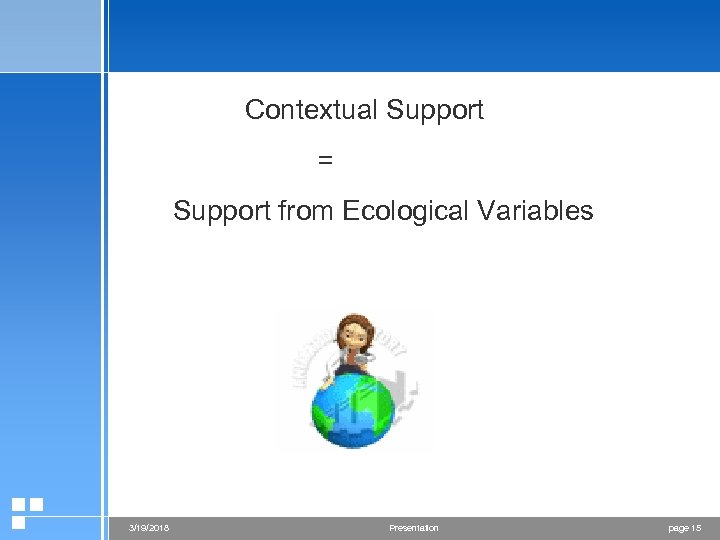 Contextual Support = Support from Ecological Variables 3/19/2018 Presentation page 15
 Objectives 4 This study investigated < 1. the impact of ecological variables < including learner variables and < learner-related variables, particularly learner < perception and attitudes on English < learning achievement of three < cohorts of graduate students. < 2. the strength and directions of the < relationships 3/19/2018 Presentation page 16
 Expected Outcomes of the Study 4 It is expected that this research would create knowledge and understanding about the roles of perception and ecological factors in ELT for academic purposes, and that learners’ micro system, ecosystem, macro system, and ecosystem impacting their ELL would be better understood. 3/19/2018 Presentation page 17
 Ecological Variables/Factors 4 The independent variables in this research are either learner variables or learnerrelated variables. They are: < 1. self-perception < 2. emotion quotient < 3. attitudes towards teaching-learning < processes employed and the < teacher 3/19/2018 Presentation page 18
 Self-Perception 4 . 1 My best friend and intimate 4 friendship 4 . 2 Social acceptance relationship 4 with the parents. Loving 4 relationships, humor, morality 4 . 3 Global appreciation 4 . 4 Social notation of the family 4 scale 4 . 5 Perception of the physical appearance 3/19/2018 Presentation page 19
 Emotion Quotient 4 . 1 Goodness 4 1. 1 Self-control 4 1. 2 Empathy 4 1. 3 Responsibility 4 . 2 Smartness 4 2. 1 Motivation 4 2. 2 Decision-making and problem 4 solving 4 2. 3 Relationship 3/19/2018 Presentation page 20
 Emotion Quotient (cont. ) 4 . 3 Happiness 4 3. 1 Being proud of oneself 4 3. 2 Life Satisfaction 4 3. 3 Peacefulness of mind 3/19/2018 Presentation page 21
 Attitudes towards IT: E-mail and Website 4 . 1 Submitting assignments by e 4 mail is useful 4 . 2 Submitting assignments by e 4 mail is appropriate 4 . 3 Saving time factor of transaction 4 by e-mail 4 . 4 E-mail transaction for 4 assignments is interesting 3/19/2018 Presentation page 22
 Attitudes (cont. ) 4 5. Submitting assignments by e 4 mail helps make transaction 4 with the teacher faster 4 6. Receiving graded assignments 4 by e-mail is appropriate 4 7. Receiving graded assignments 4 by e-mail is useful 3/19/2018 Presentation page 23
 Attitudes (cont. ) 4 . 8 Receiving graded assignments 4 by e-mail saves classroom time 4 . 9 Receiving graded assignments 4 by e-mail is interesting 4 . 10 Attitudes toward e-mail 4 transaction for assignments 4 (1) Receiving graded assignments 4 by e-mail helps student 4 obtaining useful corrections of 4 their work 3/19/2018 Presentation page 24
 Attitude (cont. ) 4 (2)Receiving graded assignments 4 by e-mail helps student 4 obtaining useful explanation and 4 corrections of their work 4 (3) Receiving graded assignments 4 by e-mail helps student 4 obtaining only useful explanation 4 without any corrections for 4 improvement of their work 3/19/2018 Presentation page 25
 Attitudes (cont. ) 4 4 4 . 11 Teacher assignments on the website . 12 Textbooks and handouts distributed by the teacher . 13 Materials in the self-access language learning center 3/19/2018 Presentation page 26
 Attitudes toward teaching-learning procedures 4 . 1 Teacher classroom management 4 . 2 Peer assessment 4 . 3 Teacher assessment 3/19/2018 Presentation page 27
 Learner variables Sex Age Regarding oneself as a Bangkokian or as a person from other parts of Thailand Years of English learning 3/19/2018 Presentation page 28
 Dependent variables 4 Project 4 Midterm tests 4 Final exams 4 Assignments and participation 3/19/2018 Presentation page 29
 Findings: Relationships among the variables On the following slide 3/19/2018 Presentation page 30
 Abbreviations 4 4 4 4 ASS=assignment EQ=emotion quotient EQ sm=emotion quotient regarding smartness EQ happy=emotion quotient regarding happiness EQ good=emotion quotient regarding goodness Final=final examination Lev. Of St. Eng. =grade level of starting English learning Midterm=midterm examination Par=classroom participation Peer=peer assessment Proj=project works Self-id=self identification (being a Bangkokian or not) YE= years of English learning 3/19/2018 Presentation page 31
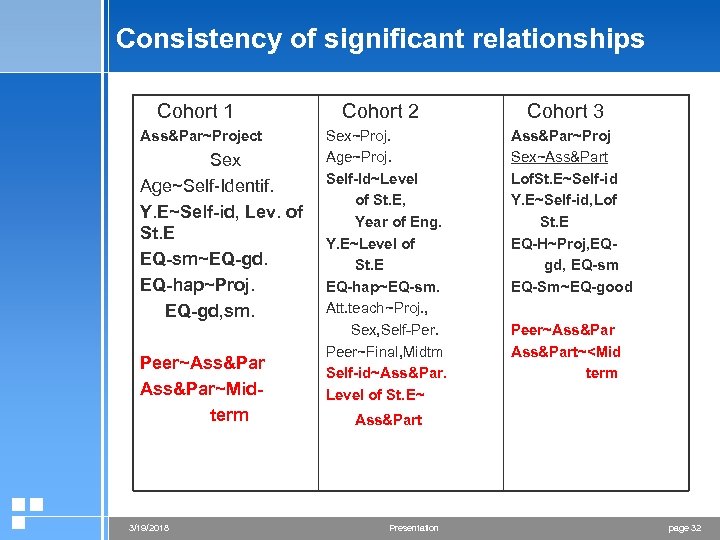 Consistency of significant relationships Cohort 1 Cohort 2 Cohort 3 Ass&Par~Project Sex~Proj. Age~Proj. Self-Id~Level of St. E, Year of Eng. Y. E~Level of St. E EQ-hap~EQ-sm. Att. teach~Proj. , Sex, Self-Per. Peer~Final, Midtm Self-id~Ass&Par. Level of St. E~ Ass&Par~Proj Sex~Ass&Part Lof. St. E~Self-id Y. E~Self-id, Lof St. E EQ-H~Proj, EQgd, EQ-sm EQ-Sm~EQ-good Sex Age~Self-Identif. Y. E~Self-id, Lev. of St. E EQ-sm~EQ-gd. EQ-hap~Proj. EQ-gd, sm. Peer~Ass&Par~Midterm 3/19/2018 Peer~Ass&Part~
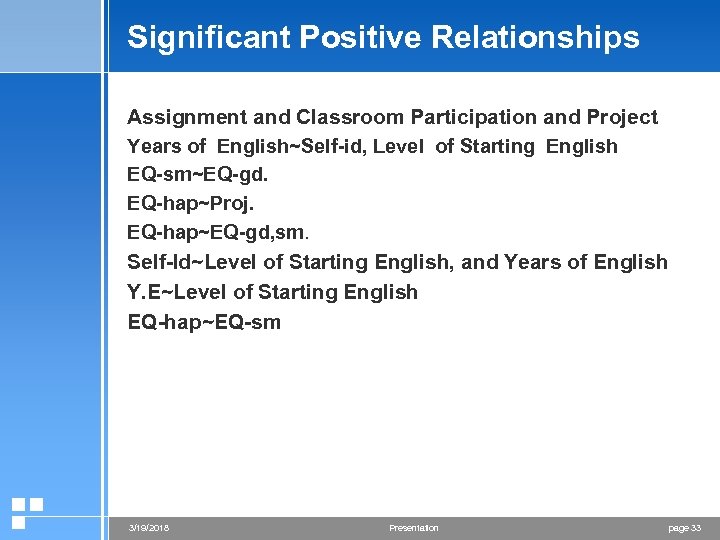 Significant Positive Relationships Assignment and Classroom Participation and Project Years of English~Self-id, Level of Starting English EQ-sm~EQ-gd. EQ-hap~Proj. EQ-hap~EQ-gd, sm. Self-Id~Level of Starting English, and Years of English Y. E~Level of Starting English EQ-hap~EQ-sm 3/19/2018 Presentation page 33
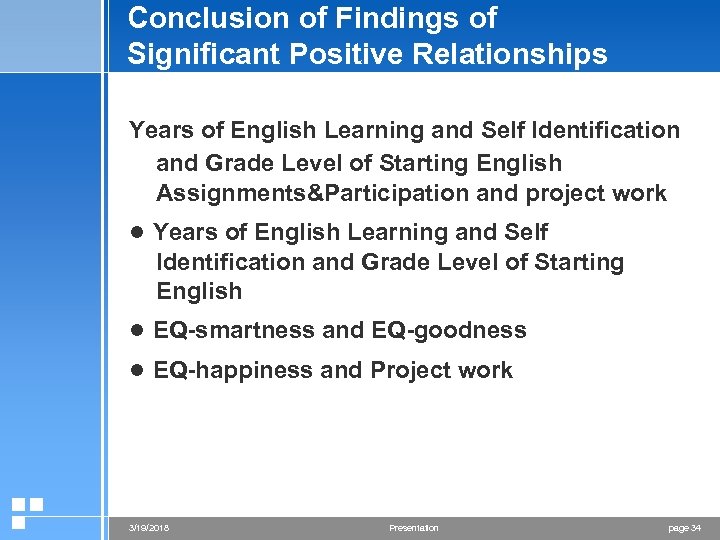 Conclusion of Findings of Significant Positive Relationships Years of English Learning and Self Identification and Grade Level of Starting English Assignments&Participation and project work ● Years of English Learning and Self Identification and Grade Level of Starting English ● EQ-smartness and EQ-goodness ● EQ-happiness and Project work 3/19/2018 Presentation page 34
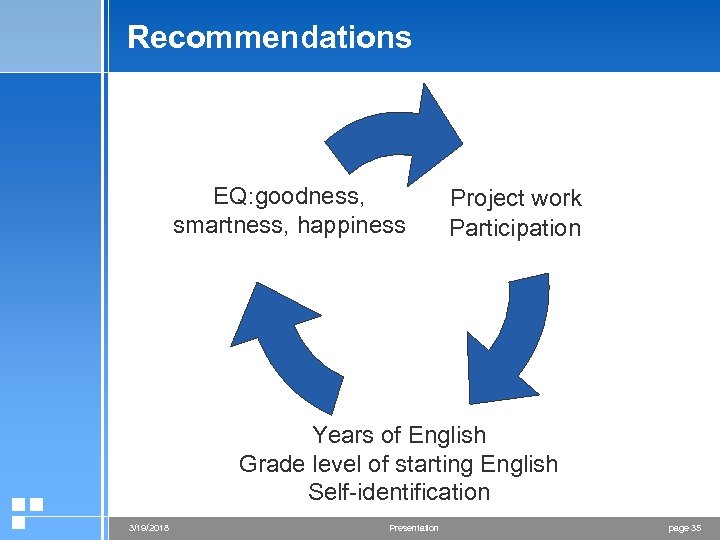 Recommendations EQ: goodness, smartness, happiness Project work Participation Years of English Grade level of starting English Self-identification 3/19/2018 Presentation page 35
 For teaching and learning ● Cultivation of learning EQ generates learning effectiveness and positive attitudes toward learning. ● Starting English learning early generates positive learning outcomes as well as positive attitudes toward oneself. ● Positive self-perception, or high self-esteem, is very crucial in the developmental process. Selfperception has been shown to reflect developing cognitive abilities and social circumstances (Dusek & Flaherty, 1981; Stanwyck, 1983). By late adolescence, a coherent and intergrated selfperception can emerge. 3/19/2018 Presentation page 36
 Role of EQ and Student Autonomy ●EQ—happiness is related to achievement in doing project work. Thus students’ autonomous learning by researching and developing individual projects should be carried out as the tasks go together with the joy of learning. 3/19/2018 Presentation page 37
 Negative Relationships 4 Significantly consistent negative relationships 4● Peer~Ass&Participation 4 ● Ass&Par~Mid-term 3/19/2018 Presentation page 38
 Conclusion of Findings of Significant Negative Relationships Consistent findings from the three cohort studies confirm the fact that there were significant negative relationships ●among peer assessment, assignment and classroom participation and ● between midterm test results and peer assessment 3/19/2018 Presentation page 39
 Recommendations 4 For Classroom Practice 1. Midterm test and peer assessment may not work very well together. The former is formal learning and assessing while the latter is for an informal and on-going process in which learners help, participate together rather than depending on teacher assessment. One may be sacrificed for the reliability and validity of the other teaching-learning process. 3/19/2018 Presentation page 40
 Recommendations (cont. ) 4 . 2 Grades from peer assessment are derived from learners grading one another while classroom assignment grades are from teacher’s grading and students’ consistency in submitting their works. Peer assessment seems not to be related to regular teacher assessment of student assignments. The use of the two assessment methods together may balance out biased grading either by the teacher or by the students. 3/19/2018 Presentation page 41
 References and Further Readings 4 Bernat, E. (2005). “Beliefs about language learning: Current knowledge, pedagogical implications and new research directions”, TESL-EJ: Teaching of English as a Second or Foreign Language. June 2005, vol. 9, no. 1. 4 Bronfenbrenner, U. (1979). The ecology of human development. Cambridge, MA: Harvard University Press. 4 Dusek, J. B. , & Flaherty, J. F. The development of self-concept during the adolescent years. Monographs of the Society for Research in Child Development, 46) , 4, Serial No. 191). Gerdes, H. & Mallinckrodt, B. (1994). Emotional, social and academic adjustment of college students: A longitudinal study of retention. Journal of Counselling and Development. 72: 28 Hamachek, D. (1995), Psychology in teaching, learning and growth. (5 th. Ed). Boston, MA: Allyn and Bacon. 3/19/2018 Presentation page 42
 References (Cont. ) House, J. D. (1993). The relationship between academic selfconcept and school withdrawal. The Journal of Social Psychology. 125 -127 , 133: 11 Loeb, R. C. & Magee, P. M. (1992), Changes in attitudes and self-perceptions during the first two years of college. J ournal of College Student Development, 33, 348 -355. Stevick, E. W. (1983). Teaching languages: A way and ways. Rowley, MA: Newbury House. Van Lier. L (2004). The Ecology of Language Learning. Monterey Institute of International Studies Paper presented at the UC Language Consortium Conference on Theoretical and Pedagogical Perspectives March 26 -28, 2004. (http: //uccllt. ucdavis. edu/leo. cfm) 3/19/2018 Presentation page 43